/

Author

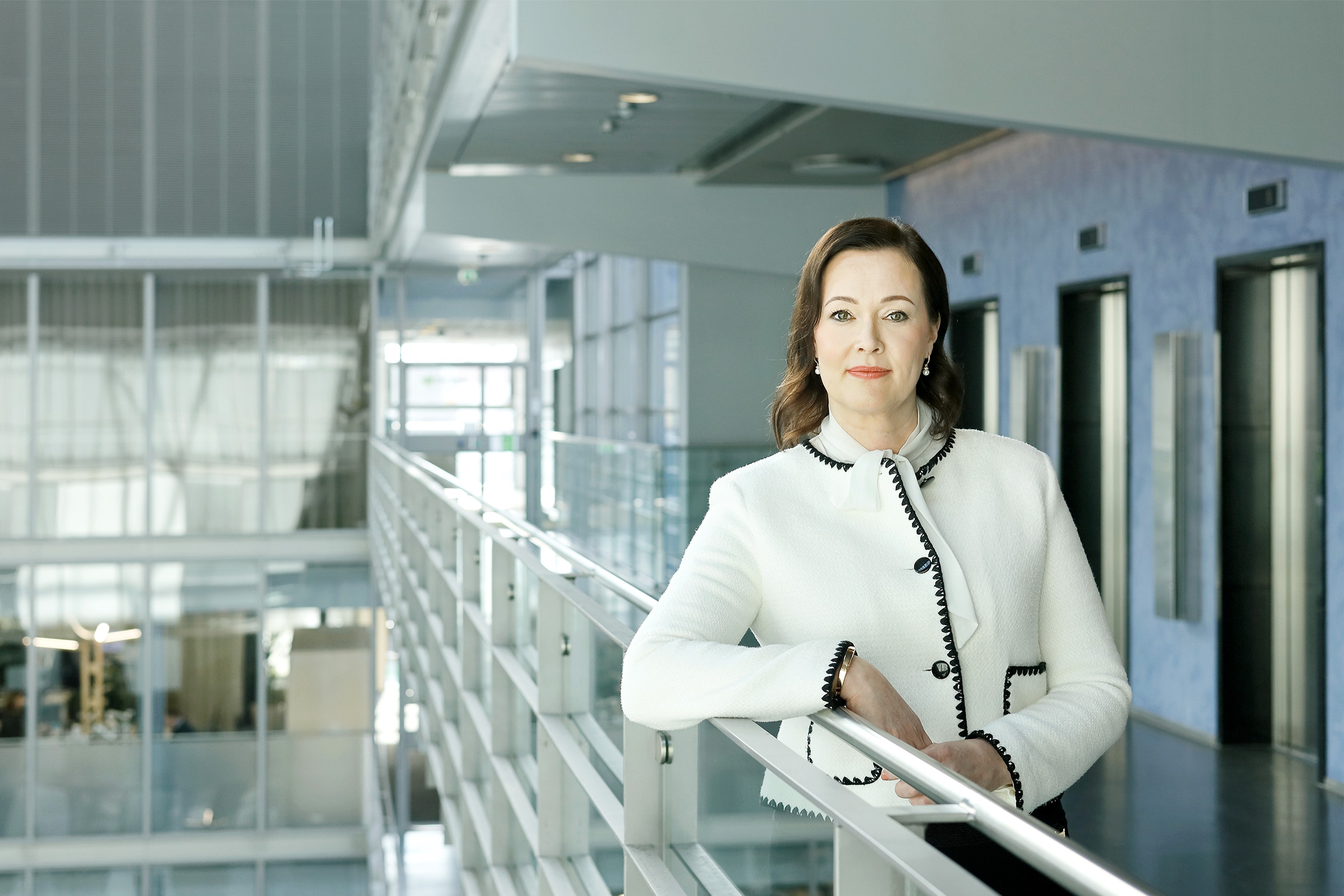
Helene Auramo

Founder and ceo

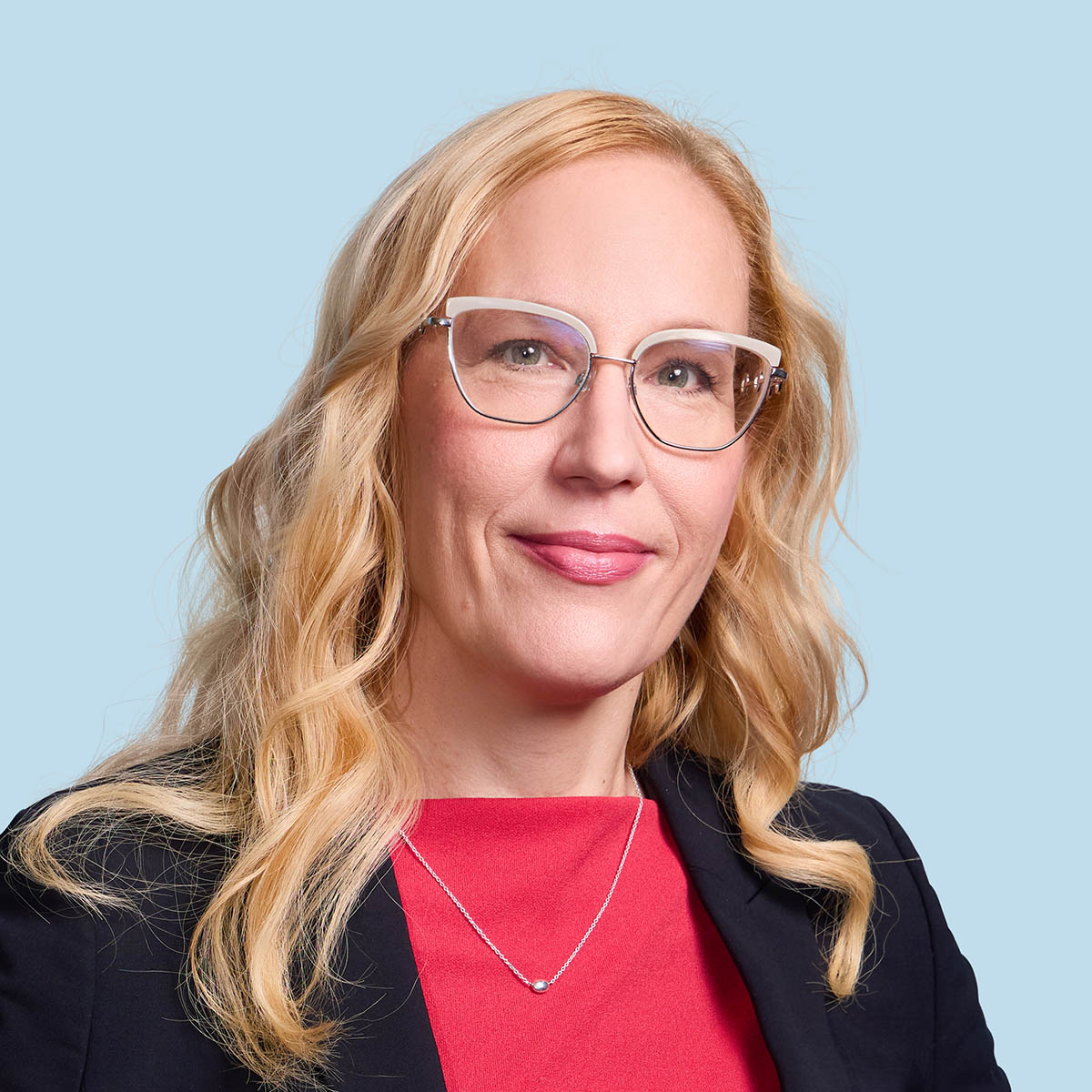
Helene Auramo is a co-founder of Listeds and Nordic Listed Leaders. She has previously co-founded Slush, Indiedays, Zipipop, and Okimo Clinic, building ventures at the intersection of media, technology, and community. She holds board positions at the Finnish Business School Graduates (Suomen Ekonomit) and Finnvera, and serves as Chair of the Investment Committee at the Finnish Business School Graduates. Helene is also a columnist for Talouselämä, Finland’s leading business magazine, and Aamulehti, one of the country’s largest newspapers. Her work focuses on leadership, growth, and the structures that shape decision-making in Nordic companies. She was awarded Future Board Member of the Year in 2022 by Future Board.

/

Author

Helene Auramo

Founder and ceo

Helene Auramo is a co-founder of Listeds and Nordic Listed Leaders. She has previously co-founded Slush, Indiedays, Zipipop, and Okimo Clinic, building ventures at the intersection of media, technology, and community. She holds board positions at the Finnish Business School Graduates (Suomen Ekonomit) and Finnvera, and serves as Chair of the Investment Committee at the Finnish Business School Graduates. Helene is also a columnist for Talouselämä, Finland’s leading business magazine, and Aamulehti, one of the country’s largest newspapers. Her work focuses on leadership, growth, and the structures that shape decision-making in Nordic companies. She was awarded Future Board Member of the Year in 2022 by Future Board.

/

Author

Helene Auramo

Founder and ceo

Helene Auramo is a co-founder of Listeds and Nordic Listed Leaders. She has previously co-founded Slush, Indiedays, Zipipop, and Okimo Clinic, building ventures at the intersection of media, technology, and community. She holds board positions at the Finnish Business School Graduates (Suomen Ekonomit) and Finnvera, and serves as Chair of the Investment Committee at the Finnish Business School Graduates. Helene is also a columnist for Talouselämä, Finland’s leading business magazine, and Aamulehti, one of the country’s largest newspapers. Her work focuses on leadership, growth, and the structures that shape decision-making in Nordic companies. She was awarded Future Board Member of the Year in 2022 by Future Board.

Leaders

Sweden cleared its 2027 target early. Kreate is changing the CEO anyway

Aug 25, 2026

Kenneth Wahlqvist leaves, Veli Taatila covers the interim, and Per Anders Quist arrives on 19 October from the agency that awarded Kreate Sverige its largest contract.

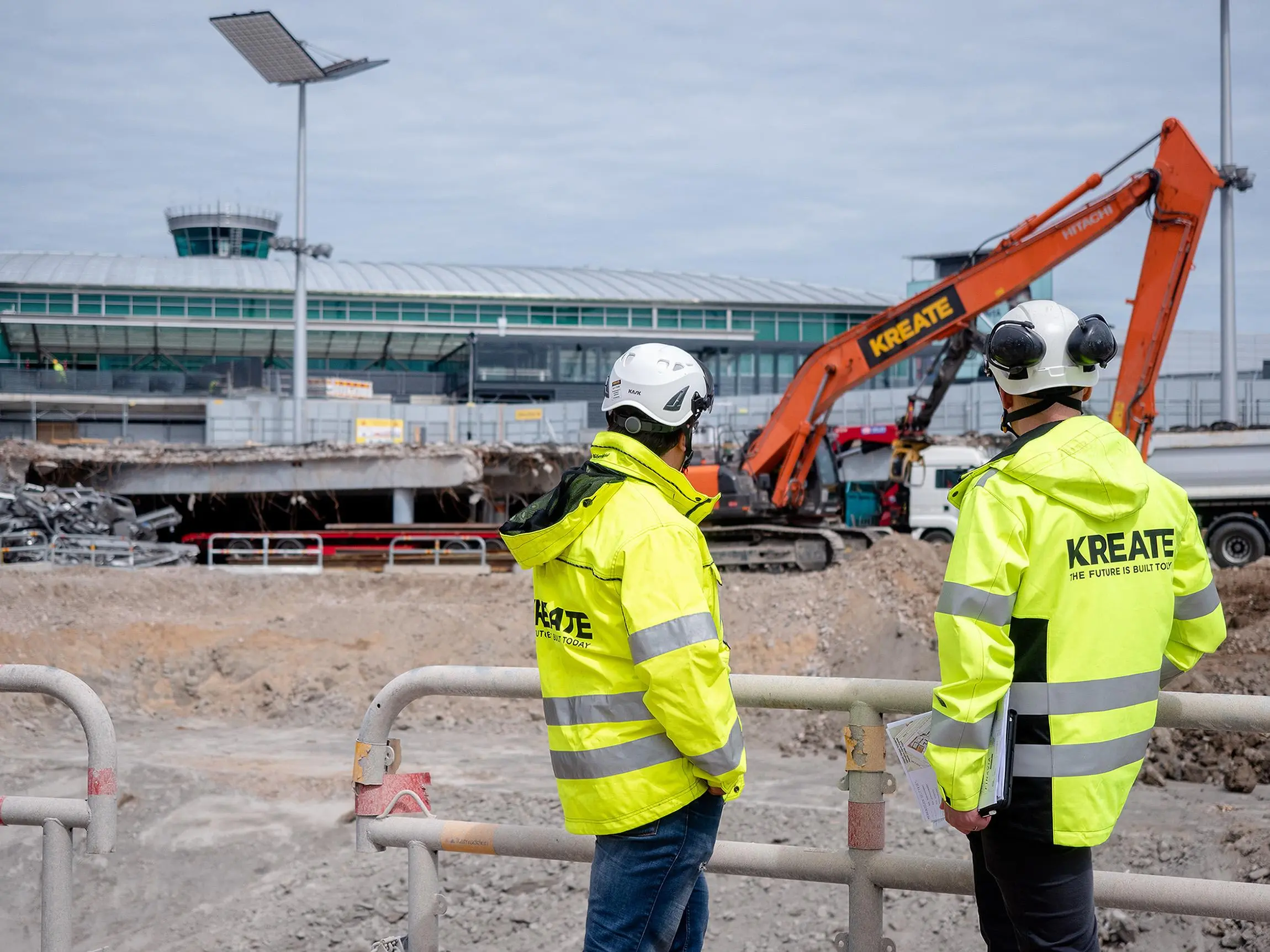
Kreate Group's subsidiary Kreate Sverige AB has appointed Per Anders Quist as chief executive officer, effective 19 October 2026. The company says the appointment is meant to support continued growth in Sweden and strengthen its position in the Nordic region, and notes that Kreate has already reached the target level set for its Swedish operations under the 2024–2027 strategy period, ahead of schedule. 

Quist joins from the Swedish Transport Administration, Trafikverket, where, according to the announcement, he was responsible for billion-scale infrastructure projects. He has more than 30 years of experience in infrastructure construction and has led major road, tunnel and other infrastructure projects in Sweden and Norway, including more than ten years at NCC in leadership roles in Norway and a board seat at NCC Norge AS. 

President and CEO Timo Vikström framed the hire around Kreate's next growth phase: "In Sweden, we have already reached a level that, a few years ago, we expected to achieve only in 2027. We intend to continue growing in the coming years. Per Anders' exceptionally broad experience in infrastructure construction from both the contractor's and the client's perspective provides him with excellent qualifications for the role. In addition, his straightforward and determined approach is a strong fit with Kreate's culture. We believe he is the right person to lead Kreate Sverige through its next phase of growth." 

Quist himself pointed to Norway as the next frontier: "Kreate has built a strong foundation for growth in Sweden. I see significant opportunities to continue growing the business in Sweden, while the Norwegian market also offers interesting opportunities. I look forward to developing our operations together with our employees and customers." The release notes Kreate currently explores Norway on a project-by-project basis and that Quist's Norwegian background supports a more permanent presence there. 

Outgoing CEO Kenneth Wahlqvist is leaving to pursue opportunities outside the company. Veli Taatila, Kreate Sverige's first CEO, will serve as interim CEO until Quist starts. 

The appointment lands on top of a record quarter

The Sweden CEO change follows weeks after Kreate's largest-ever Swedish contract and a group-wide guidance upgrade, the timing places a leadership change on top of the strongest operating momentum the unit has shown to date.

Kreate Group's April–June 2026 EBITA rose to EUR 9.3 million, or 5.0% of revenue, up from EUR 2.2 million, or 3.0% of revenue, a year earlier. Revenue for the quarter rose 152.3% to EUR 185.4 million, and the order backlog grew 215.2% to a record EUR 885.8 million. Much of that jump is acquisition-driven: KFS Finland Oy has been consolidated as a subsidiary since 1 April 2026, meaning the comparison is not like-for-like with the same quarter in 2025, when Kreate's full-year revenue was EUR 315 million. The half-year report attributes the broader growth to organizational scaling and strategic priorities including Sweden expansion, but Sweden itself, as the numbers below show, remains a small fraction of the group.Revenue for the quarter rose 152.3% to EUR 185.4 million, and the order backlog grew 215.2% to a record EUR 885.8 million. The company's half-year report linked the growth to organizational scaling and strategic priorities including Sweden expansion, and separately noted that KFS Finland Oy has been consolidated as a subsidiary since 1 April 2026.

On 16 June 2026, Kreate raised its full-year 2026 guidance to EUR 600–650 million in revenue and EUR 21–26 million in EBITA, up from a prior range of EUR 510–550 million and EUR 18–22 million, citing efficient project execution and stronger-than-expected order book development. A day after, Kreate Sverige had secured roughly SEK 320 million (about €30M) subcontract for the Lundby Tunnel renovation in Gothenburg, its largest contract to date, with Vikström saying, “We have systematically grown our business in Sweden, and the Lundby Tunnel contract is proof of our Swedish organisation’s ability to participate in increasingly larger projects based on its own special expertise. In line with our strategy, Sweden is developing into a second strong geographical pillar for the Group.”

The Swedish unit, in its own numbers

Kreate Group's half-year report gives the clearest picture of what Quist is inheriting. Sweden generated EUR 15.6 million of Group revenue in the second quarter of 2026, up 101.9% year-on-year, and EUR 31.1 million over the first half, up 82.8%; management describes this as revenue that "has developed according to plan." Sweden still accounts for a modest slice of the Group, about 10% of total revenue, against roughly 90% for Finland, but Kreate's own market assessment treats the two geographies identically: "stronger than usual" market conditions and a "strengthening" outlook in both. The backlog tells a tighter story: of the EUR 336 million Kreate expects to realize during 2026, Sweden's share is just EUR 21 million, about 6%, well below its 10% revenue weight, setting a modest ceiling on how much of this year's growth Quist's unit is expected to contribute before his own tenure begins. 

The half-year report also names underground rock construction as Kreate Sverige's largest business line, alongside growing concrete, earthworks and foundation engineering operations, and states that Kreate has become Sweden's leading contractor in tunnel lining, the same discipline underlying the Lundby Tunnel win. The report separately notes that a March 2026 tunnel-lining contract in Northern Norway marked a strategic entry into that market, which Kreate estimates at five to ten times the size of Sweden's, giving concrete shape to the Norway ambition both Vikström and Quist raised in the appointment release. 

What Kreate is aiming for

Kreate's own framing is that Sweden has outrun its 2024–2027 strategy target and is now being handed to an executive with Trafikverket and NCC Norway experience specifically to sustain that pace and to test a permanent Norwegian footprint. The Lundby Tunnel contract, running from September 2026 to August 2028, is described by the company as positioning Kreate Sverige for an expected growth phase in the Swedish tunnel construction market from 2027. Group-wide, the raised guidance implies management expects the momentum visible in the first half of 2026 to continue through year-end.

Leaders

Nightingale Health removed its operating chief's role and put two commercial chiefs in its place

Aug 24, 2026

Two releases, on 19 August. Nightingale Health spent its operating chief's role on commercial leadership ten weeks after cutting its growth target — while the finance seat stays with the founder.

Nightingale Health published two leadership releases on 19 August. Janna Ranta, chief operating officer since May 2025, became Chief Commercial Officer, Research and Healthcare. Hugh Watson, who has spent 25 years in United States laboratory diagnostics, joined from outside as Chief Commercial Officer, Americas. Both changes took effect that day. Both changes took effect that day, and the operating role Ranta leaves behind will not be filled.

Taken separately, the two releases are a busy morning in Helsinki. Taken together, they are one decision: Nightingale Health has turned an operating seat into a selling seat, at the point where it needs the Americas to start producing revenue.

The appointments move two leadership roles fully onto the commercial side

Following the appointments, two new seats now hold fully commercial roles. Suna tied the timing to a completed build phase. "In the past year, we invested heavily in refreshing our core product, the Nightingale Health Check. That work required strong operational management, and Janna had a crucial role in completing the successful product refresh. With strong data on product-market fit, I'm excited to allocate more investment to our commercial scaling, and I warmly welcome Janna to her new role."

The growth downgrade came first

Nightingale Health entered its 2025 to 2026 financial year targeting revenue growth above 50%, and restated that target in March alongside half-year revenue of EUR 2.41 million and an operating loss of EUR 8.80 million for July to December 2025. 

On 8 June it reduced the target to approximately 20%, plus or minus 5%, after roughly EUR 2 million of revenue from one project moved into the following financial year for reasons the company said were outside its control.

Suna's framing at the time was that "the reason is timing, not lost business," with revenue in the next financial year expected to exceed EUR 10 million.

Ten weeks later that framing has resource attached to it. 

Watson runs execution in the Americas, Ranta keeps group-level oversight of it

The structure is worth noting. Ranta takes global research leadership and group-level oversight of the healthcare business in the Americas. Watson owns commercial execution in the region day to day, working alongside her rather than beneath her.

Watson's record sits squarely in the market the company is trying to open: two decades at Genova Diagnostics, rising from sales into vice-president roles, followed by a period as senior vice president at Boston Heart Diagnostics, a cardiometabolic laboratory in the United States. His own account of the move was about pace. "Throughout my career, I have built commercial organizations in laboratory diagnostics, and I am particularly drawn to companies where commercial execution must keep pace with scientific innovation. Nightingale Health is exactly that: technology validated at a scale our industry rarely sees, and a commercial opportunity in the Americas to match. I look forward to building it "

Suna was explicit about what the hire signals: "Attracting a commercial leader of Hugh's caliber says a lot about where Nightingale Health is heading."

A split like this buys two things at once, regional credibility from an outside hire and continuity from the insider who ran the product refresh. That reading of the split is interpretation.

Suna has been his own interim CFO for eight months

Nightingale Health's commercial organisation gained two chiefs in one morning. Its finance seat has been open since 8 December 2025, when Tuukka Paavola left after four years in the role and Suna stepped in on an interim basis while a search began. 

Four days later the company disclosed a wider management change: chief scientific officer Jeffrey Barrett would leave by March 2026, a chief medical officer would be recruited in his place rather than a new scientific officer, and the finance search would continue in order to support international sales growth.

Eight months on, based on the disclosures reviewed for this piece, no permanent appointment to that role has been announced. The founder is still carrying it, through a downgrade and now through a commercial build-out.

Leaders

Finnair rebuilt four enabling functions in eight months and left the commercial core untouched

Aug 21, 2026

The digital and legal appointments announced on 18 August complete a set. People, finance, digital and legal, four of nine Executive Board functions, have a new holder named in 2026. The chief executive, operating, revenue, customer and communications seats have not moved. The rebuild is running from the strongest quarter Finnair has reported, and from a general meeting that rejected the company's pay report with 90 percent of the votes represented against it.

Finnair appointed Arti Zeighami, 55, as Chief Digital Officer from 19 August 2026, and Kaarina Ståhlberg, 59, as Senior Vice President and General Counsel from 31 August 2026. Both join the Executive Board and report to CEO Turkka Kuusisto. Zeighami succeeds Antti Kleemola, who supports the handover until the end of September. Ståhlberg succeeds Sami Sarelius, who continues as an executive advisor to Finnair until the end of the year.

The two profiles do not overlap, and neither comes from aviation. Zeighami was most recently Partner and Director at Boston Consulting Group working on the scaling of artificial intelligence, and before that Chief Data and Analytics Officer at H&M Group.

Ståhlberg holds a Master of Laws, was Assistant General Counsel at Nokia and General Counsel at both Posti Group and Fortum, and sits on the boards of Finnish listed companies like Aspo, Finnair, Fiskars group, Vincit.

Four of nine functions changed. None of them touch daily commercial execution.

Finnair discloses a nine-member Executive Board covering products and customers, revenue, operations, digital services, finance and strategy, people and culture, communications, and legal affairs. Four of those have a new holder named this year.

Two of the four are already in the job. Sini Kivekäs became Chief People Officer and joined the Executive Board on 2 June, the day Kaisa Aalto-Luoto left it, four months after Finnair disclosed the departure on 19 January.

Ståhlberg starts in legal on 31 August. Finance follows on 1 November, when Jussi Siitonen becomes Chief Financial Officer in place of Pia Aaltonen-Forsell, who is leaving for the same role at Valmet.

The finance change carried a governance step. Siitonen was re-elected to the Board of Directors on 24 March and resigned from it on 24 July, the day his appointment was announced. Crossing from a non-executive seat to an executive one requires exactly that, and the board consequently runs with seven of the eight directors elected in March until the next general meeting.

The rebuild is being done from a record quarter, not a bad one

Second-quarter revenue was EUR 916.7 million, up 16.4 percent from EUR 787.7 million. The comparable operating result was EUR 78.4 million against EUR 10.3 million a year earlier, and passenger numbers rose 7.6 percent to 3.314 million.

Across the half year, revenue reached EUR 1,694.8 million from EUR 1,481.9 million, and the comparable operating result turned to EUR 77.8 million from a loss of EUR 52.3 million. The first quarter had already improved, with revenue up 12.1 percent to EUR 778.1 million and a comparable operating result of EUR -0.6 million.

Finnair raised its 2026 outlook on 22 July to revenue of EUR 3.4 to 3.5 billion and a comparable operating result of EUR 120 to 190 million, assuming no material disruption to fuel availability. Kuusisto called the quarterly figure "a record-high 78.4 million euros", which is the company's characterisation of its own result. July passenger volume rose 9.3 percent year on year.

Enabling functions are often rebuilt after a shock. These are being rebuilt while the numbers improve.

The board survived the March general meeting intact. The pay report did not

The shareholders' nomination board proposed an unchanged board on 15 January, and the meeting on 24 March re-elected all eight directors, with Sanna Suvanto-Harsaae as chair and Mika Ihamuotila as vice chair. The 2025 accounts were adopted.

The remuneration report was rejected. Of the 140,441,158 shares and votes represented at the meeting, 126,215,985 were cast against approving it, approximately 94 percent of the votes cast in advance voting and approximately 90 percent of those represented. The minutes record that the resolution was advisory, that the rejection does not oblige Finnair to prepare a new report, and that it does not affect remuneration decisions already made. Rejections at this scale are uncommon in Finland.

Three dates decide whether the rebuild reads as strength

The third-quarter report in October is the first with the digital seat filled. The finance handover lands on 1 November. The 2027 nomination board proposal, due in January, is the first read on whether shareholders who rejected the pay report intend to press further. Whether four function changes in eight months speed execution or slow it remains an open question.

Business

Four of the five biggest BlackRock increases in Finland this half were never announced

Aug 20, 2026

In the first half of 2026, BlackRock's ownership grew in eight of the ten Finnish listed companies where its position is visible. Two of those increases were announced. The other six were not, because Finnish law only asks for an announcement when a holding crosses a reporting threshold. The lowest is 5 per cent, and none of these crossed it.

Ownership gained between the end of December 2025 and the end of June 2026, in basis points, with the number of BlackRock announcements each company published alongside. Register figures are drawn from Listeds executive intelligence.

Company

Ownership %

Gained

Shares, Dec 31 2025

Shares, Jun 30 2026

Change

Change %

Register rank

Announcements

Metso*

5.08 → 5.50

+42bp

n/a

n/a

n/a

n/a

n/a

8

Qt Group

1.48 → 1.74

+26bp

376,177

443,173

+66,996

+17.8%

7 → 5

none

Nordea Bank*

5.50 → 5.70

+20bp

~ 190,500,000

~ 194,600,000

~ +4,100,000

~ +2.2%

1 → 1

none

Harvia

1.91 → 2.10

+19bp

357,390

392,409

+35,019

+9.8%

12 → 13

none

Kempower

0.59 → 0.71

+12bp

329,991

396,845

+66,854

+20.3%

8 → 7

none

Orion*

5.00 → 5.11

+11bp

n/a

n/a

n/a

n/a

n/a

19

Neste

2.90 → 2.95

+5bp

22,275,300

22,669,111

+393,811

+1.8%

4 → 2

none

Revenio Group

1.59 → 1.61

+2bp

423,288

468,238

+44,950

+10.6%

7 → 8

none

Elisa

6.49 → 6.49

0bp

10,857,012

10,857,012

No change

0%

2 → 2

none

Stora Enso*

5.00 → 5.00

0bp

n/a

n/a

n/a

n/a

n/a

20

* For Metso, Orion and Stora Enso the readings are the holdings reported at the crossings closest to each end of the window: Metso 12 February and 30 June, Orion 5 January and 17 June, Stora Enso beginning of January and 26 June. Nordea's second reading is end-July 2026; all other companies are 31 December 2025 to 30 June 2026. Nordea discloses its major shareholders rounded to the nearest 0.1 million shares (e.g. 194.6 million shares), so the share counts and changes shown for Nordea are approximations.

Basis points of ownership are used here because they survive the two things that distort share counts, dilution and buybacks, and because they mean the same thing to a chair and to a portfolio manager. One caution before reading the table: the three companies with announcements are measured as combined holdings, shares plus financial instruments, as filed. The seven others are measured as shares registered in BlackRock's own name.

Four of the five biggest increases, ranks two through five, produced no announcement at all, and 77 basis points of ownership changed hands across those four companies in silence.The 47 announcements cluster at the two ends of the table, at rank one and rank nine.

Metso gained 42 basis points without changing the percentage of shares held

Metso's share holding reads 4.98 per cent on 12 February and 4.98 per cent on 30 June. Identical to the second decimal across four and a half months, on a net movement of 39,519 shares. Over the same period the holding through financial instruments went from 0.09 to 0.52 per cent, taking the combined position from 5.08 to 5.50 per cent.

That is the largest increase in exposure to any Finnish listed company in this dataset, and a share register would not show it. Metso published eight announcements while it happened, each one describing a line being crossed rather than a position being built.

Stora Enso published twenty times and ended the half exactly where it started

At the beginning of January the Stora Enso holding read 4.26 per cent in shares and 0.73 per cent through financial instruments, 5.00 per cent in total. On 26 June: 3.81 per cent in shares, 1.19 per cent through financial instruments. Total, 5.00 per cent. The shares fell forty-five basis points, the financial instruments rose forty-six, and twenty announcements describe the round trip.

Orion is the only one of the three where the share holding itself crossed the line, from 4.97 per cent on 5 January to 5.01 per cent on 17 June, with financial instruments marginal throughout at 0.02 to 0.09 per cent. Nineteen announcements, eleven basis points.

The middle of the table bought quietly, and two of those gains are smaller than they look

Qt Group, Nordea, Harvia and Kempower gained 77 basis points of BlackRock ownership between them with nothing published. In share terms Kempower grew fastest, up 20.3 per cent to 396,845 shares, with Qt Group up 17.8 per cent to 443,173.

Two entries need discounting. Revenio's holding grew 10.6 per cent in shares but two basis points in ownership, because Revenio issued roughly 9 per cent more shares in the same window and BlackRock close to kept pace. Nordea's ownership rose partly because Nordea reduced its own share count, from 3,434 million to 3,403 million.

The rule fires on crossing, not on owning

How the flagging rule works

Under the Securities Markets Act (746/2012, Chapter 9), a shareholder must notify the company and the Financial Supervisory Authority (Finanssivalvonta) when its holding crosses a reporting threshold in Finland. The lowest is 5 per cent, and the ladder runs up to 90. Notification is due without undue delay and at the latest on the next trading day. The company then publishes it as a stock exchange release.

Every position in this piece sits at the bottom of that ladder, so 5 per cent is the only threshold that matters here. A holder sitting at 0.6 per cent can double its position in silence. A holder sitting at 5.00 per cent generates a release every time it crosses back over the line, whether a lending desk was busy, an index rebalanced, or shares moved between group entities.

The crossings recur across the half rather than clustering. Stora Enso published in five separate months, Orion in three, Metso in three.

Company

Notifications

Active months

Stora Enso

20

Jan, Feb, Mar, Apr, Jun

Orion

19

Jan, Mar, Jun

Metso

8

Feb, May, Jun

Total

47

All of H1

The rule also explains why a holder can sit above 5 per cent without publishing anything. Nordea and Elisa both do, at 5.7 and 6.49 per cent, because in this window nothing crossed.

A Finnish share register shows the registered holder, and for a foreign institution that can be the institution or a custodian bank acting for it. BlackRock does not appear under its own name in the Stora Enso, Orion or Metso registers, which describes how those positions are registered rather than whether they exist.

An announcement tells you a line moved, not that a position was built

When a Finnish company publishes a BlackRock notification, the question worth asking is which column moved. At Stora Enso and Metso it was the financial instrument column, while the share column fell or stood still. The release says 5 per cent either way, and the share column on its own tells you nothing about how the exposure changed.

Silence carries the same warning in reverse. Four companies gained 77 basis points between them with nothing published. For anyone sizing institutional demand in Finnish equities, the disclosure feed is the wrong instrument on its own, because it reports crossings rather than accumulation. The two records are complementary rather than ranked. Disclosure is fast and reports only crossings. A register comparison is slower, arriving once a month, and reports levels. The announcement tells you when a line was touched; only the register tells you what was built.

A notification is a late signal, not an early one

To reach 5 per cent, a holder has to accumulate first, and the accumulation is the part nobody publishes. Kempower and Qt Group are in that phase now, at 0.71 and 1.74 per cent, in public data, with no release attached. When an announcement eventually comes, it reports the arrival and not the journey.

Business

Eighteen Finnish companies have climbed to the Helsinki main list. Ovaro wants to climb down.

Aug 19, 2026

Ovaro's board has costed its IFRS reporting at €300,000 a year and asked shareholders to move down to First North, with the share still publicly traded. Days earlier, Innofactor's Sami Ensio put his own exit price at €700,000.

On 18 August, the board of Ovaro Kiinteistösijoitus Oyj proposed that shareholders move the company from Nasdaq Helsinki's regulated main market to First North Growth Market Finland, while it remains publicly traded. An extraordinary general meeting decides on 8 September. The same morning, Ovaro withdrew its 2026 guidance.

The saving is a fifth of last year's profit

The move lets Ovaro drop IFRS, mandatory on the main market, for Finnish FAS, which First North permits.

The board puts the savings at approximately €300,000 a year. CEO Marko Huttunen told Keskisuomalainen that is about 14% of the company's administrative costs.

Set that against the company. Ovaro's 2025 revenue was €4.288m, down from €5.262m in 2024, on a net result of €1.468m. The saving is roughly a fifth of last year's profit, at a company with four employees and an €80.4m balance sheet at 31 March 2026.

Innofactor's founder priced the same listing at €700,000, then left entirely

Three days before Ovaro's announcement, Talouselämä reported Sami Ensio, founder and chief executive of the software company Innofactor, estimating that operating as a listed company meant roughly €700,000 a year in additional costs, and naming regulation as a central reason for leaving the exchange. Innofactor left by the other door: Onni Bidco's tender offer took it private, the company applied for delisting on 31 March 2025, and the shares were listed for the last time on Nasdaq Helsinki on 25 April 2025.

The two figures are not like-for-like. Ensio's €700,000 is a chief executive's estimate of the full cost of being listed; Ovaro's €300,000 is a board's estimate of one line item, the switch from IFRS to FAS reporting.

The staircase normally runs the other way

When Toivo Group — a Finnish real estate developer, like Ovaro — stepped up from First North Finland to the Helsinki main market in June 2025, Nasdaq counted it as the 18th company to make that move over the past years in Finland and the 143rd in the Nordics. Both are running totals, not 2025 counts. In Stockholm, Nasdaq's 2025 changes-to-the-list records seven companies moving up from First North in that single year and one moving down: Lucara. Helsinki closed 2025 with 136 main market companies and 47 on First North. The main market has since grown to 147 companies, while the First North roster remains unchanged. 

Shareholders vote on 8 September, and Ovaro expects First North trading to begin before the end of 2026. The most interesting number is not €300,000. It is 14% — the share of administrative costs one Finnish board has now put on the record.

Insights

One number defines the Finnish CEO Index for Q2 2026: it is zero

Aug 18, 2026

Finland's boards are replacing chief executives briskly, just not at the top of the market, and not with women. The two blanks say more than the twelve appointments do.

In a market as small and closely watched as Finland's, the interest in a quarterly count of chief executives usually lies in the names. This quarter it lies in the gaps. The Listeds CEO Index — Finland for the second quarter of 2026, produced in partnership with SAM Headhunting, records twelve new listed-company chief executives and, around them, a single number that keeps recurring. It is zero. None of the twelve is a woman. And none of the country's largest companies changed its leader at all. It is a second quarter running with the top of the market completely still, a year after more than a third of those same companies replaced their CEO.

The renewal is real, just not at the top

That stillness is not a market slowing down. Below the largest companies, renewal is running at pace. Twenty-five new chief executives took up their roles across Finnish listed companies in the first half of 2026, a rate of about 50 a year against the 43 recorded across all of 2025, and it sits on top of a market that has already renewed roughly a third of its CEOs within eighteen months.

Every one of the twelve second-quarter changes happened below Large Cap: seven in Small Cap, four on First North, one in Mid Cap. The churn is real. It has simply stopped reaching the top.

New CEOs by segment
Q2 2026 · number of starts
024687410Small CapFirst NorthMid CapLarge Cap
Source: Listeds Executive Platform
Figure 1 — New CEOs by market segment, Q2 2026. Large Cap records a second consecutive quarter at zero.

For a board, that combination is the point. "Many boards have already done the groundwork on a new direction and new focus areas, and where the sitting CEO cannot take the company there, they act," says Leena Hellfors, Managing Director of SAM Headhunting. "Succession has become a continuous capability, not an occasional project." 

“Many boards have already done the groundwork on a new direction and new focus areas, and where the sitting CEO cannot take the company there, they act. Succession has become a continuous capability, not an occasional project.”
Leena Hellfors
Leena HellforsManaging Director, SAM Headhunting

Across most of the market, that capability is visibly in use. At the very top, it is switched off.

Why the top sits still

The freeze reflects a specific instinct about the largest jobs, and the rest of the quarter shows the same instinct at work in who gets hired. The twelve new CEOs took up their roles at an average age of about 54, roughly four years older than the age at which the sitting population first became chief executives. Half were promoted from inside, and only two of the twelve came from outside Finland. Where boards did move, they reached for the experienced, the internal, the known.

"Leading a listed company is a genuinely different job, and boards look for proven experience and judgement," Hellfors notes. "There is a deep pool of capable, more senior leaders at the moment, so an experienced profile is often the natural choice." The index bears out the gradient: the largest companies appoint their CEOs oldest, and in practice do not hand the seat to a first-time or younger leader, which is understandable.

No women in Q2, but two are starting in Q3

The number that drew the most attention is the one that reads as a step back. Not one of the twelve new CEOs was a woman, against a sitting-population share of just 8.1%, and across the half-year only one of twenty-five appointments went to a woman. A market that consistently buys proven experience over runway narrows its pipeline of younger leaders, and does the same to an already thin pipeline of women.

Gender representation of new CEOs in H1 2026
4%96%4%womenWomen4%Men96%
Source: Listeds Executive Platform
Figure 2 — Gender of new CEOs across the first half of 2026 (25 starts).

The picture is not static, though. Because the index tracks the date a CEO starts, the turn is already visible. Two women are recorded as taking up CEO roles in the third quarter, both showing in the data before the quarter has even closed.

When the top does move, it moves as a team

There is a second reason the frozen tier matters: a CEO change is rarely a single change. 

Across the twelve companies that did change leader in Q2, management teams saw four arrivals and ten departures in the weeks that followed, concentrated in a few companies rather than spread evenly, but consistent in direction. 

“A CEO change is rarely a single appointment. The board has usually set the direction already, and the new CEO arrives to execute it, which is what pulls a wider management-team rebuild behind it. Increasingly the assignment is a whole core team rather than one person.”
Taru From
Taru FromSenior Partner, SAM Headhunting

Which means the stillness at the top is storing up scale. When one of Finland's largest companies does finally change its CEO, and eventually one will, the board, its investors and its management team should expect not a single appointment but a leadership-team change playing out over the following quarters.

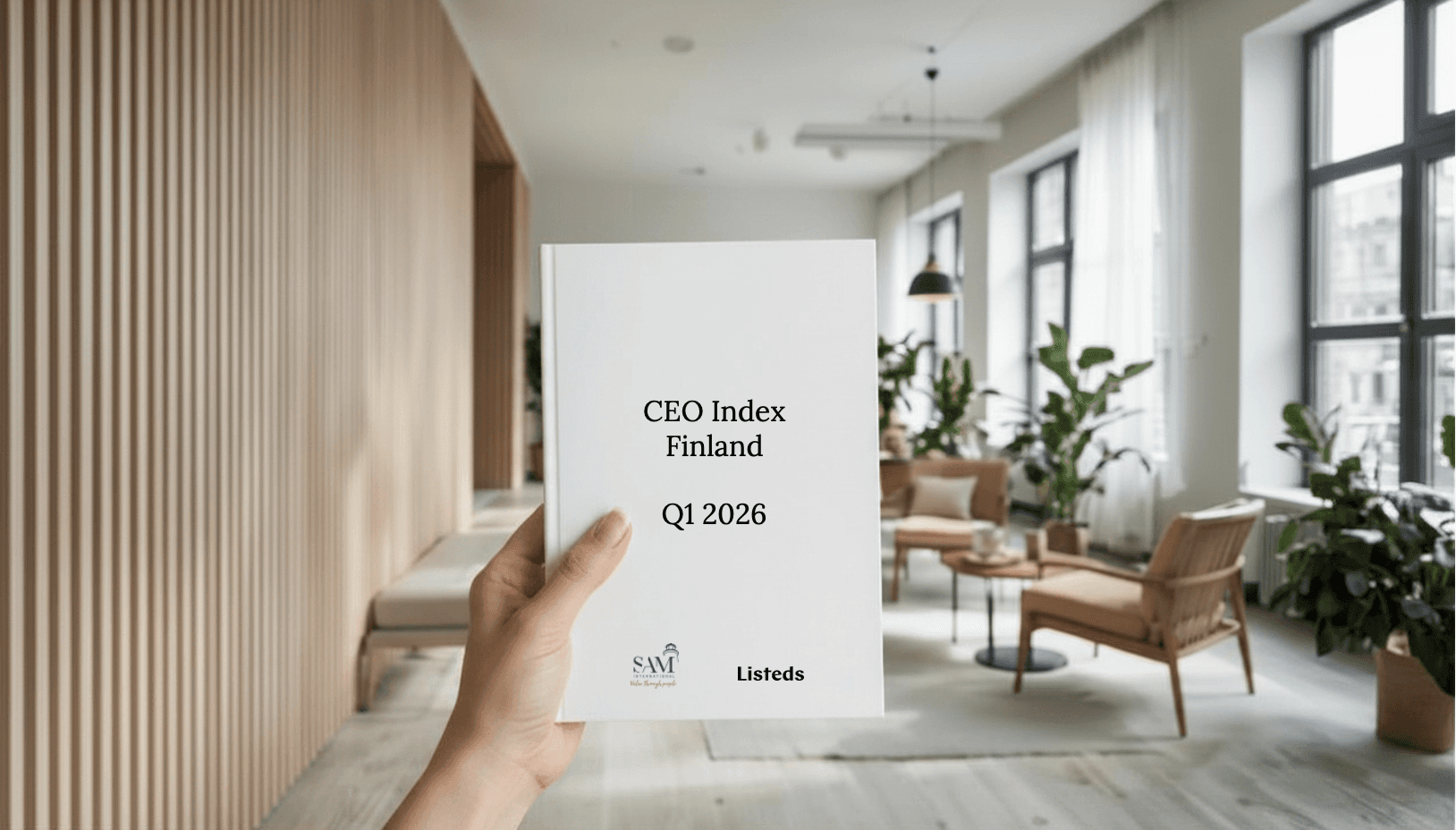
Read the index here

Leaders

The work in between is ownership: Accendo's Kai Tavakka on First North small caps

Aug 18, 2026

Weak consumer confidence has made First North small caps look cheap. Kai Tavakka of Accendo Capital argues the real constraint is ownership, not price. Small listed companies need committed, long-term owners who work with boards and management when the market is not paying attention.

“Short-term mood does not change what a company can become. It changes what you pay to own it.”
Kai Tavakka
Kai TavakkaManaging Partner, Accendo Capital

First North has been a hard place to own. The Nasdaq First North Finland index is down about 29% over the past year and about 65% over the past five, as of 6 August 2026. For many investors, that is a reason to stay away. For Kai Tavakka, Managing Partner of the Nordic active-ownership investor Accendo Capital, it is closer to the opposite.

"The mistake is to read a falling small-cap index only as a verdict on the companies inside it," Tavakka says. "Often it is also a verdict on confidence, liquidity and who is willing to own these companies through the cycle."

Why the segment got cheaper

Accendo ties the sell-off to consumer confidence. Appetite for smaller, higher-risk listed companies tends to follow it, and on Accendo’s reading confidence in Finland and Sweden has stayed weak since 2021. When households feel poorer and investors become more cautious, money moves toward larger, more familiar names. In a retail-driven market, the buyers for small and micro caps can disappear quickly.

“When confidence is low, money goes to whatever feels safe or is mainstream.”
Kai Tavakka
Kai TavakkaManaging Partner, Accendo Capital

“That pulls valuations down across the small-cap segment,” Tavakka says, “even when the potential of selected companies has not deteriorated in the same way.”

The result, on Accendo's reading, is a market where price can detach from quality. Tavakka points to a sharp compression in valuation multiples over the past five years, even as many underlying companies have improved their products, technology and cost structures.

"Of course, several companies have not delivered on their original growth ambitions," he says. "But in selected cases, we see the potential getting better while valuations have moved to new lows. That is where we see the opportunity."

Why cheap is not enough

This is where Accendo's case parts company with a simple "buy the dip" theme.

"Short-term mood does not change what a company can become," Tavakka says. "It changes what you pay to own it. The work in between is ownership: the right board, the right management, focused strategy, disciplined capital allocation and enough patience for the company to become worth more."

That is the part Accendo does itself. It runs a concentrated portfolio of Northern European small caps and works closely with boards, nomination committees and management teams rather than trading in and out. Tavakka was named Young Board Member of the Year at the 2025 Nordic Listed Leaders gala, recognition for that hands-on work.

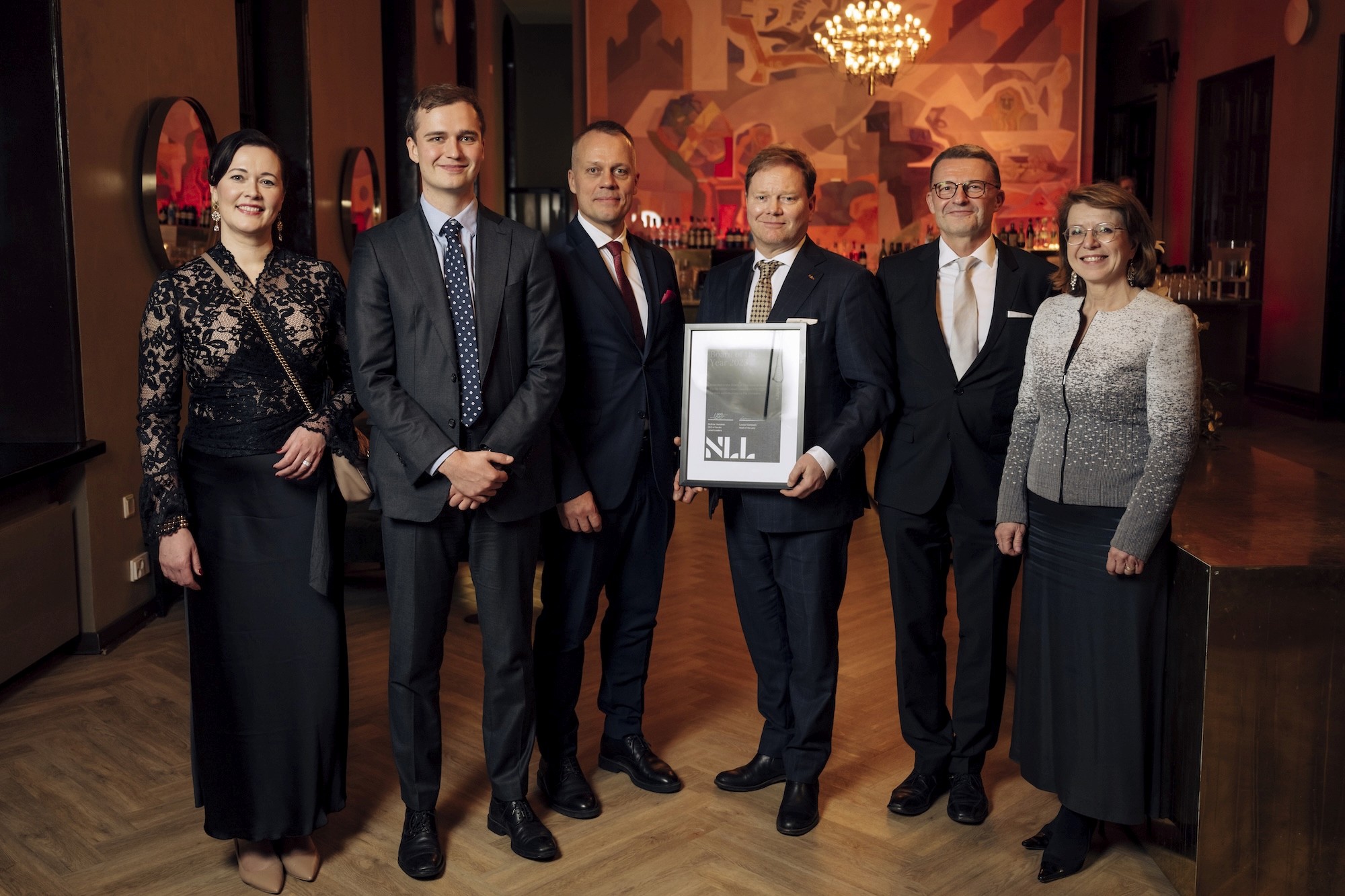
Kai Tavakka winning the award: Young Board Member of the Year at the 2025 Nordic Listed Leaders gala. Photographer: Eino Ansio. Nordic Listed Leaders is part of Listeds

The companies it has owned and engaged with as an active owner include Finnish cybersecurity firm SSH Communications Security and Helsinki-listed game studio Remedy Entertainment, alongside Swedish names such as the connectivity infrastructure group Hexatronic. On its own analysis, the entry point for the Nordic small- and micro-cap segment is among the most attractive it has seen in years.

The ownership gap

First North is, by Accendo’s description, largely a retail market, with private investors accounting for much of the trading. Today, those investors have access to a vast amount of information, but they complement rather than replace committed owners who work with the companies to strengthen strategy and governance.

Public small-cap markets, as Accendo frames it, need more committed, active and long-term owners. The market works best when it is not driven only by short-term traders or diversified portfolio managers, but also by owners willing to engage over several years. IPOs are one example. In Tavakka's view, the goal of an IPO should not be a strong first trading period. The more important question is whether the listing leaves the company with a better ownership structure: fresh capital, and owners with the incentive and the mandate to help in the next phase.

On our reading, the more useful lesson is not that First North is cheap. A two-thirds fall over five years establishes that on its own. It is that cheapness and a healthy market are not the same thing. A segment reprices back toward value only if someone is willing to own it through the doubt, and on First North that owner is often missing: the index has retail buyers and passive institutional money, but too few engaged, multi-year holders who take a board seat and stay.

Tavakka has a commercial interest in saying so; it is his company’s model. But the underlying point holds. A small-cap market can stay open and still be unhealthy: prices fall, good companies get sold too early or run out of steam, and the market grinds on. That is a governance problem before it is a pricing one, and it shows up in the ownership registers Listeds tracks company by company.

Accendo's model is typically a 10-30% stake and one or two board seats, including chair roles where it is needed. The work often includes recruiting board and management talent, focusing strategy, and strengthening financial and commercial discipline

Finland is one of the clearest cases. It has strong engineering and a deep research base, but has often struggled to turn that into global commercial winners before companies are sold or lose momentum. 

Tavakka welcomes the region's new unicorns and venture capital success stories, but argues that Europe also needs healthier listed small-cap markets. These markets allow a wider range of investors to participate in the next generation of technology companies, and give companies another route to scale if the venture capital path has not yet produced success.

Where patience matters

The market still has not recovered, and Tavakka is careful not to call a bottom. Confidence may be improving, but that does not mean valuations turn immediately. A market down roughly 65% over five years is cheap, but not risk-free.

What Accendo offers is not a prediction of the turn but a way of operating through it: concentrated positions, long holding periods and active involvement in the companies it owns. Tavakka says this patient, active-ownership approach has helped Accendo outperform its equity benchmarks since its inception in 2008. For a private investor without that toolkit, the same entry point carries more timing risk.

"We do not pretend to know the exact bottom, and we are not too concerned about it," Tavakka says. "We buy quality we understand, help companies improve, and seek value-adding exits. That is our way to invest in this part of the market."


Kai Tavakka

Managing Partner, Accendo Capital

He has been a Board Member of:

  • SSH Communications Security - Board Member since 2020

  • Remedy Entertainment - Board Member since 2024

  • Careium AB - Board Member from 2022 to 2026


Accendo Capital is a Nordic active-ownership investor focused on listed small and micro-cap technology companies in Northern Europe. Founded in 2008, Accendo typically takes concentrated ownership positions and works with companies through boards, nomination committees and management teams over multi-year periods. Its current portfolio includes companies such as SSH Communications Security, Remedy Entertainment, Hexatronic Group, Impact Coatings, and Modelon.

Leaders

The work in between is ownership: Accendo's Kai Tavakka on First North small caps

Aug 18, 2026

Weak consumer confidence has made First North small caps look cheap. Kai Tavakka of Accendo Capital argues the real constraint is ownership, not price. Small listed companies need committed, long-term owners who work with boards and management when the market is not paying attention.

“Short-term mood does not change what a company can become. It changes what you pay to own it.”
Kai Tavakka
Kai TavakkaManaging Partner, Accendo Capital

First North has been a hard place to own. The Nasdaq First North Finland index is down about 29% over the past year and about 65% over the past five, as of 6 August 2026. For many investors, that is a reason to stay away. For Kai Tavakka, Managing Partner of the Nordic active-ownership investor Accendo Capital, it is closer to the opposite.

"The mistake is to read a falling small-cap index only as a verdict on the companies inside it," Tavakka says. "Often it is also a verdict on confidence, liquidity and who is willing to own these companies through the cycle."

Why the segment got cheaper

Accendo ties the sell-off to consumer confidence. Appetite for smaller, higher-risk listed companies tends to follow it, and on Accendo’s reading confidence in Finland and Sweden has stayed weak since 2021. When households feel poorer and investors become more cautious, money moves toward larger, more familiar names. In a retail-driven market, the buyers for small and micro caps can disappear quickly.

“When confidence is low, money goes to whatever feels safe or is mainstream.”
Kai Tavakka
Kai TavakkaManaging Partner, Accendo Capital

“That pulls valuations down across the small-cap segment,” Tavakka says, “even when the potential of selected companies has not deteriorated in the same way.”

The result, on Accendo's reading, is a market where price can detach from quality. Tavakka points to a sharp compression in valuation multiples over the past five years, even as many underlying companies have improved their products, technology and cost structures.

"Of course, several companies have not delivered on their original growth ambitions," he says. "But in selected cases, we see the potential getting better while valuations have moved to new lows. That is where we see the opportunity."

Why cheap is not enough

This is where Accendo's case parts company with a simple "buy the dip" theme.

"Short-term mood does not change what a company can become," Tavakka says. "It changes what you pay to own it. The work in between is ownership: the right board, the right management, focused strategy, disciplined capital allocation and enough patience for the company to become worth more."

That is the part Accendo does itself. It runs a concentrated portfolio of Northern European small caps and works closely with boards, nomination committees and management teams rather than trading in and out. Tavakka was named Young Board Member of the Year at the 2025 Nordic Listed Leaders gala, recognition for that hands-on work.

Kai Tavakka winning the award: Young Board Member of the Year at the 2025 Nordic Listed Leaders gala. Photographer: Eino Ansio. Nordic Listed Leaders is part of Listeds

The companies it has owned and engaged with as an active owner include Finnish cybersecurity firm SSH Communications Security and Helsinki-listed game studio Remedy Entertainment, alongside Swedish names such as the connectivity infrastructure group Hexatronic. On its own analysis, the entry point for the Nordic small- and micro-cap segment is among the most attractive it has seen in years.

The ownership gap

First North is, by Accendo’s description, largely a retail market, with private investors accounting for much of the trading. Today, those investors have access to a vast amount of information, but they complement rather than replace committed owners who work with the companies to strengthen strategy and governance.

Public small-cap markets, as Accendo frames it, need more committed, active and long-term owners. The market works best when it is not driven only by short-term traders or diversified portfolio managers, but also by owners willing to engage over several years. IPOs are one example. In Tavakka's view, the goal of an IPO should not be a strong first trading period. The more important question is whether the listing leaves the company with a better ownership structure: fresh capital, and owners with the incentive and the mandate to help in the next phase.

On our reading, the more useful lesson is not that First North is cheap. A two-thirds fall over five years establishes that on its own. It is that cheapness and a healthy market are not the same thing. A segment reprices back toward value only if someone is willing to own it through the doubt, and on First North that owner is often missing: the index has retail buyers and passive institutional money, but too few engaged, multi-year holders who take a board seat and stay.

Tavakka has a commercial interest in saying so; it is his company’s model. But the underlying point holds. A small-cap market can stay open and still be unhealthy: prices fall, good companies get sold too early or run out of steam, and the market grinds on. That is a governance problem before it is a pricing one, and it shows up in the ownership registers Listeds tracks company by company.

Accendo's model is typically a 10-30% stake and one or two board seats, including chair roles where it is needed. The work often includes recruiting board and management talent, focusing strategy, and strengthening financial and commercial discipline

Finland is one of the clearest cases. It has strong engineering and a deep research base, but has often struggled to turn that into global commercial winners before companies are sold or lose momentum. 

Tavakka welcomes the region's new unicorns and venture capital success stories, but argues that Europe also needs healthier listed small-cap markets. These markets allow a wider range of investors to participate in the next generation of technology companies, and give companies another route to scale if the venture capital path has not yet produced success.

Where patience matters

The market still has not recovered, and Tavakka is careful not to call a bottom. Confidence may be improving, but that does not mean valuations turn immediately. A market down roughly 65% over five years is cheap, but not risk-free.

What Accendo offers is not a prediction of the turn but a way of operating through it: concentrated positions, long holding periods and active involvement in the companies it owns. Tavakka says this patient, active-ownership approach has helped Accendo outperform its equity benchmarks since its inception in 2008. For a private investor without that toolkit, the same entry point carries more timing risk.

"We do not pretend to know the exact bottom, and we are not too concerned about it," Tavakka says. "We buy quality we understand, help companies improve, and seek value-adding exits. That is our way to invest in this part of the market."


Kai Tavakka

Managing Partner, Accendo Capital

He has been a Board Member of:

  • SSH Communications Security - Board Member since 2020

  • Remedy Entertainment - Board Member since 2024

  • Careium AB - Board Member from 2022 to 2026


Accendo Capital is a Nordic active-ownership investor focused on listed small and micro-cap technology companies in Northern Europe. Founded in 2008, Accendo typically takes concentrated ownership positions and works with companies through boards, nomination committees and management teams over multi-year periods. Its current portfolio includes companies such as SSH Communications Security, Remedy Entertainment, Hexatronic Group, Impact Coatings, and Modelon.

Leaders

The work in between is ownership: Accendo's Kai Tavakka on First North small caps

Aug 18, 2026

Weak consumer confidence has made First North small caps look cheap. Kai Tavakka of Accendo Capital argues the real constraint is ownership, not price. Small listed companies need committed, long-term owners who work with boards and management when the market is not paying attention.

“Short-term mood does not change what a company can become. It changes what you pay to own it.”
Kai Tavakka
Kai TavakkaManaging Partner, Accendo Capital

First North has been a hard place to own. The Nasdaq First North Finland index is down about 29% over the past year and about 65% over the past five, as of 6 August 2026. For many investors, that is a reason to stay away. For Kai Tavakka, Managing Partner of the Nordic active-ownership investor Accendo Capital, it is closer to the opposite.

"The mistake is to read a falling small-cap index only as a verdict on the companies inside it," Tavakka says. "Often it is also a verdict on confidence, liquidity and who is willing to own these companies through the cycle."

Why the segment got cheaper

Accendo ties the sell-off to consumer confidence. Appetite for smaller, higher-risk listed companies tends to follow it, and on Accendo’s reading confidence in Finland and Sweden has stayed weak since 2021. When households feel poorer and investors become more cautious, money moves toward larger, more familiar names. In a retail-driven market, the buyers for small and micro caps can disappear quickly.

“When confidence is low, money goes to whatever feels safe or is mainstream.”
Kai Tavakka
Kai TavakkaManaging Partner, Accendo Capital

“That pulls valuations down across the small-cap segment,” Tavakka says, “even when the potential of selected companies has not deteriorated in the same way.”

The result, on Accendo's reading, is a market where price can detach from quality. Tavakka points to a sharp compression in valuation multiples over the past five years, even as many underlying companies have improved their products, technology and cost structures.

"Of course, several companies have not delivered on their original growth ambitions," he says. "But in selected cases, we see the potential getting better while valuations have moved to new lows. That is where we see the opportunity."

Why cheap is not enough

This is where Accendo's case parts company with a simple "buy the dip" theme.

"Short-term mood does not change what a company can become," Tavakka says. "It changes what you pay to own it. The work in between is ownership: the right board, the right management, focused strategy, disciplined capital allocation and enough patience for the company to become worth more."

That is the part Accendo does itself. It runs a concentrated portfolio of Northern European small caps and works closely with boards, nomination committees and management teams rather than trading in and out. Tavakka was named Young Board Member of the Year at the 2025 Nordic Listed Leaders gala, recognition for that hands-on work.

Kai Tavakka winning the award: Young Board Member of the Year at the 2025 Nordic Listed Leaders gala. Photographer: Eino Ansio. Nordic Listed Leaders is part of Listeds

The companies it has owned and engaged with as an active owner include Finnish cybersecurity firm SSH Communications Security and Helsinki-listed game studio Remedy Entertainment, alongside Swedish names such as the connectivity infrastructure group Hexatronic. On its own analysis, the entry point for the Nordic small- and micro-cap segment is among the most attractive it has seen in years.

The ownership gap

First North is, by Accendo’s description, largely a retail market, with private investors accounting for much of the trading. Today, those investors have access to a vast amount of information, but they complement rather than replace committed owners who work with the companies to strengthen strategy and governance.

Public small-cap markets, as Accendo frames it, need more committed, active and long-term owners. The market works best when it is not driven only by short-term traders or diversified portfolio managers, but also by owners willing to engage over several years. IPOs are one example. In Tavakka's view, the goal of an IPO should not be a strong first trading period. The more important question is whether the listing leaves the company with a better ownership structure: fresh capital, and owners with the incentive and the mandate to help in the next phase.

On our reading, the more useful lesson is not that First North is cheap. A two-thirds fall over five years establishes that on its own. It is that cheapness and a healthy market are not the same thing. A segment reprices back toward value only if someone is willing to own it through the doubt, and on First North that owner is often missing: the index has retail buyers and passive institutional money, but too few engaged, multi-year holders who take a board seat and stay.

Tavakka has a commercial interest in saying so; it is his company’s model. But the underlying point holds. A small-cap market can stay open and still be unhealthy: prices fall, good companies get sold too early or run out of steam, and the market grinds on. That is a governance problem before it is a pricing one, and it shows up in the ownership registers Listeds tracks company by company.

Accendo's model is typically a 10-30% stake and one or two board seats, including chair roles where it is needed. The work often includes recruiting board and management talent, focusing strategy, and strengthening financial and commercial discipline

Finland is one of the clearest cases. It has strong engineering and a deep research base, but has often struggled to turn that into global commercial winners before companies are sold or lose momentum. 

Tavakka welcomes the region's new unicorns and venture capital success stories, but argues that Europe also needs healthier listed small-cap markets. These markets allow a wider range of investors to participate in the next generation of technology companies, and give companies another route to scale if the venture capital path has not yet produced success.

Where patience matters

The market still has not recovered, and Tavakka is careful not to call a bottom. Confidence may be improving, but that does not mean valuations turn immediately. A market down roughly 65% over five years is cheap, but not risk-free.

What Accendo offers is not a prediction of the turn but a way of operating through it: concentrated positions, long holding periods and active involvement in the companies it owns. Tavakka says this patient, active-ownership approach has helped Accendo outperform its equity benchmarks since its inception in 2008. For a private investor without that toolkit, the same entry point carries more timing risk.

"We do not pretend to know the exact bottom, and we are not too concerned about it," Tavakka says. "We buy quality we understand, help companies improve, and seek value-adding exits. That is our way to invest in this part of the market."


Kai Tavakka

Managing Partner, Accendo Capital

He has been a Board Member of:

  • SSH Communications Security - Board Member since 2020

  • Remedy Entertainment - Board Member since 2024

  • Careium AB - Board Member from 2022 to 2026


Accendo Capital is a Nordic active-ownership investor focused on listed small and micro-cap technology companies in Northern Europe. Founded in 2008, Accendo typically takes concentrated ownership positions and works with companies through boards, nomination committees and management teams over multi-year periods. Its current portfolio includes companies such as SSH Communications Security, Remedy Entertainment, Hexatronic Group, Impact Coatings, and Modelon.

Insights

July's finance moves formed a single chain across five Helsinki-listed companies

Aug 17, 2026

Boards were quieter than at any point since the spring meetings. The month's only board departure happened because a director took a finance job.

According to Listeds data, Nordic listed companies recorded 30 board and management changes in July, down from 69 in June. Boards accounted for 2 — one appointment and one departure, against 18 recorded in June. Management teams recorded 28: 8 appointments, 16 departures, four role changes, nearly half of June's 51.

The drop is seasonal. What sits underneath it is not.

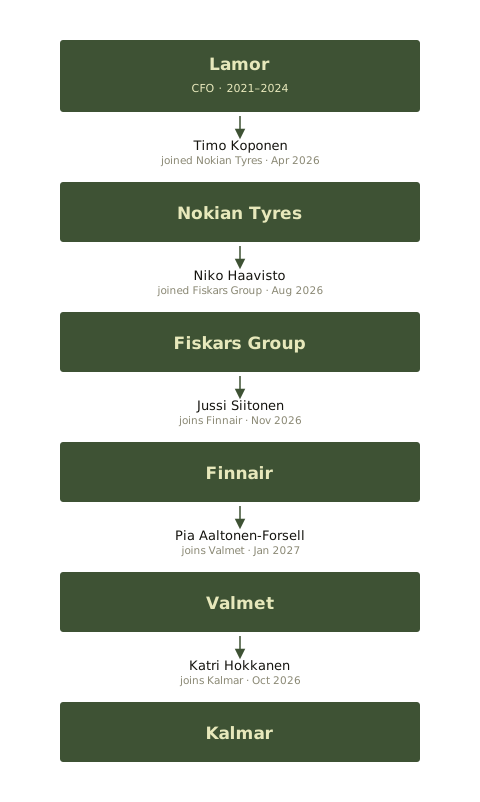
On 24 July, Finnair announced that Pia Aaltonen-Forsell was leaving as finance chief and that Jussi Siitonen would take the role from 1 November. On the same day, Valmet named Aaltonen-Forsell as its own next CFO, starting at the latest at the end of January 2027.One move, disclosed from both ends, three minutes apart.

Follow it in both directions and five Helsinki-listed companies sit on the same line.

Fiskars Group disclosed on 24 June that Siitonen, its CFO and deputy to the chief executive, would leave after August. Niko Haavisto, previously CFO at Nokian Tyres and CapMan, took the Fiskars finance role on 10 August. Siitonen went to Finnair on 1 November, and resigned from Finnair's board on 24 July to take it. Aaltonen-Forsell goes to Valmet, replacing Katri Hokkanen, who leaves at the end of September after nearly four years in the role and close to twenty years at the company. Hokkanen goes to Kalmar on 1 October, replacing Sakari Ahdekivi, who steps down on 30 September and stays in a transition role to 31 December. Ahdekivi is now among the proposed board members of WISA Group, the plywood business UPM is demerging.

Election to the WISA Group board is conditional on UPM's extraordinary general meeting of 31 August 2026 and completion of the demerger is expected on or about 31 October 2026.
Sources: company stock exchange releases, 24 June - 7 August 2026

Five companies. Four finance vacancies, each filled from another listed company — and the chain ends at a board seat.

“There is no shortage of Finnish finance chiefs. There is just a short list, and every board most likely knows who is on it.”
Helene Auramo
Helene AuramoCEO, Listeds

The disclosure sequence is worth noting on its own. Fiskars named Siitonen's exit on 24 June; Finnair named his destination on 24 July. A departing company discloses the vacancy roughly a month before the hiring company discloses the hire. Under the Nasdaq Helsinki inside-information regime that is the system working as intended, and it means the market reads a single move in two instalments — usually without knowing, at the first instalment, which company is at the other end. August and completion of the demerger is

The gaps the chain leaves behind

Orderly on paper, the sequence opens holes.

Valmet's finance chief leaves at the end of September. Her successor arrives at the latest at the end of January 2027. No interim arrangement is disclosed — a stretch of up to four months at the top of finance in a company weighing a two-company split.

Bioretec's Tuukka Paavola left with immediate effect on 2 July, six months after taking the role. Controller Anna-Mari Venola holds the duties on an interim basis while recruitment runs.

SSH Communications Security is the tightest case. Michael Kommonen held the finance role until the end of July. Cristian Arias, from Neural DSP Technologies, starts by 1 October at the latest. Cover for August and September is not disclosed. It is also the company's second appointment to that seat this year: Maria Alahuhta was named in April, and in June the company disclosed she would not take it up. Separately, on 17 July, SSH announced that Rami Raulas will retire as chief executive and that the board has opened a search. He remains in post until a successor is appointed.

Reaktor Group, listed on Nasdaq Helsinki's main market since June, named Antti Akkanen — currently finance chief of Ahlsell's Finnish operations — from 1 October, succeeding Ilkka Kosola, who leaves at the end of September. That one is covered end to end.

Boards: the quietest month since spring

Two of July's board changes bear on this story.

Telia Company's extraordinary general meeting on 2 July elected Susanne Blanke, VP AI Strategy and Transformation at Husqvarna Group, as a new director. The other was Siitonen leaving Finnair's board for its finance seat.

Betolar's nomination committee proposed Rainer Peltoniemi on 10 July; shareholders elected him on 7 August, expanding the board from six to seven. Vibeke Krohn became Betolar's president and chief executive on 1 August, succeeding Tuija Kalpala.

The month's heaviest governance item is not yet a change. On 16 July, UPM proposed the board of WISA Group: Tapio Korpeinen as chair, with Ahdekivi, Frank Herrmann, Nina Kiviranta, Mats Nordlander and Emmanuelle Picard as members. Korpeinen is UPM's own finance chief and leaves its group executive team on 31 December. The election is conditional on UPM's extraordinary general meeting of 31 August and on the demerger completing, expected on or about 31 October, with trading in WISA Group shares expected to start on or about 2 November.

Leaders

Digia names Kimmo Kärkkäinen CFO, hired from fellow IT company Vincit

Aug 14, 2026

Kimmo Kärkkäinen will take over as Digia's CFO by February 2027 at the latest, arriving from Vincit's finance seat. It is the second time since 2017 that Digia has filled its CFO role with a sitting CFO from another Nasdaq Helsinki company, a pattern Listeds examines across the wider market in a companion piece.

Digia has appointed Kimmo Kärkkäinen (b. 1972) as Chief Financial Officer and a member of the management team, effective by February 2027 at the latest, reporting to President and CEO Timo Levoranta. Kärkkäinen joins from Vincit, where he is currently CFO, and has previously held CFO roles at Fira Group and leadership positions at Sitedrive Oy, private-equity firm Bocap, Affecto Plc, and TeliaSonera.

He succeeds Kristiina Simola, who announced on 21 April 2026 that she would step down to pursue a board career after serving as Digia's CFO since 2017. Simola remains in post through the transition, with an outside date of end-October 2026.

Vincit has confirmed Kärkkäinen's resignation "to join another company," with him continuing in role during a transition period until the beginning of November 2026 at the latest while it recruits a successor. CEO Julius Manni thanked him for developing the company's processes and leadership culture.

On the appointment, Kärkkäinen said: "Digia has made an impressive journey as a profitable growth company, and it has a strong position in the Finnish software and services market. I am excited to join Digia in building its next phase. As Chief Financial Officer, I want to support the implementation of the strategy and the growth of shareholder value together with a skilled team.”

Levoranta cited Kärkkäinen’s “strong experience in financial management and business development,” as well as his experience in mergers and acquisitions and in building growth companies and new businesses.

Sales are still growing, but Digia's EBITA margin is shrinking

Digia enters the transition from a mixed position. Full-year 2025 was strong: net sales rose 5.5% to EUR 217.0 million, and the fourth quarter closed the year hard, with net sales up 10.5% to EUR 60.2 million and EBITA up 45.5% to EUR 8.5 million; the March 2026 AGM approved a dividend of EUR 0.19 per share. But 2026 opened weaker. In the first quarter, net sales grew 4.9% to EUR 56.4 million while EBITA fell 28.2% to EUR 3.3 million, partly on non-recurring change-negotiation and provision costs. The first half told the same story: net sales up 2.9% to EUR 110.7 million against EBITA down 16.7% to EUR 6.4 million, with EUR 2 million of non-recurring items, even as the equity ratio improved to 48.5% and net gearing fell to 23.4%; Digia pointed to market uncertainty weighing on customer investment decisions.

Market pressure ran alongside headcount reductions: Digia announced change negotiations on 27 February 2026, with negotiations beginning on 5 March and covering roughly 300 of Digia's 1,600 employees. The negotiations concluded on 25 March, with 31 positions ultimately set to be reduced and estimated annual cost savings of about EUR 2.4 million.

Against that backdrop, Digia set medium-term targets at its 5 February 2026 strategy update and 21 May 2026 Capital Markets Day: average annual net sales growth above 10%, an EBITA margin above 12% at the end of the strategy period, and 30% of net sales from outside Finland at the end of the strategy period.

This is the second time Digia has hired its CFO from another listed company

The move fits a recurring Nasdaq Helsinki pattern: rather than promote internally or hire a first-time CFO, Finnish listed companies frequently recruit a sitting CFO from another listed company. Digia is a clear case. Simola arrived from Digitalist Group Plc in 2017, Kärkkäinen from Vincit in 2026, both from public-company finance seats.

And the pattern rarely stops at a single move. Kärkkäinen's own departure now leaves Vincit's CFO seat open, and Vincit has already begun the search for a successor. That vacancy is the next in a run of ten finance-chief changes Listeds tracked across Nasdaq Helsinki and First North between December 2025 and August 2026, read as a set in the companion feature: The easiest way to become CFO of a Finnish listed company? Already be one at another.

Insights

The easiest way to become CFO of a Finnish listed company? Already be one at another

Aug 13, 2026

Between December 2025 and August 2026, at least ten CFOs changed seats across Nasdaq Helsinki and First North. Read as a set, one feature stands out: every incoming CFO already held the title at another listed company. None was an internal promotion. None was a first-time CFO.

On 5 August 2026, Digia named Kimmo Kärkkäinen its next CFO, recruited from Vincit, itself a listed IT company. We got curious: is it normal for a Finnish listed company to hire its CFO from within the industry, straight out of another public company's finance seat? So we checked our own data, and got the answer.

On its own, the Digia appointment is a routine leadership-moves story, the kind Listeds covers dozens of times a year. But set it beside every other CFO move Listeds has tracked over the past months, and a pattern appears that no single release shows on its own.

Ten CFO hires, and not one was promoted from within

Across the ten moves in the table below, not one incoming CFO was promoted from within their new company, and not one was taking a CFO title for the first time. Every appointee arrived already holding the CFO role at another listed company.

That is the story worth telling. It is a stronger, more defensible claim than the "domino chains" it is tempting to draw from the same data, because, as set out below, chains are partly an artefact of how you connect the dots, whereas the absence of internal promotions is a genuine, countable pattern.

Ten CFOs changed companies between December 2025 and August 2026

This is not a sample. It is every CFO change Listeds tracked across Nasdaq Helsinki and First North in the window, verified against primary company releases.

Incoming CFO

New company

Came from (CFO seat)

Announced

Effective from

Kimmo Kärkkäinen

Digia

Vincit

5 Aug 2026

by Feb 2027

Pia Aaltonen-Forsell

Valmet

Finnair

24 Jul 2026

by end of Jan 2027

Jussi Siitonen

Finnair

Fiskars Group

24 Jul 2026

1 Nov 2026

Niko Haavisto

Fiskars Group

Nokian Tyres

24 Jun 2026

10 Aug 2026

Jukka Kainulainen

Revenio Group

Kempower

13 May 2026

24 Aug 2026

Minni Lempinen

KH Group

Endomines

6 May 2026

17 Aug 2026

Katri Hokkanen

Kalmar

Valmet

30 Mar 2026

1 Oct 2026

Tuomas Mäkipeska

Kemira

YIT

23 Oct 2025

1 April 2026

Robin Pulkkinen

F-Secure

Revenio Group

18 Dec 2025

by June 2026

Saara Ukkonen

Gofore

Witted Megacorp Oyj

18 Dec 2025

1 April 2026

Two dating notes, in the interest of precision: Minni Lempinen was acting CFO at Endomines before KH Group; and Tuomas Mäkipeska's move to Kemira was announced in October 2025 and took effect on 1 April 2026. The window is therefore best described as December 2025 to August 2026, not "the first seven months of 2026"; three of the ten were announced in 2025.

The "domino chains" oversell it; the real pattern is what's missing

It is tempting to connect these into cascades, because several of the seats link up. But a note of analytical caution belongs here: every CFO departure creates a vacancy that someone fills, so almost any set of same-role moves can be drawn as a "chain." Tracing a seat backwards through its last three occupants does not prove the moves caused one another. It mostly proves that finance-chief roles, once vacated, get filled.

So the chains below are offered as illustration, not as a discovered structure. They show how tightly the same small pool recirculates, but the load-bearing finding remains the one above: no internal promotions, no first-timers.

Chain 1: Industrial & transport circuit

Niko Haavisto left Nokian Tyres for Fiskars Group; Jussi Siitonen left Fiskars for Finnair; Pia Aaltonen-Forsell left Finnair for Valmet; Katri Hokkanen left Valmet for Kalmar. Each departure vacated the seat the next executive filled. The Finnair-to-Valmet link was confirmed in the companies' own releases; the Valmet-to-Kalmar and Fiskars-to-Finnair links likewise.

chain1_industrial_transport.svg

Chain 2: Energy & healthtech circuit

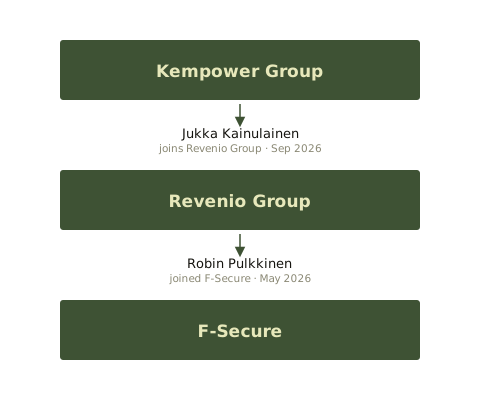
Jukka Kainulainen moved from Kempower to Revenio Group; Robin Pulkkinen then moved from Revenio Group to F-Secure.

Chain 3: the Digia hub

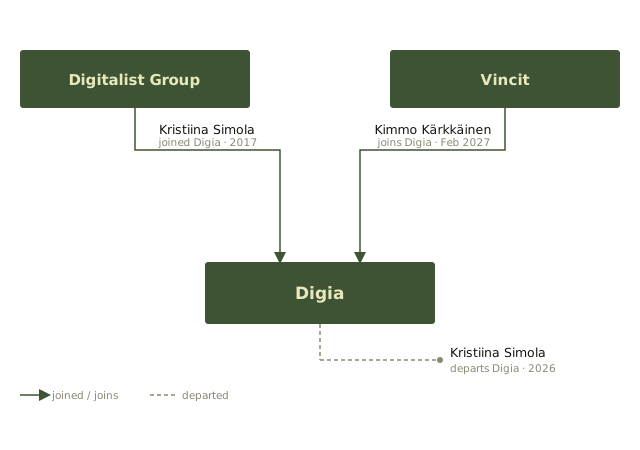
Kristiina Simola arrived at Digia from Digitalist Group in 2017; Kimmo Kärkkäinen arrives from Vincit in 2026. Two different companies, feeding the same seat, nine years apart.

chain3_digia_hub.svg

The same thing keeps happening in Finnish listed IT

This isn't only a 2026 story, either. Look at one corner of the market, Finnish listed IT, and the same thing keeps happening. The cases below aren't the whole picture, and plenty of IT names are missing from them. They're just a few real, publicly announced appointments, dropped in to show that the same move, hiring a CFO who already holds the job at another listed company, keeps turning up in the sector year after year rather than only last summer:

Incoming CFO

New company

Came from

Effective from

Kristiina Simola

Digia

Digitalist Group Plc

2017

Petri Hiljanen

Bittium

Detection Technology Oyj

Apr 2024

Mervi Kerkelä-Hiltunen

Teleste

QPR Software Oyj

Oct 2024

Familiarity, scarcity and caution could all explain it

None of this can be proved from the move data alone.

The simplest explanation is familiarity with the job's disclosure burden. A sitting Nasdaq Helsinki or First North CFO already knows the IFRS reporting cycle, the AGM calendar and the disclosure rules, so a board and CEO that hires one is buying a shorter learning curve than any outside candidate could offer.

A second explanation is scarcity. Finland's listed universe is small, and the number of executives who have actually run finance inside a public company is smaller still, so boards keep drawing from the same short list.

A third is caution. In a year when several of these companies are cutting costs and defending margins, a proven public-company track record reads as the safer appointment, and the safest appointment is the person already doing the job somewhere else.

Every listed-company CFO is already someone else's candidate

For boards, the takeaway is a little uncomfortable: the pool of finance chiefs in Helsinki is shallow, and it keeps recycling itself. If your CFO walks, the realistic replacement is another listed company's current CFO, which means your own CFO is, by the same logic, already on someone else's shortlist.

For investors, the thing to watch is the open seats. Vincit's vacancy, created by the Digia hire, is still unfilled as of writing, and where its next CFO comes from could carry the pattern on into 2027. And for the market as a whole, the real signal is what isn't happening: almost nobody is being promoted into these jobs from within. That points to thin internal succession for the finance chief across Finnish listed companies, a governance question worth a story of its own.

Insights

Finland barely had CMOs. The US trend replacing them has now reached Nasdaq Helsinki

Aug 12, 2026

For three years, the reinvention of the marketing chief into a growth owner has been reshaping the C-suite of America's Fortune 500. Finland's listed-company management teams never carried many CMOs to begin with, yet the same shift is now surfacing on Nasdaq Helsinki, and it arrives as a question for boards and CEOs, not for marketing.

On 15 September 2025, the Chief Marketing and Sustainability Officer role at Rebl Group ended. Among the Chief titles the small-cap group kept was a different one: Chief Growth Officer. Taken alone, it is a single management change at one listed company. Taken against the wider record, it is one of the clearest Finnish instances yet of a shift documented at scale in the United States.
On 7 July 2026, Forrester published its third annual analysis of marketing leadership in the Fortune 500. Marketing executives who sit on the top team or report to the CEO are now found at 52% of F500 companies, down from 58% a year earlier.

The "chief marketing officer" title itself is used by just 36%, down from 49% in a single year. Forrester's Ian Bruce argues the decline reading misses the point: the role is not disappearing, it is being reinvented into chief growth officer, chief commercial officer and chief customer officer, giving one leader accountability for growth across the whole customer lifecycle.

Finland barely had CMOs to lose on the management teams

The temptation is to read this as an American story. Across the 188 companies actively listed on Nasdaq Helsinki and First North, seven have a standalone Chief Marketing Officer (not seven percent, seven companies), and not one of them is a large cap. All 33 Finnish large caps have zero. Where Forrester is tracking the CMO's decline at the top of the US market, the top of the Finnish market had already finished that decline before the story began.

Most senior marketing owner

Companies

Share of 188

Standalone Chief Marketing Officer

7

4%

Chief title with marketing bundled into other functions

9

5%

Below the Chief line (EVP, SVP, VP, Director, Head)

24

13%

No one with marketing in a management team title

148

79%

Most senior marketing owner
Share of 188 companies
5%13%79%188companiesStandalone Chief Marketing Officer4% · 7Chief title, marketing bundled5% · 9Below the Chief line13% · 24No marketing in management title79% · 148
Source: Listeds Executive Platform
Figure 1 — Most senior marketing owner, share of 188 Nasdaq Helsinki and First North companies. 79% carry no marketing role in their management team at all.

But the absence of the CMO title is the wrong thing to fix on. The part of the American trend that matters is not the marketing chief leaving; it is where the growth mandate goes next, and who at the top table is made to own the number. On that question, the change is visible in Finland too.

Rebl kept a growth title where a marketing one used to sit. Raute appointed Arto Kaikkola as Chief Commercial Officer effective 5 May 2026, a seat that folds sales, marketing, communications and commercial excellence into a single owner. And the inflow follows the same shape, though not the same title. Of nine senior marketing hires across Finnish listed companies in 2025 and 2026, only one — Framery's acting CMO — holds a marketing-only Chief title. Two more reached Chief level with marketing bundled into something else: sustainability at Gofore, commercial duties at Raute. The remaining six arrived below Chief level entirely, as EVPs, SVPs, VPs or a Director. The new senior marketing hire in Finland rarely gets a Chief title of any kind, let alone a marketing-only one.

Where the CMO title does survive, it clusters among recent arrivals. Companies that listed in 2021 or later carry a standalone CMO at four times the rate of those listed earlier (9% against 2%), and hold any Chief-level marketing seat at more than triple the rate (16% against 5%). But this is not evidence that going public designs the role in: in three of the five recent-listing CMOs the title predates the IPO, so the pattern is really the marketing title fading among long-listed incumbents, not newer companies inventing it. For boards, that is the point. The growth-ownership question is sharpest exactly where most of the market sits, at the long-established companies that have already let the marketing title go.

IPO cohort

Companies

Standalone CMO

Any Chief-level marketing seat

Listed 2021 or later

58

5 (9%)

9 (16%)

Listed before 2021

130

2 (2%)

7 (5%)

Two directions, not one

Here Finland diverges from the American script. The F500 reinvention runs in one direction: marketing consolidates upward into a commercial growth owner. The Finnish record splits in two. Some companies route the function up into a commercial or growth chief, as at Rebl and Raute. Others route it down into communications, the reputation and disclosure seat. Valmet's rebuilt leadership team placed communications inside an EVP for People, Communications and Culture, with no marketing role surviving at the top; around thirty listed companies now carry a senior communications owner whose title has no marketing scope at all.

These are opposite bets rather than two versions of one. Placing the function under a growth or commercial chief treats growth as a revenue-and-customer problem with a single accountable owner. Placing it under communications treats the senior storytelling seat as an investor-and-stakeholder function, with the growth number sitting elsewhere, typically spread across the CEO and sales. In a market as institutionally owned and disclosure-driven as the Nordic one, the pull toward communications is strong.

The question for the board

A Finnish listed-company board appoints and oversees the CEO and signs off on how the company frames its strategy and top team; the CEO builds that team beneath it. So the board's real question is broader than where the marketing title lands: it is whether someone visibly owns growth at all. When a company removes a marketing chief and names a growth or commercial chief in its place, the answer is easy to read. It is harder to read when no growth title exists.

Tokmanni shows how easily that case is misjudged. No executive there holds a marketing, growth or commercial title, which looks at first like an empty seat. But the growth mandate is owned. The CEO leads it; the Swedish Dollarstore segment, the acquisition meant to make Tokmanni "a Nordic leader in the variety discount retail market," sits on the executive team in its own right; and a newly created Chief Strategy and Transformation Officer joins from 1 September 2026. Growth is carried there by geography and strategy, not by a functional label.

That is the boardroom test, and the question is not "do we have a CMO." The data says most Finnish management teams never will. The sharper question: since the company will keep growth under a commercial, strategy or business-unit owner regardless, has the board decided which, and can it name the person who owns the number? What a board should refuse to accept is the outcome where the marketing title goes and nobody, by function, geography or strategy, visibly holds growth in its place.

Forrester's steadiest F500 finding is that once these reinvented leaders are appointed, they are given close to four years to deliver. The American trend is arriving in the Nordics. The question for boards and CEOs is not whether they will have a CMO, but whether they will design who owns growth, or inherit that answer by default.

Leaders

Raisio built its growth plan before it hired Elli Siltala. Her first move is to listen

Aug 11, 2026

Raisio spent 2025 preparing to grow: it sold off a loss-making plant-protein unit, set hard 2027 targets and built a standing M&A function. Then it handed the company to Elli Siltala, a food-industry veteran of around 25 years at Valio, who has said her first priority is to listen and learn before setting a direction. The plan is already built. The open question is how Raisio's new chief executive chooses to take it forward.

Raisio is a Finnish brand house. It’s worth sits in names: Benecol, brand sold on cholesterol lowering products, and Elovena, the oats brand, both marketed well beyond Finland, alongside home-market staples such as Sunnuntai baking goods, Torino pasta and Nalle cereals.

Growing a brand house means one of two things: build the brands harder, or buy new ones. Raisio's board has said, in writing, that it intends to do both, and it has spent the past eighteen months building the capacity to do the buying.

On Wednesday, 12 August 2026, the company publishes its half-year report. Elli Siltala, appointed CEO on 7 August, does not start until 1 September; until then the outgoing Pasi Flinkman holds the seat.

The board chose the tool. The CEO chose to listen

Chairman Arto Tiitinen said in the appointment release that "under Elli Siltala's leadership our ambition is to grow the company through both organic growth and acquisitions." Read against the run of Nordic CEO-change releases, that is a pointed line. Boards usually credential the incoming chief executive and gesture at a "next phase." Tiitinen named the instrument, acquisitions, and set the direction before Siltala set foot in the building.

Siltala's own words went the other way. After the standard opening, she closed on this: "My first priority will be to listen, learn and build a shared understanding of how we can create long-term value for our shareholders, customers and employees."

Across the incoming-CEO releases on Listeds Executive Intelligence database, that is unusual. Most new chief executives arrive with at least a directional theme on day one: a capability to strengthen, a strategy to keep executing, a model to scale. Siltala, in this set, is the only one to make listening itself the priority and to leave the agenda more open.

The growth plan was built a year before its CEO

Here is what makes the contrast matter. The growth Tiitinen named is not merely an intention waiting on a new leader. It is a plan already in operation, and Flinkman built it.

Raisio narrowed before it aimed to grow. On 13 February 2025 it agreed to sell its entire plant-protein business, including the Härkis and Beanit brands, the Kauhava production assets and 16 employees, to Valio for EUR 7 million in cash: a unit that had booked EUR 4.5 million in net sales but a EUR 2.6 million loss in 2024.

A month later, on 13 March 2025, it published a 2025 to 2027 strategy built on three growth areas: breakfast and snacking, heart health, and new business. The sequence is the point: sell the loss-maker, then concentrate on the brands that pay.

The strategy set targets for the end of 2027: net sales of EUR 250 million and EBIT of over EUR 30 million, up from 2025 comparable figures of EUR 224.2 million and EUR 28.5 million. Acquisitions were written into the plan from the start.

Raisio then built the capacity to act on them. It created a dedicated M&A Director role, hiring Anni Palmio, a strategy-and-M&A lead from Paulig with earlier brand roles at Findus and Haribo, with effect from 1 September 2025, and set up a committee to steer the board's M&A work. A mid-cap food company of around 350 people does not stand up a permanent acquisition function by accident.

Two dates belong side by side. Palmio's M&A seat took effect on 1 September 2025. Siltala's CEO seat takes effect on 1 September 2026. The acquisition machinery is exactly one year older, and it was assembled under the CEO now leaving to other opportunities.

A brand builder, handed a buyer's mandate

Siltala's career has largely followed the commercial side of the business, with a strong focus on sales and marketing. She was at Valio from 2001 to 2025, progressing from various business, sales and marketing roles to executive positions including EVP Domestic Sales and Marketing, EVP Markets, EVP Core Businesses and Brands, and finally EVP Core Businesses, Home Markets and Primary Production.

She left Valio in November 2025. From May 2026 she was Chief Loyalty and Media Officer at SOK, a seat spanning marketing, loyalty, retail media, communications and public affairs, which she held for roughly three months before Raisio named her.

There is a Nordic small-world footnote here. The plant-protein business Raisio sold in early 2025 went to Valio, the company where Siltala spent her career and sat on the executive team at the time. She now leads the company that sold it.

That profile also runs against the Nordic grain. Marketing and brand titles rarely reach the top table of Finnish listed companies at all, based on ongoing preliminary Listeds analysis, only a handful carry a standalone chief marketing officer, and large caps are notably absent from that list

A sales-and-marketing leader moving up to run a listed company is rarer again. At a brand house, though, the fit is a natural one: when a company's value lives in names like Benecol and Elovena, a chief executive who has spent a career close to sales, brands and customers is on home ground.

The open question is how she chooses to balance the two: carry the acquisition programme forward as set out, or lean toward the organic, category-led growth she seems to know well.

Business

Mehiläinen acquires Heltti’s occupational health business

Aug 10, 2026

Finnish healthcare group Mehiläinen has acquired the occupational health services of Heltti Oy in a business transaction taking effect on 1 September 2026. The deal strengthens Mehiläinen’s position as one of Finland’s leading providers of occupational health services.

Around 60 of Heltti’s occupational health professionals will transfer to Mehiläinen as existing employees. Founded in 2013, Heltti has built a reputation for customized, fixed-price occupational health services for companies whose employees perform intellectual work. It currently serves more than 800 small and medium-sized companies across Finland, with its occupational health services used by approximately 9,000 employees.

The two companies have worked together since 2020, when Mehiläinen became Heltti’s partner clinic. “It is truly wonderful to take the next step together and welcome you to the Mehiläinen team,” said Antti Miettinen, Business Director of Working Life Services at Mehiläinen, adding that Heltti’s expertise, values and services complement Mehiläinen’s offering.

Heltti clients will gain access to Mehiläinen’s broad range of services and network, including its Digital Clinic and YritysMehiläinen corporate service, which provides real-time visibility into occupational health service usage and sick-leave monitoring.

Heltti will continue its therapy, mental health care and organizational development businesses under a new brand from 1 September 2026.

Timo Lappi, Chairman of Heltti’s Board, marked the milestone on LinkedIn, counting 4,867 days from the company’s founding to the sale of its occupational health business. He wrote that Heltti had helped tens of thousands of people across more than 1,000 client companies and said the company had built what he described as Finland’s best workplace in the health sector, based on research.

Business

Finnish machinery jobs hit highest level since the financial crisis, as orders pick up

Aug 10, 2026

Finland's machinery and metal products sector added jobs and orders in the second quarter of 2026, according to new data from Technology Industries of Finland.

Employment in the sector reached its highest level since the 2008 financial crisis, while orders across the wider technology industry grew 13% from the first quarter and 19% from a year earlier.

Finnish technology industry new orders

Quarterly new orders received by Finnish technology industry companies, split between exports and the domestic market.

EUR millionNew orders, Finnish technology industry
02 5005 0007 50010 00012 50015 00020102011201220132014201520162017201820192020202120222023202420252026
Source : Order backlog survey by the Federation of Finnish Technology Industries. Figures are quarterly new orders in EUR million, not seasonally adjusted. Individual quarters can be volatile due to the timing of large orders.

Machinery and metal products employed 138,200 people at the end of June 2026, the most since the financial crisis and 2,500 more than the lowest point of the last downturn. Order backlogs across the technology industry rose 8% between March and June, and a key demand indicator hit +20, its highest since late 2021. The technology industry's 2025 revenue came in at EUR 104 billion, up 2.8% from 2024.

Finnish technology industry order backlog

Quarter-end order backlog for Finnish technology industry companies, split between exports and the domestic market.

EUR millionOrder backlog, Finnish technology industry
010 00020 00030 00040 00020102011201220132014201520162017201820192020202120222023202420252026
Source : Order backlog survey by the Federation of Finnish Technology Industries. Figures are quarter-end order backlog in EUR million, not seasonally adjusted.

Orders up 13 percent, backlogs up 8 percent

Metric

Value

Machinery and metal products employment

138,200 (end of June 2026)

New orders, technology industry

+13% Q1 to Q2 2026, +19% year on year

Order backlog, technology industry

+8% end of March to end of June 2026

Demand indicator (tender request net balance)

+20 at end of June 2026, highest since late 2021

Technology industry revenue, 2025

EUR 104 billion, +2.8% from 2024

Jobs across the whole technology industry dipped slightly this quarter. That drop came from services, like IT and consulting, not from manufacturing.

A signal worth tracking for supplier guidance

An 8% jump in order backlogs in one quarter is worth watching, especially for suppliers tied to maritime, defense, and data centers. It's the kind of signal that shows up later in company guidance. Listeds' Signals Platform tracks these order and demand signals across Finnish listed companies, so leaders can see the shift early.

This connects to last week's Listeds piece on Finland's Q2 GDP, where growth beat the US but came from fewer people working fewer hours overall. This new data adds a twist: the technology industry, one of Finland's leading export sectors, is actually adding jobs and orders. The dip in total technology-industry employment was attributed to services, particularly information technology and design and consulting, while machinery and metal products employment returned to its highest level since the financial crisis. Worth reading together: Finland grew faster than the US in Q2 but with fewer workers and fewer hours.

Insights

CEO Index — Finland | Q2 2026

Aug 11, 2026

Finnish listed companies saw 12 new CEOs take up the role in the second quarter of 2026, against 13 in Q1. Combined, the first half of 2026 has produced 25 new CEO starts, an H1 run rate of about 50 a year, still above the ~44 recorded across all of 2025. On a quarterly basis Q2 annualizes to roughly 48, easing from Q1's own 52-annualized reading.

On diversity the quarter brought no movement: all 12 who started were men, leaving the market-wide female CEO share at 8.1%. Large Cap recorded zero changes for a second consecutive quarter. The age profile, which had swung sharply younger in Q1, moved back up — and past the norm. Q2's new CEOs took up the role at an average age of 54, against an active population that started at about 50. Renewal continues, but the profile of who is renewed keeps shifting quarter to quarter.

Highlights
  • 12 new CEOs started in Q2 2026, annualizing to ~48; H1 2026 total now 25, an H1 run rate of ~50 vs ~44 in 2025
  • Large Cap: zero CEO changes for a second consecutive quarter
  • External hires: 50% of Q2 starts (6 of 12), down from 62% in Q1 but still above the ~47% 2025 baseline — though 2 of the 5 internal promotions were sitting interim/deputy CEOs, which puts the external share at 6 of 10, or 60%, on starts that actually changed the leader
  • Average starting age of new CEOs: ~54 years, about four years above the active population's ~50 average age at start, reversing Q1's dip to 49–50
  • Women: 0 of 12 new CEOs in Q2 and 1 of 25 across H1 2026 (4.0%), against an 8.1% share of women in the active CEO population (15 of 186); the 9.3% baseline carried forward from the 2025 report has itself fallen
  • Two international starts (German, Estonian), leaving the nationality mix close to flat at 83.3% Finnish
12
new CEOs in Q2 (13 in Q1 2026)
0%
of new CEOs are women (8% of all active CEOs)
54
years is the average age of new CEOs (54 among all active CEOs)
83%
of new CEOs are Finnish (83.3% among all active CEOs)

Large Cap stays quiet

The most interesting continuity from Q1 is where CEO change still isn't happening. More than one in three Large Cap companies changed their CEO in 2025. Since then the tier has stood still: two full quarters, all of Q1 and all of Q2 2026, without a single new CEO starting. All 12 of the Q2 changes happened below Large Cap.

That freeze at the top is the quarter's defining pattern. Every one of the twelve changes landed in Small Cap, First North or Mid Cap — the segments that, on the index's own figures, tend to hire their CEOs youngest — while the largest companies, which take on their leaders at the oldest ages, chose not to move at all. The contrast points to something specific about how a large-cap board approaches the job.

New CEOs by segment
Q2 2026 · number of starts
024687410Small CapFirst NorthMid CapLarge Cap
Source: Listeds Executive Platform
Figure 1 — New CEOs by market segment, Q2 2026. Large Cap records a second consecutive quarter at zero.

By industry, the changes were more spread out than in Q1: Consumer Discretionary led with 4 (Duell, Martela, Tallink Grupp, Wetteri), followed by Industrials with 3 (Boreo, Summa Defence, Wulff-Yhtiöt), Financials and Technology with 2 each (Alisa Pankki, Titanium; Canatu, Siili Solutions), and Real Estate with 1 (Investors House).

New CEOs by industry
Q2 2026 · number of starts
Consumer discr.4Industrials3Financials2Technology2Real Estate1
Source: Listeds Executive Platform
Figure 2 — New CEOs by industry, Q2 2026. Consumer = Consumer Discretionary; no Consumer Staples starts were recorded in the quarter.

The external-hire spike cools off

Of the 12 new CEOs who started in Q2 2026, 6 were external hires, 5 were promoted from within management, and 1 came from the board — Aarne Simula's move from the Wetteri board into the CEO seat is the only board-to-CEO transition of the quarter. That puts the external share at 50%, down from Q1's 62% but still running above the 47% share recorded across 2025 as a whole.

Two of the five internal promotions, however, were already serving as interim/deputy CEO: Aki Gynther at Alisa Pankki and Tomi Virtanen at Duell. Measured against the 10 starts that did change the leader, the external share is 6 of 10, or 60%.

Source of new CEOs in Q2 2026
50.0%41.7%8.3%50%externalExternal50.0%From management41.7%From board8.3%
Source: Listeds Executive Platform
Figure 3 — Where the quarter's new CEOs came from, Q2 2026.

New CEOs start older than the market norm

New CEOs who started in Q2 2026 averaged roughly 54 years of age (based on birth year) — about four years older than the ~50 average age at which the active population started, and a reversal of Q1's dip to 49–50.

At the younger end, Maximilian Slawinski (Canatu) and Peep Jalakas (Tallink Grupp), both born in 1985, stand out; at the older end, Jukka Akselin (Investors House), born in 1961, reflects continued demand for experienced operators in smaller, asset-heavy businesses. Q1's "renewal at the margins" signal did not carry through the second quarter.

Average age of active CEOs versus new CEOs
years
All CEOsNew CEOs
0.014.028.042.056.02025 indexQ1 2026Q2 2026
Source: Listeds Executive Platform
Figure 4 — Average age of active CEOs versus new CEOs, 2025 index to Q2 2026.
“Leading a listed company is a genuinely different job, and boards look for proven experience and judgement. There is a deep pool of capable, more senior leaders at the moment, so an experienced profile is often the natural choice.”
Leena Hellfors
Leena HellforsManaging Director, SAM Headhunting

Gender representation: a sharp step backward

Every one of the 12 new CEOs who started in Q2 2026 is male. That's a full reversal from Q1's already-thin 7.7% (1 of 13), and it pulls the point-of-entry figure well below the 8.1% share of women in the active CEO population (15 of 186). Two conseMany boards have already done the grouncutive quarters without meaningful female representation among new starters is a stronger signal than either quarter alone; across H1 2026 as a whole, 1 of 25 starts went to a woman — 4.0%, or roughly half the active-population share.

Women among new CEOs
% share
0.0%3.0%6.0%9.0%12.0%7.7%0.0%4.0%8.1%Q1 2026Q2 2026H1 2026Active population
Source: Listeds Executive Platform
Figure 5 — Women as a share of new CEO starts. The final bar is the active CEO population, shown for reference, not a start figure.

The baseline itself is moving the same way. The 9.3% figure carried forward from the 2025 CEO Index stands at 8.1% on the current snapshot, so representation is eroding through attrition among sitting CEOs as well as through the pipeline of new starters.

Gender representation of new CEOs in H1 2026
4%96%4%womenWomen4%Men96%
Source: Listeds Executive Platform
Figure 6 — Gender of new CEOs across the first half of 2026 (25 starts).

International hires remain the exception

The quarter saw two international starts. Maximilian Slawinski (German) joined Canatu and Peep Jalakas (Estonian) joined Tallink Grupp, leaving the Finnish share of new CEOs at 83.3% (10 of 12). As in Q1, international hires reflect specific sector or turnaround expertise rather than a broader shift in recruitment patterns.

Active CEOs' nationality
share of the total
FinnishInternational
All active CEOs, Q2 End 202683.3%16.7%New CEOs in Q2 202683.3%16.7%
Source: Listeds Executive Platform
Figure 7 — Nationality of active CEOs against the Q2 2026 intake. The two bars are identical, which is the finding: the quarter reproduced the existing mix exactly.

The aggregate mix barely moves, and Q2 shows why: the intake arrived at almost exactly the rate already embedded in the population. Non-Finnish CEOs hold 16.7% of active roles (31 of 186), and non-Finnish starts made up 16.7% of the quarter's intake (2 of 12).

Internationalization is concentrated at the top of the market. Large Cap CEOs are 56.2% Finnish, against 80.8% in Mid Cap, 91.1% in Small Cap and 95.7% on First North. But it is not confined there: 17 of the 31 non-Finnish CEOs sit below Large Cap.

CEO nationality by market segment
share of active CEOs in each segment
FinnishInternational
Large Cap56.2%43.8%Mid Cap80.8%19.2%Small Cap91.1%8.9%First North95.7%All active CEOs83.3%16.7%
Source: Listeds Executive Platform
Figure 8 — CEO nationality by market segment, active population as of 30 June 2026.

A CEO change is rarely a single change

Across the 12 companies that changed CEO in Q2 2026, at least 6 saw some kind of management-team change around the same time.

Not every departure was necessarily tied to the CEO change. Some were already planned. A few "exits" were really just a smaller management team, not someone leaving the company. Several companies saw no management-team change at all.

“A CEO change is rarely a single appointment. The board has usually set the direction already, and the new CEO arrives to execute it, which is what pulls a wider management-team rebuild behind it. Increasingly the assignment is a whole core team rather than one person.”
Taru From
Taru FromSenior Partner, SAM Headhunting

At a glance

Metric

2025 annual

Q1 2026

Q2 2026

Pace of CEO changes

~44/year

13/qtr (~52 annualized)

12/qtr (~48 annualized)

Large Cap turnover

over 33% of firms

0%

0%

External-hire share (all started)

~47%

62% (8/13)

50% (6/12)

Avg new-CEO age

~53-54

~49-50

~54

Women among new CEOs

7.7% (1/13)

0% (0/12)

Women in active population

9.3%

9.3%

8.1% (15/186)

Finnish share of new CEO-s

84.6%

83.3% (10/12)

Finnish share, active population

~84.2%

83.5%

83.3% (155/186)

About the data

The analysis draws on the Listeds Executive Intelligence platform and covers CEOs who started in the role at Nasdaq Helsinki main list and First North listed companies between 1 April and 30 June 2026. The index is keyed to the date each CEO takes up the position, not the date the appointment was announced. Active-population figures reflect a snapshot of 186 CEO roles as of 30 June 2026. Deputy CEO/Interim CEO promotions to CEO are counted as seperate CEO start.

Role equivalents to CEO are included in the count; titles in the dataset include President and CEO as well as Chairman of the Management Board. Companies listed on Nasdaq Helsinki are included regardless of country of domicile. Market-cap segments reflect each company's classification as of the snapshot date, not the start date.

A CEO start that confirms a sitting interim or deputy CEO is counted and classified as an internal promotion. The external-hire share is reported on all starts, with a secondary figure excluding interim confirmations, since those do not change who leads the company.

Age figures are calculated from birth year.

Baseline figures for 2025 and Q1 2026 are carried forward from the CEO Index — Finland | 2025 and the CEO Index — Finland | Q1 2026.

Leaders

Panu Mikkonen takes over as Bioretec's fourth CFO in just over a year

Aug 7, 2026

Bioretec has appointed Panu Mikkonen as chief financial officer from 6 October 2026, the fourth person to be named to the role since September 2025.

The appointment itself is quite routine. What stands out is the pattern around it: of roughly 400 management-team changes at Finnish listed companies that Listeds has tracked so far in 2026, Bioretec's finance function stands out for cycling through four CFOs (two of them interim) in just over a year, a pace uncommon for the role.

How the CFO role changed hands

Anne-Mari Matikainen took over as interim CFO with immediate effect on September 15, 2025, while outgoing CFO Johanna Salko stayed on to support the transition until her departure on November 30, 2025. Tuukka Paavola became permanent CFO on January 20, 2026, but Bioretec disclosed his departure barely six months later, on July 2, 2026. Anna-Mari Venola stepped in as interim CFO the same week to bridge to Mikkonen. Mikkonen is the fourth person to hold or be named CFO in roughly 13 months.

Frequent leadership changes cut two ways. Rapid turnover carries a cost of its own, in lost continuity and institutional memory, but replacing a poor fit quickly can equally signal decisiveness.

Two of the four moves were interim appointments, the usual way a company covers a gap while it searches, not four permanent hires that failed. Interim finance chiefs are in many cases also confirmed in the job later, though at Bioretec neither was made permanent.

All four CFO changes have unfolded under a single chief executive, Sarah van Hellenberg Hubar-Fisher, who became CEO after serving an interim position since May 2025, only in August 2025, weeks before the first of them; new chief executives often rebuild the finance function around themselves, and some of the turnover may reflect that. Bioretec has not disclosed the reasons behind each departure.

The backdrop he inherits

The finance turnover has run alongside an unsettled operating period. On October 31, 2025, Bioretec restated its first-half 2025 net sales, said it no longer expected accelerated growth, and withdrew its financial targets. Net sales then fell 12.6% to EUR 1.2 million in the first quarter of 2026. The company ran two rounds of change negotiations inside a year: one opened November 12, 2025 , a second in production concluded June 17, 2026 with three terminations.

Governance was reset in parallel: the May 8, 2026 Annual General Meeting re-elected five directors and added David Gill, resolved no dividend on a 2025 loss of EUR 7.87 million, and elected Kustaa Poutiainen as the Chairperson. The market registered the disruption: Bioretec's shares closed at EUR 0.083 on October 28, 2025, down from EUR 0.129 before the restatement three sessions earlier, on volume many times the daily average.

Mikkonen's mandate

On paper, Mikkonen fits the brief. He arrives with nearly 30 years across finance, business controlling, corporate development and strategic leadership, most recently as CFO of BPW Kraatz Group, where he ran finance and IT across Finland and the Baltics and worked as a strategic partner to management and the board. Earlier, he has held senior roles at Atoy Group and Nordcloud Group, and a master's in accounting from the Helsinki School of Economics, round out a career weighted toward cross-border finance operations and organisational change.

He reports to CEO Sarah van Hellenberg Hubar-Fisher and joins the management team. He succeeds Anna-Mari Venola, Bioretec's Controller, who has held the role on an interim basis since early July 2026.

Bioretec frames the hire around "international finance leadership, business transformation, and value creation"; that stress on transformation over steady-state stewardship reads as a signal of the kind of finance chief the company thinks it needs now.

Bioretec's target, set in December 2025, is to exceed EUR 10 million in net sales by 2028. The clearest positive in the period is regulatory: the RemeOs DrillPin received FDA Breakthrough Device Designation in December 2025 , building on RemeOs's first U.S. market authorization in March 2023 and its comprehensive CE mark in Europe in January 2025.

Mikkonen's brief, in the CEO's words, is to help "execute our growth strategy and expand globally". The nearer-term test is narrower: carrying a finance team through a full fiscal year without another departure. Whether he breaks that pattern will be the clearest early sign that Bioretec has steadied its finance function.

Leaders

Luotea names asset-management executive Rikard Nyhrén to lead the Swedish business to accelerate improvement in profitability

Aug 6, 2026

A day before Luotea posted half-year results showing Sweden pulling ahead of a lagging Finland, the group named Rikard Nyhrén, most recently of Intea and Newsec, as CEO of its Swedish operations from February 2027 with the group’s profit guidance now resting on Sweden.

He succeeds Mikko Taipale, who has stepped down from the role and from Luotea's Group Management Team effective immediately; Saman Khalilian, CFO of Luotea Sweden, will run the unit on an interim basis until Nyhrén arrives. CEO Antti Niitynpää said the appointment supports Luotea's aim to "accelerate improvement in profitability" in Sweden.

The change lands at the point where Sweden has become the group's growth engine. Swedish net sales rose roughly 10% in the first quarter and 9% in the second, even as Finnish cleaning and support services fell a further 7%, and the reaffirmed full-year guidance, adjusted EBITA to increase, or increase significantly, against 2025's EUR 7.0 million, increasingly rests on Sweden holding its trajectory.

Two features of the appointment stand out. Management is changing the leadership of its best-performing region at the moment that region is working; and it has gone outside facility services to do it.

Nyhrén, born in 1981, joins from Intea Fastigheter, where he heads asset management. He has held senior roles at Newsec, Hemsö and Parmaco, and was chief technical officer at Hemsö. He trained as a construction engineer at Mälardalen University. So his background spans both sides of the business Luotea wants to build: property and asset management, and the technical side, not cleaning or facility management.

His background points to where Luotea wants to grow: property services and data-driven services, both central to its 2026–2028 strategy. This is our read of the hire, not a reason the company has given.

The numbers behind the timing

The appointment landed one day before Luotea published half-year results. Group net sales for the second quarter rose 1.5% to EUR 88.1 million and adjusted EBITA rose to EUR 2.5 million, with Swedish net sales up 9%.

For the first half, net sales increased 0.4% to EUR 174.2 million, adjusted EBITA improved to EUR 2.9 million, and operating profit stood at EUR 0.5 million.

The improvement builds on the first quarter, when Luotea said that the "turnaround in Sweden proceeds as planned" even as group net sales dipped on price competition and delayed investment decisions in Finland.

Governance and group context

The change follows Luotea's AGM on 29 April 2026, which re-elected the six-member board under chair Johan Mild and vice chair Pasi Tolppanen, approved a EUR 0.07 per share dividend for 2025, and authorised repurchases of up to 2 million shares (about 5.2%).

Hanna Inget is also the latest in a run of Group Management Team moves since Luotea's creation. Hanna Inget joined as Chief Commercial Officer from 1 March 2026 to lead commercial operations and customer experience.

Luotea is a recent listing, created on 31 December 2025 when Lassila & Tikanoja plc completed a partial demerger; the remaining facility services operations were renamed Luotea Plc and continued on Nasdaq Helsinki under the ticker LUOTEA. For full-year 2025, continuing operations reported adjusted EBITA of EUR 7.0 million, up from EUR 1.2 million a year earlier, on net sales of EUR 346.0 million, a 1.0% decline.

Financial snapshot

Period

Net sales

Adjusted EBITA

Operating profit

EPS

FY2025 (cont. ops)

EUR 346.0m (-1.0%)

EUR 7.0M

EUR 3.0M

EUR 0.03

Q1 2026

EUR 86.0m (-0.6%)

EUR 0.3M

EUR -0.4M

EUR -0.02

Q2 2026

EUR 88.1m (+1.5%)

EUR 2.5M

EUR 0.9M

EUR 0.01

H1 2026

EUR 174.2m (+0.4%)

EUR 2.9

EUR 0.5M

EUR -0.01

Why this move matters

Sweden is no small unit. It brought in EUR 121.9 million of Luotea's EUR 346.0 million in 2025 net sales, about 35% of the group, and the only part growing, up 9% while Finland fell 5.7%.

The company frames Nyhrén's job around its stated aim to "accelerate improvement in profitability" in Sweden.

Leadership continuity there is the exception within the group: the CEO role has moved now twice in a single announcement, a faster cadence than the rest of the Group Management Team, stable since the December 2025 demerger.

The full-year outlook has been reaffirmed unchanged through both the Q1 and H1 reports despite the results in Finland have been declining.

With Sweden's leadership in transition, Nyhrén's stated priority "driving profitable and sustainable growth in Sweden", puts him at the centre of whether Luotea keeps that guidance intact through 2027.

Leaders

Outokumpu combines its two European businesses under Matthieu Jehl as Rolf Schencking departs

Aug 4, 2026

The merger of Stainless Europe and Advanced Materials business lines into one Europe unit is the third change to Outokumpu's leadership team that Listeds has tracked in ten months, and it brings two of the Evolve strategy's four pillars under a single European leader.

Outokumpu has given Matthieu Jehl command of a single, enlarged European business, merging its stainless Europe and advanced materials operations into one unit and parting company with Rolf Schencking, who had run advanced materials since 2024. The change takes effect on 1 August 2026 and gives one president the European operations that absorbed Outokumpu's weakest demand and drove its 2025 net loss.

Jehl, who led business line Stainless Europe and joined the leadership team in 2025, now runs both the stainless business that weighed on 2025 earnings and the advanced materials business the company is counting on for growth. He continues to report to President and CEO Kati ter Horst.

A leadership team that keeps changing

This is the third change to Outokumpu's leadership team that Listeds has recorded in ten months. Johann Steiner took over business area Americas in October 2025 when Tamara Weinert left; Anouk de Graaf joined as head of people, sustainability and corporate relations in February 2026; and Jehl's promotion, alongside Schencking's exit, follows in August.

The board has moved at a similar pace. Four of its ten seats have changed hands in roughly sixteen months. Hilde Merete Aasheim and Olavi Huhtala joined in April 2025 AGM as Pierre Vareille left, and Timo Ritakallio and Jenni Lukander joined after the March 2026 AGM, with Ritakallio elected vice chair and Kari Jordan re-elected chair.

Date

Name

Change

Aug 2026

Matthieu Jehl

Appointed president, business area Europe (new combined unit)

Aug 2026

Rolf Schencking

Departed as president, business line advanced materials

Apr 2026

Timo Ritakallio

Joined board, elected vice chair

Apr 2026

Jenni Lukander

Joined board

Feb 2026

Anouk de Graaf

Joined leadership team as EVP, people, sustainability and corporate relations

Oct 2025

Johann Steiner

Moved to president, business area Americas

Oct 2025

Tamara Weinert

Departed as president, business area Americas

What changes, and what the company says

The new business area Europe sits above two commercial organizations, one for stainless and one for advanced materials, in place of two business lines reporting up in parallel. Outokumpu says the structure is meant to sharpen customer focus and support execution of Evolve, its 2026–2030 growth plan.

Announcing the change, ter Horst said
"I wish Matthieu every success in his new role as President of business area Europe. With extensive experience across the steel industry, Matthieu combines a deep understanding of market dynamics, a strong strategic perspective and a relentless focus on operational excellence. His leadership, business acumen and energy will be key to advancing business area Europe's competitiveness, supporting the execution of our EVOLVE strategy and delivering on its ambitions. I would also like to express my sincere appreciation to Rolf Schencking for his valuable contributions to Outokumpu."

Inside the Evolve strategy

Evolve is Outokumpu's growth plan for 2026–2030, and the consolidation changes who runs its European pillars. The company organizes it around four pillars: holding cost competitiveness and cash generation in its core sustainable stainless steel business, building profitable growth in advanced materials and alloys, moving up the chromium value chain to draw more from its own chrome mine, and developing new products from proprietary materials technology.

Two of those four pillars now sit inside business area Europe, which is why the consolidation matters beyond the org chart. The alloys pillar carries capital. Outokumpu has begun a two-phase investment in high-nickel alloys at its Avesta site in Sweden, starting with a EUR 30 million first phase to install an electro slag remelting unit and finish engineering work. The company puts the two phases combined at an estimated EUR 150 million and says it is targeting a return above its 20% internal hurdle rate for transformative investments.

A chromium project runs in parallel. A USD 45 million pilot plant in the United States for low-CO2 enriched ferrochrome and chromium metal is expected to be operational in the first half of 2027, and the company published its first related patent applications in July 2026. Alongside the growth spending, a EUR 100 million restructuring program is due to deliver annual cost savings by the end of 2027, roughly half of them within 2026.

The appointment places both the recovering Stainless Europe and the Advanced Materials business lines under one president, in place of the two business lines that reported separately before.

The governance read

The board Jehl now reports into has been rebuilt with sector weight. Hilde Merete Aasheim, who joined in 2025, was President and CEO of Norsk Hydro from 2019 to 2024, which puts direct Nordic big-metals chief-executive experience on the board just as Outokumpu commits capital to new alloy and chromium lines.

Why the timing points to Europe

The numbers explain why Europe is the seat that matters. Full-year 2025 adjusted EBITDA fell to EUR 167 million with a net loss of EUR 137 million, as business area Europe absorbed the weakest demand. Earnings have since turned: second-quarter 2026 adjusted EBITDA reached EUR 100 million, the company returned to a net profit of EUR 25 million, and net debt fell to EUR 224 million.

What to watch

On Outokumpu's own description, the two commercial units inside business area Europe serve different ends. Stainless Europe supplies large quantities of cost-competitive stainless steel; advanced materials is the specialized, higher-margin unit making nickel-based alloy solutions for demanding applications, and the company calls high-nickel alloys, the focus of its July 2026 investment, a segment offering higher margins and resilience. Both now report to Jehl, who came up through stainless.

The question the structure raises is whether the specialized, higher-margin alloys business holds its priority and investment pace inside a unit led from the volume side of stainless. Two near-term checkpoints will show how the combined unit performs: third-quarter results, which Outokumpu has guided to keep adjusted EBITDA broadly in line with the second quarter, and progress on the EUR 150 million high-nickel alloys investment at Avesta.

Business

Finland grew faster than the US in Q2 but with fewer workers and fewer hours

Aug 3, 2026

Finland's GDP grew 0.9 per cent quarter-on-quarter in Q2 2026 — equivalent to roughly 3.6 per cent annualized. That's faster than the US's headline 1.5 per cent, a figure reported on an annualized basis that works out to about 0.37 per cent quarter-on-quarter. Once the two are put on the same footing, Finland's growth outpaces America's. But it came from fewer people working fewer hours.

Finland's total output, adjusted for working days, grew 1.8 per cent in June 2026 from a year earlier, Statistics Finland reported on 30 July. Seasonally adjusted, output rose 0.3 per cent from May, and May's own figure was revised only marginally, to 2.7 per cent year-on-year from 2.8 per cent. The pace did ease between the two months, though: the year-on-year rate slowed from 2.7 per cent in May to 1.8 per cent in June, so this is growth continuing rather than accelerating.

Finnish Economic Output, 2005–2026

Volume of total output — trend and seasonally & working-day adjusted index series. Interactive view: hover for monthly values, click legend items to isolate a series, or use the range controls below.

Index point (2015 = 100)

Latest trend: 114.312-mo change: +2.5%
90951001051101151202005M012007M012009M012011M012013M012015M012017M012019M012021M012023M012025M01
Seasonally & working-day adjusted
Trend index series
Source: Statistics Finland, trend indicator of output

Note: Both series are indexed to 2015 = 100. The seasonally and working-day adjusted series reflects month-on-month volatility; the trend series smooths short-term noise to show the underlying direction of output. Figures are sourced directly from Statistics Finland and have not been modified or estimated.

The quarterly picture looks solid, if preliminary. On flash data, seasonally adjusted GDP grew 0.9 per cent in April–June from the previous quarter, and 2.5 per cent from the same quarter of 2025 on a working-day-adjusted basis, figures that will be revised when the national accounts are published in August.

The story for leadership sits underneath those headline numbers. Even as output expanded, the labour input behind it shrank: on the same preliminary read, the number of employed persons (working-day adjusted) was 1.1 per cent lower than a year earlier, with the flash estimate putting hours worked down 1.4 per cent.

Put together, those two data points imply labour productivity — output per hour worked — rose in Q2, a combination companies would normally welcome. Whether that reflects genuine efficiency gains, cyclical labour hoarding unwinding, or simply weak headcount catching up to already-soft demand is not yet answerable from the flash data alone.

Statistics Finland's Labour Force Survey, released a week earlier on 21 July, fills in that picture. The average number of employed persons aged 15 to 74 was 2,600,000 in the second quarter — 29,000 fewer than a year before (−1.1 per cent) — while the number of unemployed rose by 39,000. The unemployment rate climbed to 11.4 per cent, up from 10.2 per cent a year earlier. Hours worked, on the survey's own measure, fell 1.1 per cent. The decline was concentrated in construction, while administrative and support services grew the most, and the share of part-time workers who wanted full-time hours edged up — a contraction focused on specific sectors rather than broad-based. The survey's margins of error are worth keeping in mind: ±18,000 on the employed figure and ±15,000 on the unemployed.

Set against its neighbours and peers, Finland's Q2 print looks respectable but not exceptional on growth alone — the divergence from employment is what stands out. The euro area and the wider EU both reported their Q2 flash estimates on the same day as Finland's monthly figures: euro area GDP rose 0.4 per cent quarter-on-quarter and the EU 0.5 per cent, both accelerating from essentially flat growth in Q1, with Ireland (+3.9 per cent), Lithuania (+1.7 per cent) and Sweden (+1.4 per cent) posting the strongest quarterly gains in the bloc. Finland's 0.9 per cent sits comfortably above both aggregates.

Denmark and Norway aren't yet part of the comparison — both report on a longer lag, and neither had published Q2 figures at the time of writing. The last confirmed readings are Q1: Denmark's economy grew 1.5 per cent quarter-on-quarter, revised down from an initial 1.9 per cent estimate, Mainland Norway, which excludes the petroleum and offshore shipping sectors, grew 0.2 per cent quarter-on-quarter in the first quarter, matching the revised pace recorded in the previous quarter. Both figures predate the current quarter and can't be compared directly to Finland's Q2 print.

The clearer contrast for now is with Sweden and the US. Sweden's own Q2 rebound came with employment rising, not falling — the employment rate climbed to 70.6 per cent by June, from 69.4 per cent in May. In the US, payroll employment kept growing through Q2 — averaging modest but positive monthly gains, including +57,000 in June — even as a separate household survey showed civilian employment falling sharply and labor force participation dropping to 61.5 per cent, its lowest since March 2021. Finland's combination of solid output growth and a shrinking workforce is, on the evidence available so far, a genuinely distinct pattern among the peers that have reported — though a fuller regional picture will only be possible once Denmark and Norway's Q2 numbers are in.

The data are preliminary, drawn from Statistics Finland's Trend Indicator of Output. Revised quarterly national accounts are due on 28 August 2026, and will be the next firm read on whether the output–employment gap is a data artefact or a genuine shift.

Business

African swine fever in Finland halts Atria and HKFoods exports to Japan, China and beyond

Jul 31, 2026

Finland has recorded its first-ever case of African swine fever (ASF). On 30 July 2026, a resident near Vaalimaa in Virolahti found three dead wild piglets and brought them to the Finnish Food Authority. Preliminary tests came back positive.

The result is now being confirmed at the EU reference laboratory in Spain. The Authority has drawn a restriction zone around the site, limited pig movements within it, and is working to gauge how far the virus has spread among wild boar. ASF does not infect humans.

The finding reached the stock exchange almost immediately. On 31 July, Finland's two listed meat producers, Atria and HKFoods, issued near-identical statements: neither has contract pig farms inside the restriction zone, and Finnish pork remains safe to eat. But several export markets automatically bar pork from any country where ASF is detected, regardless of where the case occurred.

For Atria, exports to Japan, China, Singapore and Taiwan stopped with immediate effect. It can still ship within the EU and to South Korea, the one non-EU market where a regionalisation agreement lets trade continue based on where an outbreak sits. "Our aim is to open talks immediately with the countries where exports have now stopped," said Markku Hirvijärvi, head of Atria Finland's meat business and exports. Chicken and beef exports are unaffected. HKFoods likewise suspended non-EU pork exports, including to China and Japan, and says it will redirect those volumes elsewhere.

Both companies had flagged this scenario only weeks earlier. Atria's half-year report warned the pork market would stay unstable through end-2026, citing the ASF outbreak identified in Spain in the fourth quarter of 2025, falling pork exports on the back of China's import tariffs, and demand in Europe running below expectations; it also disclosed a EUR 0.6 million cost from an ASF case at its own Estonian farm a year earlier. HKFoods' first-quarter report stated the risk of ASF reaching Finland had "increased significantly" since the disease appeared on Estonian pig farms in June 2025.

The timing is unfortunate, arriving just as both showed improving numbers. HKFoods' comparable operating profit from continuing operations rose 23.7% year-on-year in Q1 to EUR 5.7 million; Atria's adjusted EBIT increased 13.45% to EUR 34.6 million over the half-year. Atria Finland CEO Mika Ala-Fossi said it is too early to size the financial impact, which will hinge on how quickly export markets reopen.

What to watch: confirmation from the EU reference laboratory; whether the restriction zone expands if more infected wild boar appear; and the pressure on European pork prices as volumes meant for China and Japan seek a home in an already oversupplied market.

Leaders

Mara Zavagno is Konecranes' fourth internal promotion to the top in eighteen months

Jul 31, 2026

As Mara Zavagno steps up to lead People & Culture, the pattern behind Konecranes' leadership churn comes into focus: four top-team seats have changed since early 2025, and every one has been filled from inside.

Konecranes Plc announced on 29 July 2026 that it will promote Mara Zavagno to Executive Vice President, People & Culture, effective 1 October 2026. Zavagno joins the Leadership Team and reports to President and CEO Marko Tulokas. She succeeds Anneli Karkovirta, who retires after twelve years and leaves the Leadership Team on 1 August 2026.

On its own it looks routine: a retirement flagged back in February, a successor named on schedule. But this is the fourth change to Konecranes' top team in eighteen months, and every one has gone to someone already inside the company. That consistency is the part worth watching. It reassures investors weighing how stable the leadership is, and it carries just as much weight with employees. A steady run of internal promotions tells people their own careers can grow here, which is often what matters most when they think about their future with a company.

The signal: internal succession is now the default

Since the start of 2025, four of the Leadership Team's nine seats have turned over, and Konecranes has looked inside the house every time.

Marko Tulokas was elevated to CEO in June 2025 from within the leadership group, succeeding Anders Svensson. When Jussi Rautiainen took over Business Area Industrial Equipment on 1 January 2026, he stepped into the operational role Tulokas had vacated. When Minna Aila left as EVP Corporate Affairs & Brand at the end of 2025, Konecranes chose not to recruit a successor at all, redistributing her responsibilities internally. And now Karkovirta's successor is a twelve-year insider by way of the Terex MHPS acquisition.

Tulokas made the preference explicit in announcing Zavagno: "I am very pleased that we found such an excellent successor for our People & Culture leadership from within the company … and for growing such an excellent successor to take on her role."

For a company that has changed nearly half its top team in eighteen months, that consistency is the reassuring part. This is concentrated, sequenced turnover with continuity of institutional knowledge, not a revolving door, and not an outside-in reset of strategy. The other five Leadership Team seats have not moved at all, and at board level Pasi Laine and Ulf Liljedahl have chaired and vice-chaired across both the 2025 and 2026 AGMs, with only two of eight director seats turning over.

Why it matters now: a softer half-year to execute through

The continuity question is not just theoretical, because the new-look team has to deliver against a weaker top line. Net sales fell 5.3% in H1 2026 to EUR 1.93 billion, and comparable EBITA was down 9.3%. What cushions that is the order book, which grew to EUR 3.38 billion at end-June — up 16.1% year on year — on order intake that rose 6.9% in the half.

Guidance has been held unchanged across all three 2026 disclosures: net sales approximately at or above 2025 levels, and a comparable EBITA margin approximately at 2025 levels. 

Financial snapshot

Metric

Q1 2026 (Jan–Mar)

H1 2026 (Jan–Jun)

FY 2025

Net sales

EUR 907.9m (−7.7%)

EUR 1.93bn (−5.3%)

EUR 4.19bn (−0.9%)

Order intake

EUR 1.07bn (+0.3%)

EUR 2.31bn (+6.9%)

EUR 4.39bn (+9.7%)

Order book (period-end)

EUR 3.18bn (+7.9%)

EUR 3.38bn (+16.1%)

EUR 2.99bn (+3.5%)

Comparable EBITA

EUR 105.7m, 11.6% margin (−3.1%)

EUR 235.2m, 12.2% margin (−9.3%)

EUR 588.1m, 14.0% margin (record)

Operating profit

EUR 95.6m (−4.4%)

EUR 215.2m (−9.1%)

EUR 542.4m, 13.0% margin

Basic EPS

EUR 0.28 (−8.6%)

EUR 0.66 (−9.3%)

EUR 5.05

Free cash flow

EUR 34.6m

EUR 14.4m

EUR 529.6m

Net debt / gearing

EUR −184.9m (net cash) / −9.5%

EUR 22.3m / 1.1%

EUR −163.5m (net cash) / −7.8%

A diversity-heavy release, a top team still taking shape

Konecranes leaned hard on the language of diversity in announcing Zavagno, and it is worth noticing because it is not something Finnish industrials say often. Tulokas credited her with having “systematically developed Konecranes’ diversity culture to meet the best industry standards.” Zavagno’s own statement returned to the theme more than once, calling inclusion, trust and “diversity of thought” essential drivers of innovation and growth. She is, after all, the company’s Chief Inclusion & Diversity Officer, promoted onto the Leadership Team from the very portfolio she built.

Diversity, of course, is about far more than gender — nationality, background, discipline and ways of thinking all count, and by some of those measures the team does bring range. Zavagno herself is a case in point: she is Italian, holds a degree in Political Science and Economics from the University of Padova, and came to Konecranes through the 2017 Terex MHPS acquisition. Still, on the one dimension that is easiest to measure, the gender balance at the top, the release sits a little ahead of the numbers.

From 1 October the Leadership Team has nine members: six men and three women. No woman runs a business or holds one of the senior executive seats. The CEO, the CFO and deputy CEO, and all three business-area presidents are men, as is the technologies chief. The three women all hold corporate functions rather than businesses — Zavagno in People & Culture, Sirpa Poitsalo as General Counsel and Christine George in Corporate Strategy & Communications. The team is fairly narrow in age too, with members born between 1963 and 1978 and six of the nine born in the 1960s.

Zavagno’s arrival does little to shift that composition. She replaces another woman, the retiring Karkovirta, so the three-of-nine gender balance holds rather than improves, and the operational roles stay entirely male. The board is more balanced, with three women among its eight directors. On the evidence of its own leadership page, then, Konecranes is a company talking confidently about diversity while still building it — at least in its senior ranks — which is exactly why the promotion of a D&I leader to the top table is the detail worth drawing out.

Leadership team changes since early 2025

Announced

Change

20 Jan 2025

Anders Svensson announces departure as President & CEO; search for successor begins

15 May 2025

Marko Tulokas appointed President & CEO, effective 1 June 2025

5 Nov 2025

Jussi Rautiainen appointed President, Business Area Industrial Equipment, effective 1 Jan 2026, joining the Leadership Team

17 Dec 2025

Minna Aila, EVP Corporate Affairs & Brand, leaves the Leadership Team effective 31 Dec 2025; no successor recruited, duties redistributed

9 Feb 2026

Karkovirta's summer 2026 retirement announced; successor search opened

29 Jul 2026

Mara Zavagno appointed EVP, People & Culture, effective 1 Oct 2026

Investor watchpoints

Three things will tell you whether the internal-continuity bet is paying off. First, order-book conversion: the EUR 3.38 billion backlog has to translate into a stronger H2 for the reaffirmed full-year guidance to hold. Second, integration: the H1 acquisitions — a majority stake in Mitsubishi Electric FA Industrial Products in Japan, plus service deals in Thailand, New Zealand and Spain — still have to show contribution, and integration is a People & Culture job as much as a commercial one. Third, whether the internal-succession preference extends the next time a seat opens, or proves specific to this cycle.

Business

Nokia's chair put half a million euros into the dip. Finland's biggest pension funds went the other way.

Jul 30, 2026

The share has given back nearly half its June rally. Once the automatic fee-shares are removed, the insiders still trading on their own account lean one way, and it's the opposite way from the country's biggest pension funds.

On July 24, Nokia’s board chair Timo Ihamuotila bought 60,000 Nokia shares at a volume-weighted €8.45 — about €507,000 of his own money, disclosed three days later under the EU Market Abuse Regulation. He was buying into a slide that took the Helsinki-listed share from a €14.805 close on June 3 to €7.556 on July 29, a fall of about 49%. The stock still trades well above the roughly €3.4 it changed hands at a year ago, before Nokia's USD 1 billion NVIDIA AI-RAN partnership in October 2025 set off a run that carried it more than fourfold into June.

Not every insider "purchase" is a market call. Nokia's April 9 AGM set 2026 board fees at €440,000 for the Chair, €210,000 for the Vice Chair and €185,000 for each other member, and resolved that "approximately 40% of the annual fee will be paid in Nokia shares" — shares the directors must hold for their first three years,  so the near-identical share receipts booked for non-executives on May 4, and executives' incentive allocations (Jan 14, May 4, July 9), are compensation. Strip those out, and what's left are the voluntary, open-market trades.

On their own account, the flow tilts to buying.

Ihamuotila had already bought €537,400 on Jan 30 (close €5.42) and €454,805 on Apr 28 (close €9.41). His July 24 purchase was followed by CTO and AI Officer Pallavi Mahajan (around €520,426) and technology standards chief Patrik Hammarén (€365,480), Chief People Officer Kristen Pressner (€519,993) and Chief Geopolitical & Government Relations Officer Mikko Hautala (€55,689) — the last two buying at €7.84 on July 29, days after the Q2 report. Mid-rally, CEO Justin Hotard added €772,102 (Apr 28) - though under Nokia's co-investment long-term incentive arrangement, so not a purely discretionary open-market buy. Nearer the peak, in late May with the shares around €13, Konstanty Owczarek bought around €430,885 and €514,099 (May 22 and 26), and Victoria Hanrahan around €622,595. The only own-account sellers were ahead of the run: Raghav Sahgal (>€1m, Mar 10) and board member Thomas Dannenfeldt (€234,312, Mar 19). Read together, discretionary insiders have on balance been adding — the chair most visibly, on the way down.

€7.556−49% from the 3 June peak+122% in twelve monthsClose, 29 July 2026
€2.50€5.00€7.50€10.00€12.50€15.00Jul '25SepNovJan '26MarMayJulNVIDIA AI-RAN deal · 28 Oct '25Q2 guidance · 23 Jul '2612345678910111213
Bought on own accountSold on own accountPaid in shares
Purchases on own account
1Timo Ihamuotila€537,400Board chair30 Jan
4Timo Ihamuotila€454,805Board chair28 Apr
5Justin Hotard€772,102President and CEO · co-investment plan28 Apr
6Konstanty Owczarek€430,885Chief Corporate Development Officer22 May
7Konstanty Owczarek€514,099Chief Corporate Development Officer26 May
8Victoria Hanrahan€622,595Chief of Staff · between 26 and 28 May28 May
9Timo Ihamuotila€507,000Board chair24 Jul
10Pallavi Mahajan€520,426Chief Technology and AI Officer24 Jul
11Patrik Hammarén€365,480President, Technology Standards24 Jul
12Kristen Pressner€519,993Chief People Officer29 Jul
13Mikko Hautala€55,689Chief Geopolitical & Government Relations Officer29 Jul
Disposals on own account
2Raghav Sahgalover €1,000,000Chief Customer Officer10 Mar
3Thomas Dannenfeldt€234,312Board member19 Mar
Source: Nokia managers' transactions disclosed under MAR Article 19; Nasdaq Helsinki closing prices. Hollow dots are share-based fees and incentive allocations (14 Jan, 4 May, 9 Jul), which are compensation. Amounts from MAR disclosures; USD trades converted to euro (see note). Justin Hotard's 28 April acquisition was made under Nokia's co-investment long-term incentive arrangement, so it is not a purely discretionary open-market buy. Nothing here implies knowledge of non-public information. Listeds · 29 July 2026

The Nordic counterweight.

As leadership bought, Finland's largest institutions sold — though large funds routinely rebalance and take profits after a run this steep, so their selling isn't necessarily a call on the stock. Fidelity's FMR LLC let its voting rights slip below 5% (to 4.92%, disclosed June 30) just before the July 23 results — a threshold flag on voting rights, not a stock dump: its actual shareholding stayed just above 5% (5.20%). Among registered owners, the big pension funds cut hard between March 31 and June 30, while state holder Solidium held firm. 

Registered owner

March 31

June 30

Change 

Solidium Oy (state, #1)

325.0m

325.0m

0.0m

Varma

91.3m

61.0m

−30.3m

Ilmarinen

75.0m

49.4m

−25.6m

Elo

29.9m

20.1m

−9.8m

State Pension Fund (VER)

20.0m

11.0m

−9.0m

The quarter wasn't the problem for Nokia; the outlook was.

Q2 on July 23 showed 9% constant-currency net-sales growth, comparable operating profit up 18% to €434 million, AI & Cloud revenue more than doubling, and a record €2.8 billion of AI & Cloud orders. What unsettled the market was guidance: CEO Hotard flagged memory as the "most significant" supply constraint, Nokia lifted 2026 restructuring charges to about €800 million, and guided Q3 profit broadly flat before a Q4 pickup — echoing Ericsson, down about 12% on July 14 on the same memory-cost warning, per press reports. Investors sold the outlook, not the quarter.

One holder is still comfortably ahead: NVIDIA subscribed for its 2.9% stake at USD 6.01 (EUR 5.16) in the October 2025 issuance — below today's ~€7.6, even after the 49% drop. 

Business

Iberdrola is buying Caruna at a €5 billion valuation. Why Finns are not happy, and why the anger misses the point

Jul 29, 2026

Iberdrola, one of Europe’s largest electricity companies, is buying Caruna, the grid that powers 1.5 million Finns. The deal has reignited Finnish anger over foreign ownership of critical infrastructure, and reopened old wounds about how the grid was sold, priced and taxed in the first place.

On 21 July 2026, Spain's Iberdrola agreed to buy 80% of Caruna, the company whose wires reach about a quarter of Finland. The sellers, US private equity firm KKR and Canada's Ontario Teachers' Pension Plan, are exiting in full. The two Nordic pension owners, Finland's Elo and Sweden's AMF, are keeping their combined 20%. The price for the 80% stake is about €2 billion, valuing Caruna at around €5 billion including debt. Completion is expected in the first quarter of 2027, subject to Finnish foreign investment screening, EU merger control, and foreign subsidy review.

The opposition wasted no time. Antti Kaikkonen, leader of the opposition Centre Party, wrote in a Facebook post that the government should not watch this from the sidelines but actively explore a domestic ownership solution for the grid, with Finnish pension companies possibly taking part. 

He called the original sale of Fortum's networks to foreign investors a serious mistake whose consequences persist: a monopoly whose customers cannot change their network company yet pay rising transfer fees while profits flow abroad. He was careful to add that he does not oppose foreign investment in general, only that critical infrastructure should put the national interest first.

The diagnosis is sharp, and widely shared. But the remedy that now dominates the public reaction, making Caruna Finnish again, is on its own the wrong frame. Caruna has not been in majority Finnish hands since 2014, and the owners now selling are already American and Canadian. 

The harder question, the one Finns have been paying for since 2016, is why a monopoly that every household in its area depends on was turned into a financial asset in the first place, and what that ownership model does to the people at the end of the line.

Why this is personal for 1.5 million Finns

Caruna is Finland's largest electricity distribution company. It owns and runs the local grid that carries power to about 744,000 customer connections and is the primary distributor in 57 municipalities in southern, southwestern and western Finland, plus Joensuu and Koillismaa. Those connections reach roughly 1.5 million people, more than a quarter of the country's population of about 5.6 million. Its share of the national distribution market is close to 20%.

A distribution grid is a natural monopoly. A household cannot choose a different set of wires to its home. 

If you live in Caruna's area, you pay Caruna to move your electricity, whatever your energy supplier, and you pay it every month of the year. That is why the bill is personal, and why it bites hardest for many households in a Finnish winter, when heating and darkness push consumption to its annual peak and the distribution charge rides on top of every kilowatt hour.
Regulation caps how fast these charges can rise, and how much a grid company can earn, precisely because customers have nowhere else to go.

The gap inside Caruna's own network shows how much the model matters. In 2025, according to Sähköhinta.com figures reported by Kauppalehti, the basic monthly distribution charge in Caruna's main area was €29.71, the fourth highest of any Finnish grid company and roughly double the national average of €14.85. In the separately run Caruna Espoo area, the basic charge was only €7.34, and the energy charge was 2.66 cents per kilowatt hour against 5.26 cents in the main area. Same owner, very different bills.

That is also why the bill carries memory. When the grid was first sold, Finns were promised that private ownership would not raise transfer prices. It did.

The sale that still stings

Caruna exists because of a political decision that its architects promised would be painless. The sale of Fortum's Finnish distribution business was approved by the government in late 2013 and completed on 24 March 2014, when state-controlled Fortum sold the grid to a consortium called Suomi Power Networks for about €2.55 billion

The buyers were Australia's First State Investments and Canada's Borealis Infrastructure, each with 40%, alongside the Finnish pension investors Keva and LocalTapiola Pension. 

The grid served about 640,000 customers at the time. In the ministerial committee, the sale was backed across Jyrki Katainen's six party coalition, by the Social Democrats, the National Coalition Party, the Greens, the Swedish People's Party and the Christian Democrats. 

Only the Left Alliance's Paavo Arhinmäki opposed it, filing a dissenting opinion on the grounds that a natural monopoly carrying critical infrastructure should stay in public hands.

The ministers who led it were confident in public. Prime Minister Katainen said the sale would not raise transfer prices for customers because electricity transfer and its pricing are strictly regulated. 

Minister of Economic Affairs Jan Vapaavuori called it "a safe solution for Finland's energy policy" and argued that because network companies face a regulated ceiling on their returns, no price spike could even be constructed.

Pekka Haavisto, the minister responsible for Fortum ownership steering, defended the deal too, saying the distribution grid was not infrastructure the state needed to own, that the operator could not price freely, and that it carried heavy obligations for maintenance and customer liability.

It did not hold. At the turn of 2016, Caruna announced transfer price increases averaging about 27%, reported elsewhere as up to a third, from the start of March. The backlash was national, and with the Consumer Ombudsman raising the prospect of a class action, the company backed down, phasing the increase in and temporarily cutting the basic fee, with no further rises before 2018. 

It did not stay down: in April 2018 Caruna raised distribution charges again, by about 6.5% on average including taxes. The company, a monopoly's customers cannot walk away from had become, in Finnish public debate, shorthand for public anger.

In fairness, not all of the spending was optional. The Tapani storm that swept Finland on St Stephen's Day, 26 December 2011, with a second storm, Hannu, hours behind it, was among the most destructive the country had seen: it toppled trees onto overhead lines across the south and cut power to hundreds of thousands of homes, some for more than a week. 

The disaster exposed how fragile the grid was, and Parliament's answer was the 2013 Electricity Market Act, which required distribution companies to storm-proof their networks so that weather outages could not exceed six hours in towns or 36 hours in the countryside, to be achieved by 2028, with extensions to 2036 for the hardest rural stretches, mainly by burying cables underground. Caruna's grid, now about 89,000 km and roughly two-thirds underground, was rebuilt to that standard. The obligation was genuine. The fight was always over how much of that cost, and how much profit on top, landed on customers who could not say no.

Then there was tax. Caruna's ownership structure kept its Finnish tax bill strikingly low. 

In a series of investigations, public broadcaster Yle found that in 2014 the company reported more than €50 million in operating profit but, after financing costs, paid only about €800,000 in Finnish corporate tax, using a complex intra-group debt structure routed through Dutch, Luxembourg, Maltese and Cayman Islands companies, with owner loans carrying interest well above bank rates. 

In 2016 it paid an effective rate of about 0.28% on more than €150 million of operating profit. 

The civil society group Finnwatch estimated that Finland lost around €12 million in tax revenue in 2017 alone, and pointed to a balance sheet exemption rule that let Caruna deduct all of its interest costs after its owners had driven the company's equity negative with very large shareholder loans. 

Finland tightened these rules in stages, and the first stage barely touched Caruna. The 2019 reform under the EU anti-tax-avoidance directive broadened the interest limit but left the balance sheet exemption intact, so little changed: Caruna paid only about €10.7 million in Finnish corporation tax in 2020, and Finnwatch estimated the state still lost around €10 million that year. 

The real bite came from a later change to that exemption, in force from the start of 2023. Caruna could no longer deduct all the interest on its owner loans, and its Finnish corporation tax roughly doubled, from €13 million in 2022 to €26 million in 2023, with about €9 million of the rise coming from the rule change. 

The loss to the public ran wider than the tax bill. Before 2014 the grid sat inside Fortum, which is majority owned by the Finnish state, so the state shared in its earnings through Fortum's dividends. Selling it for €2.55 billion brought a one off gain, but it handed the recurring dividend stream of a regulated monopoly to private owners. And the whole tax structure rested on a simple asymmetry: interest on owner loans is deductible in Finland, while dividends are not, so financing Caruna with shareholder debt rather than equity turned profit that would have been taxed into deductible interest routed abroad.

The backlash eventually reached the law. In 2021, Sanna Marin's government pushed through amendments to the Electricity Market Act, in force that August, that cut distribution companies' maximum allowed return and shrank the size of one off increases. The reasonable rate of return on capital fell to 4%, from about 5.73% in 2020, grid companies were projected to collect some €350 million less from customers, and the ceiling on annual transfer price increases was halved from 15% to 8%. It was the first turn of the screw. The Energy Authority would tighten again for 2024 to 2031, and that is what the companies, Caruna among them, took to court.

From price cap to Washington

The tension between a regulated monopoly and its owners has since moved to the courtroom. 

The Energy Authority tightened the model that limits how much grid companies may earn for 2024 to 2031, most importantly by freezing the valuation of existing networks at their 2023 level. Almost every distribution and transmission company, Caruna among them, challenged the methods at the Market Court, which rejected the appeals in full on 21 November 2025. The profit cap stood.

Caruna's foreign owners went further than anyone in Finland expected, and they did not wait for the Market Court's verdict to do it. Invoking investor protection under the Energy Charter Treaty, they filed to take Finland to the International Centre for Settlement of Investment Disputes, the World Bank linked arbitration body in Washington.

A company whose grid the Finnish state once owned was now suing the Finnish state on an international stage, in what would be the first such claim ICSID has handled against Finland. ICSID cases typically run three to four years, and the rulings are binding with no appeal. Whoever owns Caruna next inherits that dispute as part of the package.

Who the new owner is

Caruna is passing from financial owners with a fixed horizon to a strategic industrial one. Iberdrola is a Spanish multinational utility based in Bilbao and chaired by Ignacio Galán, one of the largest electricity companies in the world, with about 45,000 employees, serving more than 100 million people, and operations in roughly 30 countries.   With a market capitalisation of more than €140 billion, Iberdrola is Europe's largest electricity company by market value.

Caruna would join the regulated networks it already runs in Spain, the United Kingdom through ScottishPower, the United States through Avangrid, and Brazil through Neoenergia, alongside one of the world's largest wind portfolios.

In one sense the deal brings the grid closer to home, from American and Canadian funds to a European company inside the single market, bound by EU rules and subject to EU merger control, though that is only the domicile, not the whole story.

The more revealing view is one level up, at who owns Iberdrola. Its largest shareholder is the Qatar Investment Authority, with close to 7%. At roughly $600 billion it is one of the world's largest sovereign wealth funds, and a deliberate anchor investor in Iberdrola since 2011. Next comes BlackRock, the world's largest asset manager at some $15.3 trillion, though its holding is the passive, index-driven kind it takes in almost every big listed company. One owner is strategic, the other close to automatic, but either way a fifth of Finland's electricity grid would sit, in effect, at the end of a chain that runs through Doha and New York.

That scale cuts two ways. Iberdrola is a working network operator rather than a passive owner: it runs regulated grids under demanding regulators in Spain, Britain, the United States and Brazil, and it has the balance sheet to fund the storm proofing and cabling that Caruna's tariffs exist to pay for. It is not a controversy free buyer, though. It spent years at odds with the Mexican government before selling most of its Mexican fleet, about $6.2 billion of assets, to a state backed fund in 2023 and 2024, with some litigation continuing.

For Iberdrola, none of this dims the appeal of Caruna. The logic is a clear playbook: acquire stable, regulated network assets in politically secure countries and hold them for the long term, and a Finnish distribution monopoly with a mandated investment programme and a regulated return is exactly that. The company says the ownership change will not affect Caruna's operations, customers, employees or investments.

The size difference matters, and it works both ways. Caruna is essential to 1.5 million Finns, but to Iberdrola it is tiny. Caruna is worth about €5 billion, only a few percent of the a company Iberdrola’s size. Its 744,000 customers are a small number next to Iberdrola's much larger networks in Spain, the United States, Brazil and Britain. That can be reassuring, because an owner this big can easily afford the investment Caruna's grid needs. It can also be unsettling, because a grid Finns cannot live without will be run by a company for which it is a minor part of a much bigger business.

Why the Nordic owners stayed, and why the return was fading

The most revealing detail is who did not sell. Pension companies Elo, with 7.5%, and AMF, with 12.5%, keep their combined 20%. Elo's head of equity investments, Jukka Vähäpesola, told Kauppalehti that Elo received the offer and turned it down because the price was not high enough, arguing that Caruna has real potential as society electrifies and networks matter more than ever. 

AMF's infrastructure portfolio manager, Fredrik Lundeborg, said AMF is a satisfied long term investor looking forward to working with Iberdrola.

The North American owners saw it differently. Caruna had been a strong payer: in 2023 the group paid its owners €130 million in dividends, up from €35.1 million the year before, plus €66.7 million in shareholder-loan interest, €196.7 million in all, about 40% of revenue, on a record €213 million operating profit. But 2023 was the high-water mark. 

The Energy Authority's 2024 to 2031 model cut allowed returns, and the grid companies then lost their court challenge, so the most profitable years seemed to be ending. KKR and Ontario Teachers' chose to sell. The pension companies, with their longer horizons, did not: Elo said the price was simply too low to give up an asset it still rates highly. Two kinds of owner, one company, opposite conclusions.

What it means for prices

This is, of course, the question Finnish households are really asking: do prices go up now? An owner change does not by itself move a regulated monopoly's prices. The Energy Authority sets the framework, and a grid company may raise distribution charges by at most 8% per year (section 26 a of the Electricity Market Act). 

But the 8% is a limit on the speed of increase, not the level: how much a company may charge in total is capped separately by its allowed return, so the ceiling cannot simply be compounded year after year to double a bill. Within that framework, the owner still chooses.

The Energy Authority's network director Veli-Pekka Saajo told Kauppalehti that prices in the Espoo area are not set to rise immediately, but the main Caruna area is different. Caruna ran a deficit of just under €160 million in 2024, meaning it collected less than the regulator allows. A company in that position can raise prices to close the gap. Saajo estimated that perhaps €100 million of deficit may remain, and that if Caruna lifts charges by the full allowed 8%, increases could continue for roughly another year. The 2025 figures are due in the autumn. 

Beyond that, as Helsingin Sanomat's Juha Pippuri has pointed out, grid companies still hold hundreds of millions of euros in so called uninvoiced transfer receivables, revenue the old, looser cap would have let them collect but they did not, which frames the direction of travel. 

As Saajo put it, the ownership change does not alter the regulator's methods, but the owner decides on what timetable, and whether, to use the accumulated deficit.

Two ways to read it

Not everyone sees the sale as a loss. Iberdrola is not a fund hunting an exit but an industrial utility that builds and runs networks for a living, and its shareholders are the kind of long horizon institutions, Norway's sovereign wealth fund among them, that hold regulated grids for decades. 

On this reading Caruna moves from financial owners who wanted a return to a strategic owner who wants the asset, which is what a grid needs. It is also, defenders note, ordinary listed company ownership, no different in kind from Fortum's own international register, only far larger: With a market capitalisation of more than €140 billion Iberdrola is worth close to eight times Fortum. A state, they add, cannot guarantee the capital or the operational focus that an owner like this brings.

There is a more forward-looking case, and it comes from the demand side. Pasi Kuokkanen, who heads ELFI, the association of Finland's large electricity users, welcomed Iberdrola's arrival in Kauppalehti, suggesting Caruna may be less the prize than the foothold. Iberdrola sells far more than wires, and if it brings its full range to Finland, long-term clean-power contracts for industry and data centres, it would hand Fortum a serious rival and, through competition, ease price pressure. That competition would play out in the open parts of the market, though, not in Caruna itself, whose regulated price the state still sets whoever owns it.

The sharper critique runs the other way. A regulated monopoly is a rare kind of asset, with almost guaranteed demand and a return set by the regulator, and critics argue the allowed return was set too high. An analysis commissioned by the electricity users' association ELFI, based on 2019 conditions, put grid companies' returns €480 to €705 million above a reasonable level. A ceiling expressed as a percentage of the asset base can even reward raising prices, since a larger base means a larger absolute profit. 

Ownership, meanwhile, has often been routed through low tax jurisdictions, and by some accounts few of Finland's large grid and energy companies are genuinely domestic. And if a country decides critical infrastructure matters enough, the state can step in. 

Britain, facing the loss of its last major steelworks, took control of the Chinese owned British Steel in 2025 and nationalised it outright in 2026, on national security grounds. A steel plant is not a power grid, but the lesson carries: when a government judges an asset too important to lose, it can take it back.

Bringing it home is harder than the anger suggests

So the sharper way to read Kaikkonen's demand is not as a call to prefer a Finnish owner over a Spanish one. It is a question about what the state is willing to do about essential infrastructure it once controlled, or wants to control. 

The state's other energy holdings are substantial. It owns all of Gasgrid, the gas transmission network, about 51% of the power company Fortum, 44% of the refiner Neste, and a majority of the transmission grid Fingrid. What it does not own, at all, are the two largest distribution networks, the wires that actually reach people's homes: Caruna, the biggest, now passing to Spain, and Elenia, the second biggest, already 90% owned by Germany's Allianz and Australia's Macquarie.

Finland has shown it can act, but even that was a fight. Early in 2026, according to Helsingin Sanomat, the pension company Ilmarinen had been shopping its 20% stake in the national transmission grid, Fingrid, to foreign buyers "around the western hemisphere." That alarmed a government that treated the backbone as national property. Invoking its pre-emption right after months of wrangling, the state, with OP, Finland's largest financial group, bought the stake for about €560 million, the state paying roughly €400 million to lift its holding to 59.5%, which Finance Minister Riikka Purra justified on national security grounds. 

It was the Caruna dynamic in miniature: Ilmarinen argued its duty is to maximize returns for pensioners, not to serve the state, and used foreign bids to raise the price, the same logic now driving Caruna's owners. But Fingrid is the high voltage backbone, and there is currently no state plan or mechanism to reacquire Caruna. 

If Finland wanted a domestic solution, it would need both a vehicle and a mandate, and neither is obvious. 

Some have floated the state investment company Solidium, but it is a poor fit. Solidium holds minority stakes in listed companies such as Nokia and Sampo, about €10 billion in all, not controlling positions in unlisted infrastructure, and 80% of Caruna for around €2 billion would lock up a fifth of its portfolio in a single asset well outside its remit. 

The pension companies are no answer either. Elo and AMF already hold 20%, but, as Ilmarinen's Fingrid sale showed, they invest for returns, not to keep assets Finnish.

The more realistic route is the one just used for Fingrid: the state buying directly, on national security grounds, through the Ministry of Finance's ownership steering. But that is a far bigger leap here. With Fingrid the state was already the majority owner and held a pre-emption right; in Caruna it owns nothing and has no such right, and would have to find around €2 billion for 80%, or roughly €1.3 billion for a bare majority.

A neater and more ironic option would be Fortum itself, the state-controlled company that sold Caruna in 2014, buying it back, alone or with the state. But that would reverse the very logic of the original sale. 

Fortum has spent the decade since getting out of distribution and redeploying toward bigger European ambitions, above all its takeover of Germany's Uniper, a bet that imploded when Uniper's Russian gas exposure collapsed after the 2022 invasion of Ukraine, forcing Fortum to hand Uniper to the German state at a pre-tax loss of just under €6 billion.Those losses landed on Finnish taxpayers, and critics judged them predictable and avoidable

Because Fortum is majority state-owned, the hit fell largely on the state, and through it on citizens, gutting the value of its own stake and the dividends it had counted on. The Uniper rescue talks, led for Finland by ownership-steering minister Tytti Tuppurainen, dominated Finnish headlines for months. 

The opposition filed two no-confidence motions, accusing the government of failing to oversee its majority stake and pressing for answers on who had signed off €8 billion in loans and guarantees to Uniper; by one estimate the losses came to roughly €1,700 per Finnish tax household. 

The recurring sense that Finland keeps fumbling its biggest energy calls is part of what still feeds the anger, Caruna included. 

Fortum, in any case, is not about to buy back a regulated grid. The state controls Fortum, but it cannot simply order a listed company with tens of thousands of other shareholders to spend €2 billion undoing its own past decision. None of that is on the table today.

Step back, and Caruna is one more piece of critical Nordic infrastructure passing between global owners, with domestic pension money riding along in the minority, a pattern now familiar across the region. 

It is not inherently bad: regulated grids need patient capital and heavy investment, and owners like Iberdrola and the pension funds seem to have interest in both. 

But it sharpens the question the Caruna years should have taught Finland to ask early. Who exactly owns the assets a country cannot function without, how long do they mean to stay, what return do they need, and what disputes do they carry, like the arbitration claim now waiting in Washington. 

The deal also shows how hard ownership is to reverse. Finland let the grid go for €2.55 billion in 2014; buying it back today would cost around €5 billion, roughly double. So the wires will not change in any way a customer can see, and in Caruna's heartland the bills will likely keep climbing as the deficit is worked down, felt most in the dark of winter. 

It is worth asking what is actually at stake, because critical infrastructure covers very different things. The high-voltage backbone, Fingrid, and the cross-border links that hold the national system together are a genuine security matter, which is why the state guards them. 

A local distribution grid is essential too, but the case against foreign ownership of it is weaker. The wires do not leave the country, the regulator sets the prices, and no owner, Spanish, Qatari or American, can switch Finland off; Caruna is bound by Finnish and EU law and an independent regulator whoever holds the shares. 

For an asset like this the honest worry is not national security but economics: who captures the returns from a captive customer base, how much leaves in interest and dividends, and how little comes back to the public. 

So is there anything to be done? About Caruna itself, little. The anger is understandable, and the sale is a genuine hot potato, but the deal is signed, and no Finnish buyer is waiting.

What Finland can still decide is what comes next, and not only in electricity. The debate about which assets are genuinely critical and worth keeping, ports and telecoms as much as grids and power stations, belongs before a bid arrives, not after it. It has to be honest about money, too: holding strategic assets is not free, and a country short of cash cannot keep everything, so at times selling is the rational call. The point is to choose deliberately what to protect and what to let go, rather than discover deal by deal what has already gone. Caruna is a lesson with a bill attached. The only question is whether Finland reads it before the next sale, or after.

Picture of Joni Leskinen

Leaders

Titanium's Joni Leskinen reveals his top emerging markets picks

Jul 6, 2026

Emerging markets have underperformed developed markets for nearly 15 years, but something has shifted. Titanium's Portfolio Manager Joni Leskinen tells Listeds why he is overweight on South Korea, Taiwan, Brazil, and Poland, and why China and India have been pushed to the sidelines.

When emerging markets are discussed as a single asset class, the essentials get lost. Leskinen's approach is built on two layers: macro picks the most favourable markets, and from those, he hunts for companies with strong global positioning.

"Emerging markets have changed dramatically," Leskinen says. "The key themes right now are artificial intelligence, defence, and electrification. South Korea and Taiwan stand out particularly well in these areas; that's where you find companies with a strong global strategic position and pricing power that should hold up for some time yet."

China and India are at unusually low weights. In India, earnings growth has stalled, and recent geopolitical events have pushed up inflationary pressure; the high share of food in the consumption basket makes the situation tricky. China is wrestling with property-sector problems, including weak domestic consumption.

"Even though we are underweight China, the structure of our holdings differentiates us significantly from the index. China is still one of the global leaders in battery, robotics, and AI technology, and its ability to scale is the strongest anywhere."

In practice, the fund's country weights deviate meaningfully from the usual category reference. The fund runs no formal benchmark, but measured against the MSCI Emerging Markets Index, the standard yardstick for the asset class, Brazil is around 8% of the portfolio versus roughly 5% in the index. Poland is roughly 4% versus 1%. South Korea's core weight is about 10 percentage points above it.

South Korea: Value-Up is starting to show in the numbers

The Kospi, South Korea's main stock index, has finally begun to price in what the "Korea discount" debate has been calling for over many years. The Corporate Value-Up Program, a government reform launched in 2024 to push listed companies toward stronger shareholder returns and better governance, has produced concrete results faster than most expected.

"Dividend yields have improved noticeably, buybacks are back, and the cancellation of treasury shares in particular has exploded. In 2023, share cancellations totalled around €2.9 billion; in 2024, the figure was already €7.6 billion; and in 2025, more than €13 billion. Value-Up has started to work."

Despite the strong rally, shares are still cheap. Investors are paying only about eight times expected annual earnings, low by global standards, where the US market is closer to 20. Memory-chip names look cheaper still once their fast growth is taken into account: on a growth-adjusted basis, they screen as undervalued, which Leskinen sees as leaving room for further upside even after the recent run.

Alongside memory, Korea offers attractive picks linked to the electrification megatrend and a defence sector worth highlighting separately.

"Korean defence companies are top-tier, with short delivery times and a strong global order book. Finland, Poland, and several Middle Eastern countries have placed orders. AI, defence, and electrification are three themes that should run for several years and do so profitably."

Taiwan: TSMC and the year of semiconductor winners

Taiwan's story is dominated by one company and one sector: semiconductors. The wave of huge spending by tech giants on AI, the data centres, servers, and chips needed to build and run it, has lifted the sector's growth rates to a rare level.

By one useful measure, Leskinen says, Taiwan's leaders still look cheap. The idea is simple: the faster a company is growing, the more its earnings are worth paying for, so a high valuation can still be a bargain if growth is fast enough. The standard gauge for this, the PEG ratio, divides a stock's price-to-earnings multiple by its growth rate, and anything below one is usually read as attractive.

"For many quality names, the PEG ratio is below one. TSMC's revenue and earnings growth have been clearly above 30%, and results have beaten analyst expectations quarter after quarter."

One of the biggest worries on every investor's mind, a China conflict, gets a measured assessment from Leskinen.

"I don't see this China risk as realistic. China's leadership plays the long game, and military action against Taiwan would shatter China's own growth targets through sanctions. China is not yet self-sufficient in all key sectors."

Brazil: a cheap market, a commodity tailwind, and an election question mark

Brazil is the classic high-beta emerging market, with a macro picture that has been a roller coaster in recent years.

Brazil's President, Luiz Inácio "Lula" da Silva, returned to office in 2023 for a third term, and Leskinen credits his government with a run of solid economic numbers:

"During Lula's term, unemployment has fallen to a historic low, GDP has grown well, around 3.4% in 2024 and over 2% in 2025, and private consumption has strengthened. Bolsa Família and minimum-wage increases have shown up especially in poverty reduction and rising school attendance, which matters in particular for girls' education."

Bolsa Família is Brazil's long-running welfare programme, which pays cash to low-income families on the condition that their children stay in school and keep up with health check-ups. It is one of the largest schemes of its kind in the world.

Public debt is, however, the variable to watch, alongside whether commodity prices stay higher than expected; Brazil's commodity-driven economy benefits directly from that. The big banks are in good shape, and earnings momentum looks solid.

"Presidential elections are in October, and that is a meaningful volatility driver. Brazil is also interesting from a currency standpoint at this point in the cycle."

Poland: Europe's bright spot and a country of doers

If South Korea and Taiwan represent the technology edge of emerging markets, for Leskinen, Poland represents one of the best of Europe's real economy.

"Poland's outlook is excellent. GDP growth this year is between 3 and 3.8%, equities are cheap at 10 to 11x earnings, the labour force is well educated, and the country is seeing strong reverse migration, including from the UK. Private consumption is growing, and Poland sits in a logistical sweet spot geographically."

The market has been supported by the unlocking of EU recovery funds, but Leskinen is clear that the Poles themselves have done the work. This is a "country of doers". His shopping list is concentrated in banks, where ROEs are running around 20% and dividend yields are strong.

"If and when Ukrainian reconstruction eventually starts, certain Polish companies and sectors are exceptionally well positioned for it. At that point, we'll most likely raise our Poland weight further."

Currency risk: no hedging, and that's the point

One of the perennial questions retail investors ask about emerging markets is currency risk. Leskinen's answer is direct: Titanium does not hedge the won, the real, or the zloty.

"Hedging costs are quite high, and the assumption is that local currencies appreciate over the longer term as the economy grows faster than developed markets. Even if hedging were cheaper, I would skip it."

Risks priced in, except possibly Poland

Geopolitical risk in emerging markets has, in Leskinen's view, generally come down compared with the historical baseline. Paradoxically, US policy now looks less predictable than, for instance, China's. One thing, however, is not being priced.

"If Russia were to start testing the borders, Poland would be in a geographically difficult position, and markets are not pricing this at all. My base case is that Russia will leave Poland alone, and Poland itself has invested heavily in defence over the past few years."

The most important structural shift, in Leskinen's reading, is the falling dependence on the United States. Trade between emerging markets has grown rapidly, the bilateral trade of China and India being a striking example, and the resilience emerging markets showed during Trump's tariff push and the Iran conflict was, in his words, "a remarkable change."

ESG in emerging markets through opportunities, not just risk

Leskinen's ESG background colours the approach, and emerging markets are surprisingly interesting in this respect: in many places, he says, sustainability work is now done much better than in Europe.

"Europe focuses on ESG risks and risk reporting. But sustainability is an essential tool when assessing the long-term potential of an investment, meaning the opportunities. When I was talking with a Brazilian bank, I didn't even get to ask about social responsibility or human capital before they started walking me through them in detail as part of their corporate culture. In places, it's done better than in Western ESG reporting."

Korea's Value-Up obliges the board to act in the interests of all shareholders, and China has introduced a rule whereby a company whose price-to-book stays below one for a long period must produce an action plan to lift its valuation. Leskinen sees global reporting standards being adopted across emerging markets at a fast pace.

The takeaway for retail investors

The way Leskinen tells it, the 15-year slump in emerging markets is an index-level illusion: beneath it, individual markets and sectors have evolved at very different speeds.

Right now, in his reading, the opportunities sit at the intersection of three themes: AI, defence, and electrification, and within those, especially in South Korea, Taiwan, Poland, and increasingly cheap Brazil.

Almost everywhere, he argues, the risks are already in the price, with Poland the possible exception. And with Value-Up-style reforms rewarding well-run companies, the case for picking individual markets and stocks is, in his view, stronger than it has been in a decade.

Leaders

Panu Porkka, the quiet engine behind Verkkokauppa.com's loudest bets

Jun 19, 2026

Panu Porkka was named CEO of the Year at the Nordic Listed Leaders Gala. He talks about the people he leans on, what he looks for in a leader, and why he thinks Finland could use a little more Swedishness.

When Panu Porkka stepped up to accept CEO of the Year 2025 at the Nordic Listed Leaders Gala, he didn’t talk much about himself; instead, he talked about his wife and his team. It was a telling choice for a man who runs one of the most closely watched retailer companies on the Nasdaq Helsinki, and a useful place to start, because the way Porkka leads has a lot to do with the people he chooses to lean on.

"I would not be sane without my wife," he says. Across the phases of a demanding career, she has, in his telling, made his personal and professional growth possible. The work of a listed-company chief executive is, by his own account, sometimes very lonely. 

What carries him through the dark stretches is having someone who reminds him he has done his best. With two children, aged five and seven, the ambition at home is shared too: to be as good a father as the hours allow. It is, he says, team play on both sides, and most of it sits in a place that never shows up in the work or on the newspaper pages.

A team that carries the weight

Ask what makes the job rewarding, and the answer is one word: team. Porkka describes a management group he rates as genuinely professional, working to a clear shared agenda and, crucially, carrying responsibility together rather than waiting to be told. 

The phrase he keeps returning to is shared ownership. The overlap between people, the way one steps in where another leaves off, would not function, he says, without it. 

Like-minded people, excited about the same thing, supporting each other and taking the weight: that is what turns a lonely job into a workable one.

It is also the lens through which he reads talent. Asked what he looks for, Porkka does not hesitate. Attitude is, by a distance, the most important quality: the drive to take hold of a problem and solve it, the instinct to say "I will handle that," the ability to get things done and bring people along. 

Curiosity is the second component, a genuine appetite to learn, to stay open, to ask the other person to tell you more, and to want to understand not just what they think but why. Over 25 years, he has come to trust those two signals above almost anything on a CV.

The German lesson

Much of how Porkka works was shaped in Germany.  Porkka spent around eight years with Lidl, much of it in Finland and later in Germany, where he steered international sales for Northern Europe and later ran Swiss operations as chief operating officer, including a market opening there. 

Germany was never foreign to him: he attended the German School of Helsinki, the language and culture are familiar, and the country is something of a second home.

The management culture left a mark. German business, as he describes it, is matter-of-fact, with the substance of the task firmly in the foreground. It prizes anticipation and planning, treats chance as something to be designed out, and rewards working out what you are trying to achieve before you set off to measure it. 

After Lidl, Porkka spent four years at Tokmanni, after which he made a move into specialty retail as chief executive of the Finnish bookshop chain Suomalainen Kirjakauppa.

No hundred-day plan

Porkka did not arrive at Verkkokauppa.com with a 100-day checklist. He joined the board in April 2017 and became CEO in March 2018, succeeding founder Samuli Seppälä, who had led the company for 26 years and built it from a basement startup into one of Finland's most recognizable retail brands before moving to the board.

There was no formal brief beyond the obvious one: growth had begun to slow, and the company needed to find its next chapter.
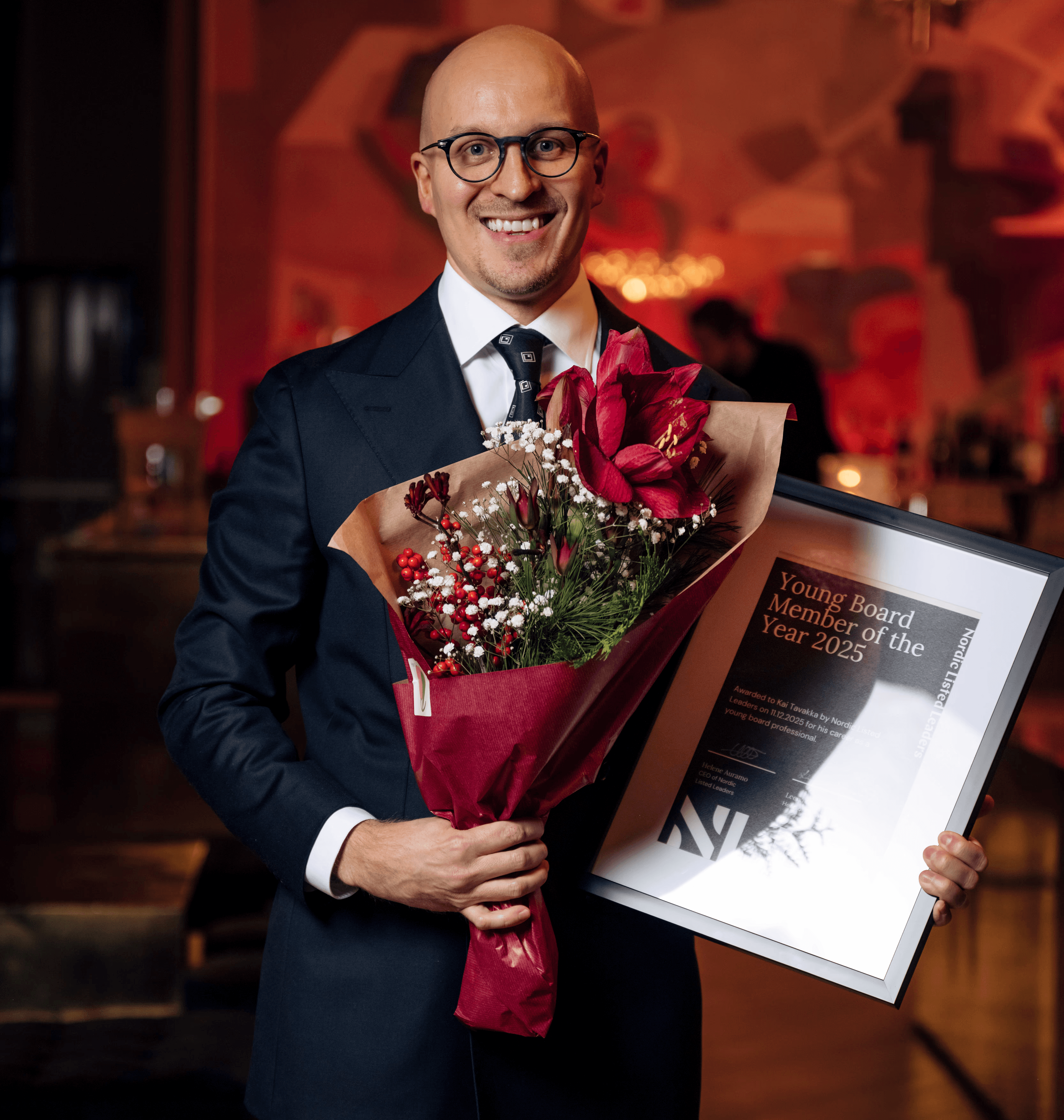
What Porkka inherited was a business shaped by an entrepreneurial culture that had been one of its greatest strengths. Seppälä's willingness to challenge convention, move quickly, and back bold ideas had helped create a company that stood apart from its competitors. Much of the spirit that defined Verkkokauppa.com, from its relentless focus on customers to its appetite for unconventional bets, was a direct product of its founder.

The challenge was that success had also created a company that still operated much like a fast-growing startup. Many decisions, processes, and ways of working reflected years of founder-led growth. Porkka's task was not to replace that culture but to preserve its strengths while building an organization that could scale beyond any one individual.

That meant developing a stronger management structure, broadening ownership across the leadership team, documenting processes, and introducing systems that made performance more transparent for investors and analysts. 

It was as much a cultural transition as an operational one: moving from a founder-led organization to a more distributed model of leadership without losing the ambition and boldness that had made the company successful in the first place. 

The one-hour bet

Much of that investment went into building a logistics platform designed for fast, cost-efficient delivery. After an extensive review in 2018 and 2019, the company selected Swisslog's AutoStore system and rolled it out at scale, including what Porkka describes as the world's only installation of its kind built into a multi-storey building.

The automation did not stop at storage. Packing processes were automated, internal goods flows were redesigned, and the company moved beyond a model that had once relied solely on Posti. Together, the changes laid the foundation for some of Verkkokauppa.com's most ambitious customer-facing innovations.

However, the boldest bet was the one-hour delivery. The doubters had a clear story, he recalls. Finns want to drive to the shop, see the fridge before they buy it, and talk to a salesperson. Nobody truly needs same-day delivery, let alone same-hour. 
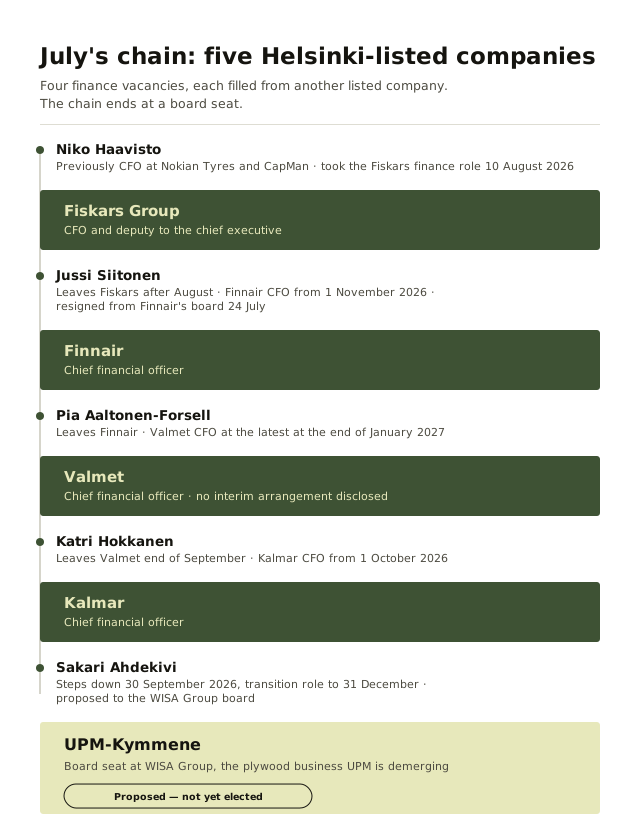
Porkka and his team bet the opposite. Make it easy enough that the gift for tonight's birthday party arrives within the hour, and you have created real value. He saw it as the next disruption, and the company went after it with what he calls a startup mentality and a strong collective belief.

A dose of Swedishness

That belief is, if anything, stronger today. Porkka frames the present as his most accomplished stretch, a company competing hard in a tight market, with thin category margins, and still finding room to invest and rewrite how retail is done in Finland.

He closes on a national note that doubles as a leadership one. Finland's economy, he thinks, is showing signs of life, and the country could use a dose of Swedishness: more optimism, more willingness to celebrate when a company succeeds rather than defaulting to scepticism and asking why someone failed. 

The point is not that Finland lacks ambition. Rather, he believes that a culture that openly welcomes success makes it easier for companies to think bigger, attract investment, and pursue growth.

After all, companies rarely grow beyond the limits of what they believe they can become.

Insights

The talk is ahead of the money: mapping Europe's defence VC

Jun 16, 2026

Europe is talking loudly about rearmament and strategic autonomy. The harder question is whether private risk capital is showing up to match the rhetoric. One mapping of the venture landscape suggests the talk is still ahead of the money.

Europe, the argument now runs, must take responsibility for its own defence, and that cannot be done on public budgets alone. It requires private capital flowing into defence, security and resilience, and it requires investors to move past the reflexive exclusion of "sin stocks" that long kept weapons and lethal capability off the responsible-investment menu. Investment policies are changing. The question is whether they are changing far enough, and fast enough.

That question is easy to assert and hard to answer. So Catharina Candolin, a board member at the listed cybersecurity company SSH Communications Security and a strategy-and-preparedness specialist at OP Pohjola, set out to test one slice of it. 

Across a series of LinkedIn posts she built, then crowdsourced, a working map: how many Europe-domiciled venture funds, broadly themed around defence, security and resilience, actually exist today, either deploying capital or out raising. Each round of comments and messages sharpened it. By her own framing it is a work in progress, not a final tally. Venture capital is only one instrument among several, and the picture is partial by design. But it is a concrete, countable proxy for how much dedicated risk capital the continent has assembled behind the theme.

Listeds has verified and enriched that list, and is now extending it. The origination is hers; the expansion is a shared effort, and it is still under way.

Her criteria were deliberately strict on structure and deliberately broad on theme. To qualify, a fund had to be Europe-domiciled (a European office attached to a US fund did not count); a genuine venture structure (corporate venture arms, investment companies and sovereign or state vehicles were excluded); and themed around defence in the wide sense, taking in cyber, energy, advanced materials, space and dual-use technology, while leaving out funds too generalist to count. Everything had to be publicly verifiable.

What the map shows

The verified list runs to 49 funds, and its shape is more revealing than its length. Most of the money is small: 19 funds sit below €50 million, the emerging and specialist micro-funds where much of Europe's early defence-tech conviction currently lives. Ten more occupy the €50–100 million middle. Only 20 funds clear €100 million, and within that band the genuinely large, dedicated pools are scarce: a handful above €300 million, led by DTCP's €500 million Project Liberty and Paladin's €342 million cyber fund, thinning out quickly below them.

For scale, S&P Global counted around 386 Europe-focused private equity and venture funds in 2024. A defence, security and resilience slice of 49, several of them still raising rather than deploying, is a modest share for a theme Europe now calls existential.

By status, the list splits roughly three to two: around 31 funds are actively investing, while 18 are still raising toward a target, which means a meaningful share of the headline capacity is announced ambition rather than committed capital. For an investor reading the field, that distinction matters: a target is not a cheque.

The through-line is the one Europe keeps circling back to. The continent is thin on risk capital, and defence is no exception. The scaled, dedicated venture pools that a serious rearmament of the private sector would imply are present, but few, and several of the largest are still being raised.

What that capital is chasing is real enough. European defence tech is building fast: Helsing's autonomous-systems software, Quantum Systems' reconnaissance drones, Frankenburg and Tytan on drone interceptors and Finland's own ICEYE in satellite imaging. The companies are raising, and 2025 was a record year, with European defence, security and resilience startups taking in around $8.7 billion

But much of the biggest money still comes from outside Europe: in the period covered, US investors supplied around two-thirds of the capital raised by European defence-tech companies

That is the gap this map measures: not whether the companies exist, but whether Europe has built enough dedicated funds of its own to back them.

A Nordic and Baltic reading, with care

The geography is suggestive rather than conclusive. On this snapshot Germany leads with eleven funds and the United Kingdom follows with seven, the rest spread across the continent. 

Finland appears twice, and the pair tells a story in miniature: Cloudberry VC is actively deploying, while Sparkmind Capital's second fund is still raising. Its focus sits at the growth stage rather than the earliest startups. The Baltics punch above their economic weight (Lithuania fields four funds, Estonia two), a reminder that proximity to the threat tends to concentrate both attention and capital.

The honest caveat

This is the venture slice only. Defence and resilience companies also draw on growth equity, project and infrastructure finance, government co-investment and the primes' own balance sheets, none of which this exercise captures.

The list as it stands (49 Europe-domiciled VC funds across three size bands, with live investing-versus-raising status, and still growing) is below. If you want to see the live updated version, you can visit our insights page.

49 / 49 funds
FundCategoryCountrySizeStatus
DTCP Project LibertyScaled defence, dual-use & resilience capital🇩🇪 Germany
€500M
Raising / target
Paladin Cyber Fund IIScaled defence, dual-use & resilience capital🇬🇧 United Kingdom
€342M
Investing / deploying
Project A Fund VScaled defence, dual-use & resilience capital🇩🇪 Germany
€325M
Investing / deploying
World FundScaled defence, dual-use & resilience capital🇩🇪 Germany
€300M
Investing / deploying
EDT VenturesScaled defence, dual-use & resilience capital🇬🇧 United Kingdom
€300M
Raising / target
Join Capital Fund IIIScaled defence, dual-use & resilience capital🇩🇪 Germany
€235M
Raising / target
Vsquared IIScaled defence, dual-use & resilience capital🇩🇪 Germany
€214M
Investing / deploying
FORWARD.one IIIScaled defence, dual-use & resilience capital🇳🇱 Netherlands
€200M
Investing / deploying
OTB Ventures Fund 2Scaled defence, dual-use & resilience capital🇳🇱 Netherlands
€170M
Investing / deploying
Alpine Space Ventures (Fund I)Scaled defence, dual-use & resilience capital🇩🇪 Germany
€170M
Investing / deploying
Hyperion FundScaled defence, dual-use & resilience capital🇪🇸 Spain
€150M
Investing / deploying
Presto Tech HorizonsScaled defence, dual-use & resilience capital🇨🇿 Czechia
€150M
Investing / deploying
Expeditions Fund IIScaled defence, dual-use & resilience capital🇵🇱 Poland
€150M
Raising / target
Keen D&S Tech FundScaled defence, dual-use & resilience capital🇳🇱 Netherlands
€150M
Raising / target
Sparkmind Fund IIScaled defence, dual-use & resilience capital🇫🇮 Finland
€150M
Raising / target
Expansion VCScaled defence, dual-use & resilience capital🇫🇷 France
€142M
Investing / deploying
Matterwave Industrial Tech IIScaled defence, dual-use & resilience capital🇩🇪 Germany
€130M
Investing / deploying
Omnes Real Tech 2Scaled defence, dual-use & resilience capital🇫🇷 France
€112M
Raising / target
NewSpace Capital Fund IScaled defence, dual-use & resilience capital🇱🇺 Luxembourg
€105M
Investing / deploying
Baryon FundFocused early-stage funds🇱🇺 Luxembourg
€100M
Investing / deploying
Adara Ventures IVFocused early-stage funds🇪🇸 Spain
€100M
Raising / target
Verne Capital (Fund I)Focused early-stage funds🇩🇪 Germany
€100M
Raising / target
Seraphim SpaceFocused early-stage funds🇬🇧 United Kingdom
€92M
Investing / deploying
PolarionFocused early-stage funds🇳🇴 Norway
€86M
Raising / target
Ananda Impact Fund VFocused early-stage funds🇩🇪 Germany
€73M
Raising / target
BalnordFocused early-stage funds🇱🇺 Luxembourg
€70M
Investing / deploying
Primo ClimateFocused early-stage funds🇮🇹 Italy
€60M
Investing / deploying
Primo SpaceFocused early-stage funds🇮🇹 Italy
€60M
Investing / deploying
ArchangelFocused early-stage funds🇪🇪 Estonia
€50M
Investing / deploying
Defence InvestFocused early-stage funds🇮🇪 Ireland
€50M
Raising / target
Radix VenturesEmerging / specialist micro-funds🇵🇱 Poland
€41M
Investing / deploying
Aneli CapitalEmerging / specialist micro-funds🇱🇹 Lithuania
€35M
Investing / deploying
First Momentum IIEmerging / specialist micro-funds🇩🇪 Germany
€35M
Investing / deploying
Cloudberry VCEmerging / specialist micro-funds🇫🇮 Finland
€30M
Investing / deploying
Iron Wolf CapitalEmerging / specialist micro-funds🇱🇹 Lithuania
€30M
Investing / deploying
T|Y|R.vcEmerging / specialist micro-funds🇩🇰 Denmark
€30M
Investing / deploying
Unconventional VenturesEmerging / specialist micro-funds🇩🇰 Denmark
€30M
Investing / deploying
Darkstar Ventures Fund IEmerging / specialist micro-funds🇪🇪 Estonia
€25M
Raising / target
201 VenturesEmerging / specialist micro-funds🇪🇸 Spain
€20M
Investing / deploying
Sisyphus VenturesEmerging / specialist micro-funds🇬🇧 United Kingdom
€20M
Investing / deploying
Vanagon VenturesEmerging / specialist micro-funds🇩🇪 Germany
€20M
Investing / deploying
BSV VenturesEmerging / specialist micro-funds🇱🇹 Lithuania
€15M
Investing / deploying
Baobab VenturesEmerging / specialist micro-funds🇬🇧 United Kingdom
€14M
Investing / deploying
Twin Track VenturesEmerging / specialist micro-funds🇬🇧 United Kingdom
€12M
Raising / target
Final FrontierEmerging / specialist micro-funds🇩🇰 Denmark
€4.5M
Raising / target
Angel One FundEmerging / specialist micro-funds🇺🇦 Ukraine
€2.8M
Investing / deploying
Luminova VenturesEmerging / specialist micro-funds🇨🇿 Czechia
<€50M
Raising / target
MD-One VenturesEmerging / specialist micro-funds🇬🇧 United Kingdom
<€50M
Raising / target
ScaleWolfEmerging / specialist micro-funds🇱🇹 Lithuania
<€50M
Raising / target


About the compiler.


Catharina Candolin

Has more than 15 years of experience working at the Finnish Defence Forces and NATO. She sits on the board of SSH Communications Security Corporation and works on strategy and preparedness at OP Pohjola. She is a member of the Hanaholmen Initiative advisory board and a frequent public speaker, and holds a PhD, an eMBA and Certified Board Member (HHJ) status. She was named Honorary Member of the Year at the 2025 Nordic Listed Leaders Gala (Nordic Listed Leaders is part of Listeds). 


Reading the European capital landscape for defence? Listeds brings the Nordic capital community together with the companies defining the defence, security and resilience sector at our defence investor event in Helsinki on 21 September 2026: an evening of company pitches and direct conversation for the people who allocate, research and steward capital across the region. Apply for a seat at the event.


Investor Event

Listeds Investor Event · Defence

Nordic defence is in a once-in-a-generation growth cycle. Eight listed and pre-IPO companies pitch to 100+ invited investors at Valkoinen Sali, Helsinki

21 September 2026

Apply for a seat


Insights

The talk is ahead of the money: mapping Europe's defence VC

Jun 16, 2026

Europe is talking loudly about rearmament and strategic autonomy. The harder question is whether private risk capital is showing up to match the rhetoric. One mapping of the venture landscape suggests the talk is still ahead of the money.

Europe, the argument now runs, must take responsibility for its own defence, and that cannot be done on public budgets alone. It requires private capital flowing into defence, security and resilience, and it requires investors to move past the reflexive exclusion of "sin stocks" that long kept weapons and lethal capability off the responsible-investment menu. Investment policies are changing. The question is whether they are changing far enough, and fast enough.

That question is easy to assert and hard to answer. So Catharina Candolin, a board member at the listed cybersecurity company SSH Communications Security and a strategy-and-preparedness specialist at OP Pohjola, set out to test one slice of it. 

Across a series of LinkedIn posts she built, then crowdsourced, a working map: how many Europe-domiciled venture funds, broadly themed around defence, security and resilience, actually exist today, either deploying capital or out raising. Each round of comments and messages sharpened it. By her own framing it is a work in progress, not a final tally. Venture capital is only one instrument among several, and the picture is partial by design. But it is a concrete, countable proxy for how much dedicated risk capital the continent has assembled behind the theme.

Listeds has verified and enriched that list, and is now extending it. The origination is hers; the expansion is a shared effort, and it is still under way.

Her criteria were deliberately strict on structure and deliberately broad on theme. To qualify, a fund had to be Europe-domiciled (a European office attached to a US fund did not count); a genuine venture structure (corporate venture arms, investment companies and sovereign or state vehicles were excluded); and themed around defence in the wide sense, taking in cyber, energy, advanced materials, space and dual-use technology, while leaving out funds too generalist to count. Everything had to be publicly verifiable.

What the map shows

The verified list runs to 49 funds, and its shape is more revealing than its length. Most of the money is small: 19 funds sit below €50 million, the emerging and specialist micro-funds where much of Europe's early defence-tech conviction currently lives. Ten more occupy the €50–100 million middle. Only 20 funds clear €100 million, and within that band the genuinely large, dedicated pools are scarce: a handful above €300 million, led by DTCP's €500 million Project Liberty and Paladin's €342 million cyber fund, thinning out quickly below them.

For scale, S&P Global counted around 386 Europe-focused private equity and venture funds in 2024. A defence, security and resilience slice of 49, several of them still raising rather than deploying, is a modest share for a theme Europe now calls existential.

By status, the list splits roughly three to two: around 31 funds are actively investing, while 18 are still raising toward a target, which means a meaningful share of the headline capacity is announced ambition rather than committed capital. For an investor reading the field, that distinction matters: a target is not a cheque.

The through-line is the one Europe keeps circling back to. The continent is thin on risk capital, and defence is no exception. The scaled, dedicated venture pools that a serious rearmament of the private sector would imply are present, but few, and several of the largest are still being raised.

What that capital is chasing is real enough. European defence tech is building fast: Helsing's autonomous-systems software, Quantum Systems' reconnaissance drones, Frankenburg and Tytan on drone interceptors and Finland's own ICEYE in satellite imaging. The companies are raising, and 2025 was a record year, with European defence, security and resilience startups taking in around $8.7 billion

But much of the biggest money still comes from outside Europe: in the period covered, US investors supplied around two-thirds of the capital raised by European defence-tech companies

That is the gap this map measures: not whether the companies exist, but whether Europe has built enough dedicated funds of its own to back them.

A Nordic and Baltic reading, with care

The geography is suggestive rather than conclusive. On this snapshot Germany leads with eleven funds and the United Kingdom follows with seven, the rest spread across the continent. 

Finland appears twice, and the pair tells a story in miniature: Cloudberry VC is actively deploying, while Sparkmind Capital's second fund is still raising. Its focus sits at the growth stage rather than the earliest startups. The Baltics punch above their economic weight (Lithuania fields four funds, Estonia two), a reminder that proximity to the threat tends to concentrate both attention and capital.

The honest caveat

This is the venture slice only. Defence and resilience companies also draw on growth equity, project and infrastructure finance, government co-investment and the primes' own balance sheets, none of which this exercise captures.

The list as it stands (49 Europe-domiciled VC funds across three size bands, with live investing-versus-raising status, and still growing) is below. If you want to see the live updated version, you can visit our insights page.

49 / 49 funds
FundCategoryCountrySizeStatus
DTCP Project LibertyScaled defence, dual-use & resilience capital🇩🇪 Germany
€500M
Raising / target
Paladin Cyber Fund IIScaled defence, dual-use & resilience capital🇬🇧 United Kingdom
€342M
Investing / deploying
Project A Fund VScaled defence, dual-use & resilience capital🇩🇪 Germany
€325M
Investing / deploying
World FundScaled defence, dual-use & resilience capital🇩🇪 Germany
€300M
Investing / deploying
EDT VenturesScaled defence, dual-use & resilience capital🇬🇧 United Kingdom
€300M
Raising / target
Join Capital Fund IIIScaled defence, dual-use & resilience capital🇩🇪 Germany
€235M
Raising / target
Vsquared IIScaled defence, dual-use & resilience capital🇩🇪 Germany
€214M
Investing / deploying
FORWARD.one IIIScaled defence, dual-use & resilience capital🇳🇱 Netherlands
€200M
Investing / deploying
OTB Ventures Fund 2Scaled defence, dual-use & resilience capital🇳🇱 Netherlands
€170M
Investing / deploying
Alpine Space Ventures (Fund I)Scaled defence, dual-use & resilience capital🇩🇪 Germany
€170M
Investing / deploying
Hyperion FundScaled defence, dual-use & resilience capital🇪🇸 Spain
€150M
Investing / deploying
Presto Tech HorizonsScaled defence, dual-use & resilience capital🇨🇿 Czechia
€150M
Investing / deploying
Expeditions Fund IIScaled defence, dual-use & resilience capital🇵🇱 Poland
€150M
Raising / target
Keen D&S Tech FundScaled defence, dual-use & resilience capital🇳🇱 Netherlands
€150M
Raising / target
Sparkmind Fund IIScaled defence, dual-use & resilience capital🇫🇮 Finland
€150M
Raising / target
Expansion VCScaled defence, dual-use & resilience capital🇫🇷 France
€142M
Investing / deploying
Matterwave Industrial Tech IIScaled defence, dual-use & resilience capital🇩🇪 Germany
€130M
Investing / deploying
Omnes Real Tech 2Scaled defence, dual-use & resilience capital🇫🇷 France
€112M
Raising / target
NewSpace Capital Fund IScaled defence, dual-use & resilience capital🇱🇺 Luxembourg
€105M
Investing / deploying
Baryon FundFocused early-stage funds🇱🇺 Luxembourg
€100M
Investing / deploying
Adara Ventures IVFocused early-stage funds🇪🇸 Spain
€100M
Raising / target
Verne Capital (Fund I)Focused early-stage funds🇩🇪 Germany
€100M
Raising / target
Seraphim SpaceFocused early-stage funds🇬🇧 United Kingdom
€92M
Investing / deploying
PolarionFocused early-stage funds🇳🇴 Norway
€86M
Raising / target
Ananda Impact Fund VFocused early-stage funds🇩🇪 Germany
€73M
Raising / target
BalnordFocused early-stage funds🇱🇺 Luxembourg
€70M
Investing / deploying
Primo ClimateFocused early-stage funds🇮🇹 Italy
€60M
Investing / deploying
Primo SpaceFocused early-stage funds🇮🇹 Italy
€60M
Investing / deploying
ArchangelFocused early-stage funds🇪🇪 Estonia
€50M
Investing / deploying
Defence InvestFocused early-stage funds🇮🇪 Ireland
€50M
Raising / target
Radix VenturesEmerging / specialist micro-funds🇵🇱 Poland
€41M
Investing / deploying
Aneli CapitalEmerging / specialist micro-funds🇱🇹 Lithuania
€35M
Investing / deploying
First Momentum IIEmerging / specialist micro-funds🇩🇪 Germany
€35M
Investing / deploying
Cloudberry VCEmerging / specialist micro-funds🇫🇮 Finland
€30M
Investing / deploying
Iron Wolf CapitalEmerging / specialist micro-funds🇱🇹 Lithuania
€30M
Investing / deploying
T|Y|R.vcEmerging / specialist micro-funds🇩🇰 Denmark
€30M
Investing / deploying
Unconventional VenturesEmerging / specialist micro-funds🇩🇰 Denmark
€30M
Investing / deploying
Darkstar Ventures Fund IEmerging / specialist micro-funds🇪🇪 Estonia
€25M
Raising / target
201 VenturesEmerging / specialist micro-funds🇪🇸 Spain
€20M
Investing / deploying
Sisyphus VenturesEmerging / specialist micro-funds🇬🇧 United Kingdom
€20M
Investing / deploying
Vanagon VenturesEmerging / specialist micro-funds🇩🇪 Germany
€20M
Investing / deploying
BSV VenturesEmerging / specialist micro-funds🇱🇹 Lithuania
€15M
Investing / deploying
Baobab VenturesEmerging / specialist micro-funds🇬🇧 United Kingdom
€14M
Investing / deploying
Twin Track VenturesEmerging / specialist micro-funds🇬🇧 United Kingdom
€12M
Raising / target
Final FrontierEmerging / specialist micro-funds🇩🇰 Denmark
€4.5M
Raising / target
Angel One FundEmerging / specialist micro-funds🇺🇦 Ukraine
€2.8M
Investing / deploying
Luminova VenturesEmerging / specialist micro-funds🇨🇿 Czechia
<€50M
Raising / target
MD-One VenturesEmerging / specialist micro-funds🇬🇧 United Kingdom
<€50M
Raising / target
ScaleWolfEmerging / specialist micro-funds🇱🇹 Lithuania
<€50M
Raising / target


About the compiler.


Catharina Candolin

Has more than 15 years of experience working at the Finnish Defence Forces and NATO. She sits on the board of SSH Communications Security Corporation and works on strategy and preparedness at OP Pohjola. She is a member of the Hanaholmen Initiative advisory board and a frequent public speaker, and holds a PhD, an eMBA and Certified Board Member (HHJ) status. She was named Honorary Member of the Year at the 2025 Nordic Listed Leaders Gala (Nordic Listed Leaders is part of Listeds). 


Reading the European capital landscape for defence? Listeds brings the Nordic capital community together with the companies defining the defence, security and resilience sector at our defence investor event in Helsinki on 21 September 2026: an evening of company pitches and direct conversation for the people who allocate, research and steward capital across the region. Apply for a seat at the event.


Investor Event

Listeds Investor Event · Defence

Nordic defence is in a once-in-a-generation growth cycle. Eight listed and pre-IPO companies pitch to 100+ invited investors at Valkoinen Sali, Helsinki

21 September 2026

Apply for a seat


Insights

The talk is ahead of the money: mapping Europe's defence VC

Jun 16, 2026

Europe is talking loudly about rearmament and strategic autonomy. The harder question is whether private risk capital is showing up to match the rhetoric. One mapping of the venture landscape suggests the talk is still ahead of the money.

Europe, the argument now runs, must take responsibility for its own defence, and that cannot be done on public budgets alone. It requires private capital flowing into defence, security and resilience, and it requires investors to move past the reflexive exclusion of "sin stocks" that long kept weapons and lethal capability off the responsible-investment menu. Investment policies are changing. The question is whether they are changing far enough, and fast enough.

That question is easy to assert and hard to answer. So Catharina Candolin, a board member at the listed cybersecurity company SSH Communications Security and a strategy-and-preparedness specialist at OP Pohjola, set out to test one slice of it. 

Across a series of LinkedIn posts she built, then crowdsourced, a working map: how many Europe-domiciled venture funds, broadly themed around defence, security and resilience, actually exist today, either deploying capital or out raising. Each round of comments and messages sharpened it. By her own framing it is a work in progress, not a final tally. Venture capital is only one instrument among several, and the picture is partial by design. But it is a concrete, countable proxy for how much dedicated risk capital the continent has assembled behind the theme.

Listeds has verified and enriched that list, and is now extending it. The origination is hers; the expansion is a shared effort, and it is still under way.

Her criteria were deliberately strict on structure and deliberately broad on theme. To qualify, a fund had to be Europe-domiciled (a European office attached to a US fund did not count); a genuine venture structure (corporate venture arms, investment companies and sovereign or state vehicles were excluded); and themed around defence in the wide sense, taking in cyber, energy, advanced materials, space and dual-use technology, while leaving out funds too generalist to count. Everything had to be publicly verifiable.

What the map shows

The verified list runs to 49 funds, and its shape is more revealing than its length. Most of the money is small: 19 funds sit below €50 million, the emerging and specialist micro-funds where much of Europe's early defence-tech conviction currently lives. Ten more occupy the €50–100 million middle. Only 20 funds clear €100 million, and within that band the genuinely large, dedicated pools are scarce: a handful above €300 million, led by DTCP's €500 million Project Liberty and Paladin's €342 million cyber fund, thinning out quickly below them.

For scale, S&P Global counted around 386 Europe-focused private equity and venture funds in 2024. A defence, security and resilience slice of 49, several of them still raising rather than deploying, is a modest share for a theme Europe now calls existential.

By status, the list splits roughly three to two: around 31 funds are actively investing, while 18 are still raising toward a target, which means a meaningful share of the headline capacity is announced ambition rather than committed capital. For an investor reading the field, that distinction matters: a target is not a cheque.

The through-line is the one Europe keeps circling back to. The continent is thin on risk capital, and defence is no exception. The scaled, dedicated venture pools that a serious rearmament of the private sector would imply are present, but few, and several of the largest are still being raised.

What that capital is chasing is real enough. European defence tech is building fast: Helsing's autonomous-systems software, Quantum Systems' reconnaissance drones, Frankenburg and Tytan on drone interceptors and Finland's own ICEYE in satellite imaging. The companies are raising, and 2025 was a record year, with European defence, security and resilience startups taking in around $8.7 billion

But much of the biggest money still comes from outside Europe: in the period covered, US investors supplied around two-thirds of the capital raised by European defence-tech companies

That is the gap this map measures: not whether the companies exist, but whether Europe has built enough dedicated funds of its own to back them.

A Nordic and Baltic reading, with care

The geography is suggestive rather than conclusive. On this snapshot Germany leads with eleven funds and the United Kingdom follows with seven, the rest spread across the continent. 

Finland appears twice, and the pair tells a story in miniature: Cloudberry VC is actively deploying, while Sparkmind Capital's second fund is still raising. Its focus sits at the growth stage rather than the earliest startups. The Baltics punch above their economic weight (Lithuania fields four funds, Estonia two), a reminder that proximity to the threat tends to concentrate both attention and capital.

The honest caveat

This is the venture slice only. Defence and resilience companies also draw on growth equity, project and infrastructure finance, government co-investment and the primes' own balance sheets, none of which this exercise captures.

The list as it stands (49 Europe-domiciled VC funds across three size bands, with live investing-versus-raising status, and still growing) is below. If you want to see the live updated version, you can visit our insights page.

49 / 49 funds
FundCategoryCountrySizeStatus
DTCP Project LibertyScaled defence, dual-use & resilience capital🇩🇪 Germany
€500M
Raising / target
Paladin Cyber Fund IIScaled defence, dual-use & resilience capital🇬🇧 United Kingdom
€342M
Investing / deploying
Project A Fund VScaled defence, dual-use & resilience capital🇩🇪 Germany
€325M
Investing / deploying
World FundScaled defence, dual-use & resilience capital🇩🇪 Germany
€300M
Investing / deploying
EDT VenturesScaled defence, dual-use & resilience capital🇬🇧 United Kingdom
€300M
Raising / target
Join Capital Fund IIIScaled defence, dual-use & resilience capital🇩🇪 Germany
€235M
Raising / target
Vsquared IIScaled defence, dual-use & resilience capital🇩🇪 Germany
€214M
Investing / deploying
FORWARD.one IIIScaled defence, dual-use & resilience capital🇳🇱 Netherlands
€200M
Investing / deploying
OTB Ventures Fund 2Scaled defence, dual-use & resilience capital🇳🇱 Netherlands
€170M
Investing / deploying
Alpine Space Ventures (Fund I)Scaled defence, dual-use & resilience capital🇩🇪 Germany
€170M
Investing / deploying
Hyperion FundScaled defence, dual-use & resilience capital🇪🇸 Spain
€150M
Investing / deploying
Presto Tech HorizonsScaled defence, dual-use & resilience capital🇨🇿 Czechia
€150M
Investing / deploying
Expeditions Fund IIScaled defence, dual-use & resilience capital🇵🇱 Poland
€150M
Raising / target
Keen D&S Tech FundScaled defence, dual-use & resilience capital🇳🇱 Netherlands
€150M
Raising / target
Sparkmind Fund IIScaled defence, dual-use & resilience capital🇫🇮 Finland
€150M
Raising / target
Expansion VCScaled defence, dual-use & resilience capital🇫🇷 France
€142M
Investing / deploying
Matterwave Industrial Tech IIScaled defence, dual-use & resilience capital🇩🇪 Germany
€130M
Investing / deploying
Omnes Real Tech 2Scaled defence, dual-use & resilience capital🇫🇷 France
€112M
Raising / target
NewSpace Capital Fund IScaled defence, dual-use & resilience capital🇱🇺 Luxembourg
€105M
Investing / deploying
Baryon FundFocused early-stage funds🇱🇺 Luxembourg
€100M
Investing / deploying
Adara Ventures IVFocused early-stage funds🇪🇸 Spain
€100M
Raising / target
Verne Capital (Fund I)Focused early-stage funds🇩🇪 Germany
€100M
Raising / target
Seraphim SpaceFocused early-stage funds🇬🇧 United Kingdom
€92M
Investing / deploying
PolarionFocused early-stage funds🇳🇴 Norway
€86M
Raising / target
Ananda Impact Fund VFocused early-stage funds🇩🇪 Germany
€73M
Raising / target
BalnordFocused early-stage funds🇱🇺 Luxembourg
€70M
Investing / deploying
Primo ClimateFocused early-stage funds🇮🇹 Italy
€60M
Investing / deploying
Primo SpaceFocused early-stage funds🇮🇹 Italy
€60M
Investing / deploying
ArchangelFocused early-stage funds🇪🇪 Estonia
€50M
Investing / deploying
Defence InvestFocused early-stage funds🇮🇪 Ireland
€50M
Raising / target
Radix VenturesEmerging / specialist micro-funds🇵🇱 Poland
€41M
Investing / deploying
Aneli CapitalEmerging / specialist micro-funds🇱🇹 Lithuania
€35M
Investing / deploying
First Momentum IIEmerging / specialist micro-funds🇩🇪 Germany
€35M
Investing / deploying
Cloudberry VCEmerging / specialist micro-funds🇫🇮 Finland
€30M
Investing / deploying
Iron Wolf CapitalEmerging / specialist micro-funds🇱🇹 Lithuania
€30M
Investing / deploying
T|Y|R.vcEmerging / specialist micro-funds🇩🇰 Denmark
€30M
Investing / deploying
Unconventional VenturesEmerging / specialist micro-funds🇩🇰 Denmark
€30M
Investing / deploying
Darkstar Ventures Fund IEmerging / specialist micro-funds🇪🇪 Estonia
€25M
Raising / target
201 VenturesEmerging / specialist micro-funds🇪🇸 Spain
€20M
Investing / deploying
Sisyphus VenturesEmerging / specialist micro-funds🇬🇧 United Kingdom
€20M
Investing / deploying
Vanagon VenturesEmerging / specialist micro-funds🇩🇪 Germany
€20M
Investing / deploying
BSV VenturesEmerging / specialist micro-funds🇱🇹 Lithuania
€15M
Investing / deploying
Baobab VenturesEmerging / specialist micro-funds🇬🇧 United Kingdom
€14M
Investing / deploying
Twin Track VenturesEmerging / specialist micro-funds🇬🇧 United Kingdom
€12M
Raising / target
Final FrontierEmerging / specialist micro-funds🇩🇰 Denmark
€4.5M
Raising / target
Angel One FundEmerging / specialist micro-funds🇺🇦 Ukraine
€2.8M
Investing / deploying
Luminova VenturesEmerging / specialist micro-funds🇨🇿 Czechia
<€50M
Raising / target
MD-One VenturesEmerging / specialist micro-funds🇬🇧 United Kingdom
<€50M
Raising / target
ScaleWolfEmerging / specialist micro-funds🇱🇹 Lithuania
<€50M
Raising / target


About the compiler.


Catharina Candolin

Has more than 15 years of experience working at the Finnish Defence Forces and NATO. She sits on the board of SSH Communications Security Corporation and works on strategy and preparedness at OP Pohjola. She is a member of the Hanaholmen Initiative advisory board and a frequent public speaker, and holds a PhD, an eMBA and Certified Board Member (HHJ) status. She was named Honorary Member of the Year at the 2025 Nordic Listed Leaders Gala (Nordic Listed Leaders is part of Listeds). 


Reading the European capital landscape for defence? Listeds brings the Nordic capital community together with the companies defining the defence, security and resilience sector at our defence investor event in Helsinki on 21 September 2026: an evening of company pitches and direct conversation for the people who allocate, research and steward capital across the region. Apply for a seat at the event.


Investor Event

Listeds Investor Event · Defence

Nordic defence is in a once-in-a-generation growth cycle. Eight listed and pre-IPO companies pitch to 100+ invited investors at Valkoinen Sali, Helsinki

21 September 2026

Apply for a seat


Sponsored

The pitch night comes to the public markets — starting with defence

Jun 5, 2026

It's happening. On 21 September 2026, Listeds puts eight Nordic defence and dual-use companies on one stage in Helsinki — listed, pre-IPO and established growth companies — ten minutes each, in front of around a hundred investors and decision-makers.

Here's why I'm excited. A listed company asked us to run a pitching event, and I co-founded Slush — so I know exactly what a stage and ten minutes can do for a company. But this isn't a startup night. The companies on this stage are public-market, growth and pre-IPO names with real revenue and real order books, and that kind of clarity almost never gets ten focused minutes in front of the right room. We're changing that.

The numbers make the case. Finland's defence and security spending hits 2.4% of GDP in 2026, Sweden's 2.8%, with NATO aiming at 5% by 2035. Order books at the region's defence and dual-use companies have re-rated faster than almost any other corner of the Nordic market. A once-in-a-generation cycle — so we're starting there.

No panels. No fillers. Eight pitches, then the room opens into a booth and cocktail floor where company leaders and investors can actually talk.

Seats are by invitation, and we have eight stage slots for Nordic defence and dual-use companies — listed, pre-IPO and growth, not startups.

Read more here: Request a seat or apply to pitch.


Investor Event

Listeds Investor Event · Defence

Nordic defence is in a once-in-a-generation growth cycle. Eight listed and pre-IPO companies pitch to 100+ invited investors at Valkoinen Sali, Helsinki

21 September 2026

Apply for a seat

Sponsored

The pitch night comes to the public markets — starting with defence

Jun 5, 2026

It's happening. On 21 September 2026, Listeds puts eight Nordic defence and dual-use companies on one stage in Helsinki — listed, pre-IPO and established growth companies — ten minutes each, in front of around a hundred investors and decision-makers.

Here's why I'm excited. A listed company asked us to run a pitching event, and I co-founded Slush — so I know exactly what a stage and ten minutes can do for a company. But this isn't a startup night. The companies on this stage are public-market, growth and pre-IPO names with real revenue and real order books, and that kind of clarity almost never gets ten focused minutes in front of the right room. We're changing that.

The numbers make the case. Finland's defence and security spending hits 2.4% of GDP in 2026, Sweden's 2.8%, with NATO aiming at 5% by 2035. Order books at the region's defence and dual-use companies have re-rated faster than almost any other corner of the Nordic market. A once-in-a-generation cycle — so we're starting there.

No panels. No fillers. Eight pitches, then the room opens into a booth and cocktail floor where company leaders and investors can actually talk.

Seats are by invitation, and we have eight stage slots for Nordic defence and dual-use companies — listed, pre-IPO and growth, not startups.

Read more here: Request a seat or apply to pitch.


Investor Event

Listeds Investor Event · Defence

Nordic defence is in a once-in-a-generation growth cycle. Eight listed and pre-IPO companies pitch to 100+ invited investors at Valkoinen Sali, Helsinki

21 September 2026

Apply for a seat

Insights

Meet Finland’s Future Leaders 2026, six young leaders shaping Nordic listed companies

Jun 4, 2026

Six of Finland’s most promising young listed-company leaders were recognized in Helsinki today at the Nordic Listed Leaders Future Leaders event. The evening’s most senior honor, CEO of the Year 2026, went to Janne Paavola, CEO of Nokian Panimo Oyj.

The event set out to do something Finnish capital markets rarely do in public: put a spotlight on the next generation of leadership inside listed companies.

“Finland’s listed companies have an exceptionally strong generation of young leaders who often remain invisible in public,” says Helene Auramo, founder of Nordic Listed Leaders and co-founder of Slush. “We want to bring them forward and show that a listed company, too, can be a dynamic and inspiring place to build a career and leadership.”

The Future Leader winners

CEO of the Year — Janne Paavola, Nokian Panimo Oyj. Paavola rose to CEO from within the company and took Nokian Panimo public, listing it on Nasdaq’s First North growth market in April 2025. The jury singled out a successful listing in a challenging market, along with his personal, learning-oriented way of building the company — combining, in the jury’s words, bold building with sustainable growth.

CFO of the Year — Lauri Isotalo, Framery Group Oyj. Isotalo played a central role in Framery Group’s transformation from a founder-led business through a private-equity phase to a company listed on the Nasdaq Helsinki. The jury particularly valued a successful initial public offering and two refinancings within the same year, in which the CFO held a strong role.

CMO of the Year — Sanna-Kaisa Niikko, Marimekko Oyj. Under Niikko’s leadership, Marimekko has strengthened its brand and international visibility, with sales growing across all of the company’s main markets. The jury rewarded a bold and distinctive approach to marketing Finnish design internationally.

COO of the Year — Tapani Salminen, Canatu Oyj. Salminen has built Canatu’s operational capabilities through a fast and demanding growth phase. The jury was convinced by his hands-on approach and the concrete steps with which he has moved the company forward.

CTO/CDO of the Year — Ilari Richardt, Terveystalo Oyj. As CDO and SVP Digital Services, Richardt has led Terveystalo’s wide-ranging digitalization and delivered tangible business benefits through the company’s operational development programme. The jury recognized him as a visionary leader who has produced concrete results.

CLO of the Year — Tuulia Niemelä, Springvest Oyj. Niemelä stepped up to general counsel and joined the management team in October 2025, having rapidly built the legal function of a fast-growing, First North-listed investment-services company.

How the winners were chosen

The awards were decided through a careful evaluation process. Initial screening was carried out on the Listeds platform, which analyzes listed-company leadership and financial metrics. Finalists were then asked to provide written answers, assessed by an independent jury, with any potential conflicts of interest taken into account.

The 2026 jury comprised Minja Salmio (Future Leader 2025, chair), Mikael Rautanen (Future Leader 2024), Niko Pakalén (Cevian Capital), Riikka Aaltonen (Talouselämä), Sonja Siggberg (Hannes Snellman), Rasmus Alopaeus (PwC Finland) and Alexandra Therman-Londen (Nordea).

“This year’s standard was impressive,” says jury chair and Future Leader 2025 Minja Salmio. “Among the finalists were leaders who, early in their careers, have already taken companies through listings, international expansion and demanding growth phases. It was a pleasure to see how varied and ambitious leadership is in Finnish listed companies.”

Partners of Nordic Listed Leaders are Talouselämä, Hannes Snellman, IR Partners, Adecco, hasan & partners, Nordea, PwC, Dell Technologies, Admincontrol, Vivicta, and Euroclear.

Leaders

When the direction changes: Tuija Kalpala on Betolar’s pivot and the reality of commercializing innovation

Jun 1, 2026

True innovation culture reveals itself when conditions are toughest. In this interview, Tuija Kalpala shares how a changing market forced Betolar to question its original path, and how that process unlocked a far more powerful vision. What began as a response to external pressure became a strategic turning point: a reminder that breakthroughs often emerge not from perfect plans, but from the courage to rethink them. This is a story of resilience, scientific curiosity, and leadership that chooses progress over comfort at Betolar.

In theory, strategy is deliberate. In practice, it often emerges through reaction — what Henry Mintzberg famously described as “a pattern in a stream of decisions.”

For large industrial groups, strategic change tends to take the form of divestments, spin-offs, or portfolio pruning. Business units are sold, split, or shut down when markets turn or returns disappoint. For smaller listed growth companies, the reality is starker: when the market no longer pulls as expected, every assumption must be re-examined.

That moment arrived for Betolar.

Founded on the promise of replacing cement with industrial sidestreams, Betolar entered the market at a time when sustainability was not just fashionable but funded. Two years later, the environment had changed radically. Interest rates rose. Construction activity collapsed, particularly in Finland, and parts of Europe, and the willingness to pay a premium for green solutions diminished sharply. 

“The interest is still there,” says Tuija Kalpala, CEO of Betolar.  “But the ability to commit to low-carbon projects, especially on the private side, has weakened significantly.”

In other words: demand in principle, but not in practice.

When construction hits the brakes

Construction markets are inherently cyclical, yet the current downturn has been unusually severe. 

Finnish listed construction companies such as YIT and SRV have repeatedly reported constrained housing demand. Analysts and economists broadly share this view, pointing to a lack of new projects, tight financing conditions, and persistently weak visibility. According to the Finnish Ministry of Finance, while a gradual recovery is expected over 2025–26, the pace is likely to remain slow, and uncertainty persists as to when private construction activity will regain momentum.

For Betolar, whose original business relied on replacing cement with low carbon alternatives in concrete applications, this posed a fundamental challenge. Even more problematic was a parallel shift in raw material markets.

The company had built its early technology on widely used industrial sidestreams such as blast furnace slag, a recognized and standardized substitute for cement. When Betolar was founded, slag was cheap and plentiful. During the pandemic-era green boom, that changed.

Large global cement players locked in long-term supply contracts. Prices rose sharply, in some cases approaching the price of cement itself. At the same time, the slag market became tight and many customers complained about the availability of slag. 

“The world changed on us from two directions at once,” Kalpala notes. “The construction market weakened with the demand for low-carbon solutions, and the availability and economics of sidestreams changed dramatically.”

Turning over every stone

For a small growth company, such conditions allow little margin for gradual course correction. Strategy must be questioned more often than in large corporations, and usually with far fewer buffers.

The question Betolar faced was blunt: what happens to growth when the market it was built for disappears?

The answer did not emerge from the boardroom, but from experimental work.

In the company’s laboratory in Kannonkoski, researchers were testing alternative industrial residues — materials that the cement industry had largely ignored due to high metal content. The original objective was simply purification: could these underutilized slags be cleaned enough to function as binders?

Almost accidentally, the team discovered something else.

“We realized we could remove the metals entirely including the strategic and critical metals,” Kalpala explains. “Not partially — but 99%.”

This was not a pre-defined target. It was an unexpected technological breakthrough in metal extraction.

From cement substitute to metallurgical platform

What emerged was a fundamentally different value proposition: a metallurgical separation technology capable of extracting valuable metals from industrial residues and producing a cement-like green binder as a by-product.

The implications were profound.

Betolar has since filed ten patents related to the technology and validated the process with universities and research institutions. External testing has confirmed the results. 

“This is not just about construction anymore,” Kalpala says. “This is about unlocking value from materials that are currently considered as waste.”

The company’s first commercial project reflects that shift. Betolar is working with global mining company Anglo American on the Sakatti mining project in Sodankylä, testing how future tailings could be processed using Betolar’s method. The goal is twofold: recover remaining metals from tailings and produce a green binder that could replace cement entirely within mining operations.

The ambition is nothing less than cement-free mines.

The long road to commercialisation

For all the technological promise, Kalpala is pragmatic about the realities of commercialization.

“Innovation takes time. Much more time than people expect,” she says. “Nothing happens overnight, especially when you are selling new technology.”

The immediate priorities are not scale, but credibility: raising the technology readiness level, building a proof-of-concept facility, and enabling in-house pilot-scale processing. This allows Betolar to test more materials, refine the process, and sell the technology globally. 

It is a patient strategy, and a necessary one.

Lessons for companies facing a pivot

Betolar’s experience offers broader lessons for listed growth companies navigating structural change.

First, strategic pivots require openness. “You cannot be emotionally attached to the original plan,” Kalpala says. “You have to be willing to turn every stone.”

Second, experimentation must be embraced. Betolar launched five new products to market in 2025, not because they are all guaranteed successes, but because learning also happens through testing and selling.

Third, sales skills and marketing matter, especially in Finland.

“There is still a belief that good technology sells itself,” Kalpala notes. “It doesn’t. First you need to understand the customer needs and then have targeted marketing, presence at conferences, and the courage to speak about what you’re building.”

Betolar has invested in focused social media, industry visibility, and partnerships. Collaboration with stainless steel giant Outokumpu has been particularly valuable. For a small company, references are hard to secure, especially in industries that are mainly dominated by giants.

Being listed on First North has helped. “It brings a certain level of trust, and it has opened some doors,” Kalpala says. 

Can it become a billion-euro business?

She believes it can, though not overnight, and not without execution risk.

“The market potential is significant,” Kalpala emphasises. “For example, mine tailings represent one of the world’s largest waste challenges. When combined with opportunities in mining, metallurgy, and industrial sidestreams, we are looking at industries measured in the hundreds of billions of euros globally.”

“At the same time, we are advancing our technology and continuing to increase its technology readiness level. Importantly, we are already seeing clear traction. Our collaboration with Anglo American in the Sakatti project is a good example of how our solutions are gaining real industrial interest.”

The pivot is still underway, and customer adoption and the scaling of commercial operations remain critical. 

However, the direction is clear, and Kalpala remains optimistic about the long-term opportunity.

Business

Half of Finnish employees would swap base salary for bigger bonuses, Mandatum survey findings show

May 28, 2026

Half of Finnish employees would now trade fixed pay for performance-linked bonuses, according to Mandatum's Reward and Compensation Survey 2026. The findings point to a broader shift in how employees view compensation, with variable pay gaining acceptance well beyond senior management and sales roles.

Some 48 percent of employees said they would accept a lower base salary in exchange for the chance to earn higher bonuses, up from 38 percent in 2024, based on the survey results published today. The rise was strongest among younger employees, men, and higher earners, although support among women also increased.

The compensation survey was conducted by Bondata on behalf of Mandatum in March–April 2026. It included telephone interviews with 101 employer representatives and panel responses from 1,003 private-sector employees in Finland.

For management teams at Finnish listed companies, CEOs, CHROs, CFOs, and the people group leads who actually own comp design, that 10-point jump is the data point worth circling. Variable pay used to be something employers had to sell. It has now started to be asked for.

Employers see the same signal. A majority view variable compensation as a core part of an ideal scheme, and growth-oriented companies in particular are leaning into both short-term bonuses and long-term incentives.

Mandatum's Business Director for Incentives, Kiisa Hulkko-Nyman, frames it as "a clear shift towards more performance- and results-driven compensation, which is welcomed by both management and staff."

There is also a perception gap that should land on every management team's agenda: 71 percent of employers rate their compensation practices as at least good, but only 47 percent of employees agree. That 24-point delta is rarely about the money itself. It is usually about communication, clarity, and perceived fairness, the soft layer around the numbers.

Mandatum's Tarja Tyni, EVP for corporate clients, flags the risk that transparency rules push employers toward flatter, more defensive pay structures: "Outstanding performance should be recognized and rewarded, and performance-based compensation is an effective way to achieve this."

Other data points worth a management team's time:

  • Demand for non-cash benefits is rising fast. 65 percent of employees now consider supplementary pension important (up from 50 percent in 2024), 57 percent personnel funds (up from 46), and 53 percent insurance benefits (up from 49).

  • A majority of employees doubt their statutory pension will maintain their standard of living. More than 60 % of employees believe employers should carry more responsibility for retirement, disability, and family financial security than they currently do.

  • AI's footprint on comp is still small but directional: 8 percent of companies have built AI into their compensation schemes, and 30 percent of employees see AI as an opportunity to lift their earnings.

  • 57 percent of employees say they intend to use their new right to ask what peers earn, once the directive applies.

Taken together, the findings point to a broader reset in how employees view compensation. Salary still matters, but employees are placing more value on upside, flexibility, transparency, and long-term financial security. For listed companies competing over scarce leadership and specialist talent, compensation is becoming a sharper competitive tool — and a more visible reflection of company culture.

Insights

CEO Index — Finland | Q1 2026

May 26, 2026

A sharper reset cycle, but a narrower one

Produced in partnership with SAM Headhunting

Finnish listed companies appointed 13 new CEOs in the first quarter of 2026.  At that quarterly pace, 2026 would deliver roughly 52 CEO changes, compared with 44 in 2025 — a step change in the rate of renewal at the top of the Finnish stock market.

But pace is only part of the story. Against the 2025 annual index, four shifts stand out in Q1 2026: Large Cap turnover has collapsed from more than one in three companies in 2025 to zero in Q1 2026; external hires now account for 62% of appointments, up from 45%; new CEOs are averaging 49-50 years, roughly five years younger than the active population; and the share of women among new appointments has slipped to 7.7%, below the 9.3% baseline. The reset is sharper at the point of entry — and narrower, concentrated at the smaller end of the market.

Highlights

  • 13 new CEOs in Q1 2026 — annualized pace of ∼52 vs 44 in 2025

  • Zero CEO changes in Large Cap, down from >33% turnover in 2025

  • External hires: 62% of Q1 appointments, up from 47% in 2025

  • Average age of new CEOs: 49-50 years as of May 2026, vs 53-54 for the active population

  • Women: 1 of 13 new CEOs (7.7%), below the 9.3% active CEO population share

  • Two international hires, leaving the overall nationality mix essentially unchanged

The findings draw on the Listeds Executive Intelligence platform and cover all CEO appointments in Finnish listed companies in the period 1 January to 31 March 2026. Baseline figures for the active CEO population refer to the CEO Index — Finland | 2025 published in February 2026.

New CEOs stepped into challenging circumstances

Most of the 13 companies that changed CEO in Q1 2026 reported a decline in profitability in their most recent fiscal year, according to their annual reports. Enento Group and Duell Corporation were among the notable exceptions, both reporting improved operating profits.

Enento and Sitowise both recorded modest net-sales growth of around 3% in the fourth quarter of 2025 and are among the cases where new CEO appointments coincided with wider management changes. These situations represent the more active end of the spectrum; the full picture of follow-on organizational change will only become visible in the Q2 index, when a longer post-appointment window is available.

Large cap goes from most active to most stable

The most striking shift in the quarter is where CEO change did not happen. In 2025, large cap had the highest turnover rate of any segment, with more than one in three of the 32 large-cap companies changing CEO during the year. In Q1 2026, large cap recorded zero appointments.

Every change in the quarter happened below that tier:

  • Small cap: 6 CEO changes

  • Mid cap: 4

  • First North: 3

  • Large cap: 0

The burden of renewal has moved one tier down the market, where companies operate with tighter resources and fewer layers, and where leadership changes translate more directly into execution moves.

“While some companies are undergoing significant changes, these should be viewed in the light of longer-term sector pressures. Industrial transformation, regulatory demands in financial services, and profitability pressures continue to shape leadership decisions,” says Taru From, senior partner at SAM Headhunting.

From also points to a clear shift in what companies are asking for. “Nearly every leadership search now asks for a step change and for renewal. Companies are looking for leaders who can bring, create, and lead through change. That means having a clear vision, alongside the experience and track record to back it up.”

Renewal at the point of entry: new CEOs are five years younger

New CEOs appointed in Q1 2026 average 49-50 years of age, compared with 53-54 across the active CEO population. The nearly five-year gap is one of the clearest signals in the quarter that renewal is happening at the margins, even while the overall leadership base shifts only slowly.

At the lower end of the range, Juho Ahosola (Talenom) and Anna Wäck (Sitowise), both born in 1988, illustrate this move toward earlier leadership transitions. At the other end, Teppo Paavola (Enento), born in 1967, reflects the continued demand for experienced financial and technology leaders.

“We are seeing a gradual shift toward younger CEOs, particularly those with strong operational backgrounds. Boards are looking for leaders who can combine execution with adaptability in uncertain environments.” — Leena Hellfors, managing director, SAM Headhunting

Boards are hiring externally more than before

Of the 13 appointments in Q1 2026:

  • 8 were external hires

  • 4 were internal hires

  • 1 came from the board

In 2025 as a whole, external hires accounted for 20 of 44 appointments (45%). The Q1 2026 share is 62%, a meaningful jump. Internal experience remained a factor — several new CEOs were drawn from COO, business unit, or CFO roles — but the quarter leaned more decisively on outside talent than the 2025 average.

The examples illustrate the mix of backgrounds rather than a single pattern:

  • Aki Gynther (Alisa Bank) and Alexander Schoschkoff (Alexandria) bring sector-specific financial expertise.

  • Anna Wäck (Sitowise) and Matti Erkheikki (QPR Software) represent internal operational continuity.

  • Fred Larsen (Lamor) and Markku Taskinen (Dovre Group) bring governance and project leadership backgrounds.

“Boards are becoming more deliberate in CEO selection. The mandate is often clearer from day one, which reduces the need for a long transition period.” — Leena Hellfors

Across both internal and external hires, the common thread across the quarter is readiness to execute rather than transition gradually.

Gender representation moves in the wrong direction at the point of entry

Women accounted for 7.7% of Q1 2026 appointments — one of 13 new CEOs — below the 9.3% share of women in the active CEO population as measured in the 2025 annual index. Single-quarter figures are volatile given the small base, but the direction matters: renewal at the point of entry is not currently narrowing the gender gap.

Sector-level patterns have shifted compared to the 2025 index. Industrials now show the highest representation of female CEOs, followed by health care, with consumer staples, financials, and consumer discretionary forming a middle tier. Basic materials and technology remain at the lower end, with only limited female representation at the CEO level.

International hires remain the exception

The quarter saw two international appointments, leaving the overall nationality mix largely unchanged.

Individual cases highlight where international recruitment adds value. Jean-Charles Gaudechon, a French gaming-industry veteran, now steers Remedy Entertainment. Christian Gebauer, a Swedish expert in decentralized management, was appointed to lead Relais Group in January. Both illustrate targeted international hires where specific expertise is required, rather than a broader shift toward international leadership across the market.

Sector pressure continues from 2025

Leadership changes in Q1 2026 are visible across sectors, with industrials, financials, technology, utilities, and consumer-facing businesses all represented. Industrials led with Sitowise, Dovre Group, and Talenom. Financials were represented by Alisa Bank and Alexandria. Technology saw QPR Software, utilities saw Lamor, and consumer discretionary saw Remedy Entertainment change hands.

Industry-level data show that CEO changes remain concentrated in a few sectors, but the pattern has evolved since 2025. Industrials continue to account for the largest number of new CEO appointments, while financials and consumer discretionary now follow closely behind. Technology remains active but at a lower level, and utilities continue to see limited turnover.

Follow-on management change: too early to generalize

The 2025 index reported an average of 4.2 group management changes per new CEO (2.3 hires, 1.9 resignations), with the appointment of Scott Phillips at Hiab driving the largest post-CEO restructuring of the year (19 changes, linked to the Cargotec/Kalmar demerger).

For Q1 2026, it is too early to report a comparable figure: most appointments only happened in February or March, and the full pattern of post-CEO management change will not be visible until the Q2 index. Early indicators from Enento and Sitowise suggest that leadership transitions are again coinciding with wider management adjustments at more than isolated companies.

Conclusion

Thirteen appointments in a single quarter, at a pace that would exceed 2025’s full-year total, is the sharpest signal yet that the CEO reset cycle is tightening. Boards are moving faster, hiring more externally, and appointing younger leaders than the active population would suggest.

But the reset is narrower than the headline numbers suggest. Large Cap is quiet after a year of unusual activity. Women remain underrepresented at the point of entry, and international hires are the exception rather than the norm. The renewal is real. The profile of who is being renewed, less so.

The CEO Index — Finland will next be updated at the end of Q2 2026. Readers can follow the CEO Newsletter for interim leadership signals. They can also discover a more visual and concise version of the CEO Index Q1 2026 by viewing or downloading a slide deck.

At a glance: 2025 annual vs Q1 2026

Metric

2025 annual

Q1 2026

Direction

Pace of CEO changes

43/year

13/qtr (∼52 annualized)

+21% run rate

Large Cap turnover

>33% of firms

0%

Full stop

External-hire share

47% (20/43)

62% (8/13)

+15 pts

Avg new-CEO age

53-54

49-50

∼5 yrs below pop.

Women among new CEOs

9.3% (pop. baseline)

7.7% (1/13)

–1.6 pts

Finnish share

84.2%

83.1%

Effectively flat

About the data

The analysis draws on the Listeds Executive Intelligence platform and covers all CEO appointments in Finnish listed companies made between 1 January and 31 March 2026. Active-population figures are carried forward from the CEO Index — Finland | 2025 published in February 2026, which covered 183 active CEOs across 184 listed companies as of 29 January 2026.

Leaders

Labor law expert Sanna Honkinen: Finnish companies face an AI restructuring question that the law hasn't fully answered

May 20, 2026

Chinese courts have ruled that AI adoption alone does not justify dismissing workers. Finnish employers have far broader discretion — but the legal risk emerges earlier than many boards realize.

When a Hangzhou tech company tried to replace its AI quality-assurance supervisor with a large language model — offering him a 40% pay cut to a different role, then firing him when he refused — China's courts ruled the dismissal illegal. The Hangzhou Intermediate People's Court decision, published in late April as part of a set of typical AI-related labor cases, established a principle now drawing international attention: AI adoption alone does not justify firing workers.

Finnish employers operate under very different rules, but the underlying question Chinese courts raised is one Finnish boards will face soon, if they aren't facing it already: at what point does deploying AI shift from being a productivity-driven investment to a decision that results in a reduction of the workforce?

"There is no black and white answer to that," says Sanna Honkinen, head of employment practice at Hannes Snellman. And that ambiguity, she warns, is where the legal risk lives.

The Chinese precedent

The Hangzhou ruling, upheld on appeal on April 28, centered on a quality assurance supervisor identified only as Zhou. Hired in 2022 at a monthly salary of 25,000 yuan (USD3,676) to oversee his employer's AI output, Zhou was told in 2025 that the company intended to replace his role with a large language model. He was offered a different position at 15,000 yuan — a 40% pay cut — and dismissed when he refused.

The Intermediate People's Court ruled that AI-driven job replacement does not constitute a "major change in objective circumstances" under China's Labor Contract Law, the legal threshold normally required to justify redundancy-based termination. The court also found the reassignment offer unreasonable on its own terms. The ruling built on a December 2024 Beijing arbitration decision involving a map data worker dismissed after AI took over his role, reaching the same conclusion: adopting AI is a business choice, not an unforeseen event, and its costs cannot be shifted unilaterally onto employees.

The cases have drawn international legal attention because they cut against the assumption — common in at-will jurisdictions like the United States — that AI-driven restructuring is a straightforward business decision. Finland's framework sits between these poles.

The Finnish legal reality

Finnish employers have considerably more discretion than their Chinese counterparts to restructure around AI.

"In Finland, the employer has the right to decide what business activities are operated and how business and roles within the company are organized," Honkinen says.

Roles can be terminated for financial, production-related, or reorganization reasons linked to technological development, including AI adoption, provided the amount of work has genuinely declined. But that discretion comes with procedural strings attached.

Under Finland's Co-operation Act, employers with at least 50 employees must begin change negotiations if planned measures could materially affect employees' work tasks, working methods, working hours, or lead to layoffs or dismissals on financial or production-related grounds. Employers with 20 to 49 employees face similar obligations in cases involving broader personnel reductions.

Employers must also assess whether employees can be reassigned or retrained before dismissals take place. "The employer has to consider whether the employee can be placed into another role or trained for another role," Honkinen says.

That retraining obligation is narrower than it sounds. Companies do not have to educate employees into entirely new professions — the expectation is shorter-term training into adjacent roles where employees already possess the core capabilities needed.

The timing trap

The harder question for Finnish boards is not whether they can reduce roles, but when AI adoption becomes serious enough to trigger the formal negotiation process.

That is Honkinen's central warning. Companies that drift from AI experimentation into operational deployment without recognizing the transition can find themselves on the wrong side of the procedural line.

"At what point does the company have sufficient information on the estimated impacts on employees?" she says. There is no clean answer in the statute — and the timing matters, because employers cannot make business decisions that directly result in headcount reductions before change negotiations have been completed. 

At the same time, change negotiations cannot be held on a “just in case” basis without a concrete plan and an assessment of workforce impacts. "That is something that needs to be remembered," Honkinen says.

As understanding of AI’s concrete impact on business operations grows, it becomes increasingly likely that we will see more change negotiations carried out already at the stage when new AI investments are being considered, she adds.

The Chinese rulings flagged a structurally similar issue from the opposite direction. Courts there argued that if AI restructuring becomes necessary, employers should first prioritize retraining workers, offer reasonable reassignment terms, and provide support measures before moving to dismissals. Two very different legal systems have landed on overlapping employer obligations.

The transition is already underway

A 2025 survey commissioned by OP Financial Group found that 38% of large Finnish companies had already replaced some work tasks with AI, while more than half said they planned to do so in the future. The same survey found that 84% of companies had trained employees to use AI tools.

An IMF paper published earlier this year estimated that around one-fifth of Finland's workforce faces a risk of AI-related job displacement, particularly in software development, finance, and administrative work — even as Finland remains among the countries best positioned to benefit from AI adoption overall.

Honkinen says the largest impact is likely to fall on knowledge-work sectors where companies can automate parts of expert workflows without removing the need for human oversight. She pointed particularly to junior roles, including in the legal sector itself, where AI can increasingly automate repetitive tasks previously handled by entry-level employees.

"The most junior roles are, of course, roles where there might be the most impact," Honkinen says. But she argued the issue is more complicated than simply reducing headcount. "You can't really have senior employees in the future without first having junior employees."

That tension is likely to become more visible across Nordic companies as AI takes over portions of administrative, analytical, and documentation-heavy work that traditionally formed the training ground for younger professionals.

Rather than eliminating entire professions, Honkinen says many companies are likely to redesign workflows and redistribute responsibilities. "It's more a matter of changes in the scope of work. New skills and new tasks might be introduced."

Most companies are still approaching AI cautiously rather than aggressively replacing workers. "At the moment, the general assumption is that individuals are still needed to verify the results of AI," she says.

What boards should actually ask

Honkinen says boards should focus less on immediate labor savings and more on whether management has a credible long-term workforce strategy.

"What they should ask from management is whether there is systematic development of employee skills and capabilities taking place in the company," she says.

She describes the current moment as a "strategic transformation of working life," where companies need clearer plans for training employees, introducing AI tools, and adapting organizational structures over time.

In practical terms, that points to several questions Finnish boards and management teams should be working through now:

  • Is there a documented workforce skills plan tied to the AI roadmap, not just a cost-savings case?

  • At what threshold does a pilot become a deployment that triggers change negotiation obligations — and who inside the company is responsible for flagging that line?

  • Are AI usage policies in place before deployment scales, including rules on what data employees can share with external tools and how confidential information is handled?

  • Are change-negotiation timelines built into AI rollout plans, rather than treated as an afterthought once decisions have effectively been made?

"In many companies, there is a growing need for new policies and new instructions to employees as to how to use AI," Honkinen says.

Despite the pace of technological change, she does not see a strong need for entirely new labor legislation in Finland. "The thing with law is that when we have technological innovation, it might be difficult to have a legal framework that is always able to follow the technological innovations."

The larger challenge for Finnish employers, she suggests, is operational rather than legislative. Companies need to decide when AI adoption stops being a technology experiment and becomes a workforce restructuring process — and act before the law makes that decision for them. At the same time, they need to ensure employees are systematically trained to use AI effectively and responsibly.

Market Signals

Pihlajalinna cuts 220 as a six-month restructuring reaches its end

May 5, 2026

Pihlajalinna's announcement on Tuesday that it will cut around 220 positions, down from the 270 originally signalled, closes a restructuring arc that began six months ago. The change negotiations covered 2,100 of the company's 4,500 employees, meaning roughly 5% of total headcount, and about 10% of those in scope, are being let go.

The May 5 news isn't a surprise. It's the third act of a story that opened on October 30, 2025.

Act 1 — the warning

On October 30, Pihlajalinna issued a profit warning. 2025 revenue would land near €650M, down from €704.4M the previous year. Management pointed to divestments in housing services and weak demand from the public sector "low morbidity and low procurement volumes." 

Crucially, profitability guidance was left intact: EBITA was still expected to land at €65M or above, against €55.2M the year before. The translation was clear. The top line was collapsing faster than expected, and margins would be defended by cutting.

Act 2 — the scaffolding

The scaffolding for those cuts went up the very next morning. On October 31, Pihlajalinna paired its Q3 report, revenue down 9.3%, adjusted EBITA up 18.2%,  with a brand-new operating model and Management Team, effective January 1, 2026. The company collapsed into four units: health services, medical leadership, commercial operations, and group services. Anu Kallio left the management team in December. Seppo Kariniemi's role shifted on January 2.

Act 3 — the cuts

Today's announcement closes the loop: revenue shock, then a new operating model, then a workforce right-sized to match it. 

What isn’t closed is the outcome. The new structure is built for a smaller cost base. But it now has to prove it can carry growth.

Leaders

Fortum’s new geopolitics chief signals a wider shift in Finnish corporate leadership

May 5, 2026

Fortum’s appointment of Samu Paukkunen as Director, Geopolitics and Resilience, effective 1 June, is the latest sign that defence and security expertise is moving from the margins of Finnish corporate life to the executive table.

Paukkunen joins from the Finnish Institute of International Affairs and previously led climate and energy security at NATO. His profile fits an emerging pattern across Finnish listed companies. 

Nokia recruited former ambassador to the United States and Russia Mikko Hautala as Chief Geopolitical and Government Relations Officer, with a parallel role as Chairman of Nokia Defence. 

Kesla appointed Tapio Pirinen to lead Kesla Defence alongside its PMO function in March 2025. 

Summa Defence brought in Rear Admiral (ret.) Juha Vauhkonen, a former director of Finnish Defence Intelligence, to head defence and security affairs. He started in September 2024 and left a year later.
The titles vary, Director Geopolitics, Chairman Defence, Defence and Security Affairs, but the direction is the same. 

Three years after Finland joined NATO, and with energy security, dual-use technology and supply-chain resilience now board-level concerns, listed companies are hiring out of the diplomatic corps, the defence forces and the intelligence community.

For Fortum, a critical-infrastructure operator with cross-border exposure, Paukkunen’s appointment looks less like a one-off and more like a category that is here to stay.

Leaders

Stubb floats Canada in the EU and pushes Europe to rethink its borders

Apr 16, 2026

Finland’s president has floated an unlikely idea: that Canada could one day join the European Union. Behind it lies a deeper question about what Europe is becoming.

In Canada, Alexander Stubb, the president of Finland, said that the world is moving into a new order. In this shifting landscape, he is advancing a bold, even visionary argument: that Europe’s future may lie not only in strengthening itself, but in redefining its borders.

Speaking in Ottawa, where he has built close ties with Canada’s leadership, Stubb has emphasized the ease of that relationship, noting regular contact with Prime Minister Mark Carney.

As a recent joint statement put it, Finland and Canada are bound by more than trade or security interests. Their partnership rests on “values-based realism,” a shared commitment to democracy, the rule of law, and pragmatic cooperation in an unstable world, alongside respect for diversity and a recognition that global challenges demand collaboration beyond traditional alliances.

From this, Stubb draws a striking, if still hypothetical, conclusion. Canada, he suggests, could one day join the European Union—a “marriage made in heaven.”

"I think Canada in terms of its whole composure, its value base, is so close to the European Union that the least we can do is to forge a really close strategic partnership," he said.

A survey conducted in March 2026 suggests the idea may not be entirely fringe. One in four Canadians supports EU membership, while a majority says it is at least worth exploring. 

A northern axis

The idea may sound bold, but it is not as far-fetched as it seems. Finland and Canada have much in common. Both are Arctic countries. Both are members of NATO. Both live close to geopolitical tension: Finland next to Russia, Canada in a changing global order, where even territorial questions such as Greenland have resurfaced.

Their cooperation has grown stronger. Joint statements highlight a close partnership in security, trade, and technology. At a time when alliances are under pressure, this signals a move toward deeper ties.

Stubb’s remarks also reflect a wider shift in Europe. With war in Ukraine and changing American priorities, Europe is rethinking its role in the world.

Enlargement, reimagined

EU enlargement is normally limited to European countries that meet strict political and economic criteria. Stubb’s suggestion challenges that logic. What if values, not borders, defined Europe?

Canada would, by most measures, qualify. It is economically advanced, institutionally stable, and politically aligned. Trade ties with Europe are already deep.

Canada, too, could have reasons to look east. Closer ties with Europe would diversify its economic and security partnerships, reducing reliance on the United States amid shifting American priorities. Recent discussions in Canada suggest a growing unease about that dependence, as political signals from Washington become less predictable.

Yet the obstacles are significant. Geography remains a barrier. Public opinion on both sides of the Atlantic would be uncertain. Institutional questions would multiply.

More interestingly, Stubb’s proposal reframes the debate: not whether Europe should expand, but what Europe is.

A confident messenger

That such an idea comes from Helsinki is not surprising. Alexander Stubb reflects Finland’s shift from the margins of European politics to its strategic center. Its accession to NATO in 2023 marked a historic turn. Its border with Russia is no longer just national—it is a frontier of the West.

At home, he enjoys strong backing. Roughly three-quarters of Finns rate his performance positively, placing him close to Sauli Niinistö at a similar stage.

Stubb’s style is notably informal by presidential standards. He mixes diplomacy with personal connections, whether engaging European counterparts or, at times, playing golf with Donald Trump.

Strategic imagination

For now, Canada’s EU membership remains distant, more a thought experiment than a policy goal. But the importance of Stubb’s remarks lies elsewhere.

They reflect a Europe searching for scale, relevance, and resilience. In that search, long-held assumptions about geography, alliances, and identity are being tested.

His suggestion may never materialize. Yet it captures something real: in a fragmented world, even the boundaries of Europe are no longer fixed.

Leaders

From lawyer to future leader: Minja Salmio’s journey inside Nightingale Health

Apr 2, 2026

On a conference call stretching across continents, the atmosphere was formal and intense. On one side, an overwhelming assembly of executives, lawyers, and investors from one of the world’s largest economies. On the other side, a small Finnish team is trying to convince them of something ambitious: that a health technology developed in Finland could help change how the world predicts and prevents chronic disease.

For Minja Salmio, it was one of those moments when everything was on the line.

Deals like this don’t happen every day. But they are the kinds of moments that define a growth company, and the leaders inside it.

Today, Minja Salmio serves as a management team member and chief commercial officer for EMEA at Nightingale Health, helping drive the health technology company’s global commercialization. In 2025, she was recognized as Future Leader of the Year at the Nordic Listed Leaders Gala, an award highlighting emerging leaders in Nordic listed companies.

A career without a plan

Salmio did not set out to become a growth leader in a global health tech company.

“I’ve never really planned my career,” she says. “I’ve always focused on giving 110 percent to whatever was in front of me.”

For 15 years, her work centered around law. As an attorney specializing in dispute resolution, she handled complex cases across industries from startups to large listed companies. Dispute resolution and a growth mindset have something in common, according to Salmio.

“In litigation, you constantly analyze what went wrong and how to fix it. That mindset is surprisingly useful when you’re running a fast-growing company.”

That background gave her something many executives lack: a deep understanding of risk, negotiation, and the many ways business decisions can fail.

But when she joined Nightingale in 2017, the role quickly expanded beyond legal as the company accelerated its international expansion, building partnerships aimed at screening populations for the risk of chronic illnesses such as diabetes, as well as heart, liver, and kidney disease.

Minja Salmio won the Future Leader award at the Nordic Listed Leaders Gala 2025. She was photographed by Eino Ansio.

Wearing six hats at once

Startups, and especially ambitious growth companies, rarely operate within neat job descriptions.

At Nightingale, Salmio built the company’s legal function from scratch. Over time, her responsibilities expanded far beyond legal affairs. She helped steer regulation, quality, information security, governance, communication, and strategic projects.

She says that the chance to take on such a wide range of responsibilities has been possible only because she was surrounded by colleagues who were willing to share knowledge generously and trust her with new challenges - something she considers a reflection of the team and the opportunities she has been given.

However, at one point, the scope of the work felt almost impossible.

“There were moments when it felt like there were too many balls in the air at the same time,” she says.

Yet the pressure itself was not the hardest part. The real challenge was focus.

In high-growth companies, everything might feel urgent, and new opportunities seem important. Leaders often find themselves pulled in multiple directions at once.

“Eventually, I realized that the situation was not sustainable. The real question becomes: what is the most important thing for the company right now?”

For her, that answer became clear: contributing to customer growth and supporting the company’s commercial progress.

The moments that define a company

Behind the scenes, Salmio played a key role in some of the most critical milestones in Nightingale’s history.

She was part of the team that raised approximately €140 million in growth funding from international investors, including partners in Japan and the United States. She also contributed to one of Finland’s fastest IPO processes, taking the company public on the Nasdaq First North Growth Market in less than five months in 2021, and four years later, the company’s transition to the Main Market of Nasdaq Helsinki. 

“There are moments when it really feels like life or death for the company,” she says. “When funding closes, it’s an incredible relief, but also a reminder of how much trust investors have placed in the team.”

The negotiations themselves could be intense. International partners, large teams, and cultural differences all had to be navigated carefully.

But those experiences also shaped the company’s internal culture.

“In a small team, every person plays an essential role. When everyone is ready to help and tackle each challenge with a “whatever it takes” mindset, the impossible starts to feel within reach. Over the years, going through so much together has truly brought us close.”

The power of mission

What drives that level of commitment?

For Salmio, the answer lies in the company’s mission.

Nightingale Health is working to tackle one of the largest challenges in modern healthcare: chronic diseases. By using advanced disease risk detection technology, the company aims to enable the implementation of a preventative and outcome-based healthcare system.

Already, the technology has been used in primary healthcare on a large scale, and hundreds of thousands of individuals have received risk assessments for major diseases. Every day, biological samples are analyzed in the company’s laboratories in Finland, the UK, the US, Japan, and Singapore with the aim of creating a healthier world.

For Salmio, the significance of that work makes the effort worthwhile.

“We are trying to solve one of the biggest health problems in the world,” she says. 

That sense of purpose creates a culture that she describes with a smile as “a little bit crazy.”

“In the best way,” she adds.

Everyone in the company knows the challenge is enormous. But that shared ambition is also what binds the team together.

The youngest in the room

Many times during negotiations and international projects, Salmio notices she is the youngest in the room. But she says it has never been something she dwells on, especially since on a day-to-day basis at Nightingale, she works with a diverse team in terms of age, gender, and professional background.

Her approach is simple: focus on the substance.

“If you know the topic and you’re genuinely interested in it, people take notice. Respect comes from competence.”

Her legal background has also helped. Years in dispute resolution taught her how to structure arguments, stay calm under pressure, and defend a position clearly.

Building teams that trust each other

If there is one lesson Salmio emphasizes most strongly about leadership, it is trust.

High standards matter, she says. So does decisiveness. Leaders must take ownership and move forward even when perfect answers do not exist.

But leadership also depends on something more human: understanding people.

“It’s important to recognize each person’s strengths and motivations,” she says. “When you understand what drives people, you can build teams that perform far beyond expectations.”

She adds that leadership, for her, has been less about having all the answers and more about learning continuously - from successes, from mistakes, and especially from the people around her.

She also believes in keeping a sense of humor, even during difficult periods.

“Serious business doesn’t mean you have to be serious all the time.”

Perhaps most importantly, she tries to create an environment where mistakes are treated as opportunities to learn rather than reasons to assign blame.

The courage to jump

Looking back, Salmio’s career path might appear unconventional: from dispute-resolution lawyer to commercial leader in a global health tech company.

But in her view, the path reflects a key factor in success: curiosity.

“If you always stay safe and familiar, you miss incredible opportunities,” she says.

Her advice to future leaders, especially those at the beginning of their careers, is straightforward.

Don’t try to fit yourself into a predetermined mold.

Focus on the work in front of you. Give it everything you have. And when the moment comes to take a leap into something new, trust that the experience you’ve built will carry you forward.

Sometimes, the most meaningful careers are the ones that were never planned at all.

Leaders

Taija Lehtola exit marks near-total leadership reset at Sitowise

Mar 30, 2026

Taija Lehtola, Chief Human Resources Officer and member of the Group Management Team at Sitowise Group Oyj, will step down from her role by September 2026.

Lehtola has led the company’s human resources and culture development since August 2022. CEO Anna Wäck credits her with strengthening people-centric leadership and supporting employee wellbeing, positioning her role at the core of how the organization operates.

Her departure completes a broader shift.

With Lehtola’s exit, Sitowise has now almost entirely rebuilt its executive team in 2026.

Seven out of eight leadership team members have either changed roles or been replaced within the year. Only Daniel Doeser remains from the previous structure.

Over a short period, the company has installed a new CEO, CFO, and multiple business and technology leaders, reshaping its leadership core at speed.

Key leadership changes include:

  • Anna Wäck appointed CEO in January 19, 2026

  • Sanna Sormaala joined as CFO on January 7, 2026

  • Jannis Mikkola promoted to Deputy CEO and Executive Vice President, Technical Consulting (previously EVP, Infrastructure Solutions) on January, 2026

At the same time, several senior leaders have exited, including former CEO Heikki Haasmaa, as well as Turo Tinkanen, Timo Räikkönen, and Kim Strömberg.

Additional leadership appointments include CTO Mikko Korhonen and SVP, Infrastructure Solutions, Elina Väistö, further reinforcing the new structure.

This reset comes just weeks after Sitowise announced a new mid-term strategy to return to profitable growth.

The updated strategy sets clear financial and operational ambitions, including an adjusted EBITA margin above 10% and growth ahead of the market over the next 24 to 36 months. 

Notably, the strategy places people at the center. “Empower people” is defined as a key focus area, with the ambition to build a high-performance workplace culture. 

That might create a defining tension.

Culture-led leadership and performance-driven execution do not always move in the same direction. When a company resets its leadership while redefining its strategy, it is effectively deciding how that balance will be managed going forward.

Lehtola’s exit sits at that intersection. Chief People Officers often act as carriers of cultural continuity, linking past leadership with future direction. When that role exits after a near-total leadership overhaul, it typically signals that change is wanted, also in the culture. 

The extended transition period, with Lehtola remaining until September, suggests a controlled handover. But the real signal lies ahead. The profile of her successor will reveal whether Sitowise doubles down on culture-led leadership or shifts more decisively toward performance and efficiency.

Taija Lehtola has been appointed as Chief Human Resources Officer and member of the executive team at Alko. She will assume her role no later than September.

Leaders

Inside the boardroom pipeline: Annika Ekman of Ilmarinen on how Finnish boards are really built

Mar 24, 2026

Ilmarinen’s Investment Director Annika Ekman explains how nomination committees of Finnish publicly listed companies have become one of the most strategic forces in corporate governance.

At the recent Listeds & Nordic Listed Leaders gathering, one theme emerged clearly: the future of companies is often shaped long before strategy presentations: during the process of building the board itself.

Annika Ekman, investment director at Ilmarinen, offered a rare inside view into how that process works from the perspective of one of Finland’s most influential institutional investors. She also shared the trend she has seen in the nomination processes in Finland.

Active ownership at scale

Ilmarinen’s influence in Finnish publicly listed companies is significant. In 2025, the pension insurer participated in 39 shareholder nomination committees across Finnish companies, spanning small-cap firms to major global players.

Among them are companies such as Fortum, Neste, Metso, Valmet, Elisa, Kesko, Wärtsilä, and Tieto, alongside a broad range of mid- and small-cap companies from technology to industrials. 

Through these committees, investors are not merely observers of corporate governance; they are very active participants in shaping it.

Ekman herself operates at the intersection of investing and governance. She serves on the boards of Finnish conglomerate Aspo and cybersecurity expert Cinia and participates in several nomination committees across major Finnish companies.

Her governance work includes roles in nomination committees at companies such as Kesko, Lumo Kodit, Orion, Oriola, Orthex, Posti Group, and Wärtsilä, and she is also involved in the shareholder nomination committee of Neste.

How Nordic boards are built

In Finnish listed companies, the board holds the highest decision-making authority and is elected annually by shareholders. Yet the way board candidates are identified varies.

Ekman explained that in Finland, three models are typically used. Sometimes the existing board proposes its own successors. In other cases, the board collaborates with representatives of major shareholders. But the most common and widely supported model is the shareholder nomination committee, where representatives of the company’s largest owners prepare the board proposal for the general meeting.

For long-term investors such as Ilmarinen, it is an essential mechanism of active ownership.

Ownership, Ekman noted, should come with responsibility and influence. Through nomination committees, large shareholders can ensure that the board has the capabilities needed for the company’s strategy, risk management, and long-term value creation.

Designing the board, not discovering it

One of the central ideas in Ekman’s message was that strong boards are built through a deliberate process.

Nomination committees typically start by reviewing how the current board functions and what capabilities the company needs going forward. The board chair may present an assessment of board work, and the CEO often shares a perspective on the company’s strategic direction. External board evaluations, interviews with directors, and structured searches for candidates help shape the final proposal.

Only after this analysis does the committee identify potential new board members. Executive search companies may be used, interviews are conducted, and succession planning is discussed. Compensation structures are also reviewed to ensure they remain competitive.

The goal is to assemble a board whose collective expertise supports the company’s long-term success.

Why the bar for boards is rising

In the Nordic governance system, the link between ownership and board composition is unusually strong. Institutional investors, pension funds, and major shareholders participate actively in forming boards, ensuring that renewal happens in step with strategy and long-term value creation.

According to Ekman, the work of nomination committees has also become increasingly strategic. Boards today are expected to guide companies through complex environments shaped by geopolitical risks, technological disruption, and sustainability pressures. As a result, the expectations placed on directors have evolved.

Ekman noted that modern board members are expected to bring a broader understanding of multiple areas, including finance, strategy, sustainability, and technology. The era when a director could rely on deep expertise in just one or two fields is largely over. Instead, boards need individuals capable of understanding how different dimensions of the business interact and influence long-term value creation.

The bar for board competence has clearly risen. And nomination committees, often led by major shareholders, have become the place where those expectations are translated into board composition.

Through this work, Ekman and other long-term owners help determine who will sit around the board table when the most consequential decisions are made.

Leaders

When stability slows change: Strategists Apostolatos and Tujunen on Finland’s growth challenge

Mar 17, 2026

Finland is one of Europe’s most stable societies, yet its economy has grown slowly for years. Strategist Konstantinos Apostolatos argues the country lacks urgency and focus. Political strategist Taru Tujunen agrees reform can be slow, but says stability and consensus politics are also central to Finland’s success.

That contradiction brought a Brussels-based strategist to Helsinki for a week of meetings with political leaders, investors, family offices, and founders. 

Konstantinos Apostolatos, a Greek-born advisor who has worked across governments and corporations, arrived with a simple argument: Finland’s challenge is not capability but ambition, focus, governance, and execution.

Konstantinos Apostolatos is a Greek-born advisor who has worked across governments and corporations. Photo by Apostolatos.

During the visit, Apostolatos met a small group of decision-makers in private discussions about how a country that functions well might still be underperforming economically. 

His message, repeated in conversations and in a memo shared with Finnish leaders and politicians, was simple. Finland is one of Europe’s most stable, intelligent, and well-functioning societies, yet its economic growth remains weak.

The comfort paradox

To Apostolatos, Finland suffers from what might be called a comfort paradox. 

Its institutions function well, and society is stable. These qualities make the country resilient and trustworthy. They also make it slower to act. 

Countries often move fastest when they are forced to. Greece faced a debt crisis that left little room for delay and pushed through sweeping reforms. 

Today, it has returned to growth and regained investor confidence. The difference, he argues, was urgency and the political alignment that came with it. 

Faced with collapse, political leaders, ministers, and business executives adopted a collective “let’s get it done” mindset. Under pressure, Greece aligned around a few priorities — digitalization, tax reform, tourism, and green energy — pushed through reforms quickly, and has since outgrown eurozone averages while regaining investor confidence.

Finland faces the opposite situation: no immediate crisis and therefore less pressure to make difficult, concentrated bets or to align politics and business behind a small set of priorities.

In Apostolato’s view, the country lacks a clearly stated and aligned national ambition definition of success for the next decade.

Without measurable goals for growth, employment, and competitiveness relative to other countries, strategies risk becoming diffuse. 

Successful transformations, he writes in his memo, begin with a stretch ambition defined in concrete terms and benchmarked against peers.

Competing only with oneself, he suggests, is not enough.

Over the past fifteen years, Finland’s economic performance has lagged behind many comparable European economies. Recent economic data suggest that Apostolato’s concerns are not easily dismissed. 

Since the financial crisis, GDP growth has been significantly weaker than in Sweden and Denmark, while productivity growth has remained largely stagnant. Investment levels have also trailed several peer countries. For a nation that consistently ranks among the world’s most stable, educated, and well-governed societies, the gap between institutional strength and economic dynamism has become increasingly difficult to ignore.

A Finnish perspective

Taru Tujunen, a senior advisor for Finnish Innovation Fund Sitra, broadly agrees that stability can slow reform.

“Finland’s stability has been an enormous strength,” says Tujunen, who has worked closely with governments and national decision-makers. “But it has also meant we have often been slow to implement major societal changes. In a rapidly changing global environment, this can make it harder to respond to new opportunities.”

In her view, the link between stability and slower reform has not always been fully acknowledged in Finnish political debate.

Over the decades, Finland has evolved from what was once described as a “nation of melancholy songs” into the world’s happiest society. Yet success has also reduced the perceived urgency for structural change.

The consequences, she argues, can be seen in modest economic growth, expanding bureaucracy, and increasingly complex public administrative structures.

Consensus politics and the limits of urgency

Tujunen believes the explanation lies as much in political culture as in institutional design.

“Finns have historically not demanded large societal changes,” she says. “We are still a strongly consensus-oriented society, even though political polarization has increased somewhat in recent years.”

Finland’s electoral system reinforces this dynamic. Coalition governments composed of several parties require continuous negotiation and compromise.

“This collaborative model is excellent from a democratic perspective,” she notes. “But the downside is that making large strategic prioritizations can be difficult.”

Still, she cautions that urgency can emerge quickly when a situation is widely perceived as a crisis.

“Very few societies change without some form of external pressure,” she says.

Finland’s decision to join NATO illustrates the point. Public opinion shifted rapidly following Russia’s invasion of Ukraine, and the political system moved with unusual speed.

“Consensus formed almost overnight,” Tujunen says. “And the political system carried the decision through very effectively.”

Fewer priorities, bigger bets

Apostolatos's diagnosis follows his central prescription. 

He argues Finland should align around a measurable national ambition and select a small number of flagship initiatives for the next decade.

These initiatives should be treated less like traditional policy programs and more like investment vehicles: clear mandates, measurable outcomes, professional management, stable multi-year funding, and continuity across political cycles.

Transparent metrics and independent evaluation would allow programmes to be adjusted or abandoned if they fail to deliver. Structured correctly, such initiatives could also attract private capital through new forms of public-private partnerships.

He suggests Finland could position itself as a European “resilience lab”, integrating education, security, clean industry, and social cohesion into a competitive model.

Potential focus areas include higher education, cybersecurity, energy systems, clean industrial value chains, and advanced biomaterials — sectors where Finland already has strong capabilities but has yet to scale its efforts globally.

Tujunen believes strategic prioritisation is politically possible, but only to a point.

Finland has experience with nationally agreed initiatives prepared through parliamentary cooperation, she notes, and there is broad consensus on the importance of investing in education and research.

“The difficulty is rarely agreeing on what to support,” she says. “The difficulty is deciding what not to support.”

Competing for talent and capital

Apostolatos also points to competitiveness for talent and investment.

In a global market for entrepreneurs and highly skilled professionals, Finland’s tax and incentive structures are often seen as uncompetitive, he argues. Without stronger conditions for founders and high-skill workers, reversing slow growth and relatively high unemployment will be difficult.

Tujunen agrees that Finland could strengthen its attractiveness but believes the country often underestimates its own advantages.

“Finland is in many ways a better place to build a company or pursue education than its reputation suggests,” she says.

From strategy to execution

Apostolatos is equally critical of what he sees as the gap between strategy and execution.

National strategies, he argues, often look compelling on paper but lack financial rigour and clear accountability. Each major initiative should therefore be backed by what he calls “investor-grade” planning — specifying capital commitments, expected returns, timelines, and responsibility.

Regular independent evaluations would allow programs to be adjusted or discontinued if they fail to deliver. Long-term public–private partnerships would also be essential, he adds, rather than expecting governments alone to drive the transformation.

Tujunen notes that the challenge is not uniquely Finnish.

“Implementing strategies is difficult for public institutions everywhere,” she says. “Politics operates in a world of dispersed power, where decision-making and execution are intentionally separated.”

Private companies operate differently, with more centralized authority and faster decision-making.

“That comparison is not entirely fair,” she says. “But if the question is whether the public sector needs stronger execution capability, the answer is clearly yes.”

Choosing the future

If Finland were forced to concentrate its efforts, Tujunen believes the country should build on areas where it already has structural strengths.

Energy systems are one example. Finland has successfully developed a diversified energy sector spanning nuclear power, wind, and emerging hydrogen infrastructure.

Education remains another obvious priority, both for raising domestic skill levels and attracting international talent and researchers.

Digitalization should cut across all policy areas, she argues, while industries such as pharmaceuticals and defence technology also hold significant potential.

The challenge is not identifying promising sectors but making difficult choices about where to concentrate resources.

In a world of intensifying economic competition, she suggests, the real test for Finland will be whether it can move from broad consensus to focused national ambition.

Finland’s challenge may therefore not be whether it has the capabilities to succeed, but whether a country that functions well can generate enough urgency to compete in a faster-moving world.

Leaders

The hidden risk in CEO transitions: executive team derailers

Mar 3, 2026

CEO transitions are a consistent focal point in annual reports and board discussions. What receives far less attention, in research and in practice, is how the executive team prepares itself for the change. And yet, this is where success or failure often begins.

A change at the top extends beyond strategy. It alters relationships, shifts influence, and resets informal power structures. “When a new leader joins the executive team, something has irreversibly changed,” says Tommi Lehtinen, owner and lead consultant at SCCG, who has been assessing leaders for decades. “As an executive team member, it is important to recognize that all the dynamics that start unfolding immediately will be reflected throughout the entire organization.”

Tommi Lehtinen, owner and lead consultant at SCCG, is an executive-level HR consultant and organizational psychologist, specializing in leadership assessment and executive team development and dynamics. Photo by SCCG.

These internal dynamics are the underexamined side of CEO succession. The scale of change alone suggests they deserve more scrutiny. According to the CEO Index — Finland | 2025, produced in partnership with SAM Headhunting, 44 CEO changes took place in listed Finnish companies during 2025 alone, meaning that almost a quarter of them welcomed new leaders. Large-cap companies experienced the highest relative turnover, with more than one-third changing CEOs during the year. In many cases, leadership change triggered broader reshuffling at the top.

“It is important to recognize that the executive team acts as a mirror to the organization,” Lehtinen says. “If members do not commit to and trust the new CEO, this will be reflected throughout the organization and may paralyze the whole.”

The human side of succession

Boards sometimes assume that seasoned executives will simply adjust and move forward. Lehtinen considers this a flawed assumption. “They are ordinary human beings with emotions, facing something new. Everyone reacts in their own way,” he says.

Uncertainty, curiosity, concern, and even quiet fear can surface. Under pressure, predictable patterns emerge. In organizational psychology, these are known as derailers: stress reactions that push capable leaders off track.

“One common reaction is withdrawal,” Lehtinen explains. “People become quiet. They observe from the sidelines.”

Another frequent response, particularly in Nordic contexts, is passive aggression. “In the executive team, people may appear constructive. Decisions may be slowed down. Behind the scenes, actions may even go against agreed decisions.”

The most subtle version is superficial cooperation. “It is a withdrawal from genuine collaboration, replaced by superficial cooperation.”

A capable CEO will interpret many of these reactions as normal responses to change. But Lehtinen stresses that responsibility does not rest solely with the incoming leader.

“There should be responsibility at the executive team level. Members should recognize their own emotions and process them so that they do not surface destructively.”

Four ways executives can prepare for a CEO transition

Lehtinen outlines four practical starting points to help executives navigate a CEO transition.

Recognize your own derailers

Before debating strategy, examine your defensive reactions. Do you withdraw? Tighten control? Become overly critical? “Members should recognize their own emotions and process them so that they do not surface destructively,” Lehtinen says. 

Separate ego from enterprise

Transitions inevitably trigger status concerns. That is human. But protecting personal territory at the expense of enterprise coherence is costly. Leaders must, in Lehtinen’s words, “let go of individual drivers that only protect one’s own ego and instead commit, take responsibility, and help the whole succeed.”

Start from trust

The baseline assumption shapes behavior. “The new CEO was hired for a reason. It is reasonable to assume that he or she wants to do the job well.” Trust does not imply blind loyalty. It means enabling collaboration first and recalibrating based on evidence rather than fear.

Make commitment visible

After clearing the “ego cache,” proactively shape the next phase of growth through clear, deliberate communication. Reinforce consistent messaging, define sharp priorities, and foster open yet constructive debate to project stability to employees at a moment when reassurance matters most.

Moving deeper into a new year of slow economic growth, CEO changes are likely to remain a defining feature among listed Nordic companies. The differentiator will not only be the choice of leader, but the readiness of the executive team to step into the next chapter together.

Weekend

Wolt, SEES, and Salama show the power of a small market

Feb 19, 2026

“Five and a half million people with modest purchasing power and even weaker willingness to spend,” says Riku Vassinen, CEO of marketing communications agency Hasan and Partners and a board member at Salama Brewing Company, describing the Finnish market. It is, he adds, “a difficult combination. The market exists elsewhere.”

For Salama, fragrance house SEES, and food delivery company Wolt, that reality has shaped strategy from the start. In a small home market, growth demands sharper positioning and earlier international moves, sometimes even at a Hollywood scale.

Riku Vassinen, CEO of marketing communications agency Hasan and Partners and a board member at Salama Brewing. Photo given by Vassinen.

Salama. Export as structure

Salama, a craft brewer founded by four friends in 2019, shows how quickly the domestic ceiling appears.

The Helsinki-based brewery recently began exporting to China, marking its 23rd export market. Export revenue is approaching half of the total turnover. At the current pace, Sweden may soon surpass Finland as its largest market.

International growth has been deliberate. Salama has maintained a steady presence at festivals, bars, and trade events outside Finland.

Recognition followed. Hop Culture selected Salama as one of the most interesting breweries in the world in 2025. The New York Times listed its Salamanation bar as a must-visit destination in Helsinki. In an ironic twist, fame abroad accelerated recognition at home.

SEES. Small and fast

SEES, led by CEO Elisa Koivumaa, represents a different kind of leverage.

SEES hand wash products. Photographed by Christian Jakowleff.

Earlier this month, the Finnish fragrance house placed its products in the Grammy Awards goodie bags, Koivumaa shared on LinkedIn. International visibility had been building earlier. SEES products had appeared in the And Just Like That series, Koivumaa explains to Listeds.

The collaboration came without a marketing agency. Someone on the HBO team had discovered SEES on Instagram and was drawn to its minimalist aesthetic.

“Small can be an advantage,” Koivumaa says, adding that a niche brand like SEES should think globally from day one.

Her thinking was shaped by time spent living in Japan, where branding, storytelling, and restraint are highly valued. The experience led her to question why Finland’s strengths, pure nature, quiet design, and conceptual clarity, so rarely translate into global hit brands.

Part of the obstacle, she suspects, is fear of failure. Some founders worry that not entering large supermarket chains signals defeat. Koivumaa disagrees. When HBO requested products for the sequel to the HBO series Sex and the City, SEES was able to customize the products and meet the requirements immediately.

Being niche allows the brand to position itself as exclusive and premium. Producing biodegradable cosmetics, scents, and detergents in Finland is not a limitation. It enables SEES to say yes only to opportunities that align with its values. Above all, it leaves room to think internationally from day one.

Wolt. Hollywood without hesitation

Wolt, acquired by DoorDash in 2022, reflects the same small market logic at a greater scale, with the backing to think bigger.

Andrew MacDonald, CEO of MacWell (wearing black), photographed during filming with Owen Wilson in Australia. Photo provided by MacWell.

In its first global brand ambassador campaign, Wolt cast Owen Wilson, known from Midnight in Paris and Zoolander, and rolled out a cinematic campaign across 25 countries last year.

According to MacWell, the agency leading the project, the decisive factor was not the celebrity alone but the process. As Andrew MacDonald, CEO of MacWell, puts it: "Wolt was looking for an iconic face whose influence could travel across regions while still feeling neighborly and authentic.” Wilson was selected after extensive shortlisting, and the creative was written with his voice in mind. The guiding question was simple: how would Owen do this?"

The production took place in Australia over a single, tightly orchestrated day, involving multiple teams and remote collaboration. The more lasting lesson came afterward.

“A celebrity is not an idea. You need to match the persona's brand to your brand positioning,” says Liisa Paasio, executive creative director at MacWell. It requires investments, she states, but offers exponential returns.

MacWell's Executive Creative Producer Marc Stevenson urges Finnish companies to ask bigger questions. What kind of campaign could we build with an A-list star? What if it were possible? He sums it up: “If you do not ask, you do not receive.” 

Built for beyond

Vassinen argues that the shift must happen early. “Companies must look beyond Finnish borders. This means that leaders must speak to global audiences and brands must be built for international relevance from the very beginning.”

For Salama, that has meant export markets accounting for nearly half of revenue. For SEES, it has meant designing a brand that can respond quickly when the global media calls. For Wolt, it has meant launching a campaign across 25 countries with a Hollywood actor at its center.

Finland’s 5.5 million consumers do not allow companies to rely solely on domestic depth. The constraint demands clarity, speed, and international orientation.

Leaders

Leading transformation without a crisis: lessons from Aspo’s board 

Feb 18, 2026

Some of the hardest board decisions are made when performance is solid, and the pressure is internally driven. In 2025, Aspo’s board chose to act anyway, applying private-equity-style discipline to make structural decisions that will reshape the company.

Transformations are easy to admire once they’re complete. Much harder to lead in real time.

In 2025, the board of Aspo made a series of decisions that fundamentally reshaped the company. Leipurin, the smallest of its units, was agreed to be divested, sharpening the company’s strategic focus. The future of the two remaining businesses — ESL Shipping and Telko — is currently being reassessed, including an evaluation of forming two independent listed companies. 

This was not fine-tuning. It was a set of bold, structural decisions, taken openly, under the scrutiny that comes with being a listed company.

We spoke with Heikki Westerlund, chair of Aspo, to focus less on what the board decided and more on how it governed under high pressure. In this conversation, he shares his key lessons on disciplined self-control, trust, decision-making under pressure, and what boards often underestimate when leading real transformation.

What shaped the chair behind the board

Westerlund’s approach to board work has been formed over decades with a clear focus on value creation. A strong private equity influence runs through it: disciplined execution, clear ownership of outcomes, and timetables that force decisions rather than defer them.

Early exposure to board effectiveness debates through Sitra and the Finnish Venture Capital Association laid the theoretical groundwork. CapMan later provided a practical environment to apply those ideas under active, performance-driven ownership. Leadership roles in well-run listed companies such as Orion and Tikkurila added perspective on how rigorous governance translates into long-term performance in public markets.

Along the way, Westerlund has consciously absorbed best practices from role models, including Lauri Ratia, Ari Tolppanen, Hannu Syrjänen, and Jari Paasikivi. The result is a chairmanship style that pairs discipline and judgment with the ability to act decisively.

Aspo’s board was awarded Board of the Year 2025 at the Nordic Listed Leaders Gala. From left to right: Annika Ekman, Tatu Vehmas, Tapio Kolunsarka, Heikki Westerlund, Mikael Laine, and Kaarina Ståhlberg. The photo is missing one board member: Patricia Allam.

“The chair should speak last”

One principle comes up repeatedly in Westerlund’s description of board leadership: disciplined self-control.

“In most companies, I used to be the youngest in the room,” he reflects. “Most probably, that led me to ask questions rather than provide answers. The guideline that the chair speaks last is important — you want to hear real views, not polite consensus.”

That philosophy shapes Aspo’s board dynamics in a very practical way. Meetings are built around ensuring a shared understanding of the business at a granular level: where the company stands today, how and where money is actually made, and which assumptions may no longer hold.

“Surprisingly often, boards initially lack a common understanding of the basics,” he says. “If you don’t fix that, you can’t prioritize the right discussions and actions.”

From portfolio logic to hard decisions

Aspo’s recent transformation didn’t start with a crisis. It started with a portfolio question.

How should Aspo be structured to meet current equity market expectations?

The answer was not about fine-tuning the existing structure. The board chose to move toward a model of two clearer entities — Aspo Infra and Aspo Compounder — while exiting businesses that no longer fit the long-term vision. In parallel, the company accelerated its shift away from Russia and toward acquisitions in the Nordics, divesting nearly 10 businesses and acquiring almost the same number.

“Excluding moving from East to West based on our values, these decisions were not easy,” Westerlund says plainly. “But we were convinced they would add shareholder value, benefit the businesses, and open new opportunities for our people.”

That confidence did not come naturally; it was built deliberately. The board worked closely with management, applying what he describes as “private-equity-style discipline,” involving clear timetables, execution focus, and a relentless link between strategy and value creation.

When boards become “too active,” and why that’s sometimes necessary

One of Westerlund’s most revealing reflections concerns how the board’s role changes during transformation compared to more stable periods.

“It’s a function of two things,” he explains. “How much trust the board has in management, and how clear the strategy is. If either is missing, the board naturally becomes more active.”

That intensity, however, must be temporary.

“In PE-style governance, deviation leads to intervention, but only until clarity is restored. Then the board must step back again. Otherwise, you risk blurring roles.”

The line between support and interference is thin and constantly moving during change.

Board development needs to be continuous

Selecting the right people is only the starting point. Effective boards treat development as a constant responsibility, not a one-off phase at the beginning of a term.

“Many new board members lack deep industry knowledge,” Westerlund notes. “You have to build that. Getting to know customers and understanding industry dynamics.”

In practice, this means boards must actively create space for learning. Management is expected to speak openly about customers, competitors, and market shifts, while board members are encouraged to bring in external perspectives from their own networks and experiences. 

Over time, relevance is maintained not through tenure, but through curiosity, preparation, and continuous engagement with the business.

Evaluation, feedback, and uncomfortable truths

Board evaluations at Aspo combine structured surveys with open dialogue. But Westerlund is candid about what feedback hurts most.

“In a listed company, disappointing share price development is always uncomfortable,” he says. “At the same time, many factors limit what and when you can communicate externally. From the outside, it may look like nothing is happening, even when internally a lot is being done.”

That tension between perception and reality is something many boards recognize, and few talk about openly.

Despite the seriousness of the decisions, one thing stands out: the boardroom atmosphere. “We take our responsibilities very seriously,” Westerlund says, “but we also have a very good spirit. Sometimes we laugh a lot.”

That psychological safety isn’t accidental. It’s built outside formal meetings: through preparation, one-on-one conversations, and ensuring every voice is genuinely heard before decisions are made.

“In most cases, real disagreements are rare if you’ve done your homework in advance,” he concludes.

Business

[Earnings wrap] Aspo improves margins, Framery posts strong growth as market reacts cautiously

Feb 16, 2026

The Helsinki market processed a fresh batch of earnings updates today, with several mid-cap names reporting mixed results. Investor reactions were cautious, with Aspo, Framery, and Wulff all trading lower by the close despite generally improving underlying performance.

Industrial conglomerate Aspo closed down 6.25 percent after reporting a clear improvement in profitability but weaker-than-expected revenue. Group revenue rose to EUR 616.3 million from 592,6 million, while comparable EBITA increased more than 25 percent to EUR 36.5 million from EUR 29.1 million a year earlier. Comparable earnings per share climbed to EUR 0.51, and free cash flow turned positive at EUR 26.5 million.

Performance diverged across segments: Telko improved, while ESL Shipping continued to face weaker spot demand. The company is evaluating structural options for ESL Shipping, including a possible divestment or partial demerger, and expects the sale of Leipurin to close in the first quarter of 2026. Management guided for higher comparable EBITA in 2026, and the board proposed a EUR 0.25 per share dividend, equivalent to roughly 49 percent of comparable EPS. I

Office pod manufacturer Framery also declined sharply, with the shares closing 11.14 percent lower, after delivering strong growth but softer-than-expected profitability. Full-year revenue surged 37 percent to EUR 222.1 million, while adjusted EBIT reached EUR 50.5 million, representing a margin of 22.8 percent. Fourth-quarter profitability was pressured by IPO-related costs, U.S. tariffs, and unfavorable exchange rates.

The company completed its listing on Nasdaq Helsinki during the year and continues to expand beyond office pods toward broader smart office solutions. It targets annual organic revenue growth above 10 percent and a midterm adjusted EBIT margin of 25 percent. Despite strong growth and high employee participation in the IPO, the market reacted negatively to the earnings quality and near-term cost pressures.

Wulff reported record net sales and rising operating profit but also traded slightly lower, ending the day down 1.22 percent. Net sales for 2025 increased 19 percent to EUR 122.3 million, while operating profit reached EUR 4.8 million and comparable operating profit rose to EUR 4.0 million.

Growth was driven primarily by the Worklife Services segment, supported by organic expansion in staffing services and acquisitions in accounting. The company continues to pursue a strategy aimed at doubling net sales to EUR 230 million by 2030, with a focus on operational efficiency and digital development. The board proposed a dividend of EUR 0.17 per share. Investors appeared to welcome the growth but remained cautious about profitability momentum.

Leaders

Terveystalo appoints Hilppa Rautpalo as SVP, HR and member of group management team

Feb 16, 2026

Terveystalo has appointed Hilppa Rautpalo as Senior Vice President, Human Resources and a member of the Group Management Team. She will assume the role no later than 14 August 2026 and report to President and CEO Ville Iho.

Rautpalo joins Terveystalo from Lassila & Tikanoja, where she currently serves as Senior Vice President for Legal Affairs, Human Resources and EHSQ and is a member of the company’s management team. She previously held the role of Senior Vice President of Human Resources at the company. Rautpalo holds a Master of Laws degree and is trained on the bench, bringing a combined legal and HR leadership background across several industries.

She will succeed Minttu Sinisalo, who served as Senior Vice President, People and Careers at Terveystalo between 2020 and 2025 and left the company in December 2025 to join Kesko.

The appointment comes at a time when Terveystalo continues to emphasise culture, leadership development and workforce capability in a healthcare market facing structural change and ongoing pressure around staffing, productivity and service quality.

“I warmly welcome Hilppa to Terveystalo. Hilppa has extensive, in-depth experience in strategic personnel management and operational environments, combining strong service expertise with the complex personnel issues and operating models. She possesses excellent abilities to enhance Terveystalo’s organisational culture, employee experience, and leadership structures at a time when we are investing in employee well-being, skills development, customer centricity and sustainable growth,” says Ville Iho, CEO of Terveystalo.

Leaders

PwC CEO Survey: While global confidence cools, Finnish CEOs expect stronger revenue in 2026

Feb 12, 2026

Global CEO confidence is cooling, with only a minority expecting revenue growth in the year ahead. In contrast, Finnish CEOs are more optimistic about their companies’ 12-month revenue prospects than peers in the United States, Germany, and the United Kingdom, according to PwC’s latest survey.

There is a quiet shift underway in Finnish leadership teams. 

Globally, CEO confidence is cooling. Only about 30 percent of CEOs worldwide believe their company’s revenue will grow in 2026, down from 38 percent in the previous survey and lower than the recent peak of 56 percent in 2022, according to PwC’s latest Global CEO Survey report. Uncertainty, geopolitics, technology disruption, and trade tensions are weighing on leaders almost everywhere.

But Finland is moving in the opposite direction.

According to the findings of the annual survey, Finnish CEOs are more optimistic about their own companies’ growth than many of their international peers. While short-term confidence has declined sharply across most major economies, Finland and Sweden stand out as exceptions. Over a three-year horizon, Finnish CEOs are also more confident than their counterparts in Germany and the UK.

The central bank expects Finland’s gross domestic product to edge up by a modest 0.3% in 2025, so the optimism reported by PwC suggests recovery.

As PwC Finland CEO Kauko Storbacka puts it: “Finnish CEOs see their own company’s growth over the next twelve months more optimistically than in many other countries and appear to trust that a turnaround for the better is coming. The same positive tone can be seen in the responses from Finland’s key trading partners, such as Sweden and Germany.” 

The paradox: global caution, local confidence

Globally, the mood remains cautious. CEOs report feeling increasingly exposed to near-term threats, particularly cyber risks, macroeconomic volatility, and geopolitical conflict.

Cybersecurity has become one of the biggest concerns globally, with nearly a third of CEOs seeing it as a major threat. In Finland, concern about cyber risk is even greater than in many other countries, reflecting both geopolitical realities and the digital nature of many Finnish industries.

Geopolitical tensions and macroeconomic volatility are also rising on the risk agenda. Interestingly, tariffs, a major concern globally, are less prominent for Finnish CEOs, though companies with strong US exposure remain vulnerable.

Storbacka notes that companies are learning to operate in this new reality: “Companies appear to have adapted well to the new situation. For firms with significant business operations in the United States, the risk is naturally higher, as tariffs have recently become a central instrument in international trade policy,” Storbacka notes.

Renewal is no longer optional

Perhaps the most important signal from the survey is this: CEOs know they must renew their companies faster. Besides leaps in AI, companies eye diversification. 

Globally, 42 percent of CEOs say their companies have entered new industries in the past five years. Nearly half of those planning acquisitions expect to invest outside their core sector. 

Finnish CEOs are also planning deals. “More than half of Finnish CEOs are planning to complete one or more acquisitions in Finland over the next three years. When looking abroad, Finnish CEOs say they will invest, in addition to the United States, in nearby regions, with Sweden cited as the most important, followed by Estonia and Norway,” says Aitor de la Torre, partner at PwC Finland.

Still, there is a structural constraint. CEOs report spending nearly half of their time on short-term issues. In Finland, the share is similarly high. In an uncertain environment, that is understandable. Yet it inevitably reduces the space available for long-term reinvention.

Confidence may be returning. The more difficult question is whether transformation can keep pace with it.

Weekend

Think global from day one: How Finland’s Almada Label entered Hollywood closets

Feb 11, 2026

A Finnish fashion brand worn by Jennifer Lawrence, Rosie Huntington-Whiteley, and Kelly Rutherford may look like an overnight success story. In reality, Almada Label’s rise into Hollywood closets has been the result of deliberate global positioning from day one. It is also a reminder that in a small market, scale begins with mindset.

Almada Label, a Finnish fashion brand founded by friends Alexa Dagmar and Linda Juhola, has quietly found its way into the wardrobes of Hollywood actors and global influencers. Its pieces have appeared on red carpets, in editorials, and on the social feeds of stylists whose client lists define global taste.

From the outside, it may look sudden, but in reality, it was built deliberately, and globally, from day one.

Almada Label founders Linda Juhola and Alexa Dagmar (right). Photo by the brand.

“Finland is such a small market. There simply aren’t enough people here to build a sustainable consumer business at scale,” the founder, Alexa Dagmar, says. “The world is full of opportunity, and through the internet, you can reach anyone. It would be foolish not to try to do this globally.”

Neither founder studied fashion formally. But Alexa grew up around consumer business through her family and learned early that building a brand meant thinking beyond borders.

From the start, Almada treated itself as an international project rather than a local label, hoping to expand later. The early instinct was to look first toward Sweden, Norway, and Denmark. Being nearby made those markets feel like the natural next step.

But something unexpected happened.

Through social media, organic interest began to come not from nearby markets, but from Germany and the United States. Stylists and influencers in those countries responded strongly to the minimalist Finnish aesthetic. 

“We realized it doesn’t matter what is physically close,” she says. “What matters is where the organic interest starts. There’s no point pushing into a market unless there is a real reason to be there.”

In Germany, the market lacked strong local brands in the same niche. In the US, Nordic minimalism carried cultural cachet. Influencers began discovering the label through social media. Stylists began requesting pieces. 

Building visibility without big budgets

Unlike many fashion brands, Almada did not launch with major funding. The company has always been self-financed. There was no large marketing budget, no global PR machine in the early years.

Instead, the founders relied on a focused digital strategy and persistence.

Performance marketing on Meta, Google, and Pinterest supported e-commerce growth, but most visibility came through relationships. The founders personally reached out to stylists and influencers. They offered products to try without pressure and without expectation.

“We’ve never forced placements. We’ve simply asked if someone would like to try the pieces.”

This approach carried risk. There were no guarantees of coverage or exposure. But it allowed the brand to remain selective and authentic. When a stylist with a strong network discovered the label, new opportunities followed quickly. One placement led to another. The effect was cumulative — a snowball rolling downhill.

Over time, the PR and gifting pool expanded organically. For years, this was handled entirely in-house. Only recently has the brand partnered with a PR agency with offices in London and New York to coordinate loans and products to media and stylists more systematically.

Distribution: fewer places, better places

From the beginning, Almada Label prioritized quality over scale in distribution. The goal was never to be everywhere. It was to be in the right places.

Almada Label is known for its minimalistic and clean aesthetic. Photo by the brand.

Premium positioning requires patience. Entering too many stores too quickly risks diluting the brand. Instead, the founders waited until they could secure placement in the specific boutiques and department stores they wanted. If the right partner wasn’t available, they waited longer.

E-commerce has been the backbone. Even recently, in 2025, nearly 80 percent of turnover has come from e-commerce, with Finland representing less than 20 percent of total sales.

Retail expansion has followed credibility, not the other way around. Today, Almada is present in locations such as Le Bon Marché in Paris, Harrods in London, and department stores within the KaDeWe Group in Germany. In many cases, buyers have discovered the brand through influencers and stylists rather than traditional wholesale outreach.

An international sales agency and consultants have supported the expansion, but the core strategy has remained consistent: treat the brand as global from the beginning.

Lessons from building globally from day one

Dagmar believes small Finnish labels can think globally from the start.

“You have to treat your brand as an international project,” she says. “All copy, all communication, all visuals. Otherwise, it’s very hard to be found organically.”

Trade fairs and industry events also played a role. Attending international fashion fairs allowed the founders to understand budgets, meet contacts, and test assumptions. Many of the practical realities of scaling globally became clear only through these experiences.

The founders’ own influencer backgrounds gave them an advantage. They understood how digital ecosystems worked and how stylists and creators discover new brands. That knowledge helped them navigate the early stages without large budgets.

The lesson for B2C founders is not that Hollywood is the goal. It is that global positioning must be the starting point.

In a small market, you rarely grow into the world by first dominating Finland. More often, you grow into Finland by first mattering somewhere else.

Insights

Board self-evaluation and growth: What the Finnish data actually show

Jan 29, 2026

When boards take time to evaluate their own performance, their companies are more likely to report successful growth outcomes.

This insight emerges from The Great Board Study 2024, one of the most comprehensive recent datasets on board work in Finland, conducted by the Certified Board Member (HHJ) training program and Talentree. The findings discussed here were presented by Minni Rimpioja at a joint executive event hosted by Nordic Listed Leaders and Admincontrol, bringing together CEOs, board chairs, and owners.

The study is based on responses from 828 experienced board professionals, including board members and chairs across company sizes, ownership structures, and industries. Rather than offering abstract prescriptions for “good governance,” the data highlights practical patterns that distinguish boards operating in more successful companies from those that are not.

Growth and self-evaluation move together

One of the clearest patterns in the data concerns growth targets.

Among companies that report succeeding well in achieving their growth objectives, 62% conduct board self-evaluations. Among companies that report failing to meet their growth ambitions, the figure drops to 39%.

Source: The Great Board Study 2024 by HHJ & Talentree

The study does not claim that self-evaluation causes growth. What it does show is a strong association between systematic board self-assessment and reported success in growth outcomes. Boards in growth-oriented companies appear more willing to examine their own effectiveness, decision-making, and ways of working.

As Rimpioja observed during the discussion, high-performing boards tend to treat their own effectiveness with the same discipline that management applies to operational performance.

The real governance gap lies in alignment, not strategy

Another important insight challenges a common assumption: poor performance is rarely explained by the absence of strategy alone.

Companies that underperform consistently score lower on several governance fundamentals, including:

  • clarity of owner's intent toward the board

  • effectiveness of the owner–board–management chain

  • clarity of roles and responsibilities across governance levels

In companies that perform well, owner intent is more clearly communicated, governance roles are better understood, and accountability flows more smoothly through the organization.

The implication is straightforward but often overlooked: strategy struggles not because it is missing, but because governance alignment is weak. This pattern is especially relevant in owner-led, family-owned, and mixed-ownership companies, where governance structures often evolve informally as the business grows.

Boards prioritize strategy — but lag on technology and AI

When respondents were asked what competencies boards will need most in the future, the answers followed a familiar hierarchy. Strategic competence, customer understanding, and commercial and financial expertise ranked highest.

Technology and AI competence ranked noticeably lower. 

This creates a revealing tension. While digitalization and AI are reshaping business models across industries, many boards still appear to view technology primarily as an operational issue rather than a core governance responsibility. The data suggest that boards recognize the importance of technology’s impact, but have not yet fully internalized their role in guiding, challenging, and governing it at the board level.

The paradox of small companies: highest impact, lowest evaluation

Company size also matters.

In organizations with revenues above €50 million, 78% of boards conduct self-evaluations. In companies with revenues below €1 million, the share falls to 35%.

This is paradoxical. In smaller companies, boards often have greater relative influence over strategic direction, risk-taking, and major investment decisions. Yet these boards are least likely to systematically assess their own performance. The data suggest that governance risk may be highest precisely where formal evaluation practices are weakest.

Self-evaluation as a mechanism, not a mirror

Perhaps the most important insight is not whether boards conduct evaluations, but how they use the results.

Across the study, development areas are often identified through surveys or discussions. However, the boards that report stronger outcomes are those that embed self-evaluation into their ongoing work: linking it to the annual board calendar, strategy discussions, competence development, succession planning, and explicit improvements in decision-making practices.

In these cases, self-evaluation functions not as a reflective exercise, but as an operating mechanism for continuous improvement.

The chair’s role in board self-evaluation

In HHJ courses, board self-evaluations are discussed regularly, and among participants in the HHJ Pro programme, self-evaluation has become a well-established part of board work. According to Minni Rimpioja, the topic comes up repeatedly in training sessions, but it is discussed most intensively in the HHJ Chair programs — for a reason.

“In self-evaluations, the chair carries a particularly complex responsibility,” Rimpioja explains. “This is also where the process most often breaks down.”

Rimpioja notes that the chair’s role begins with ensuring that evaluation results are not merely collected, but genuinely addressed. The chair must make sure that the board takes time to go through the results and engages in open discussion about what they mean in practice. These conversations are not always easy, but without them, the evaluation has little value.

Under the chair’s leadership, the board must then decide on concrete actions to further develop its work. Identifying development areas alone is not enough. According to Rimpioja, the chair also carries responsibility for ensuring that agreed actions are implemented, that progress is followed up, and that development does not remain a one-off exercise.

“In many cases, this work continues outside the boardroom,” she adds. One-to-one discussions with individual board members may be necessary, particularly when sensitive issues cannot be effectively addressed in a full board setting.

Finally, Rimpioja highlights the chair’s role in communicating the outcomes of the self-evaluation to owners. Translating internal board discussions into clear messages helps strengthen transparency, trust, and governance credibility.

Seen through this lens, board self-evaluation is not primarily a technical process. As Rimpioja puts it, it is a leadership task.

A final observation

The Great Board Study 2024 does not suggest that successful companies have flawless boards. Instead, it points to something more realistic — and more actionable.

Companies that perform well tend to have boards that are willing to question themselves, address weaknesses, and evolve their way of working over time.

Growth does not require perfect governance. It requires learning governance.

Leaders

Europe, finally thinking like a founder with EU Inc

Jan 21, 2026

Startup founders and investors across Europe paid close attention when Ursula von der Leyen, president of the European Commission, took the stage at the World Economic Forum in Davos yesterday.

Not because Europe suddenly promised more subsidies or grand strategies. But because, for once, the language sounded familiar. Practical. Almost founder-like.

When von der Leyen said, “We call it EU Inc,” she gave a name to a frustration that has quietly shaped European startup life for over a decade. Europe has talent, capital, research, ambition, and world-class founders. What it has lacked is the ability to move at the speed those founders need.

This time, the problem was not framed as cultural or philosophical. It was framed as structural. And that alone made people lean forward.

The single market in theory and in practice

For years, Europe has marketed itself as a single market of 450 million people. On paper, that is true. In reality, any founder who has tried to scale beyond their home country knows how quickly that promise collapses. Each new member state brings new company law, new capital rules, new option structures, and new paperwork. Expansion becomes an administrative exercise rather than a growth decision. Many companies quietly decide it is easier to incorporate elsewhere.

Von der Leyen said the quiet part out loud: “We live in an age where capital and data can cross Europe in a second. And business must be able to move just as freely.” The gap between those two realities acts as a handbrake on growth, profitability, and ambition.

EU Inc, also known in Brussels as the “28th regime,” is the first serious attempt to remove that handbrake. The idea is deceptively simple. A new, optional, pan-European company structure that works across the union with one coherent rulebook. A company that is European, not just in spirit, but in legal reality.

Execution, not intention

One voice urging a measure of realism is Jaakko Lindgren, partner at business law firm Dottir. From a legal perspective, he sees EU Inc as both necessary and long overdue. Europe’s internal market has been constrained by fragmented company law for decades, and the fact that the EU is now actively trying to fix this is, in his view, clearly the right direction. The open question is execution.

Jaakko Lindgren is a partner at Dottir, a business law firm specializing in technology.

Lindgren cautions that EU Inc must become a genuinely usable structure rather than a symbolic one. Europe has introduced ambitious company forms before, such as the European Company, which exists on paper but has seen limited real-world adoption. Avoiding the same fate will require legal clarity, simplicity, and real commitment from member states.

He also points to a likely side effect. Implementation speed will matter. If some countries adapt their legal, tax, and registry systems faster than others, startups and investors will naturally gravitate toward those jurisdictions. In that sense, EU Inc could quietly turn into a competition between member states.

Could Finland benefit from this? Lindgren hopes so, but he is realistic. Rolling out a new EU-level company form requires deep legislative changes and coordination across ministries and authorities. That kind of reform takes years, not months. Optimism is warranted, he says, but only if political will and legal execution keep pace with ambition.

Why founders and investors care

For founders, EU Inc is not about ideology. It is about being able to raise money, issue stock options, expand teams, and operate across borders without constantly re-architecting the company. It is about staying focused on building products instead of navigating regulatory mosaics. In the end, it is about choosing Europe not because it feels right, but because it finally works.

Investors heard something equally important in von der Leyen’s speech. She linked EU Inc to a broader push to build a deeper, more liquid European capital market. Not fragmented pools of national capital, but an integrated system where money can flow to scaleups, SMEs, innovation, and industry. That matters because venture capital is not just about ideas. It is about scale, exits, and confidence that Europe can support companies all the way through.

From hope to process

For many founders, this moment brought something increasingly rare in the current climate: hope. Not hype or empty optimism, but the sense that Europe may finally be offering something concrete to believe in again. A new point of orientation at a time when many are questioning where growth, ambition, and long-term value can realistically be built. In uncertain times, symbolic signals matter. And this one landed.

The breadth of support behind EU Inc makes that clear. According to Finnish public broadcaster YLE, prominent Finnish startup figures such as Ilkka Paananen, CEO of Supercell, Miki Kuusi, founder and CEO of Wolt, and Aino Bergius, former CEO of Slush, have voiced their support. This is not a fringe idea. It is a shared conclusion reached independently by thousands of people building and funding companies across Europe.

A point of no return

The European Commission has formally launched preparatory work for the 28th regime, and based on its current work program, a legislative proposal is scheduled for the first quarter of 2026.

That timeline does not guarantee that the policy will become law. But it does mark something important. Once an idea reaches this level of formal process and public commitment, it cannot simply be ignored or quietly shelved.

And perhaps that is why this moment resonated so deeply. For once, Europe did not tell its entrepreneurs to wait, to be patient, or to adapt to the system as it is. It signaled that it wants to move faster, too.

That is why, after Davos, so many people arrived at the same quiet conclusion. Europe is finally starting to think like a founder. The real test now is whether it keeps going.

Leaders

Jumping onto a moving train: How Carl Haglund took charge of KH Group in a matter of days

Jan 20, 2026

When Carl Haglund became chief executive of KH Group, the transition did not unfold over months. It took days.

From the outside, such speed can look reckless. In reality, it reflected prior preparation.

Haglund had joined the board of KH Group at the beginning of 2025. He was not new to the business: since 2020, he had served on the board of Nordic Rescue Group, one of KH Group’s core assets. NRG manufactures Saurus-branded fire trucks.

By late summer, the board of KH Group had reached a decisive conclusion. The company’s transformation required momentum, focus, and execution. The question was no longer whether change was needed, but how fast it could be delivered.

Why speed was possible

A listed-company transformation is not a clean-slate exercise. It requires immediate credibility with investors and employees. For an outsider CEO, the learning curve would have been steep and the honeymoon brief.

Haglund already knew the company well. He understood the group structure, the subsidiaries, and the drag created by Indoor Group — the loss-making consumer businesses of Asko and Sotka that had absorbed disproportionate management attention and financial resources.

When Haglund’s own professional situation unexpectedly opened up, the pieces fell into place. A phone call from the Chair, Juha Karttunen, came on a Monday evening. From the outset, one thing was clear: if he entered the process, he would do so fully, without considering any other roles. There was, however, one condition. Without unanimous support from the board, he would not accept the position.

The board agreed. Haglund took a few days to reflect. The decision was made.

No honeymoon, only reality

Many new chief executives inherit a grace period. Haglund inherited a profit warning issued on the very day his appointment was announced.

The profit warning reflected deeper constraints. Indoor Group’s performance had weighed on KH Groups’ two other companies: construction machinery maker KH Koneet and Nordic Rescue Group. But also, expectations of a recovery in construction and infrastructure markets had not materialized. 

“The warning did not change the situation,” Haglund says. “It clarified it.”

The first 120 days: three priorities

In his first four months, Haglund focused on three things.

The first was executing a decision already taken: exiting Indoor Group, which included the Sotka and Asko furniture businesses and represented a 56.4% ownership stake. Strategically, the case had been clear for some time. What remained was to find a financially workable solution and push it through. That happened in early November.

The second priority was refinancing. Indoor’s losses had weakened the group’s balance sheet and reduced financial flexibility. With two other businesses — KH Koneet and Nordic Rescue Group — the task was to restore competitiveness in funding and free management capacity.

The third was strategic simplification. KH Group had long been difficult for investors to categorise: part industrial operator, part investment structure. Haglund has been explicit that the future is industrial. The group’s core is equipment trading and rescue vehicles, and the structure must serve that reality.

“If the structure consumes more energy than the businesses,” he says, “it is wrong.”

How transformation actually works

Haglund describes himself as someone who enjoys change projects — not because they are dramatic, but because they demand discipline. His approach to transformation is pragmatic rather than rhetorical.

A successful change, he argues, depends on a shared understanding of the end state, a common view of where the organization stands today, and a clear sequence of actions. Transparency matters, but so does order. Improvisation is sometimes necessary — but only within a framework.

“You need a clear and understandable plan,” he says. “And you need the ability to adapt when reality disagrees with it.”

The core leadership team communicates daily, extending beyond the formal group management to key operational leaders. The focus is firmly on execution. Sales activity, in particular, is something Haglund follows closely. His hands-on approach gives him a real-time sense of how the transformation is progressing — not through reports, but through the business itself.

Four months in, Haglund says there have been no strategic surprises — a sign that the speed of the transition was underpinned by preparation, not haste. He knew, broadly, where he was landing.

When a fast CEO change works

Rapid leadership changes in listed companies often fail. They fail when the diagnosis is unclear, when boards have not done sufficient groundwork, or when incoming executives must learn the business while running it.

KH Group avoided that trap by doing the opposite. The strategic direction was already known. And the incoming chief executive did not need to be briefed as he was already on the train.

There was also an element of timing, even luck. Board members are rarely available at precisely the right moment. In this case, circumstances aligned.

Whether the transformation will ultimately be reflected in the share price will take time. But structurally, the company already looks different, and in turnarounds, that is often where recovery begins.

Haglund believes the shift is already visible. After nearly five years of decline — close to -60% — the share price has risen around 8% over the past three months. He has also invested personally, purchasing €20,000 worth of shares just last week. The Chairman, Juha Karttunen, has likewise increased his stake, buying €80,000 worth of shares at the end of December 2025.

It is not a promise of outcome, but a clear statement of belief.

Weekend

Where Finns travel now

Jan 16, 2026

According to fresh figures from the Association of Finnish Travel Industry (SMAL), Finns are still travelling — even as the economy tightens and climate concerns reshape behaviour. Travel agency sales grew again in 2025, up just over four percent. Travel hasn’t disappeared. It has softened, stretched, and rearranged itself.

Portugal, slowly

Portugal has moved quietly up the list. Not loudly, not suddenly, but steadily. Mainland Portugal and Madeira both saw strong growth last year, with package travel to Portugal rising more than 40 percent.

It’s easy to see why. Portugal offers long seasons of mild weather, even as southern Europe grows hotter and more crowded. Cities like Lisbon and Porto combine urban culture with cute cafés, rustic architecture, and hilly viewpoints, while the Algarve and Madeira deliver pristine rocky beaches and rewarding nature hikes. Prices remain slightly cheaper than Helsinki restaurants, and a familiar food scene built on fish and meat has grown more nuanced, blending African and Brazilian notes with international concept hangouts. The pace is calm and predictable, appealing to travelers who value safety and ease over spectacle. For Finns, Portugal feels neither exotic nor overexposed — a place that works, year after year.

Morocco, with curiosity

Morocco is still a surprise — and that is part of the appeal. Package travel more than doubled in a year, a rare jump in a time when many destinations are flattening.

Finns go for the colours, the craft, the weight of history. Ancient medinas, Islamic architecture, and traces of Arab, Berber, and European rule sit side by side, creating cities that feel dense with meaning rather than staged. Food is central to the experience. Slow-cooked tagines, regionally distinct couscous, fresh bread, olives, and mint tea shape a cuisine that is both ritualistic and social. Crafts, music, and daily commerce flow naturally through bazaars and narrow alleyways, making culture part of everyday movement rather than a scheduled attraction.

Southern Europe, off-season

Greece and Spain remain at the top, but something has changed. Summer trips to the Mediterranean are no longer automatic. Finns are travelling earlier in the year, or later — May instead of July, September instead of August.

Heatwaves and crowds have reshaped habits. The destination stays the same. The timing does not.

Japan, quietly returning

Japan has found its way back onto Finnish itineraries. Not in large numbers, but with intention. It’s a destination chosen carefully, often after years of travel elsewhere.

Finland, by choice

Perhaps the most telling shift is closer to home. Domestic travel and travel to nearby regions continue to grow. Warm summers have helped, but so has a renewed appreciation for space, water, and silence.

Summer cottages, the archipelago, Lapland outside peak season — Finland itself has become a destination again, not a compromise.

Fewer packages, more Freedom

Traditional flight-based package travel declined by nearly eight percent last year. At the same time, spending on individual travel services rose sharply. Finns are booking later, mixing flights and hotels themselves, and leaving room for weather and mood to decide.

Where Finns went in 2025

While travel habits are shifting toward flexibility and off-season movement, the classics still matter. According to SMAL, these were the most popular destinations for Finnish travellers in 2025, based on flight-based leisure travel packages.

Top 10 destinations, 2025

  1. Greece — 208,809 travellers

  2. Spain — 160,979

  3. Turkey — 42,956

  4. Cyprus — 29,345

  5. Portugal — 27,410

  6. Thailand — 25,908

  7. Italy — 23,310

  8. Egypt — 11,652

  9. Croatia — 11,222

  10. Cape Verde — 8,425

About the numbers

SMAL — and before it, SMY — has compiled Finnish travel statistics since 1965. Over time, travel itself has changed profoundly.

Traditional package tours are no longer the whole picture. Alongside them, Finns increasingly book flights and accommodation separately, tailor itineraries online, and combine services across platforms. Since a legislative change in 2018, many of these self-built trips are technically classified as travel packages, even if they don’t always appear clearly in statistics.

As a result, the figures above mainly reflect pre-produced, flight-based package travel. This explains why some popular city destinations don’t fully register in the rankings, despite their visibility on social media and booking platforms.

Weekend

Top restaurants to visit now, according to the one person I always call

Jan 9, 2026

When I want to know where to eat next — not just a good restaurant, but the right one — I have one person I always call: Sara Vanninen.

She has a rare talent for spotting places before they feel obvious, introducing me to restaurants, cafés, and excellent spots I wouldn’t have found on my own. I trust her instinct.

Vanninen is a Helsinki-based fashion and food curator best known for her blog Tickle Your Fancy. You can also follow her on Instagram.

Here’s where she sends me — and you — right now.

The top three Sara Vanninen wants to visit and try next

Restaurant Jason

📍 Yrjönkatu 5 E, Helsinki
Jason is Michelin-recognized chef Jari Vesivalo’s first fully independent restaurant in central Helsinki. The cooking is Nordic at heart, gently influenced by Asia, with a focus on precision rather than spectacle. It’s the kind of place where you can commit to a full menu or simply stop by for one beautifully composed dish.

Esmes

📍 Iso Roobertinkatu 24, Helsinki
Esmes is shaped by season, availability, and close relationships with producers. The menu changes constantly, guided by what’s freshest on any given day.

Boreal

📍 Uudenmaankatu 9, Design District, Helsinki
Boreal is deeply rooted in Finnish nature and seasonality. Its contemporary approach draws on organic agriculture, foraging, and carefully sourced produce. Especially in winter, the food feels grounding and thoughtful — a place for slower dinners and deeper conversations.

Three spots she recommends

Le Grec

📍  Rikhardinkatu 2, Helsinki
A modern Greek restaurant in the heart of the city, Le Grec combines straightforward surroundings with genuinely good food. 

Laivakoira

📍 Tehtaankatu 34 D, Helsinki
Known affectionately as Laivis, Laivakoira is a low-threshold neighbourhood restaurant in Eira. Inspired by classic culinary traditions, it plays with modern techniques, bold seasoning, and a relaxed atmosphere. 

Gina Bakery

📍 Aleksanterinkatu 13, Helsinki
Gina Bakery is stylish, sweet, and easy to love. Opened by restaurateur Hans Välimäki, it offers porridge, pastries, and baked goods. 

If you live in or are visiting Helsinki, these are places worth visiting right now.

Leaders

From unicorns to centaurs: Finland’s startup scene is growing up

Jan 8, 2026

For more than a decade, the global startup economy has been fixated on unicorns—companies valued at more than one billion dollars. Valuations became a shorthand for success, often disconnected from the underlying business reality. That era is now fading. In its place, a more demanding benchmark is taking hold: revenue.

After years of cheap capital, soaring valuations, and “growth at all costs,” the tech sector is sobering up. Startups are increasingly judged not by how much they raise, but by how much they earn. The creature gaining attention today is not a unicorn, but a centaur.

The term centaur, coined by Bessemer Venture Partners, refers to companies that have crossed $100 million in annual recurring revenue (often in the startups discussed as ARR). It is most commonly used in the SaaS and software sectors, where subscription models make recurring revenue easy to measure. There are more than 1,200 unicorns globally, yet only an estimated 160 cloud centaurs—Cloud and SaaS companies with over $100 million in annual recurring revenue—according to Bessemer Venture Partners (2022). While the total number of centaurs across all sectors is higher, no comprehensive global count exists.

What matters is not the count, but what the milestone represents. Reaching $100 million in recurring revenue signals true product–market fit, repeatable growth, and the ability to scale globally. It reflects performance rather than promise.

The view from one of Finland’s most experienced growth CEOs

Few Finnish leaders have witnessed the global startup journey as closely as Mårten Mickos, former CEO of MySQL, an open-source relational database management system. For him, the centaur framing is not just trendy—it’s essential.

Mårten Mickos is an experienced global tech leader, entrepreneur, and author of Kasvun paikka (2025) — a Finnish business book on leadership, growth, and scaling companies with purpose.

“Centaur is a new moniker for startup companies that become growth companies, reaching and then exceeding 100 million in revenues. It's a practical and useful way of measuring real impact on the economy," Mickos says. "Company valuations rise and shrink, but revenues measure true value delivered to customers.” In other words: unicorns show potential; centaurs show performance.

Why Finland is suddenly talking about centaurs

The centaur debate gained momentum in Finland when entrepreneur Kristo Ovaska, co-founder of Smartly.io and Taito.ai, compiled a list of Finnish companies that have reached centaur status. Alongside it, he highlighted a long-term ambition he has been advancing as a board member of the Startup Foundation: 100 Finnish startups generating more than €100 million in annual revenue by 2050.

According to Pia-Maria Nickström, CEO of Startup Foundation, the 100× ambition is a necessary and deliberately demanding target for Finland. The goal is to mobilize the entire ecosystem—founders, investors, policymakers, universities, and support organizations—around a shared and concrete definition of success.

Finland’s centaur club

Based on Ovaska’s compilation, Finland has produced roughly 20 centaurs over the past 25 years. For a country of 5.5 million people, that record is notable. Among the most prominent are Supercell, Wolt, HMD Global, Oura, and RELEX Solutions.

Taken together, these companies generate multi-billion-euro annual revenues, employ tens of thousands of people globally, and rank among Finland’s most significant technology-driven export successes since Nokia.

Yet Nickström consistently brings the discussion back to a less comfortable issue: the pipeline. The ambition cannot be realised without a steady flow of new companies—and that flow is weakening. In 2016, roughly 600 startups were founded in Finland. Today, the number is closer to 200. While the average quality of new ventures may be improving, volume still matters. Fewer attempts mean fewer future centaurs.

Why the centaur shift matters

The shift from unicorns to centaurs quietly redefines what success looks like in the Nordic startup economy. Valuations are a function of capital markets and sentiment. Revenue reflects customer trust. Focusing on €100 million revenue milestones encourages founders to build scalable business models earlier, to think globally from the outset, and to optimise for long-term value creation rather than early exits.

If Finland were to grow from roughly 20 centaurs to 100, the impact would be structural. It would mean a new generation of export champions, a stronger domestic ownership base, and tens of thousands of high-value jobs.

How Finland gets from 20 to 100 centaurs

Mårten Mickos believes Finland’s trajectory toward one hundred centaurs is already in motion. The real question is not whether the country will get there, but how quickly. For him, the journey unfolds along two parallel paths:

1. People

Finland must continue empowering young, startup-curious builders early and boldly. Programs like FR8 and Aalto Founder School show how powerful early encouragement can be, while Slush continues to amplify Finnish ambition. A dense web of founder-to-founder support is also emerging, with today’s centaur leaders reinvesting their time, capital, and experience back into the ecosystem.

2. Structures

This is where Finland still faces friction. As Mickos has pointed out, stock option frameworks remain uncompetitive, bureaucracy and regulation continue to slow down growth companies, and talent immigration is widely discussed but implemented too cautiously. These challenges are practical rather than philosophical—and each one directly affects how quickly Finnish companies can scale.

A Nordic maturity moment

At its core, the equation is simple: founders can build world-class businesses, but only if the surrounding system supports growth instead of resisting it.

Mickos argues Finland must hold two truths at once: support young founders more than ever before, and challenge them to build enduring, revenue-driven companies. At the same time, Finland must adopt a societal mindset that instinctively supports growth companies and removes obstacles from their path.

In many ways, this marks the second act of Finland’s startup story. The unicorn era taught founders how to dream; the centaur era is teaching them how to build something customers truly love. The transition signals that Finland is no longer chasing mythical creatures—it is building real ones, grounded in customers and revenue.

Weekend

One of the simplest ways to become happier, according to neuroscience

Jan 2, 2026

I’m a coach, and over the years, I’ve studied neuroscience to understand what actually helps people feel better and function better. 

One of the simplest methods I learned, and still recommend, is the gratitude journal.

It sounds almost too easy to matter. Yet both neuroscience and behavioral science consistently show that writing down what you’re grateful for can change how the brain works — and you can often feel the difference in just a few days.

What research shows

Multiple studies show that people who regularly write gratitude lists experience higher levels of positive emotion, better sleep, and lower stress compared to control groups. In some studies, benefits appeared within one to two weeks.

Neuroscience adds another layer. Brain imaging studies have found that practicing gratitude increases activity in the medial prefrontal cortex, a region involved in emotional regulation, learning, and meaning-making. This area becomes more active — and more efficient — the more gratitude is practiced, suggesting the brain is literally being trained to notice positive information more easily.

Other studies show that gratitude practices reduce activity in the brain’s threat and stress systems, particularly those linked to rumination and chronic worry. In simple terms, gratitude lowers the nervous system’s background noise. Problems don’t disappear, but they stop dominating attention.

Why writing matters

Research consistently finds that writing gratitude is more effective than just thinking it.

Writing slows the brain down. It deepens encoding in memory-related networks and strengthens emotional associations. When gratitude is written, the brain treats it as something worth storing, not just passing through.

This is why short, written gratitude exercises tend to have longer-lasting effects than fleeting positive thoughts.

Why the effect is so fast

The brain is highly plastic when it comes to attention. What you repeatedly notice, your brain learns to prioritize.

When someone writes a gratitude journal, even just three concrete things a day, the brain begins to shift its default scanning pattern. Instead of constantly asking “What’s wrong?”, it slowly starts asking “What’s working?”

That shift alone can noticeably improve mood, sleep, and emotional balance in days, not months. Many people report feeling calmer, more grounded, and more resilient within the first week.

Why this matters especially to leaders

High performers and leaders are often trained to focus on gaps, risks, and next steps. That mindset is useful until it becomes the only lens.

Gratitude journaling doesn’t reduce ambition. Research suggests it actually supports long-term motivation and resilience, helping people recover faster from stress and setbacks.

That’s why I often recommend working on this. It’s low effort, scientifically proven, and surprisingly powerful.

Three minutes. A pen. Three real things you’re thankful for.

Sometimes the simplest things are the best ones.

Weekend

One test that makes you think differently

Dec 23, 2025

We spend years developing our skills and judgment, but rarely examine the inner voice that shapes how we use them. Inspired by the Saboteur Assessment, this piece looks at how that critic operates and what can change when you start noticing it instead of following it. 

I recently had a session with a top executive coach. She asked me to do a short self-assessment, the Saboteur Assessment. I didn’t expect much from it. And then, to my own surprise, I loved it.

Test results show archetypes of the inner critic.

This was not just another online self-help test. The Saboteur Assessment, part of the Positive Intelligence framework, measures mental fitness by estimating the balance between the “Sage”, the constructive and adaptive mind, and the “Saboteur”, the patterns of thinking that work against us under stress. The model is based on the New York Times bestseller Positive Intelligence by Shirzad Chamine, who has trained faculty at Stanford and Yale business schools.

To be clear, the assessment was not useful because it was comforting. Quite the opposite. It gave language to something most of us experience every day and rarely stop to examine: the way our own mind can quietly work against us.

You know the moments. You leave a meeting that went well, yet your mind fixates on one sentence you could have phrased better. You wake up at night worrying about a decision you already made. You delay a difficult conversation because it doesn’t feel like the right time. Or you reach a meaningful milestone and almost immediately move the goalposts.

Your mind is your best friend. It helps you plan, anticipate, protect, and perform. But it can also be your worst enemy.

This idea of an inner critic is well established in psychology. Often described as inner speech, covert self-talk, or internal monologue, it refers to the ongoing verbal commentary we carry inside our heads. Research suggests that this internal dialogue plays a central role in how we regulate our thoughts, emotions, and behaviour across both childhood and adulthood. Psychologists Charles Fernyhough and Peter Alderson-Day, for example, argue that inner speech helps us plan, reflect, and problem-solve, but can also reinforce self-criticism and rumination when it turns repetitive or evaluative rather than constructive.

The Judge

How do you become aware of the critic that lives inside you? The test introduces the concept of the Judge, the master saboteur we all carry. The Judge replays mistakes long after they matter, warns obsessively about future risks, and keeps pointing out what is wrong with you, with others, or with your life.

What makes the Judge so powerful is that it rarely sounds harsh. It sounds reasonable. It disguises itself as realism, responsibility, or high standards. Especially in leadership roles, it can feel like competence. Over time, though, it quietly drains energy, increases stress, and narrows perspective.

Once active, the Judge invites other patterns. Avoidance, control, overachievement, perfectionism, constant busyness, people-pleasing, or relentless vigilance. These are not character flaws. They are learned survival strategies — automatic ways the mind tries to keep us safe, valued, or in control.

The value of the assessment is not in fixing yourself. It is in noticing. When a thought is named, it loses some of its authority. You begin to recognise when the Judge is speaking, instead of assuming every critical voice is true or useful.

For me, the shift was subtle but powerful. I stopped asking what was wrong with me and started observing how my mind reacts under pressure. That small change creates space. And in that space, choice becomes possible.

The assessment is not therapy. It is a mirror. Leadership, growth, and a meaningful life rarely begin with doing more. They begin with seeing more clearly.

Sometimes, one simple test is enough to change the conversation inside your head. You can do the 10-minute test for free here.

Weekend

Christmas Croissant – The better Christmas tart?

Dec 19, 2025

If Finland had to pick one flavor that defines Christmas desserts, it would be simple: plum jam. It’s also the heart of the Finnish Christmas tart (joulutorttu), the childhood memory, the scent that fills the kitchen every December.

But what if you could get the exact same taste, or even better?

That’s why the best Christmas treats aren’t the complicated ones. They’re the ones like this: super quick, unbelievably delicious, and packed with plum marmalade in every bite. Christmas Croissants taste just like the classic joulutorttu, but because the marmalade spreads through the whole pastry, many say they’re even better.

Meet your new holiday essential: Christmas Croissants.

Ingredients (8–12 croissants)

  • 500 g puff pastry ( In Finnish: lehti- tai voitaikina)

  • 270 g plum marmalade (In Finnish: luumumarmeladia)

To finish

  • 1 tbsp powdered sugar (In Finnish: tomusokeria)

How to make the Christmas Croissants

  1. Let the pastry thaw
    Allow the puff pastry sheets to thaw according to package instructions.

  2. Cut into croissant shapes
    Slice each sheet diagonally to form triangles.

  3. Add the Christmas magic
    Spoon about one teaspoon of plum marmalade onto the wide end of each triangle.

  4. Roll them up
    Roll from the wide base toward the tip to shape into croissants.

  5. Bake
    Bake at 225 °C (435 °F) for 10–15 minutes, until golden and crispy.

  6. Finish beautifully
    Dust the warm croissants with powdered sugar.
    Enjoy fresh—they’re irresistible straight from the oven.

Why this is the best quick Christmas bake

  • Takes only minutes
    No folding stars or tricky shapes. Just roll and bake.

  • The true joulutorttu flavor
    Crispy pastry + warm plum jam = pure Finnish Christmas.

  • Perfect jam in every bite
    No more “all the filling in the middle”. The flavor is everywhere.

Effortless yet elegant. Looks impressive, tastes divine, and works for any moment from breakfast to glögi (mulled wine) gatherings.

Business

What Nordic leaders can learn from Japan

Dec 15, 2025

Listeds takes a peek into different markets. In this article, we go through Miki Aho’s insights on the Japanese market. He distills a simple message for Nordic leaders: if you want to succeed in Japan, or simply learn from it, start with rigorous planning and uncompromising quality.

Few Finnish executives have led major consumer businesses in both Tokyo and Copenhagen, but Miki Aho has. Now based in Sydney, he has spent nearly a decade with Danone, managing operations worth over €100 million in Denmark and Norway, and previously leading a 170-person sales organization in Japan. Earlier in his career, he held roles with Fazer and McKinsey & Company in Finland.

When Aho, currently a sales director for Australia and New Zealand at the French multinational, moved to Tokyo in 2019 to head Danone’s sales in Japan, it wasn’t just a new market; it was a new rhythm.

Born to a Finnish father and Japanese mother, he grew up hearing Japanese at home but never speaking it fluently. “I could handle everyday interactions, but business language in Japan was a whole different world,” he says.

More than three years later, and now in a broader Asia-Pacific leadership role, Aho distils a simple message for Nordic leaders: if you want to succeed in Japan, or simply learn from it, start with rigorous planning and uncompromising quality.

“In Japan, planning is the work”

“One thing that really struck me was the difference in tempo,” Aho says. “In Denmark or Finland, we might plan for a few weeks to a month and then improvise. In Japan, you plan for six months, and when it launches, everything runs like clockwork.”

He laughs, recalling his early days in Japan. “I was used to speed and flexibility. But in Japan, a launch scheduled three months ahead is already considered late. Nothing happens ‘roughly right’, it’s about getting every detail right.”

That patience isn’t accidental; it’s institutionalized. Japanese companies often build consensus through nemawashi—informal, behind-the-scenes alignment—and sometimes formalize decisions through a bottom-up process in which a written proposal circulates for review. It takes longer to decide, but execution is rapid and unified once consensus is reached, echoing Toyota’s management philosophy: Make decisions slowly by consensus, thoroughly considering all options; implement decisions rapidly.

Aho thinks that the weakness of the Japanese system is agility. Pivoting is hard because decisions are hierarchical. “The initiative for change rarely comes from lower levels. In the Nordics, we can change direction fast. In Japan, once the train leaves, it doesn’t stop.”

The strength, on the other hand, lies in precision. “When a launch finally happens, it moves fast and flawlessly; every detail has been anticipated, every stakeholder aligned.” It’s a level of readiness that Nordic organizations could learn from. Yet, he adds, perfection has its price: too much structure can make Nordic-style spontaneity look like chaos to Japanese eyes. “The ideal is probably somewhere in between. The Japanese discipline of preparation combined with the Nordic courage to adapt on the go.”

“Quality is not a metric, it’s honour”

Aho recalls a case when a delivery delay of just one or two days prompted a formal letter of apology to customers – explaining exactly why the error happened and what corrective actions were taken to ensure it would never happen again.

In Japan, quality is not simply a KPI; it is a moral commitment. Rooted in concepts such as monozukuri (craftsmanship) and kaizen (continuous improvement), companies have long institutionalized defect prevention and pride in precision. Consumers expect near-perfection in both function and presentation, down to the straightness of a label or the alignment of a package. Miss the standard, and trust can be lost for good.

Apology, too, plays a defined role in business culture. It signals respect, responsibility, and dedication to improvement, not necessarily admission of legal fault, and serves to restore the moral balance after a failure of service.

“The contrast with Nordic pragmatism is stark,” Aho observes. “In the Nordics, we might accept small mistakes as part of the process. In Japan, consistency is credibility.”

Trust through consistency (and lunch)

“Everyone in my sales team in Japan was older and had a longer tenure than I,” Aho recalls. “Trust didn’t come from my title; it came from proving that I could make their work easier and their results stronger.”

In Japan, relationships aren’t built only in meeting rooms. Socializing after work is part of the job. “We had lunch with team members every day. It wasn’t just about eating, it was about showing commitment to the group.”

The country’s long-standing nomikai tradition, after-hours dinners or drinks to deepen bonds, has softened since the pandemic, but remains a key social glue within teams and with partners. Nordic cultures, by contrast, often value clear work-life boundaries and egalitarian informality. Both models have something to teach each other.

“Surface-level interaction is easy,” Aho reflects, “but when you invest the time, genuine connection comes more naturally than it often does in Finland or Denmark.”

Aho points out that Japan admires the Nordic reputation for purity, design, and responsibility. “The appetite to experiment is there. But we have to meet their standards, not expect them to lower theirs.”


Leaders

We’ve entered the era of hard leadership

Nov 26, 2025

Leadership fashions rarely move in straight lines. Our discussion with Sami Itani, professor of practice at Aalto University School of Business, suggests they may once again be shifting away from three decades of soft, empathetic management and toward a harder style built on clarity, accountability, and performance.

Drawing on the cyclical patterns identified by Barley and Kunda, this article explores why the change is happening, what it asks of today’s leaders, and how to operate in a moment when empathy alone no longer suffices, yet coldness won’t work either.

In 1992, Stephen Barley and Gideon Kunda published a now-classic study, Design and Devotion: Surges of Rational and Normative Ideologies of Control in Managerial Discourse, a work that Sami Itani counts among his personal favorites.

Their finding was simple but profound: leadership and management thinking don’t evolve in a straight line from authoritarian to humane, from rational to emotional. Instead, they move in cycles. Periods of rational (“hard”) and normative (“soft”) ideologies alternate, reflecting the broader economic and cultural tides of their times.

Today, as the world grapples with geopolitical instability, cost pressures, AI-driven transformation, and rising societal polarization, the pendulum is swinging again. After three decades of “human-centric leadership,” we are seeing the signs that we are entering what could be called the hard leadership era.

From empathy to accountability

“When we talk about hard leadership, it is often about clarity, measurability, and performance,” says Itani. “It’s result-driven, consistent, and built on individual accountability. Reward systems are personal and logical.”

Soft leadership, by contrast, views employees as holistic individuals. “It’s about understanding the person behind the role, influencing through values and emotions, and supporting personal growth,” he says.

Itani cautions against moralizing these styles. “Hard isn’t bad, and soft isn’t good. Each has its benefits and flaws. Nothing fits all.”

He traces the current shift back to the early 1990s, when the “soft era” began. Hierarchies flattened, purpose became a mantra, and emotional intelligence entered the leadership discussion. “Now, after more than 30 years, it looks like the wave is turning,” Itani notes. “We are seeing a return to structure, performance, and results.”

Culture and the corporate mirror

Tommi Lehtinen, organizational psychologist and founding partner at SCCG, argues that leadership cultures mirror their societies. “Organizational leadership is always, at least in part, a reflection of the surrounding value culture,” he says. “When societies lean toward liberalism and softness, a counterforce emerges — hardness and conservatism. The same pattern appears inside companies and is often triggered by shifts in performance. After years of strong margins and purpose-driven leadership, a downturn swings the pendulum back to clarity, control, and efficiency.”

Lehtinen calls the dynamic cyclical, since societies and organizations always search for balance. “Good leaders do not get lost in the swing; they navigate it,” he explains. “Experienced leaders read these cycles, see the system and their financial context, and align with the business context and strategy.”

The generational challenge

For many leaders, the transition is disorienting. “We have a whole generation of 40- and 50-year-olds who built their careers in an era of empowerment, empathy, and coaching,” Itani says. “Now the world around them, if moving to the hard leadership era, values decisiveness, speed, and measurable outcomes.”

He believes historical awareness helps. “When you understand that these cycles always come and go, it’s easier not to panic. The key is contextual leadership, knowing your organization, your industry, and your people.”

Clarity as the new kindness

So what does effective leadership look like in this harder era?

“Honesty and consistency,” Itani says. “People still value fairness and trust. Hard leadership doesn’t mean cold leadership; it means clarity.”

He sees courage as timeless. “The ability to have difficult conversations is the most consistent trait of good leaders across eras. You can’t outsource it to HR or consultants.”

The new cycle

If the 1990s to 2020s were defined by empathy, flexibility, and purpose, the coming decade may be remembered for discipline, decisiveness, and performance. Yet the human dimension isn’t disappearing, it’s being reframed.

The pendulum is shifting, and leaders must adapt to it. Hard leadership isn’t the end of empathy; it’s a shift toward clarity, direction, and accountability. The real challenge is not choosing soft or hard, but reading the moment and adapting.

Leaders

The loneliest job in leadership: What leaders reveal about letting people go

Dec 2, 2025

In management books, layoffs are described as an unfortunate but sometimes necessary instrument for safeguarding a company’s future.

At Listeds, we started looking into this topic because many leaders told us they felt left out of the conversation: media stories tend to focus on those who lose their jobs (as the stories should), but rarely on the moral and emotional strain on the person delivering the news. 

We conducted an online survey for leaders on LinkedIn and through our newsletter. Fifty business leaders and management team members answered our question about how it actually felt to conduct layoffs. The vocabulary we were used to changed. Out went “rightsizing”, in came “lonely,” “sad,” and “numb.” Someone said, it felt “like I had betrayed my team,” while another one delivered the cruelest job description of all: [I was] “made to be the human buffer between a corporation and grieving, vulnerable employees.”

Our dataset of 50 responses offers a rare peek into that other side. The responses came mostly from Finland, and the respondents were largely CEOs and management team members in SMEs, listed firms, and growth companies. 

The results reveal three points.

  1. It’s never just business. Leaders don’t experience layoffs as a clean business decision. Even when they believed the move was necessary to save the company, they still reported feelings of shame, guilt, or sadness.

  2. The pain extends beyond the moment. The pain did not stop at delivering the news to the one who was about to leave. Instead, the most painful part was carrying the consequences for everyone else. Many agonized over the people who stay.

  3. Humanity helps. What got them through was trusting the process – and leaning on transparency and small, human gestures, not PowerPoint presentations polished to perfection.

This chimes with Western and Nordic research. Recent research supports that instinct. A 2025 Norwegian study by Grønstad and Bernstrøm found that when organizations downsize, short-term sickness absence rises among those who remain. The effect was partly explained by reduced organizational commitment — a reminder that how people feel after a layoff shapes their health and engagement.

Scandinavian work on “relational leadership” has likewise found that leaders in high-trust cultures experience layoffs as a kind of norm violation: after spending years building psychological safety, now they are forced to break it.

The emotional undertow

When asked, “How did it really feel?”, leaders did not write about the numbers. They wrote about themselves.

  • “Lonely, sad, unsure.”

  • “Felt like I had betrayed my team.”

  • “It was so sad… the most heartbreaking task to perform.”

  • “At that point: numb.”

  • A smaller group reported a kind of relief: “First it’s hard, but then you feel empowered because the hard decision is communicated.”

The issue can be examined through the lens of cognitive dissonance: leaders hold two beliefs at once: “I care about my people” and “I am taking away their income.” The bigger the gap, the stronger the emotion. In Nordic contexts, where equality and proximity to staff are strong, the gap is often wide.

The real hardest part

On paper, the hardest part of layoffs is deciding which positions to cut. In practice, the leaders we surveyed said the real strain began afterwards. 

What stayed with them was not the spreadsheet work but the human aftermath: watching the faces of staff as the news landed, knowing what it meant for families, keeping up the morale among those who remained, repeating the process in subsequent rounds, and holding the line when individuals pleaded for exceptions.

Their reflections echo Western research on moral injury in leadership. The distress that arises not from doing something objectively wrong, but from acting against one’s own values under a sense of duty. Unlike middle managers who can appeal to “orders from above,” senior leaders cannot outsource the blame. They are the headquarters of decision-making.

What humane looks like in the Nordics

When asked how they handled the process as humanely as possible, a quiet consensus emerged:

Do it yourself. Many insisted on delivering the message personally. Delegating the hardest conversation of all, they said, would have felt like evasion.

Explain the reasoning. Again and again came variations of the same verb: to listen. They described walking people through the logic, answering questions, and staying available. 

Offer a soft landing. Several provided extended notice, outplacement help, or generous severance. 

Prepare and stay present. One leader wrote simply, “I prepared, I listened, I was present”. 

Seek perspective. Some spoke of debriefing with HR, the chair, or a trusted peer.

The surprises

We also asked, “Was there anything that surprised you?” The answers were revealing:

  • Some expected anger, and got acceptance: “I expected more anger. But they handled it surprisingly well.”

  • Others were surprised that the company did not appreciate their effort, but employees did.

  • A few were struck by how shocking the news was: “people froze totally.”

  • One noted that laid-off employees were more upset with those who stayed than with the company itself. Classic survivor-syndrome dynamics.

What leaders want to tell other leaders

Our final question was the most generous: “What would you tell another leader facing layoffs right now?” Echoing similar pieces of advice, the answers offer a tiny handbook:

  • “Take time, this is your main job right now.”

  • “Communicate as much as humanly possible, be present.”

  • “Empathy is vital; let people leave with dignity.”

  • “Follow the procedure… you're not alone.”

  • “Try to make decisions that don’t make you lose sleep.”

  • And, importantly: “It’s not your fault.”

This last point may be the most useful insight for executives reading this. Western studies on job-insecurity interventions show that employees recover faster when leaders remain visible, human, and not visibly broken by the process. Leaders, therefore, have to regulate their own guilt: not to be cold, but to stay present for those who remain.

So the benefit for leaders is threefold:

  1. Understanding: What you are feeling is not unusual.

  2. Preparation: Expect it to take longer than planned — and to require openness, stamina, and genuine presence to keep the process humane.

  3. Insight: Finally, please remember that your people will watch how you treat those who leave to decide whether to stay loyal to you.

In the quiet after the meeting ends, leadership is stripped to its essence: the weight of care, offered to those who leave and those who remain to rebuild.

Business

When AI enters the office, does purpose walk out?

Dec 8, 2025

The Nordic model faces an existential test: can a region built on meaningful work keep its soul in the age of machines?

For decades, the Nordic world of work has been the envy of many: flat hierarchies, trust-based management, and a deeply held belief that work should be purposeful as well as productive. Now, artificial intelligence has arrived in Nordic boardrooms and break rooms alike — not with the menace of mass redundancy, but with a subtler challenge: meaning.

As the California Management Review (2024) notes, the Nordic model’s tradition of trust and worker involvement could be the region’s greatest advantage in navigating the AI transition. Yet new data suggest that the sense of meaning which underpins this model is eroding — and the spread of AI could accelerate the slide.

The meaning recession

Long before ChatGPT became a colleague, the sense of purpose in work had begun to fray. Across the developed world, surveys show that only a minority of employees feel their work is deeply meaningful. A systematic review of two decades of research (2000–2020) found that despite growing interest in the concept, meaningfulness in practice remains “alarmingly low” in many workplaces (ResearchGate).

Nordic countries, long thought immune thanks to social cohesion and equality, are not spared. In the Adecco Group’s Global Workforce of the Future 2025 report, 76% of workers believe AI will create new jobs, and 70% see their roles evolving positively.

Yet the same report finds that only about one-third of workers feel able to measure the impact of their work, and those who lack purpose are far more likely to leave their employer. The numbers are stark: 99% of employees who feel a daily purpose plan to stay, compared to just 53% of those who don’t.

Such figures hint at a cultural contradiction. Even as Nordic firms pour resources into well-being and flexibility, attachment to why we work is weakening. Unless handled wisely, AI could turn that quiet drift into a full-blown crisis of purpose.

The double-edged machine

Artificial intelligence carries a seductive promise. Algorithms can lift drudgery from human shoulders, freeing people to focus on creativity, strategy, and empathy—the very areas where Nordic workers traditionally excel. The OECD notes that AI, properly applied, can make work safer and more engaging (OECD, The Impact of AI on the Workplace).

Yet early experience tells a more ambivalent story. A Frontiers in Artificial Intelligence study finds that while AI can reduce stress and routine, it can also weaken autonomy and blur the link between effort and outcome (Frontiersin.org, 2024). Harvard Business Review reports that employees using AI daily often feel lonelier and less connected to colleagues (HBR, 2024).

Meanwhile, a Guardian-covered study by the Institute for Work and Technology found that workplaces with higher exposure to AI, robotics, and digital tracking saw lower quality of life and a loss of perceived meaningfulness (The Guardian, 2024). The risk is not just technological displacement but existential displacement: when humans no longer see how their labour matters.

A 2025 empirical study on AI and employee well-being explains how AI adoption alone does not improve employee well-being (Journal of Business Research, Finland). Benefits arise only when technology enhances the aspects of work employees value — task clarity, autonomy, and safety. The authors conclude that “AI’s positive impact on well-being is conditional: it depends on its alignment with employees’ needs and values.”

In short: AI makes work better only when it makes work more human.

A Nordic paradox

Purpose hasn’t been a soft metric in the Nordics. It’s part of the social contract. High taxes and generous welfare systems are tolerated because work itself is meant to be dignified, participatory, and valuable.

If that glue weakens, so does the region’s edge. Nordic productivity and innovation have long rested on trust, psychological safety, and intrinsic motivation, the factors difficult to code into an algorithm. 

Yet the region’s strengths of high digital maturity, social trust, and consensus-driven management mean it can pioneer a more human-centred approach to AI.

The Adecco report points to a clear blueprint: future-ready workers. These are the adaptable, tech-savvy third of the workforce who are at the forefront of using AI. They are those who receive guidance on how to deliver high-value work, understand how their role links to strategy, and take ownership of their skill development.

These traits of purpose, clarity, and autonomy are the same ones that define the Nordic work ethos.

Keeping purpose in the machine age

How can leaders keep that ethos alive as AI deepens its reach?

The evidence suggests three clear priorities:

1. Make the “why” explicit.
Every AI initiative should start with a conversation about purpose: what problem it solves, what value it creates, and how human roles evolve.

SwissCognitive (2025) finds that employees who understand this alignment report significantly higher engagement and meaning. The Adecco report echoes this: workers who connect their role to company strategy show higher retention and satisfaction.

2. Protect autonomy and mastery.
AI should support people, not override them. Transparent algorithms help preserve trust and human control — especially important in societies built on flat hierarchies.

Nordic labour relations, with their deep roots in co-determination, are ideally suited for this balance.

3. Invest in human connection.
Purpose thrives in collaboration and learning. The Adecco report says that 55% of employees expect to work with AI agents in the next year, but trust in AI is double among those involved in its implementation.

Leaders should channel AI-enabled time savings toward creativity, mentorship, and innovation — not more optimization.

Beyond efficiency

For all its power, AI has no sense of why. It mirrors intent, but cannot generate it.

In that void lies the modern leader’s duty: to ensure technology serves human purpose, not the reverse.

The Nordic model, pragmatic yet idealistic, remains uniquely placed to show how this can be done. But it will require vigilance. Purpose, once lost, is hard to automate back.


Sources:

  • The Adecco Group (2025): Global Workforce of the Future 2025 – Humanity at Work

  • California Management Review (2024): AI, Employees, and Trust: How the Nordic Model Can Help Future-Proof Organisations

  • Journal of Business Research (2025): AI and Employee Wellbeing in the Workplace: An Empirical Study

  • OECD (2024): The Impact of AI on the Workplace

  • Frontiers in Artificial Intelligence (2024): Exploring How AI Adoption in the Workplace Affects Employees

  • Harvard Business Review (2024): Using AI at Work Makes Us Lonelier and Less Healthy

  • The Guardian (2024): Workplace AI, Robots and Trackers Are Bad for Quality of Life

  • SwissCognitive (2025): AI and the Pursuit of Purpose

  • ResearchGate (2023): Systematic Review of Meaningful Work 2000–2020

Weekend

Three gadgets that make me a better leader

Nov 24, 2025

As a former tech columnist for Finnish lifestyle magazine Image, I used to spend evenings testing the latest devices, games, and apps. Back then, it was mostly about curiosity and play. But in recent years, how I use technology has shifted. Now I focus on tools that genuinely improve my life, especially my resilience and performance.

Today, as a founder, board member, and mother of two (plus one puppy who’s convinced he’s the third), performance means something different: the ability to focus deeply, recover better, and show up at my best.

Here are the three tools that help me do just that.

Oura — Turning wellbeing into self-leadership

The Oura Ring has been part of my life since its very first version launched at Slush in 2017. I loved the idea of a Finnish company turning wellbeing into science, and years later, I now have a rich archive of data: thousands of nights, steps, and moments tracked.

Image credit: Oura.

What I rely on most today are its Resilience and Readiness metrics. They reveal how well my body recovers from stress and how much capacity I have for the day ahead. Checking them has become a quiet morning ritual: coffee, Oura data, and reflection. If my readiness is high, I’ll try to dive into creative or strategic work if possible. If it’s low, I’ll plan a slower, recovery-oriented day, especially in the evening.

Oura shows me how my body responds to stress over time, not just from one night’s sleep. For a founder or leader, this is gold. It’s data that teaches you self-management.

A few insights I’ve learned from years of Oura data:

  • I get restorative time during meetings, lunches, and phone calls with people. Human connection itself can mean recovery.

  • Once, after a work trip to Japan, I caught the flu, and it took me weeks to regain my “Exceptional” resilience level. This is a reminder of how long true recovery takes.

  • Even a single glass of wine at 5 p.m. noticeably affects my sleep and recovery the next day.

Oura has become more than a device; it’s a feedback mirror for how I live and recover.

Endel — Soundscapes for flow 

Sound helps me to focus. When I need to get into the flow — on a train heading from Helsinki to Tampere, or at home between meetings and Lego chaos — I use Endel, an app that creates adaptive soundscapes based on your circadian rhythm, movement, and even the weather.

Image credit: Endel.

I used to listen to “normal” music, classical, rap, and ambient, but the lyrics or melodies often pulled me away. Endel doesn’t. Its soundscapes are purpose-built to help the brain focus.

Backed by neuroscience, Endel reports that it can increase focus sevenfold and reduce stress 3.6x with regular use, leading to up to 95% longer focus time. From my own experience, I can genuinely feel the difference; it helps me concentrate faster and stay in flow longer.

Sometimes I use it as a trick: I set a five-minute timer for a task I’ve been avoiding. The moment the sound begins, my brain shifts gears. Five minutes later, I’m deep into it, and the hardest part of the task is already behind me.

There’s also a Nordic alternative I’ve come to appreciate: Audicin, a recently launched Finnish innovation. Crafted by neuroscience and music psychology experts, Audicin’s binaural beats help the nervous system relax in as little as 10 minutes, and they even offer a wearable headband for the sessions.

According to Petteri Lahtela, co-founder of Oura Health: The HRV (heart rate variability) increase on my Oura ring, during naps and relaxation, has been by far the biggest with Audicin compared to any other method.”

Bose — finding silence in the noise

With two kids, a puppy, and a startup, silence is often a luxury. Between calls, trains, and home life, my secret weapon for years has been the noise-canceling Bose QuietComfort Ultra Headphones.

Image credit: Bose.

I use them with Endel when traveling, or simply to mark the start of deep work. The world doesn’t disappear, but it becomes more distant, soft enough to think clearly again. 

Research from the British Journal of Psychology (2019) found that background noise can reduce cognitive performance by up to 66% in complex tasks.

So, I follow my small ritual: headphones on, coffee in hand, press play on Endel. The act itself tells my brain — it’s time to work.

Technology can overwhelm or empower. The difference lies in how intentionally we use it. For me, these three tools — Endel for focus, Oura for insight, and Bose for calm — form a simple formula for better performance.


Stay on the pulse, catch the signals

Subscribe to Listeds Leadership Intelligence Platform:

  • leader and company database access

  • email alerts

  • career, boards and interim opportunities

Our Pulse newsletter

Your weekly leadership intelligence briefing.

What happened, why it matters, and what to watch across every CEO, board, and executive move in Nordic listed companies, starting with Finland. Fast, factual, and to the point.

Delivered every Monday.

By signing up, you agree to our Privacy Policy

Join our Pulse, Best-of-the-Week, and Weekend newsletters

Join our Pulse, Best-of-the-Week, and Weekend newsletters