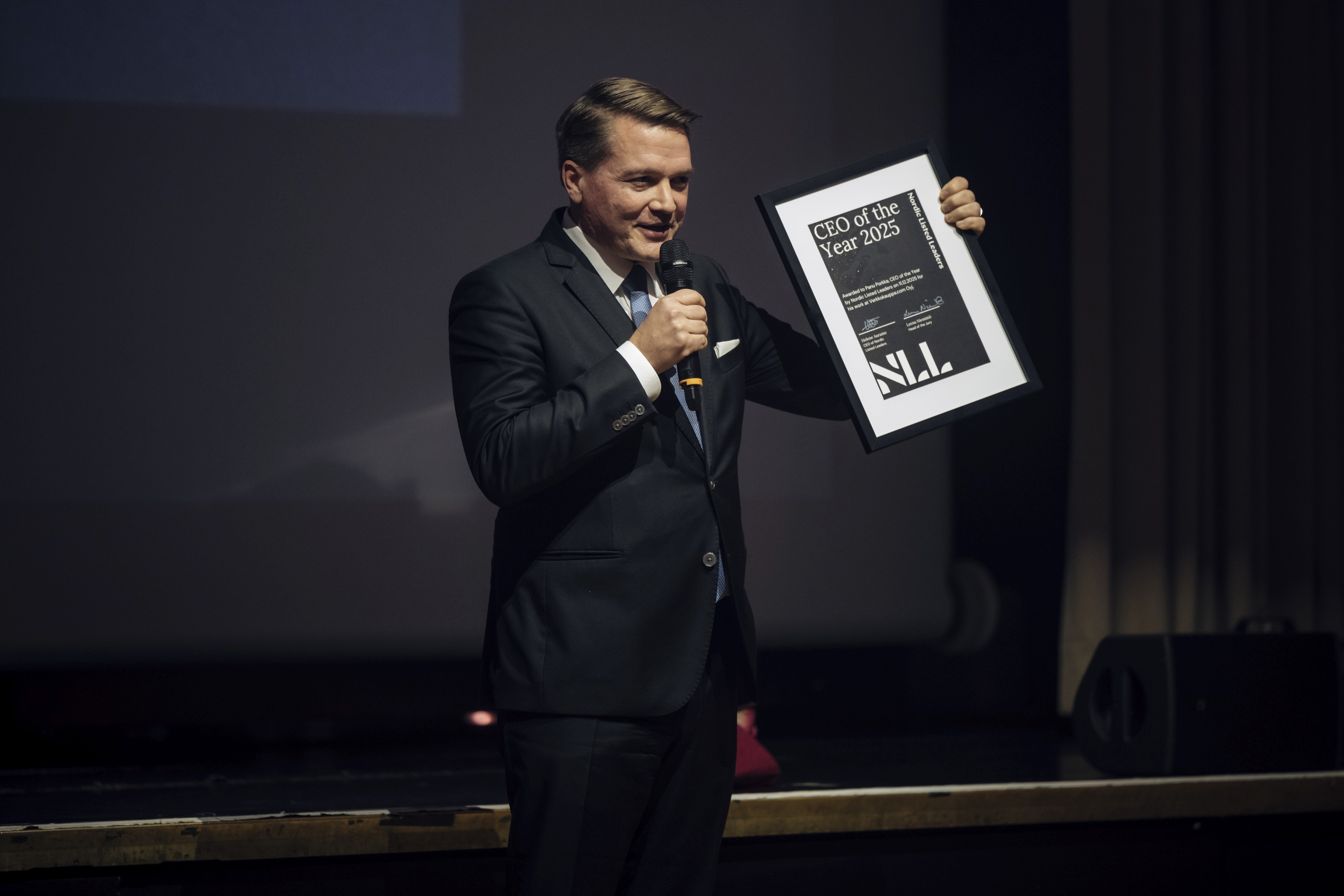
Panu Porkka was named CEO of the Year at the Nordic Listed Leaders Gala. He talks about the people he leans on, what he looks for in a leader, and why he thinks Finland could use a little more Swedishness.

When Panu Porkka stepped up to accept CEO of the Year 2025 at the Nordic Listed Leaders Gala, he didn’t talk much about himself; instead, he talked about his wife and his team. It was a telling choice for a man who runs one of the most closely watched retailer companies on the Nasdaq Helsinki, and a useful place to start, because the way Porkka leads has a lot to do with the people he chooses to lean on.

"I would not be sane without my wife," he says. Across the phases of a demanding career, she has, in his telling, made his personal and professional growth possible. The work of a listed-company chief executive is, by his own account, sometimes very lonely. 

What carries him through the dark stretches is having someone who reminds him he has done his best. With two children, aged five and seven, the ambition at home is shared too: to be as good a father as the hours allow. It is, he says, team play on both sides, and most of it sits in a place that never shows up in the work or on the newspaper pages.

A team that carries the weight

Ask what makes the job rewarding, and the answer is one word: team. Porkka describes a management group he rates as genuinely professional, working to a clear shared agenda and, crucially, carrying responsibility together rather than waiting to be told. 

The phrase he keeps returning to is shared ownership. The overlap between people, the way one steps in where another leaves off, would not function, he says, without it. 

Like-minded people, excited about the same thing, supporting each other and taking the weight: that is what turns a lonely job into a workable one.

It is also the lens through which he reads talent. Asked what he looks for, Porkka does not hesitate. Attitude is, by a distance, the most important quality: the drive to take hold of a problem and solve it, the instinct to say "I will handle that," the ability to get things done and bring people along. 

Curiosity is the second component, a genuine appetite to learn, to stay open, to ask the other person to tell you more, and to want to understand not just what they think but why. Over 25 years, he has come to trust those two signals above almost anything on a CV.

The German lesson

Much of how Porkka works was shaped in Germany.  Porkka spent around eight years with Lidl, much of it in Finland and later in Germany, where he steered international sales for Northern Europe and later ran Swiss operations as chief operating officer, including a market opening there. 

Germany was never foreign to him: he attended the German School of Helsinki, the language and culture are familiar, and the country is something of a second home.

The management culture left a mark. German business, as he describes it, is matter-of-fact, with the substance of the task firmly in the foreground. It prizes anticipation and planning, treats chance as something to be designed out, and rewards working out what you are trying to achieve before you set off to measure it. 

After Lidl, Porkka spent four years at Tokmanni, after which he made a move into specialty retail as chief executive of the Finnish bookshop chain Suomalainen Kirjakauppa.

No hundred-day plan

Porkka did not arrive at Verkkokauppa.com with a 100-day checklist. He joined the board in April 2017 and became CEO in March 2018, succeeding founder Samuli Seppälä, who had led the company for 26 years and built it from a basement startup into one of Finland's most recognizable retail brands before moving to the board.

There was no formal brief beyond the obvious one: growth had begun to slow, and the company needed to find its next chapter.

What Porkka inherited was a business shaped by an entrepreneurial culture that had been one of its greatest strengths. Seppälä's willingness to challenge convention, move quickly, and back bold ideas had helped create a company that stood apart from its competitors. Much of the spirit that defined Verkkokauppa.com, from its relentless focus on customers to its appetite for unconventional bets, was a direct product of its founder.

The challenge was that success had also created a company that still operated much like a fast-growing startup. Many decisions, processes, and ways of working reflected years of founder-led growth. Porkka's task was not to replace that culture but to preserve its strengths while building an organization that could scale beyond any one individual.

That meant developing a stronger management structure, broadening ownership across the leadership team, documenting processes, and introducing systems that made performance more transparent for investors and analysts. 

It was as much a cultural transition as an operational one: moving from a founder-led organization to a more distributed model of leadership without losing the ambition and boldness that had made the company successful in the first place. 

The one-hour bet

Much of that investment went into building a logistics platform designed for fast, cost-efficient delivery. After an extensive review in 2018 and 2019, the company selected Swisslog's AutoStore system and rolled it out at scale, including what Porkka describes as the world's only installation of its kind built into a multi-storey building.

The automation did not stop at storage. Packing processes were automated, internal goods flows were redesigned, and the company moved beyond a model that had once relied solely on Posti. Together, the changes laid the foundation for some of Verkkokauppa.com's most ambitious customer-facing innovations.

However, the boldest bet was the one-hour delivery. The doubters had a clear story, he recalls. Finns want to drive to the shop, see the fridge before they buy it, and talk to a salesperson. Nobody truly needs same-day delivery, let alone same-hour. 

Porkka and his team bet the opposite. Make it easy enough that the gift for tonight's birthday party arrives within the hour, and you have created real value. He saw it as the next disruption, and the company went after it with what he calls a startup mentality and a strong collective belief.

A dose of Swedishness

That belief is, if anything, stronger today. Porkka frames the present as his most accomplished stretch, a company competing hard in a tight market, with thin category margins, and still finding room to invest and rewrite how retail is done in Finland.

He closes on a national note that doubles as a leadership one. Finland's economy, he thinks, is showing signs of life, and the country could use a dose of Swedishness: more optimism, more willingness to celebrate when a company succeeds rather than defaulting to scepticism and asking why someone failed. 

The point is not that Finland lacks ambition. Rather, he believes that a culture that openly welcomes success makes it easier for companies to think bigger, attract investment, and pursue growth.

After all, companies rarely grow beyond the limits of what they believe they can become.

|

|

Leaders

Panu Porkka, the quiet engine behind Verkkokauppa.com's loudest bets

Panu Porkka, the quiet engine behind Verkkokauppa.com's loudest bets

·

5 min read

Explore and follow profiles from this article to get timely updates:
Panu Porkka was named CEO of the Year at the Nordic Listed Leaders Gala. He talks about the people he leans on, what he looks for in a leader, and why he thinks Finland could use a little more Swedishness.

When Panu Porkka stepped up to accept CEO of the Year 2025 at the Nordic Listed Leaders Gala, he didn’t talk much about himself; instead, he talked about his wife and his team. It was a telling choice for a man who runs one of the most closely watched retailer companies on the Nasdaq Helsinki, and a useful place to start, because the way Porkka leads has a lot to do with the people he chooses to lean on.

"I would not be sane without my wife," he says. Across the phases of a demanding career, she has, in his telling, made his personal and professional growth possible. The work of a listed-company chief executive is, by his own account, sometimes very lonely. 

What carries him through the dark stretches is having someone who reminds him he has done his best. With two children, aged five and seven, the ambition at home is shared too: to be as good a father as the hours allow. It is, he says, team play on both sides, and most of it sits in a place that never shows up in the work or on the newspaper pages.

A team that carries the weight

Ask what makes the job rewarding, and the answer is one word: team. Porkka describes a management group he rates as genuinely professional, working to a clear shared agenda and, crucially, carrying responsibility together rather than waiting to be told. 

The phrase he keeps returning to is shared ownership. The overlap between people, the way one steps in where another leaves off, would not function, he says, without it. 

Like-minded people, excited about the same thing, supporting each other and taking the weight: that is what turns a lonely job into a workable one.

It is also the lens through which he reads talent. Asked what he looks for, Porkka does not hesitate. Attitude is, by a distance, the most important quality: the drive to take hold of a problem and solve it, the instinct to say "I will handle that," the ability to get things done and bring people along. 

Curiosity is the second component, a genuine appetite to learn, to stay open, to ask the other person to tell you more, and to want to understand not just what they think but why. Over 25 years, he has come to trust those two signals above almost anything on a CV.

The German lesson

Much of how Porkka works was shaped in Germany.  Porkka spent around eight years with Lidl, much of it in Finland and later in Germany, where he steered international sales for Northern Europe and later ran Swiss operations as chief operating officer, including a market opening there. 

Germany was never foreign to him: he attended the German School of Helsinki, the language and culture are familiar, and the country is something of a second home.

The management culture left a mark. German business, as he describes it, is matter-of-fact, with the substance of the task firmly in the foreground. It prizes anticipation and planning, treats chance as something to be designed out, and rewards working out what you are trying to achieve before you set off to measure it. 

After Lidl, Porkka spent four years at Tokmanni, after which he made a move into specialty retail as chief executive of the Finnish bookshop chain Suomalainen Kirjakauppa.

No hundred-day plan

Porkka did not arrive at Verkkokauppa.com with a 100-day checklist. He joined the board in April 2017 and became CEO in March 2018, succeeding founder Samuli Seppälä, who had led the company for 26 years and built it from a basement startup into one of Finland's most recognizable retail brands before moving to the board.

There was no formal brief beyond the obvious one: growth had begun to slow, and the company needed to find its next chapter.

What Porkka inherited was a business shaped by an entrepreneurial culture that had been one of its greatest strengths. Seppälä's willingness to challenge convention, move quickly, and back bold ideas had helped create a company that stood apart from its competitors. Much of the spirit that defined Verkkokauppa.com, from its relentless focus on customers to its appetite for unconventional bets, was a direct product of its founder.

The challenge was that success had also created a company that still operated much like a fast-growing startup. Many decisions, processes, and ways of working reflected years of founder-led growth. Porkka's task was not to replace that culture but to preserve its strengths while building an organization that could scale beyond any one individual.

That meant developing a stronger management structure, broadening ownership across the leadership team, documenting processes, and introducing systems that made performance more transparent for investors and analysts. 

It was as much a cultural transition as an operational one: moving from a founder-led organization to a more distributed model of leadership without losing the ambition and boldness that had made the company successful in the first place. 

Our Pulse newsletter

Your weekly leadership intelligence briefing.

What happened, why it matters, and what to watch across every CEO, board, and executive move in Nordic listed companies, starting with Finland. Fast, factual, and to the point.

Delivered every Monday.

By signing up, you agree to our Privacy Policy

Our Pulse newsletter

Your weekly leadership intelligence briefing.

What happened, why it matters, and what to watch across every CEO, board, and executive move in Nordic listed companies, starting with Finland. Fast, factual, and to the point.

Delivered every Monday.

By signing up, you agree to our Privacy Policy

The one-hour bet

Much of that investment went into building a logistics platform designed for fast, cost-efficient delivery. After an extensive review in 2018 and 2019, the company selected Swisslog's AutoStore system and rolled it out at scale, including what Porkka describes as the world's only installation of its kind built into a multi-storey building.

The automation did not stop at storage. Packing processes were automated, internal goods flows were redesigned, and the company moved beyond a model that had once relied solely on Posti. Together, the changes laid the foundation for some of Verkkokauppa.com's most ambitious customer-facing innovations.

However, the boldest bet was the one-hour delivery. The doubters had a clear story, he recalls. Finns want to drive to the shop, see the fridge before they buy it, and talk to a salesperson. Nobody truly needs same-day delivery, let alone same-hour. 

Porkka and his team bet the opposite. Make it easy enough that the gift for tonight's birthday party arrives within the hour, and you have created real value. He saw it as the next disruption, and the company went after it with what he calls a startup mentality and a strong collective belief.

A dose of Swedishness

That belief is, if anything, stronger today. Porkka frames the present as his most accomplished stretch, a company competing hard in a tight market, with thin category margins, and still finding room to invest and rewrite how retail is done in Finland.

He closes on a national note that doubles as a leadership one. Finland's economy, he thinks, is showing signs of life, and the country could use a dose of Swedishness: more optimism, more willingness to celebrate when a company succeeds rather than defaulting to scepticism and asking why someone failed. 

The point is not that Finland lacks ambition. Rather, he believes that a culture that openly welcomes success makes it easier for companies to think bigger, attract investment, and pursue growth.

After all, companies rarely grow beyond the limits of what they believe they can become.

Board Programme

Built for Nordic listed company boards.

The only programme in the Nordics designed specifically for listed-company board work.
Five sessions, one cohort, twenty leaders in one room - Helsinki, 2026.

Board Programme

Built for Nordic listed company boards.

The only programme in the Nordics designed specifically for listed-company board work.
Five sessions, one cohort, twenty leaders in one room - Helsinki, 2026.

Topics

# Topics

Authors

Founder and ceo

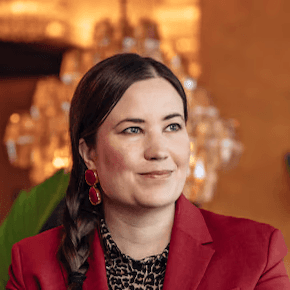
Helene Auramo is a co-founder of Listeds and Nordic Listed Leaders. She has previously co-founded Slush, Indiedays, Zipipop, and Okimo Clinic, building ventures at the intersection of media, technology, and community. She holds board positions at the Finnish Business School Graduates (Suomen Ekonomit) and Finnvera, and serves as Chair of the Investment Committee at the Finnish Business School Graduates. Helene is also a columnist for Talouselämä, Finland’s leading business magazine, and Aamulehti, one of the country’s largest newspapers. Her work focuses on leadership, growth, and the structures that shape decision-making in Nordic companies. She was awarded Future Board Member of the Year in 2022 by Future Board.

Founder and ceo

Helene Auramo is a co-founder of Listeds and Nordic Listed Leaders. She has previously co-founded Slush, Indiedays, Zipipop, and Okimo Clinic, building ventures at the intersection of media, technology, and community. She holds board positions at the Finnish Business School Graduates (Suomen Ekonomit) and Finnvera, and serves as Chair of the Investment Committee at the Finnish Business School Graduates. Helene is also a columnist for Talouselämä, Finland’s leading business magazine, and Aamulehti, one of the country’s largest newspapers. Her work focuses on leadership, growth, and the structures that shape decision-making in Nordic companies. She was awarded Future Board Member of the Year in 2022 by Future Board.

Authors

Founder and ceo

Helene Auramo is a co-founder of Listeds and Nordic Listed Leaders. She has previously co-founded Slush, Indiedays, Zipipop, and Okimo Clinic, building ventures at the intersection of media, technology, and community. She holds board positions at the Finnish Business School Graduates (Suomen Ekonomit) and Finnvera, and serves as Chair of the Investment Committee at the Finnish Business School Graduates. Helene is also a columnist for Talouselämä, Finland’s leading business magazine, and Aamulehti, one of the country’s largest newspapers. Her work focuses on leadership, growth, and the structures that shape decision-making in Nordic companies. She was awarded Future Board Member of the Year in 2022 by Future Board.

All Listeds newsletters (bundle)

One sign-up, the full picture.

Get every Listeds newsletter: the daily signal drumbeat, the weekly Pulse briefing, the monthly Best of the Month, the CEO letter, and the Weekend read.

By signing up, you agree to our Privacy Policy

All Listeds newsletters (bundle)

One sign-up, the full picture.

Get every Listeds newsletter: the daily signal drumbeat, the weekly Pulse briefing, the monthly Best of the Month, the CEO letter, and the Weekend read.

By signing up, you agree to our Privacy Policy

Latest signalsLive feed
Moves trackerLive feed

Investor Event

Listeds Investor Event · Defence

Nordic defence is in a once-in-a-generation growth cycle. Eight listed and pre-IPO companies pitch to 100+ invited investors at Valkoinen Sali, Helsinki

21 September 2026

Latest on Listeds

Monthly Leadership Moves

August's biggest seats were filled without a search

Sep 17, 2026

Two new listed chief executives, and neither was chosen by the board that will supervise them. Four finance seats moved, and not one went to a first-time CFO.

On 3 August, Aspo named the chief executive of a company that will not trade until January. On 31 August, UPM's shareholders elected the board of one that will not trade until November, six weeks after its chief executive had already been named. Both appointments were internal. Neither went through a search.

According to Listeds Executive Intelligence, Nordic listed companies recorded 57 board and management changes in August: 51 in management teams and 6 at board level. Boards accounted for roughly one change in ten for a second consecutive month — and most of the board activity that did happen was produced by corporate structure rather than by nomination committees. Every one of the month's larger moves was at a Helsinki issuer or at a Helsinki issuer's Nordic subsidiary.

The demergers set the month's bookends

Aspo's board approved the demerger plan separating ESL Shipping into a new listed company on 3 August and appointed Matti-Mikael Koskinen as chief executive of ESL Shipping Group Plc the same day. Koskinen has run ESL Shipping Ltd since 2013. The demerger completes on 31 December, trading is expected to start on or about 4 January 2027, and the company's own board will not be elected until an extraordinary general meeting on 7 December, four months after its chief executive was named. Rolf Jansson, Aspo's chief executive, is intended to be elected chair.

At the other end of the month, UPM's extraordinary general meeting on 31 August approved the plywood demerger and elected WISA Group Plc's board: Tapio Korpeinen as chair, Mats Nordlander as deputy chair, and Sakari Ahdekivi, Frank Herrmann, Nina Kiviranta and Emmanuelle Picard as members. Tuija Suur-Hamari had been named WISA's President and CEO six weeks earlier, on 16 July. The demerger is expected to complete on or about 31 October, with trading from 2 November, nine weeks after the board was seated.

Under the Finnish Corporate Governance Code, appointing the chief executive is the board's own duty. A demerger inverts that sequence, and there is no other way to staff a company that does not yet exist. The consequence, on this author's reading rather than anything either company has said, is that both new boards take office with their most consequential appointment already made, and their first exercise of that duty will be a review rather than a choice.

One thing the WISA sequence does change: Suur-Hamari will be one of a small number of women running a Helsinki-listed company. Listeds’ CEO Index — Finland | Q2 2026 shows women holding 8.1 per cent of the 186 sitting chief executive roles at 30 June, and one of the 25 first-half starts. Women held 8.1 per cent of the 186 sitting chief executive roles at 30 June, and one of the 25 first-half starts. August added a second name to that pipeline — Elli Siltala, appointed chief executive of Raisio plc on 7 August.

The finance seat moved sideways, or not at all

The month's finance moves were the mirror image of a market hiring new talent into the role.

Digia filled its chief financial officer seat on 5 August by taking Vincit's sitting CFO, Kärkkäinen — the second time since 2017 that Digia has filled the role with a sitting CFO from another Nasdaq Helsinki company. Bioretec named Panu Mikkonen chief financial officer from 6 October, the fourth person named to that seat since September 2025, two of them interim. Kempower appointed Juha Jaatinen interim chief financial officer on 13 August. 

No Helsinki company promoted a first-time chief financial officer into the role in August. 

Eight executives named in two days

Three companies named eight executives across 18 and 19 August.

Nordea's 19 August release did two things at once. It merged Group Risk and Group Compliance into a single function under Mark Kandborg, who continues on the Group Leadership Team, with Nahale Ståhl Hallengren as Chief Compliance Officer from the same date, outside the Group Leadership Team. And it filled leadership in the bank's two largest customer units: Per Långsved, who joined Nordea in 2019 as Head of Personal Banking Sweden and Country Senior Executive, becomes Head of Personal Banking and joins the Group Leadership Team; Randi Marjamaa, at Nordea since 2006, takes a newly created Business Banking leadership post and also joins the Group Leadership Team. Sara Mella steps back from operational roles.

Nightingale Health removed its operating chief's role on 19 August and put two commercial chiefs in its place, at the point where its Americas business needs to produce revenue. Janna Ranta, chief operating officer since May 2025, became Chief Commercial Officer, Research and Healthcare. Hugh Watson, who has spent 25 years in United States laboratory diagnostics, joined from outside as Chief Commercial Officer, Americas.

Finnair named its digital and legal chiefs on 18 August. With those two, four of the nine Executive Board functions — people, digital, legal and finance — have a new holder named in 2026. The chief executive, operating, revenue, customer and communications seats have not moved. The rebuild is running from the strongest quarter Finnair has reported, and from a general meeting that rejected the company's remuneration report with 90 per cent of the votes represented against it.

Helsinki issuers hired for their Swedish operations

Two of the month's chief executive appointments were at Swedish subsidiaries, and both went to local candidates rather than to executives moved out from Finland.

Kreate Group appointed Per Anders Quist chief executive of Kreate Sverige AB on 24 August. Quist joins from Trafikverket, the Swedish Transport Administration, where he was responsible for major infrastructure projects, and has NCC Norway experience behind him. Kreate's own framing is that Sweden has run ahead of its strategy target and is now being handed to an executive expected to sustain that pace and to test a permanent Norwegian footprint. Luotea named Rikard Nyhrén, who joins from Intea and Newsec, chief executive of Luotea Sweden, starting by February 2027.

Talent moved the other way too. Siili Solutions' Chief People Officer, Taru Salo, left on 4 August for Attendo, with Timo Miiluniemi stepping in on an interim basis.

What August actually says

Three things follow for boards and nomination committees.

A demerger is a leadership decision long before it is a market event. The chief executives of two companies that will not trade until November and January were settled in July and early August, and shareholders approved them inside a structural vote.

Board changes remain an AGM-season phenomenon. Six board changes against 51 in management teams, with the largest single block produced by one extraordinary general meeting, says that off-cycle board activity in Helsinki is driven by corporate structure rather than by committee work.

And the finance function is where succession planning is thinnest — but the evidence for that is a lateral market and an interim bench, not a hiring pattern break. August's finance seats were filled by people who already held the title, or left open. Whether September's first-time appointments turn into a pattern or revert to the lateral hire is the question the next two months answer.

Market Signals

Six of the nine biggest ownership moves in Helsinki in August required no notification

Sep 16, 2026

Three did. Two of those were the same bond amortisation at one company, and the third — a take-private crossing 90% — filed in September, after the month it belonged to.

August looked quiet on Nasdaq Helsinki flagging notifications. The shareholder registers moved more than the disclosure feed did. Finland's thresholds start at 5%, and most of the month's largest register moves never touched the ladder.

Here is what moved, what was notified, and what the gap between those two sets says about reading Nordic ownership.

Citycon: the take-private the register sees last

G City Ltd's directly registered stake in Citycon grew from 39.50% to 42.55% during August, a gain of 5.6 million shares. 

In the same window the Skandinaviska Enskilda Banken Helsinki Branch nominee account, which had been holding a large Citycon block in custody, shrank by 4.8 million shares. Citibank Europe's custodial line edged down as well.

That is not buying. It is the shares crossing out of nominee registration into G City's own name as the tender offer settles. G City's flagging notification of 2 September puts its total holding at 91.05%, against a directly registered position of 42.55% at the end of August. Both are correct: the rest still sits in custodial accounts, re-registering in tranches. Read alone, the register would tell you G City owns less than half of Citycon.

G City crossed 90% on 1 September, commenced compulsory redemption of the minority shares and will apply to delist. Our Citycon piece this week has the offer periods, the divestment and the parking dispute.

Faron: a new largest register holder, and no new money

Heights Capital Management, through CVI Investments, crossed a threshold in Faron Pharmaceuticals on 4 August and filed the next day: shares up from 7.99% to 9.41%. The same notification shows its holding through financial instruments falling from 12.53% to 11.30%, and combined exposure barely moving, 20.52% to 20.72%. This is a convertible bond converting under the up-to-€35m arrangement Faron entered with a Heights-managed entity in April 2025 — not a purchase. Faron's own treasury holding fell from 10.97% to 9.37% in the same event, through dilution rather than a sale.

Also on the move

Register moves during August. None of these required a notification.

Lemonsoft — Rite Ventures grew from 58.7% to 61.1%, continuing to mop up minority shares after its mandatory tender offer earlier in 2026. 

Bittium — the SEB Helsinki Branch nominee line rose from 7.2% to 9.7%, the largest custodial swing of the month. 

Siili Solutions — Jtel Oy grew from 2.8% to 4.4%. 

Solwers — Terrasolid Ltd grew from 5.5% to 6.7%. 

Tokmanni — the SEB Helsinki Branch nominee stake fell from 13.3% to 12.0%. 

Revenio Group — BlackRock fell from 1.6% to 0.4%.

What the ladder catches

Finnish thresholds run at 5, 10, 15, 20, 25, 30, 50, two-thirds and 90% of shares or votes. Set the nine moves against that ladder:

Move

Notified

Why

Faron — Heights 7.99% → 9.41%

Yes, 5 Aug

Crossed a threshold on the share line

Faron — treasury 10.97% → 9.37%

Yes, 4 Aug

Crossed a threshold on the share line

Citycon — G City 86.51% → 91.05%

Yes, 2 Sept

Crossed 90% on 1 Sept, after the month closed

Lemonsoft — Rite Ventures 58.7% → 61.1%

No

No threshold between 50% and two-thirds

Solwers — Terrasolid 5.5% → 6.7%

No

No threshold between 5% and 10%

Siili — Jtel 2.8% → 4.4%

No

Entirely below 5%

Revenio — BlackRock 1.6% → 0.4%

No

Entirely below 5%

Bittium — SEB nominee 7.2% → 9.7%

No

Custodial nominee line

Tokmanni — SEB nominee 13.3% → 12.0%

No

Custodial nominee line

Both of the August notifications here came from one issuer, and they describe two halves of a single bond amortisation. The largest ownership event of the Helsinki summer filed in September. Read one instrument without the other and you get a month that looks like this one: quiet on the feed, busy on the register.

Join our Pulse, Best-of-the-Week, and Weekend newsletters

Join our Pulse, Best-of-the-Week, and Weekend newsletters