When boards take time to evaluate their own performance, their companies are more likely to report successful growth outcomes.
This insight emerges from The Great Board Study 2024, one of the most comprehensive recent datasets on board work in Finland, conducted by the Certified Board Member (HHJ) training program and Talentree. The findings discussed here were presented by Minni Rimpioja at a joint executive event hosted by Nordic Listed Leaders and Admincontrol, bringing together CEOs, board chairs, and owners.
The study is based on responses from 828 experienced board professionals, including board members and chairs across company sizes, ownership structures, and industries. Rather than offering abstract prescriptions for “good governance,” the data highlights practical patterns that distinguish boards operating in more successful companies from those that are not.
Growth and self-evaluation move together
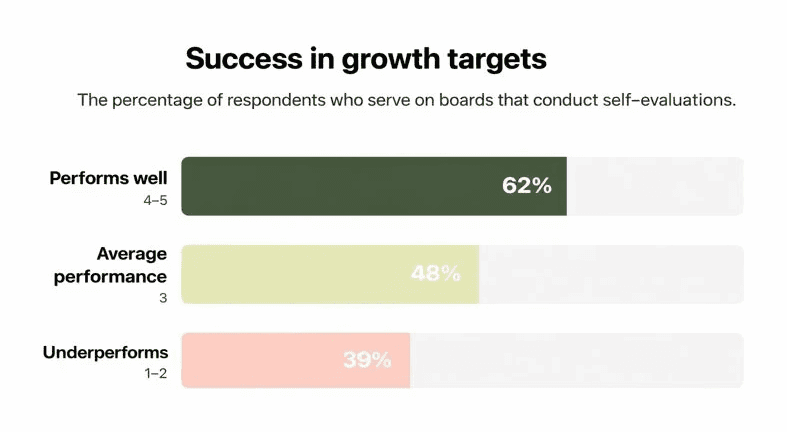
One of the clearest patterns in the data concerns growth targets.
Among companies that report succeeding well in achieving their growth objectives, 62% conduct board self-evaluations. Among companies that report failing to meet their growth ambitions, the figure drops to 39%.
Source: The Great Board Study 2024 by HHJ & Talentree
The study does not claim that self-evaluation causes growth. What it does show is a strong association between systematic board self-assessment and reported success in growth outcomes. Boards in growth-oriented companies appear more willing to examine their own effectiveness, decision-making, and ways of working.
As Rimpioja observed during the discussion, high-performing boards tend to treat their own effectiveness with the same discipline that management applies to operational performance.
The real governance gap lies in alignment, not strategy
Another important insight challenges a common assumption: poor performance is rarely explained by the absence of strategy alone.
Companies that underperform consistently score lower on several governance fundamentals, including:
clarity of owner's intent toward the board
effectiveness of the owner–board–management chain
clarity of roles and responsibilities across governance levels
In companies that perform well, owner intent is more clearly communicated, governance roles are better understood, and accountability flows more smoothly through the organization.
The implication is straightforward but often overlooked: strategy struggles not because it is missing, but because governance alignment is weak. This pattern is especially relevant in owner-led, family-owned, and mixed-ownership companies, where governance structures often evolve informally as the business grows.
Boards prioritize strategy — but lag on technology and AI
When respondents were asked what competencies boards will need most in the future, the answers followed a familiar hierarchy. Strategic competence, customer understanding, and commercial and financial expertise ranked highest.
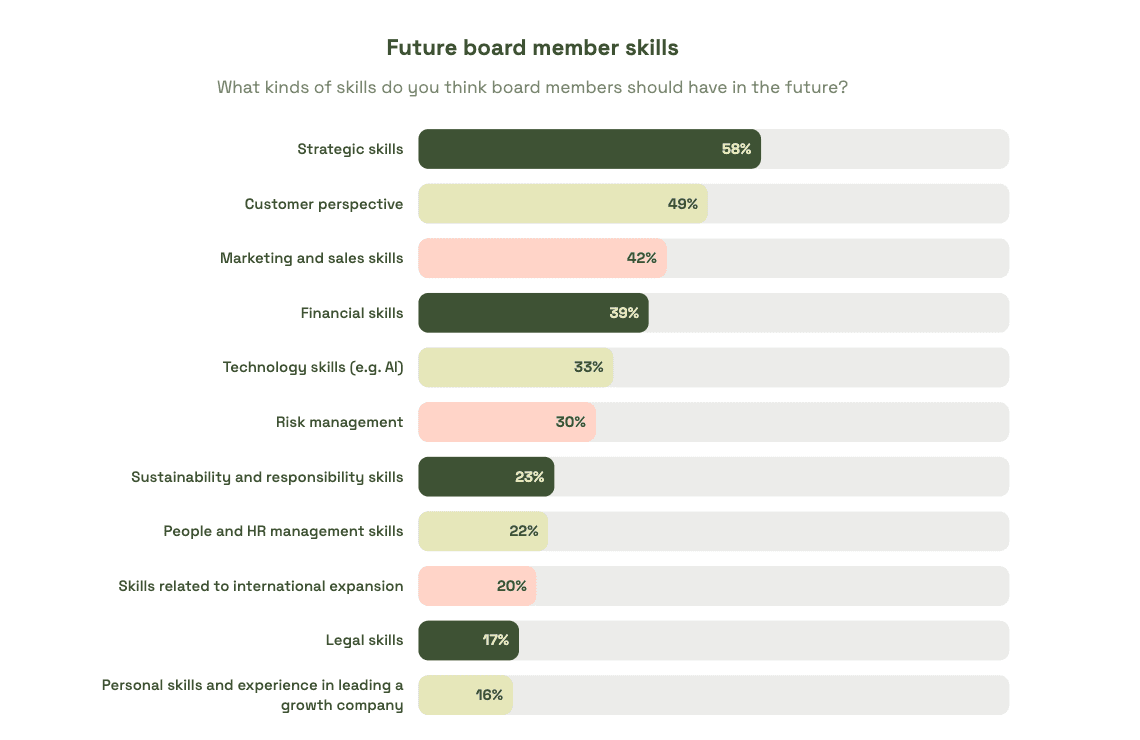
Technology and AI competence ranked noticeably lower.
This creates a revealing tension. While digitalization and AI are reshaping business models across industries, many boards still appear to view technology primarily as an operational issue rather than a core governance responsibility. The data suggest that boards recognize the importance of technology’s impact, but have not yet fully internalized their role in guiding, challenging, and governing it at the board level.
The paradox of small companies: highest impact, lowest evaluation
Company size also matters.
In organizations with revenues above €50 million, 78% of boards conduct self-evaluations. In companies with revenues below €1 million, the share falls to 35%.
This is paradoxical. In smaller companies, boards often have greater relative influence over strategic direction, risk-taking, and major investment decisions. Yet these boards are least likely to systematically assess their own performance. The data suggest that governance risk may be highest precisely where formal evaluation practices are weakest.
Self-evaluation as a mechanism, not a mirror
Perhaps the most important insight is not whether boards conduct evaluations, but how they use the results.
Across the study, development areas are often identified through surveys or discussions. However, the boards that report stronger outcomes are those that embed self-evaluation into their ongoing work: linking it to the annual board calendar, strategy discussions, competence development, succession planning, and explicit improvements in decision-making practices.
In these cases, self-evaluation functions not as a reflective exercise, but as an operating mechanism for continuous improvement.
The chair’s role in board self-evaluation
In HHJ courses, board self-evaluations are discussed regularly, and among participants in the HHJ Pro programme, self-evaluation has become a well-established part of board work. According to Minni Rimpioja, the topic comes up repeatedly in training sessions, but it is discussed most intensively in the HHJ Chair programs — for a reason.
“In self-evaluations, the chair carries a particularly complex responsibility,” Rimpioja explains. “This is also where the process most often breaks down.”
Rimpioja notes that the chair’s role begins with ensuring that evaluation results are not merely collected, but genuinely addressed. The chair must make sure that the board takes time to go through the results and engages in open discussion about what they mean in practice. These conversations are not always easy, but without them, the evaluation has little value.
Under the chair’s leadership, the board must then decide on concrete actions to further develop its work. Identifying development areas alone is not enough. According to Rimpioja, the chair also carries responsibility for ensuring that agreed actions are implemented, that progress is followed up, and that development does not remain a one-off exercise.
“In many cases, this work continues outside the boardroom,” she adds. One-to-one discussions with individual board members may be necessary, particularly when sensitive issues cannot be effectively addressed in a full board setting.
Finally, Rimpioja highlights the chair’s role in communicating the outcomes of the self-evaluation to owners. Translating internal board discussions into clear messages helps strengthen transparency, trust, and governance credibility.
Seen through this lens, board self-evaluation is not primarily a technical process. As Rimpioja puts it, it is a leadership task.
A final observation
The Great Board Study 2024 does not suggest that successful companies have flawless boards. Instead, it points to something more realistic — and more actionable.
Companies that perform well tend to have boards that are willing to question themselves, address weaknesses, and evolve their way of working over time.
Growth does not require perfect governance. It requires learning governance.
·
5 min read

When boards take time to evaluate their own performance, their companies are more likely to report successful growth outcomes.
This insight emerges from The Great Board Study 2024, one of the most comprehensive recent datasets on board work in Finland, conducted by the Certified Board Member (HHJ) training program and Talentree. The findings discussed here were presented by Minni Rimpioja at a joint executive event hosted by Nordic Listed Leaders and Admincontrol, bringing together CEOs, board chairs, and owners.
The study is based on responses from 828 experienced board professionals, including board members and chairs across company sizes, ownership structures, and industries. Rather than offering abstract prescriptions for “good governance,” the data highlights practical patterns that distinguish boards operating in more successful companies from those that are not.
Growth and self-evaluation move together
One of the clearest patterns in the data concerns growth targets.
Among companies that report succeeding well in achieving their growth objectives, 62% conduct board self-evaluations. Among companies that report failing to meet their growth ambitions, the figure drops to 39%.
Source: The Great Board Study 2024 by HHJ & Talentree
The study does not claim that self-evaluation causes growth. What it does show is a strong association between systematic board self-assessment and reported success in growth outcomes. Boards in growth-oriented companies appear more willing to examine their own effectiveness, decision-making, and ways of working.
As Rimpioja observed during the discussion, high-performing boards tend to treat their own effectiveness with the same discipline that management applies to operational performance.
The real governance gap lies in alignment, not strategy
Another important insight challenges a common assumption: poor performance is rarely explained by the absence of strategy alone.
Companies that underperform consistently score lower on several governance fundamentals, including:
clarity of owner's intent toward the board
effectiveness of the owner–board–management chain
clarity of roles and responsibilities across governance levels
In companies that perform well, owner intent is more clearly communicated, governance roles are better understood, and accountability flows more smoothly through the organization.
The implication is straightforward but often overlooked: strategy struggles not because it is missing, but because governance alignment is weak. This pattern is especially relevant in owner-led, family-owned, and mixed-ownership companies, where governance structures often evolve informally as the business grows.
Boards prioritize strategy — but lag on technology and AI
When respondents were asked what competencies boards will need most in the future, the answers followed a familiar hierarchy. Strategic competence, customer understanding, and commercial and financial expertise ranked highest.
Technology and AI competence ranked noticeably lower.
This creates a revealing tension. While digitalization and AI are reshaping business models across industries, many boards still appear to view technology primarily as an operational issue rather than a core governance responsibility. The data suggest that boards recognize the importance of technology’s impact, but have not yet fully internalized their role in guiding, challenging, and governing it at the board level.
The paradox of small companies: highest impact, lowest evaluation
Company size also matters.
In organizations with revenues above €50 million, 78% of boards conduct self-evaluations. In companies with revenues below €1 million, the share falls to 35%.
This is paradoxical. In smaller companies, boards often have greater relative influence over strategic direction, risk-taking, and major investment decisions. Yet these boards are least likely to systematically assess their own performance. The data suggest that governance risk may be highest precisely where formal evaluation practices are weakest.

Self-evaluation as a mechanism, not a mirror
Perhaps the most important insight is not whether boards conduct evaluations, but how they use the results.
Across the study, development areas are often identified through surveys or discussions. However, the boards that report stronger outcomes are those that embed self-evaluation into their ongoing work: linking it to the annual board calendar, strategy discussions, competence development, succession planning, and explicit improvements in decision-making practices.
In these cases, self-evaluation functions not as a reflective exercise, but as an operating mechanism for continuous improvement.
The chair’s role in board self-evaluation
In HHJ courses, board self-evaluations are discussed regularly, and among participants in the HHJ Pro programme, self-evaluation has become a well-established part of board work. According to Minni Rimpioja, the topic comes up repeatedly in training sessions, but it is discussed most intensively in the HHJ Chair programs — for a reason.
“In self-evaluations, the chair carries a particularly complex responsibility,” Rimpioja explains. “This is also where the process most often breaks down.”
Rimpioja notes that the chair’s role begins with ensuring that evaluation results are not merely collected, but genuinely addressed. The chair must make sure that the board takes time to go through the results and engages in open discussion about what they mean in practice. These conversations are not always easy, but without them, the evaluation has little value.
Under the chair’s leadership, the board must then decide on concrete actions to further develop its work. Identifying development areas alone is not enough. According to Rimpioja, the chair also carries responsibility for ensuring that agreed actions are implemented, that progress is followed up, and that development does not remain a one-off exercise.
“In many cases, this work continues outside the boardroom,” she adds. One-to-one discussions with individual board members may be necessary, particularly when sensitive issues cannot be effectively addressed in a full board setting.
Finally, Rimpioja highlights the chair’s role in communicating the outcomes of the self-evaluation to owners. Translating internal board discussions into clear messages helps strengthen transparency, trust, and governance credibility.
Seen through this lens, board self-evaluation is not primarily a technical process. As Rimpioja puts it, it is a leadership task.
A final observation
The Great Board Study 2024 does not suggest that successful companies have flawless boards. Instead, it points to something more realistic — and more actionable.
Companies that perform well tend to have boards that are willing to question themselves, address weaknesses, and evolve their way of working over time.
Growth does not require perfect governance. It requires learning governance.





Investor Event
Listeds Investor Event · Defence
Nordic defence is in a once-in-a-generation growth cycle. Eight listed and pre-IPO companies pitch to 100+ invited investors at Valkoinen Sali, Helsinki
21 September 2026


Latest on Listeds

