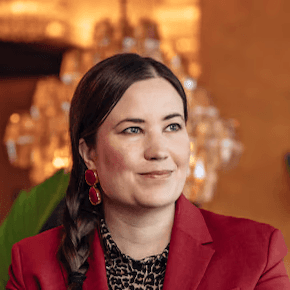
Kimmo Kärkkäinen will take over as Digia's CFO by February 2027 at the latest, arriving from Vincit's finance seat. It is the second time since 2017 that Digia has filled its CFO role with a sitting CFO from another Nasdaq Helsinki company, a pattern Listeds examines across the wider market in a companion piece.

Digia has appointed Kimmo Kärkkäinen (b. 1972) as Chief Financial Officer and a member of the management team, effective by February 2027 at the latest, reporting to President and CEO Timo Levoranta. Kärkkäinen joins from Vincit, where he is currently CFO, and has previously held CFO roles at Fira Group and leadership positions at Sitedrive Oy, private-equity firm Bocap, Affecto Plc, and TeliaSonera.

He succeeds Kristiina Simola, who announced on 21 April 2026 that she would step down to pursue a board career after serving as Digia's CFO since 2017. Simola remains in post through the transition, with an outside date of end-October 2026.

Vincit has confirmed Kärkkäinen's resignation "to join another company," with him continuing in role during a transition period until the beginning of November 2026 at the latest while it recruits a successor. CEO Julius Manni thanked him for developing the company's processes and leadership culture.

On the appointment, Kärkkäinen said: "Digia has made an impressive journey as a profitable growth company, and it has a strong position in the Finnish software and services market. I am excited to join Digia in building its next phase. As Chief Financial Officer, I want to support the implementation of the strategy and the growth of shareholder value together with a skilled team.”

Levoranta cited Kärkkäinen’s “strong experience in financial management and business development,” as well as his experience in mergers and acquisitions and in building growth companies and new businesses.

Sales are still growing, but Digia's EBITA margin is shrinking

Digia enters the transition from a mixed position. Full-year 2025 was strong: net sales rose 5.5% to EUR 217.0 million, and the fourth quarter closed the year hard, with net sales up 10.5% to EUR 60.2 million and EBITA up 45.5% to EUR 8.5 million; the March 2026 AGM approved a dividend of EUR 0.19 per share. But 2026 opened weaker. In the first quarter, net sales grew 4.9% to EUR 56.4 million while EBITA fell 28.2% to EUR 3.3 million, partly on non-recurring change-negotiation and provision costs. The first half told the same story: net sales up 2.9% to EUR 110.7 million against EBITA down 16.7% to EUR 6.4 million, with EUR 2 million of non-recurring items, even as the equity ratio improved to 48.5% and net gearing fell to 23.4%; Digia pointed to market uncertainty weighing on customer investment decisions.

Market pressure ran alongside headcount reductions: Digia announced change negotiations on 27 February 2026, with negotiations beginning on 5 March and covering roughly 300 of Digia's 1,600 employees. The negotiations concluded on 25 March, with 31 positions ultimately set to be reduced and estimated annual cost savings of about EUR 2.4 million.

Against that backdrop, Digia set medium-term targets at its 5 February 2026 strategy update and 21 May 2026 Capital Markets Day: average annual net sales growth above 10%, an EBITA margin above 12% at the end of the strategy period, and 30% of net sales from outside Finland at the end of the strategy period.

This is the second time Digia has hired its CFO from another listed company

The move fits a recurring Nasdaq Helsinki pattern: rather than promote internally or hire a first-time CFO, Finnish listed companies frequently recruit a sitting CFO from another listed company. Digia is a clear case. Simola arrived from Digitalist Group Plc in 2017, Kärkkäinen from Vincit in 2026, both from public-company finance seats.

And the pattern rarely stops at a single move. Kärkkäinen's own departure now leaves Vincit's CFO seat open, and Vincit has already begun the search for a successor. That vacancy is the next in a run of ten finance-chief changes Listeds tracked across Nasdaq Helsinki and First North between December 2025 and August 2026, read as a set in the companion feature: The easiest way to become CFO of a Finnish listed company? Already be one at another.

|

|

Leaders

Digia names Kimmo Kärkkäinen CFO, hired from fellow IT company Vincit

Digia names Kimmo Kärkkäinen CFO, hired from fellow IT company Vincit

·

5 min read

Explore and follow profiles from this article to get timely updates:
Credit: Vincit, Kimmo Kärkkäinen

Credit: Vincit, Kimmo Kärkkäinen

Kimmo Kärkkäinen will take over as Digia's CFO by February 2027 at the latest, arriving from Vincit's finance seat. It is the second time since 2017 that Digia has filled its CFO role with a sitting CFO from another Nasdaq Helsinki company, a pattern Listeds examines across the wider market in a companion piece.

Digia has appointed Kimmo Kärkkäinen (b. 1972) as Chief Financial Officer and a member of the management team, effective by February 2027 at the latest, reporting to President and CEO Timo Levoranta. Kärkkäinen joins from Vincit, where he is currently CFO, and has previously held CFO roles at Fira Group and leadership positions at Sitedrive Oy, private-equity firm Bocap, Affecto Plc, and TeliaSonera.

He succeeds Kristiina Simola, who announced on 21 April 2026 that she would step down to pursue a board career after serving as Digia's CFO since 2017. Simola remains in post through the transition, with an outside date of end-October 2026.

Vincit has confirmed Kärkkäinen's resignation "to join another company," with him continuing in role during a transition period until the beginning of November 2026 at the latest while it recruits a successor. CEO Julius Manni thanked him for developing the company's processes and leadership culture.

On the appointment, Kärkkäinen said: "Digia has made an impressive journey as a profitable growth company, and it has a strong position in the Finnish software and services market. I am excited to join Digia in building its next phase. As Chief Financial Officer, I want to support the implementation of the strategy and the growth of shareholder value together with a skilled team.”

Levoranta cited Kärkkäinen’s “strong experience in financial management and business development,” as well as his experience in mergers and acquisitions and in building growth companies and new businesses.

Our Pulse newsletter

Your weekly leadership intelligence briefing.

What happened, why it matters, and what to watch across every CEO, board, and executive move in Nordic listed companies, starting with Finland. Fast, factual, and to the point.

Delivered every Monday.

By signing up, you agree to our Privacy Policy

Our Pulse newsletter

Your weekly leadership intelligence briefing.

What happened, why it matters, and what to watch across every CEO, board, and executive move in Nordic listed companies, starting with Finland. Fast, factual, and to the point.

Delivered every Monday.

By signing up, you agree to our Privacy Policy

Sales are still growing, but Digia's EBITA margin is shrinking

Digia enters the transition from a mixed position. Full-year 2025 was strong: net sales rose 5.5% to EUR 217.0 million, and the fourth quarter closed the year hard, with net sales up 10.5% to EUR 60.2 million and EBITA up 45.5% to EUR 8.5 million; the March 2026 AGM approved a dividend of EUR 0.19 per share. But 2026 opened weaker. In the first quarter, net sales grew 4.9% to EUR 56.4 million while EBITA fell 28.2% to EUR 3.3 million, partly on non-recurring change-negotiation and provision costs. The first half told the same story: net sales up 2.9% to EUR 110.7 million against EBITA down 16.7% to EUR 6.4 million, with EUR 2 million of non-recurring items, even as the equity ratio improved to 48.5% and net gearing fell to 23.4%; Digia pointed to market uncertainty weighing on customer investment decisions.

Market pressure ran alongside headcount reductions: Digia announced change negotiations on 27 February 2026, with negotiations beginning on 5 March and covering roughly 300 of Digia's 1,600 employees. The negotiations concluded on 25 March, with 31 positions ultimately set to be reduced and estimated annual cost savings of about EUR 2.4 million.

Against that backdrop, Digia set medium-term targets at its 5 February 2026 strategy update and 21 May 2026 Capital Markets Day: average annual net sales growth above 10%, an EBITA margin above 12% at the end of the strategy period, and 30% of net sales from outside Finland at the end of the strategy period.

This is the second time Digia has hired its CFO from another listed company

The move fits a recurring Nasdaq Helsinki pattern: rather than promote internally or hire a first-time CFO, Finnish listed companies frequently recruit a sitting CFO from another listed company. Digia is a clear case. Simola arrived from Digitalist Group Plc in 2017, Kärkkäinen from Vincit in 2026, both from public-company finance seats.

And the pattern rarely stops at a single move. Kärkkäinen's own departure now leaves Vincit's CFO seat open, and Vincit has already begun the search for a successor. That vacancy is the next in a run of ten finance-chief changes Listeds tracked across Nasdaq Helsinki and First North between December 2025 and August 2026, read as a set in the companion feature: The easiest way to become CFO of a Finnish listed company? Already be one at another.

Follow moves like this on the Listeds Executive Intelligence Platform.

Board Programme

Built for Nordic listed company boards.

The only programme in the Nordics designed specifically for listed-company board work.
Five sessions, one cohort, twenty leaders in one room - Helsinki, 2026.

Board Programme

Built for Nordic listed company boards.

The only programme in the Nordics designed specifically for listed-company board work.
Five sessions, one cohort, twenty leaders in one room - Helsinki, 2026.

Authors

Founder and ceo

Helene Auramo is a co-founder of Listeds and Nordic Listed Leaders. She has previously co-founded Slush, Indiedays, Zipipop, and Okimo Clinic, building ventures at the intersection of media, technology, and community. She holds board positions at the Finnish Business School Graduates (Suomen Ekonomit) and Finnvera, and serves as Chair of the Investment Committee at the Finnish Business School Graduates. Helene is also a columnist for Talouselämä, Finland’s leading business magazine, and Aamulehti, one of the country’s largest newspapers. Her work focuses on leadership, growth, and the structures that shape decision-making in Nordic companies. She was awarded Future Board Member of the Year in 2022 by Future Board.

Founder and ceo

Helene Auramo is a co-founder of Listeds and Nordic Listed Leaders. She has previously co-founded Slush, Indiedays, Zipipop, and Okimo Clinic, building ventures at the intersection of media, technology, and community. She holds board positions at the Finnish Business School Graduates (Suomen Ekonomit) and Finnvera, and serves as Chair of the Investment Committee at the Finnish Business School Graduates. Helene is also a columnist for Talouselämä, Finland’s leading business magazine, and Aamulehti, one of the country’s largest newspapers. Her work focuses on leadership, growth, and the structures that shape decision-making in Nordic companies. She was awarded Future Board Member of the Year in 2022 by Future Board.

Sayali Mahurkar is a Junior Data and Business Analyst at Listeds, where she supports research, insights and data validation. She holds a Master’s in Statistics and Data Science, and has previously interned at Morgan Stanley and The Reserve Bank of India.

Sayali Mahurkar is a Junior Data and Business Analyst at Listeds, where she supports research, insights and data validation. She holds a Master’s in Statistics and Data Science, and has previously interned at Morgan Stanley and The Reserve Bank of India.

Authors

Founder and ceo

Helene Auramo is a co-founder of Listeds and Nordic Listed Leaders. She has previously co-founded Slush, Indiedays, Zipipop, and Okimo Clinic, building ventures at the intersection of media, technology, and community. She holds board positions at the Finnish Business School Graduates (Suomen Ekonomit) and Finnvera, and serves as Chair of the Investment Committee at the Finnish Business School Graduates. Helene is also a columnist for Talouselämä, Finland’s leading business magazine, and Aamulehti, one of the country’s largest newspapers. Her work focuses on leadership, growth, and the structures that shape decision-making in Nordic companies. She was awarded Future Board Member of the Year in 2022 by Future Board.

Sayali Mahurkar is a Junior Data and Business Analyst at Listeds, where she supports research, insights and data validation. She holds a Master’s in Statistics and Data Science, and has previously interned at Morgan Stanley and The Reserve Bank of India.

All Listeds newsletters (bundle)

One sign-up, the full picture.

Get every Listeds newsletter: the daily signal drumbeat, the weekly Pulse briefing, the monthly Best of the Month, the CEO letter, and the Weekend read.

By signing up, you agree to our Privacy Policy

All Listeds newsletters (bundle)

One sign-up, the full picture.

Get every Listeds newsletter: the daily signal drumbeat, the weekly Pulse briefing, the monthly Best of the Month, the CEO letter, and the Weekend read.

By signing up, you agree to our Privacy Policy

Latest signalsLive feed
Moves trackerLive feed

Investor Event

Listeds Investor Event · Defence

Nordic defence is in a once-in-a-generation growth cycle. Eight listed and pre-IPO companies pitch to 100+ invited investors at Valkoinen Sali, Helsinki

21 September 2026

Latest on Listeds

Market Signals

Citycon approved a €422.6M sale of three Finnish shopping centres to a company controlled by G City's shareholders

Sep 15, 2026

Myyrmanni, Koskikeskus and Trio, classified as a related-party transaction and approved by the independent directors on 12 August. 

On 12 August 2026, Citycon Oyj's board approved the divestment of three Finnish shopping centres — Myyrmanni in Vantaa, Koskikeskus in Tampere and Trio in Lahti — at an appraisal value of approximately €422.6m, based on the 30 June 2026 valuation.

The buyer is Noga Finland Retail Properties Oy, which Citycon's release describes as controlled by the shareholders of G City Ltd. G City and its subsidiary Gazit Europe Netherlands B.V. held approximately 89.68 per cent of Citycon at the time. Citycon classified the transaction as a related-party transaction deviating from the ordinary course of business, and states that the independent board members approved it.

Completion is expected in the second half of 2026, conditional on a public offering of securities in Noga Retail Properties Ltd. and other customary conditions. Citycon may provide vendor financing of up to €84.5m at market terms, and retains asset and property management of the three centres after closing, for which it will receive management and success fees.

The numbers

Appraisal value of the three centres

approx. €422.6m

Against the 28 May LOI

approx. €400m at 31 March 2026 book value

Vendor financing Citycon may provide

up to €84.5m — about a fifth of the price

G City + Gazit at approval / after 31 August

89.68% 

Separate related-party facility, 13 May

up to €200m mutual on-call loan, repayable 15 February 2028

Governance and ownership

The transaction is the third disclosed related-party item between Citycon and its controlling owner in four months.

  • 13 May — Citycon's board approved a mutual on-call loan facility of up to €200m with G City, repayable by 15 February 2028, at interest set on arm's-length terms by an independent pricing agent. The release notes G City is Citycon's parent and a related party, and states the facility was approved unanimously by the independent board members.

  • 28 May — Citycon signed a non-binding letter of intent for the divestment of Finnish centres at a book value of around €400m as at 31 March 2026.

  • 12 August — The board approved the sale of the three centres at approximately €422.6m, again by decision of the independent board members.

The parking dispute, in date order

One of the three centres is at the centre of a public dispute in Finland this summer. The sequence, as reported:

  • July 2026 — Citycon cut free parking at Myyrmanni from two hours to one. Free parking was also shortened to one hour at Iso Omena and Lippulaiva in Espoo; a K-Citymarket merchant told Länsiväylä the conduct was classless.

  • 8 August — Espoo City Council chair Jarno Limnéll wrote in Länsiväylä that Citycon should re-evaluate the decision and enter genuine dialogue with entrepreneurs and customers, noting Iso Omena houses a library, pharmacy and health centre.

  • 12 August — The board approved the sale of all three centres.

  • 14 August — MP Mia Laiho, chair of the Länsi-Uusimaa wellbeing services county board, called for Citycon to come to the negotiating table over the one-hour limit at Iso Omena.

  • 4 September — Citycon extended free parking at Myyrmanni to 90 minutes. No change in Espoo 

These are separate decisions by the same company in the same weeks. 

What to watch

Completion of the €422.6m divestment depends on the public offering of Noga Retail Properties Ltd. securities, and the timing of that offering determines whether the transaction closes before or after Citycon leaves the exchange. G City commenced compulsory redemption proceedings on 2 September, and Finnish redemption proceedings ran to a determined redemption price. The delisting application follows as soon as it is permitted under applicable law.


Executive Intelligence

Women hold 34.9% of Helsinki board seats. The chair's seat moved the other way.

Sep 14, 2026

The half in which the EU board gender directive fell due, measured against the Listeds board composition dataset. Women's share of board seats rose 1.3 points. The share of female chairs fell from 12.0% to 10.7%.

According to the Board Index — Finland H1 2026 study by Listeds and Admincontrol, women's share of board seats on Nasdaq Helsinki rose from 33.6% to 34.9% over the first half of the year. The gain was 1.3 percentage points in six months, continuing the upward trend that began in 2022 (28.2%). 30 June 2026 was the compliance deadline for the EU directive on gender balance on the boards of listed companies (Directive (EU) 2022/2381). The largest single-year gain, however, came in 2025, when the share climbed 3.0 points from 30.6% to 33.6% — a full year before the deadline took effect.

The 40% target applies to a narrower group than the market average covers

The market-wide average still falls short of the directive's 40% target. The directive's obligations, however, apply only to companies above certain size thresholds — in Finland, more than 250 employees and either a balance sheet above €43 million or turnover above €50 million — whereas the Board Index figures cover the whole of Nasdaq Helsinki and the First North market. In the Large Cap segment, which comes closest to the group in scope, the threshold was passed: women held 42.0% of board seats at the end of June. Market-cap segment is an approximation rather than the legal test: some Mid Cap companies clear the employee and turnover thresholds, while a few Large Cap companies with small workforces do not. The lowest shares sit in small companies and on First North, which are largely outside the directive's scope.

One woman on the board is no longer enough

The change over the first half was not only a matter of volume. The emphasis shifted from appointing a first woman to filling more than one seat: the share of companies with only one woman on the board fell from 26.2% to 21.9%. At the same time, the share of companies where more than 40% of directors are women rose from 24.0% to 27.8%.

By segment, the largest step was taken in Small Cap companies, where women's share rose from 29.6% to 32.4%. First North remains the most male-dominated market segment: women hold just 27.5% of board seats there. By industry, the sharpest gains came in consumer staples (36.1% → 40.0%) and technology (29.5% → 32.9%). Real estate remains the least gender-diverse industry, with women at 25.0%.

Eight all-male boards — and fewer female chairs than before

One indicator stood still, the other turned down. The number of all-male boards remained at eight companies (4.4% → 4.3% of companies), and all of them are Small Cap or First North companies: Digitalist Group, Dovre Group, Eagle Filters Group, Norrhydro Group, Pallas Air, Summa Defence, Sunborn International and Titanium.

The share of female chairs fell from 12.0% (22 companies) to 10.7% (20 companies). Progress in board membership has therefore not yet reached the head of the table.

At the other end of the range, a group of companies has reached or passed gender parity. The highest shares of women were at Suominen (66.7%), Aktia Bank and Verkkokauppa.com (both 57.1%) and Huhtamäki (55.6%). Fiskars, Kempower, Orion, Stora Enso, Administer and Modulight landed at exactly 50%.

Internationalisation did not move at all

The nationality mix was entirely unchanged: Finnish nationals held 77.3% of board seats both at the start and at the close of the half. In every reading since 2022 the figure has sat between 77% and 78%. The only real movement in the series came in 2025, when the Finnish share fell from 78.2% to 77.3%.

Internationalisation is concentrated in a small number of large companies and in certain industries. The most international industries are telecommunications (44.1% Finnish), health care (61.9%) and energy (62.5%). Among market segments, Large Cap is the most international (58.4% Finnish). The most domestic industries are consumer staples (88.0%) and industrials (85.3%); among segments, Small Cap (87.8%) and First North (86.1%). The internationalisation of Finnish listed companies' business has not carried through to their board composition, and new listings still arrive on the exchange with largely all-domestic boards.

“Finnish listed companies are internationalising their business faster than their boards. If a company's growth comes from outside its home market, the board should include at least one director who has relevant business experience from that market. Today's digital board meeting systems make high-quality, frictionless board work possible across borders as well.”
Henrikki Hirvonen
Henrikki HirvonenCountry Manager Finland, Admincontrol

Average age edged down

The average age of boards fell from 57.6 to 57.0 years over the half. Across the full series, however, boards have aged: the average has risen from 55.7 years at the end of 2022, with the sharpest single move — up 1.1 years — in 2025 alone. Millennials (born 1980–1999) rose from 12.0% to 12.2% of board seats, and directors under 50 from 18.1% to 18.5%. The share of companies with no millennial director fell from 50.3% to 47.1%.

Even the youngest boards sit at or above 45 years of age. The only exception is Talenom, whose board has a calculated average age of 40.8 years and where 80.0% of directors are millennials.

Most of the adjustment came before the deadline, not because of it

Progress over the first half was broader than regulation alone requires, as shares also rose outside the directive's size thresholds. The open question is whether it continues without a deadline attached to it. The pattern in the data suggests much of the adjustment was anticipatory: the largest annual gain came in 2025, before the deadline, and the pace roughly halved in the half when compliance actually fell due.

“Diversity is measured by gender, nationality and age because those are measurable. A board's real capability, however, is a question of expertise: does the board's expertise match the tactics and the strategy the company intends to execute over the coming years. Composition is only the starting point. Diverse board work is not automatically effective, because different perspectives produce better decisions only if the way the board works lets them reach the table.”
 Henrikki Hirvonen
Henrikki HirvonenCountry Manager Finland, Admincontrol

Summary

Metric

1 Jan 2026

30 Jun 2026

Women on boards

33.6%

34.9%

Boards with no women

4.4% (8 companies)

4.3% (8 companies)

Boards with only one woman

26.2%

21.9%

Boards above 40% women

24.0%

27.8%

Female board chairs

12.0%

10.7%

Finnish directors

77.3%

77.3%

Average board age

57.6

57.0

Millennial directors

12.0%

12.2%

Boards with no millennial

50.3%

47.1%

Read the full index: Board Index — Finland | H1 2026

Join our Pulse, Best-of-the-Week, and Weekend newsletters

Join our Pulse, Best-of-the-Week, and Weekend newsletters