/

Leaders

Leaders

We track the most important leadership changes and share insights from our conversations with top thinkers and industry leaders.

/

Leaders

Leaders

We track the most important leadership changes and share insights from our conversations with top thinkers and industry leaders.

/

Leaders

Leaders

We track the most important leadership changes and share insights from our conversations with top thinkers and industry leaders.

Leadership Moves

Lars Bell arrives at the end of SSH's rebuild. The share is up 49.5% in five days.

Sep 9, 2026

Since January, SSH Communications Security has lowered its sales outlook, watched an incoming chief financial officer withdraw before her start date, and completed a tender offer on its convertible capital securities. Lars Bell's appointment as chief executive, announced 3 September and effective 1 October, is the most visible event in that sequence. It is not the first.

Read on its own, a planned CEO succession looks orderly. Read against the year behind it, it is the last announced piece of a rebuild that began eight months earlier.

The share price read it the other way round. Most of that sequence passed with barely a mark: the three CFO events moved the share −2.2%, +0.5% and −0.5%. Then, in the five sessions to 7 September, SSH's share (SSH1V, Nasdaq Helsinki) rose from EUR 1.786 to EUR 2.67, up 49.5%, on 569,004 shares against August's 403,172 across 21 sessions.

Three CFO plans, and a quarter with EBITDA negative

SSH lowered its 2025 net sales outlook on 2 January. Full-year 2025 net sales came in down 2.4%; Q1 2026 turned EBITDA negative; Q2 revenue recovered to EUR 5.7 million, up 6.8% year on year, while EBITDA was down 40.7%.

The finance seat moved three times in three months. Maria Alahuhta was appointed CFO on 2 April, her start date was brought forward to 1 October, and on 12 June SSH disclosed she would not take up the role. Cristian Arias was appointed on 7 July, starting 1 October, the same day Bell begins.

What the market paid for

Date

Event

Close (EUR)

Move

Volume

15 Jan

Two New Partnerships with COMIT Corporation in Vietnam and ChyunYao in Taiwan. 

3.47

+24.4%

607,544

17 Feb

FY2025 results

2.41

−6.9%

176,389

2 Apr

Alahuhta appointed CFO

2.19

−2.2%

33,058

12 Jun

Alahuhta withdraws

2.10

+0.5%

40,611

7 Jul

Arias appointed CFO

1.98

−0.5%

38,468

17 Jul

CEO retirement + Q2

2.035

−8.7%

39,444

3 Sep

Bell appointed CEO

2.11

+11.1%

98,535

7 Sep

Bank selects PrivX for Zero Trust


2.67

+18.7%

209,389

Three CFO events: −2.2%, +0.5%, −0.5%. None traded an average day's volume for the year (55,597 shares). On the day SSH disclosed that an incoming CFO would not take up the role, the share rose half a per cent on 40,611 shares.

The disclosures that did move it were the outlook cut on 2 January (−7.9%), the full-year results on 17 February (−6.9%), and the CEO seat. The 17 July release, which carried the retirement of Rami Raulas alongside the Q2 figures, took the share down 8.7% that day, and 18.2% from the 16 July close to the 23 July close.

The largest single day of the September run came two sessions after the appointment was public, on 7 September, +18.7%, as one of the world's largest banks selected SSH Communications Security's PrivX solution to implement Zero Trust with Zero Standing Access. 

Same buyer, different product

Bell comes from Omada A/S, where he was Chief Customer Officer and, from November 2025 to April 2026, interim chief executive. Before that: chief executive of Pedab Denmark, and long tenures at Microsoft, HP and IBM: more than twenty-five years in enterprise software.

His discipline is Identity Governance and Administration. SSH sells Zero Trust privileged access and quantum-safe network encryption. The two compete for the same security budget and often reach the same buyer, but they are not the same product. 

What to watch

Bell and Arias both start on 1 October, which makes SSH's Q3 report the first disclosure a rebuilt executive team owns rather than inherits. It is also the first test of whether the Q2 revenue recovery survives these changes.

Leadership Moves

Teemu Kokko moves from Arvo's board to its chief executive's chair

Sep 7, 2026

Kokko becomes deputy CEO in December and chief executive on 1 April 2027, after five years on Arvo's board of directors. The nomination committee that selected him sits under the supervisory board, one level above that board; Arvo has not disclosed whether he keeps his seat.

On 1 September 2026, Arvo Sijoitusosuuskunta released as inside information that Teemu Kokko will become its chief executive. He starts as deputy CEO in early December 2026 and takes over on 1 April 2027.

Kokko joins from the insurance underwriter Arch Underwriters Europe Oy, where he is regional director. He has also been a member of Arvo's board of directors since 2021.

The committee sits one level up

Arvo is a cooperative. Its highest governing body is not the board of directors but the supervisory board which represents the members, has 18 to 30 seats, serves three-year terms and meets roughly three times a year. That body appoints a nomination committee from among its own members.

When Jari Pirinen announced on 8 September 2025 that he would retire in spring 2027 on turning 66, Arvo said management succession planning sat with that committee, and supervisory board chair Tuomo Tamminen said it would report on progress later.

So the body that selected Kokko is not the board Kokko sits on. It is drawn from a members' organ and answers to the members.

In a listed limited company there is no such layer. The board appoints the chief executive itself. That is the comparison for any Finnish board weighing one of its own directors as a successor: Arvo can point to a committee above the board; a listed board has to show its process instead.

Two things Arvo has not disclosed. The release does not say whether Kokko remains a member of the board of directors once he becomes deputy CEO in December or chief executive in April. Nor does it say how the board handled his candidacy, he has been a director throughout the period covered by the succession process announced in September 2025.

Arvo's board was re-elected in February 2026 and comprises Marjo Kolehmainen as chair (a director since 2018, chair since 2022), Mika Kiljala as vice chair (director since 2017), Juha Laakkonen and Kokko (both since 2021), and Titta Mantila (since 2024).

The handover runs 19 months end to end

Retirement flagged in September 2025. Successor named in September 2026. Four months as deputy chief executive from early December 2026. Handover on 1 April 2027. Pirinen then moves to special duties on the board of directors from that date, takes accrued leave, and retires on 31 May 2027.

That is a longer and more pre-committed sequence than Helsinki practice, where chief executive changes are often announced with an interim in place and a search still running.

The numbers he inherits, and the transaction inside them

Arvo reported group operating profit of EUR 8.5 million for the first half of 2026, against EUR 6.5 million a year earlier, and a net result of EUR 7.0 million against EUR 2.7 million. Annualised return on invested capital was 17.0 per cent, against 10.3 per cent. Equity per unit rose to EUR 123 from EUR 117.

Most of the step-up traces to one position. Arvo sold its entire holding of 896,806 shares in Nasdaq Stockholm-listed HANZA AB in March 2026 for a capital gain of approximately EUR 6.9 million. It had taken those shares in 2025 as part of the price for exiting Leden Group — a Finnish seller accepting equity in a Swedish listed acquirer, then realising it inside twelve months. That structure is the more transferable lesson in the half-year for anyone selling a Finnish asset across the Gulf of Bothnia.

Underlying performance was already ahead of target before the disposal. Parent-company return on invested capital was 10.1 per cent for full-year 2025, which the company said clearly exceeded the board's return target, and the board proposed a per-unit interest of EUR 5.77, which Arvo characterised as about 60 per cent of the year's earnings. At the end of 2025 the cooperative had 22,373 members and 814,470 units.

The units closed at EUR 84.20 on 3 September 2026. Equity per unit was EUR 123 at 30 June 2026. On those two dates the units traded roughly 32 per cent below reported equity per unit — a gap readers should weigh themselves, and one measured across a two-month interval rather than at a single date. Inderes rates the units Accumulate as at 21 August 2026; Arvo is a commissioned research client of Inderes, and its coverage should be read with that in mind.

The mandate points one way, the reported share the other

Tamminen set the direction in the appointment release:

"Under Teemu's leadership, we believe Arvo's investment operations will develop further and the share of direct investments will grow."

He paired it with a constraint in the same release:

"We continue to regard it as important that Arvo remains a stable payer of the per-unit interest, as in previous years."

Grow the illiquid share; keep the cash distribution steady. Those two pull against each other, and holding both is the substance of the job.

The measured direct share has been moving the other way. Direct investments were 47 per cent of the portfolio at fair value at the end of 2025, up from 44 per cent a year earlier. At 30 June 2026 they were 40 per cent, against 45 per cent at 30 June 2025.

The profit and the fall have a common cause: the HANZA exit produced the gain and removed a direct holding. So the growth mandate starts from a lower base than the 2025 figures suggest. 

Deal activity has continued. Arvo took a minority stake in bus operator Wiimax Oy alongside Wiimax's acquisition of J.M. Eskelisen Lapin Linjat Oy, and joined a Helmet Capital-led investor group in Oskutuote Oy, a wild bird food specialist.

Why it matters beyond one cooperative

Arvo listed its units on Nasdaq First North Growth Market Finland, Cooperatives segment, on 20 June 2023 under the ticker ARVOSK — the first cooperative units listed on Nasdaq's Nordic markets. It is a listed issuer with a members' register the size of a mid-cap shareholder base and a governance architecture most Finnish listed companies gave up decades ago.

Three questions for any company announcing a new chief executive.

  • Who runs the process, and does that body sit above the candidate or beside him? Arvo can point one level up.

  • What gets disclosed at the moment of appointment? Whether the incoming chief executive keeps a board seat, and how his candidacy was handled, are reasonable things for a market to be told at announcement rather than to reconstruct afterwards.

  • What is the mandate measured against? Kokko is asked to grow direct investments while keeping the per-unit interest stable, from a direct share that fell in the most recent reported period, after a disposal that produced the profit he inherits credit for.

Leadership Moves

Two new listed CEOs, no search, no external hire

Sep 2, 2026

No Large Cap company changed its chief executive in the first half of 2026. The demergers at UPM and Aspo have produced two new listed-CEO seats anyway — and both went to the parent's own executive, named before the board that will supervise them existed.

Two people will become chief executives of Nasdaq Helsinki-listed companies in the next five months. Neither was recruited. Neither was chosen by the board of the company they will run, because at the time they were appointed that board had not been elected and the company did not yet exist.

Tuija Suur-Hamari becomes President and CEO of WISA Group Plc when UPM's plywood demerger completes, expected on or about 31 October, with trading due to start on 2 November. Matti-Mikael Koskinen becomes CEO of ESL Shipping Group Plc when Aspo's demerger completes on 31 December, with trading expected on or about 4 January 2027

Both are internal. Both were named by the demerging parent's board. And both arrive in a market where, on the Listeds CEO Index — Finland, produced in partnership with SAM Headhunting, the largest Finnish listed companies did not appoint a single new chief executive in either quarter of the first half of 2026.

Two names, both from inside

Suur-Hamari has run UPM Plywood since 1 November 2025 at the latest, on an appointment announced on 17 April 2025. She joined UPM from Wihuri, where she had been Managing Director of Wipak Oy since 2016, and before that was President and CEO of Kotkamills Oy. Born in 1969, she holds a Master's degree in engineering from Helsinki University of Technology. WISA will be her first listed-company chief executive role, and it arrives almost exactly a year after she joined UPM.

Koskinen has been Managing Director of ESL Shipping Ltd since 1 May 2013, appointed at the age of 41 from Meriaura, where he had been Managing Director since 2007. Thirteen years in the same operating role, and the company he runs is being listed around him.

Neither is a first-time chief executive. Both are first-time listed-company chief executives, and neither reached the seat through a search.

Against a market that stopped hiring at the top

The index recorded 12 new CEO starts in the second quarter of 2026 and 25 across the first half, an annualised pace of about 50 against 44 for all of 2025. Every one of the Q2 starts happened below Large Cap: seven Small Cap, four First North, one Mid Cap. Large Cap recorded zero changes for a second consecutive quarter, a year after more than a third of that tier replaced its CEO.

Set the demerger appointments against that and the pattern is consistent rather than contrary. External hires were 50% of Q2 starts, or 60% of the ten starts that actually changed the leader. The two demerger appointments are internal promotions, the share of external hires on seats created by corporate structure so far is zero. Where boards did hire in Q2, the average age at start was about 54, roughly four years above the age at which the sitting population first took the role. A 1969 birth year puts Suur-Hamari at 56 or 57 on day one; Koskinen, 41 in March 2013, will be in his mid-fifties.

So the demerger wave is not widening the pool. It is creating seats and filling them with the profile Finnish boards were already buying.

One thing it does change: Suur-Hamari will be one of a small number of women running a Nasdaq Helsinki-listed company. Women held 8.1% of the 186 sitting CEO roles at 30 June, and one of the 25 first-half starts. The CEO index already records two women taking up CEO roles in the third quarter; WISA adds a fourth-quarter one, and it arrives by demerger rather than by succession.

The seat is created by a structural vote, not a succession decision

Under the Finnish Corporate Governance Code, appointing the chief executive is the board's own duty. A demerger inverts the sequence, unavoidably. UPM announced Suur-Hamari as WISA's President and CEO on 29 April. Tapio Korpeinen as chair, Mats Nordlander as deputy chair, and Sakari Ahdekivi, Frank Herrmann, Nina Kiviranta and Emmanuelle Picard were elected as board members by UPM's extraordinary general meeting six weeks later, on 31 August. Aspo's board intended that Rolf Jansson will be elected as Chair of the Board and Matti-Mikael Koskinen as CEO of ESL Shipping Group on 3 August; ESL Shipping Group's own board will not be elected until the extraordinary general meeting on 7 December, four months after the fact.

Shareholders in both cases vote on a structure. The chief executive comes attached to it.

That is not a criticism of any of the people named — there is no other way to staff a company that does not yet exist. 

Valmet is the one that would break the freeze

WISA and ESL Shipping Group are not Large Cap businesses. WISA reported EUR 409 million in plywood sales in 2025; ESL Shipping Group generated EUR 178.4 million over the twelve months to June 2026, and Telko Group EUR 294.6 million.

Valmet is a different order. Its board announced on 24 July that it would review separating Biomaterial Solutions and Services from Process Performance Solutions into two listed companies. Process Performance Solutions runs at roughly EUR 1.7 billion in annual net sales after the Severn acquisition, with close to 70% of that now outside pulp and paper. Group net sales were about EUR 5.2 billion in 2025, leaving Biomaterial Solutions and Services as much the larger of the two, though Valmet has not disclosed a standalone figure for it in this release. Chair Pekka Vauramo said the board would proceed only if separation proved "clearly in the best interests of our shareholders." An update is due no later than the full-year 2026 results.

If it happens, one board decision produces two Large Cap-scale chief executive seats in a tier that recorded no CEO change at all in the first half of 2026. No leadership has been named for either. President and CEO Thomas Hinnerskov runs both today.

There is a second thing to watch at Valmet. CFO Katri Hokkanen leaves at the end of September; her successor Pia Aaltonen-Forsell arrives at the latest at the end of January 2027, and no interim arrangement has been disclosed. The company is weighing a two-company split across that gap.

The seat nobody has named

Aspo's demerger creates one more chief executive question than it answers. Rolf Jansson has been Aspo's CEO and, since 23 January 2026, also Managing Director of Telko. He is intended to be elected chair of ESL Shipping Group's board. Who leads Telko Group Plc, the continuing company, renamed, is not disclosed in the demerger plan. The prospectus is due in November.

What to watch

Three things follow for boards and nomination committees.

A demerger is a leadership decision at least a year before it is a market event. The CEO, the leadership team and the board of a company that will not trade until 2027 were all settled in the summer of 2026, and shareholders approved them inside a structural vote.

The route does not widen the pipeline. Every demerger-created seat named so far has gone to an executive already inside the parent, at the age profile Finnish boards have been favouring anyway.

And the counting matters. These starts land in the Q4 2026 and Q1 2027 CEO Index, not the current one, which means the index will register CEO appointments that no board actually searched for. Whether Valmet adds two Large Cap entries to that count is the open question of the next two quarters.

Leadership Moves

Nordea appoints four leaders, three to the Group Leadership Team

Aug 28, 2026

Nordea's 19 August release names Group Leadership Team membership four times and leaves it out once. Asked whether the omission was deliberate, the bank confirmed to Listeds that the incoming Chief Compliance Officer will not be a member.

Nordea announced four management changes on 19 August 2026. Two fill Group Leadership Team seats in the bank's two biggest customer units. The other two lead Risk and Compliance, which merge into one function on 1 January 2027. All four leaders come from inside the bank, and none of the appointments is final: The appointments are pending regulatory approval* the release states.

Personal Banking goes to the man who ran it in Sweden for six years

Per Långsved, currently Head of Nordea Life & Pension, becomes Head of Personal Banking and a member of the Group Leadership Team on 1 November 2026. He joined Nordea in 2019 as Head of Personal Banking Sweden and Country Senior Executive and held that role until he took over Nordea Life & Pension on 1 March 2025 

So the appointment is closer to a return than a first attempt: six years running the same business in one market, then approximately eighteen months in life and pensions, now the business again across four. The scale changes even though the subject matter does not. Chief executive Frank Vang-Jensen put it in growth terms: "Per is an experienced growth driver with a strong focus on customer focus, collaboration and inspiring leadership."

He replaces Sara Mella, who is stepping down from operational roles to embark on the next phase of her career as a non-executive after seven years leading Personal Banking. "I would like to extend a warm thank you to Sara for her valuable contributions and dedication," Vang-Jensen said.

A twenty-year insider takes Business Banking, and leaves a Norwegian seat open

Randi Marjamaa, currently Head of Personal Banking Norway and Country Senior Executive, becomes Deputy Head of Business Banking and a member of the Group Leadership Team on 1 January 2027 at the latest. She joined Nordea in 2006. Twenty years of tenure carries a different signal than a recent lateral hire.

"Randi brings a strong business understanding and a dedicated Norway focus into the Group Leadership Team," Vang-Jensen said. The release names no successor in Norway. It also does not name a Head of Business Banking, or say why the unit is getting a deputy head now.

The compliance chief loses the seat

Group Risk and Group Compliance will merge on 1 January 2027, and Nordea's account is efficiency with a safeguard attached: "This will strengthen the coordination between the units, drive efficiency by leveraging shared technology and data capabilities to enhance risk oversight, while preserving the independent second-line role of Compliance". Nothing in the release explains why the merger is happening now.

Mark Kandborg, Chief Risk Officer, heads the new Group Risk & Compliance unit and continues on the Group Leadership Team. Nahale Ståhl Hallengren, currently Head of Group Financial Crime Compliance, becomes Chief Compliance Officer on the same date, reporting to the Chief Risk Officer and Head of Group Risk & Compliance, with reporting lines also to the Group CEO and the Board of Directors.

Read the two announcements together and the structural point is visible in what the release does and does not say. Jamie Graham will step down as Chief Compliance Officer and a member of the Group Leadership Team as of 31 December 2026. His successor is named as Chief Compliance Officer with reporting lines, and not as a Group Leadership Team member. 

Asked whether that was deliberate, Nordea confirmed it in a written reply to Listeds on 28 August: "Nahale Ståhl Hallengren will as Chief Compliance Officer not be a member of the Group Leadership Team. She will be reporting to the Chief Risk Officer and Head of Group Risk & Compliance, with reporting lines also to the Group CEO and the Board of Directors as regulations require." Compliance keeps the escalation route a second line of defence needs when it reports to the first. It no longer sits in the room where senior management meets.

Graham advises for three months after the merger takes effect

Graham leaves the Group Leadership Team on 31 December 2026 for family reasons and stays on as senior adviser until 31 March 2027, giving the merged function about three months of overlap across year-end reporting. "I want to thank Jamie for his broad competence and strong commitment during the past ten years," Vang-Jensen said.

The board settled in March before management changed in August

At the annual general meeting on 24 March 2026, shareholders approved a dividend of EUR 0.96 per share for 2025 and authorised a mid-year dividend of about half of first-half net profit, capped at EUR 3bn. Sir Stephen Hester was re-elected chair, eight shareholder-elected members were re-elected, and Simon Cooper, formerly of HSBC and Standard Chartered, was newly elected. Lene Skole was elected vice chair at the statutory board meeting the same day.

Governance was settled first and management reorganised underneath it, with the executive changes taking effect between November 2026 and January 2027.

The changes land on solid earnings, not a weak quarter

First-quarter operating profit rose 2% to EUR 1,634M, even after the bank booked EUR 190M of restructuring costs as items affecting comparability, EUR 168M of it staff costs Total operating income fell 2% in that quarter, to EUR 2,910M, then rose 4% in the second quarter to EUR 3,032M. Return on equity was 15.4% in the first quarter and 15.9 per cent in the second, against 15.7 and 16.2 per cent a year earlier. Six days before the management announcement, the board confirmed to pay a mid-year dividend of EUR 0.34 per share on 13 August 2026 or as soon as possible thereafter.

Paying out while restructuring the control functions is a bank reorganising from a position of strength rather than under pressure. The restructuring charge, the streamlining language around the merger, and the 2030 strategy's emphasis on shared technology point the same way. What the release does not do is quantify what the merger saves, if it does.

Whether a reporting line to the chief executive and the board carries the weight the seat carried will be shown in the first year of the merged unit.

*Nordea is a significant institution under direct European Central Bank supervision, so senior appointments go through a fit-and-proper assessment. The supervisor tests reputation, experience, independence of mind, time commitment, and whether the management body remains suitable as a whole. 

Leadership Moves

Sweden cleared its 2027 target early. Kreate is changing the CEO anyway

Aug 25, 2026

Kenneth Wahlqvist leaves, Veli Taatila covers the interim, and Per Anders Quist arrives on 19 October from the agency that awarded Kreate Sverige its largest contract.

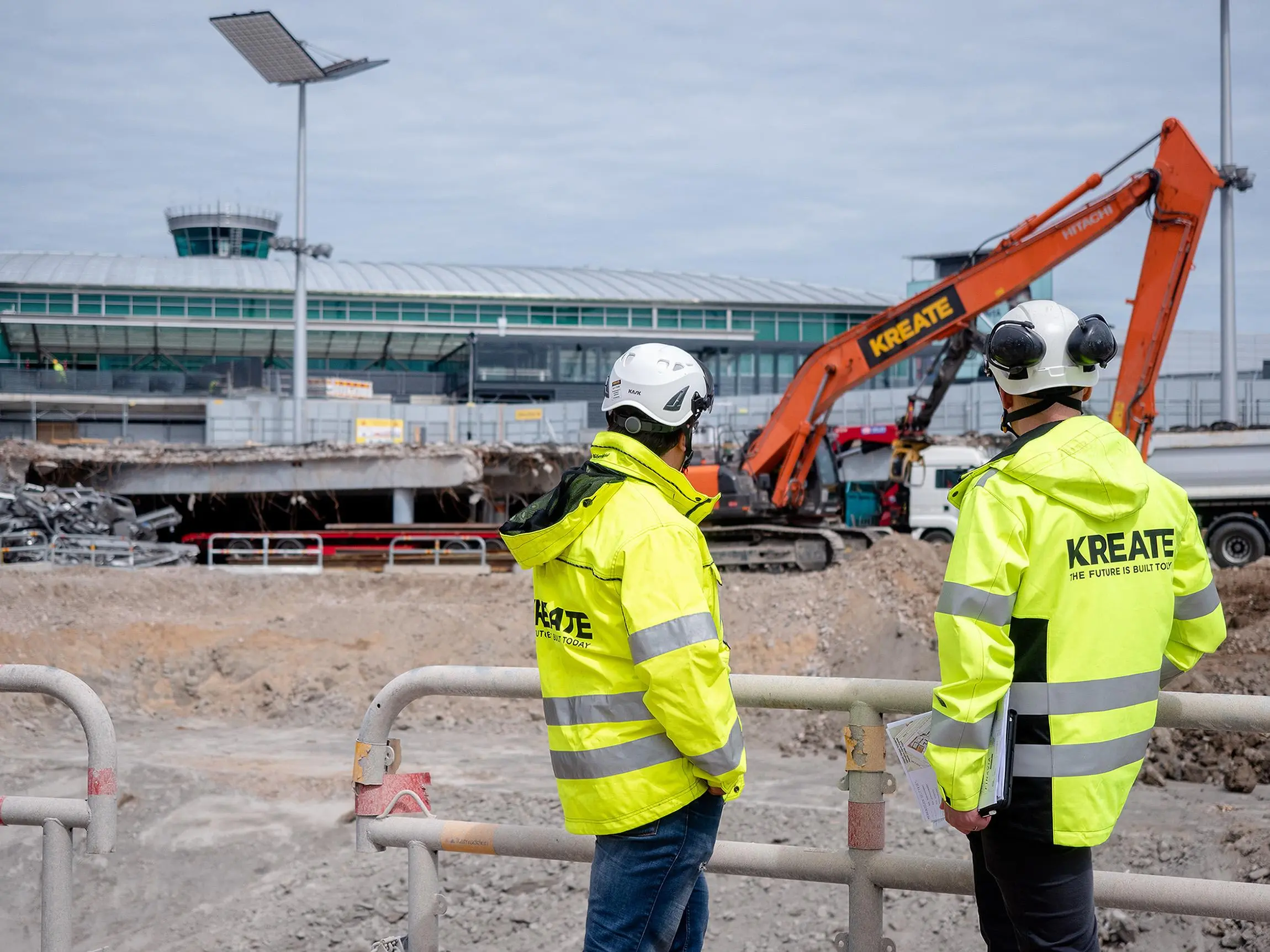
Kreate Group's subsidiary Kreate Sverige AB has appointed Per Anders Quist as chief executive officer, effective 19 October 2026. The company says the appointment is meant to support continued growth in Sweden and strengthen its position in the Nordic region, and notes that Kreate has already reached the target level set for its Swedish operations under the 2024–2027 strategy period, ahead of schedule. 

Quist joins from the Swedish Transport Administration, Trafikverket, where, according to the announcement, he was responsible for billion-scale infrastructure projects. He has more than 30 years of experience in infrastructure construction and has led major road, tunnel and other infrastructure projects in Sweden and Norway, including more than ten years at NCC in leadership roles in Norway and a board seat at NCC Norge AS. 

President and CEO Timo Vikström framed the hire around Kreate's next growth phase: "In Sweden, we have already reached a level that, a few years ago, we expected to achieve only in 2027. We intend to continue growing in the coming years. Per Anders' exceptionally broad experience in infrastructure construction from both the contractor's and the client's perspective provides him with excellent qualifications for the role. In addition, his straightforward and determined approach is a strong fit with Kreate's culture. We believe he is the right person to lead Kreate Sverige through its next phase of growth." 

Quist himself pointed to Norway as the next frontier: "Kreate has built a strong foundation for growth in Sweden. I see significant opportunities to continue growing the business in Sweden, while the Norwegian market also offers interesting opportunities. I look forward to developing our operations together with our employees and customers." The release notes Kreate currently explores Norway on a project-by-project basis and that Quist's Norwegian background supports a more permanent presence there. 

Outgoing CEO Kenneth Wahlqvist is leaving to pursue opportunities outside the company. Veli Taatila, Kreate Sverige's first CEO, will serve as interim CEO until Quist starts. 

The appointment lands on top of a record quarter

The Sweden CEO change follows weeks after Kreate's largest-ever Swedish contract and a group-wide guidance upgrade, the timing places a leadership change on top of the strongest operating momentum the unit has shown to date.

Kreate Group's April–June 2026 EBITA rose to EUR 9.3 million, or 5.0% of revenue, up from EUR 2.2 million, or 3.0% of revenue, a year earlier. Revenue for the quarter rose 152.3% to EUR 185.4 million, and the order backlog grew 215.2% to a record EUR 885.8 million. Much of that jump is acquisition-driven: KFS Finland Oy has been consolidated as a subsidiary since 1 April 2026, meaning the comparison is not like-for-like with the same quarter in 2025, when Kreate's full-year revenue was EUR 315 million. The half-year report attributes the broader growth to organizational scaling and strategic priorities including Sweden expansion, but Sweden itself, as the numbers below show, remains a small fraction of the group.Revenue for the quarter rose 152.3% to EUR 185.4 million, and the order backlog grew 215.2% to a record EUR 885.8 million. The company's half-year report linked the growth to organizational scaling and strategic priorities including Sweden expansion, and separately noted that KFS Finland Oy has been consolidated as a subsidiary since 1 April 2026.

On 16 June 2026, Kreate raised its full-year 2026 guidance to EUR 600–650 million in revenue and EUR 21–26 million in EBITA, up from a prior range of EUR 510–550 million and EUR 18–22 million, citing efficient project execution and stronger-than-expected order book development. A day after, Kreate Sverige had secured roughly SEK 320 million (about €30M) subcontract for the Lundby Tunnel renovation in Gothenburg, its largest contract to date, with Vikström saying, “We have systematically grown our business in Sweden, and the Lundby Tunnel contract is proof of our Swedish organisation’s ability to participate in increasingly larger projects based on its own special expertise. In line with our strategy, Sweden is developing into a second strong geographical pillar for the Group.”

The Swedish unit, in its own numbers

Kreate Group's half-year report gives the clearest picture of what Quist is inheriting. Sweden generated EUR 15.6 million of Group revenue in the second quarter of 2026, up 101.9% year-on-year, and EUR 31.1 million over the first half, up 82.8%; management describes this as revenue that "has developed according to plan." Sweden still accounts for a modest slice of the Group, about 10% of total revenue, against roughly 90% for Finland, but Kreate's own market assessment treats the two geographies identically: "stronger than usual" market conditions and a "strengthening" outlook in both. The backlog tells a tighter story: of the EUR 336 million Kreate expects to realize during 2026, Sweden's share is just EUR 21 million, about 6%, well below its 10% revenue weight, setting a modest ceiling on how much of this year's growth Quist's unit is expected to contribute before his own tenure begins. 

The half-year report also names underground rock construction as Kreate Sverige's largest business line, alongside growing concrete, earthworks and foundation engineering operations, and states that Kreate has become Sweden's leading contractor in tunnel lining, the same discipline underlying the Lundby Tunnel win. The report separately notes that a March 2026 tunnel-lining contract in Northern Norway marked a strategic entry into that market, which Kreate estimates at five to ten times the size of Sweden's, giving concrete shape to the Norway ambition both Vikström and Quist raised in the appointment release. 

What Kreate is aiming for

Kreate's own framing is that Sweden has outrun its 2024–2027 strategy target and is now being handed to an executive with Trafikverket and NCC Norway experience specifically to sustain that pace and to test a permanent Norwegian footprint. The Lundby Tunnel contract, running from September 2026 to August 2028, is described by the company as positioning Kreate Sverige for an expected growth phase in the Swedish tunnel construction market from 2027. Group-wide, the raised guidance implies management expects the momentum visible in the first half of 2026 to continue through year-end.

Leadership Moves

Nightingale Health removed its operating chief's role and put two commercial chiefs in its place

Aug 24, 2026

Two releases, on 19 August. Nightingale Health spent its operating chief's role on commercial leadership ten weeks after cutting its growth target — while the finance seat stays with the founder.

Nightingale Health published two leadership releases on 19 August. Janna Ranta, chief operating officer since May 2025, became Chief Commercial Officer, Research and Healthcare. Hugh Watson, who has spent 25 years in United States laboratory diagnostics, joined from outside as Chief Commercial Officer, Americas. Both changes took effect that day. Both changes took effect that day, and the operating role Ranta leaves behind will not be filled.

Taken separately, the two releases are a busy morning in Helsinki. Taken together, they are one decision: Nightingale Health has turned an operating seat into a selling seat, at the point where it needs the Americas to start producing revenue.

The appointments move two leadership roles fully onto the commercial side

Following the appointments, two new seats now hold fully commercial roles. Suna tied the timing to a completed build phase. "In the past year, we invested heavily in refreshing our core product, the Nightingale Health Check. That work required strong operational management, and Janna had a crucial role in completing the successful product refresh. With strong data on product-market fit, I'm excited to allocate more investment to our commercial scaling, and I warmly welcome Janna to her new role."

The growth downgrade came first

Nightingale Health entered its 2025 to 2026 financial year targeting revenue growth above 50%, and restated that target in March alongside half-year revenue of EUR 2.41 million and an operating loss of EUR 8.80 million for July to December 2025. 

On 8 June it reduced the target to approximately 20%, plus or minus 5%, after roughly EUR 2 million of revenue from one project moved into the following financial year for reasons the company said were outside its control.

Suna's framing at the time was that "the reason is timing, not lost business," with revenue in the next financial year expected to exceed EUR 10 million.

Ten weeks later that framing has resource attached to it. 

Watson runs execution in the Americas, Ranta keeps group-level oversight of it

The structure is worth noting. Ranta takes global research leadership and group-level oversight of the healthcare business in the Americas. Watson owns commercial execution in the region day to day, working alongside her rather than beneath her.

Watson's record sits squarely in the market the company is trying to open: two decades at Genova Diagnostics, rising from sales into vice-president roles, followed by a period as senior vice president at Boston Heart Diagnostics, a cardiometabolic laboratory in the United States. His own account of the move was about pace. "Throughout my career, I have built commercial organizations in laboratory diagnostics, and I am particularly drawn to companies where commercial execution must keep pace with scientific innovation. Nightingale Health is exactly that: technology validated at a scale our industry rarely sees, and a commercial opportunity in the Americas to match. I look forward to building it "

Suna was explicit about what the hire signals: "Attracting a commercial leader of Hugh's caliber says a lot about where Nightingale Health is heading."

A split like this buys two things at once, regional credibility from an outside hire and continuity from the insider who ran the product refresh. That reading of the split is interpretation.

Suna has been his own interim CFO for eight months

Nightingale Health's commercial organisation gained two chiefs in one morning. Its finance seat has been open since 8 December 2025, when Tuukka Paavola left after four years in the role and Suna stepped in on an interim basis while a search began. 

Four days later the company disclosed a wider management change: chief scientific officer Jeffrey Barrett would leave by March 2026, a chief medical officer would be recruited in his place rather than a new scientific officer, and the finance search would continue in order to support international sales growth.

Eight months on, based on the disclosures reviewed for this piece, no permanent appointment to that role has been announced. The founder is still carrying it, through a downgrade and now through a commercial build-out.

Leadership Moves

Finnair rebuilt four enabling functions in eight months and left the commercial core untouched

Aug 21, 2026

The digital and legal appointments announced on 18 August complete a set. People, finance, digital and legal, four of nine Executive Board functions, have a new holder named in 2026. The chief executive, operating, revenue, customer and communications seats have not moved. The rebuild is running from the strongest quarter Finnair has reported, and from a general meeting that rejected the company's pay report with 90 percent of the votes represented against it.

Finnair appointed Arti Zeighami, 55, as Chief Digital Officer from 19 August 2026, and Kaarina Ståhlberg, 59, as Senior Vice President and General Counsel from 31 August 2026. Both join the Executive Board and report to CEO Turkka Kuusisto. Zeighami succeeds Antti Kleemola, who supports the handover until the end of September. Ståhlberg succeeds Sami Sarelius, who continues as an executive advisor to Finnair until the end of the year.

The two profiles do not overlap, and neither comes from aviation. Zeighami was most recently Partner and Director at Boston Consulting Group working on the scaling of artificial intelligence, and before that Chief Data and Analytics Officer at H&M Group.

Ståhlberg holds a Master of Laws, was Assistant General Counsel at Nokia and General Counsel at both Posti Group and Fortum, and sits on the boards of Finnish listed companies like Aspo, Finnair, Fiskars group, Vincit.

Four of nine functions changed. None of them touch daily commercial execution.

Finnair discloses a nine-member Executive Board covering products and customers, revenue, operations, digital services, finance and strategy, people and culture, communications, and legal affairs. Four of those have a new holder named this year.

Two of the four are already in the job. Sini Kivekäs became Chief People Officer and joined the Executive Board on 2 June, the day Kaisa Aalto-Luoto left it, four months after Finnair disclosed the departure on 19 January.

Ståhlberg starts in legal on 31 August. Finance follows on 1 November, when Jussi Siitonen becomes Chief Financial Officer in place of Pia Aaltonen-Forsell, who is leaving for the same role at Valmet.

The finance change carried a governance step. Siitonen was re-elected to the Board of Directors on 24 March and resigned from it on 24 July, the day his appointment was announced. Crossing from a non-executive seat to an executive one requires exactly that, and the board consequently runs with seven of the eight directors elected in March until the next general meeting.

The rebuild is being done from a record quarter, not a bad one

Second-quarter revenue was EUR 916.7 million, up 16.4 percent from EUR 787.7 million. The comparable operating result was EUR 78.4 million against EUR 10.3 million a year earlier, and passenger numbers rose 7.6 percent to 3.314 million.

Across the half year, revenue reached EUR 1,694.8 million from EUR 1,481.9 million, and the comparable operating result turned to EUR 77.8 million from a loss of EUR 52.3 million. The first quarter had already improved, with revenue up 12.1 percent to EUR 778.1 million and a comparable operating result of EUR -0.6 million.

Finnair raised its 2026 outlook on 22 July to revenue of EUR 3.4 to 3.5 billion and a comparable operating result of EUR 120 to 190 million, assuming no material disruption to fuel availability. Kuusisto called the quarterly figure "a record-high 78.4 million euros", which is the company's characterisation of its own result. July passenger volume rose 9.3 percent year on year.

Enabling functions are often rebuilt after a shock. These are being rebuilt while the numbers improve.

The board survived the March general meeting intact. The pay report did not

The shareholders' nomination board proposed an unchanged board on 15 January, and the meeting on 24 March re-elected all eight directors, with Sanna Suvanto-Harsaae as chair and Mika Ihamuotila as vice chair. The 2025 accounts were adopted.

The remuneration report was rejected. Of the 140,441,158 shares and votes represented at the meeting, 126,215,985 were cast against approving it, approximately 94 percent of the votes cast in advance voting and approximately 90 percent of those represented. The minutes record that the resolution was advisory, that the rejection does not oblige Finnair to prepare a new report, and that it does not affect remuneration decisions already made. Rejections at this scale are uncommon in Finland.

Three dates decide whether the rebuild reads as strength

The third-quarter report in October is the first with the digital seat filled. The finance handover lands on 1 November. The 2027 nomination board proposal, due in January, is the first read on whether shareholders who rejected the pay report intend to press further. Whether four function changes in eight months speed execution or slow it remains an open question.

Insider interviews

The work in between is ownership: Accendo's Kai Tavakka on First North small caps

Aug 18, 2026

Weak consumer confidence has made First North small caps look cheap. Kai Tavakka of Accendo Capital argues the real constraint is ownership, not price. Small listed companies need committed, long-term owners who work with boards and management when the market is not paying attention.

“Short-term mood does not change what a company can become. It changes what you pay to own it.”
Kai Tavakka
Kai TavakkaManaging Partner, Accendo Capital

First North has been a hard place to own. The Nasdaq First North Finland index is down about 29% over the past year and about 65% over the past five, as of 6 August 2026. For many investors, that is a reason to stay away. For Kai Tavakka, Managing Partner of the Nordic active-ownership investor Accendo Capital, it is closer to the opposite.

"The mistake is to read a falling small-cap index only as a verdict on the companies inside it," Tavakka says. "Often it is also a verdict on confidence, liquidity and who is willing to own these companies through the cycle."

Why the segment got cheaper

Accendo ties the sell-off to consumer confidence. Appetite for smaller, higher-risk listed companies tends to follow it, and on Accendo’s reading confidence in Finland and Sweden has stayed weak since 2021. When households feel poorer and investors become more cautious, money moves toward larger, more familiar names. In a retail-driven market, the buyers for small and micro caps can disappear quickly.

“When confidence is low, money goes to whatever feels safe or is mainstream.”
Kai Tavakka
Kai TavakkaManaging Partner, Accendo Capital

“That pulls valuations down across the small-cap segment,” Tavakka says, “even when the potential of selected companies has not deteriorated in the same way.”

The result, on Accendo's reading, is a market where price can detach from quality. Tavakka points to a sharp compression in valuation multiples over the past five years, even as many underlying companies have improved their products, technology and cost structures.

"Of course, several companies have not delivered on their original growth ambitions," he says. "But in selected cases, we see the potential getting better while valuations have moved to new lows. That is where we see the opportunity."

Why cheap is not enough

This is where Accendo's case parts company with a simple "buy the dip" theme.

"Short-term mood does not change what a company can become," Tavakka says. "It changes what you pay to own it. The work in between is ownership: the right board, the right management, focused strategy, disciplined capital allocation and enough patience for the company to become worth more."

That is the part Accendo does itself. It runs a concentrated portfolio of Northern European small caps and works closely with boards, nomination committees and management teams rather than trading in and out. Tavakka was named Young Board Member of the Year at the 2025 Nordic Listed Leaders gala, recognition for that hands-on work.

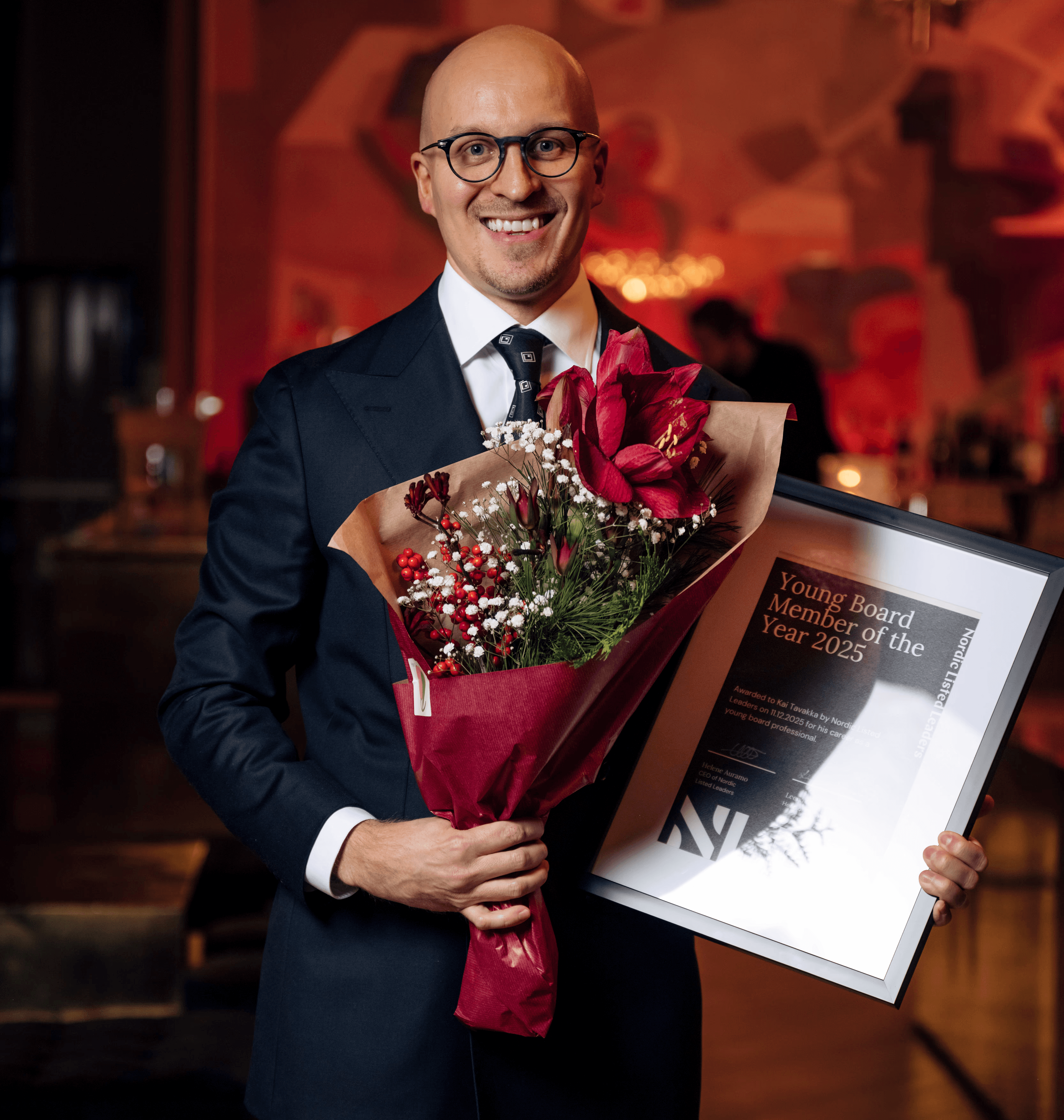
Kai Tavakka winning the award: Young Board Member of the Year at the 2025 Nordic Listed Leaders gala. Photographer: Eino Ansio. Nordic Listed Leaders is part of Listeds

The companies it has owned and engaged with as an active owner include Finnish cybersecurity firm SSH Communications Security and Helsinki-listed game studio Remedy Entertainment, alongside Swedish names such as the connectivity infrastructure group Hexatronic. On its own analysis, the entry point for the Nordic small- and micro-cap segment is among the most attractive it has seen in years.

The ownership gap

First North is, by Accendo’s description, largely a retail market, with private investors accounting for much of the trading. Today, those investors have access to a vast amount of information, but they complement rather than replace committed owners who work with the companies to strengthen strategy and governance.

Public small-cap markets, as Accendo frames it, need more committed, active and long-term owners. The market works best when it is not driven only by short-term traders or diversified portfolio managers, but also by owners willing to engage over several years. IPOs are one example. In Tavakka's view, the goal of an IPO should not be a strong first trading period. The more important question is whether the listing leaves the company with a better ownership structure: fresh capital, and owners with the incentive and the mandate to help in the next phase.

On our reading, the more useful lesson is not that First North is cheap. A two-thirds fall over five years establishes that on its own. It is that cheapness and a healthy market are not the same thing. A segment reprices back toward value only if someone is willing to own it through the doubt, and on First North that owner is often missing: the index has retail buyers and passive institutional money, but too few engaged, multi-year holders who take a board seat and stay.

Tavakka has a commercial interest in saying so; it is his company’s model. But the underlying point holds. A small-cap market can stay open and still be unhealthy: prices fall, good companies get sold too early or run out of steam, and the market grinds on. That is a governance problem before it is a pricing one, and it shows up in the ownership registers Listeds tracks company by company.

Accendo's model is typically a 10-30% stake and one or two board seats, including chair roles where it is needed. The work often includes recruiting board and management talent, focusing strategy, and strengthening financial and commercial discipline

Finland is one of the clearest cases. It has strong engineering and a deep research base, but has often struggled to turn that into global commercial winners before companies are sold or lose momentum. 

Tavakka welcomes the region's new unicorns and venture capital success stories, but argues that Europe also needs healthier listed small-cap markets. These markets allow a wider range of investors to participate in the next generation of technology companies, and give companies another route to scale if the venture capital path has not yet produced success.

Where patience matters

The market still has not recovered, and Tavakka is careful not to call a bottom. Confidence may be improving, but that does not mean valuations turn immediately. A market down roughly 65% over five years is cheap, but not risk-free.

What Accendo offers is not a prediction of the turn but a way of operating through it: concentrated positions, long holding periods and active involvement in the companies it owns. Tavakka says this patient, active-ownership approach has helped Accendo outperform its equity benchmarks since its inception in 2008. For a private investor without that toolkit, the same entry point carries more timing risk.

"We do not pretend to know the exact bottom, and we are not too concerned about it," Tavakka says. "We buy quality we understand, help companies improve, and seek value-adding exits. That is our way to invest in this part of the market."


Kai Tavakka

Managing Partner, Accendo Capital

He has been a Board Member of:

  • SSH Communications Security - Board Member since 2020

  • Remedy Entertainment - Board Member since 2024

  • Careium AB - Board Member from 2022 to 2026


Accendo Capital is a Nordic active-ownership investor focused on listed small and micro-cap technology companies in Northern Europe. Founded in 2008, Accendo typically takes concentrated ownership positions and works with companies through boards, nomination committees and management teams over multi-year periods. Its current portfolio includes companies such as SSH Communications Security, Remedy Entertainment, Hexatronic Group, Impact Coatings, and Modelon.

Insider interviews

The work in between is ownership: Accendo's Kai Tavakka on First North small caps

Aug 18, 2026

Weak consumer confidence has made First North small caps look cheap. Kai Tavakka of Accendo Capital argues the real constraint is ownership, not price. Small listed companies need committed, long-term owners who work with boards and management when the market is not paying attention.

“Short-term mood does not change what a company can become. It changes what you pay to own it.”
Kai Tavakka
Kai TavakkaManaging Partner, Accendo Capital

First North has been a hard place to own. The Nasdaq First North Finland index is down about 29% over the past year and about 65% over the past five, as of 6 August 2026. For many investors, that is a reason to stay away. For Kai Tavakka, Managing Partner of the Nordic active-ownership investor Accendo Capital, it is closer to the opposite.

"The mistake is to read a falling small-cap index only as a verdict on the companies inside it," Tavakka says. "Often it is also a verdict on confidence, liquidity and who is willing to own these companies through the cycle."

Why the segment got cheaper

Accendo ties the sell-off to consumer confidence. Appetite for smaller, higher-risk listed companies tends to follow it, and on Accendo’s reading confidence in Finland and Sweden has stayed weak since 2021. When households feel poorer and investors become more cautious, money moves toward larger, more familiar names. In a retail-driven market, the buyers for small and micro caps can disappear quickly.

“When confidence is low, money goes to whatever feels safe or is mainstream.”
Kai Tavakka
Kai TavakkaManaging Partner, Accendo Capital

“That pulls valuations down across the small-cap segment,” Tavakka says, “even when the potential of selected companies has not deteriorated in the same way.”

The result, on Accendo's reading, is a market where price can detach from quality. Tavakka points to a sharp compression in valuation multiples over the past five years, even as many underlying companies have improved their products, technology and cost structures.

"Of course, several companies have not delivered on their original growth ambitions," he says. "But in selected cases, we see the potential getting better while valuations have moved to new lows. That is where we see the opportunity."

Why cheap is not enough

This is where Accendo's case parts company with a simple "buy the dip" theme.

"Short-term mood does not change what a company can become," Tavakka says. "It changes what you pay to own it. The work in between is ownership: the right board, the right management, focused strategy, disciplined capital allocation and enough patience for the company to become worth more."

That is the part Accendo does itself. It runs a concentrated portfolio of Northern European small caps and works closely with boards, nomination committees and management teams rather than trading in and out. Tavakka was named Young Board Member of the Year at the 2025 Nordic Listed Leaders gala, recognition for that hands-on work.

Kai Tavakka winning the award: Young Board Member of the Year at the 2025 Nordic Listed Leaders gala. Photographer: Eino Ansio. Nordic Listed Leaders is part of Listeds

The companies it has owned and engaged with as an active owner include Finnish cybersecurity firm SSH Communications Security and Helsinki-listed game studio Remedy Entertainment, alongside Swedish names such as the connectivity infrastructure group Hexatronic. On its own analysis, the entry point for the Nordic small- and micro-cap segment is among the most attractive it has seen in years.

The ownership gap

First North is, by Accendo’s description, largely a retail market, with private investors accounting for much of the trading. Today, those investors have access to a vast amount of information, but they complement rather than replace committed owners who work with the companies to strengthen strategy and governance.

Public small-cap markets, as Accendo frames it, need more committed, active and long-term owners. The market works best when it is not driven only by short-term traders or diversified portfolio managers, but also by owners willing to engage over several years. IPOs are one example. In Tavakka's view, the goal of an IPO should not be a strong first trading period. The more important question is whether the listing leaves the company with a better ownership structure: fresh capital, and owners with the incentive and the mandate to help in the next phase.

On our reading, the more useful lesson is not that First North is cheap. A two-thirds fall over five years establishes that on its own. It is that cheapness and a healthy market are not the same thing. A segment reprices back toward value only if someone is willing to own it through the doubt, and on First North that owner is often missing: the index has retail buyers and passive institutional money, but too few engaged, multi-year holders who take a board seat and stay.

Tavakka has a commercial interest in saying so; it is his company’s model. But the underlying point holds. A small-cap market can stay open and still be unhealthy: prices fall, good companies get sold too early or run out of steam, and the market grinds on. That is a governance problem before it is a pricing one, and it shows up in the ownership registers Listeds tracks company by company.

Accendo's model is typically a 10-30% stake and one or two board seats, including chair roles where it is needed. The work often includes recruiting board and management talent, focusing strategy, and strengthening financial and commercial discipline

Finland is one of the clearest cases. It has strong engineering and a deep research base, but has often struggled to turn that into global commercial winners before companies are sold or lose momentum. 

Tavakka welcomes the region's new unicorns and venture capital success stories, but argues that Europe also needs healthier listed small-cap markets. These markets allow a wider range of investors to participate in the next generation of technology companies, and give companies another route to scale if the venture capital path has not yet produced success.

Where patience matters

The market still has not recovered, and Tavakka is careful not to call a bottom. Confidence may be improving, but that does not mean valuations turn immediately. A market down roughly 65% over five years is cheap, but not risk-free.

What Accendo offers is not a prediction of the turn but a way of operating through it: concentrated positions, long holding periods and active involvement in the companies it owns. Tavakka says this patient, active-ownership approach has helped Accendo outperform its equity benchmarks since its inception in 2008. For a private investor without that toolkit, the same entry point carries more timing risk.

"We do not pretend to know the exact bottom, and we are not too concerned about it," Tavakka says. "We buy quality we understand, help companies improve, and seek value-adding exits. That is our way to invest in this part of the market."


Kai Tavakka

Managing Partner, Accendo Capital

He has been a Board Member of:

  • SSH Communications Security - Board Member since 2020

  • Remedy Entertainment - Board Member since 2024

  • Careium AB - Board Member from 2022 to 2026


Accendo Capital is a Nordic active-ownership investor focused on listed small and micro-cap technology companies in Northern Europe. Founded in 2008, Accendo typically takes concentrated ownership positions and works with companies through boards, nomination committees and management teams over multi-year periods. Its current portfolio includes companies such as SSH Communications Security, Remedy Entertainment, Hexatronic Group, Impact Coatings, and Modelon.

Insider interviews

The work in between is ownership: Accendo's Kai Tavakka on First North small caps

Aug 18, 2026

Weak consumer confidence has made First North small caps look cheap. Kai Tavakka of Accendo Capital argues the real constraint is ownership, not price. Small listed companies need committed, long-term owners who work with boards and management when the market is not paying attention.

“Short-term mood does not change what a company can become. It changes what you pay to own it.”
Kai Tavakka
Kai TavakkaManaging Partner, Accendo Capital

First North has been a hard place to own. The Nasdaq First North Finland index is down about 29% over the past year and about 65% over the past five, as of 6 August 2026. For many investors, that is a reason to stay away. For Kai Tavakka, Managing Partner of the Nordic active-ownership investor Accendo Capital, it is closer to the opposite.

"The mistake is to read a falling small-cap index only as a verdict on the companies inside it," Tavakka says. "Often it is also a verdict on confidence, liquidity and who is willing to own these companies through the cycle."

Why the segment got cheaper

Accendo ties the sell-off to consumer confidence. Appetite for smaller, higher-risk listed companies tends to follow it, and on Accendo’s reading confidence in Finland and Sweden has stayed weak since 2021. When households feel poorer and investors become more cautious, money moves toward larger, more familiar names. In a retail-driven market, the buyers for small and micro caps can disappear quickly.

“When confidence is low, money goes to whatever feels safe or is mainstream.”
Kai Tavakka
Kai TavakkaManaging Partner, Accendo Capital

“That pulls valuations down across the small-cap segment,” Tavakka says, “even when the potential of selected companies has not deteriorated in the same way.”

The result, on Accendo's reading, is a market where price can detach from quality. Tavakka points to a sharp compression in valuation multiples over the past five years, even as many underlying companies have improved their products, technology and cost structures.

"Of course, several companies have not delivered on their original growth ambitions," he says. "But in selected cases, we see the potential getting better while valuations have moved to new lows. That is where we see the opportunity."

Why cheap is not enough

This is where Accendo's case parts company with a simple "buy the dip" theme.

"Short-term mood does not change what a company can become," Tavakka says. "It changes what you pay to own it. The work in between is ownership: the right board, the right management, focused strategy, disciplined capital allocation and enough patience for the company to become worth more."

That is the part Accendo does itself. It runs a concentrated portfolio of Northern European small caps and works closely with boards, nomination committees and management teams rather than trading in and out. Tavakka was named Young Board Member of the Year at the 2025 Nordic Listed Leaders gala, recognition for that hands-on work.

Kai Tavakka winning the award: Young Board Member of the Year at the 2025 Nordic Listed Leaders gala. Photographer: Eino Ansio. Nordic Listed Leaders is part of Listeds

The companies it has owned and engaged with as an active owner include Finnish cybersecurity firm SSH Communications Security and Helsinki-listed game studio Remedy Entertainment, alongside Swedish names such as the connectivity infrastructure group Hexatronic. On its own analysis, the entry point for the Nordic small- and micro-cap segment is among the most attractive it has seen in years.

The ownership gap

First North is, by Accendo’s description, largely a retail market, with private investors accounting for much of the trading. Today, those investors have access to a vast amount of information, but they complement rather than replace committed owners who work with the companies to strengthen strategy and governance.

Public small-cap markets, as Accendo frames it, need more committed, active and long-term owners. The market works best when it is not driven only by short-term traders or diversified portfolio managers, but also by owners willing to engage over several years. IPOs are one example. In Tavakka's view, the goal of an IPO should not be a strong first trading period. The more important question is whether the listing leaves the company with a better ownership structure: fresh capital, and owners with the incentive and the mandate to help in the next phase.

On our reading, the more useful lesson is not that First North is cheap. A two-thirds fall over five years establishes that on its own. It is that cheapness and a healthy market are not the same thing. A segment reprices back toward value only if someone is willing to own it through the doubt, and on First North that owner is often missing: the index has retail buyers and passive institutional money, but too few engaged, multi-year holders who take a board seat and stay.

Tavakka has a commercial interest in saying so; it is his company’s model. But the underlying point holds. A small-cap market can stay open and still be unhealthy: prices fall, good companies get sold too early or run out of steam, and the market grinds on. That is a governance problem before it is a pricing one, and it shows up in the ownership registers Listeds tracks company by company.

Accendo's model is typically a 10-30% stake and one or two board seats, including chair roles where it is needed. The work often includes recruiting board and management talent, focusing strategy, and strengthening financial and commercial discipline

Finland is one of the clearest cases. It has strong engineering and a deep research base, but has often struggled to turn that into global commercial winners before companies are sold or lose momentum. 

Tavakka welcomes the region's new unicorns and venture capital success stories, but argues that Europe also needs healthier listed small-cap markets. These markets allow a wider range of investors to participate in the next generation of technology companies, and give companies another route to scale if the venture capital path has not yet produced success.

Where patience matters

The market still has not recovered, and Tavakka is careful not to call a bottom. Confidence may be improving, but that does not mean valuations turn immediately. A market down roughly 65% over five years is cheap, but not risk-free.

What Accendo offers is not a prediction of the turn but a way of operating through it: concentrated positions, long holding periods and active involvement in the companies it owns. Tavakka says this patient, active-ownership approach has helped Accendo outperform its equity benchmarks since its inception in 2008. For a private investor without that toolkit, the same entry point carries more timing risk.

"We do not pretend to know the exact bottom, and we are not too concerned about it," Tavakka says. "We buy quality we understand, help companies improve, and seek value-adding exits. That is our way to invest in this part of the market."


Kai Tavakka

Managing Partner, Accendo Capital

He has been a Board Member of:

  • SSH Communications Security - Board Member since 2020

  • Remedy Entertainment - Board Member since 2024

  • Careium AB - Board Member from 2022 to 2026


Accendo Capital is a Nordic active-ownership investor focused on listed small and micro-cap technology companies in Northern Europe. Founded in 2008, Accendo typically takes concentrated ownership positions and works with companies through boards, nomination committees and management teams over multi-year periods. Its current portfolio includes companies such as SSH Communications Security, Remedy Entertainment, Hexatronic Group, Impact Coatings, and Modelon.

Leadership Moves

Digia names Kimmo Kärkkäinen CFO, hired from fellow IT company Vincit

Aug 14, 2026

Kimmo Kärkkäinen will take over as Digia's CFO by February 2027 at the latest, arriving from Vincit's finance seat. It is the second time since 2017 that Digia has filled its CFO role with a sitting CFO from another Nasdaq Helsinki company, a pattern Listeds examines across the wider market in a companion piece.

Digia has appointed Kimmo Kärkkäinen (b. 1972) as Chief Financial Officer and a member of the management team, effective by February 2027 at the latest, reporting to President and CEO Timo Levoranta. Kärkkäinen joins from Vincit, where he is currently CFO, and has previously held CFO roles at Fira Group and leadership positions at Sitedrive Oy, private-equity firm Bocap, Affecto Plc, and TeliaSonera.

He succeeds Kristiina Simola, who announced on 21 April 2026 that she would step down to pursue a board career after serving as Digia's CFO since 2017. Simola remains in post through the transition, with an outside date of end-October 2026.

Vincit has confirmed Kärkkäinen's resignation "to join another company," with him continuing in role during a transition period until the beginning of November 2026 at the latest while it recruits a successor. CEO Julius Manni thanked him for developing the company's processes and leadership culture.

On the appointment, Kärkkäinen said: "Digia has made an impressive journey as a profitable growth company, and it has a strong position in the Finnish software and services market. I am excited to join Digia in building its next phase. As Chief Financial Officer, I want to support the implementation of the strategy and the growth of shareholder value together with a skilled team.”

Levoranta cited Kärkkäinen’s “strong experience in financial management and business development,” as well as his experience in mergers and acquisitions and in building growth companies and new businesses.

Sales are still growing, but Digia's EBITA margin is shrinking

Digia enters the transition from a mixed position. Full-year 2025 was strong: net sales rose 5.5% to EUR 217.0 million, and the fourth quarter closed the year hard, with net sales up 10.5% to EUR 60.2 million and EBITA up 45.5% to EUR 8.5 million; the March 2026 AGM approved a dividend of EUR 0.19 per share. But 2026 opened weaker. In the first quarter, net sales grew 4.9% to EUR 56.4 million while EBITA fell 28.2% to EUR 3.3 million, partly on non-recurring change-negotiation and provision costs. The first half told the same story: net sales up 2.9% to EUR 110.7 million against EBITA down 16.7% to EUR 6.4 million, with EUR 2 million of non-recurring items, even as the equity ratio improved to 48.5% and net gearing fell to 23.4%; Digia pointed to market uncertainty weighing on customer investment decisions.

Market pressure ran alongside headcount reductions: Digia announced change negotiations on 27 February 2026, with negotiations beginning on 5 March and covering roughly 300 of Digia's 1,600 employees. The negotiations concluded on 25 March, with 31 positions ultimately set to be reduced and estimated annual cost savings of about EUR 2.4 million.

Against that backdrop, Digia set medium-term targets at its 5 February 2026 strategy update and 21 May 2026 Capital Markets Day: average annual net sales growth above 10%, an EBITA margin above 12% at the end of the strategy period, and 30% of net sales from outside Finland at the end of the strategy period.

This is the second time Digia has hired its CFO from another listed company

The move fits a recurring Nasdaq Helsinki pattern: rather than promote internally or hire a first-time CFO, Finnish listed companies frequently recruit a sitting CFO from another listed company. Digia is a clear case. Simola arrived from Digitalist Group Plc in 2017, Kärkkäinen from Vincit in 2026, both from public-company finance seats.

And the pattern rarely stops at a single move. Kärkkäinen's own departure now leaves Vincit's CFO seat open, and Vincit has already begun the search for a successor. That vacancy is the next in a run of ten finance-chief changes Listeds tracked across Nasdaq Helsinki and First North between December 2025 and August 2026, read as a set in the companion feature: The easiest way to become CFO of a Finnish listed company? Already be one at another.

Leadership Moves

Raisio built its growth plan before it hired Elli Siltala. Her first move is to listen

Aug 11, 2026

Raisio spent 2025 preparing to grow: it sold off a loss-making plant-protein unit, set hard 2027 targets and built a standing M&A function. Then it handed the company to Elli Siltala, a food-industry veteran of around 25 years at Valio, who has said her first priority is to listen and learn before setting a direction. The plan is already built. The open question is how Raisio's new chief executive chooses to take it forward.

Raisio is a Finnish brand house. It’s worth sits in names: Benecol, brand sold on cholesterol lowering products, and Elovena, the oats brand, both marketed well beyond Finland, alongside home-market staples such as Sunnuntai baking goods, Torino pasta and Nalle cereals.

Growing a brand house means one of two things: build the brands harder, or buy new ones. Raisio's board has said, in writing, that it intends to do both, and it has spent the past eighteen months building the capacity to do the buying.

On Wednesday, 12 August 2026, the company publishes its half-year report. Elli Siltala, appointed CEO on 7 August, does not start until 1 September; until then the outgoing Pasi Flinkman holds the seat.

The board chose the tool. The CEO chose to listen

Chairman Arto Tiitinen said in the appointment release that "under Elli Siltala's leadership our ambition is to grow the company through both organic growth and acquisitions." Read against the run of Nordic CEO-change releases, that is a pointed line. Boards usually credential the incoming chief executive and gesture at a "next phase." Tiitinen named the instrument, acquisitions, and set the direction before Siltala set foot in the building.

Siltala's own words went the other way. After the standard opening, she closed on this: "My first priority will be to listen, learn and build a shared understanding of how we can create long-term value for our shareholders, customers and employees."

Across the incoming-CEO releases on Listeds Executive Intelligence database, that is unusual. Most new chief executives arrive with at least a directional theme on day one: a capability to strengthen, a strategy to keep executing, a model to scale. Siltala, in this set, is the only one to make listening itself the priority and to leave the agenda more open.

The growth plan was built a year before its CEO

Here is what makes the contrast matter. The growth Tiitinen named is not merely an intention waiting on a new leader. It is a plan already in operation, and Flinkman built it.

Raisio narrowed before it aimed to grow. On 13 February 2025 it agreed to sell its entire plant-protein business, including the Härkis and Beanit brands, the Kauhava production assets and 16 employees, to Valio for EUR 7 million in cash: a unit that had booked EUR 4.5 million in net sales but a EUR 2.6 million loss in 2024.

A month later, on 13 March 2025, it published a 2025 to 2027 strategy built on three growth areas: breakfast and snacking, heart health, and new business. The sequence is the point: sell the loss-maker, then concentrate on the brands that pay.

The strategy set targets for the end of 2027: net sales of EUR 250 million and EBIT of over EUR 30 million, up from 2025 comparable figures of EUR 224.2 million and EUR 28.5 million. Acquisitions were written into the plan from the start.

Raisio then built the capacity to act on them. It created a dedicated M&A Director role, hiring Anni Palmio, a strategy-and-M&A lead from Paulig with earlier brand roles at Findus and Haribo, with effect from 1 September 2025, and set up a committee to steer the board's M&A work. A mid-cap food company of around 350 people does not stand up a permanent acquisition function by accident.

Two dates belong side by side. Palmio's M&A seat took effect on 1 September 2025. Siltala's CEO seat takes effect on 1 September 2026. The acquisition machinery is exactly one year older, and it was assembled under the CEO now leaving to other opportunities.

A brand builder, handed a buyer's mandate

Siltala's career has largely followed the commercial side of the business, with a strong focus on sales and marketing. She was at Valio from 2001 to 2025, progressing from various business, sales and marketing roles to executive positions including EVP Domestic Sales and Marketing, EVP Markets, EVP Core Businesses and Brands, and finally EVP Core Businesses, Home Markets and Primary Production.

She left Valio in November 2025. From May 2026 she was Chief Loyalty and Media Officer at SOK, a seat spanning marketing, loyalty, retail media, communications and public affairs, which she held for roughly three months before Raisio named her.

There is a Nordic small-world footnote here. The plant-protein business Raisio sold in early 2025 went to Valio, the company where Siltala spent her career and sat on the executive team at the time. She now leads the company that sold it.

That profile also runs against the Nordic grain. Marketing and brand titles rarely reach the top table of Finnish listed companies at all, based on ongoing preliminary Listeds analysis, only a handful carry a standalone chief marketing officer, and large caps are notably absent from that list

A sales-and-marketing leader moving up to run a listed company is rarer again. At a brand house, though, the fit is a natural one: when a company's value lives in names like Benecol and Elovena, a chief executive who has spent a career close to sales, brands and customers is on home ground.

The open question is how she chooses to balance the two: carry the acquisition programme forward as set out, or lean toward the organic, category-led growth she seems to know well.

Stay on the pulse, catch the signals

Register to Listeds Platform to follow companies and leaders

Stay on the pulse, catch the signals

Register to Listeds Platform to follow companies and leaders

Latest signalsLive feed
Moves trackerLive feed

Investor Event

Listeds Investor Event · Defence

Nordic defence is in a once-in-a-generation growth cycle. Eight listed and pre-IPO companies pitch to 100+ invited investors at Valkoinen Sali, Helsinki

21 September 2026

Stay on the pulse, catch the signals

Subscribe to Listeds Leadership Intelligence Platform:

  • leader and company database access

  • email alerts

  • career, boards and interim opportunities

Our Pulse newsletter

Your weekly leadership intelligence briefing.

What happened, why it matters, and what to watch across every CEO, board, and executive move in Nordic listed companies, starting with Finland. Fast, factual, and to the point.

Delivered every Monday.

By signing up, you agree to our Privacy Policy