/

Author

Devdatta Temgire

Analyst

Devdatta Temgire is a data and business analyst at Listeds. He contributes research, data analysis, and pattern detection to the publication’s coverage of Nordic-listed companies, with a focus on board composition, leadership transitions, and financials. He holds an honors degree in artificial intelligence and data science alongside a bachelor’s in computer engineering, and previously worked at KPMG.

/

Author

Devdatta Temgire

Analyst

Devdatta Temgire is a data and business analyst at Listeds. He contributes research, data analysis, and pattern detection to the publication’s coverage of Nordic-listed companies, with a focus on board composition, leadership transitions, and financials. He holds an honors degree in artificial intelligence and data science alongside a bachelor’s in computer engineering, and previously worked at KPMG.

/

Author

Devdatta Temgire

Analyst

Devdatta Temgire is a data and business analyst at Listeds. He contributes research, data analysis, and pattern detection to the publication’s coverage of Nordic-listed companies, with a focus on board composition, leadership transitions, and financials. He holds an honors degree in artificial intelligence and data science alongside a bachelor’s in computer engineering, and previously worked at KPMG.

Leaders

Juuso Pajunen joins Tieto from Terveystalo, and Finland's CFO chain runs one seat longer

Sep 18, 2026

Two stock exchange releases at 9:00 a.m. on 16 September moved one CFO between two Helsinki large caps that had cut guidance two days apart in July. Terveystalo named no successor and opened the search the same day — twelve days after handing Pajunen a second executive brief. Tieto filled the seat with a sitting CFO, which is the only way the job has been filled in Finland since December 2025.

Terveystalo and Tieto published matching stock exchange releases at 9:00 a.m. EEST on 16 September 2026. Pajunen, Terveystalo's Chief Financial Officer since November 2022, leaves on 15 December 2026 and joins Tieto by 1 January 2027 at the latest, reporting to Endre Rangnes. Terveystalo named no successor and opened the search the same day. The same Tieto release confirmed Johan Enger Nygaard at Tieto Tech Consulting and Bent Philipps at Tieto Indtech from 1 October, both interim since May 2026. 

Tieto's last first-time CFO is leaving; the next one arrives with the title

In August, Listeds counted atleast ten CFO changes across Nasdaq Helsinki and First North between December 2025 and August 2026. Every incoming CFO already held the title at another listed company. None was promoted from inside. None was taking the job for the first time. 

Tomi Hyryläinen, who steps down at the end of December 2026 after nearly eight years, joined Tieto in 2018 from PwC Finland, where he had been an assurance leader and partner. Tieto was his first listed-company CFO seat. Tieto has now filled it with a CFO already running finance at another Helsinki large cap, and before that at AFRY and Pöyry Group. 

Terveystalo widened Pajunen's job twelve days before losing him

Terveystalo reports in three segments today: Healthcare Services, Portfolio Businesses and Sweden. On 4 September it said Portfolio Businesses would be split from 1 January 2027, with Oral Health and Public Partnerships each becoming a reportable segment in their own right, and named Pajunen EVP of Portfolio Businesses until the end of 2026. He was covering for Henri Mäenalanen, who had announced on 29 June that he was leaving on 1 October to run Yliopiston Apteekki. Twelve days after taking the second brief, Pajunen announced his own exit. 

The date lands inside a crowded quarter. The EUR 574 million Silmäasema acquisition is expected to close by late 2026 or in the first quarter of 2027, the four-segment reporting starts on 1 January, and the Shareholders' Nomination Board must deliver its proposals by 1 February 2027. The CFO search runs across all of it.

Ville Iho put it in the company's own words: "Juuso has played a key role in the implementation of Terveystalo's profit improvement program and significant acquisitions, as well as in the development of financial leadership.”

One balance sheet is being levered up, the other handed back

Terveystalo reported first-half revenue of EUR 601.5 million, down 10.0%, adjusted operating profit of EUR 59.8 million, down 29.3%, and earnings per share of EUR 0.24, down 44.4%. On 15 July it cut 2026 adjusted operating profit guidance to EUR 120–140 million from EUR 135–165 million, against EUR 156.3 million delivered in 2025. It has raised its leverage ceiling to 3x net debt to adjusted EBITDA, cut dividend distribution to at least 50% of net result, and committed EUR 275 million in cash plus 36,500,000 new shares to Silmäasema, roughly 22.4% of shares outstanding after completion. 

Tieto reported second-quarter revenue of EUR 426.6 million, down 7.9%, with adjusted operating profit up 45.1% to EUR 63.4 million and margin at 14.9% against 9.4%. It cut its organic growth outlook on 17 July to between –5% and –3% and held the margin range at 14.8–15.8%. 

At Tieto he set the brief himself: "Tieto has a strong position in technological transformation and is well positioned for digital opportunities. At the same time, both Tieto and the entire industry are undergoing rapid changes, driven by AI. I am excited to join this fast-paced industry and believe that, with my broad experience across multiple businesses, I can contribute to the execution of Tieto’s ambitious strategy. As a CFO, I will focus on ensuring profitable growth and value creation while I believe that it all starts with culture." 

The audit committee chair moved between CFOs too

The annual general meeting on 24 March 2026 elected Petri Castrén, Kemira's Chief Financial Officer from 2013 to 2026 and its interim chief executive in 2023 and 2024. He chairs the audit committee, taking the seat from Kristian Pullola, formerly Nokia's and Finnair’s CFO, who left the board at the same meeting. 

What each company has committed to deliver

Terveystalo is running its ARC strategy toward adjusted earnings per share growth of 10% a year, leverage of no more than 3x and dividend distribution of at least 50% of net result. Nearer term it has to land 2026 adjusted operating profit inside EUR 120–140 million, close Silmäasema and capture the EUR 11–15 million of annual pre-tax run-rate synergies it has disclosed, complete the Solo Health acquisition in the first half of 2027. 

Tieto has to hold an adjusted operating margin of 14.8–15.8% while organic revenue contracts by 3% to 5%, finish resetting Tieto Tech Consulting by integrating Infopulse, Avega, EVRY India and Mentormate and reducing up to 500 roles, run the EUR 90 million buyback to March 2027.  That agenda is what the incoming CFO is being hired to pay for.

Terveystalo's next appointment is the cleanest test of the pattern

Whoever Terveystalo names will either confirm the August finding or be the first genuine exception to it, and the answer should arrive before the nomination board files its proposals on 1 February 2027. Watch also whether an interim covers the gap from 15 December, and how much of a handover Tieto gets: Hyryläinen leaves at the end of December and Pajunen arrives by 1 January at the latest. 

Business

Steady Energy takes its nuclear plans to First North

Sep 16, 2026

A reverse listing into 3North Partners puts a pre-revenue reactor developer on First North. The board, not the order book, is what investors are pricing.

Steady Energy, the Finnish developer of heat-only small modular reactors, is coming to First North through a share exchange in which investment company 3North Partners acquires all of its shares. Counting the investment commitments and a retail offering of up to €5 million, the company would open at a market value of roughly €345 million, against a share capital valued at about €270 million at listing after dilution from staff options.

The company has not signed a single binding delivery agreement.

Pension capital commits ahead of the first commercial milestone

3NP has secured irrevocable commitments of about €69.8 million in a directed issue. Elo, Ilmarinen and Varma are among the investors, alongside Suomen Teollisuussijoitus (Tesi) and Fortum Energy Holding B.V. The European Investment Bank has added a convertible loan of up to €40 million, its first financing for a small modular reactor project.

The participation of three major Finnish pension insurers adds institutional backing to the transaction, alongside the €115 million financing package.

The board is the instrument doing the de-risking

Pekka Lundmark, former chief executive of Fortum and Nokia, will chair the combined company. Chirayu Batra, Juha Juntunen, Petteri Tenhunen and Timo Ahopelto join him. Behind 3NP are Ahopelto and Lundmark, alongside Juha Hulkko, one of the creators of Bittium, Ilkka Paananen of Supercell and Tero Ojanperä. 3NP's chief executive Tuomo Vähäpassi was involved in taking Canatu to market through a SPAC.

The structure resembles a reverse listing: 3NP acquires Steady Energy and brings the combined company to First North. The transaction also puts a prominent group of technology and business figures around a company that remains in the product-development phase and has yet to sign a binding delivery agreement.

Founders lock up for three years and still take €850,000 each at closing

Tommi Nyman, Hannes Haapalahti and Petteri Tenhunen accept a three-year transfer restriction. They also sell shares to 3NP for €850,000 each in connection with closing, and may release a further €750,000 each once the company announces its first appointment as first-priority plant supplier.

The second release is well built. It pays only on a commercial milestone, which is where alignment should sit. The €850,000 at closing is the part worth naming plainly: founder liquidity ahead of a single signed contract, inside a lock-up structured to signal the opposite.

Retail investors are offered up to €5 million of a €115 million package, under five per cent. Nyman frames the public tranche as access and share liquidity rather than funding, which is accurate.

2028 is the date to hold the company to

The €20 million test reactor in Salmisaari should be running at the end of next year. Kuopio is the furthest-advanced project, with environmental assessment and zoning under way and Kuopion Energia as counterparty. Kerava, Jyväskylä and Helsinki follow. Nyman expects first-priority supplier selection before the end of 2028 and a first plant operating in the early 2030s.

Helsinki's tender is worth watching for a narrower reason. It examines both heat-only reactors and reactors producing heat and electricity. The LDR-50 does heat alone, which is the source of its cost advantage and also the limit of where it can compete.

The targets assume everything lands: revenue above €500 million by 2035 and €1 billion by 2040, at an adjusted operating margin of 25 to 30 per cent, across a priority market in Finland, Sweden, Poland and Czechia the company sizes at €30 billion and 230 to 300 reactors by 2050. A single unit is priced at €75 to €150 million. The French-founded Calogena is already circling the same Finnish demand.

Between here and there sit a licensing process, a construction decision and a first customer. The 2028 appointment is what converts this from a financing story into an operating one.

Business

The world will cross 1.5°C within a few years, UNEP says. The EU dropped the duty to plan for it in March.

Sep 11, 2026

Net-zero alone would not bring temperatures back to 1.5°C before the second half of the 22nd century. The report says most developed countries now need net-negative targets beyond 2050. The Omnibus made having a transition plan at all optional.

The UN Environment Programme published Limiting Overshoot: Navigating exceedance of 1.5°C and pathways towards return on 2 September 2026. Its opening line is a position, not a projection: global warming is set to cross 1.5°C above pre-industrial levels, likely within the next few years. Even an optimistic scenario of full implementation of all national climate plans plus additional net-zero targets puts expected peak temperature rise at 1.8°C.

"There are no good outcomes if we remain above 1.5°C," said Inger Andersen, UNEP's Executive Director, on publication.

The best available case and the breaking point are the same number

That 1.8°C appears twice, in two roles. It is the peak under the most optimistic scenario. It is also the level past which the return trip stops working: beyond around 1.8°C, decline to 1.5°C during the 21st century becomes increasingly challenging.

The best case available therefore sits at the threshold where coming back down becomes hard. The report's own verdict: by no means an acceptable or preferred pathway, simply the best remaining option.

Net-zero is a milestone towards net-negative

That is the report's own section heading, and its point is that mitigation policy can no longer be framed solely around reaching zero.

The math here deserves a second read. Global net-zero would produce a temperature decline of roughly 0.3°C per century, so if mitigation stops there, a return to 1.5°C is unlikely before the second half of the 22nd century, even at a 1.8°C peak. Keeping a return within credible reach relies at a minimum on net-negative targets for most developed countries beyond 2050. Every Nordic economy is in that group.

For a Nordic listed company holding a 2035 or 2040 net-zero commitment, the commitment is not what comes under pressure. Its sufficiency as an endpoint does.

The obligation went in March

The Omnibus I Directive was published in the Official Journal on 26 February 2026 and entered into force on 18 March. It removed from the CSDDD the requirement to adopt and implement a climate transition plan. Member states have until 19 March 2027 to transpose the reporting changes, so national law in Helsinki, Stockholm and Copenhagen is still catching up. Under the CSRD a company discloses information about a plan where it has one, and nothing obliges it to have one. Scope narrowed at the same time, to more than 1,000 employees and turnover above €450 million, leaving much of the Nordic mid-cap universe outside mandatory reporting. Outside banking and the Paris conditions on green bonds, the duty is voluntary.

Some of the Nordic names were on the other side of the rollback

The narrowing was not something Nordic large caps asked for. Nokia, Nordea, Ingka Group and Vattenfall were among 194 organisations that signed a joint statement on 1 July 2025 urging the EU not to weaken the CSRD and CSDDD. Listeds covered the case for holding the line in a commercial partnership column by Riikka Kuha of Hannes Snellman in November 2025.

What still moves the number

The report is not fatalistic, and it is specific about where the leverage sits.

Every fraction of a degree avoided, and every year by which overshoot is shortened, saves lives, protects ecosystems and reduces economic losses. The fastest lever in the immediate term is methane and other short-lived climate pollutants, because cutting them slows the rate of warming quickly rather than decades out. After that the sequence is deep and sustained decarbonisation to at least net-zero as temperatures peak, then sustained net-negative CO2 emissions as they decline.

The report is blunt about the deadline on that last capability. Decisions made during the coming decade will shape technology, infrastructure and land-use choices, determining whether countries retain the capacity to move beyond net zero if required.

Which is the practical translation for a Nordic board. March removed the requirement to hold a transition plan. It did not remove the decade in which the plan had to be made.

Business

Finland lands Google's €13bn; Fortum sells half of Loviisa's output to 2049

Sep 10, 2026

Google will invest at least €13 billion in Finnish digital infrastructure across 2027 and 2028, with data centres and supporting infrastructure in Hamina, Kajaani, Muhos and Vaala. It is the company's largest single investment in Europe. For scale: annual industrial investment in Finland normally totals around €10 billion, and Etla puts the €13 billion at roughly a fifth of all investment flowing into the country in a year. 

Google announced the investment on 9 September. It has operated in Finland since 2009 and is developing new infrastructure in Hamina, Kajaani, Muhos and Vaala 

Fortum has signed a 22-year power purchase agreement with Google covering up to 50% of Loviisa's capacity. Offtake begins in 2028 at a reduced volume and runs at half the plant's capacity from 2030 to 2049. The two parties also signed a memorandum of understanding to explore new flexibility capacity and new generation, including potential new reactors at Loviisa

The political reception 

Every named Finnish voice in Google's release welcomed the investment without qualification: the prime minister, the climate and environment minister, and the municipal leaders of all four host locations. The caution came from outside it.

Prime Minister Petteri Orpo said “Finland is an attractive destination for investments, and attracting further investment remains a top priority". Speaking at Google's announcement event, he took on the question the build raises for households: energy prices will not rise because of the investments. He also said public debate in Finland tends to underestimate data centres, and that the investments mean jobs for Finns.

Climate and Environment Minister Sari Multala tied her support to supply, saying “These investments are very welcome in Finland and demonstrate that it is possible to invest in AI infrastructure in a way that benefits both local communities and the broader energy system, including other energy users. This long-term approach and commitment are exactly what we need to generate value for both investors and Finnish society. A long-term agreement with an energy company helps ensure that new electricity generation capacity is developed to meet growing demand"

The four municipalities emphasised grid position and local business. Vaala's municipal manager Minna Kärkkäinen said the municipality "is located at a key point in Finland's main electricity grid, which makes it an attractive location for industry and energy projects"; Hamina, Kajaani and Muhos pointed to regional economy, jobs and the data economy.

Outside the release, EK director Sami Pakarinen told Verkkouutiset that "this is, if anything, fantastic news for the Finnish economy." 

The market reaction 

Fortum closed at €21.36 on 8 September, a quiet 0.7% gain that left it up 17.5% from the 2025 year-end close of €18.18. The next session was anything but quiet. The stock jumped 15.8% on 9 September to close at €24.74 after the Google nuclear deal, its sharpest one-day gain in at least a year, taking the year-to-date advance to 36.1%

Fortum has said the agreement is expected to raise the group's comparable return on net assets by approximately 1.4 percentage points over time, once half the plant's output is contracted.

What the contract secures

Loviisa's two units are licensed by the end of 2050. The Finnish government granted that extension in February 2023, replacing licences valid to 2027 and 2030. Fortum has a lifetime-extension investment programme of about €1 billion under way — ten portfolios, more than 300 projects and states that without those investments the plant could not continue producing after 2030.

CEO Markus Rauramo said long-term partnerships are essential "especially in today's uncertain market environment characterized by low visibility and highly volatile electricity prices." Loviisa supplies around 10% of Finland's electricity and employs about 580 people.

Ownership and disclosure

Fortum is majority state-owned; the Finnish State holds just over half the shares. Half of the plant's capacity is contracted to one counterparty for the years 2030–2049. Neither party has disclosed the contract price, and Fortum's 1.4-percentage-point RONA guidance is the only quantification of the deal's value available to shareholders. The MoU on new capacity at Loviisa carries no announced timetable or investment figure.

The rest of the energy package

Onshore wind PPAs with Valorem (Ostrobothnia) and Suomen Hyötytuuli (Ostrobothnia and Central Finland) take Google's new-to-grid onshore wind capacity to 629 MW more than the roughly 446 MW Google had previously contracted across five announced PPAs in Finland. A contracted 94 MW battery system near Kajaani is expected operational in late 2027. Fingrid CEO Asta Sihvonen-Punkka said of the site choices: "Our aim is to keep the costs of the growing electricity system competitive, while reducing environmental impacts."

Google also committed €31 million over four years across the four municipalities, including €10 million for research and innovation, AI skills training for over 4,400 workers through Google.org's AI Opportunity Fund, and a programme with EKAMI to train up to 100 students a year for data centre roles.

The economic projections, and the challenge to them

Google projects an average €3.6 billion annual contribution to Finnish GDP during construction, more than 37,000 jobs nationwide — about 16,000 in construction, at an average €911 million in annual labour income — and 7,000 jobs a year once operational, at wages 24% above the Finnish median. 

Yle put the projections to Google's own Gemini, which judged the claim "economically and in scale heavily exaggerated, and conceptually misleading". Etla senior researcher Sakari Lähdemäki was more measured: "I'm critical too, but not that critical." He said €13 billion equals roughly a fifth of all annual investment into Finland, and that the decisive question is how much of it leaves the country again as imported hardware. On Yle's calculation from Google's own figures, about half the €13 billion goes on semiconductors and other materials and equipment imported from abroad, which do not add to Finnish GDP. "Imports aren't 100% of it, so some production inevitably stays in Finland too," Lähdemäki said. On the employment figures: "Google has calculated these perhaps more optimistically than with any great precautionary principle." Data centres, he said, employ heavily during construction and are largely automated afterwards.

Against Google's own capital budget, the Finnish commitment is small: Alphabet's reported 2026 capital expenditure guidance is between USD 195 billion and USD 205 billion, up from a previous range of USD 180 billion to USD 190 billion.

Business

Oura's board is being built for Nasdaq: prospectus reveals $1.21bn in nine-month revenue and four US-market directors

Sep 4, 2026

Oura has filed publicly for a Nasdaq listing in the United States and, according to reporting by The Wall Street Journal, intends to list during September. The Finnish smart ring maker submitted a confidential filing in May. The prospectus arrives with a board reshaped for US public markets, and a Nordic presence now outnumbered on it.

The prospectus filed with the U.S. Securities and Exchange Commission shows revenue of $1.21 billion for the nine months ended 30 June 2026, the first three quarters of a fiscal year that ends 30 September, against $697.6 million in the same period a year earlier, a rise of 74%. Full-year FY2025 revenue was $907.9 million, against $406.8 million the year before. The net loss attributable to common shareholders over the same nine months was $924.3 million, compared with $182.8 million a year earlier.

Oura shipped 3.1 million rings in the nine-month period, against 1.8 million a year earlier. Membership revenue reached $240.5 million, up 121%, and paid members doubled to 5 million, the recurring line that will matter most to public-market investors, and the one that turns a hardware company into a subscription business.

The headline loss sits beneath a $985m deemed dividend

Before the deemed dividend attached to preferred shares, Oura's net result for the period was a profit of $60.8 million, against $1.6 million a year earlier. The $924.3 million figure emerges after a $985 million deemed dividend to holders of redeemable convertible preferred shares is deducted. The comparable deemed dividend a year earlier was $184.4 million.

Oura raised more than $1.2 billion privately before this filing. A Fidelity-led round in October 2025 valued the company at $11 billion. The listing could raise up to $3 billion for the company and some of its backers at a valuation exceeding $16 billion, Bloomberg reported on 24 August 2026, a repricing of roughly 45% in under a year. 

The new board adds Robinhood's IPO-era CFO and Wolt's founder

Oura said on 2 September that it will appoint Jason Warnick, Leslie Kilgore, Miki Kuusi and David Sze as directors.

Warnick spent seven years as chief financial officer of Robinhood, where he helped take the company public and through its subsequent life as a listed business. He retired from the role earlier this year and was succeeded by Shiv Verma. Before that he spent nearly two decades at Amazon across finance, investor relations, audit and enterprise risk, and began his career as a CPA at Deloitte & Touche.

Kilgore sits on the boards of Netflix and Pinterest, and has previously served on those of LinkedIn, Medallia and Nextdoor. She was chief marketing officer at Netflix, and held earlier positions at Amazon, Procter & Gamble and Booz Allen Hamilton.

Kuusi co-founded Wolt and led it as chief executive from 2014 until DoorDash acquired the company in 2022. He now oversees DoorDash's international business and serves as chief executive of London-based Deliveroo. 

Sze is a partner at Greylock Partners, where he led investments in Facebook, LinkedIn, Roblox and Pandora. He previously held senior operating roles at Excite and Excite@Home.

The four join Timo Ahopelto, Dennis Durkin, chief executive Tom Hale, Wen Hsieh, Eurie Kim and chairman David Shuman on the board.

"Adding Jason, Leslie, Miki, and David strengthens our board with leaders who know what it takes to build and scale category-defining global businesses," Hale said in the company's statement.

What the appointments say about where Oura's governance now sits

The appointments describe a specific destination. Warnick is a CFO who has already run a listing and the quarterly reporting cycle that follows it. Kilgore brings the consumer-brand seat that US public boards expect. Sze holds an investor seat. None of the three has a Nordic mandate.

That leaves a ten-person board on which Ahopelto and Kuusi are the Nordic voices, at a company founded in Oulu that will report as a US filer under SEC rules rather than the Finnish Corporate Governance Code. For Nordic investors, Oura is on the way to becoming a company you can read about but not vote on in Helsinki, the governance follows the listing venue, and the listing venue is Nasdaq.

Oura is not leaving Finland. The engineers stay, the product stays. What moves is the register, the governance regime and the venue where the company answers for itself. IQM proved that part is a choice, it took both listings. Oura’s prospectus takes one.

Business

Two Helsinki demergers are locked in, a third is under review

Sep 4, 2026

UPM's shareholders approved the WISA Group separation on 31 August. Aspo votes on 7 December. Valmet has not yet approved a plan.

UPM-Kymmene's extraordinary general meeting approved the demerger of its Plywood business on 31 August 2026, seating the board of the new company at the same meeting. WISA Group Plc is expected to complete on or about 31 October and start trading on Nasdaq Helsinki on 2 November. UPM shareholders receive one WISA share for each UPM share held; the Finnish Tax Administration has ruled the demerger tax-neutral, and the Financial Supervisory Authority approved the listing prospectus in July and a supplement in August.

Aspo's board approved its own demerger plan on 3 August 2026. ESL Shipping moves into ESL Shipping Group Plc and the continuing company was renamed Telko Group Plc, on the same one-for-one basis. The extraordinary general meeting is set for 7 December, completion for 31 December, and trading in ESL Shipping Group shares for on or about 4 January 2027. A separate share exchange folds Lighthouse HoldCo's 21.4% direct stake in ESL Shipping into the new company, after which OP Finland Infrastructure LP (about 14.3%) and Varma Mutual Pension Insurance Company (about 10.7%) are expected to be its two largest shareholders.

Valmet is furthest from a vote. Its board announced on 24 July 2026 that it would review separating Biomaterial Solutions and Services from Process Performance Solutions into two listed companies. No plan has been approved. An update is due no later than the full-year 2026 results. 

Where the three stand


UPM → WISA Group

Aspo → ESL Shipping Group / Telko Group

Valmet

Stage

Approved by EGM, 31 Aug 2026

Plan approved by board, 3 Aug 2026

Strategic review only

Shareholder vote

Done

7 Dec 2026

None scheduled

Completion

On or about 31 Oct 2026

31 Dec 2026

Not set

First trading day

2 Nov 2026

On or about 4 Jan 2027

Not set

CEO of new company

Tuija Suur-Hamari

Matti-Mikael Koskinen (ESL Shipping Group); Telko Group not disclosed

Not disclosed

Chair

Tapio Korpeinen

Rolf Jansson (ESL Shipping Group, intended)

Not disclosed

Net sales

EUR 409M plywood sales, 2025

EUR 178.4M (ESL Shipping Group) and EUR 294.6M (Telko Group), 12 months to June 2026

EUR 1.7B (Process Performance Solutions), annualised

2030 target

EUR 550M+ sales, 13% comparable EBIT margin

EUR 40M+ comparable EBIT

Not set

Tax-neutral ruling

Confirmed

Confirmed

n/a

The numbers behind WISA

WISA will operate seven production units across five locations in Finland and Estonia, with capacity of around 785,000 cubic metres a year. Plywood sales were EUR 409 million in 2025 on EUR 55 million of comparable EBITDA, against a 2030 target of more than EUR 550 million in sales and a 13% comparable EBIT margin, with a dividend policy of roughly half of annual profit.

The 31 August meeting also elected WISA's board — Tapio Korpeinen as chair, Mats Nordlander as deputy chair, and Sakari Ahdekivi, Frank Herrmann, Nina Kiviranta and Emmanuelle Picard, each serving until WISA's first annual general meeting. 

Valmet itself demerged from Metso in 2013.

The leadership consequences of these three transactions are covered separately by Listeds in  Two new listed CEOs, no search, no external hire: two new listed-CEO seats created without a search, filled from inside the parent, against a Large Cap tier that recorded no CEO change in the first half of 2026.

Business

Nordea expects hiring to turn this winter. Danske sees one vacancy for every nine jobseekers.

Sep 3, 2026

Nordea raised its 2026 growth forecast to 1.7 per cent on 2 September. Danske, forecasting in June, has 1.1 per cent. Both keep unemployment above 10 per cent this year, and sit a percentage point apart on the 2027 ECB rate.

Nordea's upgrade took 2026 up from 1.0% and added 2.0% in both 2027 and 2028. Danske has 0.8% for next year, having cut both years from 1.5 and 1.9% on an energy price shock. 

Some of the gap is just timing. Danske's editorial deadline was 2 June, before Statistics Finland's Q2 flash and before the summer run of data that prompted Nordea's upgrade. The energy-driven downgrade Danske made in June has not so far shown up in the output figures.

What has not moved with the data is the labour market call. Both houses put unemployment above 10% this year, and Danske has it still above 10% in 2027.

Finland, %

Nordea 2026

2027

Danske 2026

2027

GDP

1.7

2.0

1.1

0.8

Unemployment rate

10.4

9.0

10.5

10.1

Government deficit, % of GDP

3.30

2.88

5.0

4.8

Government debt, % of GDP

90.80

92.26

90.9

93.3

ECB deposit rate, end of period

2.75

3.00

2.50

2.00

Nordea forecasts a further year at 2.0% growth in 2028 and unemployment down to 8.0%; Danske's horizon stops at 2027. The 2025 base figures differ slightly, EUR 281.7bn against EUR 280.6bn, so the rates are not measured off the same base.

The rate path is the one split the calendar does not explain

Both houses expect the ECB to raise rates again. They then point in opposite directions.

Nordea forecasts three further 25 basis point moves, taking the deposit rate to 2.75% by year-end and 3.00% in 2027, and says the timing looks wrong for Finland, where consumer price inflation was 2.1% in July with services at 1.7% and goods at 1.1%. Danske forecasts two hikes to 2.50% and then cuts, potentially from spring 2027, back to 2.00% by the end of that year, on the view that the hiking cycle will be much shorter than the last one.

The reasoning behind the shorter cycle is a comparison with 2022. Heidi Schauman, Danske's head of research, argues the starting point is not the same: "This time, the major economies are more balanced". On that reading, price and wage increases are harder to push through than they were four years ago, second-round effects stay modest, and the ECB has less work to do.

That is a full percentage point of difference on the policy rate in eighteen months, and it lands on anyone financing capacity into the recovery. It is also the one line where a June forecast and a September forecast are looking at broadly the same question, because both are calls on what the ECB does next rather than on what Finland did last quarter.

The high unemployment rate is partly a participation story

Listeds flagged the underlying divergence on 3 August: GDP grew 0.9% quarter-on-quarter in Q2 while employed persons fell 1.1% year-on-year and hours worked fell 1.4%, on Statistics Finland's flash data. The revised accounts on 28 August cut that quarterly figure to 0.4%, so the gap between output and hours is narrower than the flash implied, but it has not closed.

Both houses now read that combination as something other than a weak economy, from different directions. Nordea points to output per hour worked rising 2.8% year-on-year in the second quarter, roughly what the previous 18 years delivered combined, and names R&D investment rising since 2018, cheap electricity and moderate wage settlements as durable drivers rather than cyclical ones. Danske points at the denominator: trend unemployment at 10.6% is the highest since 1999, but participation has risen above 69%, a level not seen since the early 1990s, so the rate reflects a growing labour force as much as weak hiring.

Danske is blunter about how thin demand for labour still is, with roughly one job vacancy for every nine unemployed jobseekers, and its Finland economist is explicit that a broader consumption recovery requires employment to improve first. Nordea expects that turn sooner. Its economist Juho Kostiainen dates it: "A positive turn in the labor market is expected next winter", on the back of hiring intentions that have improved clearly this year.

Neither is describing a labour market that has turned yet. Housing tells a similar story: prices for old dwellings fell 3.9% year-on-year in Q2 and Nordea has residential starts down to 15,000, with Danske expecting a fall of 2.8% in prices this year before a 1.0% recovery next.

What it means for boards

Two forecasts, three months apart, agreeing that output is growing and that hiring has not followed. The question for a board is which lever moves first when it does.

If Nordea is right, hiring turns this winter and the market for experienced operators tightens before the Labour Force Survey shows it. If Danske's slower read holds, headcount stays a usable lever well into 2027 and the financing cost of waiting falls rather than rises.

Boards do not have to wait for the quarterly accounts to find out which. Hiring intentions and workforce negotiations move first, and executive appointments move ahead of both. Listeds tracks workforce change negotiations and leadership appointments across Nasdaq Helsinki and First North for exactly this reason. A recovery that shows up in productivity before payroll shows up in mandates before it shows up in the statistics.

One thing to keep in mind. Danske's June numbers predate both the Q2 flash and the revised accounts, and Statistics Finland updates the quarter again on 18 September.

Nordea is a partner in Nordic Listed Leaders which is part of Listeds. They also are a partner in the investor event defence. We retain full editorial control over our coverage.

Leaders

Two new listed CEOs, no search, no external hire

Sep 2, 2026

No Large Cap company changed its chief executive in the first half of 2026. The demergers at UPM and Aspo have produced two new listed-CEO seats anyway — and both went to the parent's own executive, named before the board that will supervise them existed.

Two people will become chief executives of Nasdaq Helsinki-listed companies in the next five months. Neither was recruited. Neither was chosen by the board of the company they will run, because at the time they were appointed that board had not been elected and the company did not yet exist.

Tuija Suur-Hamari becomes President and CEO of WISA Group Plc when UPM's plywood demerger completes, expected on or about 31 October, with trading due to start on 2 November. Matti-Mikael Koskinen becomes CEO of ESL Shipping Group Plc when Aspo's demerger completes on 31 December, with trading expected on or about 4 January 2027

Both are internal. Both were named by the demerging parent's board. And both arrive in a market where, on the Listeds CEO Index — Finland, produced in partnership with SAM Headhunting, the largest Finnish listed companies did not appoint a single new chief executive in either quarter of the first half of 2026.

Two names, both from inside

Suur-Hamari has run UPM Plywood since 1 November 2025 at the latest, on an appointment announced on 17 April 2025. She joined UPM from Wihuri, where she had been Managing Director of Wipak Oy since 2016, and before that was President and CEO of Kotkamills Oy. Born in 1969, she holds a Master's degree in engineering from Helsinki University of Technology. WISA will be her first listed-company chief executive role, and it arrives almost exactly a year after she joined UPM.

Koskinen has been Managing Director of ESL Shipping Ltd since 1 May 2013, appointed at the age of 41 from Meriaura, where he had been Managing Director since 2007. Thirteen years in the same operating role, and the company he runs is being listed around him.

Neither is a first-time chief executive. Both are first-time listed-company chief executives, and neither reached the seat through a search.

Against a market that stopped hiring at the top

The index recorded 12 new CEO starts in the second quarter of 2026 and 25 across the first half, an annualised pace of about 50 against 44 for all of 2025. Every one of the Q2 starts happened below Large Cap: seven Small Cap, four First North, one Mid Cap. Large Cap recorded zero changes for a second consecutive quarter, a year after more than a third of that tier replaced its CEO.

Set the demerger appointments against that and the pattern is consistent rather than contrary. External hires were 50% of Q2 starts, or 60% of the ten starts that actually changed the leader. The two demerger appointments are internal promotions, the share of external hires on seats created by corporate structure so far is zero. Where boards did hire in Q2, the average age at start was about 54, roughly four years above the age at which the sitting population first took the role. A 1969 birth year puts Suur-Hamari at 56 or 57 on day one; Koskinen, 41 in March 2013, will be in his mid-fifties.

So the demerger wave is not widening the pool. It is creating seats and filling them with the profile Finnish boards were already buying.

One thing it does change: Suur-Hamari will be one of a small number of women running a Nasdaq Helsinki-listed company. Women held 8.1% of the 186 sitting CEO roles at 30 June, and one of the 25 first-half starts. The CEO index already records two women taking up CEO roles in the third quarter; WISA adds a fourth-quarter one, and it arrives by demerger rather than by succession.

The seat is created by a structural vote, not a succession decision

Under the Finnish Corporate Governance Code, appointing the chief executive is the board's own duty. A demerger inverts the sequence, unavoidably. UPM announced Suur-Hamari as WISA's President and CEO on 29 April. Tapio Korpeinen as chair, Mats Nordlander as deputy chair, and Sakari Ahdekivi, Frank Herrmann, Nina Kiviranta and Emmanuelle Picard were elected as board members by UPM's extraordinary general meeting six weeks later, on 31 August. Aspo's board intended that Rolf Jansson will be elected as Chair of the Board and Matti-Mikael Koskinen as CEO of ESL Shipping Group on 3 August; ESL Shipping Group's own board will not be elected until the extraordinary general meeting on 7 December, four months after the fact.

Shareholders in both cases vote on a structure. The chief executive comes attached to it.

That is not a criticism of any of the people named — there is no other way to staff a company that does not yet exist. 

Valmet is the one that would break the freeze

WISA and ESL Shipping Group are not Large Cap businesses. WISA reported EUR 409 million in plywood sales in 2025; ESL Shipping Group generated EUR 178.4 million over the twelve months to June 2026, and Telko Group EUR 294.6 million.

Valmet is a different order. Its board announced on 24 July that it would review separating Biomaterial Solutions and Services from Process Performance Solutions into two listed companies. Process Performance Solutions runs at roughly EUR 1.7 billion in annual net sales after the Severn acquisition, with close to 70% of that now outside pulp and paper. Group net sales were about EUR 5.2 billion in 2025, leaving Biomaterial Solutions and Services as much the larger of the two, though Valmet has not disclosed a standalone figure for it in this release. Chair Pekka Vauramo said the board would proceed only if separation proved "clearly in the best interests of our shareholders." An update is due no later than the full-year 2026 results.

If it happens, one board decision produces two Large Cap-scale chief executive seats in a tier that recorded no CEO change at all in the first half of 2026. No leadership has been named for either. President and CEO Thomas Hinnerskov runs both today.

There is a second thing to watch at Valmet. CFO Katri Hokkanen leaves at the end of September; her successor Pia Aaltonen-Forsell arrives at the latest at the end of January 2027, and no interim arrangement has been disclosed. The company is weighing a two-company split across that gap.

The seat nobody has named

Aspo's demerger creates one more chief executive question than it answers. Rolf Jansson has been Aspo's CEO and, since 23 January 2026, also Managing Director of Telko. He is intended to be elected chair of ESL Shipping Group's board. Who leads Telko Group Plc, the continuing company, renamed, is not disclosed in the demerger plan. The prospectus is due in November.

What to watch

Three things follow for boards and nomination committees.

A demerger is a leadership decision at least a year before it is a market event. The CEO, the leadership team and the board of a company that will not trade until 2027 were all settled in the summer of 2026, and shareholders approved them inside a structural vote.

The route does not widen the pipeline. Every demerger-created seat named so far has gone to an executive already inside the parent, at the age profile Finnish boards have been favouring anyway.

And the counting matters. These starts land in the Q4 2026 and Q1 2027 CEO Index, not the current one, which means the index will register CEO appointments that no board actually searched for. Whether Valmet adds two Large Cap entries to that count is the open question of the next two quarters.

Insights

Helsinki's boards run 270 committees under 60 different names

Sep 1, 2026

Around forty of those names belong to a single company each. Citycon has the only cyber committee on the exchange, and last year it did not meet.

Citycon's board has a Cyber Committee. It is the only one on Nasdaq Helsinki. The company's own governance disclosure records that in 2025, the Cyber Committee did not convene. Its Audit and Governance Committee met four times that year. Its Nomination and Remuneration Committee met seven.

A cyber committee is a defensible answer to a real exposure for a listed property owner. What stands out is that no other Helsinki-listed board has formalised the same risk in the same way, or in many cases at all.

35+ committee names belong to a single company each

Citycon is not the only board with a committee nobody else has. Raisio established an M&A Committee at its 2025 annual general meeting, chaired by board chair Arto Tiitinen. Orion runs an R&D Committee, chaired by Hilpi Rautelin, the only one of its kind in the Finnish listed market. Revenio has an Integration Committee. GRK Infra has a Tender and Project Committee. HKFoods runs a Working Committee and a Special Committee. Fortum has folded technology and investment into one body, and YIT has done the same with investment and projects.

Audit and remuneration still do almost all of the work

Across 184 Helsinki-listed companies, 127 have at least one board committee. Fifty-seven have none. Those 127 boards run 270 committees between them.

The functions concentrate tightly. Audit appears in 122 committee mandates, remuneration in 71, and people, personnel or human resources in 59. Nomination or governance appears in 26, sustainability in 14, risk in 13.

Another 11 committees use "Compensation" instead of remuneration, so a body explicitly charged with pay appears in 82 of the 270 — and that still excludes the 17 Personnel, People and Human Resources committees holding the same mandate without naming pay.

The names do not concentrate at all. After normalising for capitalisation and ampersands, those 270 committees carry 60 distinct labels, and 38 of them are used by exactly one company.

Most of that variety is cosmetic. People and Sustainability. Sustainability and Personnel. Sustainability and HR. Remuneration and HR. HR and Compensation. People and Compensation. Human Resources and Remuneration. Seven labels, one mandate.

The Code mandates the function, not the label

None of this is a compliance failure. The Finnish Corporate Governance Code 2026 is explicit: "Companies do not have an obligation under the Corporate Governance Code to establish committees or a shareholders' nomination board. As the establishment of the committees is not obligatory, the lack of committees is not deemed to be a departure from the code and therefore there is no need to report or explain it."

The Code also lets boards merge mandates, stating that "the board of directors may combine duties of the committees referred to in the Corporate Governance Code into a single committee or also establish other permanent or temporary committees, combine the duties assigned to different committees, or decide that a certain matter be prepared by the entire board of directors ". It requires only that the statutory audit duties sit somewhere, whether in a dedicated audit committee, in another committee, or with the board as a whole.

Committee data does not aggregate across Helsinki

For a board, a specialist committee is a statement about where directors spend their hours. Orion formalising research and development, and Nokia formalising both technology and strategy, tell a reader something that the committee list in an annual report otherwise flattens.

For anyone reading across the market, the absence of a shared vocabulary is the cost. Screening Nasdaq Helsinki for boards with a technology committee returns no reliable answer. Nokia, Kalmar, Kempower and Revenio call it Technology. Fortum calls it Technology and Investment. Sotkamo Silver calls it Technical. Citycon has carved cyber out on its own. (That reading is interpretation. It is a comparability problem for investors and index work, not a governance failing at any individual company.)

Worth watching is whether specialist committees spread beyond the handful of boards that run them. Technology-type committees number seven across the market. Cyber committees number one, and last year it did not meet.

Business

Fourteen months in Finland, and second place among Helsinki's chief executives goes to Nokia's Hotard

Aug 26, 2026

Justin Hotard arrived from Intel with no history in the Finnish listed market. Investors have just placed him behind only Marimekko's Tiina Alahuhta-Kasko, and ahead of every other leader they rated.

Hotard took over as Nokia's chief executive on 1 April 2025, arriving from Intel with no record in the Finnish listed market. Fourteen months later he entered the chief executive table of Pörssiyhtiöiden Luottamus & Maine 2026 in second place, rated by 9,195 Finnish retail investors.

Pekka Lundmark, the man he replaced, held second place in the same index in 2023. And second again in 2024. Two people have now held that seat, and investors rated both of them second.

Reputation and Trust Analytics conducted the survey in collaboration with the Finnish Stock Exchange Foundation (Pörssisäätiö) and the Finnish Shareholders' Association (Suomen Osakesäästäjät), ranking listed companies and their chief executives separately. This edition appeared on 21 August, with fieldwork from 11 May to 1 June. Marimekko's Tiina Alahuhta-Kasko was named the best CEO for the third consecutive time. Kone topped the company table with a reputation score of 4.15.

Two chief executives reached the top ten from outside the market, one of them in a single edition

Only the top ten is published, so what follows is visible movement rather than a full ranking.

Chief executive

Came from

Took the seat

First top-ten place

Since

Justin Hotard

Intel

Nokia, Apr 2025

2nd (2026)

first top ten

Philippe Delorme

Schneider Electric

Kone, Jan 2024

10th (2024)

6th, then 3rd

Heikki Malinen

Outokumpu

Neste, Oct 2024

5th (2026)

first top ten

Topi Manner

Finnair

Elisa, Mar 2024

5th (2024)

10th, then 8th

Hotard and Delorme are the clean cases. Neither could have been ranked before arriving, because the index covers chief executives of Finnish listed companies and both were running divisions elsewhere. Delorme reached third in his third edition. Hotard reached second in his first.

Malinen and Manner do not prove the same thing, and it is worth saying why. Both were already running Finnish listed companies, Outokumpu and Finnair, when earlier editions were fielded. Neither appeared in those top tens, but with roughly 180 sitting chief executives, placing eleventh and placing hundredth look identical from outside. Their earlier standing is unmeasured, not absent.

Nokia is ranked 44th, and its chief executive is ranked second

Nokia scores 3.56 and sits 44th on the company table. Its chief executive sits second. Neste sits 27th; its chief executive sits fifth. Same survey, and in both cases the leader is rated far above the company. 

It is tempting to read this as company reputation being slow and personal reputation being fast. The study's own figures refuse that reading. Neste climbed from 71st to 27th in a single edition, gaining 0.47 points, the largest move in the study. Qt Group fell from 21st to 69th, down 0.51. Company standing can move violently inside one year, so the gap at Nokia is not a story about different speeds. It is a gap whose cause is not in the published data.

A third of Finnish listed leadership is being rated on intent rather than record

The Listeds CEO Index, produced in partnership with SAM Headhunting, counts 186 sitting chief executives on Nasdaq Helsinki and First North Finland. Sixty-eight of them, were appointed in 2025 or later. 

Hotard's second place is what that cohort looks like when investors are asked to rate it. He has held the mandate for fourteen months. Whatever the ranking is measuring, in his case it cannot be measuring a record of delivery, because there is not yet much of one to measure.

For a board, a chief executive's placing is the weaker of the two numbers

For a nomination committee that has just appointed, the useful caution is that a new chief executive's high personal rating is not evidence the hire worked. Hotard entered at second within a year of arriving from another market, and Delorme reached third inside three editions. Neither placing can carry information about performance that has not happened yet.

The company table is the harder number, and it does not seem to follow the chief executive.  Kone was already among the leading companies in 2023, under Henrik Ehrnrooth and before Delorme arrived. Nokia's 44th sits underneath a second-placed leader. Neste's 27th rose by 44 places in the year after a change at the top, which is suggestive and nothing more.

Six of the ten most reputable listed companies in Finland make machines

Rank

Company

Score

1

Kone

4.15

2

Wärtsilä

4.08

3

Vaisala

4.06

4

Ponsse

4.01

5

Konecranes

3.95

6

Framery Group

3.90

7

Kalmar

3.86

8

Sampo

3.84

9

Fiskars

3.81

9

Olvi

3.81

Scores are the average of eight dimensions on a scale of one to five, where 4.00 and above is classed as excellent and 3.50 to 3.99 as good. Sampo, Fiskars, Framery Group and Olvi are the only names in the top ten that do not manufacture industrial machines. The overall average across all companies rated was 3.55, described by the study as the highest since 2022. At the other end, Citycon placed last at 2.64 and Posti Group second to last in its first full year as a listed company.

Four of the ten most respected chief executives have held the seat under three years

Rank

Chief executive

Company

In the seat since

1

Tiina Alahuhta-Kasko

Marimekko

2016

2

Justin Hotard

Nokia

Apr 2025

3

Philippe Delorme

Kone

Jan 2024

4

Liisa Hurme

Orion

Nov 2022

5

Heikki Malinen

Neste

Oct 2024

6

Håkan Agnevall

Wärtsilä

Feb 2021

7

Frank Vang-Jensen

Nordea

Sep 2019

8

Topi Manner

Elisa

Mar 2024

9

Petri Niemisvirta

Mandatum

2023

10

Juho Nummela

Ponsse

Jun 2008

No scores are published for chief executives, only ranks. Median time in the seat across the ten is about three and a half years. Nummela at eighteen years and Alahuhta-Kasko at ten sit at one end; Hotard, Malinen, Manner and Delorme have all been appointed since January 2024.

Leaders

Sweden cleared its 2027 target early. Kreate is changing the CEO anyway

Aug 25, 2026

Kenneth Wahlqvist leaves, Veli Taatila covers the interim, and Per Anders Quist arrives on 19 October from the agency that awarded Kreate Sverige its largest contract.

Kreate Group's subsidiary Kreate Sverige AB has appointed Per Anders Quist as chief executive officer, effective 19 October 2026. The company says the appointment is meant to support continued growth in Sweden and strengthen its position in the Nordic region, and notes that Kreate has already reached the target level set for its Swedish operations under the 2024–2027 strategy period, ahead of schedule. 

Quist joins from the Swedish Transport Administration, Trafikverket, where, according to the announcement, he was responsible for billion-scale infrastructure projects. He has more than 30 years of experience in infrastructure construction and has led major road, tunnel and other infrastructure projects in Sweden and Norway, including more than ten years at NCC in leadership roles in Norway and a board seat at NCC Norge AS. 

President and CEO Timo Vikström framed the hire around Kreate's next growth phase: "In Sweden, we have already reached a level that, a few years ago, we expected to achieve only in 2027. We intend to continue growing in the coming years. Per Anders' exceptionally broad experience in infrastructure construction from both the contractor's and the client's perspective provides him with excellent qualifications for the role. In addition, his straightforward and determined approach is a strong fit with Kreate's culture. We believe he is the right person to lead Kreate Sverige through its next phase of growth." 

Quist himself pointed to Norway as the next frontier: "Kreate has built a strong foundation for growth in Sweden. I see significant opportunities to continue growing the business in Sweden, while the Norwegian market also offers interesting opportunities. I look forward to developing our operations together with our employees and customers." The release notes Kreate currently explores Norway on a project-by-project basis and that Quist's Norwegian background supports a more permanent presence there. 

Outgoing CEO Kenneth Wahlqvist is leaving to pursue opportunities outside the company. Veli Taatila, Kreate Sverige's first CEO, will serve as interim CEO until Quist starts. 

The appointment lands on top of a record quarter

The Sweden CEO change follows weeks after Kreate's largest-ever Swedish contract and a group-wide guidance upgrade, the timing places a leadership change on top of the strongest operating momentum the unit has shown to date.

Kreate Group's April–June 2026 EBITA rose to EUR 9.3 million, or 5.0% of revenue, up from EUR 2.2 million, or 3.0% of revenue, a year earlier. Revenue for the quarter rose 152.3% to EUR 185.4 million, and the order backlog grew 215.2% to a record EUR 885.8 million. Much of that jump is acquisition-driven: KFS Finland Oy has been consolidated as a subsidiary since 1 April 2026, meaning the comparison is not like-for-like with the same quarter in 2025, when Kreate's full-year revenue was EUR 315 million. The half-year report attributes the broader growth to organizational scaling and strategic priorities including Sweden expansion, but Sweden itself, as the numbers below show, remains a small fraction of the group.Revenue for the quarter rose 152.3% to EUR 185.4 million, and the order backlog grew 215.2% to a record EUR 885.8 million. The company's half-year report linked the growth to organizational scaling and strategic priorities including Sweden expansion, and separately noted that KFS Finland Oy has been consolidated as a subsidiary since 1 April 2026.

On 16 June 2026, Kreate raised its full-year 2026 guidance to EUR 600–650 million in revenue and EUR 21–26 million in EBITA, up from a prior range of EUR 510–550 million and EUR 18–22 million, citing efficient project execution and stronger-than-expected order book development. A day after, Kreate Sverige had secured roughly SEK 320 million (about €30M) subcontract for the Lundby Tunnel renovation in Gothenburg, its largest contract to date, with Vikström saying, “We have systematically grown our business in Sweden, and the Lundby Tunnel contract is proof of our Swedish organisation’s ability to participate in increasingly larger projects based on its own special expertise. In line with our strategy, Sweden is developing into a second strong geographical pillar for the Group.”

The Swedish unit, in its own numbers

Kreate Group's half-year report gives the clearest picture of what Quist is inheriting. Sweden generated EUR 15.6 million of Group revenue in the second quarter of 2026, up 101.9% year-on-year, and EUR 31.1 million over the first half, up 82.8%; management describes this as revenue that "has developed according to plan." Sweden still accounts for a modest slice of the Group, about 10% of total revenue, against roughly 90% for Finland, but Kreate's own market assessment treats the two geographies identically: "stronger than usual" market conditions and a "strengthening" outlook in both. The backlog tells a tighter story: of the EUR 336 million Kreate expects to realize during 2026, Sweden's share is just EUR 21 million, about 6%, well below its 10% revenue weight, setting a modest ceiling on how much of this year's growth Quist's unit is expected to contribute before his own tenure begins. 

The half-year report also names underground rock construction as Kreate Sverige's largest business line, alongside growing concrete, earthworks and foundation engineering operations, and states that Kreate has become Sweden's leading contractor in tunnel lining, the same discipline underlying the Lundby Tunnel win. The report separately notes that a March 2026 tunnel-lining contract in Northern Norway marked a strategic entry into that market, which Kreate estimates at five to ten times the size of Sweden's, giving concrete shape to the Norway ambition both Vikström and Quist raised in the appointment release. 

What Kreate is aiming for

Kreate's own framing is that Sweden has outrun its 2024–2027 strategy target and is now being handed to an executive with Trafikverket and NCC Norway experience specifically to sustain that pace and to test a permanent Norwegian footprint. The Lundby Tunnel contract, running from September 2026 to August 2028, is described by the company as positioning Kreate Sverige for an expected growth phase in the Swedish tunnel construction market from 2027. Group-wide, the raised guidance implies management expects the momentum visible in the first half of 2026 to continue through year-end.

Leaders

Nightingale Health removed its operating chief's role and put two commercial chiefs in its place

Aug 24, 2026

Two releases, on 19 August. Nightingale Health spent its operating chief's role on commercial leadership ten weeks after cutting its growth target — while the finance seat stays with the founder.

Nightingale Health published two leadership releases on 19 August. Janna Ranta, chief operating officer since May 2025, became Chief Commercial Officer, Research and Healthcare. Hugh Watson, who has spent 25 years in United States laboratory diagnostics, joined from outside as Chief Commercial Officer, Americas. Both changes took effect that day. Both changes took effect that day, and the operating role Ranta leaves behind will not be filled.

Taken separately, the two releases are a busy morning in Helsinki. Taken together, they are one decision: Nightingale Health has turned an operating seat into a selling seat, at the point where it needs the Americas to start producing revenue.

The appointments move two leadership roles fully onto the commercial side

Following the appointments, two new seats now hold fully commercial roles. Suna tied the timing to a completed build phase. "In the past year, we invested heavily in refreshing our core product, the Nightingale Health Check. That work required strong operational management, and Janna had a crucial role in completing the successful product refresh. With strong data on product-market fit, I'm excited to allocate more investment to our commercial scaling, and I warmly welcome Janna to her new role."

The growth downgrade came first

Nightingale Health entered its 2025 to 2026 financial year targeting revenue growth above 50%, and restated that target in March alongside half-year revenue of EUR 2.41 million and an operating loss of EUR 8.80 million for July to December 2025. 

On 8 June it reduced the target to approximately 20%, plus or minus 5%, after roughly EUR 2 million of revenue from one project moved into the following financial year for reasons the company said were outside its control.

Suna's framing at the time was that "the reason is timing, not lost business," with revenue in the next financial year expected to exceed EUR 10 million.

Ten weeks later that framing has resource attached to it. 

Watson runs execution in the Americas, Ranta keeps group-level oversight of it

The structure is worth noting. Ranta takes global research leadership and group-level oversight of the healthcare business in the Americas. Watson owns commercial execution in the region day to day, working alongside her rather than beneath her.

Watson's record sits squarely in the market the company is trying to open: two decades at Genova Diagnostics, rising from sales into vice-president roles, followed by a period as senior vice president at Boston Heart Diagnostics, a cardiometabolic laboratory in the United States. His own account of the move was about pace. "Throughout my career, I have built commercial organizations in laboratory diagnostics, and I am particularly drawn to companies where commercial execution must keep pace with scientific innovation. Nightingale Health is exactly that: technology validated at a scale our industry rarely sees, and a commercial opportunity in the Americas to match. I look forward to building it "

Suna was explicit about what the hire signals: "Attracting a commercial leader of Hugh's caliber says a lot about where Nightingale Health is heading."

A split like this buys two things at once, regional credibility from an outside hire and continuity from the insider who ran the product refresh. That reading of the split is interpretation.

Suna has been his own interim CFO for eight months

Nightingale Health's commercial organisation gained two chiefs in one morning. Its finance seat has been open since 8 December 2025, when Tuukka Paavola left after four years in the role and Suna stepped in on an interim basis while a search began. 

Four days later the company disclosed a wider management change: chief scientific officer Jeffrey Barrett would leave by March 2026, a chief medical officer would be recruited in his place rather than a new scientific officer, and the finance search would continue in order to support international sales growth.

Eight months on, based on the disclosures reviewed for this piece, no permanent appointment to that role has been announced. The founder is still carrying it, through a downgrade and now through a commercial build-out.

Business

Eighteen Finnish companies have climbed to the Helsinki main list. Ovaro wants to climb down.

Aug 19, 2026

Ovaro's board has costed its IFRS reporting at €300,000 a year and asked shareholders to move down to First North, with the share still publicly traded. Days earlier, Innofactor's Sami Ensio put his own exit price at €700,000.

On 18 August, the board of Ovaro Kiinteistösijoitus Oyj proposed that shareholders move the company from Nasdaq Helsinki's regulated main market to First North Growth Market Finland, while it remains publicly traded. An extraordinary general meeting decides on 8 September. The same morning, Ovaro withdrew its 2026 guidance.

The saving is a fifth of last year's profit

The move lets Ovaro drop IFRS, mandatory on the main market, for Finnish FAS, which First North permits.

The board puts the savings at approximately €300,000 a year. CEO Marko Huttunen told Keskisuomalainen that is about 14% of the company's administrative costs.

Set that against the company. Ovaro's 2025 revenue was €4.288m, down from €5.262m in 2024, on a net result of €1.468m. The saving is roughly a fifth of last year's profit, at a company with four employees and an €80.4m balance sheet at 31 March 2026.

Innofactor's founder priced the same listing at €700,000, then left entirely

Three days before Ovaro's announcement, Talouselämä reported Sami Ensio, founder and chief executive of the software company Innofactor, estimating that operating as a listed company meant roughly €700,000 a year in additional costs, and naming regulation as a central reason for leaving the exchange. Innofactor left by the other door: Onni Bidco's tender offer took it private, the company applied for delisting on 31 March 2025, and the shares were listed for the last time on Nasdaq Helsinki on 25 April 2025.

The two figures are not like-for-like. Ensio's €700,000 is a chief executive's estimate of the full cost of being listed; Ovaro's €300,000 is a board's estimate of one line item, the switch from IFRS to FAS reporting.

The staircase normally runs the other way

When Toivo Group — a Finnish real estate developer, like Ovaro — stepped up from First North Finland to the Helsinki main market in June 2025, Nasdaq counted it as the 18th company to make that move over the past years in Finland and the 143rd in the Nordics. Both are running totals, not 2025 counts. In Stockholm, Nasdaq's 2025 changes-to-the-list records seven companies moving up from First North in that single year and one moving down: Lucara. Helsinki closed 2025 with 136 main market companies and 47 on First North. The main market has since grown to 147 companies, while the First North roster remains unchanged. 

Shareholders vote on 8 September, and Ovaro expects First North trading to begin before the end of 2026. The most interesting number is not €300,000. It is 14% — the share of administrative costs one Finnish board has now put on the record.

Insights

The easiest way to become CFO of a Finnish listed company? Already be one at another

Aug 13, 2026

Between December 2025 and August 2026, at least ten CFOs changed seats across Nasdaq Helsinki and First North. Read as a set, one feature stands out: every incoming CFO already held the title at another listed company. None was an internal promotion. None was a first-time CFO.

On 5 August 2026, Digia named Kimmo Kärkkäinen its next CFO, recruited from Vincit, itself a listed IT company. We got curious: is it normal for a Finnish listed company to hire its CFO from within the industry, straight out of another public company's finance seat? So we checked our own data, and got the answer.

On its own, the Digia appointment is a routine leadership-moves story, the kind Listeds covers dozens of times a year. But set it beside every other CFO move Listeds has tracked over the past months, and a pattern appears that no single release shows on its own.

Ten CFO hires, and not one was promoted from within

Across the ten moves in the table below, not one incoming CFO was promoted from within their new company, and not one was taking a CFO title for the first time. Every appointee arrived already holding the CFO role at another listed company.

That is the story worth telling. It is a stronger, more defensible claim than the "domino chains" it is tempting to draw from the same data, because, as set out below, chains are partly an artefact of how you connect the dots, whereas the absence of internal promotions is a genuine, countable pattern.

Ten CFOs changed companies between December 2025 and August 2026

This is not a sample. It is every CFO change Listeds tracked across Nasdaq Helsinki and First North in the window, verified against primary company releases.

Incoming CFO

New company

Came from (CFO seat)

Announced

Effective from

Kimmo Kärkkäinen

Digia

Vincit

5 Aug 2026

by Feb 2027

Pia Aaltonen-Forsell

Valmet

Finnair

24 Jul 2026

by end of Jan 2027

Jussi Siitonen

Finnair

Fiskars Group

24 Jul 2026

1 Nov 2026

Niko Haavisto

Fiskars Group

Nokian Tyres

24 Jun 2026

10 Aug 2026

Jukka Kainulainen

Revenio Group

Kempower

13 May 2026

24 Aug 2026

Minni Lempinen

KH Group

Endomines

6 May 2026

17 Aug 2026

Katri Hokkanen

Kalmar

Valmet

30 Mar 2026

1 Oct 2026

Tuomas Mäkipeska

Kemira

YIT

23 Oct 2025

1 April 2026

Robin Pulkkinen

F-Secure

Revenio Group

18 Dec 2025

by June 2026

Saara Ukkonen

Gofore

Witted Megacorp Oyj

18 Dec 2025

1 April 2026

Two dating notes, in the interest of precision: Minni Lempinen was acting CFO at Endomines before KH Group; and Tuomas Mäkipeska's move to Kemira was announced in October 2025 and took effect on 1 April 2026. The window is therefore best described as December 2025 to August 2026, not "the first seven months of 2026"; three of the ten were announced in 2025.

The "domino chains" oversell it; the real pattern is what's missing

It is tempting to connect these into cascades, because several of the seats link up. But a note of analytical caution belongs here: every CFO departure creates a vacancy that someone fills, so almost any set of same-role moves can be drawn as a "chain." Tracing a seat backwards through its last three occupants does not prove the moves caused one another. It mostly proves that finance-chief roles, once vacated, get filled.

So the chains below are offered as illustration, not as a discovered structure. They show how tightly the same small pool recirculates, but the load-bearing finding remains the one above: no internal promotions, no first-timers.

Chain 1: Industrial & transport circuit

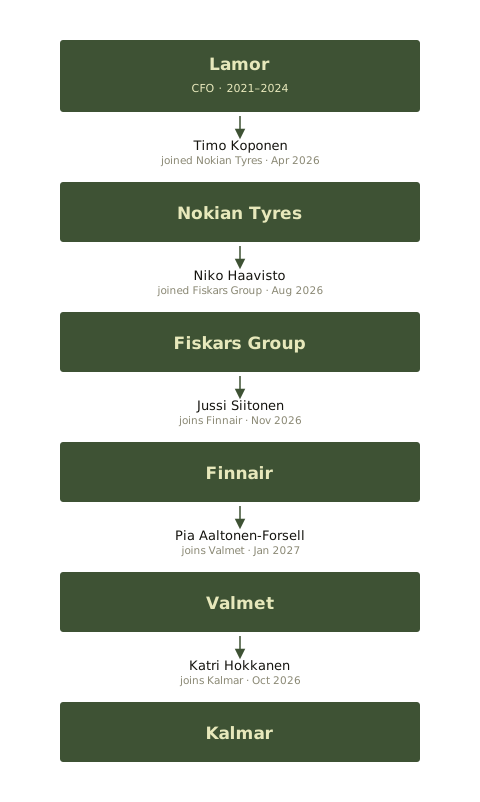
Niko Haavisto left Nokian Tyres for Fiskars Group; Jussi Siitonen left Fiskars for Finnair; Pia Aaltonen-Forsell left Finnair for Valmet; Katri Hokkanen left Valmet for Kalmar. Each departure vacated the seat the next executive filled. The Finnair-to-Valmet link was confirmed in the companies' own releases; the Valmet-to-Kalmar and Fiskars-to-Finnair links likewise.

chain1_industrial_transport.svg

Chain 2: Energy & healthtech circuit

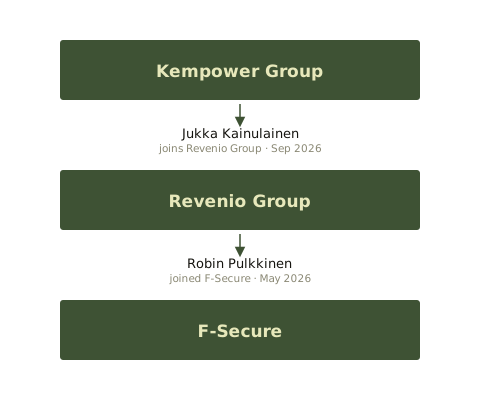
Jukka Kainulainen moved from Kempower to Revenio Group; Robin Pulkkinen then moved from Revenio Group to F-Secure.

Chain 3: the Digia hub

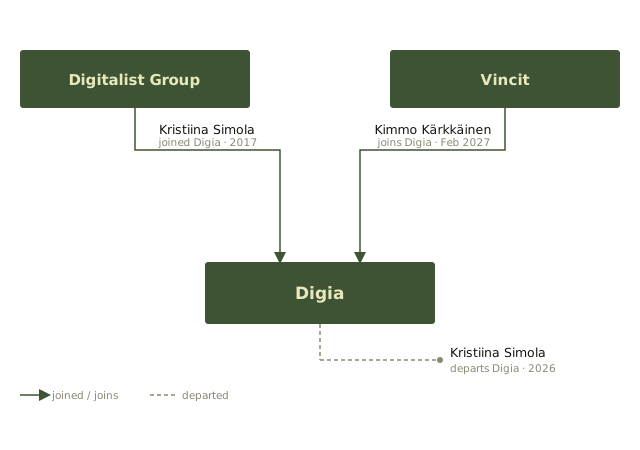
Kristiina Simola arrived at Digia from Digitalist Group in 2017; Kimmo Kärkkäinen arrives from Vincit in 2026. Two different companies, feeding the same seat, nine years apart.

chain3_digia_hub.svg

The same thing keeps happening in Finnish listed IT

This isn't only a 2026 story, either. Look at one corner of the market, Finnish listed IT, and the same thing keeps happening. The cases below aren't the whole picture, and plenty of IT names are missing from them. They're just a few real, publicly announced appointments, dropped in to show that the same move, hiring a CFO who already holds the job at another listed company, keeps turning up in the sector year after year rather than only last summer:

Incoming CFO

New company

Came from

Effective from

Kristiina Simola

Digia

Digitalist Group Plc

2017

Petri Hiljanen

Bittium

Detection Technology Oyj

Apr 2024

Mervi Kerkelä-Hiltunen

Teleste

QPR Software Oyj

Oct 2024

Familiarity, scarcity and caution could all explain it

None of this can be proved from the move data alone.

The simplest explanation is familiarity with the job's disclosure burden. A sitting Nasdaq Helsinki or First North CFO already knows the IFRS reporting cycle, the AGM calendar and the disclosure rules, so a board and CEO that hires one is buying a shorter learning curve than any outside candidate could offer.

A second explanation is scarcity. Finland's listed universe is small, and the number of executives who have actually run finance inside a public company is smaller still, so boards keep drawing from the same short list.

A third is caution. In a year when several of these companies are cutting costs and defending margins, a proven public-company track record reads as the safer appointment, and the safest appointment is the person already doing the job somewhere else.

Every listed-company CFO is already someone else's candidate

For boards, the takeaway is a little uncomfortable: the pool of finance chiefs in Helsinki is shallow, and it keeps recycling itself. If your CFO walks, the realistic replacement is another listed company's current CFO, which means your own CFO is, by the same logic, already on someone else's shortlist.

For investors, the thing to watch is the open seats. Vincit's vacancy, created by the Digia hire, is still unfilled as of writing, and where its next CFO comes from could carry the pattern on into 2027. And for the market as a whole, the real signal is what isn't happening: almost nobody is being promoted into these jobs from within. That points to thin internal succession for the finance chief across Finnish listed companies, a governance question worth a story of its own.

Leaders

Raisio built its growth plan before it hired Elli Siltala. Her first move is to listen

Aug 11, 2026

Raisio spent 2025 preparing to grow: it sold off a loss-making plant-protein unit, set hard 2027 targets and built a standing M&A function. Then it handed the company to Elli Siltala, a food-industry veteran of around 25 years at Valio, who has said her first priority is to listen and learn before setting a direction. The plan is already built. The open question is how Raisio's new chief executive chooses to take it forward.

Raisio is a Finnish brand house. It’s worth sits in names: Benecol, brand sold on cholesterol lowering products, and Elovena, the oats brand, both marketed well beyond Finland, alongside home-market staples such as Sunnuntai baking goods, Torino pasta and Nalle cereals.

Growing a brand house means one of two things: build the brands harder, or buy new ones. Raisio's board has said, in writing, that it intends to do both, and it has spent the past eighteen months building the capacity to do the buying.

On Wednesday, 12 August 2026, the company publishes its half-year report. Elli Siltala, appointed CEO on 7 August, does not start until 1 September; until then the outgoing Pasi Flinkman holds the seat.

The board chose the tool. The CEO chose to listen

Chairman Arto Tiitinen said in the appointment release that "under Elli Siltala's leadership our ambition is to grow the company through both organic growth and acquisitions." Read against the run of Nordic CEO-change releases, that is a pointed line. Boards usually credential the incoming chief executive and gesture at a "next phase." Tiitinen named the instrument, acquisitions, and set the direction before Siltala set foot in the building.

Siltala's own words went the other way. After the standard opening, she closed on this: "My first priority will be to listen, learn and build a shared understanding of how we can create long-term value for our shareholders, customers and employees."

Across the incoming-CEO releases on Listeds Executive Intelligence database, that is unusual. Most new chief executives arrive with at least a directional theme on day one: a capability to strengthen, a strategy to keep executing, a model to scale. Siltala, in this set, is the only one to make listening itself the priority and to leave the agenda more open.

The growth plan was built a year before its CEO

Here is what makes the contrast matter. The growth Tiitinen named is not merely an intention waiting on a new leader. It is a plan already in operation, and Flinkman built it.

Raisio narrowed before it aimed to grow. On 13 February 2025 it agreed to sell its entire plant-protein business, including the Härkis and Beanit brands, the Kauhava production assets and 16 employees, to Valio for EUR 7 million in cash: a unit that had booked EUR 4.5 million in net sales but a EUR 2.6 million loss in 2024.

A month later, on 13 March 2025, it published a 2025 to 2027 strategy built on three growth areas: breakfast and snacking, heart health, and new business. The sequence is the point: sell the loss-maker, then concentrate on the brands that pay.

The strategy set targets for the end of 2027: net sales of EUR 250 million and EBIT of over EUR 30 million, up from 2025 comparable figures of EUR 224.2 million and EUR 28.5 million. Acquisitions were written into the plan from the start.

Raisio then built the capacity to act on them. It created a dedicated M&A Director role, hiring Anni Palmio, a strategy-and-M&A lead from Paulig with earlier brand roles at Findus and Haribo, with effect from 1 September 2025, and set up a committee to steer the board's M&A work. A mid-cap food company of around 350 people does not stand up a permanent acquisition function by accident.

Two dates belong side by side. Palmio's M&A seat took effect on 1 September 2025. Siltala's CEO seat takes effect on 1 September 2026. The acquisition machinery is exactly one year older, and it was assembled under the CEO now leaving to other opportunities.

A brand builder, handed a buyer's mandate

Siltala's career has largely followed the commercial side of the business, with a strong focus on sales and marketing. She was at Valio from 2001 to 2025, progressing from various business, sales and marketing roles to executive positions including EVP Domestic Sales and Marketing, EVP Markets, EVP Core Businesses and Brands, and finally EVP Core Businesses, Home Markets and Primary Production.

She left Valio in November 2025. From May 2026 she was Chief Loyalty and Media Officer at SOK, a seat spanning marketing, loyalty, retail media, communications and public affairs, which she held for roughly three months before Raisio named her.

There is a Nordic small-world footnote here. The plant-protein business Raisio sold in early 2025 went to Valio, the company where Siltala spent her career and sat on the executive team at the time. She now leads the company that sold it.

That profile also runs against the Nordic grain. Marketing and brand titles rarely reach the top table of Finnish listed companies at all, based on ongoing preliminary Listeds analysis, only a handful carry a standalone chief marketing officer, and large caps are notably absent from that list

A sales-and-marketing leader moving up to run a listed company is rarer again. At a brand house, though, the fit is a natural one: when a company's value lives in names like Benecol and Elovena, a chief executive who has spent a career close to sales, brands and customers is on home ground.

The open question is how she chooses to balance the two: carry the acquisition programme forward as set out, or lean toward the organic, category-led growth she seems to know well.

Business

Mehiläinen acquires Heltti’s occupational health business

Aug 10, 2026

Finnish healthcare group Mehiläinen has acquired the occupational health services of Heltti Oy in a business transaction taking effect on 1 September 2026. The deal strengthens Mehiläinen’s position as one of Finland’s leading providers of occupational health services.

Around 60 of Heltti’s occupational health professionals will transfer to Mehiläinen as existing employees. Founded in 2013, Heltti has built a reputation for customized, fixed-price occupational health services for companies whose employees perform intellectual work. It currently serves more than 800 small and medium-sized companies across Finland, with its occupational health services used by approximately 9,000 employees.

The two companies have worked together since 2020, when Mehiläinen became Heltti’s partner clinic. “It is truly wonderful to take the next step together and welcome you to the Mehiläinen team,” said Antti Miettinen, Business Director of Working Life Services at Mehiläinen, adding that Heltti’s expertise, values and services complement Mehiläinen’s offering.

Heltti clients will gain access to Mehiläinen’s broad range of services and network, including its Digital Clinic and YritysMehiläinen corporate service, which provides real-time visibility into occupational health service usage and sick-leave monitoring.

Heltti will continue its therapy, mental health care and organizational development businesses under a new brand from 1 September 2026.

Timo Lappi, Chairman of Heltti’s Board, marked the milestone on LinkedIn, counting 4,867 days from the company’s founding to the sale of its occupational health business. He wrote that Heltti had helped tens of thousands of people across more than 1,000 client companies and said the company had built what he described as Finland’s best workplace in the health sector, based on research.

Business

Finnish machinery jobs hit highest level since the financial crisis, as orders pick up

Aug 10, 2026

Finland's machinery and metal products sector added jobs and orders in the second quarter of 2026, according to new data from Technology Industries of Finland.

Employment in the sector reached its highest level since the 2008 financial crisis, while orders across the wider technology industry grew 13% from the first quarter and 19% from a year earlier.

Finnish technology industry new orders

Quarterly new orders received by Finnish technology industry companies, split between exports and the domestic market.

EUR millionNew orders, Finnish technology industry
02 5005 0007 50010 00012 50015 00020102011201220132014201520162017201820192020202120222023202420252026
Source : Order backlog survey by the Federation of Finnish Technology Industries. Figures are quarterly new orders in EUR million, not seasonally adjusted. Individual quarters can be volatile due to the timing of large orders.

Machinery and metal products employed 138,200 people at the end of June 2026, the most since the financial crisis and 2,500 more than the lowest point of the last downturn. Order backlogs across the technology industry rose 8% between March and June, and a key demand indicator hit +20, its highest since late 2021. The technology industry's 2025 revenue came in at EUR 104 billion, up 2.8% from 2024.

Finnish technology industry order backlog

Quarter-end order backlog for Finnish technology industry companies, split between exports and the domestic market.

EUR millionOrder backlog, Finnish technology industry
010 00020 00030 00040 00020102011201220132014201520162017201820192020202120222023202420252026
Source : Order backlog survey by the Federation of Finnish Technology Industries. Figures are quarter-end order backlog in EUR million, not seasonally adjusted.

Orders up 13 percent, backlogs up 8 percent

Metric

Value

Machinery and metal products employment

138,200 (end of June 2026)

New orders, technology industry

+13% Q1 to Q2 2026, +19% year on year

Order backlog, technology industry

+8% end of March to end of June 2026

Demand indicator (tender request net balance)

+20 at end of June 2026, highest since late 2021

Technology industry revenue, 2025

EUR 104 billion, +2.8% from 2024

Jobs across the whole technology industry dipped slightly this quarter. That drop came from services, like IT and consulting, not from manufacturing.

A signal worth tracking for supplier guidance

An 8% jump in order backlogs in one quarter is worth watching, especially for suppliers tied to maritime, defense, and data centers. It's the kind of signal that shows up later in company guidance. Listeds' Signals Platform tracks these order and demand signals across Finnish listed companies, so leaders can see the shift early.

This connects to last week's Listeds piece on Finland's Q2 GDP, where growth beat the US but came from fewer people working fewer hours overall. This new data adds a twist: the technology industry, one of Finland's leading export sectors, is actually adding jobs and orders. The dip in total technology-industry employment was attributed to services, particularly information technology and design and consulting, while machinery and metal products employment returned to its highest level since the financial crisis. Worth reading together: Finland grew faster than the US in Q2 but with fewer workers and fewer hours.

Leaders

Luotea names asset-management executive Rikard Nyhrén to lead the Swedish business to accelerate improvement in profitability

Aug 6, 2026

A day before Luotea posted half-year results showing Sweden pulling ahead of a lagging Finland, the group named Rikard Nyhrén, most recently of Intea and Newsec, as CEO of its Swedish operations from February 2027 with the group’s profit guidance now resting on Sweden.

He succeeds Mikko Taipale, who has stepped down from the role and from Luotea's Group Management Team effective immediately; Saman Khalilian, CFO of Luotea Sweden, will run the unit on an interim basis until Nyhrén arrives. CEO Antti Niitynpää said the appointment supports Luotea's aim to "accelerate improvement in profitability" in Sweden.

The change lands at the point where Sweden has become the group's growth engine. Swedish net sales rose roughly 10% in the first quarter and 9% in the second, even as Finnish cleaning and support services fell a further 7%, and the reaffirmed full-year guidance, adjusted EBITA to increase, or increase significantly, against 2025's EUR 7.0 million, increasingly rests on Sweden holding its trajectory.

Two features of the appointment stand out. Management is changing the leadership of its best-performing region at the moment that region is working; and it has gone outside facility services to do it.

Nyhrén, born in 1981, joins from Intea Fastigheter, where he heads asset management. He has held senior roles at Newsec, Hemsö and Parmaco, and was chief technical officer at Hemsö. He trained as a construction engineer at Mälardalen University. So his background spans both sides of the business Luotea wants to build: property and asset management, and the technical side, not cleaning or facility management.

His background points to where Luotea wants to grow: property services and data-driven services, both central to its 2026–2028 strategy. This is our read of the hire, not a reason the company has given.

The numbers behind the timing

The appointment landed one day before Luotea published half-year results. Group net sales for the second quarter rose 1.5% to EUR 88.1 million and adjusted EBITA rose to EUR 2.5 million, with Swedish net sales up 9%.

For the first half, net sales increased 0.4% to EUR 174.2 million, adjusted EBITA improved to EUR 2.9 million, and operating profit stood at EUR 0.5 million.

The improvement builds on the first quarter, when Luotea said that the "turnaround in Sweden proceeds as planned" even as group net sales dipped on price competition and delayed investment decisions in Finland.

Governance and group context

The change follows Luotea's AGM on 29 April 2026, which re-elected the six-member board under chair Johan Mild and vice chair Pasi Tolppanen, approved a EUR 0.07 per share dividend for 2025, and authorised repurchases of up to 2 million shares (about 5.2%).

Hanna Inget is also the latest in a run of Group Management Team moves since Luotea's creation. Hanna Inget joined as Chief Commercial Officer from 1 March 2026 to lead commercial operations and customer experience.

Luotea is a recent listing, created on 31 December 2025 when Lassila & Tikanoja plc completed a partial demerger; the remaining facility services operations were renamed Luotea Plc and continued on Nasdaq Helsinki under the ticker LUOTEA. For full-year 2025, continuing operations reported adjusted EBITA of EUR 7.0 million, up from EUR 1.2 million a year earlier, on net sales of EUR 346.0 million, a 1.0% decline.

Financial snapshot

Period

Net sales

Adjusted EBITA

Operating profit

EPS

FY2025 (cont. ops)

EUR 346.0m (-1.0%)

EUR 7.0M

EUR 3.0M

EUR 0.03

Q1 2026

EUR 86.0m (-0.6%)

EUR 0.3M

EUR -0.4M

EUR -0.02

Q2 2026

EUR 88.1m (+1.5%)

EUR 2.5M

EUR 0.9M

EUR 0.01

H1 2026

EUR 174.2m (+0.4%)

EUR 2.9

EUR 0.5M

EUR -0.01

Why this move matters

Sweden is no small unit. It brought in EUR 121.9 million of Luotea's EUR 346.0 million in 2025 net sales, about 35% of the group, and the only part growing, up 9% while Finland fell 5.7%.

The company frames Nyhrén's job around its stated aim to "accelerate improvement in profitability" in Sweden.

Leadership continuity there is the exception within the group: the CEO role has moved now twice in a single announcement, a faster cadence than the rest of the Group Management Team, stable since the December 2025 demerger.

The full-year outlook has been reaffirmed unchanged through both the Q1 and H1 reports despite the results in Finland have been declining.

With Sweden's leadership in transition, Nyhrén's stated priority "driving profitable and sustainable growth in Sweden", puts him at the centre of whether Luotea keeps that guidance intact through 2027.

Leaders

Taru Salo exits Siili Solutions for Attendo as tech consultancy's executive rebuild continues

Aug 5, 2026

Chief People Officer Taru Salo is leaving Siili Solutions for Attendo, handing the people agenda to Timo Miiluniemi on an interim basis as the AI-focused digital development company navigates a leadership reset while continuing to invest in AI and international growth.

Salo, who joined Siili in 2021, will leave her post at the end of August. Timo Miiluniemi, currently director, people and learning, will become interim CPO on September 1 while the company begins the search for a permanent successor, the Finnish technology consultancy announced yesterday.

Salo's departure marks the fifth change to Siili's management team since September 2025 and comes as the company continues its search for a permanent chief executive following Tomi Pienimäki's departure in May.

Interim CEO Markku Savusalo thanked Salo for her contribution. ”I want to thank Taru for the past five years at Siili – especially for her strong approach to competence development and driving Siili’s AI transformation," he said.

On the same day, Attendo revealed Salo’s next destination. The HR executive will join the Nordic care-services company as chief human resources officer on Sept. 14.

Attendo said the appointment is intended to strengthen its HR capabilities, leadership and organizational renewal as technology and AI reshape care delivery and competition for skilled workers. The company highlighted Salo's experience leading Siili's AI transformation program and noted that she received AI Finland's AI Forerunner Female Award in 2025.

Leadership reset continues

Salo's departure marks the latest executive change during a year of transition for Siili.

In May, CEO Tomi Pienimäki stepped down by agreement with the board of directors after leading the company for four years into what the board described as a “new strategic phase.” Markku Savusalo, previously VP of digital engineering, was appointed interim CEO while the search for a permanent chief executive continues.

The leadership changes have coincided with a difficult operating environment. In April, Siili launched change negotiations covering around 311 employees in Finland after management said AI adoption among Finnish customers had progressed more slowly than expected. The process concluded with temporary layoffs affecting consultants, fixed-term employees and members of management during 2026. Savusalo said the measures were intended to safeguard profitability while the company continued strengthening its sales organization and service offering.

Financial pressure remains

The management changes have unfolded against a weaker operating backdrop. Revenue declined over 3% to EUR 108.1 million in 2025, while adjusted EBITA fell to EUR 4.1 million after Siili cut its earnings guidance in December, citing postponed customer decisions and a technical accounting correction.

The pressure carried into 2026. First-quarter revenue fell over 14% year over year to EUR 25.7 million and adjusted EBITA slipped to a loss of EUR 0.2 million from a EUR 1.3 million profit a year earlier.

Despite the weaker start, Siili reaffirmed its full-year guidance of EUR 102 million to EUR 126 million in revenue and adjusted EBITA of EUR 3.7 million to EUR 6.9 million, and said the layoff negotiations would not affect that outlook.

What Siili is working toward

While managing leadership turnover and weaker demand, Siili has continued executing its strategy around AI, international growth and capability development.

The company became one of the first Finnish businesses to receive ISO/IEC 42001 certification for AI management in 2025. In May, it introduced an AI-driven modernization model featuring its Legacy Code Analyzer, which it says can reduce the initial analysis of legacy systems by 40% to 60%.

Siili also increased its ownership in Hungarian product innovation agency Supercharge to 100% from 85% and in Finnish IT consultancy Integrations Group to 70% from 55% in May. The acquisitions were financed with a bank loan, while the shareholder agreement gives the parties the option to complete the acquisition of the remaining Integrations Group stake during 2027.

Investor watchpoints

Siili's half-year report on August 11 will be the first opportunity for investors to assess performance under interim CEO Markku Savusalo. The results will also show whether the company has begun to recover from a weak first quarter while maintaining its full-year guidance.

Beyond the earnings figures, investors may look for further details on the financial and operational impact of Siili's increased ownership of Supercharge and Integrations Group.

The report will land as Siili continues recruiting both a permanent chief executive and a permanent chief people officer, leaving two key leadership positions on an interim basis during a broader organizational transition.

Leaders

Outokumpu combines its two European businesses under Matthieu Jehl as Rolf Schencking departs

Aug 4, 2026

The merger of Stainless Europe and Advanced Materials business lines into one Europe unit is the third change to Outokumpu's leadership team that Listeds has tracked in ten months, and it brings two of the Evolve strategy's four pillars under a single European leader.

Outokumpu has given Matthieu Jehl command of a single, enlarged European business, merging its stainless Europe and advanced materials operations into one unit and parting company with Rolf Schencking, who had run advanced materials since 2024. The change takes effect on 1 August 2026 and gives one president the European operations that absorbed Outokumpu's weakest demand and drove its 2025 net loss.

Jehl, who led business line Stainless Europe and joined the leadership team in 2025, now runs both the stainless business that weighed on 2025 earnings and the advanced materials business the company is counting on for growth. He continues to report to President and CEO Kati ter Horst.

A leadership team that keeps changing

This is the third change to Outokumpu's leadership team that Listeds has recorded in ten months. Johann Steiner took over business area Americas in October 2025 when Tamara Weinert left; Anouk de Graaf joined as head of people, sustainability and corporate relations in February 2026; and Jehl's promotion, alongside Schencking's exit, follows in August.

The board has moved at a similar pace. Four of its ten seats have changed hands in roughly sixteen months. Hilde Merete Aasheim and Olavi Huhtala joined in April 2025 AGM as Pierre Vareille left, and Timo Ritakallio and Jenni Lukander joined after the March 2026 AGM, with Ritakallio elected vice chair and Kari Jordan re-elected chair.

Date

Name

Change

Aug 2026

Matthieu Jehl

Appointed president, business area Europe (new combined unit)

Aug 2026

Rolf Schencking

Departed as president, business line advanced materials

Apr 2026

Timo Ritakallio

Joined board, elected vice chair

Apr 2026

Jenni Lukander

Joined board

Feb 2026

Anouk de Graaf

Joined leadership team as EVP, people, sustainability and corporate relations

Oct 2025

Johann Steiner

Moved to president, business area Americas

Oct 2025

Tamara Weinert

Departed as president, business area Americas

What changes, and what the company says

The new business area Europe sits above two commercial organizations, one for stainless and one for advanced materials, in place of two business lines reporting up in parallel. Outokumpu says the structure is meant to sharpen customer focus and support execution of Evolve, its 2026–2030 growth plan.

Announcing the change, ter Horst said
"I wish Matthieu every success in his new role as President of business area Europe. With extensive experience across the steel industry, Matthieu combines a deep understanding of market dynamics, a strong strategic perspective and a relentless focus on operational excellence. His leadership, business acumen and energy will be key to advancing business area Europe's competitiveness, supporting the execution of our EVOLVE strategy and delivering on its ambitions. I would also like to express my sincere appreciation to Rolf Schencking for his valuable contributions to Outokumpu."

Inside the Evolve strategy

Evolve is Outokumpu's growth plan for 2026–2030, and the consolidation changes who runs its European pillars. The company organizes it around four pillars: holding cost competitiveness and cash generation in its core sustainable stainless steel business, building profitable growth in advanced materials and alloys, moving up the chromium value chain to draw more from its own chrome mine, and developing new products from proprietary materials technology.

Two of those four pillars now sit inside business area Europe, which is why the consolidation matters beyond the org chart. The alloys pillar carries capital. Outokumpu has begun a two-phase investment in high-nickel alloys at its Avesta site in Sweden, starting with a EUR 30 million first phase to install an electro slag remelting unit and finish engineering work. The company puts the two phases combined at an estimated EUR 150 million and says it is targeting a return above its 20% internal hurdle rate for transformative investments.

A chromium project runs in parallel. A USD 45 million pilot plant in the United States for low-CO2 enriched ferrochrome and chromium metal is expected to be operational in the first half of 2027, and the company published its first related patent applications in July 2026. Alongside the growth spending, a EUR 100 million restructuring program is due to deliver annual cost savings by the end of 2027, roughly half of them within 2026.

The appointment places both the recovering Stainless Europe and the Advanced Materials business lines under one president, in place of the two business lines that reported separately before.

The governance read

The board Jehl now reports into has been rebuilt with sector weight. Hilde Merete Aasheim, who joined in 2025, was President and CEO of Norsk Hydro from 2019 to 2024, which puts direct Nordic big-metals chief-executive experience on the board just as Outokumpu commits capital to new alloy and chromium lines.

Why the timing points to Europe

The numbers explain why Europe is the seat that matters. Full-year 2025 adjusted EBITDA fell to EUR 167 million with a net loss of EUR 137 million, as business area Europe absorbed the weakest demand. Earnings have since turned: second-quarter 2026 adjusted EBITDA reached EUR 100 million, the company returned to a net profit of EUR 25 million, and net debt fell to EUR 224 million.

What to watch

On Outokumpu's own description, the two commercial units inside business area Europe serve different ends. Stainless Europe supplies large quantities of cost-competitive stainless steel; advanced materials is the specialized, higher-margin unit making nickel-based alloy solutions for demanding applications, and the company calls high-nickel alloys, the focus of its July 2026 investment, a segment offering higher margins and resilience. Both now report to Jehl, who came up through stainless.

The question the structure raises is whether the specialized, higher-margin alloys business holds its priority and investment pace inside a unit led from the volume side of stainless. Two near-term checkpoints will show how the combined unit performs: third-quarter results, which Outokumpu has guided to keep adjusted EBITDA broadly in line with the second quarter, and progress on the EUR 150 million high-nickel alloys investment at Avesta.

Business

Finland grew faster than the US in Q2 but with fewer workers and fewer hours

Aug 3, 2026

Finland's GDP grew 0.9 per cent quarter-on-quarter in Q2 2026 — equivalent to roughly 3.6 per cent annualized. That's faster than the US's headline 1.5 per cent, a figure reported on an annualized basis that works out to about 0.37 per cent quarter-on-quarter. Once the two are put on the same footing, Finland's growth outpaces America's. But it came from fewer people working fewer hours.

Finland's total output, adjusted for working days, grew 1.8 per cent in June 2026 from a year earlier, Statistics Finland reported on 30 July. Seasonally adjusted, output rose 0.3 per cent from May, and May's own figure was revised only marginally, to 2.7 per cent year-on-year from 2.8 per cent. The pace did ease between the two months, though: the year-on-year rate slowed from 2.7 per cent in May to 1.8 per cent in June, so this is growth continuing rather than accelerating.

Finnish Economic Output, 2005–2026

Volume of total output — trend and seasonally & working-day adjusted index series. Interactive view: hover for monthly values, click legend items to isolate a series, or use the range controls below.

Index point (2015 = 100)

Latest trend: 114.312-mo change: +2.5%
90951001051101151202005M012007M012009M012011M012013M012015M012017M012019M012021M012023M012025M01
Seasonally & working-day adjusted
Trend index series
Source: Statistics Finland, trend indicator of output

Note: Both series are indexed to 2015 = 100. The seasonally and working-day adjusted series reflects month-on-month volatility; the trend series smooths short-term noise to show the underlying direction of output. Figures are sourced directly from Statistics Finland and have not been modified or estimated.

The quarterly picture looks solid, if preliminary. On flash data, seasonally adjusted GDP grew 0.9 per cent in April–June from the previous quarter, and 2.5 per cent from the same quarter of 2025 on a working-day-adjusted basis, figures that will be revised when the national accounts are published in August.

The story for leadership sits underneath those headline numbers. Even as output expanded, the labour input behind it shrank: on the same preliminary read, the number of employed persons (working-day adjusted) was 1.1 per cent lower than a year earlier, with the flash estimate putting hours worked down 1.4 per cent.

Put together, those two data points imply labour productivity — output per hour worked — rose in Q2, a combination companies would normally welcome. Whether that reflects genuine efficiency gains, cyclical labour hoarding unwinding, or simply weak headcount catching up to already-soft demand is not yet answerable from the flash data alone.

Statistics Finland's Labour Force Survey, released a week earlier on 21 July, fills in that picture. The average number of employed persons aged 15 to 74 was 2,600,000 in the second quarter — 29,000 fewer than a year before (−1.1 per cent) — while the number of unemployed rose by 39,000. The unemployment rate climbed to 11.4 per cent, up from 10.2 per cent a year earlier. Hours worked, on the survey's own measure, fell 1.1 per cent. The decline was concentrated in construction, while administrative and support services grew the most, and the share of part-time workers who wanted full-time hours edged up — a contraction focused on specific sectors rather than broad-based. The survey's margins of error are worth keeping in mind: ±18,000 on the employed figure and ±15,000 on the unemployed.

Set against its neighbours and peers, Finland's Q2 print looks respectable but not exceptional on growth alone — the divergence from employment is what stands out. The euro area and the wider EU both reported their Q2 flash estimates on the same day as Finland's monthly figures: euro area GDP rose 0.4 per cent quarter-on-quarter and the EU 0.5 per cent, both accelerating from essentially flat growth in Q1, with Ireland (+3.9 per cent), Lithuania (+1.7 per cent) and Sweden (+1.4 per cent) posting the strongest quarterly gains in the bloc. Finland's 0.9 per cent sits comfortably above both aggregates.

Denmark and Norway aren't yet part of the comparison — both report on a longer lag, and neither had published Q2 figures at the time of writing. The last confirmed readings are Q1: Denmark's economy grew 1.5 per cent quarter-on-quarter, revised down from an initial 1.9 per cent estimate, Mainland Norway, which excludes the petroleum and offshore shipping sectors, grew 0.2 per cent quarter-on-quarter in the first quarter, matching the revised pace recorded in the previous quarter. Both figures predate the current quarter and can't be compared directly to Finland's Q2 print.

The clearer contrast for now is with Sweden and the US. Sweden's own Q2 rebound came with employment rising, not falling — the employment rate climbed to 70.6 per cent by June, from 69.4 per cent in May. In the US, payroll employment kept growing through Q2 — averaging modest but positive monthly gains, including +57,000 in June — even as a separate household survey showed civilian employment falling sharply and labor force participation dropping to 61.5 per cent, its lowest since March 2021. Finland's combination of solid output growth and a shrinking workforce is, on the evidence available so far, a genuinely distinct pattern among the peers that have reported — though a fuller regional picture will only be possible once Denmark and Norway's Q2 numbers are in.

The data are preliminary, drawn from Statistics Finland's Trend Indicator of Output. Revised quarterly national accounts are due on 28 August 2026, and will be the next firm read on whether the output–employment gap is a data artefact or a genuine shift.

Business

African swine fever in Finland halts Atria and HKFoods exports to Japan, China and beyond

Jul 31, 2026

Finland has recorded its first-ever case of African swine fever (ASF). On 30 July 2026, a resident near Vaalimaa in Virolahti found three dead wild piglets and brought them to the Finnish Food Authority. Preliminary tests came back positive.

The result is now being confirmed at the EU reference laboratory in Spain. The Authority has drawn a restriction zone around the site, limited pig movements within it, and is working to gauge how far the virus has spread among wild boar. ASF does not infect humans.

The finding reached the stock exchange almost immediately. On 31 July, Finland's two listed meat producers, Atria and HKFoods, issued near-identical statements: neither has contract pig farms inside the restriction zone, and Finnish pork remains safe to eat. But several export markets automatically bar pork from any country where ASF is detected, regardless of where the case occurred.

For Atria, exports to Japan, China, Singapore and Taiwan stopped with immediate effect. It can still ship within the EU and to South Korea, the one non-EU market where a regionalisation agreement lets trade continue based on where an outbreak sits. "Our aim is to open talks immediately with the countries where exports have now stopped," said Markku Hirvijärvi, head of Atria Finland's meat business and exports. Chicken and beef exports are unaffected. HKFoods likewise suspended non-EU pork exports, including to China and Japan, and says it will redirect those volumes elsewhere.

Both companies had flagged this scenario only weeks earlier. Atria's half-year report warned the pork market would stay unstable through end-2026, citing the ASF outbreak identified in Spain in the fourth quarter of 2025, falling pork exports on the back of China's import tariffs, and demand in Europe running below expectations; it also disclosed a EUR 0.6 million cost from an ASF case at its own Estonian farm a year earlier. HKFoods' first-quarter report stated the risk of ASF reaching Finland had "increased significantly" since the disease appeared on Estonian pig farms in June 2025.

The timing is unfortunate, arriving just as both showed improving numbers. HKFoods' comparable operating profit from continuing operations rose 23.7% year-on-year in Q1 to EUR 5.7 million; Atria's adjusted EBIT increased 13.45% to EUR 34.6 million over the half-year. Atria Finland CEO Mika Ala-Fossi said it is too early to size the financial impact, which will hinge on how quickly export markets reopen.

What to watch: confirmation from the EU reference laboratory; whether the restriction zone expands if more infected wild boar appear; and the pressure on European pork prices as volumes meant for China and Japan seek a home in an already oversupplied market.

Leaders

Mara Zavagno is Konecranes' fourth internal promotion to the top in eighteen months

Jul 31, 2026

As Mara Zavagno steps up to lead People & Culture, the pattern behind Konecranes' leadership churn comes into focus: four top-team seats have changed since early 2025, and every one has been filled from inside.

Konecranes Plc announced on 29 July 2026 that it will promote Mara Zavagno to Executive Vice President, People & Culture, effective 1 October 2026. Zavagno joins the Leadership Team and reports to President and CEO Marko Tulokas. She succeeds Anneli Karkovirta, who retires after twelve years and leaves the Leadership Team on 1 August 2026.

On its own it looks routine: a retirement flagged back in February, a successor named on schedule. But this is the fourth change to Konecranes' top team in eighteen months, and every one has gone to someone already inside the company. That consistency is the part worth watching. It reassures investors weighing how stable the leadership is, and it carries just as much weight with employees. A steady run of internal promotions tells people their own careers can grow here, which is often what matters most when they think about their future with a company.

The signal: internal succession is now the default

Since the start of 2025, four of the Leadership Team's nine seats have turned over, and Konecranes has looked inside the house every time.

Marko Tulokas was elevated to CEO in June 2025 from within the leadership group, succeeding Anders Svensson. When Jussi Rautiainen took over Business Area Industrial Equipment on 1 January 2026, he stepped into the operational role Tulokas had vacated. When Minna Aila left as EVP Corporate Affairs & Brand at the end of 2025, Konecranes chose not to recruit a successor at all, redistributing her responsibilities internally. And now Karkovirta's successor is a twelve-year insider by way of the Terex MHPS acquisition.

Tulokas made the preference explicit in announcing Zavagno: "I am very pleased that we found such an excellent successor for our People & Culture leadership from within the company … and for growing such an excellent successor to take on her role."

For a company that has changed nearly half its top team in eighteen months, that consistency is the reassuring part. This is concentrated, sequenced turnover with continuity of institutional knowledge, not a revolving door, and not an outside-in reset of strategy. The other five Leadership Team seats have not moved at all, and at board level Pasi Laine and Ulf Liljedahl have chaired and vice-chaired across both the 2025 and 2026 AGMs, with only two of eight director seats turning over.

Why it matters now: a softer half-year to execute through

The continuity question is not just theoretical, because the new-look team has to deliver against a weaker top line. Net sales fell 5.3% in H1 2026 to EUR 1.93 billion, and comparable EBITA was down 9.3%. What cushions that is the order book, which grew to EUR 3.38 billion at end-June — up 16.1% year on year — on order intake that rose 6.9% in the half.

Guidance has been held unchanged across all three 2026 disclosures: net sales approximately at or above 2025 levels, and a comparable EBITA margin approximately at 2025 levels. 

Financial snapshot

Metric

Q1 2026 (Jan–Mar)

H1 2026 (Jan–Jun)

FY 2025

Net sales

EUR 907.9m (−7.7%)

EUR 1.93bn (−5.3%)

EUR 4.19bn (−0.9%)

Order intake

EUR 1.07bn (+0.3%)

EUR 2.31bn (+6.9%)

EUR 4.39bn (+9.7%)

Order book (period-end)

EUR 3.18bn (+7.9%)

EUR 3.38bn (+16.1%)

EUR 2.99bn (+3.5%)

Comparable EBITA

EUR 105.7m, 11.6% margin (−3.1%)

EUR 235.2m, 12.2% margin (−9.3%)

EUR 588.1m, 14.0% margin (record)

Operating profit

EUR 95.6m (−4.4%)

EUR 215.2m (−9.1%)

EUR 542.4m, 13.0% margin

Basic EPS

EUR 0.28 (−8.6%)

EUR 0.66 (−9.3%)

EUR 5.05

Free cash flow

EUR 34.6m

EUR 14.4m

EUR 529.6m

Net debt / gearing

EUR −184.9m (net cash) / −9.5%

EUR 22.3m / 1.1%

EUR −163.5m (net cash) / −7.8%

A diversity-heavy release, a top team still taking shape

Konecranes leaned hard on the language of diversity in announcing Zavagno, and it is worth noticing because it is not something Finnish industrials say often. Tulokas credited her with having “systematically developed Konecranes’ diversity culture to meet the best industry standards.” Zavagno’s own statement returned to the theme more than once, calling inclusion, trust and “diversity of thought” essential drivers of innovation and growth. She is, after all, the company’s Chief Inclusion & Diversity Officer, promoted onto the Leadership Team from the very portfolio she built.

Diversity, of course, is about far more than gender — nationality, background, discipline and ways of thinking all count, and by some of those measures the team does bring range. Zavagno herself is a case in point: she is Italian, holds a degree in Political Science and Economics from the University of Padova, and came to Konecranes through the 2017 Terex MHPS acquisition. Still, on the one dimension that is easiest to measure, the gender balance at the top, the release sits a little ahead of the numbers.

From 1 October the Leadership Team has nine members: six men and three women. No woman runs a business or holds one of the senior executive seats. The CEO, the CFO and deputy CEO, and all three business-area presidents are men, as is the technologies chief. The three women all hold corporate functions rather than businesses — Zavagno in People & Culture, Sirpa Poitsalo as General Counsel and Christine George in Corporate Strategy & Communications. The team is fairly narrow in age too, with members born between 1963 and 1978 and six of the nine born in the 1960s.

Zavagno’s arrival does little to shift that composition. She replaces another woman, the retiring Karkovirta, so the three-of-nine gender balance holds rather than improves, and the operational roles stay entirely male. The board is more balanced, with three women among its eight directors. On the evidence of its own leadership page, then, Konecranes is a company talking confidently about diversity while still building it — at least in its senior ranks — which is exactly why the promotion of a D&I leader to the top table is the detail worth drawing out.

Leadership team changes since early 2025

Announced

Change

20 Jan 2025

Anders Svensson announces departure as President & CEO; search for successor begins

15 May 2025

Marko Tulokas appointed President & CEO, effective 1 June 2025

5 Nov 2025

Jussi Rautiainen appointed President, Business Area Industrial Equipment, effective 1 Jan 2026, joining the Leadership Team

17 Dec 2025

Minna Aila, EVP Corporate Affairs & Brand, leaves the Leadership Team effective 31 Dec 2025; no successor recruited, duties redistributed

9 Feb 2026

Karkovirta's summer 2026 retirement announced; successor search opened

29 Jul 2026

Mara Zavagno appointed EVP, People & Culture, effective 1 Oct 2026

Investor watchpoints

Three things will tell you whether the internal-continuity bet is paying off. First, order-book conversion: the EUR 3.38 billion backlog has to translate into a stronger H2 for the reaffirmed full-year guidance to hold. Second, integration: the H1 acquisitions — a majority stake in Mitsubishi Electric FA Industrial Products in Japan, plus service deals in Thailand, New Zealand and Spain — still have to show contribution, and integration is a People & Culture job as much as a commercial one. Third, whether the internal-succession preference extends the next time a seat opens, or proves specific to this cycle.

Leaders

Jussi Siitonen leaves Fiskars to join Finnair as CFO after airline lifts 2026 revenue guidance

Jul 29, 2026

Jussi Siitonen, CFO and deputy CEO of Fiskars Group, will join Finnair as chief financial officer on November 1, 2026, as the airline enters the next phase of its turnaround with stronger earnings, higher revenue expectations and an ambitious multi-year growth strategy. He succeeds Pia Aaltonen-Forsell, who is leaving after roughly a year in the role to join another employer.

Siitonen, 57, has served on Finnair's board of directors since 2024 and stepped down from the board on the day his appointment was announced. He replaces Aaltonen-Forsell, who joined the flag carrier in August 2025. Her next destination was revealed the same day, with Valmet appointing her as CFO and a member of its executive leadership team, effective no later than the end of January 2027. 

The CFO appointment is the latest step in a broader reshaping of Finnair's leadership. Over the past eighteen months, the airline has appointed Sini Kivekäs as chief people officer, refreshed several board positions and completed another governance cycle at its 2026 AGM. Unlike many companies undergoing significant executive turnover, Finnair is refreshing its leadership while financial performance is improving rather than deteriorating.

A board insider moves into one of Finnair's most important roles

Few incoming finance chiefs arrive with the level of familiarity Siitonen already has with the company. Alongside his executive career at consumer goods company Fiskars Group, he has spent the past two years on Finnair's board, where he most recently served on the audit committee. That gives him an understanding of the airline's strategy, capital allocation priorities and industry challenges before formally taking responsibility for its finances.

For Finnair, the appointment also brings continuity to a finance function that has changed rapidly. Aaltonen-Forsell's departure marks the airline's second CFO transition since mid-2025. Between Kristian Pullola's exit, Aaltonen-Forsell's short tenure and Siitonen's arrival, Finnair will have had three CFOs in just over a year.

The finance function is changing at a very different moment than it was a year ago. When Aaltonen-Forsell joined, Finnair was still working to restore profitability following years of disruption to its long-haul business. Today, the airline is reporting stronger operating performance while beginning to execute a new long-term strategy.

CEO Turkka Kuusisto thanked Aaltonen-Forsell for her contribution and welcomed Siitonen to the finance chief role. "I warmly thank Pia for her short but distinguished time at Finnair and wish her the best of success also in future," he said.

"At the same time, I warmly welcome Jussi to Finnair,” Kuusisto added. Through his role on Finnair's Board, Jussi has a thorough understanding of our strategy and industry, which creates a strong foundation for rapid value creation in the key role of CFO.”

Siitonen said his priority will be ensuring Finnair's financial position supports its long-term ambitions. Having served on the board, he said he already understands the company's high standards and sees the CFO's role as providing the financial foundation needed to achieve them.

A stronger business, but a more complex operating environment

Siitonen inherits a business whose financial trajectory has improved sharply over the past year.

Finnair reported second-quarter revenue of €916.7 million, an increase of over 16% from the same period a year earlier, while comparable operating profit climbed to €78.4 million from €10.3 million. The recovery has been equally visible over the first half of the year, with revenue increasing over 14% to €1.69 billion and the comparable operating result improving to a profit of €77.8 million from a loss of €52.3 million in the first half of 2025.

The stronger performance prompted management to raise its full-year revenue guidance to €3.4 billion-€3.5 billion from €3.3 billion-€3.4 billion, while maintaining its comparable operating profit outlook of €120 million-€190 million.

The outlook is not without trade-offs, however. While management has become more optimistic about revenue, it has reduced planned capacity growth for 2026 from roughly 5% to around 1% as Middle East route suspensions and continuing network adjustments weigh on the flying programme. The revised outlook suggests Finnair expects stronger pricing, ancillary revenue and network optimization—not additional capacity—to underpin second-half performance.

Underlying operating trends have remained supportive. Passenger numbers increased over 7% during the first quarter, while June traffic data showed passenger volumes rising 9%, revenue per available seat kilometre increasing over 10% and cargo volumes growing more than 20%. On-time performance, however, declined because of weather disruption across Europe.

What Finnair is trying to accomplish

Finnair's board approved a new strategy covering 2026-2029 in late 2025, marking a shift from recovery toward profitable, disciplined growth.

Rather than relying primarily on network expansion, management is targeting higher-quality earnings by growing ancillary revenue, strengthening digital retailing capabilities, expanding its loyalty program and automating customer-facing processes. The strategy also calls for continued investment in service quality while improving capital efficiency and financial returns.

The financial targets are equally ambitious. By 2029, Finnair aims to deliver a comparable EBIT margin of 6%-8%, achieve annual passenger demand growth of around 4%, invest €2 billion-€2.5 billion across the business, maintain net debt at one to two times comparable EBITDA and keep cash equivalent to at least 20% of annual sales.

The operational agenda supporting those targets is already underway. Finnair is renewing its fleet with 18 Embraer E195-E2 aircraft, plans to lease six Airbus A320ceo aircraft, has resumed services to Turku and Tampere and continues adapting its route network to geopolitical constraints and fuel-price uncertainty.

That makes the finance function central to the company's strategy. Beyond financial reporting, the CFO will oversee the capital allocation, balance-sheet discipline and investment decisions needed to fund growth while preserving financial flexibility during a period of continued operational uncertainty.

Investor watchpoints

Investors are likely to focus on three themes over the coming quarters.

First, the CFO transition spans Finnair's third-quarter reporting period, making continuity in financial communication an immediate consideration.

Second, Siitonen's appointment leaves a vacancy on the board, with no replacement yet announced.

Finally, revenue guidance has been raised even as planned capacity growth has been reduced from roughly 5% at the start of the year to around 1%. That combination suggests stronger unit economics are expected to support the second half, although the company has not explicitly attributed the revised guidance to those factors. The pace of executive change also remains unusually high, leaving Siitonen to provide continuity as Finnair shifts from recovery to executing its new strategy.

Business

Iberdrola is buying Caruna at a €5 billion valuation. Why Finns are not happy, and why the anger misses the point

Jul 29, 2026

Iberdrola, one of Europe’s largest electricity companies, is buying Caruna, the grid that powers 1.5 million Finns. The deal has reignited Finnish anger over foreign ownership of critical infrastructure, and reopened old wounds about how the grid was sold, priced and taxed in the first place.

On 21 July 2026, Spain's Iberdrola agreed to buy 80% of Caruna, the company whose wires reach about a quarter of Finland. The sellers, US private equity firm KKR and Canada's Ontario Teachers' Pension Plan, are exiting in full. The two Nordic pension owners, Finland's Elo and Sweden's AMF, are keeping their combined 20%. The price for the 80% stake is about €2 billion, valuing Caruna at around €5 billion including debt. Completion is expected in the first quarter of 2027, subject to Finnish foreign investment screening, EU merger control, and foreign subsidy review.

The opposition wasted no time. Antti Kaikkonen, leader of the opposition Centre Party, wrote in a Facebook post that the government should not watch this from the sidelines but actively explore a domestic ownership solution for the grid, with Finnish pension companies possibly taking part. 

He called the original sale of Fortum's networks to foreign investors a serious mistake whose consequences persist: a monopoly whose customers cannot change their network company yet pay rising transfer fees while profits flow abroad. He was careful to add that he does not oppose foreign investment in general, only that critical infrastructure should put the national interest first.

The diagnosis is sharp, and widely shared. But the remedy that now dominates the public reaction, making Caruna Finnish again, is on its own the wrong frame. Caruna has not been in majority Finnish hands since 2014, and the owners now selling are already American and Canadian. 

The harder question, the one Finns have been paying for since 2016, is why a monopoly that every household in its area depends on was turned into a financial asset in the first place, and what that ownership model does to the people at the end of the line.

Why this is personal for 1.5 million Finns

Caruna is Finland's largest electricity distribution company. It owns and runs the local grid that carries power to about 744,000 customer connections and is the primary distributor in 57 municipalities in southern, southwestern and western Finland, plus Joensuu and Koillismaa. Those connections reach roughly 1.5 million people, more than a quarter of the country's population of about 5.6 million. Its share of the national distribution market is close to 20%.

A distribution grid is a natural monopoly. A household cannot choose a different set of wires to its home. 

If you live in Caruna's area, you pay Caruna to move your electricity, whatever your energy supplier, and you pay it every month of the year. That is why the bill is personal, and why it bites hardest for many households in a Finnish winter, when heating and darkness push consumption to its annual peak and the distribution charge rides on top of every kilowatt hour.
Regulation caps how fast these charges can rise, and how much a grid company can earn, precisely because customers have nowhere else to go.

The gap inside Caruna's own network shows how much the model matters. In 2025, according to Sähköhinta.com figures reported by Kauppalehti, the basic monthly distribution charge in Caruna's main area was €29.71, the fourth highest of any Finnish grid company and roughly double the national average of €14.85. In the separately run Caruna Espoo area, the basic charge was only €7.34, and the energy charge was 2.66 cents per kilowatt hour against 5.26 cents in the main area. Same owner, very different bills.

That is also why the bill carries memory. When the grid was first sold, Finns were promised that private ownership would not raise transfer prices. It did.

The sale that still stings

Caruna exists because of a political decision that its architects promised would be painless. The sale of Fortum's Finnish distribution business was approved by the government in late 2013 and completed on 24 March 2014, when state-controlled Fortum sold the grid to a consortium called Suomi Power Networks for about €2.55 billion

The buyers were Australia's First State Investments and Canada's Borealis Infrastructure, each with 40%, alongside the Finnish pension investors Keva and LocalTapiola Pension. 

The grid served about 640,000 customers at the time. In the ministerial committee, the sale was backed across Jyrki Katainen's six party coalition, by the Social Democrats, the National Coalition Party, the Greens, the Swedish People's Party and the Christian Democrats. 

Only the Left Alliance's Paavo Arhinmäki opposed it, filing a dissenting opinion on the grounds that a natural monopoly carrying critical infrastructure should stay in public hands.

The ministers who led it were confident in public. Prime Minister Katainen said the sale would not raise transfer prices for customers because electricity transfer and its pricing are strictly regulated. 

Minister of Economic Affairs Jan Vapaavuori called it "a safe solution for Finland's energy policy" and argued that because network companies face a regulated ceiling on their returns, no price spike could even be constructed.

Pekka Haavisto, the minister responsible for Fortum ownership steering, defended the deal too, saying the distribution grid was not infrastructure the state needed to own, that the operator could not price freely, and that it carried heavy obligations for maintenance and customer liability.

It did not hold. At the turn of 2016, Caruna announced transfer price increases averaging about 27%, reported elsewhere as up to a third, from the start of March. The backlash was national, and with the Consumer Ombudsman raising the prospect of a class action, the company backed down, phasing the increase in and temporarily cutting the basic fee, with no further rises before 2018. 

It did not stay down: in April 2018 Caruna raised distribution charges again, by about 6.5% on average including taxes. The company, a monopoly's customers cannot walk away from had become, in Finnish public debate, shorthand for public anger.

In fairness, not all of the spending was optional. The Tapani storm that swept Finland on St Stephen's Day, 26 December 2011, with a second storm, Hannu, hours behind it, was among the most destructive the country had seen: it toppled trees onto overhead lines across the south and cut power to hundreds of thousands of homes, some for more than a week. 

The disaster exposed how fragile the grid was, and Parliament's answer was the 2013 Electricity Market Act, which required distribution companies to storm-proof their networks so that weather outages could not exceed six hours in towns or 36 hours in the countryside, to be achieved by 2028, with extensions to 2036 for the hardest rural stretches, mainly by burying cables underground. Caruna's grid, now about 89,000 km and roughly two-thirds underground, was rebuilt to that standard. The obligation was genuine. The fight was always over how much of that cost, and how much profit on top, landed on customers who could not say no.

Then there was tax. Caruna's ownership structure kept its Finnish tax bill strikingly low. 

In a series of investigations, public broadcaster Yle found that in 2014 the company reported more than €50 million in operating profit but, after financing costs, paid only about €800,000 in Finnish corporate tax, using a complex intra-group debt structure routed through Dutch, Luxembourg, Maltese and Cayman Islands companies, with owner loans carrying interest well above bank rates. 

In 2016 it paid an effective rate of about 0.28% on more than €150 million of operating profit. 

The civil society group Finnwatch estimated that Finland lost around €12 million in tax revenue in 2017 alone, and pointed to a balance sheet exemption rule that let Caruna deduct all of its interest costs after its owners had driven the company's equity negative with very large shareholder loans. 

Finland tightened these rules in stages, and the first stage barely touched Caruna. The 2019 reform under the EU anti-tax-avoidance directive broadened the interest limit but left the balance sheet exemption intact, so little changed: Caruna paid only about €10.7 million in Finnish corporation tax in 2020, and Finnwatch estimated the state still lost around €10 million that year. 

The real bite came from a later change to that exemption, in force from the start of 2023. Caruna could no longer deduct all the interest on its owner loans, and its Finnish corporation tax roughly doubled, from €13 million in 2022 to €26 million in 2023, with about €9 million of the rise coming from the rule change. 

The loss to the public ran wider than the tax bill. Before 2014 the grid sat inside Fortum, which is majority owned by the Finnish state, so the state shared in its earnings through Fortum's dividends. Selling it for €2.55 billion brought a one off gain, but it handed the recurring dividend stream of a regulated monopoly to private owners. And the whole tax structure rested on a simple asymmetry: interest on owner loans is deductible in Finland, while dividends are not, so financing Caruna with shareholder debt rather than equity turned profit that would have been taxed into deductible interest routed abroad.

The backlash eventually reached the law. In 2021, Sanna Marin's government pushed through amendments to the Electricity Market Act, in force that August, that cut distribution companies' maximum allowed return and shrank the size of one off increases. The reasonable rate of return on capital fell to 4%, from about 5.73% in 2020, grid companies were projected to collect some €350 million less from customers, and the ceiling on annual transfer price increases was halved from 15% to 8%. It was the first turn of the screw. The Energy Authority would tighten again for 2024 to 2031, and that is what the companies, Caruna among them, took to court.

From price cap to Washington

The tension between a regulated monopoly and its owners has since moved to the courtroom. 

The Energy Authority tightened the model that limits how much grid companies may earn for 2024 to 2031, most importantly by freezing the valuation of existing networks at their 2023 level. Almost every distribution and transmission company, Caruna among them, challenged the methods at the Market Court, which rejected the appeals in full on 21 November 2025. The profit cap stood.

Caruna's foreign owners went further than anyone in Finland expected, and they did not wait for the Market Court's verdict to do it. Invoking investor protection under the Energy Charter Treaty, they filed to take Finland to the International Centre for Settlement of Investment Disputes, the World Bank linked arbitration body in Washington.

A company whose grid the Finnish state once owned was now suing the Finnish state on an international stage, in what would be the first such claim ICSID has handled against Finland. ICSID cases typically run three to four years, and the rulings are binding with no appeal. Whoever owns Caruna next inherits that dispute as part of the package.

Who the new owner is

Caruna is passing from financial owners with a fixed horizon to a strategic industrial one. Iberdrola is a Spanish multinational utility based in Bilbao and chaired by Ignacio Galán, one of the largest electricity companies in the world, with about 45,000 employees, serving more than 100 million people, and operations in roughly 30 countries.   With a market capitalisation of more than €140 billion, Iberdrola is Europe's largest electricity company by market value.

Caruna would join the regulated networks it already runs in Spain, the United Kingdom through ScottishPower, the United States through Avangrid, and Brazil through Neoenergia, alongside one of the world's largest wind portfolios.

In one sense the deal brings the grid closer to home, from American and Canadian funds to a European company inside the single market, bound by EU rules and subject to EU merger control, though that is only the domicile, not the whole story.

The more revealing view is one level up, at who owns Iberdrola. Its largest shareholder is the Qatar Investment Authority, with close to 7%. At roughly $600 billion it is one of the world's largest sovereign wealth funds, and a deliberate anchor investor in Iberdrola since 2011. Next comes BlackRock, the world's largest asset manager at some $15.3 trillion, though its holding is the passive, index-driven kind it takes in almost every big listed company. One owner is strategic, the other close to automatic, but either way a fifth of Finland's electricity grid would sit, in effect, at the end of a chain that runs through Doha and New York.

That scale cuts two ways. Iberdrola is a working network operator rather than a passive owner: it runs regulated grids under demanding regulators in Spain, Britain, the United States and Brazil, and it has the balance sheet to fund the storm proofing and cabling that Caruna's tariffs exist to pay for. It is not a controversy free buyer, though. It spent years at odds with the Mexican government before selling most of its Mexican fleet, about $6.2 billion of assets, to a state backed fund in 2023 and 2024, with some litigation continuing.

For Iberdrola, none of this dims the appeal of Caruna. The logic is a clear playbook: acquire stable, regulated network assets in politically secure countries and hold them for the long term, and a Finnish distribution monopoly with a mandated investment programme and a regulated return is exactly that. The company says the ownership change will not affect Caruna's operations, customers, employees or investments.

The size difference matters, and it works both ways. Caruna is essential to 1.5 million Finns, but to Iberdrola it is tiny. Caruna is worth about €5 billion, only a few percent of the a company Iberdrola’s size. Its 744,000 customers are a small number next to Iberdrola's much larger networks in Spain, the United States, Brazil and Britain. That can be reassuring, because an owner this big can easily afford the investment Caruna's grid needs. It can also be unsettling, because a grid Finns cannot live without will be run by a company for which it is a minor part of a much bigger business.

Why the Nordic owners stayed, and why the return was fading

The most revealing detail is who did not sell. Pension companies Elo, with 7.5%, and AMF, with 12.5%, keep their combined 20%. Elo's head of equity investments, Jukka Vähäpesola, told Kauppalehti that Elo received the offer and turned it down because the price was not high enough, arguing that Caruna has real potential as society electrifies and networks matter more than ever. 

AMF's infrastructure portfolio manager, Fredrik Lundeborg, said AMF is a satisfied long term investor looking forward to working with Iberdrola.

The North American owners saw it differently. Caruna had been a strong payer: in 2023 the group paid its owners €130 million in dividends, up from €35.1 million the year before, plus €66.7 million in shareholder-loan interest, €196.7 million in all, about 40% of revenue, on a record €213 million operating profit. But 2023 was the high-water mark. 

The Energy Authority's 2024 to 2031 model cut allowed returns, and the grid companies then lost their court challenge, so the most profitable years seemed to be ending. KKR and Ontario Teachers' chose to sell. The pension companies, with their longer horizons, did not: Elo said the price was simply too low to give up an asset it still rates highly. Two kinds of owner, one company, opposite conclusions.

What it means for prices

This is, of course, the question Finnish households are really asking: do prices go up now? An owner change does not by itself move a regulated monopoly's prices. The Energy Authority sets the framework, and a grid company may raise distribution charges by at most 8% per year (section 26 a of the Electricity Market Act). 

But the 8% is a limit on the speed of increase, not the level: how much a company may charge in total is capped separately by its allowed return, so the ceiling cannot simply be compounded year after year to double a bill. Within that framework, the owner still chooses.

The Energy Authority's network director Veli-Pekka Saajo told Kauppalehti that prices in the Espoo area are not set to rise immediately, but the main Caruna area is different. Caruna ran a deficit of just under €160 million in 2024, meaning it collected less than the regulator allows. A company in that position can raise prices to close the gap. Saajo estimated that perhaps €100 million of deficit may remain, and that if Caruna lifts charges by the full allowed 8%, increases could continue for roughly another year. The 2025 figures are due in the autumn. 

Beyond that, as Helsingin Sanomat's Juha Pippuri has pointed out, grid companies still hold hundreds of millions of euros in so called uninvoiced transfer receivables, revenue the old, looser cap would have let them collect but they did not, which frames the direction of travel. 

As Saajo put it, the ownership change does not alter the regulator's methods, but the owner decides on what timetable, and whether, to use the accumulated deficit.

Two ways to read it

Not everyone sees the sale as a loss. Iberdrola is not a fund hunting an exit but an industrial utility that builds and runs networks for a living, and its shareholders are the kind of long horizon institutions, Norway's sovereign wealth fund among them, that hold regulated grids for decades. 

On this reading Caruna moves from financial owners who wanted a return to a strategic owner who wants the asset, which is what a grid needs. It is also, defenders note, ordinary listed company ownership, no different in kind from Fortum's own international register, only far larger: With a market capitalisation of more than €140 billion Iberdrola is worth close to eight times Fortum. A state, they add, cannot guarantee the capital or the operational focus that an owner like this brings.

There is a more forward-looking case, and it comes from the demand side. Pasi Kuokkanen, who heads ELFI, the association of Finland's large electricity users, welcomed Iberdrola's arrival in Kauppalehti, suggesting Caruna may be less the prize than the foothold. Iberdrola sells far more than wires, and if it brings its full range to Finland, long-term clean-power contracts for industry and data centres, it would hand Fortum a serious rival and, through competition, ease price pressure. That competition would play out in the open parts of the market, though, not in Caruna itself, whose regulated price the state still sets whoever owns it.

The sharper critique runs the other way. A regulated monopoly is a rare kind of asset, with almost guaranteed demand and a return set by the regulator, and critics argue the allowed return was set too high. An analysis commissioned by the electricity users' association ELFI, based on 2019 conditions, put grid companies' returns €480 to €705 million above a reasonable level. A ceiling expressed as a percentage of the asset base can even reward raising prices, since a larger base means a larger absolute profit. 

Ownership, meanwhile, has often been routed through low tax jurisdictions, and by some accounts few of Finland's large grid and energy companies are genuinely domestic. And if a country decides critical infrastructure matters enough, the state can step in. 

Britain, facing the loss of its last major steelworks, took control of the Chinese owned British Steel in 2025 and nationalised it outright in 2026, on national security grounds. A steel plant is not a power grid, but the lesson carries: when a government judges an asset too important to lose, it can take it back.

Bringing it home is harder than the anger suggests

So the sharper way to read Kaikkonen's demand is not as a call to prefer a Finnish owner over a Spanish one. It is a question about what the state is willing to do about essential infrastructure it once controlled, or wants to control. 

The state's other energy holdings are substantial. It owns all of Gasgrid, the gas transmission network, about 51% of the power company Fortum, 44% of the refiner Neste, and a majority of the transmission grid Fingrid. What it does not own, at all, are the two largest distribution networks, the wires that actually reach people's homes: Caruna, the biggest, now passing to Spain, and Elenia, the second biggest, already 90% owned by Germany's Allianz and Australia's Macquarie.

Finland has shown it can act, but even that was a fight. Early in 2026, according to Helsingin Sanomat, the pension company Ilmarinen had been shopping its 20% stake in the national transmission grid, Fingrid, to foreign buyers "around the western hemisphere." That alarmed a government that treated the backbone as national property. Invoking its pre-emption right after months of wrangling, the state, with OP, Finland's largest financial group, bought the stake for about €560 million, the state paying roughly €400 million to lift its holding to 59.5%, which Finance Minister Riikka Purra justified on national security grounds. 

It was the Caruna dynamic in miniature: Ilmarinen argued its duty is to maximize returns for pensioners, not to serve the state, and used foreign bids to raise the price, the same logic now driving Caruna's owners. But Fingrid is the high voltage backbone, and there is currently no state plan or mechanism to reacquire Caruna. 

If Finland wanted a domestic solution, it would need both a vehicle and a mandate, and neither is obvious. 

Some have floated the state investment company Solidium, but it is a poor fit. Solidium holds minority stakes in listed companies such as Nokia and Sampo, about €10 billion in all, not controlling positions in unlisted infrastructure, and 80% of Caruna for around €2 billion would lock up a fifth of its portfolio in a single asset well outside its remit. 

The pension companies are no answer either. Elo and AMF already hold 20%, but, as Ilmarinen's Fingrid sale showed, they invest for returns, not to keep assets Finnish.

The more realistic route is the one just used for Fingrid: the state buying directly, on national security grounds, through the Ministry of Finance's ownership steering. But that is a far bigger leap here. With Fingrid the state was already the majority owner and held a pre-emption right; in Caruna it owns nothing and has no such right, and would have to find around €2 billion for 80%, or roughly €1.3 billion for a bare majority.

A neater and more ironic option would be Fortum itself, the state-controlled company that sold Caruna in 2014, buying it back, alone or with the state. But that would reverse the very logic of the original sale. 

Fortum has spent the decade since getting out of distribution and redeploying toward bigger European ambitions, above all its takeover of Germany's Uniper, a bet that imploded when Uniper's Russian gas exposure collapsed after the 2022 invasion of Ukraine, forcing Fortum to hand Uniper to the German state at a pre-tax loss of just under €6 billion.Those losses landed on Finnish taxpayers, and critics judged them predictable and avoidable

Because Fortum is majority state-owned, the hit fell largely on the state, and through it on citizens, gutting the value of its own stake and the dividends it had counted on. The Uniper rescue talks, led for Finland by ownership-steering minister Tytti Tuppurainen, dominated Finnish headlines for months. 

The opposition filed two no-confidence motions, accusing the government of failing to oversee its majority stake and pressing for answers on who had signed off €8 billion in loans and guarantees to Uniper; by one estimate the losses came to roughly €1,700 per Finnish tax household. 

The recurring sense that Finland keeps fumbling its biggest energy calls is part of what still feeds the anger, Caruna included. 

Fortum, in any case, is not about to buy back a regulated grid. The state controls Fortum, but it cannot simply order a listed company with tens of thousands of other shareholders to spend €2 billion undoing its own past decision. None of that is on the table today.

Step back, and Caruna is one more piece of critical Nordic infrastructure passing between global owners, with domestic pension money riding along in the minority, a pattern now familiar across the region. 

It is not inherently bad: regulated grids need patient capital and heavy investment, and owners like Iberdrola and the pension funds seem to have interest in both. 

But it sharpens the question the Caruna years should have taught Finland to ask early. Who exactly owns the assets a country cannot function without, how long do they mean to stay, what return do they need, and what disputes do they carry, like the arbitration claim now waiting in Washington. 

The deal also shows how hard ownership is to reverse. Finland let the grid go for €2.55 billion in 2014; buying it back today would cost around €5 billion, roughly double. So the wires will not change in any way a customer can see, and in Caruna's heartland the bills will likely keep climbing as the deficit is worked down, felt most in the dark of winter. 

It is worth asking what is actually at stake, because critical infrastructure covers very different things. The high-voltage backbone, Fingrid, and the cross-border links that hold the national system together are a genuine security matter, which is why the state guards them. 

A local distribution grid is essential too, but the case against foreign ownership of it is weaker. The wires do not leave the country, the regulator sets the prices, and no owner, Spanish, Qatari or American, can switch Finland off; Caruna is bound by Finnish and EU law and an independent regulator whoever holds the shares. 

For an asset like this the honest worry is not national security but economics: who captures the returns from a captive customer base, how much leaves in interest and dividends, and how little comes back to the public. 

So is there anything to be done? About Caruna itself, little. The anger is understandable, and the sale is a genuine hot potato, but the deal is signed, and no Finnish buyer is waiting.

What Finland can still decide is what comes next, and not only in electricity. The debate about which assets are genuinely critical and worth keeping, ports and telecoms as much as grids and power stations, belongs before a bid arrives, not after it. It has to be honest about money, too: holding strategic assets is not free, and a country short of cash cannot keep everything, so at times selling is the rational call. The point is to choose deliberately what to protect and what to let go, rather than discover deal by deal what has already gone. Caruna is a lesson with a bill attached. The only question is whether Finland reads it before the next sale, or after.


Leaders

Finnair CFO Pia Aaltonen-Forsell joins Valmet as CFO as board weighs two-company split

Jul 27, 2026

Leadership change comes amid broader strategic reset

Pia Aaltonen-Forsell, former CFO of Finnair, will join Valmet as chief financial officer and a member of the executive leadership team no later than the end of January 2027, as the Helsinki-listed industrial technology company advances a strategic review that could separate its two core businesses into independently listed companies. 

Aaltonen-Forsell succeeds Katri Hokkanen, who will leave the role by the end of September 2026 after nearly four years as CFO and almost two decades with the company, Valmet announced on July 24.

On the same day, the board launched a strategic review to assess whether separating the two businesses of Biomaterial Solutions and Services and Process Performance Solutions into independently listed companies would create greater shareholder value.

Valmet is a Finnish industrial technology company serving process industries through two businesses. Originally established as the state-owned Valtion Metallitehtaat in 1950 and re-established as an independent listed company following its demerger from Metso in 2013, its larger Biomaterial Solutions and Services segment accounts for about 70% of revenue and supplies production equipment and maintenance for pulp, paper, tissue and renewable energy plants. Process Performance Solutions generates the remaining revenue, providing industrial automation, software and flow control systems for customers across industries including chemicals, energy, water treatment and paper manufacturing.

Valmet also announced on July 22 that Sami Riekkola, executive vice president of Pulp, Energy and Circularity, will leave for an external opportunity no later than Jan. 22, 2027. The company has begun recruiting his successor.

The business she inherits

Aaltonen-Forsell takes over the finance function as Valmet navigates a mixed financial picture. The company delivered record profitability in 2025 and has reaffirmed its 2026 guidance for net sales to remain at the 2025 level and comparable EBITA to remain at or exceed last year's result. However, orders received declined in both the first and second quarters of 2026, first-half operating cash flow fell to EUR 100 million from EUR 297 million a year earlier, and gearing increased to 39% from 35% at the end of 2025.

Aaltonen-Forsell joins from Finnair, where she has served as CFO since June 2025, helping steer the flag carrier through geopolitical disruptions and higher fuel costs. Most recently, Finnair reported a record Q2 adjusted EBIT of EUR 78 million. Aaltonen-Forsell previously held CFO positions at Northvolt, Outokumpu, Ahlström-Munksjö, Munksjö and Vacon, and earlier worked in finance leadership roles at Stora Enso. She also serves on the board of UPM-Kymmene, where she chairs the audit committee.

CEO Thomas Hinnerskov said Aaltonen-Forsell's experience across global industrial companies will strengthen the company's finance leadership. "As we continue to develop Valmet and execute our strategy, her leadership will be important in driving our financial performance, cost competitiveness, and long-term value creation for our stakeholders."

What the company is trying to accomplish

Valmet is reshaping its portfolio while maintaining its financial targets. Alongside the strategic review, Valmet is expanding Process Performance Solutions through the Severn Group acquisition, broadening its Flow Control business into the refining, energy, and metals industries. It is investing EUR 55 million over five years in its Industrial NEXUS research and development program to accelerate digital and automation technologies.

At the same time, Valmet is reducing its manufacturing footprint in Sweden, Poland and Finland. The measures are expected to generate around EUR 20 million in annual net savings by early 2027, together with approximately EUR 8 million of savings during 2026 from temporary layoffs in Finland.

Valmet reaffirmed its 2026 guidance for net sales to remain at the 2025 level of EUR 5.2 billion and comparable EBITA to remain at or exceed the 2025 level of EUR 620 million. While second-quarter net sales and comparable EBITA increased from a year earlier, orders received declined in both the first and second quarters, highlighting the need to balance profitability with investment in future growth.

Investor watchpoints

The coming months will show how smoothly Valmet completes two leadership transitions, with Hokkanen leaving by the end of September, Aaltonen-Forsell joining no later than January 2027 and a successor still to be named for Riekkola.

Investors will also focus on the board's strategic review, with an update expected alongside the company's full-year 2026 results.

Operationally, attention will remain on whether Biomaterial Solutions and Services continues its recovery in capital orders, whether the planned manufacturing savings are delivered, and how Severn Group contributes to Process Performance Solutions.

Following the first-half decline in operating cash flow, investors will also watch whether cash generation improves over the remainder of the year while Valmet works toward its reaffirmed guidance.

Leaders

Spinnova's product chief exits as Finnish sustainable fiber pioneer works toward 2026 production restart

Jul 24, 2026

After five years on Spinnova's management team, Shahriare Mahmood will leave his role as chief product and sustainability officer, as the textile technology company works to restart fiber production during 2026 following a challenging year and a series of leadership changes.

Mahmood will remain in the role until October 2026, and Spinnova has not named a successor, according to the recent press release. The departure follows several management team changes at the textile innovation company over the past 16 months, including a founder returning to lead as the CEO.

CEO Janne Poranen thanked Mahmood for his work. "I would like to thank Shahriare for his contribution to Spinnova's development. Shahriare has played an important role in advancing our product and sustainability work, and we wish him all the best for the future."

Inspired by an idea from VTT researcher Juha Salmela on how spiders spin silk, Spinnova has developed patented technology to produce textile fiber from wood pulp and waste materials without harmful chemicals or dissolving. Founded in 2009, the Finnish company has already made inroads into commercializing its biodegradable fiber with brands including The North Face, Puma, Bestseller, H&M Group, Adidas, Ecco and Marimekko.

Leadership changes continue

Mahmood's departure follows a difficult 2025 for Spinnova. Revenue fell almost 55% to EUR 344,000 from a year earlier, while the operating loss more than doubled to EUR 41.3 million, partly due to an impairment of EUR 18.4 million on the company's stake in the Woodspin joint venture, which operates Spinnova's main commercial-scale production site. The company proposed no dividend for 2025 and is not providing financial guidance for 2026. 

The product chief’s departure extends a period of high management turnover. Former CEO Tuomas Oijala stepped down in 2025, with founder Janne Poranen returning as CEO. Lasse Holopainen and Ben Selby also left the Management Team, while Mikko Lassila joined as chief commercial officer by April 15, 2026.

At the April 2026 AGM, shareholders re-elected all seven board members. Poranen continued as both CEO and chair, with the company citing its stage of development for departing from the Finnish Corporate Governance Code's recommendation to separate the roles. Shareholders also authorized the board to issue up to 5.2 million new shares, or about 10% of those outstanding, through June 30, 2027.

What Spinnova is trying to accomplish

Spinnova's immediate priority is restarting production at the Woodspin demonstration facility in Jyväskylä, which produces SPINNOVA® fiber. The plant was suspended after high production and investment costs delayed commercialization, and trial runs began in April to validate process improvements at a larger scale. The company's goal is to resume production during 2026 if the trials are successful.

Spinnova says it has reduced energy consumption in its microfibrillated cellulose manufacturing process by more than 50% compared with the previous Woodspin factory concept and lowered recipe additive costs by about one-fifth. It is also developing new fiber-finishing and drying concepts aimed at improving fiber quality while reducing production and investment costs.

Alongside the technology work, Spinnova is building an international consortium to support commercialization. During 2025, German sustainable fashion brand Armedangels, Tommy Hilfiger and Amsterdam-based Fashion for Good—a global platform that connects fashion brands with sustainability innovators—joined the initiative, although management said the partnerships are not yet notably reflected in revenue.

Investor watchpoints

The next leadership milestone is whether Spinnova appoints a successor to Shahriare Mahmood before his notice period ends in October, providing clarity on who will lead product development and sustainability through the next phase.

Investors will also be looking for evidence that the Woodspin trial runs support a return to production and that the company's expanding consortium begins contributing to commercial traction.

The company's half-year report on Aug. 25, 2026, is expected to provide the next update on leadership changes, production progress and commercial developments.

Leaders

Flying Tiger Copenhagen's Martin Sörenhag joins Tokmanni to revive Dollarstore as OKQ8's Ulrika Göransson leads strategy

Jul 22, 2026

The appointments support Tokmanni's push to improve Dollarstore and redefine its strategy 

Tokmanni Group has strengthened its leadership team with two appointments to lead Dollarstore and oversee group strategy, underscoring new CEO Sampo Päällysaho's effort to rebuild the retailer's leadership around the weakest part of its Nordic expansion.

Martin Sörenhag, managing director for the Nordic countries at Flying Tiger Copenhagen, will join Tokmanni as managing director of Dollarstore on Nov. 1, 2026, as the retailer accelerates efforts to restore profitability at its struggling Swedish discount chain, Tokmanni Group, the Finnish discount retailer that owns Dollarstore and Click Shoes, announced yesterday.

Moreover, Ulrika Göransson, director of retail and associations at Swedish fuel company OKQ8, will become Tokmanni’s chief strategy and transformation officer on Sept. 1, where she will help shape the group's next strategic phase.

Tokmanni is one of the Nordic region's largest discount retailers, operating Finland's Tokmanni chain alongside Sweden's Dollarstore and Denmark's Big Dollar. The 2023 acquisition of Dollarstore marked the group's first major expansion outside Finland and underpins its ambition to build a leading Nordic value retailer.

The appointments mark Päällysaho's second executive team reshuffle since taking over as CEO on July 6 following Mika Rautiainen's retirement. Both executives will report directly to Päällysaho. Dollarstore Managing Director Timo Heimo will remain in the role until Sörenhag joins before returning to Finland by the end of the year. 

Two retail executives with Nordic operating experience

Päällysaho said Sörenhag's international retail background and commercial expertise make him well suited to build on the initiatives already underway to improve customer traffic and strengthen Dollarstore's market appeal. He said the new leader will help advance those efforts and support the chain's long-term growth and profitability.

Sörenhag has led Flying Tiger Copenhagen's Nordic business since 2019, overseeing about 160 stores across five countries. He previously managed the retailer's Swedish operations and has held senior positions at COOP, K-Rauta, Apoteket Hjärtat and Lidl, giving him more than two decades of Nordic retail leadership experience.

Göransson joins after serving at OKQ8 since 2025. Earlier roles include CEO positions at Zetas Garden and Teknikmagasinet's Swedish and Norwegian operations, along with senior strategy, business development and marketing roles at Clas Ohlson. 

The CEO also said Göransson "will play an important role in shaping and executing our future strategy and supporting the development of our business."

Dollarstore turnaround becomes an early priority

The appointments come as Dollarstore remains a key focus for Tokmanni. In the first quarter of 2026, the segment increased revenue by over 7% year over year, but comparable EBIT declined over 35% to a loss of EUR 10.5 million as weak like-for-like sales weighed on profitability.

The challenges have also affected the wider group. Tokmanni said Dollarstore's integration contributed to significant additional costs in 2025, when full-year comparable EBIT declined 15% to EUR 84.8 million. In the third quarter, higher Dollarstore expenses weighed on group comparable EBIT despite record comparable EBIT in the core Tokmanni segment. The board also withheld a second 2024 dividend installment to strengthen the balance sheet ahead of planned investments.

Against that backdrop, Sörenhag has been brought in to help drive Dollarstore's turnaround, while Göransson joins as Tokmanni prepares its next phase of strategy under CEO Sampo Päällysaho.

What Tokmanni is trying to accomplish

Together, the hires reflect Tokmanni's effort to balance Dollarstore's turnaround with the group's longer-term strategic priorities.

Sörenhag will oversee the next stage of Dollarstore's turnaround by advancing the broader-assortment pilot stores in Erikslund and Kållered, building on the Billigast low-price campaign and completing the chain's integration into Tokmanni's sourcing organization and back-end systems through 2026.

Göransson, meanwhile, joins as the company updates its strategic and financial targets for the period beyond 2025. Tokmanni has said the process will focus on strengthening synergy utilization and supporting sustainable, profitable growth while it works toward its unchanged 2026 guidance of EUR 1.78 billion to EUR 1.86 billion in revenue and comparable EBIT of EUR 85 million to EUR 105 million.

Investor watchpoints

For investors, the appointments create two clear milestones to follow. The first is whether Sörenhag can improve Dollarstore's performance before further losses weigh on group profitability. The second is whether Göransson helps shape Tokmanni's strategic and financial direction beyond its previous strategy period, which ended in 2025.

The leadership changes also extend a period of rapid transition at the top of the company. Within roughly four months, Tokmanni will have replaced its CEO, chief strategy and transformation officer, and Dollarstore managing director. Investors will also be watching whether the board resumes a discretionary second dividend installment after withholding the equivalent payment for 2024 to preserve balance-sheet capacity.

Leaders

Nokian Tyres adds Tiina Frazer to management team as North America search continues

Jul 20, 2026

Promotion extends leadership overhaul as CEO oversees North America

Tiina Frazer, previously vice president, brand, marketing and communications at Nokian Tyres, has been appointed senior vice president, brand, marketing and communications, effective Aug. 1, 2026. She joins the management team as the Finnish tiremaker continues to strengthen its premium positioning while searching for a permanent leader for its North American passenger car tires business.

Frazer becomes the fourth management team appointment or departure at Nokian Tyres in the past eleven months. She succeeds no departing executive in the role, based on the company’s recent announcement

The Finland-based premium tire manufacturer has reshaped its leadership team over the past year with appointments including Chief Financial Officer Timo Koponen. Frazer’s promotion also follows the announced departure of Christopher Ostrander, SVP, Passenger Car Tyres, North America, who will leave the company on July 31. President and CEO Paolo Pompei has assumed responsibility for the key market on an interim basis until a successor is appointed.

Frazer brings broad brand and commercial leadership experience gained across the consumer goods, healthcare, and design sectors. Before joining Nokian Tyres in September 2025, Frazer was vice president, brands and marketing at HKFoods Finland Oy. She has also held senior leadership roles at Lumene, Roche Pharmaceuticals, and Fiskars. 

"I am delighted to welcome Tiina to the Nokian Tyres Management Team. Her experience in building impactful brands make her an excellent addition to our team as we continue to strengthen our premium position in our key markets," CEO Pompei said.

Financial backdrop

Frazer's promotion comes as Nokian Tyres' earnings recovery gathers pace. In the second quarter of 2026, net sales increased 11% year over year to EUR 379.9 million, while operating profit more than doubled to EUR 34.8 million. For the first half, net sales increased 8% to EUR 659.6 million and operating profit surged to EUR 17.0 million from a loss of 21.1 million. The company reaffirmed its 2026 guidance for continued net sales growth and segments operating profit of 8% to 10% of net sales.

What the company is trying to accomplish

The appointment comes as Nokian Tyres executes its strategy through 2029 under the theme "Making the unpredictable predictable in any weather condition." The company is aiming to build on its heritage in premium tires for demanding weather conditions while reducing its exposure to geopolitical risks following its exit from Russia.

Management has set targets of EUR 1.8 billion to EUR 2 billion in net sales by 2029, segments' EBITDA above 24%, and segments' operating profit above 15%. The strategy centers on accelerating growth in North America and Central Europe, maintaining its strong position in the Nordic markets, generating more than EUR 100 million in profitability improvements through performance initiatives, and strengthening its premium brand. Alongside its growth ambitions, the company is pursuing a net-zero emissions target across Scope 1, 2 and 3 by 2050.

Investor watchpoints

The CEO search adds to an unusually active period of leadership change. Incoming Chief Financial Officer Cristian Arias is due to join no later than Oct. 1 after Michael Kommonen departs at the end of July, following an earlier failed CFO succession, reported by Listeds. Investors will be watching how SSH manages overlapping transitions across two of its most senior executive roles.

Another watchpoint is whether SSH can restore profitability after first-half EBITDA turned to a EUR 0.4 million loss. SSH has yet to update its outlook following the first-half results.

Investors will also be monitoring how quickly the Leonardo partnership translates into reported revenue during 2026 and whether PrivX can maintain its strong growth trajectory. In addition, the board's authorization to issue up to 4 million new shares and repurchase roughly 4% of outstanding shares, valid until June 30, 2027, could become relevant for acquisitions, financing or incentive programs.

Leaders

Rami Raulas to retire from SSH as board begins CEO search after first-half loss

Jul 20, 2026

Leadership transition comes as cybersecurity firm works to restore profitability

Rami Raulas will retire as chief executive of SSH Communications Security Oyj after less than three years in the role, with the board launching a search for his successor as the Helsinki-listed cybersecurity company works to restore profitability while expanding its recurring software business and strengthening its position in defense and critical infrastructure.

Raulas will remain CEO until a replacement is appointed, ensuring continuity, SSH announced recently. The search will consider both internal and external candidates with the support of an external advisor. 

SSH Communications Security is a Helsinki-listed cybersecurity company specializing in privileged access management and quantum-safe network security. The company is expanding its presence in defense and critical infrastructure, supported by a strategic partnership with Italian defense group Leonardo, its largest shareholder following a EUR 20 million investment in 2025.

The board credited Raulas with strengthening SSH's strategic position. Board Chair Henri Österlund said Raulas helped strengthen SSH's position in defense and critical infrastructure, including the company's strategic partnership with Leonardo. 

Raulas said it had been "a privilege" to lead SSH over the past two and a half years, adding that the company had built momentum in its chosen markets and was on the right path.

The CEO change coincides with weaker earnings despite continued revenue growth. Second-quarter net sales rose almost 7% to EUR 5.7 million and first-half revenue increased almost 3% to EUR 11.1 million, but first-half EBITDA turned to a EUR 0.4 million loss from a EUR 0.6 million profit a year earlier. Subscription annual recurring revenue grew over 14% to EUR 14.8 million, while PrivX, its platform for securing privileged access to critical systems, expanded more than 25% to become the company's largest business area.

What SSH is trying to accomplish

SSH's strategy is centered on building a larger recurring software business while capitalizing on growing cybersecurity demand from defense, public-sector and critical infrastructure customers. Subscription ARR has continued to expand, as the company shifts its revenue mix away from traditional license sales.

A key priority is converting its strategic partnership with Italian defense group Leonardo into revenue. SSH expects the partnership to contribute more meaningfully during 2026 after integration work and personnel training delayed the commercial rollout. Management has repeatedly identified the relationship as a long-term growth driver.

SSH continues to expand PrivX. The company continues to add capabilities for non-human identities and agentic AI workloads while expanding deployments across financial services, energy, government, telecommunications, aviation, defense and manufacturing. At the same time, SSH is investing in quantum-safe network security as a longer-term growth opportunity.

The company now faces the challenge of delivering those growth ambitions while restoring profitability after first-half EBITDA turned negative. Growing recurring revenue, commercializing the Leonardo partnership and restoring margins are likely to remain the company's principal priorities over the coming quarters.

Investor watchpoints

The CEO search adds to an unusually active period of leadership change. Incoming Chief Financial Officer Cristian Arias is due to join no later than Oct. 1 after Michael Kommonen departs at the end of July, following an earlier failed CFO succession, reported by Listeds. Investors will be watching how SSH manages overlapping transitions across two of its most senior executive roles.

Another watchpoint is whether SSH can restore profitability after first-half EBITDA turned to a EUR 0.4 million loss. SSH has yet to update its outlook following the first-half results.

Investors will also be monitoring how quickly the Leonardo partnership translates into reported revenue during 2026 and whether PrivX can maintain its strong growth trajectory. In addition, the board's authorization to issue up to 4 million new shares and repurchase roughly 4% of outstanding shares, valid until June 30, 2027, could become relevant for acquisitions, financing or incentive programs.

Leaders

Robit CEO Mikko Kuusilehto to lead Nurminen Logistics after tariff-hit outlook cut

Jul 17, 2026

CEO transition comes as logistics group expands its European rail network while restructuring North Rail

Mikko Kuusilehto, chief executive of drilling tools maker Robit Oyj, will join Nurminen Logistics Oyj as CEO on Jan. 1, 2027, after leading Robit for less than 16 months. The appointment comes as the international rail logistics operator expands in Central Europe while responding to higher Russian railway tariffs through efficiency measures and the restructuring of North Rail.

Kuusilehto succeeds Olli Pohjanvirta, who will remain CEO through Dec. 31, 2026, before becoming an advisor while retaining his board seats at Nurminen Logistics and subsidiary North Rail Oy, the Helsinki-listed logistics company announced yesterday.

The new CEO joins as Nurminen Logistics responds to a tariff-hit outlook. Chair Irmeli Rytkönen said the board is “convinced that he has the right prerequisites to lead Nurminen Logistics in its next phase of development and strengthen the company's position in the international market.”

The incoming CEO said Nurminen Logistics has established a solid position in international rail logistics and believes the company has a strong platform for further development.

Kuusilehto has led Robit since August 2025 after more than seven years at Kuusakoski, where he served as COO before becoming CEO and president. He is expected to remain with Robit through a six-month notice period while the board searches for a successor.

During his tenure, Robit moved into the early stages of an operational recovery. After a weaker 2025, first-quarter 2026 results showed orders received rising 19% year over year and comparable EBIT more than doubling, while the company maintained its 2026 guidance.

What Kuusilehto inherits at Nurminen Logistics

Nurminen Logistics enters the CEO transition after a mixed financial performance. Full-year 2025 net sales increased by over 4% to EUR 109.4 million, with comparable EBITA of EUR 18.3 million and operating cash flow improving to EUR 20.1 million. The first quarter of 2026 was weaker, however, as net sales fell over 21% year over year to EUR 25.5 million and comparable EBITA declined to EUR 3.5 million, reflecting lower Baltic transport volumes and severe ice conditions at Finnish ports.

Alongside those near-term challenges, the company continues to pursue its international expansion strategy. It plans to double capacity on its Italy-Sweden block train route and launch a Sweden-Spain rail connection in January 2027, building on its expansion into Sweden and Central Europe. At the same time, Nurminen Logistics is implementing approximately EUR 1.5 million in efficiency measures and continuing the restructuring of subsidiary North Rail, where change negotiations target around EUR 3 million in annual savings.

The company lowered its 2026 outlook on July 2 after Russia increased railway tariffs for transport to Finland. Nurminen Logistics estimates the tariff changes will reduce 2026 net sales by around EUR 4 million to EUR 5 million and now expects full-year net sales to reach or fall slightly below the 2025 level. Comparable operating profit is expected to decline year over year while remaining at what the company describes as "a good level" of profitability.

Investor watchpoints

Investors will be watching whether Nurminen Logistics' efficiency measures and North Rail restructuring offset the impact of the revised outlook during the second half of 2026. The planned launch of the Sweden-Spain block train connection in January 2027, coinciding with Kuusilehto's first month as CEO, will also mark an early milestone in the company's Central European expansion strategy.

Investors will also watch Robit's CEO succession following Kuusilehto's departure, while Pohjanvirta's continued role as advisor and board member at Nurminen Logistics and North Rail provides continuity during the leadership transition.

Leaders

Sonata Gutauskaitė-Bubnelienė to lead SEB's Baltic integration; Niina Äikäs moves to Finland

Jul 15, 2026

SEB changes Baltic division head and Finland country manager

Sonata Gutauskaitė-Bubnelienė, CEO of SEB Lithuania, has been appointed head of SEB's Baltic division and will join the group executive committee on Sept. 1, 2026. Niina Äikäs, who has led the Baltic division since 2021, will become country manager of SEB in Finland as the Swedish bank merges its Baltic subsidiaries into a single entity to streamline operations across the region.

Gutauskaitė-Bubnelienė will retain her role as country manager and CEO of SEB Lithuania while leading the Baltic division during the ongoing merger process. Äikäs will leave the group executive committee and join SEB's senior leadership committee as part of her move to Finland, SEB announced on July 15. 

The legal merger is expected to be completed in early 2027, creating SEB Bank AS, headquartered in Estonia, while the bank's operations in Latvia and Lithuania will continue as local branches. SEB said earlier that the new structure is intended to increase its corporate financing capacity, simplify governance, and speed up product rollouts across the Baltic markets.

Explaining the decision, President and CEO Johan Torgeby said on July 15: "With more than 25 years at SEB and proven leadership skills across the Baltic organization, Sonata has successfully led our business in Lithuania, delivered strong results and driven important transformation initiatives." He added that Äikäs had successfully led the Baltic business, including the ongoing merger.

Gutauskaitė-Bubnelienė joined the Nordic banking group in 1999. She has held several senior leadership positions, including head of Baltic Retail Banking, and has served as country manager and CEO of SEB Lithuania since 2021. Äikäs joined SEB in 2008 and has held leadership roles, including head of Large Corporates Coverage in Finland and head of SEB in Shanghai, before becoming head of the Baltic division five years ago.

Strong quarter supports leadership transition

The appointments were announced alongside SEB's second-quarter 2026 results. Operating profit before items affecting comparability increased 14 percent year over year to SEK 10.8 billion, while net profit rose 5 percent to SEK 8.7 billion. Return on equity reached 15.7 percent, and the CET1 capital ratio was 17.2 percent. SEB attributed the results to higher net interest income from lending growth, increased Corporate & Investment Banking activity, growth in fee and commission income, and continued cost discipline.

During the earnings call, SEB reaffirmed its long-term financial targets and 2026 cost guidance, while management said fee income is expected to normalize after a record second quarter and that third-quarter activity is likely to be quieter.

Investor watchpoints

The appointments are subject to regulatory approval before taking effect on Sept. 1, 2026. Attention will then turn to the completion of SEB's Baltic merger, scheduled for early 2027. 

Another leadership change is also underway after Head of Group Brand, Marketing and Communication Ulrika Areskog Lilja announced her departure. She will stay through October while SEB recruits her successor.

Leaders

Canatu names CTO and CMO to support 2030 growth strategy

Jul 15, 2026

Appointments expand executive leadership after June reorganization

Canatu Plc has appointed a new chief technology officer and chief marketing officer as the Finnish deep technology company builds the leadership structure needed to deliver its updated 2030 strategy.

Walter Braun, who has held senior leadership roles at Scrona AG, a Swiss developer of precision microfabrication and semiconductor printing technology, will join as CTO on Sept. 1, 2026. Bernd Meier, most recently vice president of global service sales at American robot developer Teradyne Robotics, will join the same day as CMO, the tech company announced recently. 

Vantaa-headquartered Canatu develops carbon nanotube materials, components and manufacturing equipment used in semiconductor manufacturing, automotive technologies—including windshield and ADAS camera heaters—and point-of-care medical diagnostics.

The two appointments follow Canatu's June leadership restructuring, which introduced a new management model under which executive management, business unit leaders, and operational leaders report directly to CEO Maximilian Slawinski. The changes are intended to create clearer accountability and strengthen alignment between business units and corporate functions. 

"Walter and Bernd bring an impressive track record of leadership that combines deep technical expertise with strong commercial execution," said CEO Slawinski, who joined Canatu in May.

Braun brings experience from SÜSS MicroTec SE, Manz AG and Homag Machinery Shanghai across industrial automation, semiconductor equipment and advanced manufacturing. Meier has more than 25 years of leadership experience in sales, product management, and executive leadership across semiconductor, industrial technology, and robotics markets, including Semikron Danfoss and Infineon Technologies.

What Canatu is trying to accomplish

The appointments come as Canatu moves on with its strategy approved in March after withdrawing its previous long-term financial targets earlier that month. By 2030, the company aims to generate EUR 100 million to EUR 150 million in revenue while achieving an EBIT margin of 25% to 30%, adjusted for goodwill amortization under Finnish Accounting Standards.

Semiconductors are expected to become Canatu's primary growth driver through a predominantly recurring revenue model. The company aims to become the leading provider of carbon nanotube pellicle membrane technology for EUV lithography, supported by an installed base of 10 to 20 CNT100 SEMI reactors by 2030.

In automotive, Canatu is targeting commercial adoption of its carbon nanotube technology in full-windshield heaters, ADAS camera heaters and solar cell applications. It aims to have at least one customer reach commercial market entry for windshield heater or solar cell applications by 2030 and to manufacture ADAS camera heaters for at least one high-volume vehicle model.

The company is also seeking a leading position in point-of-care diagnostics for hormone and sepsis testing while manufacturing electrochemical biosensors for at least one commercial hormone-testing application. Alongside its core businesses, Canatu plans to develop two to five focused product families through its New Business Development activities. Capital expenditure is expected to peak at EUR 14 million to EUR 18 million in 2026 before returning to an annual average of EUR 5 million to EUR 6 million.

The ambitious targets follow a challenging 2025. Revenue declined over 29% to EUR 15.6 million as delayed customer approvals postponed revenue recognition and semiconductor reactor orders. Gross profit fell by almost 18% to EUR 11.3 million, EBITDA declined to EUR -8.4 million, and the operating loss widened to EUR -10.7 million. 

Despite the weaker financial performance, Canatu has gained some new orders. It signed a 17-month joint development agreement with DENSO Corporation, entered a separate 24-month automotive development agreement with a global technology supplier, secured a follow-on semiconductor reactor order and achieved ISO 13485 certification for its point-of-care diagnostics program during the first half of 2026.

Investor watchpoints

The appointments put new leaders in two roles. Braun takes responsibility for Canatu's technology organization as the company advances its semiconductor, automotive, and medical diagnostics businesses. Meier will lead sales, marketing, and business development as Canatu works to turn recent customer agreements and semiconductor reactor orders into revenue.

Investors will be watching whether the company can rebuild revenue following the 2025 decline, expand its installed base of CNT100 SEMI reactors, grow recurring semiconductor revenue and reach commercialization milestones in automotive applications while making progress toward its 2030 revenue and profitability targets.

Leaders

Timo Mustaniemi joins Apetit from Huhtahyvät as production director amid factory restructuring

Jul 14, 2026

Mustaniemi will oversee the Säkylä factory and contract farming as Apetit pursues its 2028 earnings targets

Timo Mustaniemi, most recently factory manager at Huhtahyvät Oy, will join Apetit Plc as production director on Sept. 1, 2026, taking responsibility for the food company's Säkylä factory and contract farming operations as it works through a factory restructuring, integrates a recent acquisition and pursues a multi-year profitability plan.

Mustaniemi will report to CEO Esa Mäki and join Apetit's corporate management team, the Finnish producer of plant-based food products and oilseed products, announced on July 13. He succeeds Ari Kulmala, who announced his resignation in March after serving on the management team since 2019. Kulmala will remain with Apetit through the end of 2026 in project-based assignments to support the transition. 

Mustaniemi brings more than two decades of operational and manufacturing leadership in the food industry. Before joining Huhtahyvät in 2023, he served as chief operating officer at Landeli Group, CEO of Maalaistuote Vataja, operated a K-Supermarket in Ikaalinen, and held production director and factory manager roles at HK Ruokatalo. He holds a Bachelor of Engineering in Bio and Food Technology and a Master of Engineering in Bioeconomy and Energy Production Management. 

"I warmly welcome Timo to Apetit to develop Apetit's Food Solutions further," CEO Esa Mäki said. Apetit said Mustaniemi will oversee production at its Säkylä facility in southwestern Finland together with contract farming, including the Räpi experimental farm.

Mustaniemi joins Apetit following a series of leadership and operational changes. Since late 2025, the company has refreshed its management team, appointed a new board chair and three new directors, completed the Foodhills acquisition, announced the closure of its Pudasjärvi frozen pizza factory and sold its Kantvik biosteam plant.

Financial backdrop

The production leadership change comes after a series of weaker financial updates.

In April, Apetit lowered its 2026 earnings guidance, saying operating results are expected to clearly decline from the comparable 2025 operating result of EUR 5.9 million, excluding the Foodhills acquisition accounting gain. The company cited Foodhills' integration costs and around EUR 2.3 million of one-off expenses related to closing the Pudasjärvi factory.

A week later, Apetit reported a first-quarter operating loss of EUR 1.4 million compared with an operating profit of EUR 2.3 million a year earlier, while net sales increased over 5% to EUR 46.1 million. Management attributed the weaker result to integration costs, higher electricity prices, and continued pressure in its Oilseed Products business.

What Apetit is trying to accomplish

Apetit's 2026-2028 strategy, "A Season of Growth," targets operating profit of more than EUR 10 million and return on capital employed above 7% by 2028. The plan focuses on expanding higher-growth businesses, particularly frozen peas, strengthening the company's Swedish operations following the Foodhills acquisition, and growing BlackGrain, its rapeseed-derived protein ingredient sold under the Yellow Fields brand.

Management has said earnings will come under pressure early in the strategy period as the company invests before profitability improves later in the plan. Several recent operational moves support that objective. The closure of the Pudasjärvi frozen pizza factory is expected to reduce future investment needs by about EUR 3 million while generating annual savings of around EUR 0.7 million from 2027. Meanwhile, selling the Kantvik biosteam plant allows Apetit to retain a long-term energy supply agreement while directing more capital toward its core food and oilseed businesses.

Mustaniemi's appointment places him at the center of that execution effort. He takes responsibility for manufacturing and contract farming as Apetit seeks to improve operational performance, integrate Foodhills, and return to earnings growth while navigating a more challenging near-term environment.

Investor watchpoints

  • Whether Mustaniemi's appointment brings stability to production leadership as Apetit completes the Pudasjärvi factory transition within its guided EUR 2.3 million one-off cost envelope.

  • Whether Foodhills integration and the Swedish business begin improving profitability during the second half of 2026 after management said it expects a rapid turnaround.

  • Whether the company can move toward its 2028 targets of operating profit above EUR 10 million and return on capital employed above 7% following a reduced 2026 outlook and first-quarter operating loss.

Leaders

Reaktor recruits Ahlsell finance chief Antti Akkanen as CFO after oversubscribed IPO

Jul 10, 2026

Ahlsell Finland CFO Antti Akkanen will join Reaktor Group as chief financial officer on October 1, 2026, succeeding Ilkka Kosola as the Finnish software and technology company prepares for its first reporting cycle as a listed business following its oversubscribed June IPO.

The appointment will see Akkanen report to CEO Pekka Horo as a member of the global leadership team, the Finnish technology company that designs, builds, and sells software products and digital solutions announced yesterday.

Kosola, who has led Reaktor's finance function for several years, will leave at the end of September following a planned succession first announced in spring 2026. 

Akkanen joins just weeks after Reaktor raised around EUR 20 million in its IPO. Trading began on Nasdaq Helsinki in June after investor demand exceeded the shares available. As Listeds reported when the offering closed, the IPO attracted strong institutional backing and positioned Reaktor to accelerate its software products business and international growth. 

Akkanen joins from Ahlsell, where he served as CFO of the technical wholesale company's Finnish operations. Earlier in his career, he held senior finance leadership roles at Kone, Oriola, Microsoft, and Nokia, with experience spanning financial planning, controlling, business finance, and mergers and acquisitions. He holds a Master of Science in Finance from the University of Vaasa.

"Antti has built and steered global finance functions through real change. He has great experience from publicly listed companies and understands how technology businesses grow and create value. We are glad to have him with us," CEO Pekka Horo said.

Akkanen said he aims to strengthen the company's financial platform. "Reaktor has shaped some of the most demanding digital products and services in the world while building an exceptional company culture. As CFO, I want to help ensure the company's financial foundation is as strong as the engineering that powers its success."

IPO shifts focus to growth

The appointment marks Reaktor's next phase as a listed company, with investor attention moving from the success of the IPO to the company's ability to deliver on the growth ambitions it presented to the market.

Reaktor began trading on Nasdaq Helsinki in June after pricing its IPO at EUR 8.25 per share, giving the company a market capitalization of around EUR 210 million. In the morning session today, the shares traded at around EUR 7.80, leaving the stock modestly below its IPO price.

Akkanen joins during Reaktor's first reporting cycle as a listed company. The company will publish its half-year report on August 19 during the transition period, followed by its January-September interim report on November 11 after he has assumed the CFO role.

Incoming CFO inherits stronger financial momentum

Reaktor reported a sharp improvement in first-quarter performance. 

Revenue increased over 30% year-on-year to EUR 39.1 million, while EBITDA almost quadrupled to EUR 10.1 million. Operating profit increased nearly sixfold to EUR 9.1 million, profit for the period climbed over 330% to EUR 7.4 million, and return on equity rose to 155.7% from 20.7% a year earlier, helped by a major Defence & Security licence agreement and higher billable hours.

The balance sheet remains an important focus. The reported equity ratio improved to 16% from 11.9% a year earlier, while net debt moved to negative EUR 1.5 million. Reaktor also reports an adjusted equity ratio of 56.2% after accounting adjustments, an area that will remain under close scrutiny as the company settles into life on the public market.

What Reaktor is trying to accomplish

Reaktor is using the IPO proceeds to accelerate its transition from a predominantly consulting-led business into a broader technology group where software products contribute a materially larger share of revenue and profit.

CEO Pekka Horo has said the new capital will be invested in three priorities: expanding the Software Product Business, particularly in Defence & Security; supporting international and domestic growth through organic expansion and selective acquisitions; and accelerating the Reaktor Ecosystem venture business.

The company's defence ambitions have already gathered pace. Reaktor recently appointed former Finnish Minister of Defence Jyri Häkämies as Senior Advisor for Defense and Security and signed a fourth licence agreement with a NATO member country. Its Intelligence Software Suite is now used in four NATO countries and is designed to provide secure, interoperable software for defence and security organisations.

Reaktor's medium-term targets include annual organic revenue growth of 8-12% and an adjusted EBIT margin of 10-12% for the Technology Solutions Business. By the end of 2030, it aims to grow the Software Product Business to EUR 60-90 million in annual revenue and EUR 30-45 million in adjusted EBIT while maintaining a dividend payout ratio of 20-40% of group profit.

Investor watchpoints

  • How smoothly the CFO transition unfolds as Reaktor completes its first reporting cycle as a listed company.

  • Whether the company can sustain the revenue growth and margin expansion reported in the first quarter.

  • Progress in strengthening the balance sheet, particularly the reported equity ratio and capital structure.

  • Progress in expanding the Defence & Security business and investing the IPO proceeds in software products, international expansion, and selective acquisitions.

  • Progress toward the medium-term financial targets presented at the IPO.

Leaders

Herantis Pharma hires Spark Therapeutics' Juha Savola as CMO ahead of pivotal Parkinson's trial

Jul 2, 2026

Former Spark Therapeutics Vice President, Clinical Development, Juha Savola, joins Herantis Pharma as chief medical officer as the biotech company prepares to test HER-096, an experimental therapy designed to slow the progression of Parkinson's disease rather than simply manage its symptoms.

Savola will oversee clinical development, regulatory strategy, and partnering efforts as Herantis enters its next phase of development following positive FDA feedback and recent financing milestones, the drug developer announced recently.

Founded in 2008, Herantis Pharma is a Finnish clinical-stage biotech company focused on neurodegenerative diseases. Its lead program, HER-096, is advancing toward Phase 2 testing, while the company remains pre-revenue with no approved products.

CEO Antti Vuolanto said Savola’s appointment strengthens the company's ability to execute on its clinical ambitions. "We are delighted to welcome Juha as our Chief Medical Officer. He brings a rare combination of scientific, clinical and strategic leadership experience, with a proven track record of guiding innovative therapies through critical development and regulatory milestones."

Savola said joining Herantis aligns with his mission to develop disease-modifying treatments for Parkinson's disease.

Before joining Herantis, Savola served as vice president, clinical development at Spark Therapeutics, where he led ophthalmology and neurology programs spanning Huntington's disease, Parkinson's disease, and epilepsy. Earlier, he held senior roles at Teva Pharmaceuticals, F. Hoffmann-La Roche, Santhera Pharmaceuticals and Juvantia Pharma, contributing to clinical development and regulatory programs across the US, Europe and Asia. 

A physician-scientist, Savola holds MD and PhD degrees from the University of Oulu, previously served as an associate professor at the University of Turku, and has authored more than 70 peer-reviewed publications.

What Herantis is trying to accomplish

Savola arrives as Herantis moves from early clinical validation to preparing one of the company's most important value-creation milestones. 

Following positive FDA feedback in June, the company is finalizing a Phase 2a proof-of-concept study designed to enroll around 100 newly diagnosed Parkinson's disease patients across Europe, while preserving the option to activate US sites should it submit an Investigational New Drug application. The study is expected to begin in 2027 and will evaluate twice-weekly subcutaneous dosing of HER-096 over six months, followed by a six-month open-label extension.

Financing remains equally important. As a pre-revenue biotechnology company, Herantis is working to complete funding for the Phase 2 program through a combination of strategic partnerships, equity financing, and non-dilutive funding. Management has said more than half of the required funding has already been secured or identified, supported by an expected EUR 8 million Horizon Europe grant awarded to a consortium led by Herantis.

The company is also trying to improve the quality and efficiency of the trial itself. In May, Herantis partnered with Basel-based TechBio company Indivi to integrate smartphone-based digital biomarkers capable of measuring motor and cognitive function, aiming to detect treatment effects more sensitively than conventional clinical assessments. 

Bringing Savola into the executive team adds experience that aligns closely with those objectives. His background leading global clinical programs and working with both the FDA and the European Medicines Agency is expected to support regulatory execution, clinical operations, and discussions with potential development partners as HER-096 advances.

Investor watchpoints

The biggest question for investors is whether Herantis can convert recent momentum into clinical progress. Positive FDA feedback, non-dilutive funding, and a strengthened leadership team have improved the company's position as it prepares for the Phase 2 program. With negative equity reported at the end of 2025, financing developments are likely to remain as important as scientific milestones.

The next catalyst will be the transition from preparation to patient enrollment. Investors will be watching for confirmation that the Phase 2a study begins on schedule in 2027, along with updates on recruitment, regulatory interactions and any decision to file an IND that would allow US clinical sites to participate. Each milestone would further validate the company's development strategy.

Strategic partnerships could become another inflection point. Management continues to evaluate potential partners alongside financing alternatives, and any collaboration with a larger pharmaceutical company would provide both additional resources and external validation for HER-096 as Herantis seeks to position the therapy as a disease-modifying treatment for Parkinson's disease.

Leaders

Sami Tanner exits Musti Group as head of strategy amid second management team vacancy

Jun 29, 2026

Two senior departures leave strategy and pureplay leadership unresolved

Sami Tanner, head of strategy at Musti Group, will leave the Nordic pet care retailer in autumn 2026 after serving on its group management team since 2018, as the company works to integrate its Portuguese acquisition and sustain double-digit growth.

Tanner is leaving to pursue a role outside the company and will remain through autumn to support the transition, Musti announced recently.

His departure follows the April announcement that Annamaija Hujala, head of Group Pureplay, will also exit at the end of September, leaving two vacancies in Musti's ten-member management team. The company has not named successors or said whether either role will be replaced or restructured.

CEO David Rönnberg thanked Tanner for his contribution during his eight years on the management team. "I would like to express my warmest thanks to Sami for his extensive contribution at Musti Group and wish him all the best in his future endeavours," Rönnberg said.

Musti Group, a Nordic pet care retailer operating across seven markets, is expanding following its acquisition of Portuguese chain ZU, whose General Manager Tobias Azevedo joined the group management team after the deal closed in late 2025. The acquisition contributed EUR 8.4 million of revenue in the first quarter of 2026 as the company continued integrating the business while expanding its store, veterinary, and grooming network.

What Musti is trying to accomplish

Musti is expanding its omnichannel pet care business across seven markets while integrating Portuguese retailer ZU. The deal added veterinary clinics and grooming spas to the group's footprint, and the appointment of ZU General Manager Tobias Azevedo to the group management team underscores the importance of embedding the Portuguese business into the company's long-term operations.

Another priority is increasing production of own-brand pet food to strengthen margins through greater vertical integration. Gross margin improved to 44 percent in the first quarter from 43 percent a year earlier, which the company attributed to a higher share of own-brand products manufactured in its own factory.

At the same time, Musti is investing in its technology backbone, optimizing its product assortment and services, and expanding geographically to outpace the broader pet care market. CEO David Rönnberg said the first-quarter performance reinforced confidence that these initiatives would continue to drive market share gains and profitable growth.

The company has so far balanced expansion with earnings growth. First-quarter 2026 net sales increased 16 percent year over year to EUR 138.5 million, while adjusted EBITDA rose 12 percent to EUR 14.2 million despite continued investment in infrastructure and the ZU integration. Full-year 2025 revenue reached EUR 508.9 million, up 14 percent, marking a return to double-digit annual growth.

Investor watchpoints

The immediate question is succession. Musti has yet to announce replacements for either Tanner or Hujala, leaving uncertainty over whether the company will refill both positions, consolidate responsibilities or reshape the management structure.

Investors will also be watching the execution of the ZU integration. With the Portuguese business already contributing EUR 8.4 million in quarterly revenue and represented on the group management team, Tanner's departure raises questions about who will lead the long-term strategic integration of Musti's largest recent acquisition.

Leaders

Tommi Valento exits Elenia to steer Lumo Kodit's post-Varma finance agenda

Jun 26, 2026

Tommi Valento, CFO of Finnish electricity distribution company Elenia, will join Lumo Kodit Oyj, Finland's largest private residential rental company, as chief financial officer and a member of the management team no later than Jan. 13, 2027, to lead its post-Varma financing priorities.

Valento succeeds CFO Erik Hjelt, who retires on July 1 after 11 years in the role, the property company, previously known as Kojamo, announced yesterday. CEO Reima Rytsölä said Valento brings "strong CFO experience in a capital-intensive industry and very strong expertise in capital structure management."

The appointment completes a three-stage succession plan. Hjelt will retire after serving as CFO since 2015 and as interim CEO between November 2024 and June 2025. Antti Syvänen, director of group accounting and financial administration, will serve as interim CFO until Valento assumes the role. 

Leadership renewal continues

Valento joins amid the most extensive leadership renewal in the company's recent history. Since Rytsölä became CEO in June 2025, Lumo Kodit has appointed Tuomas Kaulio as EVP, data & technology, and Katri Viippola as EVP, people, brand & sustainability. 

By the time Valento starts, five of the company's six senior management positions will have changed since it operated under the Kojamo name, while EVP Ville Raitio and EVP Janne Ojalehto provide continuity across investments and housing operations. 

The management changes coincide with the company's rebranding to Lumo Kodit, the integration of a 4,760-plus-apartment portfolio acquired from Varma, and a broader strategic reset.

The appointment brings in an executive with deep experience managing capital-intensive businesses. Valento has served as CFO of Elenia since 2015, leading the finance function during a period of significant investment in electricity network infrastructure. Earlier, he was CFO of Pohjolan Voima and held a debt advisory role at KPMG, bringing experience in capital-intensive businesses, financing structures, and debt markets that aligns with Lumo Kodit's priorities.

Valento said he was drawn to the company's strong foundation and ambitions for its next phase. "I am delighted to have been given the trust and excited about the opportunity to join the Lumo team at this exciting stage in the company's development. The company has a strong foundation, ambitious goals, and an important role in Finnish society. I look forward to working with Lumo's employees, management team, and board of directors in building the company's next development phase," he said.

What Lumo Kodit is trying to accomplish

Valento arrives as Lumo Kodit works to return to growth after reshaping its portfolio. 

The acquisition of over 4,760 rental apartments from Varma is expected to restore growth following apartment disposals in 2025, while management seeks to improve funds from operations per share and strengthen recurring earnings. The company is also refinancing a €600 million acquisition facility through the capital markets, maintaining a high hedge ratio against interest-rate risk and preserving balance-sheet flexibility.

Operational priorities include improving customer experience after achieving a record Net Promoter Score of 60 in March 2026 and completing the transition to a single Lumo brand following the company's name change from Kojamo earlier this year. 

Lumo Kodit reaffirmed its full-year 2026 guidance for revenue of €484 million to €497 million, implying 6%–9% annual growth, and funds from operations of €147 million to €157 million, implying 4%–11% growth, excluding non-recurring items. Management expects the recently acquired Varma portfolio to drive much of the second-half contribution needed to reach those targets.

Investor watchpoints

The handover also creates several near-term checkpoints for investors. The immediate test for the incoming CFO will be refinancing the €600 million acquisition facility, making use of the capital markets expertise that underpinned his appointment. 

Investors will also monitor whether the Varma acquisition delivers sufficient earnings growth to meet 2026 guidance, any financing activity overseen by interim CFO Syvänen before Valento's arrival, and governance developments as the shareholder nomination committee prepares proposals for the next AGM.

Leaders

Niko Haavisto joins Fiskars as CFO to lead push toward 2.5x leverage target

Jun 26, 2026

Niko Haavisto, former CFO of Nokian Tyres, will join Fiskars Group as chief financial officer on Aug. 10, 2026, succeeding Jussi Siitonen after five years in the role. Haavisto arrives as the Helsinki-listed consumer goods group begins executing its new 2026–2030 strategy, with responsibility for strengthening capital allocation, improving financial transparency, and supporting the company's deleveraging efforts.

Haavisto will become a member of the group leadership team, reporting to President and CEO Jyri Luomakoski, Fiskars announced recently. Siitonen, who has also served as deputy to the CEO, will remain through a transition period before leaving to pursue opportunities outside the company.

Experienced listed-company CFO joins at pivotal stage

Haavisto brings more than 25 years of finance leadership experience across listed companies, private equity, audit, and healthcare. Most recently, he served as CFO of Nokian Tyres between 2023 and 2025. Before that, he spent 13 years at CapMan as CFO and later senior adviser, developing expertise in capital allocation, portfolio management, and investor relations.

Earlier roles at Oriola-KD, GE Healthcare, and PricewaterhouseCoopers broadened his experience across financial control, treasury, and corporate governance. He also serves on the boards of Kuusakoski Group, Kuusakoski, Tulikivi, and SAKA.

"I am excited to join Fiskars Group, which is known for its iconic brands. I look forward to shaping, together with our teams, the Group's role as an effective portfolio and capital steward," Haavisto said. Fiskars owns homeware and outdoor brands including Gerber, Iittala, Royal Copenhagen, Wedgwood, and Georg Jensen.

CEO Luomakoski said Haavisto's experience as CFO of two listed companies made him well-suited to Fiskars' operating model.

"I am happy to welcome Niko Haavisto to our team. With his background as CFO of two listed companies, one of them being a private equity sponsor, he has the experience and relevant track record for our structure," he said.

Siitonen departs after completing organizational overhaul

Siitonen leaves after overseeing one of the most significant organizational changes in Fiskars' recent history. During his five-year tenure, the company shifted from a centrally managed organization to two operationally independent business areas — BA Vita and BA Fiskars — each with its own profit-and-loss and balance-sheet accountability.

The restructuring, announced in 2024 and completed during the first quarter of 2026, is expected to deliver annual run-rate cost savings of around EUR 12 million.

Siitonen also helped develop the group's new long-term financial framework, unveiled at Capital Markets Day in May, making him one of the architects of the strategy Haavisto will now be responsible for delivering. Fiskars has not announced a successor to Siitonen's deputy CEO responsibilities.

What Fiskars is trying to accomplish

Haavisto takes over as Fiskars shifts its focus from restructuring to execution. At its May Capital Markets Day, the company introduced new financial targets through 2030 aimed at delivering faster profitable growth, stronger cash generation, and a more disciplined balance sheet while increasing accountability within its two business areas.

Fiskars is targeting a marked improvement from 2025, aiming to lift its comparable EBIT margin to at least 12% by 2030 from 6.7% last year, while reducing net debt-to-comparable EBITDA to no more than 2.5x from 3.31x. BA Vita targets annual organic sales growth of 4%–6% and BA Fiskars 3%–5%. The group also plans cash conversion of at least 75% of EBIT, a stable, gradually increasing dividend, and expanded Business Area-level financial reporting.

"The new financial targets provide a clear framework and ambition for 2026–2030 and a path towards sustainable profitable growth, while taking into account the dynamic operating environment we continue to navigate," Luomakoski said when presenting the strategy. "They also reflect our current way of operating with increased accountability at the Business Area level and continued central oversight at Group level."

Financial context

Haavisto inherits a finance function with several priorities already underway.

Fiskars generated EUR 1.1 billion in net sales during 2025 across its portfolio of brands. In the first quarter of 2026, comparable net sales increased 2% to EUR 282.9 million, but comparable EBIT declined 7% to EUR 25 million from EUR 26.8 million, partly due to a more than EUR 2 million currency headwind from the stronger euro against the US dollar.

The balance sheet remains a focus. Net debt stood at EUR 545.8 million at the end of March, leaving leverage at 3.55x comparable EBITDA—well above the board's long-term target of 2.5x. Earlier this month, the company completed a EUR 50 million tap of its sustainability-linked bond to support refinancing and general corporate purposes, making treasury and capital allocation immediate priorities for the incoming CFO.

Operationally, BA Vita also continues to face pressure. In May, Fiskars Finland (Vita) launched change negotiations at the Iittala glass factory involving 132 employees, with plans to eliminate up to 15 positions as part of a broader transformation and organizational renewal program. Progress on improving BA Vita's profitability will be one of the earliest tests of the group's new operating model.

Investor watchpoints

Investors will be watching whether Haavisto can accelerate progress toward Fiskars' financial targets while maintaining discipline on costs and capital allocation.

Key areas include improving BA Vita's margins following the restructuring program, reducing leverage toward the 2.5x net debt-to-EBITDA target, optimizing the group's debt portfolio ahead of the 2028 maturity of its sustainability-linked bond, and determining whether Fiskars permanently separates the deputy CEO responsibilities from the CFO role.

The leadership transition comes less than three months after Fiskars completed its organizational overhaul and only weeks after unveiling its new five-year strategy, making Haavisto's early execution a key focus for investors.

Leaders

Largest shareholder Aarne Simula returns as Wetteri CEO, waives salary to execute growth plan

Jun 25, 2026

Aarne Simula, Wetteri's largest shareholder and former CEO, has returned as chief executive officer with immediate effect after Pietu Parikka stepped down by mutual agreement. Simula will forgo his CEO salary until August 2027 as he leads the automotive retailer's plan to restore profitability through higher new-car sales and industry consolidation.

Parikka had served as CEO for less than 11 months after succeeding Simula last August. As part of the leadership changes, Mika Aho was elected chairman, replacing Simula, who had held the role since the May AGM, according to Wetteri’s press release from yesterday. Simula remains a member of the board while serving as CEO. 

The board is bringing back a familiar operator as Wetteri enters the execution phase of its 2026-2028 strategy. After a loss-making first quarter, management is seeking to restore profitability by increasing new-car sales, expanding its used-car business through trade-ins, and pursuing acquisitions in Finland's consolidating automotive retail market.

Veteran executive returns to lead next phase

Simula, 61, brings more than four decades of automotive industry experience. He led Wetteri Oy from 2008 and became CEO of the listed group in 2022 before stepping aside last year to remain the company's largest shareholder, board member, and adviser to management.

Chairman Mika Aho said the board believes Simula's experience, manufacturer relationships, and knowledge of Wetteri's operations will accelerate execution of the company's strategy for profitable growth.

"Over his long career, Aarne has gained an exceptionally strong and wide-ranging understanding of the car business and of the strengths of Wetteri's operations," Aho said.

Simula has also agreed to forgo CEO salary until Aug. 1, 2027, with the board approving the arrangement.

What Wetteri is trying to accomplish

Simula returns to accelerate Wetteri's existing 2026-2028 "Ohittamaton (Unbeatable)" strategy rather than introduce a new one. The plan centers on growing new-car sales to generate more trade-in vehicles for the used-car business, improving profitability, and pursuing consolidation in Finland's fragmented automotive retail market.

The company targets annual organic revenue growth of more than 10%, adjusted operating profit of 3% of revenue, an equity ratio of at least 25%, and doubling used-car sales from 2025 levels. The strategy follows a 2025 restructuring expected to generate about EUR 4 million in annual cost savings and is supported by expansion initiatives, including new Mazda operations in Kuopio, the Sports Car Center Airport Helsinki maintenance acquisition, and strong growth in used EV sales.

"The volume of car sales is growing, and Wetteri offers the country's best brands across a nationwide sales network. We are therefore now directing our resources towards growing new car sales," Simula said.

Financial backdrop

Simula returns with the turnaround still unfinished. Wetteri reported first-quarter 2026 revenue of EUR 107.8 million, down 7% year over year, while posting a EUR 3.1 million net loss and an adjusted operating loss of EUR 1.5 million. The company nevertheless continues to expect revenue to increase and adjusted operating profit to turn positive during 2026.

The balance sheet has also been managed conservatively. Shareholders approved no dividend for 2025 and authorized the board to issue up to around 32 million new shares, equivalent to about 20% of outstanding shares, providing flexibility to fund acquisitions.

Investor watchpoints

  • Profitability: Wetteri continues to target a profitable 2026 despite reporting a EUR 3.1 million first-quarter loss. Margin improvement over the coming quarters will be the key test.

  • Consolidation: The board's authorization to issue up to 20% new shares provides firepower for acquisitions but also creates dilution risk if deals fail to generate returns.

  • Owner alignment: Simula will forgo his CEO salary until August 2027, reinforcing alignment with shareholders while concentrating execution risk in the company's largest owner.

  • Governance: With Simula returning as CEO weeks after serving as chairman, investors will watch how effectively the refreshed board maintains independent oversight.

Leaders

Betolar GC Soila Söderström exits ahead of CEO transition

Jun 24, 2026

Soila Söderström, Betolar Plc's general counsel and management team member whose remit extends across legal affairs, human resources, communications and sustainability, will leave the company on July 15, 2026, less than three weeks before incoming CEO Vibeke Krohn takes office.

The departure comes less than a week after Betolar appointed Vibeke Krohn as its next president and CEO, effective August 1, 2026. This means that Söderström's exit will precede the leadership handover by roughly two weeks. Outgoing CEO Tuija Kalpala will remain with the company as an executive advisor until the end of 2026.

Kalpala said in today’s press release that Söderström "has had an important role in the company's strategic transformation." Kalpala credited Söderström with building and leading Betolar's legal function while supporting the board and management team through a period of significant change.

"Her expertise and ability to lead complex functions during times of change have strongly supported Betolar in achieving its objectives," Kalpala said. Betolar said it has started the search for a successor. 

Betolar's leadership structure has been changing steadily since 2024. Söderström's departure is the latest change in a management team that has added Chief Growth Officer Jyri Talja, EVP Circular Materials Amir Wafin and incoming CEO Vibeke Krohn over the past 18 months.

June alone has brought a series of announcements, including a new CEO, a financing partnership, a long-term raw material supply agreement and now a management team departure.

Wider remit than a typical general counsel

Söderström joined Betolar as general counsel and secretary to both the board of directors and management team, placing her at the center of the company's governance structure. She was appointed to the management team in May 2024, expanding her responsibilities beyond legal affairs to include public affairs and advocacy, intellectual property, human resources, communications and sustainability.

Her role also made her one of the main links between the board and executive organization, combining governance responsibilities with oversight of several corporate functions.

Her departure removes one of the company's most institutionally embedded executives at a time when Betolar is executing several complex initiatives. In recent days, the company secured exclusive rights to around 10 million tonnes of titanium-bearing tailings from the Otanmäki Mine and announced a strategic partnership with Lithuanian investment firm Scalewolf, including an initial EUR 3 million convertible financing commitment and a planned EUR 8 million equity investment tied to a dedicated metal extraction technology subsidiary.

What Betolar is trying to accomplish

Söderström's exit comes as Betolar pursues a more focused strategy built around three priorities.

The first is scaling its metal extraction technology toward industrial production. The recently announced Otanmäki feedstock agreement provides access to approximately 10 million tonnes of material containing titanium and vanadium, while the EU-backed MINERVA project is intended to support technology validation.

The second is commercializing critical infrastructure protection products. Betolar's partnership with Enersense targets growing investment in electricity grid resilience across Europe, a market the company views as one of its fastest routes to revenue growth.

The third is reaching positive EBITDA by the end of 2027. In Q1 2026, Betolar reported revenue of EUR 441,000, almost triple the level a year earlier, while order intake increased 146% to EUR 221,000. EBITDA remained negative at EUR 972,000, although losses narrowed slightly from the prior year. Cash and short-term investments stood at EUR 5.2 million at the end of the quarter, down from EUR 10.3 million a year earlier.

The company entered 2026 with momentum from a record 2025, when order intake reached EUR 2.3 million. The challenge now is converting that growing commercial activity into recurring revenue quickly enough to meet its 2027 profitability target.

Investor watchpoints

The immediate question for investors is succession. Söderström's responsibilities stretched across legal affairs, communications, sustainability and human resources, and Betolar has not yet disclosed how those duties will be managed before a replacement is appointed.

Investors will also be watching the completion of the Otanmäki and Scalewolf agreements, both of which remain subject to definitive documentation. The timing is delicate: transactions of that complexity would typically involve substantial legal oversight, yet Betolar will be searching for a new general counsel while simultaneously onboarding a new CEO.

Attention will then shift to the company's August 12 half-year results, which will provide the first operational update under Krohn's leadership and the clearest indication of whether Betolar's strategic refocus is translating into commercial momentum. The report will also be the first opportunity for investors to assess whether the record revenue growth reported in the first quarter is being sustained.

Leaders

Nokian Tyres loses North America chief from market central to 2029 growth plan

Jun 24, 2026

Christopher Ostrander, former member of Nokian Tyres' board of directors, will leave his role as SVP, Passenger Car Tyres, North America, on July 31, 2026, creating a leadership vacancy in one of the markets Nokian Tyres is counting on to achieve its 2029 financial targets.

President and CEO Paolo Pompei will assume responsibility for the business on an interim basis until a successor is appointed, the Finnish tiremaker announced yesterday.

Ostrander joined the management team on Sept. 1, 2025, after stepping down from the board days earlier to take operational responsibility for the company's North American passenger car tire business. His tenure lasted less than 11 months. No reason for the departure was disclosed. 

"I would like to thank Christopher for his contributions in leading our North American business and for laying a solid foundation for the future development of our operations. We wish him all the best in his future endeavors," Pompei said. 

From boardroom to operating role

Ostrander's move from non-executive director to senior executive was one of the more unusual governance decisions at Nokian Tyres' post-Russia reset. The appointment signaled the board's confidence in his ability to help rebuild a business that had lost its largest manufacturing base following the company's exit from Russia in 2023.

His departure comes amid a broader period of leadership change. In September 2025, EVP Heavy Tyres Manu Salmi left the company, prompting interim management arrangements across both the Heavy Tyres and Manufacturing functions. Nokian Tyres also completed a CFO succession this year, with former Normet CFO Timo Koponen joining in April 2026. Board turnover has stabilized since the March 2026 AGM, when Jouko Pölönen succeeded Jukka Hienonen as chair.

Recovery gains traction

The leadership change comes as the company's financial recovery continues to strengthen. First-quarter 2026 net sales rose 4% year-on-year to EUR 279.6 million, while operating profit improved to EUR -17.8 million from EUR -35.9 million a year earlier. Cash flow from operations improved to EUR -71.4 million from EUR -121.8 million.

For full-year 2025, net sales increased 7% to EUR 1.4 billion from 2024, while operating profit jumped over 20-fold to EUR 35.8 million, marking the company's first meaningful earnings recovery since the Russia exit.

North America remains central to the strategy

North America has become an increasingly important market for Nokian Tyres as it rebuilds after exiting Russia. The region generated EUR 298 million of net sales in 2025, or about 22% of group revenue, and accounted for roughly 24% of sales in the first quarter of 2026.

Management highlighted North America as significantly outperforming the broader market in 2025, while the company continued investing in production capacity through its US factory and the ramp-up of its new Romanian plant.

Against that backdrop, Ostrander's departure creates a leadership vacancy in a market expected to play a key role in Nokian Tyres' plan to grow revenue by as much as 46% by 2029.

What Nokian Tyres is trying to accomplish

Under its strategy, "Making the unpredictable predictable in any weather condition," Nokian Tyres is targeting net sales of EUR 1.8 billion to EUR 2 billion by 2029. The company is building a geographically diversified manufacturing footprint while emphasizing its heritage in premium tires designed for demanding weather conditions.

The strategy combines growth and capital efficiency targets with sustainability objectives. The 2026–2028 Performance Share Plan measures executives against relative total shareholder return, average return on capital employed and reductions in Scope 1 and 2 CO₂ emissions intensity. The company has already reduced absolute Scope 1 and 2 emissions by more than 38% from its 2022 baseline, against a 2030 target of 42%.

Investor watchpoints

The immediate question for investors is how quickly Nokian Tyres can appoint a permanent North American leader. Pompei has previously assumed interim responsibilities following senior management departures, but a prolonged vacancy in one of the company's key growth markets would increase execution risk.

Investors will also monitor whether North America can maintain its growth trajectory as Nokian Tyres pursues its 2029 revenue ambitions and continues ramping production outside Russia. The company's new Restricted Share Plan, covering up to 120,000 shares for selected key employees, underscores management's focus on retention during a period of organizational change.

Leaders

Karnov's Åquist joins Enento as Sweden chief as recovery gains traction

Jun 22, 2026

Alexandra Åquist, chief revenue officer and country manager for Spain and Portugal at Karnov Group, will join Enento Group as country director for Sweden and a member of the executive management team no later than the beginning of 2027. The appointment comes as Sweden returns to growth, with local sales increasing 2% at comparable exchange rates in the first quarter after a difficult period for one of Enento's most important markets.

Åquist will report directly to CEO Teppo Paavola, the Finnish credit information provider announced recently. Carl Brynielsson, who has served as interim country director for Sweden, will return full-time to his role as country director for Norway and Denmark. The appointment is the latest management team change since Paavola joined Enento in January 2026, following a broader restructuring of the company's leadership and operating model.

The hire follows a stronger start to 2026 for Enento after a challenging period in Sweden. The group’s first-quarter net sales increased 5% to EUR 39.6 million, adjusted EBITDA rose 9% to EUR 13.5 million, and free cash flow climbed 59% to EUR 11.1 million.

Sweden moves from restructuring to recovery

Åquist joins as Enento seeks to build on early signs of improvement in Sweden.

The market weighed on group performance through 2024 and 2025, as regulatory uncertainty affecting loan brokers suppressed demand for consumer credit information services. Full-year 2025 net sales were EUR 152.7 million, flat at comparable exchange rates, with growth primarily driven by Business Insight operations in Finland.

Management responded by introducing a country-based operating model in March 2026, creating separate profit-and-loss responsibility for Finland and Sweden. Brynielsson assumed interim responsibility for Sweden while the search for a permanent leader was conducted.

The first quarter showed signs of improvement, with consumer credit volumes stabilizing, real estate services delivering growth, and compliance services securing new contracts.

Compliance and growth experience

Åquist joins from Karnov Group, where she most recently served as CRO and country manager for Spain and Portugal. Her career has included leadership positions across insurance, fundraising and legal information services, with much of her senior executive experience coming within Karnov's legal information and compliance business.

"We are excited to welcome Alexandra Åquist to Enento,” CEO Paavola said. “Her experience in transformations and driving growth will be instrumental to our next steps in Sweden. The role is crucial in supporting our growth agenda, improving speed-to-market, and delivering even stronger value to our customers." 

Åquist said she looks forward to leading Enento's Swedish business and building on the company's market position through innovation and customer value creation.

What Enento is trying to achieve

Enento is focused on expanding higher-growth areas, including compliance services, real estate data, and SME products, while improving performance in Sweden. 

Earlier this month, the company acquired Swedish ownership data provider Eivora AB, which management said strengthens its position in ownership and compliance data and supports the development of data- and AI-enabled services.

Enento is also seeking to balance growth investments with strong cash generation. It generated EUR 34.1 million of free cash flow in 2025 and has highlighted cost discipline, IT infrastructure consolidation and vendor optimization as ongoing priorities.

Investor watchpoints

Investors will be watching whether the recovery in Sweden continues through the second half of 2026, particularly as regulatory developments affecting Swedish loan brokers remain an important variable for consumer credit information demand.

Åquist's start date, developments within the Swedish organization, and the integration of Eivora will also be key areas to monitor. The company has yet to announce a successor to former Group General Counsel Panu Pökkylä, who left the business in April 2026.

Leaders

HidraMed COO Conan Cavanagh joins Bioretec as head of R&D to lead pipeline expansion

Jun 19, 2026

Conan Cavanagh, currently chief operating officer and head of research & development at HidraMed Solutions, will join Bioretec Oy as head of R&D on Sept. 1, as the Finnish absorbable orthopedic implant developer works toward launching new products and reaching more than EUR 10 million in annual sales by 2028.

Cavanagh will join the management team and report to CEO Sarah van Hellenberg Hubar-Fisher, the medical technology company announced recently.

Cavanagh’s appointment follows the hiring of CFO Tuukka Paavola in January and the restructuring of the company's technology organization, which included CTO Timo Lehtonen's transition to an external executive advisor role effective July 6 and the creation of separate product development and clinical affairs positions. 

Orthopedic device veteran joins leadership build-out

Cavanagh brings more than 25 years of experience across medical device and biomaterial development, from concept generation through commercialization.

He currently serves as COO and head of R&D at HidraMed Solutions, a wound care and tissue engineering company. Previously, he was the engineering director at Smith & Nephew, where he led the development and commercialization of orthopedic and sports medicine products.

His experience spans clinical studies, regulatory affairs, and intellectual property management, areas that are becoming increasingly important as Bioretec expands its portfolio of bioresorbable metal alloy RemeOs™ internationally.

"We are thrilled to welcome Conan Cavanagh to Bioretec," van Hellenberg Hubar-Fisher said. "We look forward to his leadership and input as we continue on our mission to become the global market leader in absorbable orthopedic implants."

Cavanagh said he was joining the company at an important stage in its development and looked forward to advancing growth through innovation and new technology.

R&D sits at the center of the growth plan

Bioretec has set two financial targets for its 2026–2028 strategy period: exceed EUR 10 million in annual net sales by the end of 2028 and maintain an average adjusted sales margin above 70%.

The company has tied those ambitions to a series of operational priorities. Proceeds from its April 2026 rights issue are earmarked to support commercial expansion, particularly in the United States, advance the development pipeline, launch three new products within 18 months, improve production capabilities and fund working capital requirements.

Cavanagh's responsibilities map directly onto those objectives. As head of R&D, he will oversee research strategy, product portfolio management, and execution of the development program behind the planned launches.

The appointment also fills one of the leadership positions created when responsibilities previously held by Lehtonen were split into dedicated product development and clinical affairs functions.

Growth markets are expanding, but the financial backdrop remains demanding

The hire comes as Bioretec continues to invest in growth while operating at a loss.

First-quarter net sales declined 13% year over year to EUR 1.2 million, while EBITDA widened to a loss of EUR 1.4 million. Cash and cash equivalents stood at EUR 1.9 million at the end of March, down from EUR 4.4 million a year earlier.

The headline decline masked stronger performance in the company's priority markets. US revenue increased over fivefold year over year to EUR 292,000, while European revenue tripled to EUR 434,000. Adjusted sales margin improved to 70.1%, reaching the level Bioretec has targeted for the current strategy period.

Management has also been reducing costs. In June, the company concluded change negotiations affecting its Finnish production operations, resulting in three job reductions and around EUR 0.2 million in annual savings. Together with measures announced in late 2025, the cuts reflected management's assessment that production capacity exceeded current sales volumes.

Building a team for the 2028 targets

Bioretec's leadership changes have been accompanied by a new long-term stock option program covering around 30 key employees and consultants. The plan includes up to 182.9 million options vesting over four years and carries a theoretical market value of about EUR 3.1 million.

The timeline is revealing. Within six months, the company has appointed a new CFO, reorganized its technology leadership structure, and hired a new head of R&D. The option program extends through the company's 2028 target period, when management expects net sales to exceed EUR 10 million.

Taken together, the moves suggest Bioretec is assembling a leadership team intended not only to manage the current expansion effort but also to remain in place when the company's long-term targets are put to the test.

Investor watchpoints

One of the clearest measures of progress will be product launches. Bioretec has committed to bringing three new products to market within 18 months of completing its April rights issue, placing the development pipeline under increased scrutiny.

Investors will also be watching whether rapid growth in the US and Europe can offset continued weakness elsewhere. Revenue outside those regions fell almost 60% year over year in the first quarter and remained the largest drag on overall sales performance.

A further question is whether Bioretec fills the clinical affairs position created during the restructuring. The role remains vacant as Cavanagh prepares to join in September, leaving one part of the leadership redesign still incomplete.

Leaders

Infinited Fiber Chair Vibeke Krohn joins Betolar as CEO amid push for 2027 profitability

Jun 19, 2026

Vibeke Krohn, executive chair of Infinited Fiber, will join Betolar Plc as president and CEO on Aug. 1, 2026, as the Finnish materials technology company accelerates commercialization of its metal extraction technology and critical infrastructure protection businesses. 

Krohn succeeds Tuija Kalpala, who will remain in the role through July 31 before transitioning to executive advisor through the end of 2026, the company focused on metal recovery and low-carbon construction solutions announced yesterday.

The leadership change comes days after Betolar sharpened its focus on metal extraction technology and critical infrastructure protection as its two primary growth areas. Kalpala will support the transition to ensure continuity as the company scales those operations.

Betolar is turning to Krohn's experience in scaling industrial and sustainability-focused businesses as it seeks to convert technology development into larger commercial opportunities. Krohn most recently served as executive chair of Finnish textile circularity company Infinited Fiber and previously was CEO of Tomra Textiles, part of Norwegian recycling technology group Tomra Systems. Earlier in her career, she was an associate partner at McKinsey & Company and held international leadership positions across the telecom and financial services sectors.

"I am excited to join Betolar at a pivotal time for the company," Krohn said. "I am truly impressed with the Betolar deep materials technology expertise and see great potential in developing solutions with customers and partners to meet global needs. I am delighted to join the team to accelerate commercialization and create long-term value for shareholders."

Experience aligned with Betolar's next phase

Krohn's background closely matches the company's current priorities. At Tomra Textiles, she gained experience in industrial waste stream recovery and resource efficiency, capabilities that align with Betolar's efforts to extract critical and strategic metals from mine tailings and industrial sidestreams. At Infinited Fiber, she helped guide the commercialization of a deep-technology circular economy company, offering a relevant blueprint for Betolar's own journey from technology development to broader market adoption.

Board Chair Anders Dahlblom said Krohn brings "a strong track record in leading growth companies and commercialization of technology-based solutions," adding that her experience is "well aligned with Betolar's strategic focus and the opportunities we see in our selected growth areas."

Kalpala leaves after advancing technology and commercial milestones

Kalpala departs after leading Betolar through a period of transformation. During her tenure, the company advanced its metal extraction technology, which it says can recover up to 99% of critical and strategic metals from mine tailings, and secured its first commercial order from Anglo American for the Sakatti project.

She also oversaw record order intake of EUR 2.3 million in 2025, more than double the prior year, and guided the company's expansion to the OTCQX International marketplace in the United States.

"I would like to thank the entire Betolar team as well as our partners and stakeholders for the collaboration during my tenure," Kalpala said. "Having brought the company to this stage, I am pleased to hand over the leadership to Vibeke Krohn."

The transition follows several management changes over the past 18 months, including the appointment of Chief Growth Officer Jyri Talja in April 2025 and Executive Vice President, Circular Materials, Amir Wafin in December 2025, reflecting the company's increasing focus on commercial execution.

What the company aims to accomplish

Krohn takes over as Betolar enters a critical execution period. The company's first priority is scaling its metal extraction technology from demonstration projects to industrial deployment.

A key milestone is the EUR 2.1 million EU LIFE-funded MINERVA project in Eastern Lapland, which is expected to run for about three and a half years. Betolar says the project will demonstrate the technology under Arctic mining conditions and help advance it beyond the proof-of-concept stage.

The second priority is commercializing its critical infrastructure protection business. Betolar has developed modular protective structures for electrical substations using its materials technology platform. A letter of intent signed with Enersense International in May 2026 provides an early commercial route into a market supported by rising investment in European electricity grids.

Financially, Betolar is targeting positive EBITDA by the end of the fourth quarter of 2027. The company plans to reach that milestone through growth in circular materials sales, infrastructure-related projects, and broader commercialization of its technologies.

Financial momentum supports transition

Betolar enters the leadership transition with improving commercial indicators. First-quarter revenue increased 169% year over year, while order intake rose 146%.

The EBITDA loss narrowed 3.5% from a year earlier, and the company reaffirmed guidance that net sales will grow significantly in 2026.

Cash and short-term investments declined 23% from year-end 2025 to EUR 5.2 million at the end of the first quarter, though management has pointed to growing order activity, new customer projects and technology deployment as drivers of future growth.

Investor watchpoints

Investors are likely to focus on Krohn's initial strategic priorities after she takes office in August and on whether additional management appointments follow.

The company's half-year review on Aug. 12 will be Kalpala's final major financial disclosure and Krohn's first as CEO. Performance against the record first quarter will provide an early indication of whether commercial momentum is continuing.

Further progress on the MINERVA project will be closely monitored as a key technology validation milestone. Investors will also be watching whether the Enersense letter of intent converts into a full commercial agreement, a step that could determine the pace at which the critical infrastructure protection business scales.

With these factors combined, the leadership transition comes at a pivotal point for Betolar as it seeks to translate years of technology development into sustainable revenue growth and achieve its target of positive EBITDA by the end of 2027.

Leaders

Aki Gynther takes permanent CEO role at Alisa Bank as focus shifts to SME growth

Jun 18, 2026

Aki Gynther, who has served as Alisa Bank's interim CFO and deputy CEO since March, has been appointed chief executive officer with immediate effect, becoming the permanent successor to Sampsa Laine, who left the role in February.

Gynther joined the Helsinki-based digital bank in January to prepare for CFO cover responsibilities and stepped into the management team following Laine's departure. His appointment ends four months of interim leadership and gives Alisa Bank a permanent chief executive as it seeks to turn a completed restructuring into profitable growth in SME financing.

He brings more than 20 years of leadership experience in Finland's financial sector, having held senior positions at S-Bank and OP Group, including CFO, chief risk officer, and business line leadership roles. The board said his background positions him to combine technology, business, and risk management as Alisa Bank scales its SME financing operations.

A turnaround completed, growth now the challenge

Gynther takes over as Alisa Bank emerges from a significant strategic reset. The company exited consumer lending and completed the sale of around three-quarters of its consumer loan portfolio to Sweden's Bankaktiebolaget Nordiska in January 2026 for EUR 51 million.

The transaction generated a EUR 2.4 million one-off gain but also resulted in EUR 0.8 million of impairment losses tied to the withdrawal from consumer finance.

The bank's 2025 results reflected a business in transition. Operating income declined 12% to EUR 14.9 million from EUR 17 million a year earlier, while operating expenses increased 7% to EUR 13.7 million. Result before non-recurring items and taxes fell to a loss of EUR 3.4 million, compared with a EUR 0.1 million loss in 2024.

The restructuring also reshaped Alisa Bank's balance sheet. The business customer loan portfolio declined 5% to EUR 45.4 million, while the consumer loan portfolio contracted 87% to EUR 13.4 million as the exit progressed. Total lending fell 61% to EUR 58.9 million at year-end 2025 from EUR 149.5 million a year earlier.

One outcome of the transformation was a substantially stronger capital position. The total capital adequacy ratio nearly doubled to 34.6%, while the liquidity coverage ratio stood at 1,210% at year-end 2025, giving the bank a well-capitalized platform for growth.

Growth momentum has been strongest in partner channels. Payments processed through Alisa Bank's financial software partner network increased by more than fivefold in 2025, and more than half of all invoice financing customers were acquired through those channels. The network now reaches around 160,000 SMEs, making partner distribution the bank's largest acquisition channel.

Board backs Gynther to execute growth strategy

Chairman Olli-Petteri Lehtinen said Gynther's experience at S-Bank and OP Group provides the right foundation for the company's next phase.

“We are pleased to welcome Aki Gynther as the new CEO of Alisa Bank. Aki has extensive experience and strong credentials in long-term, result-oriented business leadership, both at S-Bank and OP Group.

“We are confident that his background provides an excellent foundation for combining technology, business and risk management in a way that supports the company’s strategy of scalable growth in SME financing. Aki is well positioned to move Alisa Bank forward together with the rest of the management team.”

The appointment follows broader management renewal during 2026. Marko Ahola joined as chief risk and compliance officer in April, while Satu Uski became chief information officer on June 1.

Two additional appointments took effect alongside Gynther's promotion. Katja Vähäsilta was named deputy CEO, and Sari Salmi interim CFO, both covering for CFO Kukka Lehtimäki during parental leave. Lehtimäki briefly served as interim CEO following Laine's departure before Gynther assumed deputy CEO responsibilities in March.

All three appointments remain subject to the Finnish Financial Supervisory Authority not raising objections.

What Alisa Bank is trying to accomplish

Alisa Bank's strategy centers on three priorities: growing SME invoice financing volumes, expanding Banking-as-a-Service partnerships, and launching services in Sweden.

The company expects to remain loss-making before non-recurring items and taxes during the first half of 2026, before returning to profitability in the second half, contingent on growth in corporate financing volumes. Achieving that target is now Gynther's immediate mandate.

His comments as acting CEO suggest the bank is betting heavily on embedded finance delivered through software platforms.

“In the future, business financing will no longer be a standalone service but a core part of a company’s infrastructure, much like accounting or payments.

“When financing is based on real-time financial data and is available where businesses already operate, decision-making fundamentally changes.”

The strategy is already visible in integrations with software platforms such as Netvisor and through Banking-as-a-Service partnerships. A partnership signed with Nordea in late 2025 gives entrepreneurs access to invoice financing through Alisa Bank's technology platform.

The company's stated objectives also include reducing its non-performing loan ratio and further improving operational efficiency, with cost-saving measures expected to become more visible during 2026.

Investor watchpoints

Goal

Detail

Grow SME invoice financing volumes

Core strategic priority; partner channel payments grew over 400% in 2025 

Expand Banking-as-a-Service partnerships

Nordea partnership live; additional software and financial sector partners targeted 

Launch BaaS in Sweden

Named as a strategic development priority in the 2025 financial statements bulletin 

Achieve profitable H2 2026

Company guidance: loss-making H1, profitable H2, contingent on financing volume growth 

Reduce NPL ratio

Stated objective in 2025 financial review 

Strengthen cost structure

Cost-saving measures expected to become more visible in 2026 

The permanent CEO appointment shifts investor attention from restructuring to execution.

The first test is profitability. Alisa Bank has guided for a profitable second half of 2026 before non-recurring items and taxes, making the coming quarters an early measure of whether the turnaround can translate into sustainable earnings.

The second is loan growth. The business customer portfolio declined 5% in 2025 to EUR 45.4 million, and reversing that contraction will be the clearest indicator of demand and execution.

Third is partner-channel scaling. Payment volumes through software partners grew more than 400% last year, but investors will be watching whether that momentum converts into larger financing volumes, recurring fee income, and profitable growth.

Finally, investors will be looking for progress in Sweden. Banking-as-a-Service expansion in the Swedish market was identified as a strategic priority in the company's 2025 financial statements bulletin, but execution milestones have yet to be disclosed.

For Gynther, the challenge is no longer restructuring the bank. That work is largely complete. The task now is proving that Alisa Bank's technology-led SME financing model can scale profitably.

Leaders

Relais M&A chief Seppänen steps up as interim CFO amid returns-focused strategy

Jun 18, 2026

Sebastian Seppänen, Relais Group's director of M&A and business development, has been appointed interim chief financial officer, as the vehicle aftermarket consolidator shifts its focus from acquisition-led expansion toward profitability, cash generation and returns on capital. 

Seppänen succeeds Thomas Ekström, whose departure was announced in April and will take effect no later than October, the company announced yesterday.

Seppänen will retain responsibility for M&A and business development while overseeing the finance function, giving him a dual mandate at a pivotal point in Relais' development. The company continues to search for a permanent CFO. 

"Sebastian knows our business and strategy well,” CEO Christian Gebauer said. “Through his M&A role, he has been deeply involved in Relais Group's financing processes over the past four years, and I am confident in his ability to lead our finance function during this transition." 

An insider takes the finance helm

Seppänen is one of the executives most closely associated with Relais' acquisition strategy. During the past four years, he has been involved in transactions, financing arrangements, and business development initiatives that helped transform the company into one of the Nordic market's most active consolidators.

The scale of that expansion accelerated in 2025. Relais completed eight acquisitions during the year, extending its presence beyond the Nordic region into markets including the Benelux. Net sales increased to EUR 383.4 million from EUR 322.6 million in 2024.

His appointment suggests continuity rather than a change in direction. By keeping M&A responsibilities with Seppänen, management is signaling that acquisitions remain part of the growth agenda even as the company places greater emphasis on profitability and returns.

Growth remains strong, but the finance agenda is changing

The leadership change comes against a backdrop of strong operating performance.

Relais reported record first-quarter net sales of EUR 119 million, up 44% from EUR 82.8 million a year earlier. Adjusted EBITA increased 40% to EUR 12.8 million, while adjusted earnings per share rose 13% to EUR 0.38.

The most important figure may have been cash generation. Operating cash flow increased to EUR 10.4 million from EUR 2.7 million in the prior-year period.

For investors, that improvement reflects a broader shift underway inside the company. During the past several years, the priority was building scale through acquisitions. The next phase requires turning that larger platform into stronger cash generation and higher returns on invested capital.

That changes the nature of the CFO role. The focus is no longer solely on financing acquisitions and integrating new businesses. It increasingly involves capital allocation, balance-sheet discipline, and ensuring that acquired businesses generate acceptable returns.

Leadership and governance continue to evolve

Seppänen's promotion is the latest step in a broader reshaping of Relais' leadership structure.

Christian Johansson Gebauer became CEO in January 2026, succeeding founder Arni Ekholm, who later joined the board. Earlier this year, Relais reorganized its operations into three business segments: Commercial Vehicle Services, Products and Solutions, and Technical Wholesale.

Governance has also become more structured. At the June board meeting, directors established an Audit and Risk Committee chaired by Olli-Pekka Kallasvuo and a Financing and Investment Committee chaired by Board Chair Jesper Otterbeck.

The new committee structure reflects the company's increasing focus on capital allocation. As Relais moves beyond its most aggressive acquisition phase, decisions about investment returns, financing, and portfolio priorities become more important than simply adding revenue through deals.

Turning growth into returns

Relais made that shift explicit at its Capital Markets Day in May.

Under the theme "Turning growth into returns," management outlined three financial targets for 2026–2028: average annual double-digit EBITA growth, return on capital employed above 13%, and dividend distributions equivalent to 30% of fully diluted earnings per share on average over a business cycle.

Those goals mark a subtle but important change in emphasis. During the company's acquisition phase, growth was the primary measure of success. The new framework places greater weight on profitability, cash conversion, and the returns generated by capital already deployed.

The company has not abandoned acquisitions. In April, Relais acquired Norway-based Service-Ekspressen AS, a workshop equipment services company with NOK 28.6 million in 2025 net sales. Future transactions, however, are expected to face greater scrutiny through the lens of return on capital employed and cash generation.

Investor watchpoints

The timeline for appointing a permanent CFO remains a key question. Relais has not disclosed when the recruitment process will conclude, although Ekström is expected to leave no later than October 2026. Investors will likely watch for updates on the search process and whether a permanent appointment is announced before the transition is completed.

Profitability will also remain in focus. In the first quarter, net sales increased 44% to EUR 119 million and adjusted EBITA rose 40% to EUR 12.8 million. However, adjusted EBITA margin declined slightly to 10.8% from 11.0% a year earlier. Future results will show whether the company can maintain or improve profitability as recently acquired businesses are integrated into the group.

The impact of the new Financing and Investment Committee is another area to monitor. Established on June 16, the committee will oversee financing and investment matters and includes Board Chair Otterbeck, former CEO Arni Ekholm, and Lars Wilsby. Investors will be looking for evidence of how the new governance structure influences capital allocation and acquisition decisions.

Relais' target of achieving return on capital employed above 13% during 2026–2028 may become one of the most closely followed metrics in the updated strategy. Progress toward that target will provide a measurable indication of how effectively the company converts growth and acquisitions into returns on invested capital.

Leaders

Fastest-growing business head Sami Asikainen becomes Wulff CEO

Jun 17, 2026

Sami Asikainen, former head of Wulff Group's personnel services business, has been appointed chief executive officer of Wulff Group Plc, effective immediately. The 54-year-old succeeds Elina Rahkonen after less than nine months on the group executive board and takes charge as the company pursues an ambitious plan to nearly double revenue by 2030.

Asikainen will also serve as chair of the group executive board while continuing to lead the personnel services business, the company's newest business segment, the Nordic provider of workplace products, staffing, and accounting services, announced yesterday. 

The appointment comes just 25 days after Rahkonen announced her departure and nearly two months before her formal handover date of August 14, suggesting the board moved quickly to elevate an internal successor already viewed as a key figure in the group's growth plans, as reported by Listeds earlier.

Asikainen joined the group executive board in October 2025 after building Wulff's personnel services business, which launched in 2024 and includes staff leasing, recruitment, direct search and consulting. The segment sits within the broader worklife services division, which grew 47% year-on-year in the first quarter, making it the fastest-growing part of the group. His promotion places the executive responsible for that expansion in charge of the wider company at a time when growth, rather than restructuring, has become the priority.

"Sami Asikainen is a leader that people trust and are happy to follow. He combines a strong commercial vision, a result-oriented approach and a human, equal way of leading," Chair of the Board Heikki Vienola said. "He has the ability to see growth opportunities and get people involved in change."

The leadership transition takes place against a backdrop of boardroom stability. Former Wulff CEO Heikki Vienola returned as chair in April 2026, providing operational familiarity during the handover period. New board member Petteri Kilpinen, former CEO of TBWA Helsinki and current chair of the Finnish Olympic Committee, adds marketing and brand expertise, while directors Jussi Vienola, Kristina Vienola and Lauri Sipponen provide continuity.

From restructuring to growth

Asikainen inherits a company that has already completed much of its operational reset. Under Rahkonen, Wulff conducted three rounds of workforce negotiations between 2024 and January 2026, affecting 142 employees and eliminating 24 positions. The measures generated annualized savings of EUR 1.8 million and helped return the Finnish products business to positive operating profit growth in the first quarter.

The financial backdrop is favorable. First-quarter net sales rose 16% year-on-year to EUR 31.5 million, while EBIT increased to EUR 2.5 million from EUR 0.3 million a year earlier. The quarter also included a EUR 1.8 million gain from the sale and leaseback of the company's Tuusula warehouse.

The challenge facing the new CEO is less about restructuring and more about balancing growth across three different businesses. He now oversees personnel services, which he built; accounting services, where management expects acquisitions to play a central role; and products for work environments, a mature distribution-focused business emerging from several years of restructuring.

"It is great to be able to lead Wulff in its next growth phase. We have a clear direction: we are building profitable growth in three complementary business areas: Personnel services, Accounting services, and Products for Work Environments," Asikainen said.

What Wulff is trying to achieve

The leadership transition comes with a clear strategic roadmap already in place. Wulff reaffirmed its 2025–2030 strategy at its AGM in April, targeting net sales of EUR 230 million by 2030, nearly double the EUR 122.3 million reported in 2025. The company is also aiming to increase comparable operating profit to EUR 20 million by the end of the decade.

The growth plan combines organic expansion in personnel services and consulting with acquisition-led growth in accounting services. Management has also identified opportunities across Scandinavia, where product sales increased during the first quarter. The strategy, branded "A better world one encounter at a time," places customer experience, sales culture, and sustainability at the center of the group's development.

Asikainen's first comments as CEO closely align with that framework. His focus on sales execution, customer encounters, and people leadership suggests continuity rather than a change in direction, reinforcing the board's decision to promote from within.

Investor watch points

The first question for investors is whether Asikainen can successfully balance his dual responsibilities. He remains head of personnel services while assuming responsibility for the entire group, giving him direct oversight of Wulff's fastest-growing business but also concentrating leadership responsibilities in a single executive. Whether the company appoints a successor to lead personnel services will be closely watched.

A second focus is accounting services, which Wulff has identified as a key growth platform through acquisitions. Rahkonen was closely involved in developing the segment and its acquisition pipeline, making continuity in deal activity an important measure of execution against the 2030 plan.

Attention will also turn to Wulff's half-year results on July 16. Although Rahkonen remains CEO through the reporting period and formally departs on August 14, Asikainen's commentary alongside the results will provide investors with their first indication of how he intends to allocate capital and prioritize growth initiatives.

Finally, investors will assess whether the strong first-quarter momentum can be sustained. Wulff maintained its guidance for higher net sales and a good level of comparable operating profit in 2026. Performance in the seasonally important worklife services business will be a key indicator of whether the company remains on track toward its long-term targets.

By appointing the executive who built its fastest-growing business, Wulff has chosen continuity over reinvention. The board's bet is that the leader who helped create the group's newest growth engine can now scale the entire company.

Leaders

Duell's fourth leadership change in 10 months as CPO Anne-May Asplund exits

Jun 16, 2026

Anne-May Asplund will leave Duell Corporation as chief people officer on September 15, 2026, becoming the fourth senior leadership departure or appointment at the company in the past 10 months as CEO Tomi Virtanen reshapes the management team.

Duell announced that Asplund, a member of the management team since July 2025, will depart in September and that a recruitment process for her successor will begin immediately. Her departure comes six weeks after Tomi Virtanen was confirmed as permanent CEO following a two-month interim period. 

Asplund joined Duell's management team in 2025. During her tenure, the Finland-based importer and wholesale distributor continued to develop its European operations while navigating weaker demand across several markets. Duell serves around 8,500 dealers across Europe, offers more than 100,000 products from over 500 brands, and operates logistics centers in Finland, Sweden, the Netherlands, France, and the UK.

"I would like to thank Anne-May Asplund for her contribution to Duell and the development of the company," Virtanen said.

Leadership changes continue

Asplund's departure follows a period of change across Duell's leadership structure. The company saw board changes at its annual general meeting in November 2025, while former CEO Karl Magnus Miemois left the company in March 2026. Virtanen was appointed interim CEO the following day and was confirmed as permanent CEO on May 7.

The CPO role becomes the latest vacancy within the leadership organization as Duell continues recruitment efforts for key positions.

What the company aims to accomplish

Since his appointment as permanent CEO, Virtanen has outlined three priorities for Duell: restoring profitable growth, strengthening the company's position in target markets, and improving working capital efficiency.

The company has already taken several steps aligned with those objectives. In April, Duell established a dedicated supply chain organization focused on working capital management. The same month, it announced a distribution agreement with Quad Lock covering Finland, Sweden, and Norway, expanding its product offering in the Nordic market.

Duell has also sought to strengthen its position in France. Earlier this year, the company appointed Jean-Marc Autheman to lead French operations as it works to improve performance in the market through a stronger product portfolio and updated sales plan.

Alongside those initiatives, Duell has continued investing in operational efficiency. In May, the company's Mustasaari warehouse received the Warehouse Excellence Award 2026 from Elisa Industriq Finland after improving warehouse efficiency by nearly 40% and increasing peak-season order handling capacity by 30% to 40%.

What to watch

Duell's third-quarter results, scheduled for July 2, will be the first financial update under Virtanen's permanent leadership. Investors will likely focus on developments in working capital management, inventory efficiency, and sales trends given the priorities outlined by management.

The company expects FY2026 organic net sales to decline by around 9% and reported a 6.6% year-over-year decline in net sales during the first half of the fiscal year. Net sales totaled EUR 127 million in FY2025.

The recruitment process for a new CPO will also be a notable leadership development ahead of Duell's annual general meeting on November 24. The July third-quarter report and full-year results expected in October will provide further updates on the company's progress against its stated priorities.

Leaders

Danfoss CTO Janne Kuivalainen joins Kempower as CTO

Jun 16, 2026

Janne Kuivalainen, CTO and head of technology at Danfoss Power Electronics and Drives, will join Kempower Oyj as chief technology officer and a member of its global leadership team in October 2026. The appointment brings more than 25 years of experience in power electronics, software platforms, and international R&D leadership to the Finnish EV charging company as it expands internationally, invests in AI-driven engineering capabilities, and works to improve profitability.

Kuivalainen joins from Danfoss, where he led global technology strategy, international R&D teams, and AI-based engineering productivity initiatives. Before that, he served as senior vice president responsible for next-generation product platforms at Danfoss Drives and held leadership positions at ABB and Vacon. He succeeds the interim arrangement under Chief Operating Officer Sanna Otava, who has overseen the CTO function since the role was created earlier this year, Kempower announced yesterday.

The hire completes a six-month restructuring of Kempower's leadership organization. The company created the CTO role in January as part of a broader effort to strengthen innovation, customer responsiveness, and execution. The overhaul also saw Chief Markets Officer Jussi Vanhanen become chief product officer, expanded North America President Monil Malhotra's responsibilities to include digital solutions leadership, and established a dedicated services and aftermarket function led by former Kone executive Katri Piirtola from May 2026.

“As Kempower continues to scale globally, technology leadership is at the core of our competitiveness and growth,” CEO Bhasker Kaushal said. The company said Kuivalainen's experience in power electronics, software-driven products, and international technology organizations will support its next phase of growth.

Final piece of a broader leadership reset

Kuivalainen's appointment caps a period of significant leadership change since Kaushal became CEO in June 2025. Since then, Kempower has added a chief services and aftermarket officer, appointed a new CIO effective August 2026, and announced the departure of CFO Jukka Kainulainen, who will leave in September after five years with the company. A search for his successor is ongoing. Four of the company's eleven leadership team positions have changed hands since mid-2025, with the finance function still unresolved.

The changes come as Kempower pursues a more technology-focused strategy. By separating product management, technology development, and aftermarket operations into dedicated executive functions, management is aiming to accelerate innovation while improving execution and customer support. The addition of both a CTO and CIO role within months of each other also reflects a growing emphasis on AI-enabled productivity across engineering, product development and internal operations.

Growth accelerates as margins remain under scrutiny

The leadership transition is unfolding alongside improving business performance. Kempower reported first-quarter revenue of EUR 66.8 million, up 54% year over year, while order intake rose 16% to EUR 69 million and order backlog increased 32% to EUR 140.7 million. Energy delivered through its charging infrastructure more than doubled to 311,830 MWh, and the company added eight new customers during the quarter. Operative EBIT improved to a loss of EUR 3.5 million from a loss of EUR 7.3 million a year earlier.

Growth has increasingly been driven by markets outside the Nordics. Revenue in Europe excluding the Nordic region grew 87% year over year, while North American revenue increased more than threefold. The Nordics represented 27% of first-quarter revenue, down from 44% a year earlier, underscoring management's efforts to diversify geographically.

Investors are likely to focus on whether that growth translates into stronger profitability. Gross margin fell to 45.3% from 49.5% in the first quarter due to pricing pressure, geographic mix and elevated costs associated with product enhancements. Management says a cost-reduction program launched in the second half of 2025, including supplier negotiations, subcontractor consolidation and product cost initiatives, is expected to deliver increasing benefits through the remainder of 2026.

Technology, profitability, and succession in focus

Against that backdrop, Kuivalainen arrives with a mandate that extends beyond technology leadership. Kempower is seeking to strengthen software and AI capabilities, improve engineering productivity, and support margin recovery while continuing to scale internationally. The company reiterated its outlook for 2026 revenue growth of 10% to 30% from 2025 revenue of EUR 251.3 million and expects operative EBIT to improve significantly from last year's EUR 12.4 million loss.

For investors, three issues stand out. First is the execution of the technology roadmap under a newly established CTO function. Second is whether management can reverse recent margin pressure while maintaining growth. Third is the unresolved CFO succession, with Kainulainen's departure approaching and no replacement yet announced. With a new CIO joining in August, a new CTO arriving in October, and a CFO search underway, Kempower's leadership transition is set to continue through at least the end of 2026.

Leaders

Carpenter Co.'s Sami Huusari joins Eagle Filters Group as CEO

Jun 15, 2026

Sami Huusari, most recently division manager at Carpenter Co., will join Eagle Filters Group Oyj as chief executive officer on Aug. 24, 2026, as the filtration technology company enters a new phase of growth backed by a record €7.7 million order backlog. Huusari succeeds Acting CEO Jussi Joki-Tokola, who will step down from the executive role and continue as vice chairman of the board.

Huusari brings more than two decades of industrial manufacturing experience from companies including Carpenter Co., Recticel, and Evonik Finland. Eagle Filters said the recruitment process was launched to support the company's production expansion and the execution of its growth plans. 

The appointment follows the June 10 promotion of Daniel Lähde to CFO, completing a leadership transition across the company's top operational and financial roles, as Listeds reported earlier. 

Eagle Filters Group, a Finnish filtration technology company focused on clean energy and industrial applications, is entering the next stage of its development after a sharp improvement in demand. Huusari served as division manager at Carpenter Co. from 2023 to 2026. Before that, he was operations manager at Recticel between 2019 and 2023 and plant manager at Evonik Finland from 2014 to 2019. He holds a Bachelor of Engineering in Industrial Engineering and Management and an MBA in International Business Management.

"The Board considers Sami Huusari to be the best candidate to lead Eagle Filters Group and to strengthen the company's position in its key focus areas," the company said.

Continuity alongside change

The transition is notable because Joki-Tokola is not leaving the company. By remaining vice chairman, he preserves continuity between the board and the management team as Eagle Filters moves into its next operating phase.

The arrangement allows the company to bring in an external CEO with deep manufacturing experience while retaining institutional knowledge at the board level. The board said the CEO search was initiated to support production expansion and the execution of the company's growth plans.

A double leadership reset

Monday's announcement follows another senior leadership change disclosed less than a week earlier. On June 10, Eagle Filters appointed Daniel Lähde as CFO after promoting him from his role as group controller.

Lähde succeeded Timo Linnainmaa, who announced his resignation in January and left the company during the spring.

Together, the appointments place new leaders in the company's two most important executive positions within five weeks. The combination pairs an internally developed finance leader with an externally recruited chief executive officer whose background is rooted in industrial operations.

What Eagle Filters aims to accomplish

The leadership changes come as Eagle Filters seeks to turn improving commercial momentum into sustainable financial performance.

Management has identified production expansion as a key priority. The company plans to increase production staffing and make targeted manufacturing investments to support deliveries against its growing order book. The board directly linked Huusari's appointment to that objective, stating that the recruitment process was launched to support the production scale-up phase and the execution of growth plans.

Profitability is the second major objective. While Eagle Filters remains loss-making, recent results suggest progress. First-quarter EBITDA improved to a loss of €132,000 from a loss of €934,000 a year earlier, bringing the business close to breakeven.

The company is also strengthening its financial position to support future growth. A €2.6 million capital raise completed in May and June provides additional funding for investment, while shareholders have authorized the board to issue up to 80 million shares and 10 million stock options, giving the company flexibility to pursue future expansion initiatives.

Recent demand has been driven by continued growth in the clean energy business area, which contributed to a 190% increase in order intake during the first quarter.

The financial backdrop

Huusari inherits a business whose commercial performance has improved dramatically but which has not yet reached profitability.

For full-year 2025, Eagle Filters reported revenue of €3.1 million and EBITDA of negative €2.7 million after customer-driven delivery delays weighed on sales. The first quarter of 2026 showed a markedly different trend.

Order intake rose 190% year-on-year to €3.0 million, while the order backlog reached a record €7.7 million, almost fivefold from the prior year. Revenue more than doubled to €1.6 million, and EBITDA improved to negative €132,000.

The balance sheet has also strengthened. Alongside the recent capital raise, Business Finland forgave an outstanding loan of €708,000 plus accrued interest, reducing financial pressure as the company prepares for further investment.

The challenge ahead

The central question facing Eagle Filters is no longer whether demand exists. The record backlog provides clear evidence that customer demand is strengthening.

The challenge is converting that backlog into revenue and profitability.

Huusari's first full reporting period as CEO will be the second half of 2026. By then, investors should have a clearer view of whether Eagle Filters can translate growing demand into sustained revenue growth and positive earnings.

Leaders

Robit CEO Mikko Kuusilehto to exit amid growth turnaround and management reshaping

Jun 12, 2026

Mikko Kuusilehto, who has led Robit Plc's turnaround efforts since August 2025, will leave the Finnish drilling tools manufacturer as chief executive in December 2026 after less than 16 months in the role, the company announced today. His departure comes as Robit works to return to growth following a difficult 2025 and prepares to execute a newly secured pipeline of mining supply agreements worth EUR 7 million to EUR 10 million across Australia, North America and South Africa.

Kuusilehto succeeded Arto Halonen as CEO in August 2025 and is expected to remain with the company through a six-month notice period ending around Dec. 11, 2026. The board has initiated a search for his successor. No reason was provided for the departure beyond the standard statement that he will pursue opportunities outside the company. 

"The company thanks Kuusilehto for his contribution to Robit and for his work in developing the company's business. Robit wishes him all the best in his future endeavors," Chair of the Board Harri Sjöholm said. 

Turnaround showed early signs of progress

Kuusilehto inherited Robit, a Nasdaq Helsinki-listed supplier of drilling consumables and solutions for mining, construction and geotechnical applications, during a challenging period. 

The company's 2025 results showed net sales declining 13% to EUR 78.8 million from EUR 90.3 million a year earlier, while comparable EBIT fell 32% to EUR 1.7 million. A profit warning had already been issued in October 2025 as construction market demand weakened.

His mandate was clear: restore growth and improve profitability.

By the first quarter of 2026, early signs of progress had emerged. Received orders increased 19% year-over-year to EUR 24.1 million, while comparable EBIT more than doubled to EUR 1.4 million. Comparable EBIT margin expanded to 6.5% from 2.9%. Net sales remained broadly flat at EUR 21.3 million, but the Americas grew 31%, and the Geotechnical business expanded 53%. Management attributed the improvement to increased sales activity, distributor support, operating model changes, and lower fixed costs. Robit subsequently reaffirmed its guidance for improved net sales and comparable EBIT in 2026.

Architect of Robit's commercial expansion

Much of Robit's commercial activity during the first half of 2026 carried Kuusilehto's signature.

He served as the company's primary public spokesperson while Robit renewed a long-term supply agreement with Agnico Eagle's Kittilä mine, signed new long-term agreements with Endomines' Pampalo and Hosko mines, appointed Jan Schroeder as VP Canada, and recruited Kimmo Kuusela from Glaston as incoming VP sales & marketing.

Only one week before his departure was announced, Kuusilehto welcomed Kuusela to the company and emphasized the importance of strengthening sales leadership to support growth.

The company also announced a portfolio of new mining supply agreements worth EUR 7 million to EUR 10 million in Australia, North America, and South Africa. In that announcement, Kuusilehto said the agreements reflected customer confidence in Robit's products and validated years of work testing products in demanding mining environments.

The timing is notable. The executive who spent recent months rebuilding the sales organization, securing new contracts, and positioning the company for growth will not oversee much of their execution. Deliveries under the newly announced agreements are expected to begin in the third quarter of 2026, during the CEO transition period.

Leadership changes continue across the company

Kuusilehto's departure is the most prominent move in a broader reshaping of Robit's management team.

Since March 2025, the company has recorded at least five senior departures and four appointments. Former CFO Ville Peltonen exited in April 2025 and was replaced by Ari Suokas. Halonen departed as CEO in August 2025 before Kuusilehto took over. More recently, VP Down the Hole Perttu Aho announced his departure effective Aug. 16, 2026, while Schroeder and Kuusela were recruited to strengthen Robit's North American and global sales organizations.

The overlap creates additional execution risk. Aho's departure will leave a vacancy in the Down the Hole business only months before Kuusilehto exits, creating simultaneous transitions in two senior leadership positions during a period when Robit is attempting to convert a stronger order book into sustained growth.

What the next CEO inherits

The incoming chief executive will inherit a strategy that is already underway rather than one that needs to be created.

The first priority will be sustaining the recovery that began in early 2026 and delivering on guidance for improved net sales and profitability. With received orders up 19% in the first quarter and comparable EBIT already reaching EUR 1.4 million against a full-year 2025 comparable EBIT of EUR 1.7 million, the trajectory has improved, but execution remains critical.

North America is likely to remain at the center of Robit's growth ambitions. The region was the company's strongest-performing market in the first quarter, with sales increasing 31%, and management has invested heavily in expanding commercial leadership across Canada, the United States, and Mexico.

The new CEO will also need to ensure that recently announced supply agreements convert into revenue. Mining deliveries are scheduled to begin in the second half of 2026, making operational execution during the leadership transition particularly important.

Another challenge is the Top Hammer business. Net sales in the segment declined 15% during the first quarter, making it Robit's weakest-performing business area despite remaining the company's largest source of revenue. A recovery in Top Hammer could have a significant impact on overall growth performance.

The incoming chief executive will also be responsible for integrating incoming VP Sales & Marketing Kimmo Kuusela, filling the vacancy left by Aho's departure, and managing an ongoing patent dispute with Sandvik Mining and Construction Tools AB.

Robit disclosed in March that Sandvik had filed a patent infringement claim related to a drill bit solution with a preliminary dispute value of EUR 2 million. Robit has denied the claim, and legal proceedings are expected to continue through at least the end of 2026.

What to watch

The board has provided no indication of how long the CEO search may take. While Kuusilehto's six-month notice period provides some runway, an external candidate could face notice obligations of their own, potentially extending the transition into 2027.

Investors will also be watching Robit's second-quarter results, expected in late July, for evidence that stronger order intake is translating into revenue growth. Progress in the Top Hammer segment, execution of newly won mining contracts, and the appointment of a successor to Aho in the Down the Hole business will be additional indicators of whether Robit's recovery remains on track.

The next CEO will arrive at a company showing signs of improvement, but one still in the middle of a commercial, operational, and leadership reset.

Leaders

Finago’s Pekka Alli joins LeadDesk as CTO as CFO Teemu Rautiainen exits

Jun 11, 2026

LeadDesk Oyj is overhauling its leadership team, appointing Pekka Alli as chief technology officer, preparing for the departure of CFO Teemu Rautiainen, and moving VP of Engineering Jarno Tenni out of the group management team as the company enters its next growth phase.

Alli, director of engineering & architecture at Finago Group, will join LeadDesk on Sept. 15, 2026. At the same time, Tenni will step down from the group management team and continue as VP of engineering, reporting to the new CTO. Rautiainen, who joined the company in April 2025, will remain in his role until Oct. 2 as LeadDesk searches for a successor. 

LeadDesk, a Finland-listed provider of cloud-based customer communications and contact center software, said Alli brings experience in software architecture, SaaS product development and technology leadership. He joins from Finago Group and previously served as CEO of workforce management software company Planier and held senior architecture roles at Accountor HR Solutions. His background includes software company integrations and platform consolidation, capabilities that have become increasingly relevant following LeadDesk's recent acquisition activity.

"Pekka brings to LeadDesk strong experience in software architecture, SaaS product development and leading technology organizations. He also has practical experience in connecting software companies and platforms from a technology perspective," CEO Olli Nokso-Koivisto said. "Our goal is to build LeadDesk into Europe's most trusted AI-powered customer interaction platform, with a particular strength in the voice channel," he added. 

Alli said he looks forward to developing the company's technology, product development organization, and artificial intelligence solutions together with the existing team.

CFO exits after finance transformation

CFO Rautiainen leaves after roughly 18 months in the role, during which LeadDesk strengthened its reporting capabilities, expanded the use of SaaS metrics in decision-making and completed a broad overhaul of its finance organization.

"I am particularly proud that we have successfully carried out a major transformation of the finance function and established the organisation and operating model needed to support LeadDesk's next phase of growth," Rautiainen said.

His departure comes after a period of improving profitability. LeadDesk reported EUR 39.4 million in revenue in 2025 and achieved a record EBITDA margin of 16.9%. The company has yet to name a successor.

Management team continues to evolve

The June 10 announcements extend a broader reshaping of LeadDesk's leadership team over the past 14 months.

Former CFO Kaisa Rönkkö left in March 2025 and was succeeded by Rautiainen the following month. Saija Pouru departed as VP of operations in June 2025, while Samuel Lehtonen joined the management team in January 2026. In October 2025, Michael Ramm Østgaard, former CEO of acquired subsidiary Zisson, became chief revenue officer as LeadDesk integrated the business into its wider organization. At the same time, VP of Sales Kai Leppänen left the management team and moved into the revenue organization.

Following the September and October transitions, LeadDesk's management team will consist of CEO Nokso-Koivisto, CRO Østgaard, COO Samuel Lehtonen, CTO Alli, and a CFO yet to be appointed.

What LeadDesk is trying to achieve

The leadership changes are tied to a set of objectives that management has outlined repeatedly over the past year.

At the center is LeadDesk's ambition to build Europe's most trusted AI-powered customer interaction platform, with voice services serving as its primary point of differentiation. The company is also working to accelerate AI-driven product development, integrate technologies acquired through recent transactions, and expand its presence in regulated sectors such as healthcare.

Recent moves support those goals. The acquisition of Fluentic added multilingual AI translation capabilities to the platform, while a EUR 1.3 million contact center agreement with the Hospital District of Helsinki and Uusimaa strengthened LeadDesk's position in a compliance-intensive market. Management has also emphasized the importance of integrating acquired businesses and technologies, including Zisson and Fluentic, into a unified platform.

Alongside those growth initiatives, LeadDesk is focused on improving profitability and strengthening its SaaS operating model. Revenue from new AI solutions grew 26% year over year in the first quarter of 2026, while the company maintained guidance for a 15-20% EBITDA margin for the full year.

Against that backdrop, Alli's appointment brings architecture and integration expertise to a company increasingly focused on platform development, while the search for a new CFO will determine who takes over the financial discipline and reporting framework established during Rautiainen's tenure.

Leaders

Incap promotes three executives as regional overhaul follows acquisition drive

Jun 10, 2026

Incap Corporation has promoted three executives and added a new C-suite position as the Finnish electronics manufacturing services group reorganizes its leadership around regional operations following a series of acquisitions.

Murthy Munipalli was appointed regional president Asia Pacific, Dr. Ralf Hasler was named regional president Europe, and Helena Maripuu became chief corporate affairs officer and joined the management team. President and CEO Otto Pukk will also assume responsibility for the Americas and the rest of the world until a regional president is appointed, the company announced today.

The changes reflect the growing scale of Incap's business following several acquisitions, most recently Germany-based Lacon Group, which added operations in Germany and Romania and more than 600 employees. Munipalli will retain his role as managing director of Incap India until a successor is appointed, while Hasler will continue as managing director of the German and Romanian operations during the transition. Incap employs more than 3,000 people across Europe, Asia, and North America.

"As a result of our acquisitions in the past few years, we operate on a broader geographical scale than before," CEO Pukk said. "Organising our management structure by regions on the group level supports more effective leadership, enables us to manage the company in a more efficient way and supports the execution of our growth strategy and decentralised business model."

Regional structure aligns leadership with growth priorities

The restructuring replaces a country-based operations model with three geographic regions: Asia Pacific, Europe, and the Americas. The move comes as Incap integrates Lacon and prepares an updated group strategy expected later this year.

Munipalli's promotion places one of Incap's longest-serving executives in charge of the company's largest operational region. India accounted for almost three-quarters of the group's workforce at the end of 2025 and hosts three production facilities, making Asia Pacific the backbone of Incap's manufacturing network. Munipalli joined the company in 2008 and previously served as director of operations, India, and sales APAC.

Hasler's appointment underscores the importance of Europe following the Lacon acquisition. Europe generated EUR 125.2 million of revenue in 2025, making it Incap's largest customer market, while the acquisition established a platform for further expansion in Germany, Europe's largest EMS market. Hasler joined Incap's management team in February after the acquisition closed and previously served as CEO of Lacon.

Pukk will oversee the Americas on an interim basis. While operationally smaller than Europe and Asia Pacific, North America generated EUR 63.7 million of revenue in 2025, up from EUR 44.6 million a year earlier, highlighting the region's growing importance to the group.

The leadership changes follow a period of mixed financial performance. First-quarter 2026 revenue rose 7% year-over-year to EUR 56 million, while comparable EBITA declined 14% as foreign exchange headwinds and component availability issues weighed on profitability. Incap expects both revenue and comparable EBITA to increase in 2026, supported by the contribution from Lacon.

Separately, Director of Operations UK Jamie Maughan is expected to leave the company by the third quarter of 2026 after resigning earlier this year.

What Incap is trying to achieve

The restructuring signals a shift toward a more regional growth model as Incap integrates recent acquisitions and prepares a strategy update later this year.

The new regional president structure pushes decision-making closer to customers and operations in Asia Pacific, Europe, and the Americas. Hasler's promotion highlights the importance of Germany and Romania following the Lacon acquisition, while the group is also expanding its presence in defense electronics, where first-quarter order intake reached a record high.

The changes appear to be laying the groundwork for Incap's next phase of growth. Investors will now be watching for a permanent head of the Americas, succession plans in India and Germany, and further details of the strategy update expected before year-end.

Leaders

Group Controller Daniel Lähde promoted to CFO at Eagle Filters Group

Jun 10, 2026

Daniel Lähde, group controller at Eagle Filters Group, has been appointed CFO effective today, completing a five-year rise through the company's finance organization as the filtration technology company enters a new phase of production expansion backed by a recent €2.6 million capital raise.

Lähde succeeds Timo Linnainmaa, who announced his resignation in January and departed no later than April. The appointment fills a vacancy that remained open for nearly five months while Eagle Filters completed a directed share issue, published its first-quarter results, and strengthened its balance sheet. 

Eagle Filters Group, a Finnish material science company focused on filtration solutions for the energy industry, promoted from within rather than recruiting externally. Lähde joined the company in 2021 after a career in auditing at KPMG, where he most recently served as an Authorized Public Accountant (KHT). He holds a Master's degree in Economics and Business Administration and has overseen group-level financial reporting and controls as group controller. His appointment brings continuity as the company works through a record order backlog and scales production capacity.

"Lähde has broad experience in financial management and a wide range of financial and business management skills," the company said in the bourse release today.

Internal successor takes finance helm during recovery

The promotion closes a succession process that began when Linnainmaa announced his departure on January 20, 2026. His resignation came before the company published full-year results that later showed revenue had fallen 59% and EBITDA reached negative €2.7 million, creating a leadership gap during a challenging period for the finance function.

Rather than bringing in an external executive, the board selected a finance leader who had already worked inside the business throughout both the difficult 2025 period and the stronger start to 2026. Lähde was also part of the finance team during the company's recent directed share issue, which raised €2.6 million and resulted in the issuance of 37.7 million new shares.

Growth momentum improves as backlog reaches record level

The new CFO takes office as operating performance improves. In the first quarter of 2026, order intake increased 190% year-on-year to €3 million, revenue rose 113% to €1.6 million, and order backlog expanded almost fivefold to a record €7.7 million. EBITDA improved to negative €0.1 million from negative €0.9 million a year earlier.

Management has said the company's priority is to increase production capacity, add manufacturing personnel, and accelerate deliveries to convert the growing backlog into revenue. Eagle Filters also received a boost after Business Finland forgave a €708,000 loan and all accrued interest, further strengthening its financial position.

What to watch

The appointment is a continuity move rather than a strategic reset. The key question for investors is execution. With a record backlog and fresh capital in place, the company's ability to accelerate deliveries and recognize revenue will be the clearest measure of progress under Lähde's financial leadership.

The H1 2026 report will be the first set of results prepared under his direct oversight as CFO and will provide an early indication of whether the capital raise, production ramp-up and stronger order intake are translating into sustainable profitability.

Leaders

Kesla sales chief Kaj Koskela retires amid defense-driven transformation

Jun 9, 2026

Kaj Koskela, Kesla Plc's sales and customer care director and a management team member since 2025, will retire on July 1, 2026, as the Finnish machinery maker enters a pivotal period shaped by surging defense demand and an ongoing profitability turnaround.

Koskela will continue as a senior advisor focused on developing Kesla's distribution network while the company searches for his successor, the engineering group announced yesterday. CEO Pasi Nieminen will assume responsibility for the sales and customer care function in the interim. Kesla also announced that it has initiated recruitment for a new sales and customer care director. 

CEO Nieminen thanked Koskela for his one-year contribution. "I would like to extend my warm thanks to Kaj for his valuable work and contribution to Kesla. On behalf of the entire company, I wish Kaj all the best in this new phase of life and in his role as senior advisor," he added.

Second management exit in six weeks

The retirement marks the second management team departure disclosed by Kesla in less than six weeks. Jukka Sadinmäki, the company's product development manager and a management team member since 2022, left in May following the announcement of his resignation in April. Recruitment processes are underway for both positions as Kesla seeks to execute a year that management has described as critical for new product launches, operational improvements, and defense growth.

The departures leave vacancies in two functions central to the company's near-term priorities: commercial execution and product development.

Board-level continuity has provided a degree of stability during the management transition. Shareholders re-elected all existing directors at the annual general meeting in May, while Kristiina Helenius joined as the board's only new member.

Defense orders change the picture

The leadership changes come against a markedly improved order backdrop. First-quarter revenue declined 3.5% year-on-year to EUR 8 million, and the operating result remained negative at EUR 740,000, but orders received more than doubled to EUR 27.8 million. The increase was driven primarily by Kesla Defence, including a EUR 17 million order from a NATO country for Kerberos multi-purpose trailers announced in March.

Deliveries under the defense contract are scheduled to begin during summer 2026 and continue for around one year. The order helped lift Kesla's order backlog to EUR 27.5 million, almost tripled from a year earlier, while operating cash flow improved to EUR 929,000 from negative EUR 229,000 in the comparison period.

CEO Pasi Nieminen previously said the NATO order would significantly improve factory utilization and create a stronger foundation for profitability improvement.

From orders to delivery

Alongside the defense ramp-up, Kesla is targeting full-year revenue of EUR 38-45 million and an operating result between negative 2% and positive 2% of revenue. The company is also preparing product launches across all four business areas, completing a structural review of its operations and seeking to repay up to EUR 5 million of bridge financing by the end of 2026.

For investors, the key question is no longer whether Kesla has demand. The focus is shifting to execution: filling two senior management vacancies, delivering its largest defense contract to date, and translating a rapidly expanding order book into sustainable profitability.

Leaders

Markus Muurinen to exit Eezy as staffing group navigates leadership turnover and turnaround plan

Jun 9, 2026

Departure marks the fourth management-level exit since October as Eezy pushes for growth, profitability, and a broader shift toward technology-enabled staffing.

Markus Muurinen, business director for staffing services in Turku and Seinäjoki, will leave Eezy Plc on July 31, 2026, stepping down from the group's management team after serving in several senior sales and business leadership roles. His departure comes as the Finnish staffing and recruitment company works through an ambitious turnaround program aimed at restoring growth and lifting profitability.

"Markus has worked in many central sales and business roles at Eezy. He has driven Eezy's strategy forward with determination, always ensuring that customer needs remain at the core of all activities," CEO Johan Westermarck said in the bourse release. "I would like to thank Markus for his excellent work at Eezy and wish Markus all the best for the future."

Eezy has divided responsibility for Muurinen's business areas during the transition period. Nora Räbinä, commercial director of staffing services, will assume responsibility for operative staffing services in Turku and report directly to CEO Johan Westermarck, while Heikki Tyrväinen, business and sales director, will take responsibility for the Seinäjoki business unit in addition to his current responsibilities. The company has begun recruiting a successor. 

Management team in motion

Muurinen's departure is the latest change in what has become a period of notable executive turnover. Since October 2025, Eezy has recorded four management-level departures and two senior appointments.

Communications and Sustainability Director Marleena Bask left in October 2025 following a broader reduction of communications activities. Business Solutions Director Päivi Salo departed in February 2026 after overseeing the nationwide rollout of Eezy's AI-assisted ERP platform, while interim CFO Sari Lehto left the management team in January 2026 following the appointment of Esko Puolusmäki as chief financial officer.

The additions have included Tyrväinen, who joined the management team in October 2025 as business and sales director for the franchise entrepreneur network and national customers, and Puolusmäki, who assumed the CFO role in January 2026. The pattern is not one of wholesale turnover, but it does reflect an organization reshaping itself while executing a significant strategic shift.

Financial pressure remains

The leadership changes come during a prolonged period of revenue pressure. In the first quarter of 2026, group revenue declined 8% year-on-year to EUR 30.9 million from EUR 33.7 million, while chain-wide revenue fell to EUR 51.4 million from EUR 53.0 million. For full-year 2025, group revenue totaled EUR 139.3 million and chain-wide revenue reached EUR 233.8 million.

Profitability showed signs of improvement despite weaker sales. EBITDA increased to EUR 1.9 million in the first quarter from EUR 1.3 million a year earlier, while EBIT improved to negative EUR 0.2 million from negative EUR 0.4 million. Management attributed part of the revenue decline to the transfer of operations into the franchise entrepreneur network and continued weakness in the staffing market.

The company also strengthened its financial position through a fully underwritten rights issue that raised around EUR 10 million in gross proceeds. The funding is intended to accelerate implementation of the strategy unveiled in December 2025 and support the balance sheet during the transformation.

What Eezy is trying to accomplish

Eezy's updated strategy sets ambitious targets for 2028: chain-wide revenue exceeding EUR 330 million, group revenue exceeding EUR 200 million, and EBIT exceeding 5% of group revenue.

Those targets imply a substantial improvement from FY2025, when group revenue stood at EUR 139.3 million, and EBIT margin was 0.1%. Achieving them will require both renewed growth and a significant increase in operating efficiency.

A central element of the strategy is Eezy's AI-assisted staffing platform. By the end of 2025, the system was fully deployed across staffing operations. According to the company, 74% of shift orders in December were entered directly by customers, artificial intelligence assigned nearly half of all shifts ordered through the Eezy Asiakkaat service, and one-quarter of orders were filled within one minute. Management has described the platform as a competitive advantage through faster matching, improved efficiency, and a better customer experience.

A second priority is the expansion of the franchise entrepreneur network. During 2025, Eezy added entrepreneur-led operations in Jyväskylä, Vaasa and Kuopio. While the model has weighed on reported group revenue as operations move outside the consolidated structure, management views it as an important component of future growth.

The third pillar is concentration on core staffing and recruitment services. In April 2025, Eezy sold Farenta Oy's pharmacist and pharmacy technician staffing business, saying the divestment would allow greater focus on its core operations.

Board stability contrasts with executive turnover

While the management team has changed considerably, the board has remained stable. At the March 2026 AGM, shareholders re-elected all seven directors, including Chair Tapio Pajuharju, for another term. The AGM also approved a proposal not to distribute a dividend for the 2025 financial year.

The contrast between board continuity and executive-level movement suggests the changes are being driven by execution and organizational priorities rather than a shift in overall strategic direction.

Investor watchpoints

Investors will likely focus on three areas following Muurinen's departure.

First, the recruitment of a permanent successor and the effectiveness of the interim leadership structure in Turku and Seinäjoki.

Second, whether Eezy can translate its technology investments into measurable financial improvement. The company has highlighted growing automation rates and faster staffing processes, but investors will want evidence that those gains support revenue growth and margin expansion.

Third, progress against the strategy's 2028 targets. With group revenue declining and profitability still modest, future quarters will be closely watched for signs that the franchise network, AI-enabled operations and sharper focus on core staffing activities are beginning to deliver the scale and earnings improvement management has promised.

Leaders

Lehto's CFO exits as battery storage strategy takes shape

Jun 8, 2026

Veli-Pekka Paloranta will leave Lehto Group at the end of August. His successor will join a company still operating under a restructuring program while pursuing ambitious growth plans in battery energy storage.

Lehto Group announced recently that CFO Veli-Pekka Paloranta and the company had agreed to end his employment by the end of August 2026. Once known for construction, Lehto Group is a Finnish company now focused on developing and operating battery energy storage projects.

Paloranta will remain available to the company in an advisory capacity following his departure. Lehto said the arrangement is intended to ensure continuity in financial reporting and the fulfillment of listed-company obligations while a successor is recruited.

Paloranta has served as CFO through one of the most challenging periods in the company's history. During his tenure, Lehto navigated the bankruptcy of three operating subsidiaries in 2024, continued under a court-confirmed restructuring program, and began building a new business in battery energy storage.

A search for a new CFO is underway.

A different company than it was two years ago

Lehto's 2025 financial statements show the extent of the transformation.

Revenue increased to EUR 1.4 million from EUR 1.1 million in 2024, while the operating loss narrowed to EUR 2.6 million from EUR 5.7 million. The improvement was driven largely by lower personnel and operating expenses as the company scaled down its legacy construction operations.

Cash stood at EUR 2 million at year-end, compared with EUR 2.2 million a year earlier.

The sale of the Oulainen factory by subsidiary Lehto Components Oy in November 2025 generated EUR 4.7 million and enabled the repayment of all secured restructuring debt. About EUR 3.2 million of unsecured restructuring liabilities remain payable through 2029.

The company ended 2025 with a negative equity ratio of 17.9%.

The focus has shifted to energy storage

Battery energy storage now sits at the center of Lehto's strategy.

By the end of 2025, the company had eight battery storage units with a combined capacity of approximately 11.4 MW either operating or under installation. Four units had entered productive use and were participating in electricity markets.

In the company's 2025 financial statement release, CEO Hannu Lehto described energy storage as a business that builds on capabilities developed in construction.

"The energy storage business has many similarities to traditional construction. We develop projects, secure permits and financing for them, and design and build the facilities."

Lehto's largest announced project is located in Kalajoki. In January 2026, the company signed an agreement to acquire rights, contracts, and permits related to a battery storage project that includes a 30 MW grid connection agreement, with the possibility of increasing capacity to as much as 100 MW.

Construction is expected to begin during the second half of 2026, with productive operations targeted for the first half of 2027.

The next CFO inherits ambitious targets

Lehto has set a goal of generating around EUR 25 million in annual revenue from battery energy storage by 2028 and achieving an operating margin exceeding 10%.

The company also plans to build significant additional storage capacity, pursue an early exit from its restructuring program if conditions allow, and transfer trading from Nasdaq Helsinki's Main Market to First North Growth Market during the second half of 2026.

Those objectives represent a substantial increase from the company's current scale. Revenue in 2025 was EUR 1.4 million, and battery storage remains in the early stages of development.

The next CFO will take over as Lehto attempts to convert a growing project pipeline into a revenue-generating energy business while continuing to manage the financial obligations of its restructuring program.

Leaders

Glaston redraws its commercial map as Tuomo Nuottimäki joins leadership team

Jun 5, 2026

Glaston's appointment of Tuomo Nuottimäki to its executive leadership team is notable. The restructuring behind it is more so.

The Finnish glass-processing technology company announced today that Nuottimäki will become SVP EMEAI and a member of the executive leadership team, effective July 1. He succeeds Kimmo Kuusela, who leaves the company at the end of June.

At the same time, Glaston is dismantling the regional structure it put in place only a year ago.

The former EMEA and APAC organization will be split into two management areas. Nuottimäki will lead Europe, the Middle East, Africa, and India (EMEAI). China and Southeast Asia will report directly to President and CEO Miika Äppelqvist.

The change reduces the span of control of one of Glaston's largest commercial roles and places responsibility closer to individual markets.

"I am very pleased that we can fill this role from within Glaston with a person who has a thorough knowledge of our customers and industry. Tuomo brings decades of experience to our commercial leadership and is committed to developing how we serve customers and enable growth," Äppelqvist said in the company's stock exchange release.

A key market gets dedicated leadership

The decision matters because EMEA remains Glaston's most important region.

In 2025, EMEA generated around 45 percent of group revenue, compared with 31 percent from the Americas and 24 percent from APAC. For a company whose fortunes are closely tied to customer investment cycles, the region remains the center of gravity.

Most of Glaston's equipment ends up in the architectural glass industry, serving residential and commercial construction markets. Those markets have been weak for an extended period. Customers have postponed investments, demand for new tempering capacity has been limited, and activity in insulating glass equipment has slowed.

Management has pointed to potential support from recovery programs in countries including Germany and Austria. The Middle East also showed signs of improving activity toward the end of 2025.

If demand recovers, EMEA is likely to be one of the first places where it becomes visible in Glaston's order book.

An internal appointment with deep market knowledge

Nuottimäki brings more than 20 years of experience at Glaston and has spent most of his career in customer-facing roles.

Most recently, he led sales across the Middle East, Africa, Southeast Asia, and India. His promotion gives the leadership team someone with long-standing customer relationships across many of the markets that now form the new EMEAI region.

That experience could prove valuable in a market where equipment purchases are infrequent, sales cycles are long, and service relationships often continue for years after an installation is completed.

The appointment also continues a broader pattern within Glaston. Since Äppelqvist became CEO in 2025, the company has largely rebuilt its executive team through a combination of internal promotions and targeted external hires.

Although Nuottimäki is the newest member of the leadership team, his tenure at the company makes him one of its most experienced executives.

China moves closer to the CEO

The other half of the restructuring may prove just as important.

Rather than appointing a separate executive to oversee China and Southeast Asia, Glaston has chosen to place the region directly under Äppelqvist.

That decision reflects the different dynamics facing the business in Asia.

While architectural glass markets remained weak across much of APAC during 2025, China continues to play an important role in automotive glass, solar energy and other segments where glass content is increasing. The electrification of transport and growing investment in energy-efficient technologies continue to support long-term demand for advanced glass processing equipment.

Direct CEO oversight does not necessarily mean further organizational changes are coming. It does suggest that management wants a closer view of developments in a region that remains strategically important despite near-term market weakness.

The timing is challenging

The restructuring comes as Glaston navigates a difficult market environment.

First-quarter net sales fell 21 percent year-on-year to EUR 40.9 million, while orders received declined 14 percent to EUR 40.5 million. Although profitability improved, management maintained guidance that both net sales and comparable EBITA will fall below 2025 levels.

The company has also cited uncertainty around customer investment decisions and geopolitical tensions in the Middle East as factors weighing on demand.

That leaves Nuottimäki with a clear assignment from day one: strengthen commercial execution in the region that contributes nearly half of group revenue while preparing for a recovery that has yet to materialize.

The appointment itself is unlikely to change investor expectations. The organizational structure behind it may. Glaston is placing more accountability in its largest market and bringing Asia closer to the CEO. The first indication of whether that approach is working will come in the second half of 2026, when investors begin looking for signs that orders are recovering.

Leaders

Martela shrinks management team as new CEO takes direct control of portfolio

Jun 4, 2026

Martela's leadership transition is turning into something broader than a CEO change.

The Finnish workspace company said today that VP, HR & Sustainability Suvi-Maarit Kario and VP, Brand & Portfolio Eeva Terävä will leave in August to pursue opportunities outside the company.

The announcement follows the departure of VP, Customer Success Kimmo Hakkala in May and comes less than two weeks after Panu Ala-Nikkola returned as CEO, as Listeds reported.

A smaller management team

Three departures in a short period would attract attention at any company. What matters more is how Martela plans to respond. The company is not appointing replacements.

Instead, Martela will reduce the size of its group management team. Brand and portfolio will report directly to the CEO, while the remaining responsibilities will be distributed across the existing leadership team. The decision provides one of the first indications of how Ala-Nikkola intends to organize the company.

The move points to a simpler organization with fewer reporting layers and more authority concentrated around the CEO. It also arrives at a time when Martela is under pressure. In April, the company cut its 2026 revenue guidance to EUR 75–85 million and withdrew expectations of a profitable year.

Portfolio moves closer to the CEO

The decision is particularly notable because of the function moving under Ala-Nikkola's direct oversight.

Terävä joined Martela in 2016 and has led the company's brand and portfolio work since joining the group management team in 2021. During that period, she helped shape much of the product offering Martela is relying on to meet changing workplace demand.

By bringing portfolio responsibility under the CEO, Martela is concentrating oversight of one of its most important commercial functions.

Different departures, one direction

The two departures represent different losses for the company.

Terävä leaves after nearly a decade at Martela and with deep knowledge of the company's products and workplace strategy. Kario joined in 2023 and brought experience from Finnlines, Destia, Alstom Finland, GS-Hydro, and HKScan, helping integrate people management and sustainability into the broader business.

Yet the announcement is less about who is leaving than about the structure that remains.

An early indicator of leadership

Ala-Nikkola has inherited a company navigating weaker demand and declining profitability. Martela's response to the departures is to streamline the management structure rather than rebuild it.

Whether that proves to be a temporary arrangement or a longer-term operating model remains unclear. What is clear is that Martela's leadership transition is now extending beyond the CEO office and into the way the company itself is organized.

Leaders

Joonas Rauramo joins UPM's executive team as energy gains prominence

Jun 3, 2026

UPM has appointed Joonas Rauramo executive vice president of UPM Energy and a member of the group executive team, effective October 1. He will report directly to CEO Massimo Reynaudo.

The appointment comes at a notable time for the company. In May, UPM agreed to place its Communication Papers business into a joint venture with Sappi. The business generated €2.5 billion in revenue in 2025, equivalent to roughly a quarter of UPM's €9.7 billion group sales.

While the transaction remains subject to regulatory approval, it ranks among the company's most significant recent portfolio decisions. Against that backdrop, UPM has chosen an executive whose career has been built in power generation, renewable energy development, and industrial decarbonization.

An energy executive joins the group executive team

Rauramo arrives with nearly two decades of experience in the energy sector.

Most recently, he served as chief executive officer of Coolbrook, the Finnish industrial decarbonization technology company. Before that, he spent 14 years at Fortum, where he held several leadership positions, including vice president, wind, and vice president, solar and wind development.

He also serves on the board of renewable energy developer Korkia and on the International Energy Agency's Technology and Innovation Advisory Board.

His academic background combines engineering and business. Rauramo holds a Master of Science in Technology from Helsinki University of Technology and a Master of Science in Economics from Aalto University School of Economics.

In announcing the appointment, Reynaudo highlighted Rauramo's experience in power generation, industrial decarbonization, energy markets, project financing, mergers and acquisitions, and global partnerships.

"These are capabilities that are increasingly critical as demand for reliable, emission-free electricity continues to grow and the energy system undergoes profound transformation," Reynaudo said.

The appointment also comes after a strong start to the year for UPM Energy. In its first-quarter results, UPM described the business as having delivered record first-quarter results, supported by high electricity consumption in Finland.

Leadership changes continue across UPM

Rauramo's appointment is the latest in a series of leadership changes across the company.

In September 2025, Tuija Suur-Hamari joined the management team as executive vice president of UPM Plywood. At the annual general meeting in April 2026, shareholders elected Magnus Groth and Piia Karhu to the board, while Piia-Noora Kauppi and Kim Wahl stepped down. Henrik Ehrnrooth was re-elected chair, and Martin à Porta became deputy chair.

Taken together, the changes amount to a meaningful refresh of UPM's leadership structure over the past year.

A company in transition

The leadership changes have coincided with broader changes across the business.

In May, UPM signed a definitive agreement to combine UPM Communication Papers with Sappi's European paper business in a 50/50 joint venture. The transaction would place a €2.5 billion revenue business into a separately financed company, with UPM receiving €475 million in cash proceeds, a €98 million shareholder loan receivable, and a 50% ownership stake in the new entity.

The agreement followed another major decision in the paper business. In October 2025, UPM closed paper machine 1 at its Kaukas mill, reducing coated mechanical paper capacity by 300,000 tonnes annually and affecting 220 positions.

Together, the moves reduce UPM's exposure to graphic paper, a market that has been shrinking across Europe for years.

UPM's first-quarter results offered another snapshot of the company's changing mix. Group sales declined 5.3% to €2.5 billion and comparable EBIT fell 5% to €274 million. Yet UPM Energy delivered record first-quarter results, UPM Biofuels reported strong performance, and UPM Adhesive Materials announced an investment in a new slitting and distribution terminal near New Delhi, India.

Rauramo arrives from a different part of the industrial economy. His career has been built around power generation, renewable energy development, and industrial decarbonization. At the same time that UPM is reshaping its portfolio, it has brought that experience into its top leadership team.

A €2.5 billion revenue business is heading into a joint venture. Paper capacity has been reduced by 300,000 tonnes annually. UPM Energy has reported record first-quarter results. Rauramo's appointment is the latest addition to a growing list of changes across the company.

Leaders

Marimekko separates supply chain from product management, hires Ganni veteran Karolin Stjerna

Jun 3, 2026

Marimekko's appointment of Karolin Stjerna comes with a broader change to the way the company is organized.

The Finnish design house announced yesterday that Stjerna will join the management group as chief operating officer, supply chain, reporting directly to CEO Tiina Alahuhta-Kasko. At the same time, Marimekko is separating supply chain management from product portfolio management, two functions that previously sat under a single executive.

The decision creates separate leadership structures for operations and product direction as the company continues its international expansion.

A new supply chain leader

Stjerna joins from Danish fashion brand Ganni, where she served as COO and a member of the executive committee. Before that, she held leadership positions in supply chain, logistics, and customer service at both Ganni and L'Oréal.

Announcing the appointment, CEO Tiina Alahuhta-Kasko highlighted Stjerna's experience scaling international operations:

"I am excited to welcome Karolin to our management group. Her versatile experience in leading global operations in our industry to support international scaling is a great asset for us on our growth journey. Strategic supply chain management has an increasingly important role in building Marimekko's future competitiveness and enhancing our productivity, flexibility and agility."

The appointment places an executive with international operations experience in charge of sourcing, logistics, quality control, product development, and Marimekko's printing factory in Helsinki.

The end of a combined role

Stjerna's arrival follows the departure of Tina Broman, who served as chief supply chain and product officer. Broman stepped down on June 2 by mutual agreement.

Her role combined responsibility for sourcing, production, logistics, product development, and portfolio management. Those responsibilities will now be divided between separate functions.

Supply chain activities will move under Stjerna's leadership. Product portfolio management and development will move to the merchandising team, which is responsible for shaping the product range in line with Marimekko's brand and business objectives.

The company has started recruiting a permanent merchandising director. Until then, CMO Sanna-Kaisa Niikko will oversee the function.

Alahuhta-Kasko credited Broman with building the foundation for the next stage of development. "Under Tina's leadership, Marimekko's sourcing, own production and logistics as well as product development and portfolio management have been lifted to a new level. Together with her team, Tina has created a strong foundation for us to now move on to a new phase in supply chain and product portfolio management according to Marimekko's SCALE strategy."

Growth plans continue

The reorganization comes as Marimekko continues to expand internationally.

First-quarter 2026 net sales increased 5 percent to EUR 41.4 million. Comparable operating profit rose 19 percent to EUR 5.3 million, representing a margin of 12.7 percent. International sales grew 9 percent, while retail sales increased 20 percent across all market areas.

The company maintained its guidance for 2026, forecasting net sales growth and a comparable operating profit margin of around 16 to 19 percent.

Expansion plans also remain unchanged. Marimekko expects to open 10 to 15 new stores and shop-in-shops during 2026, primarily in Asia, while adding Indonesia and the Philippines to its franchise network.

The company is also using its 75th anniversary year to increase visibility through brand collaborations, including collections with Finnish jewelry icon Kalevala Jewelry and Hong Kong-based phone accessory company CASETiFY.

Separate ownership for two priorities

Marimekko said the reorganization reflects the growing importance of supply chain management in a more dynamic operating environment and the need for stronger product portfolio management to support international growth.

The result is a structure in which supply chain management and product portfolio management no longer sit under a single executive.

One function now reports through a chief operating officer focused on operations. The other sits within merchandising, under leadership responsible for the brand, product range, and market needs.

The company is still recruiting the executive who will permanently lead merchandising. Stjerna, meanwhile, takes responsibility for the operational side of the equation from June 8.

Business

Lamor's turnaround remains a second-half story

Jun 2, 2026

Finnish environmental services company Lamor entered 2026 with three priorities: restoring growth in its environmental services business, bringing the Kilpilahti circular oil plant into production, and refinancing a green bond maturing later this year. The first quarter showed progress in cost control, but little evidence yet that the broader turnaround is taking hold.

The provider of pollution response, remediation, recycling, and water treatment services reported a 25% year-over-year slump in revenue to €14.3 million, while EBIT declined to a loss of €0.4 million from a profit of €1.6 million a year earlier, according to the recent first-quarter report. Orders received dropped to €8.3 million from €27.6 million, and the order backlog contracted 39% to €60.4 million.

The numbers do not invalidate Lamor's full-year guidance of €80–92 million in revenue, but they increase the amount of execution required in the second half.

Order intake raises the pressure on H2

The revenue decline was largely anticipated. Lamor had already indicated that the first half would be weak and that performance would be weighted toward the second half of the year.

The more important signal was order intake. New orders totaled €8.3 million during the quarter, down nearly 70% from the comparison period. Although the company ended March with a €60.4 million backlog, that figure was down from €98.9 million a year earlier.

Revenue remained heavily concentrated. The Kuwait soil remediation project contributed €4.3 million, broadly unchanged from €4.2 million a year earlier. Equipment deliveries in Europe and service projects in South America accounted for much of the remaining revenue.

The largest new orders announced during the quarter were a €2.5 million environmental protection technology order in Kazakhstan and around €1 million orders from the UAE and Peru. While meaningful, they are modest relative to the revenue required to reach full-year guidance.

Kilpilahti remains the key strategic project

The Kilpilahti circular oil plant remains central to Lamor's long-term growth plans. The facility is designed to convert plastic waste into certified circular oil and support Finland's broader recycling objectives.

During the first quarter, work focused on preparations for the ramp-up of the first production line. According to the company, supplementary installations related to exceptional operating situations are still being completed in cooperation with the Finnish Safety and Chemicals Agency (Tukes). The target remains to begin production ramp-up by the end of June.

CEO Fred Larsen highlighted the project's long-term potential:

"We see significant long-term value-creation potential in the chemical recycling of plastics and in certified circular oil, and we are progressing systematically with the commercialisation of the concept."

Lamor expects revenue from circular oil production to increase gradually toward the end of the year. The company is also evaluating partners for a future majority sale of the recycling plant.

Financing remains a critical issue

Operational performance cannot be separated from Lamor's financing position.

The company's senior green bond matures during the third quarter of 2026. Lamor disclosed that it did not comply with the covenant limiting the ratio of net debt to adjusted EBITDA to below 3.5x. Lenders have waived the breach, but refinancing discussions remain ongoing.

At the end of March, net gearing stood at 100.9%, while the equity ratio was 33.7%, compared with a covenant floor of 30%.

The company's auditor, Ernst & Young, highlighted material uncertainties related to the refinancing process in its audit opinion on the 2025 annual report. That emphasis remains in place.

Cost reductions are showing results

The clearest area of progress was cost control.

Lamor's new global operating model and related efficiency program reduced fixed costs by €1 million year over year during the quarter. The company continues to target €8 million in annualized savings by the end of 2026 compared with 2024 levels.

Headcount fell from 729 employees at the end of the first quarter of 2025 to 567 employees a year later, a reduction of 22%.

Cash flow also improved. Operating cash flow remained negative at €0.7 million but improved significantly from the €5.6 million outflow recorded a year earlier. Net working capital declined from €55.8 million to €35.1 million, helping ease near-term liquidity pressure.

The next milestones matter

Lamor's long-term investment case remains intact. Environmental services, pollution response, and chemical recycling continue to be supported by regulatory and environmental trends.

The challenge is timing.

To meet its 2026 objectives, Lamor must deliver on several fronts simultaneously. The bond refinancing must be completed, Kilpilahti must enter production and ramp up successfully, and the core business must convert backlog and new orders into substantially stronger second-half revenue.

The company's half-year report on July 28 is likely to provide much clearer evidence on all three. By then, investors should have greater visibility into the status of the refinancing process, the start-up of Kilpilahti, and whether the revenue trajectory required to meet full-year guidance remains achievable.

Leaders

L&T builds its post-demerger leadership team

Jun 1, 2026

Lassila & Tikanoja's appointment of Arttu Lindroos as senior vice president of human resources is more than a routine executive hire. It is another step in the company's effort to build the leadership team that will carry it through its next phase as a standalone circular economy business.

The appointment comes less than a year after one of the biggest changes in the company's history. At the end of 2025, L&T completed a demerger that split the group into two separately listed companies.

The former Lassila & Tikanoja became Luotea Plc, focused on property services. The Circular Economy business was separated into a new listed company that retained the Lassila & Tikanoja name. The demerger was approved by shareholders at an Extraordinary General Meeting on December 4, 2025, and completed on December 31, 2025.

The result is a more focused company, but also one facing a new set of challenges.

A hire built for operational change

Lindroos will join L&T on September 1, 2026, reporting to president and CEO Eero Hautaniemi and joining the group executive board, the company announced today. He arrives from VR Group and has previously held HR leadership positions at Teknos and Posti.

The common thread across those organizations is operational complexity. Each relies on large frontline workforces and faces the challenge of balancing productivity, workforce planning, and organizational change.

That experience appears well aligned with L&T's current priorities.

The company employs approximately 2,300 people across Finland and Sweden and entered 2026 under pressure to improve profitability. First-quarter net sales increased 6 percent to EUR 94.8 million, but adjusted EBITA fell to EUR 0.2 million from EUR 2.6 million a year earlier. Management cited lower waste volumes, rising fuel costs, pressure on waste treatment pricing, and higher amortization expenses.

L&T has already launched a review of its waste management cost structure and implemented price increases. Restoring margins is now one of management's most immediate priorities.

Hilppa Rautpalo heads to Terveystalo

Lindroos succeeds Hilppa Rautpalo, who will leave L&T in August 2026.

Rautpalo currently serves as senior vice president of legal affairs, human resources and EHSQ and is a member of the management team. She has been appointed senior vice president, human resources, and a member of the management team at Terveystalo, where she will start no later than August 14, 2026, Listeds reported in February.

Her departure marks the loss of one of L&T's most experienced executives. It also signals a subtle organizational shift.

Rautpalo's role combined legal affairs, HR, environmental health, safety, and quality under a single executive. Lindroos arrives with a dedicated HR mandate, suggesting people, culture, and organizational development are becoming more prominent priorities as the company adapts to life after the demerger.

Preparing for the next CEO era

The appointment carries additional weight because of another leadership change already on the horizon.

Hautaniemi is scheduled to leave the company in June 2027 after leading L&T through the demerger and its repositioning as a pure-play circular economy company. No successor has been announced.

That gives Lindroos less than a year working alongside the current CEO before the next leadership transition begins.

Viewed in that context, the hire looks less like a replacement and more like part of a broader effort to strengthen the executive team before a CEO succession.

What L&T is trying to achieve next

The company's direction is becoming clearer.

First, management is deepening L&T's identity as a circular economy specialist. The demerger removed the complexity of managing two fundamentally different businesses and allows management to focus entirely on recycling, waste management, environmental services, and resource efficiency.

Second, profitability has become a pressing issue. While revenue continues to grow, earnings remain under pressure. Cost reviews, pricing actions, and operational improvements are expected to play a central role in the recovery effort.

Third, L&T continues to expand selectively. In May, the company agreed to acquire Kempeleen Siirtokuljetus and Kempeleen Jätekuljetus, two waste management and recycling businesses in Northern Finland with combined annual revenue of approximately EUR 14 million. The transaction remains subject to regulatory approval.

Taken together, the leadership changes, acquisitions, and operational initiatives point to a company moving from structural transformation to execution.

The demerger answered the question of what L&T wants to be. The next challenge is proving that a standalone circular economy company can deliver stronger growth and profitability than the structure it left behind.

Leaders

F-Secure’s product chief exits as the company shifts focus to execution

May 27, 2026

F-Secure’s leadership reshaping continues.

The Finnish cybersecurity company said recently that Chief Product Officer TL Viswanathan will leave in mid-August to pursue new opportunities. His departure marks the fifth senior leadership transition at the company in less than a year, following changes across finance, strategy, and technology.

His exit comes as F-Secure moves deeper into the commercial rollout of the telecom partnerships, embedded security products, and AI-driven development initiatives built over recent years.

Viswanathan helped build much of that foundation.

The executive behind embedded security

Viswanathan joined F-Secure roughly four years ago and became one of the central figures behind the company’s product expansion strategy.

During his tenure, he led the creation of F-Secure’s Embedded Security business and oversaw the acquisition and integration of Lookout Life, which expanded the company’s consumer identity protection capabilities.

“I want to sincerely thank TL for his outstanding contributions to F-Secure over the past years,” CEO Timo Laaksonen said in the company announcement. “TL has played a central role in setting up our Embedded Security business as well as the Lookout Life acquisition and integration.”

Laaksonen also credited Viswanathan with rebuilding the company’s product organization and strengthening its focus on consumer experience.

Viswanathan described the role as “some of the most meaningful” work of his career and said he leaves with “full confidence in the mission, the strategy, and the people executing it.”

The business he helped shape is now entering a more commercially demanding phase.

In March, F-Secure raised its 2026 revenue outlook after announcing a partnership with Verizon and stronger-than-expected business performance. The company said new Tier 1 services are expected to begin generating revenue during 2026. A separate Tier 1 Communications Service Provider agreement signed in December 2025 is also expected to reach consumers during the second half of this year.

The focus is shifting from deployment to scale.

An interim successor while the search continues

Katja Kuusikumpu, currently director of portfolio governance & operations, will become interim chief product officer effective August 17.

F-Secure has not announced a permanent successor or a timeline for the appointment.

The next product leader will inherit a business already under pressure to prove that its Embedded Security model can scale profitably through telecom operator relationships.

That makes the appointment more than a routine replacement. Product execution now sits close to the center of the company’s growth strategy.

Nearly every major leadership function has changed

Viswanathan’s departure is part of a broader turnover cycle that has reshaped much of F-Secure’s executive structure since late 2025.

In October 2025, the company appointed Santeri Kangas as CTO. In December, CFO Sari Somerkallio announced her departure, with former Revenio Group finance chief Robin Pulkkinen named as successor.

In February, former F-Secure executive Jyrki Tulokas returned as chief strategy officer after leadership roles at Verkkokauppa.com. Earlier this year, SVP of Corporate Development Antero Norkio also exited the company.

Taken together, the changes point to a company rebuilding key parts of its leadership structure while preparing for a different stage of growth. 

The appointments also reveal a clearer operational direction. Kangas brings a stronger AI-native engineering focus. Tulokas combines previous F-Secure experience with channel and e-commerce strategy expertise. Pulkkinen arrives with a mandate likely centered on profitability discipline and leverage reduction.

The company’s priorities increasingly appear aligned around three areas: scaling telecom partnerships, improving operational efficiency through AI, and expanding margins.

The strategy is becoming more defined

F-Secure’s medium-term targets now look more focused than they did immediately after the company’s 2022 separation from WithSecure.

Management has said the company is targeting high single-digit annual revenue growth, with additional upside from major Tier 1 partnerships. Once revenue reaches EUR 200 million, F-Secure expects adjusted EBITA margins to approach 40%.

Several recent product launches support that direction. Halo, F-Secure’s scam protection product, entered beta this year. Horizon, a new partner business platform designed to support telecom operators, is also in beta. Neither is expected to materially contribute to revenue this year, but both are positioned as infrastructure for future scaling.

The company is also embedding AI deeply into its development organization. F-Secure has said nearly 80% of its software development work is already fully AI-generated or AI-assisted, reducing development cycle times by more than half. That figure helps explain the importance of the CTO appointment last year and the broader emphasis on engineering efficiency.

The strategic direction itself is becoming easier to identify. The harder part now is execution.

The next phase is delivery

The financial backdrop remains mixed.

First-quarter revenue fell 2.1% year over year to EUR 36.3 million, while adjusted EBITA margin declined to 31.8% from 35.4% a year earlier. Currency-neutral revenue still grew 2.1%, and the partner channel linked to Embedded Security grew 4.6% on the same basis.

Management attributed the weaker profitability partly to restructuring costs and to investments required ahead of Tier 1 revenue ramp-up.

At the same time, net debt stood at EUR 142.3 million at the end of the quarter, leaving leverage above the company’s own long-term target.

F-Secure now has a strategy that is more coherent than it was two years ago. The company has committed heavily to telecom partnerships, AI-enabled development, and consumer security subscriptions tied to operator distribution.

The remaining challenge is proving that the model can deliver durable growth while protecting margins.

Viswanathan helped build the platform. The leadership team now has to show it can scale it.

Leaders

GRK Infra brings in Perttu Piilo as acquisition-driven growth intensifies

May 26, 2026

A new chief financial officer is stepping into one of the most demanding finance roles in Nordic infrastructure.

GRK Infra announced recently that Perttu Piilo will become CFO and a member of the group management team from July 1, succeeding Markku Puolanne after a transition period. 

Piilo arrives as GRK moves through its most expansionary phase since listing: a record order backlog, a major acquisition, larger infrastructure contracts in Sweden and Finland, and a broader push beyond its traditional public sector base.

The appointment looks less like routine succession planning and more like preparation for a more financially complex company.

A CFO hire aligned with the next phase

Piilo joins from Fira Oy, where he served as CFO. Earlier finance leadership roles at Nordic Waterproofing AB and Aro Systems Oy gave him experience in construction and telecommunications, sectors where project execution, capital allocation, and working capital discipline tend to matter more than headline growth alone.

CEO Mika Mäenpää framed the hire explicitly around GRK’s expansion plans.

“I am pleased to welcome Perttu to GRK at this strategically important stage, as the company is transitioning into the next development phase and seeking growth both organically and through acquisitions. Perttu's strong experience in financial management excellently supports the implementation of GRK's strategy.”

That strategy is becoming clearer. GRK is no longer operating purely as a Nordic infrastructure contractor competing for domestic public projects. It is building a broader infrastructure platform with greater exposure to energy, industrial construction, rail, and data center related work across multiple countries.

The outgoing CFO leaves behind a different company

Puolanne departs after overseeing GRK’s transition into listed company life and a period of rapid growth. During his tenure, the company expanded revenue to EUR 872.3 million in 2025, up 20% year over year, while building a significantly larger project pipeline.

Mäenpää acknowledged that transformation in the announcement.

“At the same time, I would like to thank Markku for his important role at GRK during these significant years. We have grown rapidly, started a new phase as a listed company and made determined progress towards our strategic goals. We wish Markku all the best in the future.”

Puolanne’s departure coincides with what is likely the most operationally demanding financial transition in the company’s history. His successor inherits not a stabilization brief, but an integration and scaling challenge.

The acquisition that explains the timing

The clearest signal came four days before the CFO announcement.

On May 18, GRK signed an agreement to acquire Keski-Suomen Betonirakenne Oy and its subsidiaries in a transaction valued at up to EUR 97.55 million including earn-outs. The structure includes roughly EUR 58.7 million in cash and 1.67 million new GRK shares valued at EUR 16 each.

KSBR generated EUR 124 million in revenue and EUR 10.9 million in operating profit in 2025, while growing revenue by 63% year over year. Its year-end order book stood at EUR 110.3 million.

The acquisition is expected to close on July 1, the same day Piilo officially assumes the CFO role.

That alignment is unlikely to be accidental.

The deal materially changes GRK’s financial profile. It expands the company deeper into concrete structures, energy infrastructure, industrial projects, and data center construction. It also broadens the customer mix toward private sector clients, reducing reliance on public procurement cycles that have historically shaped Nordic infrastructure contractors.

More importantly, it increases financial complexity immediately. Integration costs, acquisition financing, working capital requirements, and multi-year earn-out obligations now sit alongside a rapidly expanding project portfolio.

A larger Nordic infrastructure platform is emerging

GRK’s recent contract wins suggest the company is positioning itself for larger and longer-duration projects across the Nordics.

In Finland, the company was selected for the first phase of the Turku Tramway Alliance project. GRK’s share of the initial phase is estimated at roughly EUR 12 million, but the full project could eventually reach approximately EUR 190 million for the company if later phases proceed as expected.

In Sweden, GRK secured a SEK 595 million rail bridge infrastructure contract linked to the Norrbotniabanan railway project. Management described the award as another step in strengthening the company’s Swedish growth platform.

The strategic direction is becoming easier to read. GRK is concentrating on infrastructure segments tied to long-cycle public investment and the green transition: rail, energy, electrification, industrial infrastructure, and urban transport.

The KSBR acquisition accelerates that positioning rather than changing it.

The financial backdrop is more nuanced than the backlog suggests

At first glance, GRK’s first-quarter numbers looked weaker. Revenue fell 36% year over year to EUR 111.9 million after several large projects completed during 2025.

But the underlying picture was stronger than the top line implied.

Adjusted operating margin improved to 5.3% from 5.0%, while EBITDA margin rose to 9.4% from 6.8%. The equity ratio strengthened to 54.2%. Meanwhile, the order backlog reached a record EUR 883.1 million.

Once KSBR’s EUR 110.3 million backlog is added, GRK will likely be operating with the largest project pipeline in its history as a listed company. That creates opportunity and pressure at the same time.

Large infrastructure groups rarely struggle because demand disappears. They struggle when growth outpaces operational control, integration discipline, or balance sheet capacity. GRK’s leadership changes suggest the company understands that the next phase depends as much on financial execution as on winning contracts.

Piilo is stepping into the role at precisely that moment.

Leaders

Martela hands the turnaround to returning executive Panu Ala-Nikkola

May 26, 2026

Martela has chosen a familiar face to lead the next phase of its transformation. The Finnish workspace company appointed Panu Ala-Nikkola as chief executive officer, starting today, ending Ville Taipale’s five-year tenure and extending a broader leadership reset already underway at the company.

The appointment arrives at a difficult moment for Martela. The company is navigating a sharp slowdown in Nordic office demand, weakening order intake, and pressure on profitability, while simultaneously trying to reposition itself around lifecycle services and circular workspace solutions.

The board appears to have concluded that the next phase of the transition requires less operational restructuring and more commercial execution.

A returning executive, not an outside hire

Ala-Nikkola is not new to Martela. He spent more than a decade at the company between 2001 and 2013, holding senior commercial and business leadership roles, including director, business unit Finland, sales director, and group product & marketing director.

That background matters. Martela’s challenge is no longer simply operational efficiency. The harder task is rebuilding growth in a structurally changing office market while defending customer relationships across the Nordics.

Since leaving Martela, Ala-Nikkola has built broader industrial and governance experience through senior leadership positions at Huhtamäki and later as chairman of the board and chief operating officer at Aina Group.

Chairman Tapio Pajuharju framed the decision around continuity and sector understanding.

“Panu knows Martela, the industry and our customers extremely well. His strategic vision and extensive experience strongly support Martela's ongoing transformation.”

The wording is notable. The emphasis is not on disruption or reinvention. It is on familiarity, execution, and customer understanding.

The end of the Taipale era

Outgoing CEO Ville Taipale joined Martela in 2018 as vice president of operations before becoming CEO in 2021. His background was heavily operational, spanning supply chain and industrial leadership roles at Nokia, Fiskars, Componenta, and Patria Land Systems.

That profile fit the company’s earlier priorities: cost discipline, operational efficiency, and stabilizing performance after difficult years in the office furniture sector.

The company said the departure was mutually agreed. Chairman Pajuharju publicly thanked Taipale “for his work in advancing Martela’s performance.”

Still, the timing suggests a broader reassessment of what Martela now needs from leadership.

A broader leadership reset is underway

The CEO transition is only one part of a wider governance and management reshaping.

Within weeks of Ala-Nikkola’s appointment, Martela also confirmed the departure of Kimmo Hakkala, vice president, customer success, who oversaw sales and customer operations across Finland, Sweden, Norway, and the international dealer network.

That means both the chief executive role and one of the company’s most commercially important management positions changed hands almost simultaneously.

The leadership changes followed a broader board renewal at Martela’s AGM in April. Shareholders elected Tapio Pajuharju as chairman of the board and Anni Vepsäläinen as vice chairman, while reshaping committee responsibilities and governance structures.

Taken together, the changes point to something larger than routine succession planning. Martela appears to be resetting both governance and commercial leadership at the same time.

The financial backdrop explains the urgency

The scale of Martela’s financial deterioration helps explain why the board moved now.

In April, the company issued a negative profit warning, cutting its 2026 revenue guidance to EUR 75–85 million from 2025 revenue of EUR 93.7 million. It also abandoned earlier expectations of a profitable year, revising comparable operating profit guidance to a range between EUR +1 million and EUR −2 million.

The reasons were clear: weaker Nordic demand, fewer large office projects, and softer-than-expected order intake.

The first-quarter results confirmed the pressure. Revenue fell 32 percent year over year to EUR 17.5 million, while operating profit weakened to EUR −1.9 million. Orders declined across all Nordic markets. The equity ratio dropped to −13.5 percent.

Martela noted that cost reductions and efficiency measures were not enough to offset the decline in sales volumes.

Taipale had already signaled that any recovery in larger office projects was likely delayed until the second half of the year. The company pointed to newer offerings such as the Sono acoustic pod range and Maia sofa series as products aimed at more flexible workplace demand.

Why the board chose an insider

Against that backdrop, the board’s decision starts to look less like a traditional CEO succession and more like a targeted commercial intervention.

Martela is trying to defend a long-term strategic transition during a cyclical downturn. That creates two simultaneous pressures: preserving customer relationships today while repositioning the business model for tomorrow.

An external turnaround specialist might have brought operational rigor. Instead, the board selected a leader who already understands Martela’s products, Nordic customer base, and internal culture.

That choice suggests the company believes the core strategy remains intact, but execution needs to accelerate.

One early test will be how Ala-Nikkola restructures the commercial organization after Hakkala’s departure. The decision to replace the role directly, redistribute responsibilities, or redesign the customer organization will offer an early signal about how aggressively the new CEO intends to reshape the business.

Leaders

Kempower rebuilds its leadership team for a more global, software-driven business

May 25, 2026

Kempower CEO Bhasker Kaushal spent May reshaping the company’s leadership team around a clear strategic direction: more global operations, more software capability, and a larger services business.

Within two weeks, the company appointed Sami Teininen as chief information officer, confirmed the departure of CFO Jukka Kainulainen, and continued building out roles tied directly to services and international expansion. The moves come as Kempower launches its new Kempower 2.0 strategy and prepares for a more operationally demanding phase of growth.

The leadership changes matter because Kempower is trying to become more than a charging hardware company.

The Finnish EV charging group wants to reach a top-three global position in DC fast charging by 2030 while expanding recurring revenue from software, services, and aftermarket operations. That shift requires different capabilities than the company needed during its earlier expansion phase.

Sami Teininen’s appointment reflects the growing role of software and data

On May 25, Kempower appointed Sami Teininen as CIO and member of the global leadership team, effective August 2026.

Teininen joins from industrial automation company Fastems, where he oversaw global IT strategy, cybersecurity, analytics, governance, and digital transformation. Before that, he held senior international IT leadership roles at Nokian Tyres, including responsibility for North American operations.

Kaushal framed the appointment as part of Kempower’s broader scaling effort:

“As Kempower scales globally, IT has become central to how we operate, serve customers, and compete. It is no longer a support function, but a strategic enabler and differentiator.”

The emphasis on digital infrastructure aligns closely with Kempower 2.0. The company expects its installed base to expand more than 2.5 times by 2030, while aftermarket and services revenue are expected to grow faster than the company overall.

Energy delivered through Kempower chargers already increased 104% year over year in the first quarter of 2026, reaching 311,830 MWh. That growth increases demands for software, cybersecurity, data management, and operational visibility across markets.

Teininen’s background in industrial IT environments appears closely aligned with those needs, particularly as Kempower expands internationally.

Jukka Kainulainen exits during a critical stage of the company’s growth

Earlier in May, Kempower announced that CFO Jukka Kainulainen will leave the company after five years to pursue new opportunities. He will remain in the role until early September while the company searches for a successor.

Kainulainen helped lead Kempower through two important capital markets milestones: its Nasdaq First North listing in 2021 and its move to the Nasdaq Helsinki Main Market two years later.

His departure comes as Kempower introduces updated long-term financial targets and prepares for its Capital Markets Day presentation.

The company is targeting:

  • 15% to 25% annual revenue growth between 2025 and 2030

  • 10% to 15% operative EBIT margins by 2030

  • A top-three global position in DC fast charging

First-quarter figures showed continued momentum. Revenue rose 54% year over year to €66.8 million, while North American revenue more than tripled. Operative EBIT improved to negative €3.5 million from negative €7.3 million a year earlier. Order backlog stood at €140.7 million.

The CFO transition does not change those targets, but investors will likely watch closely how the company manages execution and capital allocation during the leadership handover.

The broader leadership structure mirrors Kempower’s strategy priorities

The rest of the leadership team increasingly reflects Kempower’s strategic priorities.

Katri Piirtola joined the management team in May as chief services and aftermarket officer, directly supporting the company’s push to expand lifecycle revenue. Monil Malhotra continues to lead North America, one of Kempower’s most important growth markets.

At the same time, Sanna Otava remains COO and interim CTO while the company searches for a permanent technology leader.

That combination suggests technology, software, and operations are becoming more central to how Kempower organizes itself as the business grows internationally.

Kempower is entering a different phase

The company’s recent partnerships reinforce the scale of that ambition.

In May, Kempower signed a three-year global framework agreement with APM Terminals, part of A.P. Moller–Maersk, to supply charging infrastructure across the terminal operator’s network. It also expanded its partnership with Circle K into additional European markets.

Kempower estimates the addressable DC fast-charging market across Europe, North America, and Asia-Pacific, excluding China, will grow from roughly €4.5 billion in 2025 to more than €10 billion by 2030.

The leadership changes announced in May do not look like isolated personnel decisions. They align closely with a company preparing for larger international operations, a bigger installed base, and a business model increasingly tied to software and recurring services alongside hardware sales.

Leaders

Elina Rahkonen leaves Wulff after turning an office supplier into a Nordic services group

May 25, 2026

Elina Rahkonen is leaving Wulff Group at a moment of unusual strength for the Helsinki-listed worklife services and products group. Just three and a half weeks before announcing her resignation, Wulff reported its strongest quarterly result in years: Q1 2026 net sales rose 16% to EUR 31.5 million, while operating profit climbed +730% to EUR 2.5 million.

Rahkonen, who has led Wulff since 2019, will remain CEO until August 14 while the board searches for a successor. The departure closes a seven-year period in which Wulff shifted from a traditional office products company into a broader Nordic worklife services group, with staffing, consulting, and accounting services becoming increasingly central to growth.

A CEO who knew the company before leading it

Rahkonen’s tenure was shaped by unusually deep familiarity with the business. Before becoming CEO, she served as Wulff’s CFO between 2014 and 2017 and briefly as interim CEO in 2016–2017. She returned to lead the company after serving as CEO of Aallon Group and CFO of Ahlsell Finland.

Her background combines finance, auditing, and operational leadership. Earlier in her career, she worked at Deloitte and held several financial management positions between 2002 and 2011. Alongside her executive role, she currently serves on the boards of Kreate Group, LapWall, Olas Group, and Duell.

As of December 31, 2025, Rahkonen held 40,000 Wulff shares, representing 0.6% of the company’s shares and votes.

From office products to worklife services

The board’s framing of the transition reflects how substantially the company changed during Rahkonen’s tenure. Wulff’s FY2025 net sales reached EUR 122.3 million, up from EUR 102.8 million in 2024 and more than double the level when she took over. Operating profit and market value also more than doubled during the period.

“It has been a privilege to help transform a traditional workplace product company into a diversified partner for the modern workplace,” Rahkonen said in the resignation announcement. “Our growth has been made possible by our colleagues, partners, and customers.”

A major part of that shift came through acquisitions and the expansion of Wulff’s workplace services platform. Staples Finland, acquired in 2021, now operates as an integrated part of the group after effectively doubling Wulff’s net sales through the transaction. The business serves large companies and public sector organizations with contract supply solutions covering workspaces, breakrooms, and IT services.

Alongside that, Wulff’s Products for Work Environments segment provides workplace solutions across Finland, spanning offices, remote workstations, and industrial sites. Its catalog includes more than 40,000 products, ranging from office and IT supplies to cafeteria products, ergonomics, cleaning equipment, and first aid solutions.

The transformation included repeated restructuring inside the Finnish Products for Work Environments segment. Between 2024 and early 2026, Wulff conducted three rounds of change negotiations tied to the Staples Finland integration, organizational simplification, and strategic renewal. In total, 142 employees were involved, 24 roles were eliminated, and the measures are expected to generate EUR 1.8 million in annualized savings.

The pattern across those negotiations suggests a company steadily reducing legacy complexity rather than responding to a single operational shock. The first round in February 2024 focused on integrating Staples Finland, acquired in 2021. The second, announced in March 2025, centered on reallocating resources toward customer impact and sales capability. The third round concluded in January 2026 and focused on improving service capability in customer interactions.

The effect became visible in Q1 2026, when the Finnish products business returned to positive operating profit growth. Wulff also strengthened its balance sheet in March through the sale and leaseback of its Tuusula warehouse, recording a EUR 1.8 million one-off gain.

The next phase is already defined

Chair Heikki Vienola’s comments accompanying the resignation announcement read less like a reset and more like a handover between phases of the same strategy.

He credited Rahkonen with renewing the company’s strategy, integrating acquisitions, building new service businesses, and strengthening performance culture during a period shaped by the pandemic, geopolitical instability, and softer customer demand.

More importantly, the board’s public messaging makes clear what Wulff now sees itself becoming. The company is no longer positioning itself primarily as a workplace products distributor. Its 2025–2030 strategy centers on worklife services, particularly staffing, consulting, and accounting.

The targets are ambitious: EUR 230 million in net sales and EUR 20 million in comparable operating profit by 2030, nearly doubling revenue from current levels.

Worklife Services is already driving much of the momentum. In Q1 2026, the segment grew 47.4% year over year, materially faster than the rest of the group. Management has also signaled continued acquisition activity in accounting services alongside organic expansion in staffing and consulting.

Rahkonen herself directly oversaw Wulff’s accounting business alongside the CEO role, making accounting expansion central to the company’s growth strategy rather than an adjacent initiative.

A transition with continuity

The board composition reinforces the sense of continuity around the CEO transition. April’s AGM installed Heikki Vienola as chair, returning a former group CEO to a governance role during the leadership change. Petteri Kilpinen also joined the board, bringing branding and marketing experience from TBWA Helsinki and the Finnish Olympic Committee. Jussi Vienola, Kristina Vienola, and Lauri Sipponen were re-elected.

That continuity reduces some of the uncertainty usually associated with small-cap CEO departures. Wulff enters the transition with publicly defined financial targets, a recently updated strategy, and a board led by someone with direct operational familiarity with the business.

The more important question is what kind of leader the board now wants for the next stage. The recent growth narrative points toward a services-oriented operator capable of scaling staffing and consulting businesses across the Nordics. At the same time, Wulff’s accounting strategy and acquisition activity suggest transaction and integration experience may become increasingly important.

Whoever succeeds Rahkonen will inherit a company that has already completed much of its structural reset. The challenge now is execution: integrating acquisitions, expanding Worklife Services while preserving margins, and delivering against a 2030 strategy that depends less on reinvention and more on sustained operational growth.

Leaders

Finnair brings in financial services veteran Sini Kivekäs to lead people strategy as Asia traffic grows

May 21, 2026

Finnair is looking outside aviation for one of its most important leadership appointments.

The Helsinki-based carrier has named Sini Kivekäs, 51, as chief people officer and a member of the executive board from June 1, 2026. Kivekäs joins from financial services after nearly three decades at Nordea and Aktia, a move that says as much about Finnair’s strategic priorities as it does about her background.

The appointment, disclosed in a stock exchange release today, comes at a moment when Finnair’s operational performance is strengthening, and its leadership team is being reshaped around the next phase of the airline’s strategy.

Kivekäs succeeds Kaisa Aalto-Luoto, who announced in January 2026 that she would leave Finnair by the end of June for a position outside the company.

Why Finnair hired outside aviation

Kivekäs holds a Master of Laws and most recently served on Aktia’s group executive committee, where she oversaw group functions and HR. Before joining Aktia, she held several senior leadership roles at Nordea. She arrives without aviation industry experience, but with deep exposure to talent management, organizational change, and leadership development in one of the Nordic region’s most competitive white-collar sectors.

That appears intentional.

“I warmly welcome Sini to Finnair, as we continue to develop our employee experience as a key enabler of our Finnair strategy,” CEO Turkka Kuusisto said in the release. “Sini brings with her a wealth of experience, and a solid understanding of how a holistic people plan and leading employee experience contribute to a company’s success.”

Kivekäs framed the role in similar terms. “Finnair’s clear strategy and values, and its determined forward-looking approach in a changing and increasingly unpredictable world, strongly resonate with me,” she said. “ I believe that engaged and highly skilled personnel are key to a company’s success, as employee and customer experience ultimately form one shared experience and differentiating factor.”

That distinction matters for Finnair. The airline has won Skytrax’s Best Airline in Northern Europe award 15 consecutive times, and service quality remains one of the few defensible advantages available to a mid-sized Nordic carrier competing against larger European rivals and Gulf airlines with structurally lower costs.

A broader leadership reset

The appointment also fits into a broader reshaping of Finnair’s leadership group.

In August 2025, Pia Aaltonen-Forsell joined as chief financial officer, replacing Kristian Pullola. At the board level, three long-serving directors departed at the March 2025 AGM and were replaced by Andreas Bierwirth, Nicolas Boutin, Lisa Farrar, and Mika Ihamuotila. All four were re-elected in March 2026 alongside Chair Sanna Suvanto Harsaae.

Taken together, the changes point to a company that has refreshed much of its senior leadership within a relatively short period while keeping continuity at the top.

Operational momentum supports the strategy

The timing is favorable. Finnair’s April 2026 traffic figures showed clear operational momentum. Passenger volumes rose 6.3% year on year to 1.03 million, while revenue per available seat kilometer (RASK) increased 14.7%. Passenger load factor improved to 78.0%, and Asia traffic continued to outperform, with passenger growth of 12.7% and load factors reaching 84.9%.

The strength in Asia is central to Finnair’s strategy. The airline has added frequencies to Osaka and Nagoya while scaling back parts of its North Atlantic network, reinforcing its long-standing positioning around Helsinki’s geography as a shorter connection point between Europe and Asia.

At the same time, operational reliability improved materially. On-time performance reached 87.5% in April, up from 80.2% a year earlier.

There are still constraints. Finnair suspended Middle East flights in February because of the regional security situation, leaving capacity and passenger numbers on those routes at zero in April. But industry-wide disruptions have also tightened capacity across overlapping corridors, helping support pricing elsewhere in the network.

What the hire says about Finnair’s next phase

Against that backdrop, the Kivekäs hire looks less like a routine HR appointment and more like a statement about where Finnair believes competitive advantage will come from next.

Kuusisto appears to be building a leadership team around two assumptions: that Asia remains the airline’s strongest structural opportunity, and that customer experience will increasingly depend on employee engagement rather than scale alone.

The choice of a banking executive to lead that effort reflects a broader shift in how the company views people strategy. Financial services may not be a traditional talent pipeline for airlines, but it is an industry shaped by constant transformation, sophisticated workforce expectations, and intense competition for high performers.

Those capabilities transfer.

Kivekäs will arrive just as Finnair enters its busiest summer travel period. Her first months will offer an early indication of how aggressively the airline intends to turn workforce culture into a commercial advantage rather than simply an HR function.

Leaders

Pasi Flinkman leaves Raisio just as profitability improves and the turnaround starts to show

May 21, 2026

Pasi Flinkman is leaving Raisio less than two years after taking over as CEO of the Finnish food company. The announcement landed today as an inside information release on the Helsinki stock exchange, nine days after Raisio reported one of its strongest quarterly profitability improvements in recent years.

Flinkman will remain in the role until November 2026 or until a successor is appointed. The board has already started the search process.

The timing is unusual because Raisio is not in crisis. The company enters the transition with improving profitability, a more focused portfolio, and a strategy already in motion. In practice, the next CEO inherits a business that has largely completed its restructuring phase and is now trying to turn operational discipline into sustained growth.

Chairman Arto Tiitinen framed the handover as continuity rather than redirection. In the company’s release, he credited Flinkman with renewing Raisio’s operations and improving profitability, adding that the company now has “strong foundations to continue the determined execution of its strategy.”

That strategy has become considerably clearer during Flinkman’s tenure.

The executive who simplified Raisio

Flinkman, 56, joined Raisio in June 2024 after spending most of his career inside Nordic consumer goods and food companies.

Before Raisio, he served as CEO of Orkla Suomi between 2018 and 2024, having previously worked as deputy CEO and earlier as CEO of Orkla Confectionery & Snacks Finland. Earlier roles included leadership positions at Chips, Leaf, and CSM in Finland, the Baltics, China, and the Netherlands. He holds a Master of Science in Economics and lives in Turku.

He also serves on the board of the Finnish Food and Drink Industries Federation and sits on Varma’s consultative committee for employers.

At Raisio, his main task was simplification.

The company had spent years balancing businesses with uneven strategic fit and inconsistent profitability. Under Flinkman, Raisio sold its plant protein business and concentrated resources around two areas where it still had category strength and pricing power: Benecol® and Elovena®.

The financial impact became increasingly visible during 2025 and early 2026.

Comparable EBIT from continuing operations reached EUR 28.5 million in 2025 on net sales of EUR 224.2 million, equivalent to a margin of 12.7%. In the first quarter of 2026, comparable EBIT rose to EUR 7.5 million on net sales of EUR 57.5 million, lifting the margin to 13.1% from 10.6% a year earlier. Cash flow improved, and return on invested capital increased to 11.3%.

The company also maintained enough balance sheet flexibility to continue investing while distributing EUR 0.15 per share in dividends in April.

More importantly, Raisio now looks strategically coherent in a way it did not several years ago.

The next phase is harder

The next CEO will not be starting with a turnaround mandate. The operational cleanup is largely done.

Instead, the challenge shifts toward execution: scaling brands internationally, maintaining margin discipline, and modernizing the company’s operating systems simultaneously.

Raisio’s current strategy rests on three connected priorities.

Benecol® still carries the international ambition

The Heart Health division remains central to Raisio’s long-term plans even though recent performance has been mixed.

First-quarter net sales in the segment declined 2.0% to EUR 29.3 million, partly because of pound sterling weakness and the timing of industrial sales. Flinkman nevertheless described the business foundation as solid and pointed toward expected improvement during the rest of the year.

The company is investing heavily in the Benecol® brand.

In March, Raisio launched Benecol® yogurt drinks in Spain, extending the brand further into Southern Europe. At the same time, the company is carrying out the largest redesign of Benecol®’s visual identity and communications in more than three decades.

The shift is not cosmetic. Raisio is trying to reposition the brand from a narrowly clinical cholesterol product toward a broader lifestyle and wellness proposition.

That creates both opportunity and risk.

Benecol® remains Raisio’s most internationally exposed business, and European consumer health categories are expensive to build across fragmented markets with different retail structures and consumer habits. The next CEO will inherit that expansion effort midway through execution.

Elovena® has become Raisio’s strongest operating asset

The stronger momentum currently sits inside Breakfast, Snacking & Food Solutions.

Net sales in the segment increased 4.8% in the first quarter to EUR 27.3 million. The Elovena® brand grew by almost 11%, supported by strong domestic demand and favorable raw material costs.

Elovena® matters strategically because it combines several trends at once: health-focused consumption, oats, sustainability, and domestic sourcing credibility. In March, consumers once again ranked it as Finland’s most sustainable brand.

The division is now led by Noora Pöyhönen, who joined Raisio as chief business officer in February 2026. Her arrival adds another relatively new executive voice to the company’s growth phase.

One of the larger unanswered questions for Raisio is whether Elovena® can remain primarily a strong Finnish category leader or evolve into a broader Nordic consumer brand over time.

The ERP transformation may define the next CEO’s tenure

Alongside brand expansion, Raisio is carrying out a company-wide enterprise resource planning system renewal.

ERP projects rarely attract much public attention unless they fail, but strategically, the overhaul may become one of the most consequential parts of Raisio’s transition.

Flinkman consistently described the project as a growth foundation rather than a cost reduction exercise. The objective is to create a more unified and scalable operating structure as the company becomes increasingly focused on fewer international brands.

The project is progressing according to plan, but continues to create near-term cost pressure.

That balance will become one of the defining management questions for the next CEO: how aggressively Raisio can invest in systems, international growth, and innovation without losing the profitability discipline that rebuilt investor confidence in the first place.

Raisio is also tightening its supply chain

The company has simultaneously taken steps to strengthen its domestic sourcing position.

On May 7, Raisio announced that it would shorten grain payment terms to 14 days from the industry standard of 30 days. The change affects more than 700 farmers in southwestern Finland and takes effect in June.

The decision reflects how strategically important Finnish grain has become for Raisio, particularly oats, which sit at the center of the company’s largest growth category.

The move also comes during a period when food producers across Europe are paying closer attention to supply resilience, domestic sourcing, and agricultural cost pressure.

A board in transition, but not in reset

The succession process will be overseen by a partially refreshed board following Raisio’s annual general meeting in April.

Shareholders elected Satu Ahomäki and Patrik Lundell as new directors, while Arto Tiitinen, Reija Airas, Antti Elevuori, Leena Niemistö, and Pekka Tennilä were re-elected.

Nothing in the company’s language around the transition suggests a strategic reset is under consideration.

Raisio maintained its 2026 guidance and continues to invest in innovation, capacity expansion, and the ERP transformation while expanding internationally. The company enters the CEO transition period with improved profitability, a narrower portfolio, and a clearer operating structure than it had only a few years ago.

The harder part begins now.

The next CEO inherits a company that has already done much of the painful restructuring work. The question is whether Raisio can turn that cleaner structure into durable international consumer brand growth without sacrificing the operational discipline that produced the turnaround in the first place.

Leaders

Alisa Bank promotes Satu Uski from compliance to CIO after year-long management overhaul

May 19, 2026

Satu Uski, Alisa Bank’s compliance officer since January 2025, has been promoted to chief information officer, effective June 1, 2026, as the Helsinki-listed digital bank completes a year-long reconstruction of its leadership team and sharpens its focus on scalable SME banking and regulatory-heavy growth areas. 

The appointment, still subject to FIN-FSA approval, places a compliance and financial crime specialist at the center of the bank’s technology strategy at a time when Alisa is repositioning around Banking-as-a-Service, SME financing, and tighter operational discipline.

Uski succeeds Tomi Pulkkinen, who will remain at the company as head of IT, preserving technical continuity while shifting management emphasis toward the intersection of technology, compliance, and business execution. 

“Scalability of our services and technology-driven development play a key role in our strategy,” Acting CEO Aki Gynther said in the company’s announcement today, also linking the move to the recent appointment of Marko Ahola as chief risk and compliance officer. Together, the changes mark another major step in Alisa Bank’s unusually broad management reset over the past 12 months.

A CIO shaped by regulation and digital banking

The promotion changes the balance of power inside the organization. Uski is not a traditional infrastructure CIO. Her background sits at the increasingly strategic layer between banking technology and regulatory control: Know Your Customer (KYC) procedures, Anti-Money Laundering (AML) frameworks, fraud prevention, identity verification, and digital customer lifecycle management. 

Before joining Alisa Bank, she spent five years at Tieto in senior financial services business development and compliance roles focused on financial crime prevention and regulated digital banking processes. Earlier in her career, she led Tieto’s eBanking unit with profit-and-loss responsibility across four countries and held transformation roles at Aktia. 

That profile matters because Alisa’s future growth depends less on adding lending volume and more on building a scalable, compliant digital banking infrastructure that can support SME lending and embedded banking partnerships.

A strategy built around embedded banking

The management rebuild makes most sense against Alisa Bank’s full-year 2025 results and published strategy. Operating income came in at EUR 14.9 million, while the loss before taxes reached EUR -2.1 million. At the same time, the bank’s capital adequacy ratio surged to 34.6% from 17.6%, largely because Alisa sold a significant portion of its consumer loan portfolio for EUR 51 million in December 2025. The bank described the transaction not as a distress move, but as “part of a refocusing of its business and efforts to improve profitability.”

That repositioning has clarified the bank’s strategic direction. Invoice financing has emerged as the primary growth product, while Banking-as-a-Service partnerships are becoming the core distribution model. During 2025, Alisa added partnerships with Nordea, Administer, Fennoa, and Netvisor, deepening its embedded banking ambitions. The board has also set explicit medium-term financial targets for the 2024–2027 strategy period: return on equity above 15%, annual income growth of around 20%, and a cost-to-income ratio below 50% by the end of 2027, compared with 92% at the end of 2025. That gap is what the rebuilt management team has been assembled to close.

Uski’s CIO appointment fits directly into this framework. In a Banking-as-a-Service-led bank, scalable technology, compliant digital customer journeys, and KYC/AML infrastructure are not support functions. They are part of the product itself.

That shift helps explain why the bank has rebuilt nearly every major operating function in sequence. Since mid-2025, Alisa has replaced or restructured leadership across funding, risk, business banking, and executive management. The CRCO role elevated compliance to the management team level. Uski’s promotion now extends that same logic into technology leadership. The rebuild reflects a bank focused less on growth at any cost and more on scalable, tightly governed expansion.

Execution becomes the next test

The internal impact may be equally important. By moving Pulkkinen into a specialized head of IT role rather than losing him outright, the bank avoids the disruption that often accompanies a technology leadership change during transformation periods. At the same time, Uski’s appointment gives the management team a stronger operational bridge between compliance, product development, and customer onboarding. In practice, that likely means technology priorities become more closely tied to automation, regulatory resilience, and scalable onboarding capabilities rather than standalone infrastructure modernization.

The bank’s own 2026 outlook anticipates a loss-making first half, with profitability before non-recurring items and taxes expected to turn positive in the second half. A similar back-half profitability target had also been set for 2025 but was not achieved, making the H1 2026 interim results the first real scorecard for the rebuilt leadership team.

Beyond the numbers, the unresolved CEO situation remains one of the most important structural questions around the company. Former CEO Sampsa Laine signed the 2025 Annual Report in February 2026 but had already departed by the time it was published. Acting CEO Aki Gynther’s tenure has now stretched across the consumer portfolio exit, the management overhaul, and multiple senior appointments. Whether the board eventually removes the “acting” designation may say more about Alisa Bank’s long-term direction than any single executive hire.

Alisa Bank enters 2026 leaner, more focused, and with a management team built almost from scratch around its revised strategy. The targets are public. The organizational architecture is now largely in place. What remains is execution, and Satu Uski, elevated from compliance into the CIO role, is central to that effort.

Leaders

Puuilo names Annu von Weymarn CFO as retailer prepares Sweden expansion

May 18, 2026

Annu von Weymarn, who has served as interim CFO since January, has today been appointed chief financial officer and management team member at Puuilo Plc, effective immediately, cementing the Finnish discount retailer’s finance leadership as it prepares to enter Sweden and continues an aggressive domestic store rollout.

The appointment closes the succession process that began after former CFO Ville Ranta departed and gives Puuilo permanent finance leadership at a moment when the company is balancing expansion, governance changes, and shareholder returns. Von Weymarn had already been leading the finance function for more than four months before the permanent appointment. 

Puuilo also announced last week that Venetia Messini will join as country manager of Swedish subsidiary Puuilo Varuhus AB on June 1, giving the retailer a dedicated in-country leadership structure ahead of its first Swedish pilot stores.

Internal succession after external search

Puuilo, a Finland-based discount retail chain, promoted von Weymarn from within after nearly seven years at the company. She joined in 2019 as financial controller, became head of financial controlling in 2021, and stepped into the interim CFO role at the start of 2026.

Her background is heavily weighted toward retail finance and compliance. Before joining Puuilo, she spent seven years as an IFRS specialist at Kesko and six years as an auditor at KPMG, giving the company a finance chief with deep technical accounting and reporting experience as its operating structure becomes more complex through international expansion.

The wording around the appointment is notable. CEO Juha Saarela specifically referenced a ‘thorough recruitment process’ before confirming von Weymarn permanently in the role after more than four months as interim CFO. The move reduces execution risk at a time when Puuilo is simultaneously expanding its Finnish store network and preparing its first market entry outside Finland.

Von Weymarn linked the role directly to the company’s international strategy. “It is great to continue contributing to Puuilo’s growth in my new role as CFO,” she said. “The company is in a strong phase of development, and as international expansion progresses, it is exciting to support the company’s success in international markets.”

Sweden push taking shape

The CFO appointment came a few days after Puuilo named Venetia Messini country manager for its Swedish business, effective June 1, creating a clearer operational structure for the expansion effort.

Negotiations are underway for the company’s first Swedish pilot store locations, though Puuilo has not disclosed sites or opening dates. The decision to appoint a dedicated Sweden country manager before launch suggests the company intends to operate the market locally from the outset rather than manage expansion directly from Helsinki.

Taken together, the appointments point to a deliberate sequencing of Puuilo’s next phase: establish permanent finance leadership, install country-level management in Sweden, and then move into pilot-store execution.

Governance reset now stabilizing

The leadership changes follow a broader reset across Puuilo’s governance structure over the past year.

At the company’s last AGM on May 12, shareholders re-elected all five existing board members: Susanne Hounsgaard, Jens Joller, Mammu Kaario, Tuomas Piirtola, and Markku Tuomaala. The re-election is significant because the board itself was substantially rebuilt in 2025 when several directors departed, and both Hounsgaard and Tuomaala joined.

The company also formalized its committee structure, with Piirtola chairing the audit committee and Joller chairing the HR and remuneration committee. Kaario continues as board chair.

The broader picture is of a retailer moving from transition into execution mode. Over the past twelve months, Puuilo has rebuilt parts of its board, transitioned finance leadership internally, and added operational leadership for Sweden while continuing to expand its Finnish store network with openings planned in Espoo, Lahti, Kangasala, Raasepori, Kurikka, and Turku. The success of the Sweden pilot stores is now likely to become the defining operational test for the company’s current leadership team.

Leaders

Martela loses customer success chief as board locks in new leadership structure

May 15, 2026

Kimmo Hakkala, vice president of customer success at Martela Oyj, will leave the Finnish office furniture company’s group management team on June 1, 2026, extending a broader leadership reshaping underway at the Helsinki-listed company as a newly configured board settles into place.

Hakkala, who joined Martela’s management team in January 2023, will remain with the company through an agreed transition period after stepping down from the executive group. His departure removes the company’s dedicated customer-facing commercial executive at a moment when Martela is trying to convert its sustainability positioning and Workplace-as-a-Service model into more recurring customer relationships and long-term growth. 

No successor has been named, leaving open whether Martela opts for continuity through an internal promotion or uses the opening to reset the commercial structure more broadly. 

“I would like to thank Kimmo for his contribution to developing Martela's sales and customer success function, and I wish him success for the future,” CEO Ville Taipale said in a press release on 13 May. 

Customer success function loses leadership voice

Martela, which specializes in workplace and office furniture solutions, kept customer-facing operations central during Hakkala’s tenure. 

In Finland’s Työelämän Päättäjät survey of 586 business decision-makers in 2023, the company ranked first overall among office furniture suppliers for the ninth consecutive year. Martela also received leading scores in professional customer service, product quality, ergonomics, and delivery reliability, reinforcing the strategic importance of the function Hakkala oversaw. His exit now creates uncertainty around how the company maintains that commercial momentum during a period of wider leadership transition.

The move follows several management and governance changes that have gradually reshaped the company since mid-2023. Suvi-Maarit Kario joined as vice president of HR & sustainability in August 2023, followed by Henri Berg as CFO in October that year. 

Board continuity meets executive turnover

At the board level, shareholders largely maintained continuity at the April 8, 2026 AGM while still reshaping leadership at the top. 

Eero Martela, Hanna Mattila, Jan Mattsson, Anni Vepsäläinen, and Jacob Kragh were re-elected, while Tapio Pajuharju joined as a new board member and was immediately elected chair of the board. Vepsäläinen was confirmed as vice chair. The combination of board stability and executive turnover suggests Martela’s owners are tightening governance oversight while preparing the company for a potentially broader strategic or operational transition.

Leadership transition amid challenging operating conditions 

Martela’s leadership transition is also unfolding during a significantly weaker operating period. In its January–March 2026 interim report published on May 12 , the company reported a 31.9% decline in revenue to EUR 17.5 million, while the operating result weakened to EUR -1.9 million from EUR -1.6 million a year earlier. 

CEO Ville Taipale cited weakened customer demand, elevated market uncertainty, and a sharp decline in large office projects across the Nordic region. The company has accelerated efficiency measures to improve profitability and competitiveness while continuing to invest in workplace-focused product development, including its Sono meeting pod range and Maia sofa series. The softer operating environment increases the importance of maintaining stability in customer relationships and commercial execution during the management transition. 

The timing matters because Martela’s strategy increasingly depends on execution in customer relationships rather than manufacturing alone. The company aims to become carbon neutral by 2035, with the largest emissions reductions expected to come not from operations, where emissions have already fallen sharply through zero-emission electricity, but from extending product lifecycles through refurbishment, reuse, and circular service models. That places commercial leadership at the center of the strategy. A prolonged gap in customer success leadership, therefore, introduces operational risk precisely when Martela needs to deepen recurring revenue and scale adoption of its circular Workplace-as-a-Service offering.

For investors and governance observers tracking Helsinki-listed companies, the question is becoming less about whether Martela has the right strategic positioning and more about whether the organization can maintain execution discipline while leadership changes continue across both the boardroom and management team.

Leaders

Iiris Heiskanen steps in as Scanfil CFO with group targeting EUR 1 billion turnover

May 15, 2026

Iiris Heiskanen, former CFO of Abloy Oy and a finance executive within ASSA Abloy’s Global Solutions division, has been appointed chief financial officer of Scanfil effective immediately, succeeding Kai Valo after a decade in the role. 

The appointment caps a broader management refresh that has unfolded across the Finnish electronics manufacturing services group over the past year.

Heiskanen joined Scanfil in early 2025 as director of group reporting and tax and spent roughly sixteen months inside the organization before taking the finance helm. Her appointment also brings her into the group management team, replacing Valo, who has led Scanfil’s finance organization through a decade of expansion and operational modernization. 

“Her strong drive, profound understanding of accounting and finance, and high ambitions make her an ideal person for this role,” CEO Christophe Sut said in the company’s announcement on 13 May. 

A planned succession, not a reactive hire

The succession appears carefully staged rather than reactive. Sut described Valo as “the driving force behind the modernization of Scanfil’s finance function” and said he had built capabilities that now allow the role to pass “to one of his colleagues.” The wording matters. During Valo’s tenure, Scanfil evolved into a company now targeting EUR 940–1,060 million in annual turnover, with a larger international manufacturing footprint and rising operational complexity following acquisitions and expansion into new geographies.

That context helps explain the profile of the incoming CFO. Before joining Scanfil, Heiskanen spent more than seven years at Abloy Oy in finance roles before becoming CFO of ASSA Abloy’s Global Solutions division, later returning to Abloy as CFO from 2022 to 2025. The experience gave her exposure to multi-currency treasury management, cross-border reporting structures, and finance operations inside one of Europe’s largest industrial groups, capabilities increasingly relevant for Scanfil as it scales internationally.

Management renewal underway since 2025

The CFO transition is part of a wider reshaping of Scanfil’s leadership structure that has been underway since mid-2025. Teemu Ohtamaa joined the group management team in June 2025, while Christina Wiklund moved into a new role within the team. Riku Hynninen exited the management team in July, followed by Mari Tuominen-Reini joining in August. Heiskanen’s appointment now completes a year-long sequence of leadership changes that together suggest a company repositioning itself for a more expansionary phase rather than responding to operational disruption.

At the same time, the board has largely chosen continuity. At Scanfil’s annual general meeting on 24 April 2026, all six existing board members were re-elected, with Harri Takanen continuing as chair. The company also reorganized its audit committee, appointing Juha Räisänen as chair alongside Christina Lindstedt and Minna Yrjönmäki.

The pattern inside the finance organization is particularly notable. Both Ohtamaa and Heiskanen were executives already known internally before stepping into larger leadership responsibilities. Heiskanen’s sixteen-month progression from director of group reporting and tax to CFO suggests the succession decision may have been under evaluation long before it became public.

Commercial momentum raises the stakes for finance

Commercial momentum has continued alongside the management transition. On the same day as Heiskanen’s appointment, Scanfil disclosed a new EUR 25 million supply agreement with an unnamed industrial automation customer belonging to a global technology group. The contract sits within the company’s Energy & Cleantech segment and carries potential for additional volume growth over the next three years.

“This agreement demonstrates Scanfil’s strong capabilities in electronics manufacturing,” said Lars Skanke, sales & account management director, energy & cleantech. “It also supports our strategy to grow with global customers by leveraging our international manufacturing network.”

The agreement fits a broader strategic pattern already visible in Scanfil’s recent moves. The company has been anchoring global customers within emerging production geographies, particularly in Southeast Asia, where the earlier Laerdal Medical manufacturing agreement strengthened operations in Johor Bahru, Malaysia. Energy & Cleantech, alongside Medtech & Life Science and Aerospace & Defense, has emerged as one of Scanfil’s fastest-growing verticals.

The financial backdrop facing Heiskanen is more demanding than the one inherited by her predecessor a decade ago. Scanfil’s net debt-to-EBITDA ratio climbed to 1.57 in the first quarter of 2026 from 0.22 a year earlier following acquisition activity, including the expansion around MB Elettronica. The company will host its September 2026 Capital Markets Day at MB Elettronica’s facility in Italy, signaling that Central Europe and the US market opportunities are expected to play a larger role in the next phase of growth.

Whether Heiskanen’s mandate proves primarily consolidatory, tightening capital discipline after a period of expansion, or more aggressively growth-oriented will likely become clearer later this year. But the structure of the succession already sends a message of its own: Scanfil believes the finance organization Valo spent a decade building is mature enough to produce its next CFO from within.

What Scanfil is aiming to accomplish

Cross EUR 1 billion in annual turnover in 2026

The company’s full-year guidance of EUR 940–1,060 million is backed by Q1 organic growth of 6.5% and acquisition contributions.


Scale the MB Elettronica acquisition

The September 2026 Capital Markets Day will be held at the MB Elettronica plant in Italy, signalling a deep dive into Central Europe and US market opportunities.

Grow through key verticals

Energy & Cleantech, Medtech & Life Science, and Aerospace & Defense. The EUR 25 million automation deal reinforces Energy & Cleantech momentum.

Maintain a disciplined capital structure

Net debt/EBITDA climbed to 1.57 in Q1 2026 from 0.22 a year earlier. The new CFO’s background points to active balance-sheet management.

Leaders

Kempower’s capital markets architect departs for Revenio as CFO Kainulainen closes a five-year chapter

May 15, 2026

Kempower, a Finnish EV charging manufacturer that rode two Nasdaq listings to global ambition, now faces a major executive transition, just as it expands across Europe and launches megawatt charging hardware. The choice of successor will shape how Kempower navigates its next phase.

Shortly before the Ascension Day break, Kempower announced that CFO Jukka Kainulainen will leave the company after five years in the role. He will remain until early September to support the transition while the board searches for a successor.

Hours later, Revenio Group announced Kainulainen as its incoming CFO and leadership team member, effective no later than 1 September 2026.

The release itself was short. The significance is not.

Kainulainen joined Kempower before its public market era and became one of the key executives behind the company’s transition into a listed Nordic growth company. During his tenure, Kempower completed its 2021 listing on Nasdaq First North Growth Market Finland before moving to the Nasdaq Helsinki Main Market in 2023, a step that broadened the company’s institutional investor reach as it expanded internationally.

“Jukka has played a key role at Kempower over the last 5 years, in particular the company’s listing on Nasdaq First North Growth Market Finland in 2021 and the transfer to the Nasdaq Helsinki Main Market two years ago,” CEO Bhasker Kaushal said. “On behalf of the entire Kempower team, I want to thank Jukka and wish him every success in the next chapter.”

The emphasis in Kempower’s statement was notable. The company framed Kainulainen’s contribution primarily through the lens of listings, governance, and corporate development rather than operational finance.

That reflects the role he played during Kempower’s transition from growth company to publicly traded industrial technology group. His departure leaves a gap at a moment when investor communication and capital discipline remain central to the company’s credibility story.

Expansion continues while profitability remains in focus

Kainulainen exits during an active period for Kempower commercially and strategically. In the same week, the company announced an expanded European charging infrastructure partnership with Circle K, building on more than 200 charging points already deployed in Sweden and Norway. The agreement extends the relationship into additional European markets over the coming years.

Kempower also introduced its Mega Satellite Flex charger at the ACT Expo in Las Vegas on 6 May. The new system supports both high power CCS charging of up to 560 kW and Megawatt Charging System charging of up to 1.2 MW. Commercial availability in Europe and North America is scheduled for July 2026.

At the same time, the company is still working through the economics of scaling. Kempower reported a net loss of EUR 26.2 million for 2025, and shareholders approved no dividend at the 2026 AGM.

The board itself remained largely stable at the AGM held on 6 May in Lahti. All eight directors were re-elected. Vesa Laisi became chair, while Antti Kemppi was confirmed as vice chair.

Shareholder authorizations approved at the meeting also give management flexibility during the transition period. The board received authorization to repurchase up to 5% of outstanding shares and issue up to 10% new shares, including up to 2 million shares for incentive programs.

What comes next for Kempower

Kempower has not provided further detail on the CFO succession process, including whether the search is internal or external. But the appointment will carry weight beyond finance alone.

The incoming CFO will inherit a company balancing several priorities simultaneously: scaling European infrastructure partnerships, commercializing megawatt charging technology, managing expansion across Europe and North America, and improving profitability after a loss-making year.

Just as importantly, the successor will become a central figure in maintaining investor confidence during the next stage of Kempower’s growth story.

What Kempower is aiming to accomplish

Path to profitability

Having recorded a EUR 26.2M net loss in 2025, the incoming CFO must demonstrate a credible trajectory toward break-even and positive cash generation.

European infrastructure leadership

The Circle K partnership targets broad European deployment over multiple years, building on 200+ chargepoints in Sweden and Norway.

Megawatt charging (MCS) transition

The Mega Satellite Flex (available July 2026) positions Kempower to own the infrastructure layer of the MCS shift for heavy-duty commercial vehicles.

US manufacturing growth

With facilities in Finland and the US, Kempower is deepening North American supply-chain domesticity — a tariff hedge and competitive differentiator.

Sustainability leadership

The 2026 NC State Manufacturing Leadership Award signals a deliberate effort to embed environmental performance into the corporate narrative.

Board-level capital discipline

Buyback and share issuance authorizations, alongside zero dividend, frame a posture of preserving flexibility and protecting the balance sheet.

Leaders

Summa Defence General Counsel Hanna Kyrki exits amid sweeping C-suite reshuffle and liquidity pressure

May 15, 2026

General Counsel Hanna Kyrki will leave Summa Defence Plc by 13 November 2026, ending a nine-month tenure that began shortly after the Finnish defence and security technology group was formed through its merger with Meriaura Group.

Her departure follows a six-week stretch of executive turnover at the Nasdaq First North Growth Market-listed company. Robert Blumberg assumed the role of CEO on 13 April alongside new CFO Petter Ruda, while Interim CEO Timo Huttunen stepped down from the position. 

Summa Defence said Kyrki is leaving for personal reasons and that her responsibilities will be absorbed by the existing management team rather than assigned to a direct replacement, the company announced on 13 May.

Defence-sector legal experience exits during integration phase

Kyrki joined Summa Defence’s executive management team on 4 August 2025, weeks after the merger between Meriaura and Summa Defence closed. Her background brought deep defence-sector governance experience to the newly assembled company. Before Veikkaus, she served as general counsel, chief compliance officer, and executive management team member at Finnish defence company Patria. Earlier roles at Nokia, Tellabs, Sonera, and Kone gave her experience across telecoms, technology, and industrial engineering.

The timing adds further pressure to a company still integrating multiple corporate transformations. On the same day it disclosed Kyrki’s departure, Summa Defence warned that its current working capital is expected to be sufficient for only around two months without additional financing arrangements. The company estimated it will require EUR 10–20 million in additional funding over the next 12 months. Following the Ascension Day market holiday, shares fell 36.8% to EUR 0.80 this afternoon, underscoring investor concern over the company’s liquidity position.

Against that backdrop, the decision not to immediately recruit a successor suggests management is keeping a close watch on costs while the post-merger organization stabilizes.

Leadership rebuild continues under new CEO

Blumberg acknowledged Kyrki’s role in the company’s formative post-merger period. “We thank Hanna for her contribution to the development of Summa Defence Plc and wish her all the best for the future,” CEO Robert Blumberg said in the company statement.

The sequence of changes amounts to the most substantial leadership reset since Summa Defence’s creation in 2025. What follows now is execution: a new CEO, a recently appointed CFO, and an organization still building governance structures after successive mergers. 

Whether the company appoints a new general counsel before Kyrki’s departure in November will be an early signal of how aggressively it intends to build out its permanent executive bench.

Leaders

Nokia picks Siemens exec Emma Falck to lead mobile infrastructure amid broader leadership reset

May 13, 2026

Nokia has spent the past six weeks reshaping key parts of its leadership structure, from the board and management team to its largest business unit.

Between its April AGM and today’s appointment of Emma Falck as president of mobile infrastructure, the Finnish telecom company refreshed its board, expanded its leadership team, and named a new leader for its biggest business segment.

Individually, the changes look incremental. Together, they suggest Nokia is positioning itself for a more AI-driven phase of network infrastructure. 

Falck’s appointment is the clearest signal yet. She will take over mobile infrastructure on 1 September and join the group leadership team, moving from Siemens, where she most recently served as executive vice president, products, smart infrastructure buildings. The unit she inherits is not peripheral. Mobile Infrastructure remains Nokia’s largest business and the division most exposed to competitive pressure from Ericsson and Huawei.

The choice to recruit externally matters. Rather than selecting a longtime telecom executive, Nokia chose a leader whose background spans industrial automation, operational transformation, software, and large-scale systems businesses. That choice aligns with Nokia’s recent emphasis on operational execution and software-led infrastructure.

Why Nokia chose an outsider

Falck’s background combines technical depth, international operational experience, and transformation management. Before Siemens, she spent five years as a partner and managing director at Boston Consulting Group. Earlier, she held senior roles at KONE, including responsibilities tied to the Greater China market. She also holds a PhD in engineering physics from Aalto University.

The emphasis from both Falck and Hotard was notably operational rather than visionary. “As AI moves toward physical AI, networks need to become AI-native by design for both 5G Advanced and 6G,” Hotard said in Nokia’s announcement.

Falck framed the challenge even more directly. “Customers need partners who can deliver with speed and predictability, and turn technology roadmaps into real-world performance.”

That framing reflects how Nokia has recently positioned its infrastructure business. Alongside network performance and scale, the company has increasingly emphasized software-led infrastructure, AI-native networks, automation, and operational execution in both its leadership messaging and recent product announcements.

Rather than presenting AI as a standalone product category, Nokia has increasingly framed it as part of how future networks will be designed, managed, and monetized. That ambition has become visible across several recent moves, including Nokia’s 12 May 2026 launch of agentic AI capabilities for home and broadband networks.

At Mobile World Congress in March, Nokia and Telia announced a collaboration around AI-RAN commercialization, targeting industrial and mission-critical use cases. Earlier the same month, Nokia expanded its long-running relationship with Virgin Media O2 through a multi-year 5G RAN agreement in the UK. The company has also continued investing in data center networking and software-led infrastructure.

Its new 55,000 square meter “Home of Radio” campus in Oulu, opened last year, is designed to centralize R&D and manufacturing around future network technologies. Meanwhile, the company’s Aurelis data center management platform reflects a broader push into software-defined infrastructure with lower power consumption and fewer hardware dependencies.

A broader leadership reset

These are not disconnected initiatives. The company’s recent investments, partnerships, and leadership changes increasingly point in the same direction.

“The internet supercycle fundamentally redefined networks from voice-centric to data-centric,” Hotard said in an earlier internal message. “As we begin the AI supercycle, I believe we will see a similarly radical transformation.” Nokia’s recent leadership and infrastructure decisions increasingly align with that broader framing of AI-driven network transformation.

At Nokia’s AGM in April, Timo Ihamuotila formally became chair of the board, with SAP executive Thomas Saueressig appointed vice chair. Meredith Whittaker, known internationally for her work on AI governance and digital ethics, also joined the board. Earlier in April, Kristen Pressner entered Nokia’s leadership team as chief people officer.

Taken together, the changes point to a company expanding the range of experience around its leadership table, particularly in software, AI, enterprise technology, and organizational transformation.

That matters because Nokia’s challenge increasingly extends beyond technology itself. The company already possesses much of the engineering capability required to compete in advanced network infrastructure. The harder question is whether it can consistently translate technical capability into stronger execution, software-led revenue growth, and commercial momentum.

Falck’s background in industrial technology and operational leadership appears aligned with that broader focus on execution and scalability.

Her experience at Siemens and KONE exposed her to businesses where industrial reliability, software integration, and operational predictability matter as much as product innovation. Those pressures are becoming more relevant for telecom infrastructure providers as networks become increasingly software-defined and AI-dependent.

The recent changes also extend beyond operations and technology. Nokia’s recent share transfers tied to long-term incentive programs, alongside its substantial remaining treasury share position, suggest a company preparing for a multi-year transformation cycle rather than a short-term reset.

The leadership structure now looks materially different from where Nokia started the year.

The next test is execution

Nokia’s technology roadmap is increasingly clear. The harder test is whether the company can translate that roadmap into faster deployments, more software-led revenue, and stronger commercial momentum before competitors do the same.

Falck joins Nokia as the company continues reshaping its leadership structure around AI, software, and operational execution.

Leaders

Canatu turns the page as Juha Kokkonen hands over to semiconductor veteran Maximilian Slawinski

May 11, 2026

Canatu is entering a new phase of growth. After a decade leading the Finnish carbon nanotube company, CEO Juha Kokkonen stepped down today as the board appointed Dr. Maximilian Slawinski as his successor, effective immediately.

The leadership transition, disclosed as inside information, marks the end of a transformative chapter for the Nasdaq First North Helsinki-listed deep tech company. Kokkonen will remain as an advisor through the end of 2026 to support the handover.

“Leading Canatu has been a privilege,” Kokkonen said in the company release. “When I joined in 2016, the company was a promising technology. Today, I am proud of what Canatu's highly talented team has achieved—growing revenue by nearly 100x, increasing the company's valuation tenfold, and especially establishing a leadership position in CNT pellicle membranes in these ten years.”

Under Kokkonen, Canatu evolved from an early-stage university spin-off into a commercial supplier serving semiconductor, automotive, and medical diagnostics markets. Its CNT pellicle membranes are now used in the EUV lithography process behind advanced AI chips, placing the company inside one of the world’s most strategically important technology supply chains.

From research project to AI infrastructure supplier

Chair Timo Ahopelto framed the achievement in unusually direct terms.

“I want to thank Juha for his exceptional contributions to Canatu, leading Canatu from a project capable of manufacturing a stamp sized CNT piece to a globally operating company that supplies a critical part of the AI enabling EUV chip process,” Ahopelto said.

The timing of the transition appears deliberate. At its Capital Markets Day in March, Canatu presented updated strategy targets extending to 2030 and refreshed its leadership structure for what it describes as the company’s scaling phase.

That next phase now falls to Slawinski, a German semiconductor executive whose background closely mirrors Canatu’s strategic priorities. He joins from French semiconductor materials company Soitec, where he led the automotive and industrial division. Earlier, he spent six years at German chip manufacturer Infineon Technologies in senior product and marketing leadership roles.

Ahopelto described the appointment as a strategic fit for an IP-driven materials company operating across semiconductors and automotive technology.

“He brings a rare blend of deep semiconductor expertise, understanding of IP-centered advanced materials platforms, and high clock speed of execution,” Ahopelto said.

What investors should watch next

Recent investments suggest Canatu is preparing aggressively for scale. In recent months, the company expanded its long-standing collaboration with Japanese automotive supplier DENSO through a new joint development program focused on larger transparent CNT film manufacturing equipment. The move signals that automotive applications, particularly ADAS film heaters, remain a major growth priority alongside semiconductor materials.

What investors will watch next is whether Slawinski can accelerate commercial execution without disrupting momentum. The semiconductor business is currently Canatu’s most mature growth engine, but the company’s medical diagnostics platform remains an important long-term wildcard. Analysts will also monitor whether the new CEO pursues additional partnerships, licensing deals, or manufacturing investments as Canatu pushes toward its 2030 targets.

Slawinski struck an ambitious tone in his first statement as CEO. “I am honored by the opportunity to lead Canatu,” he said, adding that he looks forward to working closely with Canatu’s team, customers, and partners to accelerate the company’s next phase of growth and value creation.

For Canatu, the next decade now begins with a different challenge: scaling from a promising Nordic deep tech success story into a globally significant advanced materials company.

Leaders

From boardroom to the books: Jan-Elof Cavander takes over as Enersense CFO

May 8, 2026

Finnish energy and infrastructure company Enersense is handing its finances to someone who already knows where everything is buried.

Today Jan-Elof Cavander officially stepped into the CFO role after less than a year on the company’s board. The move is unusual in Finnish listed companies, where directors rarely cross directly into executive management unless ownership wants continuity and close control during a critical phase.

That appears to be exactly the case at Enersense.

Cavander arrives with a background built around financially demanding businesses. Before joining Enersense’s board in August 2025, he served as CFO at Purmo Group and Rapala VMC, overseeing international operations, investor communication, and balance sheet discipline. Most recently, he worked as COO at Virala Oy Ab, the parent company of Nidoco AB, one of Enersense’s largest shareholders.

The ownership connection is notable. Both Cavander and Chair Anders Dahlblom work at Virala, giving Enersense’s largest owner strong influence over both strategy and financial execution at a time when the company is shifting from restructuring to growth.

And the restructuring phase has been significant.

From turnaround to growth

Outgoing CFO Jyrki Paappa leaves behind a much stronger balance sheet than the one he inherited in 2024. By the end of Q1 2026, Enersense had improved its equity ratio to 34.8% while cutting net gearing to 36.8%, following divestments, refinancing measures, and a tighter strategic focus.

Now the company is turning outward again.

Just a day before Cavander officially started, Enersense raised its long-term growth target and sharpened its focus on electrification and data centers. The company’s order book climbed to a record EUR 413 million, driven by growing demand for grid infrastructure and energy-related projects across the Nordics.

For the new CFO, that creates a different kind of challenge.

The turnaround years were about stabilizing the company. The next phase is about turning a growing order book into profitable and cash-generative growth while managing long project cycles, supply chain delays, and working capital pressure.

The first real test

Cavander enters the role with one major advantage: he already knows the system from the inside. During his time on the board, he sat on Enersense’s Audit Committee and reviewed the same reporting structures and controls he now oversees operationally.

The first major checkpoint comes in August, when Enersense publishes its Half Year Financial Report, the first set of results formally signed off by Cavander as CFO.

Investors will be watching for one thing above all: whether Enersense’s record order book is finally starting to translate into stronger margins and sustained growth.

Leaders

From logistics to the top: Duell confirms Tomi Virtanen as permanent CEO

May 8, 2026

Duell has confirmed Tomi Virtanen as permanent chief executive officer after a two-month interim period, concluding a leadership transition that began when Karl Magnus Miemois, former CEO, stepped down in March.

The decision comes during one of the toughest periods in Duell’s recent history. The Nordic powersports and cycling distributor reported a 6.6% decline in net sales during the first half of fiscal 2026 and lowered its full-year guidance, now expecting a 9% organic sales decline.

Virtanen only joined Duell in January as logistics director before stepping into the interim CEO role the day after Miemois announced his departure. Rather than recruiting an external turnaround specialist, the board promoted a leader already working inside the company’s operational core.

An operator, not an outsider

Duell’s biggest challenges are tied closely to inventory management, supply chains, and working capital efficiency, areas where Virtanen has built much of his career. He brings experience in international operations, aftermarket distribution, and distributor sales.

Anna Hyvönen, chair of the board, said Virtanen’s operational background and international experience provide “an excellent foundation” for strengthening the company and executing its strategy.

The new direction is already visible. In April, Duell established a dedicated Supply Chain organization focused on improving net working capital management, a move that carries clear signs of Virtanen’s influence. For distributors, inventory discipline often determines whether weak demand becomes manageable pressure or a prolonged financial problem.

Growth ambitions remain intact

Duell still holds a significant market position. The company distributes more than 100,000 products from over 500 brands through roughly 8,500 dealers across the Nordic region and Europe. Net sales reached EUR 127 million in 2025.

Despite softer demand, the company has continued selective expansion. In April, Duell secured distribution rights for Quad Lock products across Finland, Sweden, and Norway. The company also strengthened its French operations, one of its target growth markets in Europe.

Virtanen now faces a straightforward but difficult mandate: stabilize operations, improve cash efficiency, and return the business to profitable growth.

The next quarters will show whether operational discipline can translate into a broader recovery.

Leaders

Glaston loses longtime sales leader Kimmo Kuusela to Robit amid broader executive overhaul

May 8, 2026

Glaston Corporation is losing one of its longest-serving commercial leaders as Kimmo Kuusela, EVP sales & service for EMEA & APAC, departs after 21 years to join Robit Plc as VP sales & marketing. The move leaves Glaston with a leadership vacancy across two of its largest geographic markets during a period of weak industrial demand and extensive executive restructuring.

Robit said yesterday that Kuusela will join the mining technology company and its management team on August 24, 2026, with responsibility for global sales and marketing.

Glaston announced the departure yesterday but did not name a successor. Kuusela joined the company in 2005 and became a member of the executive leadership Team in May 2025, when he was appointed EVP sales & service for EMEA & APAC. His promotion came at the same time Joe Butler joined the management team as EVP sales & service for the Americas, while former Chief Sales Officer Sasu Koivumäki exited the leadership group.

The changes formed part of a broader restructuring period under President and CEO Miika Äppelqvist, who assumed the CEO role in 2025 and has since overseen a substantial reshaping of the executive team.

“I would like to warmly thank Kimmo for his contribution to Glaston’s development over many years and the many positions he has held in the company,” Äppelqvist said. “On behalf of all Glaston, I wish him success for the future.”

A company in transition

Although Kuusela spent more than two decades at Glaston, his time on the executive leadership team lasted only one year. During his career, he held leadership positions across sales, service, R&D, and strategic accounts in Europe, the Americas, and Asia-Pacific, including assignments in Singapore and the US.

His departure is the latest in an unusually active period of executive turnover at the company. According to Listeds data, Glaston has recorded more than 10 leadership changes since March 2025, suggesting a deliberate redesign of the organization rather than routine management rotation.

Among the changes were the appointments of CFO Magnus Sjöblom, EVP Services Robert Jenks and EVP Solutions & Operations Jens Mayr, alongside the departures of former CEO Toni Laaksonen, former CFO Päivi Lindqvist and former General Counsel Kaisa Latva. Most recently, Riikka Laitasalo, SVP people & culture, left the company in April 2026.

The scale of the changes means few senior executives from the pre-Äppelqvist era remain in unchanged roles. Kuusela, one of the company’s longest-serving leaders, represented an important link between Glaston’s previous leadership structure and its new operating model.

Stay on the pulse, catch the signals

Subscribe to Listeds Leadership Intelligence Platform:

  • leader and company database access

  • email alerts

  • career, boards and interim opportunities

Our Pulse newsletter

Your weekly leadership intelligence briefing.

What happened, why it matters, and what to watch across every CEO, board, and executive move in Nordic listed companies, starting with Finland. Fast, factual, and to the point.

Delivered every Monday.

By signing up, you agree to our Privacy Policy

Join our Pulse, Best-of-the-Week, and Weekend newsletters

Join our Pulse, Best-of-the-Week, and Weekend newsletters