In the red-hot IPO year of 2021, Inderes rang the bell at €25 a share.
“The IPO was a vast success,” says Mikael Rautanen, co-founder and CEO of the Finnish company that targets no smaller goal than democratizing investor information. “We set the IPO subscription price to €25 per share, and the moment we rang the bell, the share price went to €50.”
In hindsight, Rautanen is more reflective than celebratory. “Was that a good starting point for us as a listed company when the expectations of the market are through the roof?”
Over the past 16 years, Rautanen has grown Inderes from a three-founder startup into a major equity research platform in the Nordics, covering around 170 listed companies and building a large retail investor community.
The Inderes platform attracts more than 20 million annual visits, and its research team is widely regarded as the most influential within its segment in the Nordics. The company has expanded into investor relations events and investor relations software and established a presence in Sweden and Denmark.
“We failed in managing the expectations because the price jumped 100% on the ring of the bell,” he says. Today, the shares trade around €15, more than 60 percent below that euphoric first day, slightly worse than the average performance of other 2021 First North listings.
The problem, Rautanen suggests, was not demand but starting altitude. Expectations climbed so high that even strong operational delivery would struggle to keep up. COVID tailwinds that supported Inderes’ events business faded. The IPO boom that boosted market growth cooled. Russia’s invasion of Ukraine crushed growth multiples across Europe.
“It was an unhealthy way to start our life as a listed company,” he says, adding that “now we’ve pushed through it and now we’re a more resilient organization.”
He knew volatility would come eventually. “That’s just the life of being listed. That’s just the life of an entrepreneur. You’re going to have ups and downs.”
The candor with which Rautanen reflects on the IPO is striking. Many founders defend their listing narrative at all costs. He instead dissects his own decisions with the calm of an analyst — which may not be accidental. Before the IPO plan prompted stricter role definitions, Rautanen used to be an equity analyst. His career began at Nordea in trade finance, continued in equity research software at Valuatum, and culminated in building Inderes into one of the most visible capital markets platforms in the Nordics. He now also serves as a board member at Denmark’s HC Andersen Capital, a strategic partner of Inderes.
Cycles, he argues, are structural. “This is a cyclical industry. This is a cyclical business. This is a chaotic world.” Better to absorb the downturn early than late. “I’m kind of happy and grateful that we had it in the first year.”
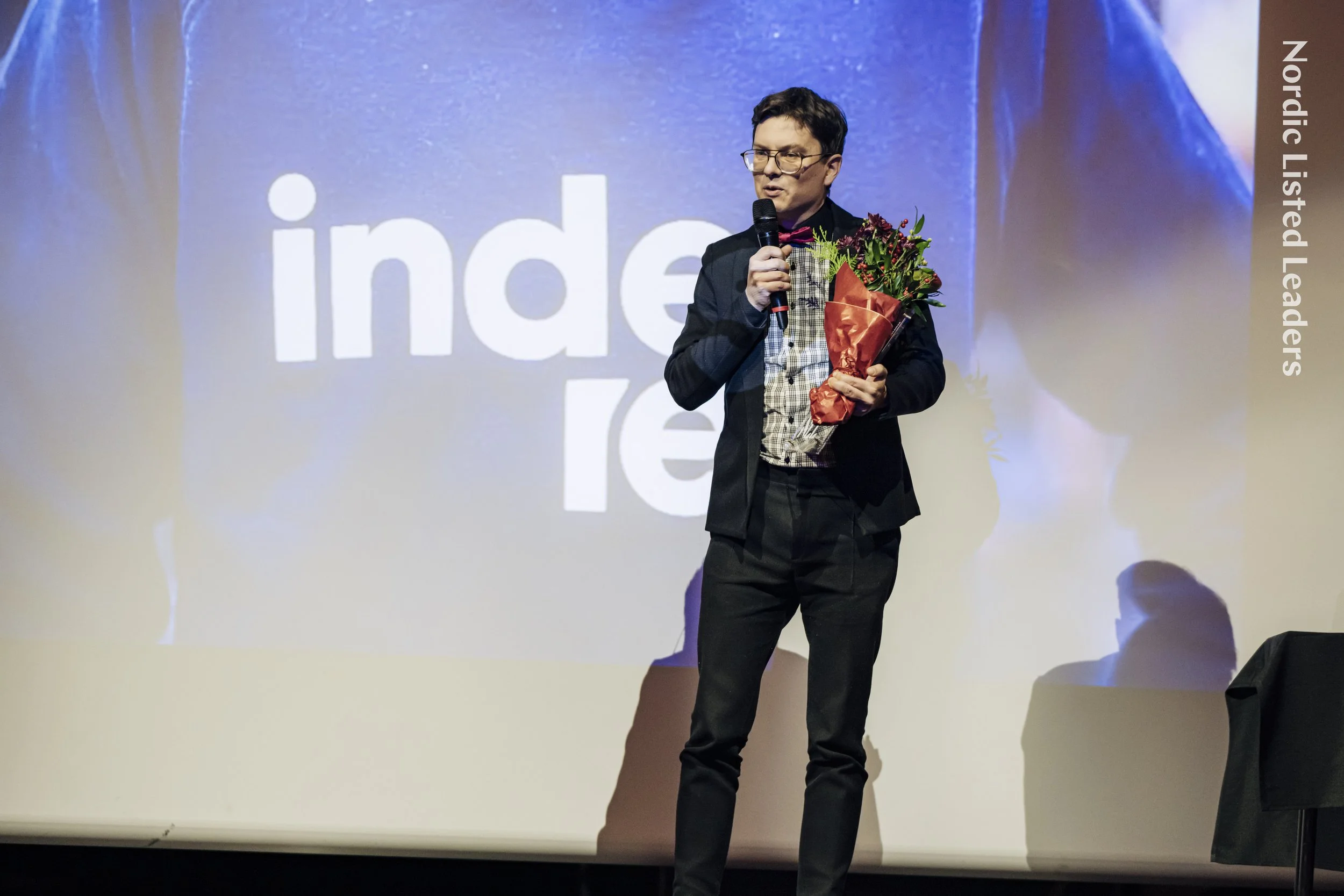
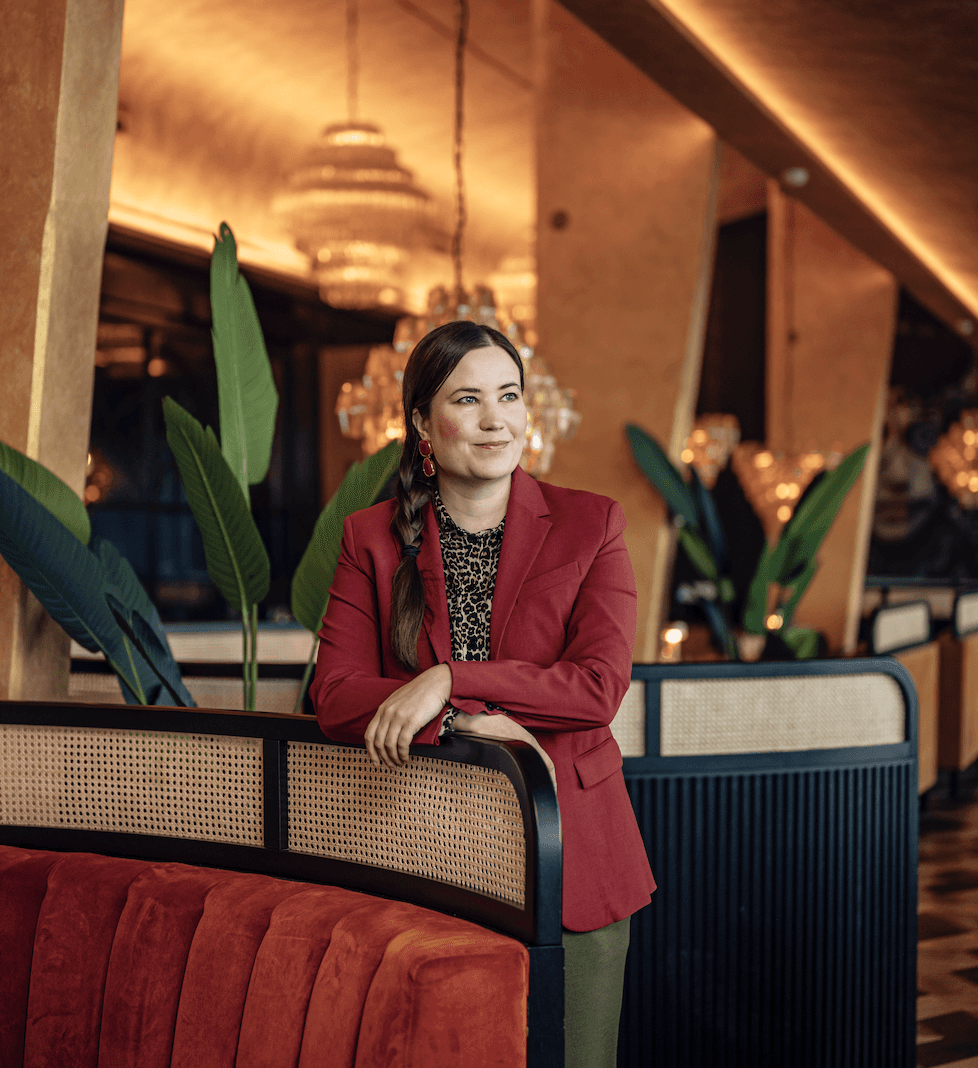
Mikael Rautanen was awarded the Future Leader of the Year in 2024 by Nordic Listed Leaders, which is part of the Listeds family. Photo by Eino Ansio.
The marriage after the wedding
Rautanen draws a distinction that resonates with many founders.
“It is equally important to think further: not only about the wedding but the kind of marriage and the life ahead as a listed company,” he says. “Because that’s what matters.”
Rautanen has been open about some unrealistic honeymoon expectations. “We were an employee-owned company when we went to the stock market, and we didn’t have any secondary sale in the IPO.” In practice, that meant the founders or long-term employees did not cash out. Even after the listing, ownership largely remained in-house. “We had probably the most strict lockups for all our employees that we have ever seen in the IPO market history.”
His thinking has evolved. “In Finland, it has been a bit like almost a criminal thing if the old owners sell in an IPO,” he says. “But it’s just natural that when a company enters a new phase, some old owners might sell, and new owners come in for that next phase.”
While Rautanen acknowledges that there were lessons along the way, he personally increased his stake after the listing.
What matters, he suggests, is durability. A public company isn’t built to celebrate peaks. It’s built to survive cycles and under the public eye.
“If we’re going to go public, we’re going to face turbulence at some point,” he says. “That’s just life.”
Disciplined anarchy meets quarterly reporting
If the IPO tested valuation discipline, public life tested culture.
Inderes operates under what it calls a “disciplined anarchy” organization model. The formal management team consists only of the CEO and CFO. There are no traditional managerial layers. Teams decide their own salaries — a model that creates friction, Rautanen admits. “These are not decisions that are supposed to be easy.” There is no travel policy. Spending decisions follow an advice process rather than hierarchical approval.
“All the decisions we make: everything is transparent,” Rautanen says. “Transparency can be an extremely strong control mechanism.”
The foundation is trust. As Rautanen puts it: “Our people are capable of making important decisions, they take responsibility for their decisions, and they want to make decisions that are good for the organization. These three things are the basic assumptions of our people.”
That humility applies internally as well as externally. The organization assumes professionals act responsibly. “Trust by default,” as Rautanen puts it. However, going public forced additional structure.
“Of course, it changed the company culture,” he says. “We’re a much more professionally run organization. We’re way more disciplined, way more structured.”
Still, he has resisted drifting toward heavy hierarchy. Listed companies, he notes, often centralize under pressure. He believes adaptability is a competitive advantage.
“If I had to choose one,” he says of the defining skill of future leaders, “it would be the ability to design organizations that are adaptive and creative. The world is becoming increasingly unpredictable and chaotic.”
Culture, in his view, determines whether the company can attract and retain the right people. “I think the best way is to have an interesting and exciting story for the company,” he says. “Something where people feel that I want to be part of that story.”
Compensation must be competitive, but it is not decisive on its own. “Rewarding only gets you to a certain level,” he says. “It needs to come from building something new and exciting.”
In a decentralized organization, responsibility is given early. For ambitious professionals, that can be more attractive than titles.
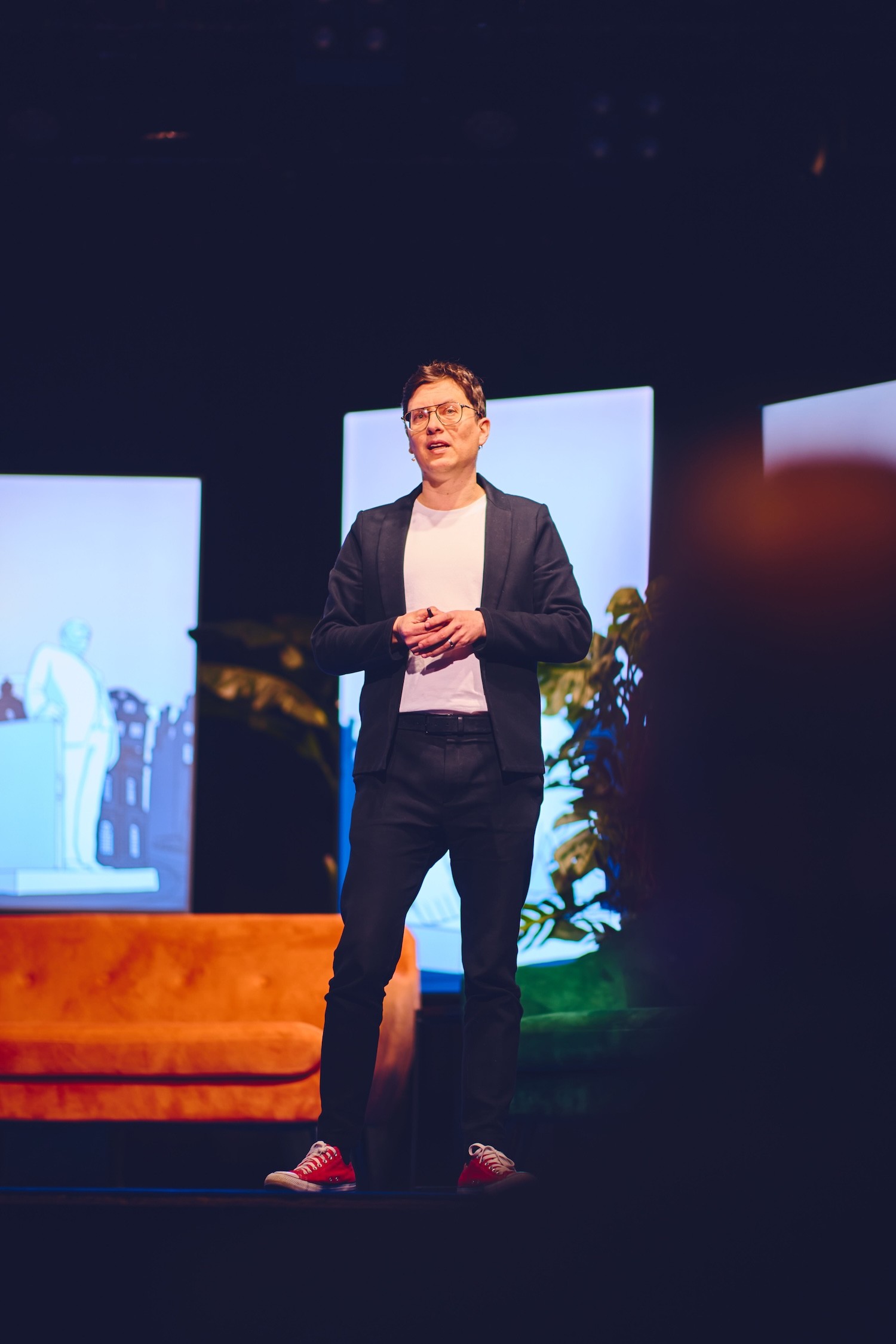
Mikael Rautanen, CEO of Inderes, speaking at the annual general meeting of 2025. Photo by Krister Majander.
The model behind the mission
Inderes’ mission is to democratize investor information by connecting investors and listed companies.
“If we can be successful in this, then it’s just going to be good for the economy, the whole society.”
The model is simple in principle and controversial in practice. Research is free for investors. Listed companies pay for coverage and investor relations services. “The company is just paying the bill, but the customer is the investor.” Inderes operates three business areas: research, events, and IR software, integrated into a digital platform.
The idea emerged in 2009 as traditional bank-led equity research retreated from small and mid-cap companies. “When we started, there really was no commissioned research,” Rautanen says. After the financial crisis, traditional equity research “more or less collapsed” for many smaller companies.
Commissioned research attempts to solve that gap. In many European markets, small and mid-cap companies lack analyst coverage altogether.
In a business model where issuers, not investors, pay, how to ensure independence? “If the investors don’t trust it [the commissioned analysis], then the investors don’t read it, and then there’s no point for the companies to pay for it.” Without credibility, there is no product. But that requires hard work. “You can never take the trust of investors for granted.”
For Rautanen, trust is not only a concept from the employee handbook but the essence of the market infrastructure. “For capital markets to function, we need trust, and to build trust in the capital markets, we need transparency.”
He sees policy moving in the same direction. European policymakers are increasingly focused on strengthening capital markets' competitiveness, including a plan to establish shared principles for commissioned equity research, which could increase credibility, he envisions.
Nordic expansion and learning the hard way
Despite the retail investor-friendly business model, Inderes’ international expansion has been slower than expected.
Sweden, with around 900 listed companies and a strong IPO culture, represents a major opportunity. It has also been humbling.
“We’ve probably made a lot of the usual mistakes going into a new market,” he says, speaking of the Swedish expansion that started in 2022. One of them was trying to replicate the full Finnish model, built over a decade, at once. That is partly why the Swedish market has not opened as quickly as expected.
Inderes is also active in Denmark and, to a lesser extent, Norway. After acquiring a minority stake in Copenhagen-based HC Andersen Capital in 2022, Inderes has licensed its technology to the investor relations and research platform. The two have also collaborated to build the Danish version of the Inderes digital service.
In Finland, the mood around entrepreneurship and investing in high-risk growth companies can at times feel pessimistic and cynical. Denmark offers a different kind of inspiration, according to Rautanen. Despite what he describes as the “absolutely horrible” performance of the Danish stock market over the past year and a multi-year slowdown in IPO activity, he says, “I love working with Danes because they’re so optimistic.”
The headwinds to expansion and single-digit revenue growth in 2025 have not broken Inderes’ spirit. According to the 2025 financial statements release, the company’s long-term target combines revenue growth of more than 30 percent with profitability. To move in that direction, Rautanen says Inderes is placing greater emphasis on its IR software business and working to return its Swedish events business to growth.
Rautanen also points to structural drivers that underpin his optimism about the Nordics. The company expects a rebound in Finland’s IPO activity and continued growth in the number of Finnish retail investors. Participation still trails Sweden, where 2.8 million people, nearly 30 percent of the population, directly own shares, according to Euroclear.
The pause at 40
After nearly two decades of building Inderes, Rautanen turned 40 and stepped away for two months late last year.
“I have been working as an entrepreneur for 16 years and never had the time to really stop or pause and reflect.” The break was planned five years earlier and took Rautanen on a more than 200-kilometer hike from Porto, Portugal, to Santiago de Compostela, Spain.
“I got to see that this company functions and evolves and gets better even when I’m not around.”
The experience clarified something essential. “Mikael is not the same as Inderes, and Inderes is not the same as Mikael.”
For a founder CEO of a listed company, that distinction can be difficult. He returned energized. “I love this job. I’m still excited. I enjoy this.”
The stock chart may look sobering. The IPO may have been too good. But beneath the volatility sits a founder willing to dissect his own missteps, disciplined about structure, and still visibly committed to the long game.
·
5 min read
Explore and follow profiles from this article to get timely updates:

In the red-hot IPO year of 2021, Inderes rang the bell at €25 a share.
“The IPO was a vast success,” says Mikael Rautanen, co-founder and CEO of the Finnish company that targets no smaller goal than democratizing investor information. “We set the IPO subscription price to €25 per share, and the moment we rang the bell, the share price went to €50.”
In hindsight, Rautanen is more reflective than celebratory. “Was that a good starting point for us as a listed company when the expectations of the market are through the roof?”
Over the past 16 years, Rautanen has grown Inderes from a three-founder startup into a major equity research platform in the Nordics, covering around 170 listed companies and building a large retail investor community.
The Inderes platform attracts more than 20 million annual visits, and its research team is widely regarded as the most influential within its segment in the Nordics. The company has expanded into investor relations events and investor relations software and established a presence in Sweden and Denmark.
“We failed in managing the expectations because the price jumped 100% on the ring of the bell,” he says. Today, the shares trade around €15, more than 60 percent below that euphoric first day, slightly worse than the average performance of other 2021 First North listings.
The problem, Rautanen suggests, was not demand but starting altitude. Expectations climbed so high that even strong operational delivery would struggle to keep up. COVID tailwinds that supported Inderes’ events business faded. The IPO boom that boosted market growth cooled. Russia’s invasion of Ukraine crushed growth multiples across Europe.
“It was an unhealthy way to start our life as a listed company,” he says, adding that “now we’ve pushed through it and now we’re a more resilient organization.”
He knew volatility would come eventually. “That’s just the life of being listed. That’s just the life of an entrepreneur. You’re going to have ups and downs.”
The candor with which Rautanen reflects on the IPO is striking. Many founders defend their listing narrative at all costs. He instead dissects his own decisions with the calm of an analyst — which may not be accidental. Before the IPO plan prompted stricter role definitions, Rautanen used to be an equity analyst. His career began at Nordea in trade finance, continued in equity research software at Valuatum, and culminated in building Inderes into one of the most visible capital markets platforms in the Nordics. He now also serves as a board member at Denmark’s HC Andersen Capital, a strategic partner of Inderes.
Cycles, he argues, are structural. “This is a cyclical industry. This is a cyclical business. This is a chaotic world.” Better to absorb the downturn early than late. “I’m kind of happy and grateful that we had it in the first year.”
Mikael Rautanen was awarded the Future Leader of the Year in 2024 by Nordic Listed Leaders, which is part of the Listeds family. Photo by Eino Ansio.
The marriage after the wedding
Rautanen draws a distinction that resonates with many founders.
“It is equally important to think further: not only about the wedding but the kind of marriage and the life ahead as a listed company,” he says. “Because that’s what matters.”
Rautanen has been open about some unrealistic honeymoon expectations. “We were an employee-owned company when we went to the stock market, and we didn’t have any secondary sale in the IPO.” In practice, that meant the founders or long-term employees did not cash out. Even after the listing, ownership largely remained in-house. “We had probably the most strict lockups for all our employees that we have ever seen in the IPO market history.”
His thinking has evolved. “In Finland, it has been a bit like almost a criminal thing if the old owners sell in an IPO,” he says. “But it’s just natural that when a company enters a new phase, some old owners might sell, and new owners come in for that next phase.”
While Rautanen acknowledges that there were lessons along the way, he personally increased his stake after the listing.
What matters, he suggests, is durability. A public company isn’t built to celebrate peaks. It’s built to survive cycles and under the public eye.
“If we’re going to go public, we’re going to face turbulence at some point,” he says. “That’s just life.”
Disciplined anarchy meets quarterly reporting
If the IPO tested valuation discipline, public life tested culture.
Inderes operates under what it calls a “disciplined anarchy” organization model. The formal management team consists only of the CEO and CFO. There are no traditional managerial layers. Teams decide their own salaries — a model that creates friction, Rautanen admits. “These are not decisions that are supposed to be easy.” There is no travel policy. Spending decisions follow an advice process rather than hierarchical approval.
“All the decisions we make: everything is transparent,” Rautanen says. “Transparency can be an extremely strong control mechanism.”
The foundation is trust. As Rautanen puts it: “Our people are capable of making important decisions, they take responsibility for their decisions, and they want to make decisions that are good for the organization. These three things are the basic assumptions of our people.”
That humility applies internally as well as externally. The organization assumes professionals act responsibly. “Trust by default,” as Rautanen puts it. However, going public forced additional structure.
“Of course, it changed the company culture,” he says. “We’re a much more professionally run organization. We’re way more disciplined, way more structured.”
Still, he has resisted drifting toward heavy hierarchy. Listed companies, he notes, often centralize under pressure. He believes adaptability is a competitive advantage.
“If I had to choose one,” he says of the defining skill of future leaders, “it would be the ability to design organizations that are adaptive and creative. The world is becoming increasingly unpredictable and chaotic.”
Culture, in his view, determines whether the company can attract and retain the right people. “I think the best way is to have an interesting and exciting story for the company,” he says. “Something where people feel that I want to be part of that story.”
Compensation must be competitive, but it is not decisive on its own. “Rewarding only gets you to a certain level,” he says. “It needs to come from building something new and exciting.”
In a decentralized organization, responsibility is given early. For ambitious professionals, that can be more attractive than titles.
Mikael Rautanen, CEO of Inderes, speaking at the annual general meeting of 2025. Photo by Krister Majander.
The model behind the mission
Inderes’ mission is to democratize investor information by connecting investors and listed companies.
“If we can be successful in this, then it’s just going to be good for the economy, the whole society.”
The model is simple in principle and controversial in practice. Research is free for investors. Listed companies pay for coverage and investor relations services. “The company is just paying the bill, but the customer is the investor.” Inderes operates three business areas: research, events, and IR software, integrated into a digital platform.
The idea emerged in 2009 as traditional bank-led equity research retreated from small and mid-cap companies. “When we started, there really was no commissioned research,” Rautanen says. After the financial crisis, traditional equity research “more or less collapsed” for many smaller companies.
Commissioned research attempts to solve that gap. In many European markets, small and mid-cap companies lack analyst coverage altogether.
In a business model where issuers, not investors, pay, how to ensure independence? “If the investors don’t trust it [the commissioned analysis], then the investors don’t read it, and then there’s no point for the companies to pay for it.” Without credibility, there is no product. But that requires hard work. “You can never take the trust of investors for granted.”
For Rautanen, trust is not only a concept from the employee handbook but the essence of the market infrastructure. “For capital markets to function, we need trust, and to build trust in the capital markets, we need transparency.”
He sees policy moving in the same direction. European policymakers are increasingly focused on strengthening capital markets' competitiveness, including a plan to establish shared principles for commissioned equity research, which could increase credibility, he envisions.
Nordic expansion and learning the hard way
Despite the retail investor-friendly business model, Inderes’ international expansion has been slower than expected.
Sweden, with around 900 listed companies and a strong IPO culture, represents a major opportunity. It has also been humbling.
“We’ve probably made a lot of the usual mistakes going into a new market,” he says, speaking of the Swedish expansion that started in 2022. One of them was trying to replicate the full Finnish model, built over a decade, at once. That is partly why the Swedish market has not opened as quickly as expected.
Inderes is also active in Denmark and, to a lesser extent, Norway. After acquiring a minority stake in Copenhagen-based HC Andersen Capital in 2022, Inderes has licensed its technology to the investor relations and research platform. The two have also collaborated to build the Danish version of the Inderes digital service.
In Finland, the mood around entrepreneurship and investing in high-risk growth companies can at times feel pessimistic and cynical. Denmark offers a different kind of inspiration, according to Rautanen. Despite what he describes as the “absolutely horrible” performance of the Danish stock market over the past year and a multi-year slowdown in IPO activity, he says, “I love working with Danes because they’re so optimistic.”
The headwinds to expansion and single-digit revenue growth in 2025 have not broken Inderes’ spirit. According to the 2025 financial statements release, the company’s long-term target combines revenue growth of more than 30 percent with profitability. To move in that direction, Rautanen says Inderes is placing greater emphasis on its IR software business and working to return its Swedish events business to growth.
Rautanen also points to structural drivers that underpin his optimism about the Nordics. The company expects a rebound in Finland’s IPO activity and continued growth in the number of Finnish retail investors. Participation still trails Sweden, where 2.8 million people, nearly 30 percent of the population, directly own shares, according to Euroclear.
The pause at 40
After nearly two decades of building Inderes, Rautanen turned 40 and stepped away for two months late last year.
“I have been working as an entrepreneur for 16 years and never had the time to really stop or pause and reflect.” The break was planned five years earlier and took Rautanen on a more than 200-kilometer hike from Porto, Portugal, to Santiago de Compostela, Spain.
“I got to see that this company functions and evolves and gets better even when I’m not around.”
The experience clarified something essential. “Mikael is not the same as Inderes, and Inderes is not the same as Mikael.”
For a founder CEO of a listed company, that distinction can be difficult. He returned energized. “I love this job. I’m still excited. I enjoy this.”
The stock chart may look sobering. The IPO may have been too good. But beneath the volatility sits a founder willing to dissect his own missteps, disciplined about structure, and still visibly committed to the long game.



Investor Event
Listeds Investor Event · Defence
Nordic defence is in a once-in-a-generation growth cycle. Eight listed and pre-IPO companies pitch to 100+ invited investors at Valkoinen Sali, Helsinki
21 September 2026


Latest on Listeds