/

Topics

/

Insights

Insights

Business

Four of the five biggest BlackRock increases in Finland this half were never announced

Aug 20, 2026

In the first half of 2026, BlackRock's ownership grew in eight of the ten Finnish listed companies where its position is visible. Two of those increases were announced. The other six were not, because Finnish law only asks for an announcement when a holding crosses a reporting threshold. The lowest is 5 per cent, and none of these crossed it.

Ownership gained between the end of December 2025 and the end of June 2026, in basis points, with the number of BlackRock announcements each company published alongside. Register figures are drawn from Listeds executive intelligence.

Company

Ownership %

Gained

Shares, Dec 31 2025

Shares, Jun 30 2026

Change

Change %

Register rank

Announcements

Metso*

5.08 → 5.50

+42bp

n/a

n/a

n/a

n/a

n/a

8

Qt Group

1.48 → 1.74

+26bp

376,177

443,173

+66,996

+17.8%

7 → 5

none

Nordea Bank*

5.50 → 5.70

+20bp

~ 190,500,000

~ 194,600,000

~ +4,100,000

~ +2.2%

1 → 1

none

Harvia

1.91 → 2.10

+19bp

357,390

392,409

+35,019

+9.8%

12 → 13

none

Kempower

0.59 → 0.71

+12bp

329,991

396,845

+66,854

+20.3%

8 → 7

none

Orion*

5.00 → 5.11

+11bp

n/a

n/a

n/a

n/a

n/a

19

Neste

2.90 → 2.95

+5bp

22,275,300

22,669,111

+393,811

+1.8%

4 → 2

none

Revenio Group

1.59 → 1.61

+2bp

423,288

468,238

+44,950

+10.6%

7 → 8

none

Elisa

6.49 → 6.49

0bp

10,857,012

10,857,012

No change

0%

2 → 2

none

Stora Enso*

5.00 → 5.00

0bp

n/a

n/a

n/a

n/a

n/a

20

* For Metso, Orion and Stora Enso the readings are the holdings reported at the crossings closest to each end of the window: Metso 12 February and 30 June, Orion 5 January and 17 June, Stora Enso beginning of January and 26 June. Nordea's second reading is end-July 2026; all other companies are 31 December 2025 to 30 June 2026. Nordea discloses its major shareholders rounded to the nearest 0.1 million shares (e.g. 194.6 million shares), so the share counts and changes shown for Nordea are approximations.

Basis points of ownership are used here because they survive the two things that distort share counts, dilution and buybacks, and because they mean the same thing to a chair and to a portfolio manager. One caution before reading the table: the three companies with announcements are measured as combined holdings, shares plus financial instruments, as filed. The seven others are measured as shares registered in BlackRock's own name.

Four of the five biggest increases, ranks two through five, produced no announcement at all, and 77 basis points of ownership changed hands across those four companies in silence.The 47 announcements cluster at the two ends of the table, at rank one and rank nine.

Metso gained 42 basis points without changing the percentage of shares held

Metso's share holding reads 4.98 per cent on 12 February and 4.98 per cent on 30 June. Identical to the second decimal across four and a half months, on a net movement of 39,519 shares. Over the same period the holding through financial instruments went from 0.09 to 0.52 per cent, taking the combined position from 5.08 to 5.50 per cent.

That is the largest increase in exposure to any Finnish listed company in this dataset, and a share register would not show it. Metso published eight announcements while it happened, each one describing a line being crossed rather than a position being built.

Stora Enso published twenty times and ended the half exactly where it started

At the beginning of January the Stora Enso holding read 4.26 per cent in shares and 0.73 per cent through financial instruments, 5.00 per cent in total. On 26 June: 3.81 per cent in shares, 1.19 per cent through financial instruments. Total, 5.00 per cent. The shares fell forty-five basis points, the financial instruments rose forty-six, and twenty announcements describe the round trip.

Orion is the only one of the three where the share holding itself crossed the line, from 4.97 per cent on 5 January to 5.01 per cent on 17 June, with financial instruments marginal throughout at 0.02 to 0.09 per cent. Nineteen announcements, eleven basis points.

The middle of the table bought quietly, and two of those gains are smaller than they look

Qt Group, Nordea, Harvia and Kempower gained 77 basis points of BlackRock ownership between them with nothing published. In share terms Kempower grew fastest, up 20.3 per cent to 396,845 shares, with Qt Group up 17.8 per cent to 443,173.

Two entries need discounting. Revenio's holding grew 10.6 per cent in shares but two basis points in ownership, because Revenio issued roughly 9 per cent more shares in the same window and BlackRock close to kept pace. Nordea's ownership rose partly because Nordea reduced its own share count, from 3,434 million to 3,403 million.

The rule fires on crossing, not on owning

How the flagging rule works

Under the Securities Markets Act (746/2012, Chapter 9), a shareholder must notify the company and the Financial Supervisory Authority (Finanssivalvonta) when its holding crosses a reporting threshold in Finland. The lowest is 5 per cent, and the ladder runs up to 90. Notification is due without undue delay and at the latest on the next trading day. The company then publishes it as a stock exchange release.

Every position in this piece sits at the bottom of that ladder, so 5 per cent is the only threshold that matters here. A holder sitting at 0.6 per cent can double its position in silence. A holder sitting at 5.00 per cent generates a release every time it crosses back over the line, whether a lending desk was busy, an index rebalanced, or shares moved between group entities.

The crossings recur across the half rather than clustering. Stora Enso published in five separate months, Orion in three, Metso in three.

Company

Notifications

Active months

Stora Enso

20

Jan, Feb, Mar, Apr, Jun

Orion

19

Jan, Mar, Jun

Metso

8

Feb, May, Jun

Total

47

All of H1

The rule also explains why a holder can sit above 5 per cent without publishing anything. Nordea and Elisa both do, at 5.7 and 6.49 per cent, because in this window nothing crossed.

A Finnish share register shows the registered holder, and for a foreign institution that can be the institution or a custodian bank acting for it. BlackRock does not appear under its own name in the Stora Enso, Orion or Metso registers, which describes how those positions are registered rather than whether they exist.

An announcement tells you a line moved, not that a position was built

When a Finnish company publishes a BlackRock notification, the question worth asking is which column moved. At Stora Enso and Metso it was the financial instrument column, while the share column fell or stood still. The release says 5 per cent either way, and the share column on its own tells you nothing about how the exposure changed.

Silence carries the same warning in reverse. Four companies gained 77 basis points between them with nothing published. For anyone sizing institutional demand in Finnish equities, the disclosure feed is the wrong instrument on its own, because it reports crossings rather than accumulation. The two records are complementary rather than ranked. Disclosure is fast and reports only crossings. A register comparison is slower, arriving once a month, and reports levels. The announcement tells you when a line was touched; only the register tells you what was built.

A notification is a late signal, not an early one

To reach 5 per cent, a holder has to accumulate first, and the accumulation is the part nobody publishes. Kempower and Qt Group are in that phase now, at 0.71 and 1.74 per cent, in public data, with no release attached. When an announcement eventually comes, it reports the arrival and not the journey.

Insights

Finland barely had CMOs. The US trend replacing them has now reached Nasdaq Helsinki

Aug 12, 2026

For three years, the reinvention of the marketing chief into a growth owner has been reshaping the C-suite of America's Fortune 500. Finland's listed-company management teams never carried many CMOs to begin with, yet the same shift is now surfacing on Nasdaq Helsinki, and it arrives as a question for boards and CEOs, not for marketing.

On 15 September 2025, the Chief Marketing and Sustainability Officer role at Rebl Group ended. Among the Chief titles the small-cap group kept was a different one: Chief Growth Officer. Taken alone, it is a single management change at one listed company. Taken against the wider record, it is one of the clearest Finnish instances yet of a shift documented at scale in the United States.
On 7 July 2026, Forrester published its third annual analysis of marketing leadership in the Fortune 500. Marketing executives who sit on the top team or report to the CEO are now found at 52% of F500 companies, down from 58% a year earlier.

The "chief marketing officer" title itself is used by just 36%, down from 49% in a single year. Forrester's Ian Bruce argues the decline reading misses the point: the role is not disappearing, it is being reinvented into chief growth officer, chief commercial officer and chief customer officer, giving one leader accountability for growth across the whole customer lifecycle.

Finland barely had CMOs to lose on the management teams

The temptation is to read this as an American story. Across the 188 companies actively listed on Nasdaq Helsinki and First North, seven have a standalone Chief Marketing Officer (not seven percent, seven companies), and not one of them is a large cap. All 33 Finnish large caps have zero. Where Forrester is tracking the CMO's decline at the top of the US market, the top of the Finnish market had already finished that decline before the story began.

Most senior marketing owner

Companies

Share of 188

Standalone Chief Marketing Officer

7

4%

Chief title with marketing bundled into other functions

9

5%

Below the Chief line (EVP, SVP, VP, Director, Head)

24

13%

No one with marketing in a management team title

148

79%

Most senior marketing owner
Share of 188 companies
5%13%79%188companiesStandalone Chief Marketing Officer4% · 7Chief title, marketing bundled5% · 9Below the Chief line13% · 24No marketing in management title79% · 148
Source: Listeds Executive Platform
Figure 1 — Most senior marketing owner, share of 188 Nasdaq Helsinki and First North companies. 79% carry no marketing role in their management team at all.

But the absence of the CMO title is the wrong thing to fix on. The part of the American trend that matters is not the marketing chief leaving; it is where the growth mandate goes next, and who at the top table is made to own the number. On that question, the change is visible in Finland too.

Rebl kept a growth title where a marketing one used to sit. Raute appointed Arto Kaikkola as Chief Commercial Officer effective 5 May 2026, a seat that folds sales, marketing, communications and commercial excellence into a single owner. And the inflow follows the same shape, though not the same title. Of nine senior marketing hires across Finnish listed companies in 2025 and 2026, only one — Framery's acting CMO — holds a marketing-only Chief title. Two more reached Chief level with marketing bundled into something else: sustainability at Gofore, commercial duties at Raute. The remaining six arrived below Chief level entirely, as EVPs, SVPs, VPs or a Director. The new senior marketing hire in Finland rarely gets a Chief title of any kind, let alone a marketing-only one.

Where the CMO title does survive, it clusters among recent arrivals. Companies that listed in 2021 or later carry a standalone CMO at four times the rate of those listed earlier (9% against 2%), and hold any Chief-level marketing seat at more than triple the rate (16% against 5%). But this is not evidence that going public designs the role in: in three of the five recent-listing CMOs the title predates the IPO, so the pattern is really the marketing title fading among long-listed incumbents, not newer companies inventing it. For boards, that is the point. The growth-ownership question is sharpest exactly where most of the market sits, at the long-established companies that have already let the marketing title go.

IPO cohort

Companies

Standalone CMO

Any Chief-level marketing seat

Listed 2021 or later

58

5 (9%)

9 (16%)

Listed before 2021

130

2 (2%)

7 (5%)

Two directions, not one

Here Finland diverges from the American script. The F500 reinvention runs in one direction: marketing consolidates upward into a commercial growth owner. The Finnish record splits in two. Some companies route the function up into a commercial or growth chief, as at Rebl and Raute. Others route it down into communications, the reputation and disclosure seat. Valmet's rebuilt leadership team placed communications inside an EVP for People, Communications and Culture, with no marketing role surviving at the top; around thirty listed companies now carry a senior communications owner whose title has no marketing scope at all.

These are opposite bets rather than two versions of one. Placing the function under a growth or commercial chief treats growth as a revenue-and-customer problem with a single accountable owner. Placing it under communications treats the senior storytelling seat as an investor-and-stakeholder function, with the growth number sitting elsewhere, typically spread across the CEO and sales. In a market as institutionally owned and disclosure-driven as the Nordic one, the pull toward communications is strong.

The question for the board

A Finnish listed-company board appoints and oversees the CEO and signs off on how the company frames its strategy and top team; the CEO builds that team beneath it. So the board's real question is broader than where the marketing title lands: it is whether someone visibly owns growth at all. When a company removes a marketing chief and names a growth or commercial chief in its place, the answer is easy to read. It is harder to read when no growth title exists.

Tokmanni shows how easily that case is misjudged. No executive there holds a marketing, growth or commercial title, which looks at first like an empty seat. But the growth mandate is owned. The CEO leads it; the Swedish Dollarstore segment, the acquisition meant to make Tokmanni "a Nordic leader in the variety discount retail market," sits on the executive team in its own right; and a newly created Chief Strategy and Transformation Officer joins from 1 September 2026. Growth is carried there by geography and strategy, not by a functional label.

That is the boardroom test, and the question is not "do we have a CMO." The data says most Finnish management teams never will. The sharper question: since the company will keep growth under a commercial, strategy or business-unit owner regardless, has the board decided which, and can it name the person who owns the number? What a board should refuse to accept is the outcome where the marketing title goes and nobody, by function, geography or strategy, visibly holds growth in its place.

Forrester's steadiest F500 finding is that once these reinvented leaders are appointed, they are given close to four years to deliver. The American trend is arriving in the Nordics. The question for boards and CEOs is not whether they will have a CMO, but whether they will design who owns growth, or inherit that answer by default.

Insights

Finland’s executive hiring outpaces board renewal in June as governance activity slows

Jul 8, 2026

Leadership activity eased in June, but companies continued adding senior executives as board changes fell sharply following the AGM season.

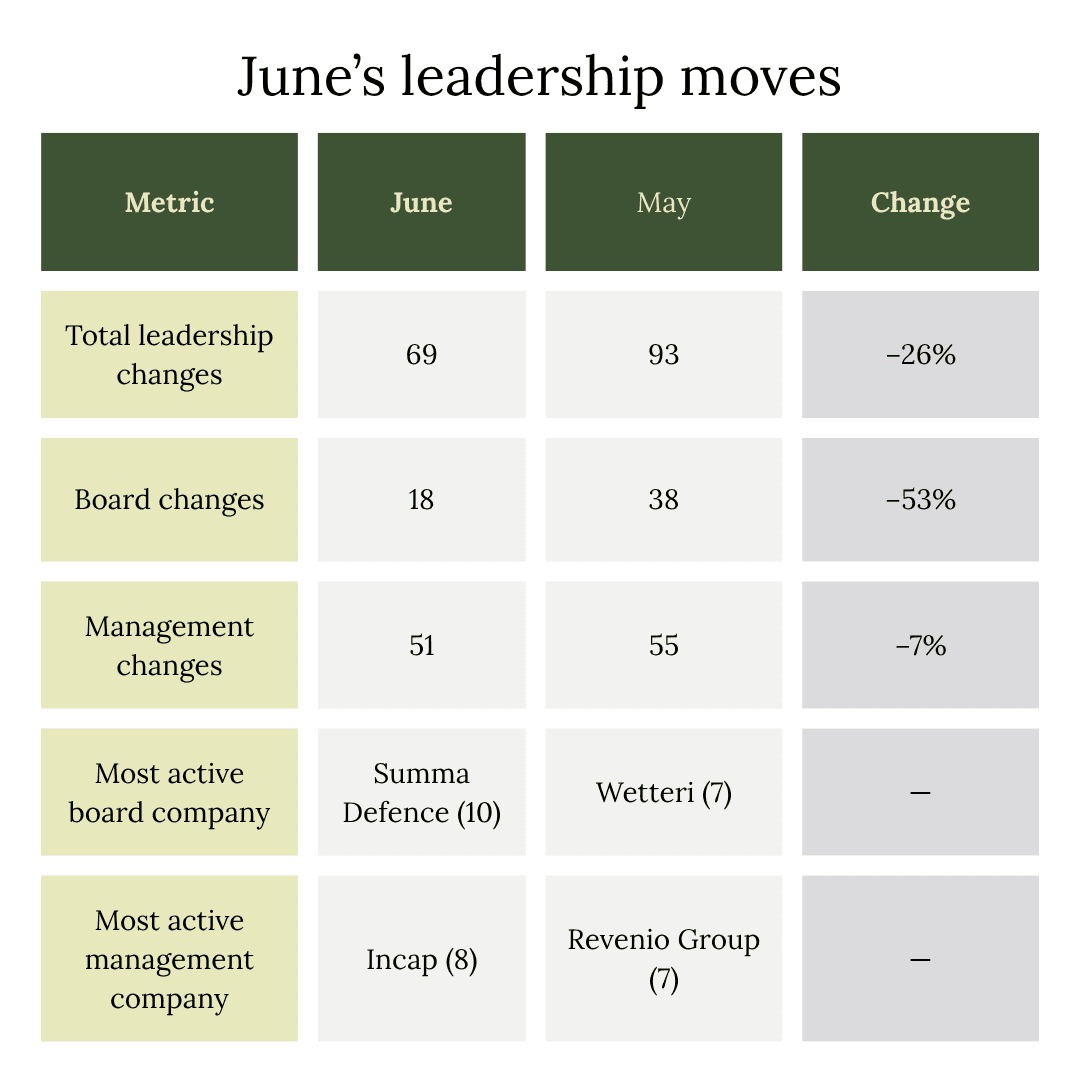
According to Listeds data, Finnish listed companies recorded 69 board and management changes during the month, down 26% from May's 93 changes. Boards accounted for 18 changes, a 53% decline from May, while management teams recorded 51 changes, down just 7% month over month.

The figures suggest that the annual governance cycle has largely run its course. After April's extensive board renewal and May's return to executive hiring, June was characterized by targeted leadership appointments aimed at strengthening operating teams rather than reshaping governance.

Board renewal slows after AGM season

Board activity declined sharply from the previous two months, with changes concentrated in only a handful of companies rather than spread across the Finnish listed market.

Summa Defence recorded the month's largest board renewal with 10 board changes after shareholders ordered a special audit into the company's finances and replaced the entire board, as reported by Listeds earlier. Juha Pinomaa was appointed chair alongside new members Ville Jaakonsalo, Ville Heikkinen, Tapani Kiiski, Jyrki Heinimaa, and Mikko Haapala. 

Biotech company Biohit followed with three board changes, appointing Kari Syrjänen as chair and Anssi Kariola as a board member. Car dealership Wetteri added Aarne Simula, the largest shareholder, to its board while Mika Aho assumed the role of chair, continuing the leadership renewal that has characterized the company lately. Listeds reported in June that Simula has returned as CEO while Wetteri plans to return to a positive adjusted operating profit this year. QPR Software also strengthened its board with the appointment of Patrik Sallner. 

The pattern differed from the previous two months. Rather than broad-based board renewal across the market, June's governance changes were concentrated in a handful of companies.

Executive hiring remains active

Management teams continued to evolve across listed companies, with the busiest activity taking place at Incap, Canatu, and Alisa Pankki.

Incap, a global provider of electronics manufacturing services, recorded the highest number of executive changes with eight management appointments. The company strengthened several regional leadership roles while appointing Helena Maripuu as chief corporate affairs officer, reflecting continued investment in both operational execution and corporate governance.

Canatu followed with seven management changes as new CEO Maximilian Slawinski continued building his leadership team. The company appointed Thomas Gädda to lead its semiconductor business and Nedal Safwat as senior vice president, medical diagnostics.

Alisa Pankki recorded five management changes in June amid its shift away from consumer lending to focus on SME financing. The bank formally appointed Aki Gynther as CEO alongside Sari Salmi as CFO, Satu Uski as chief information officer, and Katja Vähäsilta as general counsel and deputy CEO.

Finance leadership remained a recurring theme in June. Eagle Filters Group appointed Daniel Lähde as CFO, continuing this year's steady stream of finance appointments.

Elsewhere, Finnair appointed Sini Kivekäs as chief human resources officer, while Herantis Pharma named Juha Savola chief medical officer.

The first six months of 2026 now reveal a clear sequence in Finnish corporate leadership. January and February focused primarily on management teams. March reopened boardrooms as AGM season approached. April delivered the largest governance reset of the year. May shifted attention back toward executive hiring. June continued the shift, with management changes once again outnumbering board moves.

In short, if April was about deciding who would oversee the business, June was increasingly about deciding who would deliver its next phase of growth.

Insights

Four new CEOs and six CFOs in May signal a return to executive hiring

Jun 9, 2026

Four new CEO appointments and six new CFO hires marked a return to executive hiring among Finnish listed companies in May, as leadership activity shifted away from the boardroom after April's AGM-driven peak.

According to Listeds data, Finnish listed companies recorded 93 board and management changes during the month. Boards accounted for 38 changes, including 21 appointments and 17 departures. Management teams recorded 55 changes, consisting of 38 appointments and 17 departures.

The contrast with April is notable. April produced an exceptional 226 leadership changes as the AGM season reached full intensity. May still reflected the same governance cycle, but the pace became more selective as companies completed the largest board renewals and shifted attention back toward executive teams.

Board renewal remains active

Several companies continued reshaping their boards during May.

Car dealership Wetteri recorded seven board changes, the highest number among listed companies during the month. The company appointed Aarne Simula as chair alongside Mika Aho, Minna Kurunsaari, and Jarmo Rankinen as new board members, while Hannu Pärssinen, Mikael Malmsten, and Martti Haapala departed.

Revenio recorded five board changes following its acquisition of Visionix International, which closed on May 28. As part of the transaction, Marc Abitbol, Charles Vilgrain, and Nicklas Hansen joined Revenio's board, while Ann-Christine Sundell and Pekka Tammela stepped down. The appointments expand the board's expertise as Revenio integrates Visionix, a deal that significantly increases the company's scale in ophthalmic diagnostics.

Sanoma, the owner of Helsingin Sanomat and Aamulehti, also refreshed its governance structure. Timo Lappalainen became chair while Tiina Alahuhta-Kasko joined the board. The changes coincided with the departures of long-time chair Pekka Ala-Pietilä and board member Anna Herlin.

Elsewhere, KH Group and Modulight each recorded four board changes, while Faron Pharmaceuticals completed a three-person board reshuffle.

The pattern differs from April's broad-based AGM wave. Instead of dozens of companies making simultaneous changes, May's activity was concentrated in a smaller group of companies undertaking more extensive board renewals.

Executive appointments regain momentum

Management activity strengthened again after slowing during the height of the AGM season.

The month included four CEO appointments. Canatu appointed Maximilian Slawinski as CEO, succeeding Juha Kokkonen. Duell confirmed Tomi Virtanen as CEO after serving in the role on an interim basis. Martela appointed Panu Ala-Nikkola as CEO, while Siili Solutions named Markku Savusalo, VP of digital engineering, interim CEO.

Finance leadership remained a recurring theme. Six companies appointed new chief financial officers during the month, including Enersense International, F-Secure, Puuilo, Rebl Group, Scanfil, and Suominen.

Companies also continued to strengthen commercial, growth, and people leadership functions. Admicom appointed Jesse Pärnänen as chief growth officer, while Metso named Jonathan Allen chief growth officer. Sitowise appointed Elisa Rusama as chief human resources officer, and Duell added Anne-May Asplund as chief people officer.

One company stood out for executive activity. Revenio Group recorded seven management changes, including six vice president appointments, as the company reshaped parts of its leadership structure.

The first five months of 2026 now reveal a clear sequence in Finnish corporate leadership. January and February focused primarily on management teams. March reopened boardrooms as AGM season approached. April delivered the largest governance reset of the year. May suggests that the cycle is entering a new phase: board renewals are still taking place, but leadership activity is gradually shifting back toward operating teams and execution.

If April was about deciding who sits around the board table, May was increasingly about deciding who runs the business day to day.

This monthly read is part of Listeds Leadership Intelligence, where we follow the leadership changes across the Finnish market. Subscribe to our Pulse newsletter or the platform to follow the moves as they happen. The CEO Index, produced with SAM Headhunting, tracks every new chief executive, quarter by quarter.

Stay on the pulse, catch the signals

Subscribe to Listeds Leadership Intelligence Platform:

  • leader and company database access

  • email alerts

  • career, boards and interim opportunities

Our Pulse newsletter

Your weekly leadership intelligence briefing.

What happened, why it matters, and what to watch across every CEO, board, and executive move in Nordic listed companies, starting with Finland. Fast, factual, and to the point.

Delivered every Monday.

By signing up, you agree to our Privacy Policy