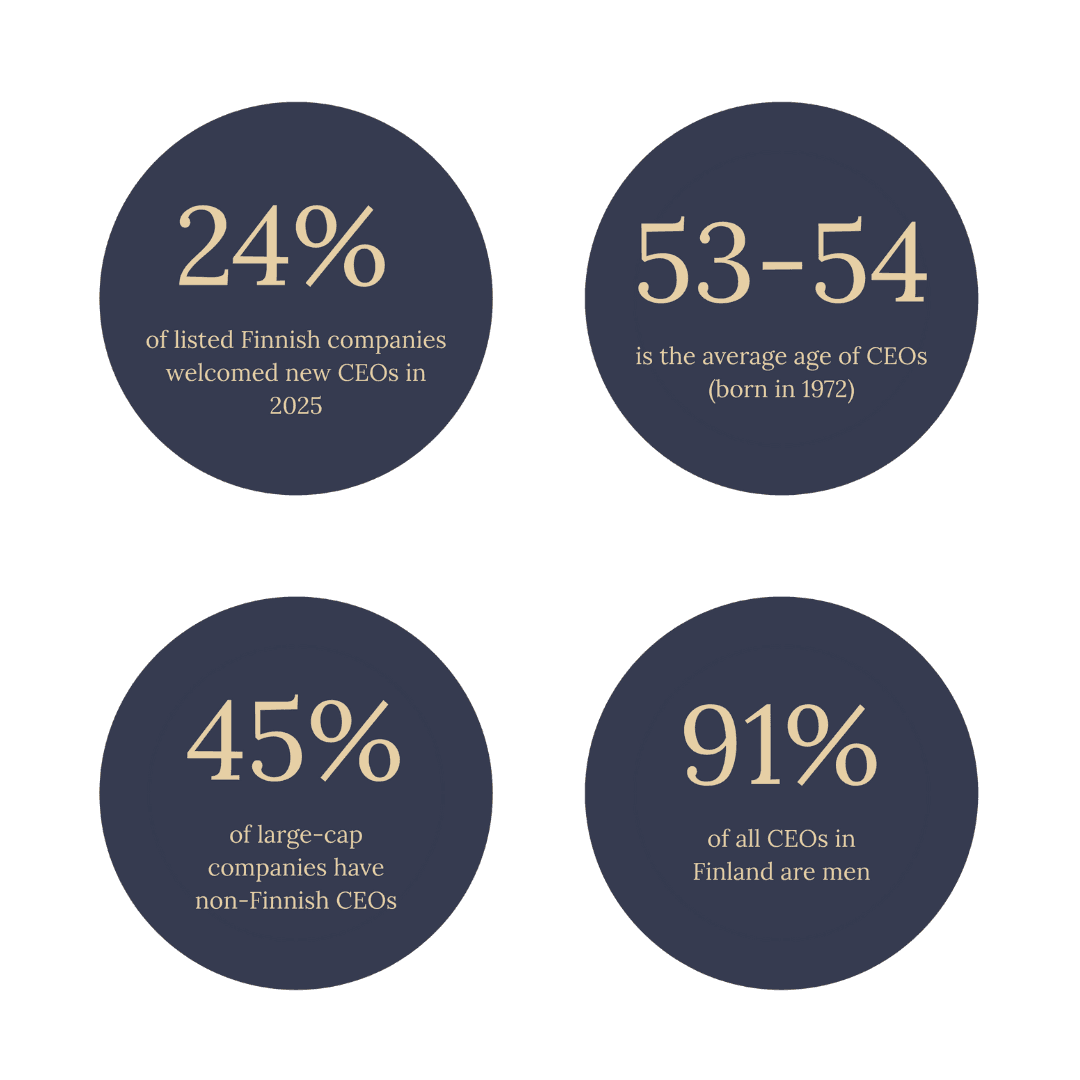
In 2025, 44 out of 184 Finnish listed companies changed their CEO, meaning roughly one in four enterprises appointed a new leader during the year, with the shift most visible among large-cap companies, where foreign CEOs now account for a growing share of appointments, the CEO Index — Finland | 2025 shows.

Among large-cap companies, CEO turnover coincided with a clear move toward more international leadership, according to the latest CEO Index — Finland compiled by Listeds in collaboration with SAM Headhunting. 

As of early 2026, 46.9 percent of large-cap CEOs are non-Finnish, bringing Finland’s largest listed companies close to an even split between domestic and foreign leaders. No other segment of the Finnish stock market shows a comparable level of internationalization.
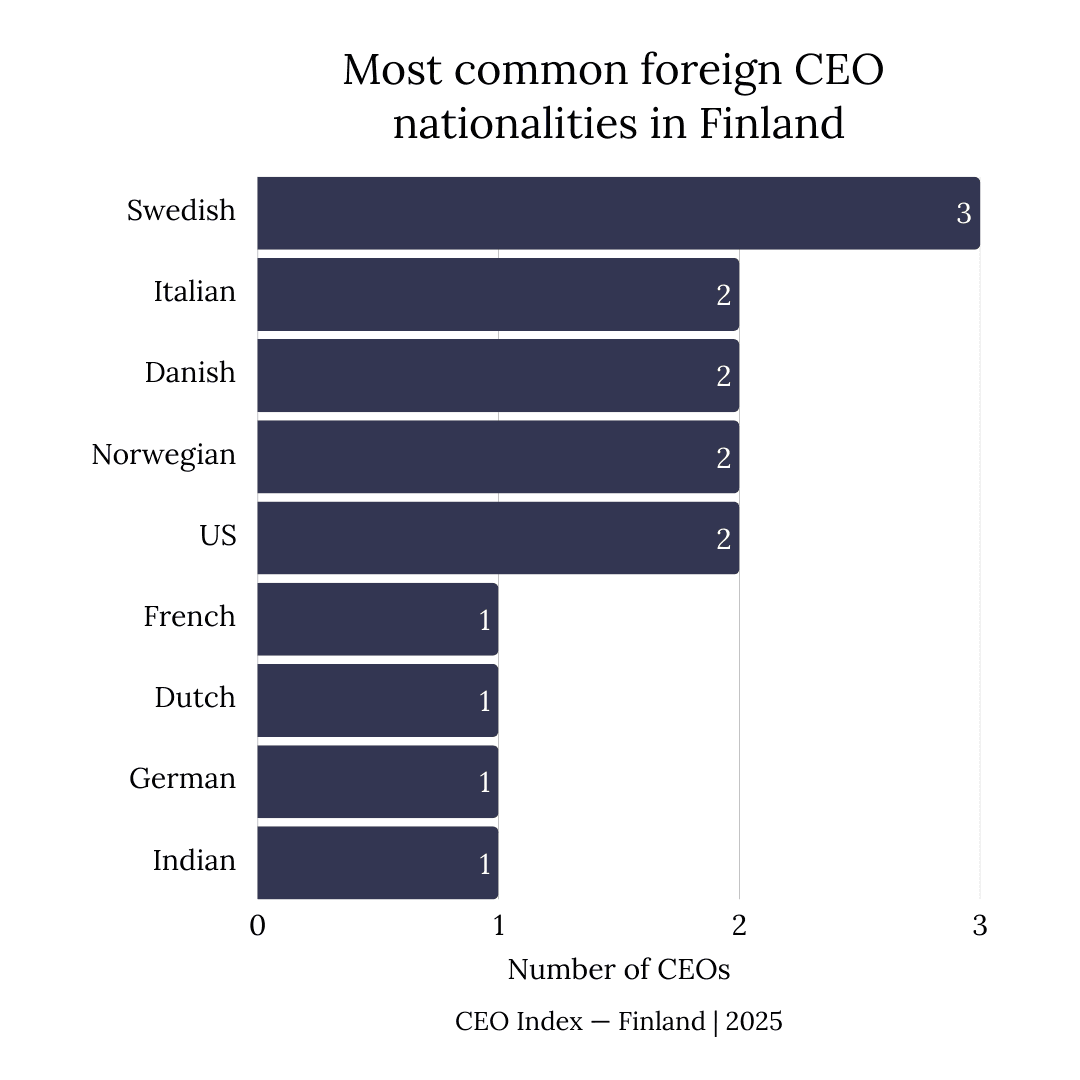
Several of the Helsinki bourse’s biggest companies illustrate the trend. Nokia is led by Justin Hotard from the United States, Telia Company by Patrik Hofbauer from Sweden, and Nordea by Frank Vang-Jensen from Denmark. Among foreign CEOs in large-cap firms, Swedish nationals form the single largest group, followed by leaders from the United States, Denmark, Norway, and Italy.
“International backgrounds are increasingly visible in the leadership of Finnish listed companies, and we expect this trend to continue in the future. It was encouraging to see that in large-cap companies, nearly half of the executives already have an international background,” says Leena Hellfors, managing partner at SAM Headhunting.

Across the broader market, however, leadership remains predominantly domestic. 84.2 percent of all active CEOs in Finland are Finnish, and growth-stage companies listed on First North continue to recruit almost exclusively from the local talent pool. International CEO recruitment is therefore selective rather than systemic, concentrated among companies with the greatest scale and cross-border exposure.

Industry structure shapes where foreign CEOs emerge

The internationalization of leadership is not uniform across sectors. Based on active CEO data as of January 29, 2026, telecommunications and basic materials show the highest shares of non-Finnish CEOs. Industrials, consumer discretionary, technology, and financials also display meaningful international representation.
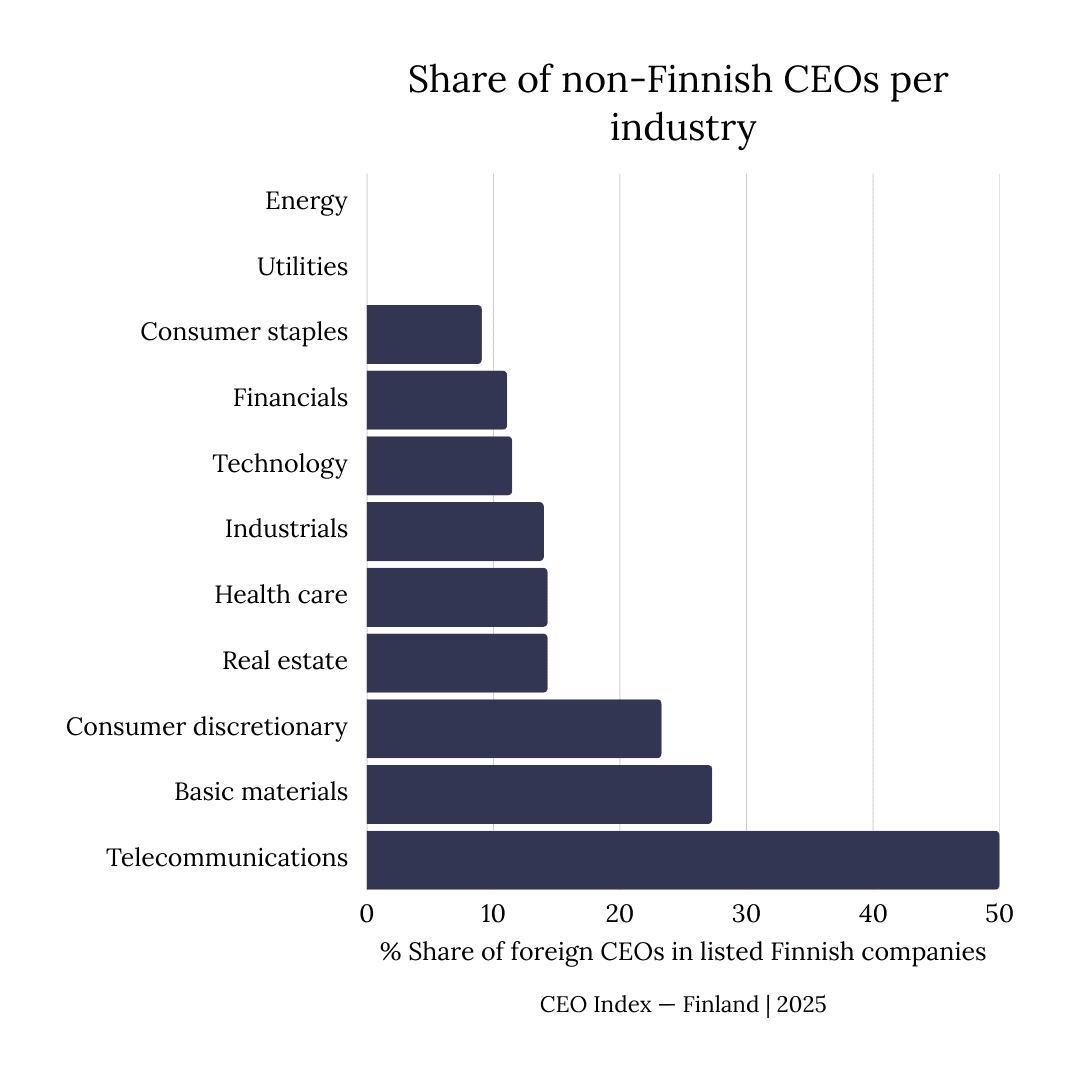
By contrast, energy and utilities remain entirely Finnish-led, reflecting regulatory intensity, domestic market focus, and more stable operating environments. The pattern suggests that boards are widening their leadership search primarily in industries where global competition and international operations are central to performance.

Turnover was broad, but large caps changed most

Leadership change in 2025 was not limited to any single segment. CEO appointments were recorded across First North, small-cap, mid-cap, and large-cap companies alike.
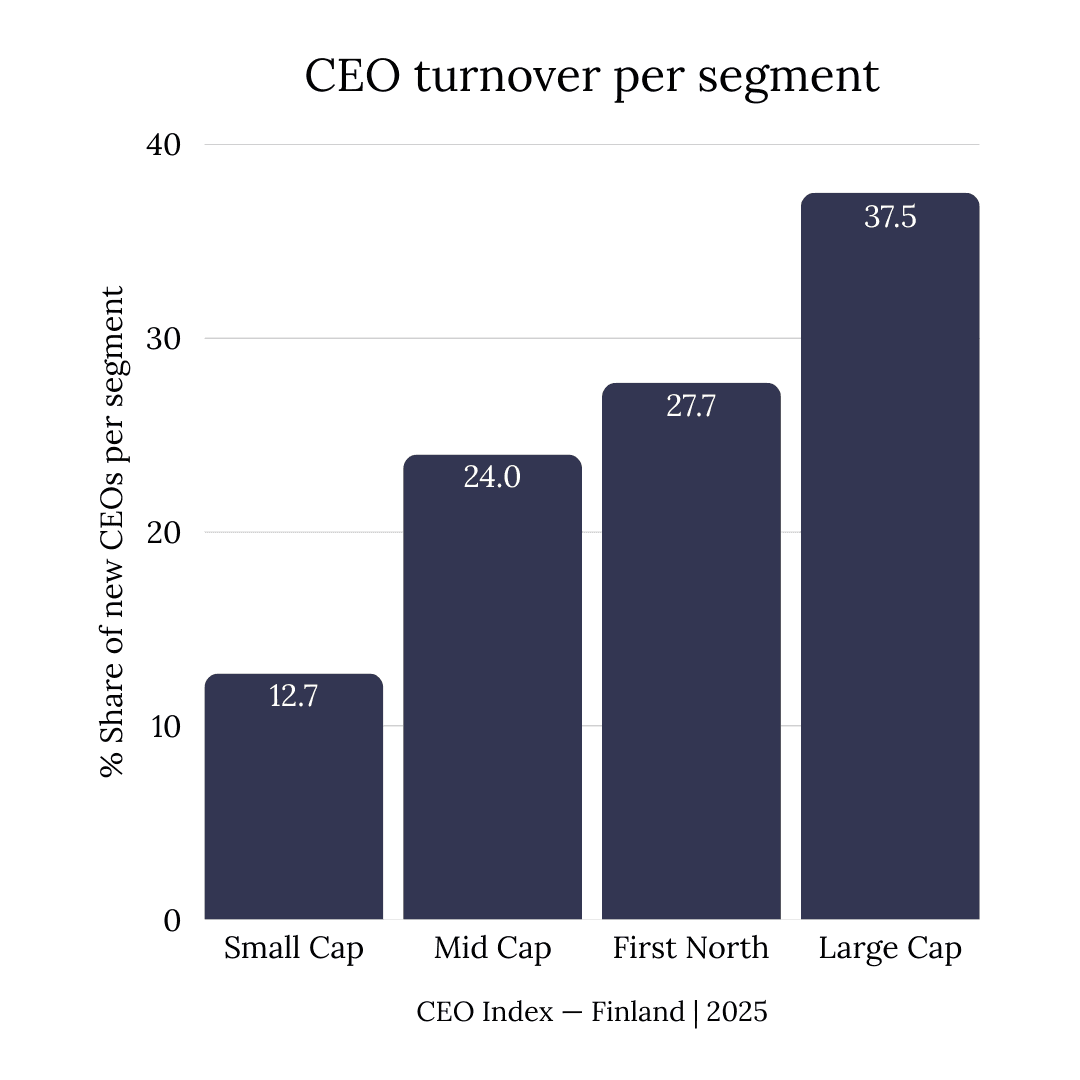
Measured relative to segment size, however, large-cap companies experienced the highest CEO turnover, with more than one-third of firms changing CEOs during the year. First North companies recorded a similar number of changes in absolute terms, but a lower turnover rate, given their larger population of listed firms.

At the industry level, turnover was concentrated rather than widespread. Industrials accounted for the largest number of new CEO appointments in 2025, followed by consumer discretionary, technology, and financials, while several other sectors saw little or no leadership change.

CEO transitions trigger most management changes in large caps

Following a CEO appointment in 2025, companies recorded an average of 3.7 group management changes, driven by 2.1 new hires and 1.6 resignations. 

Change intensity varies sharply by segment. Large-cap CEOs were the most active, averaging nearly double the leadership turnover of other segments, reflecting more deliberate top-team reshaping. First North CEOs showed relatively greater exit-driven change, while mid-cap CEOs favored stability. 

The most significant transformation followed the appointment of Scott Phillips at Hiab, who oversaw 19 management changes. Other high-impact CEOs included Endre Rangnes (Tietoevry) and Johan Westermarck (Eezy), highlighting how individual leadership transitions can dramatically reshape executive teams.

Familiarity still matters when boards choose new CEOs

Despite the visibility of international hires, Finnish boards continue to place strong weight on familiarity. Of the 44 new CEOs appointed in 2025, more than half had prior exposure to the company they now lead.

  • Ten had previously served on the board

  • Eleven had been part of the management team

  • Three had experience in both roles

These were rarely rapid successions. Board or management experience often dated back years, reflecting long leadership trajectories rather than short-term promotions.

“High CEO turnover is a critical trend to watch, and its impact is increasingly visible in board recruitment. We are seeing a clear pattern of board members stepping into CEO roles,” says Taru From, senior partner at SAM Headhunting.

A selective shift rather than a wholesale change

Taken together, the 2025 data points to selective internationalization at the top of the Finnish market. Large-cap companies are increasingly open to foreign CEOs, particularly in globally exposed industries, while smaller and growth-stage firms remain firmly Finnish-led.

For boards and investors, the message is clear. Finland’s CEO market is evolving, but it is doing so deliberately, balancing international experience with familiarity and long-term leadership development. For more information, find the CEO Index — Finland | 2025 here.

Source: CEO Index — Finland | 2025, compiled in partnership with SAM Headhunting.

|

|

Insights

Finland’s largest companies are now led almost as often by foreigners as Finns

Finland’s largest companies are now led almost as often by foreigners as Finns

·

5 min read

In 2025, 44 out of 184 Finnish listed companies changed their CEO, meaning roughly one in four enterprises appointed a new leader during the year, with the shift most visible among large-cap companies, where foreign CEOs now account for a growing share of appointments, the CEO Index — Finland | 2025 shows.

Among large-cap companies, CEO turnover coincided with a clear move toward more international leadership, according to the latest CEO Index — Finland compiled by Listeds in collaboration with SAM Headhunting. 

As of early 2026, 46.9 percent of large-cap CEOs are non-Finnish, bringing Finland’s largest listed companies close to an even split between domestic and foreign leaders. No other segment of the Finnish stock market shows a comparable level of internationalization.

Several of the Helsinki bourse’s biggest companies illustrate the trend. Nokia is led by Justin Hotard from the United States, Telia Company by Patrik Hofbauer from Sweden, and Nordea by Frank Vang-Jensen from Denmark. Among foreign CEOs in large-cap firms, Swedish nationals form the single largest group, followed by leaders from the United States, Denmark, Norway, and Italy.

“International backgrounds are increasingly visible in the leadership of Finnish listed companies, and we expect this trend to continue in the future. It was encouraging to see that in large-cap companies, nearly half of the executives already have an international background,” says Leena Hellfors, managing partner at SAM Headhunting.

Across the broader market, however, leadership remains predominantly domestic. 84.2 percent of all active CEOs in Finland are Finnish, and growth-stage companies listed on First North continue to recruit almost exclusively from the local talent pool. International CEO recruitment is therefore selective rather than systemic, concentrated among companies with the greatest scale and cross-border exposure.

Industry structure shapes where foreign CEOs emerge

The internationalization of leadership is not uniform across sectors. Based on active CEO data as of January 29, 2026, telecommunications and basic materials show the highest shares of non-Finnish CEOs. Industrials, consumer discretionary, technology, and financials also display meaningful international representation.

By contrast, energy and utilities remain entirely Finnish-led, reflecting regulatory intensity, domestic market focus, and more stable operating environments. The pattern suggests that boards are widening their leadership search primarily in industries where global competition and international operations are central to performance.

Turnover was broad, but large caps changed most

Leadership change in 2025 was not limited to any single segment. CEO appointments were recorded across First North, small-cap, mid-cap, and large-cap companies alike.

Measured relative to segment size, however, large-cap companies experienced the highest CEO turnover, with more than one-third of firms changing CEOs during the year. First North companies recorded a similar number of changes in absolute terms, but a lower turnover rate, given their larger population of listed firms.

At the industry level, turnover was concentrated rather than widespread. Industrials accounted for the largest number of new CEO appointments in 2025, followed by consumer discretionary, technology, and financials, while several other sectors saw little or no leadership change.

CEO transitions trigger most management changes in large caps

Following a CEO appointment in 2025, companies recorded an average of 3.7 group management changes, driven by 2.1 new hires and 1.6 resignations. 

Change intensity varies sharply by segment. Large-cap CEOs were the most active, averaging nearly double the leadership turnover of other segments, reflecting more deliberate top-team reshaping. First North CEOs showed relatively greater exit-driven change, while mid-cap CEOs favored stability. 

The most significant transformation followed the appointment of Scott Phillips at Hiab, who oversaw 19 management changes. Other high-impact CEOs included Endre Rangnes (Tietoevry) and Johan Westermarck (Eezy), highlighting how individual leadership transitions can dramatically reshape executive teams.

CEO newsletter

For those carrying responsibility at the top.

A monthly letter on leadership, power, and transition in the Nordics. Written by Helene Auramo, drawn from real CEO conversations and leadership signals.

Delivered monthly.

By signing up, you agree to our Privacy Policy

CEO newsletter

For those carrying responsibility at the top.

A monthly letter on leadership, power, and transition in the Nordics. Written by Helene Auramo, drawn from real CEO conversations and leadership signals.

Delivered monthly.

By signing up, you agree to our Privacy Policy

Familiarity still matters when boards choose new CEOs

Despite the visibility of international hires, Finnish boards continue to place strong weight on familiarity. Of the 44 new CEOs appointed in 2025, more than half had prior exposure to the company they now lead.

  • Ten had previously served on the board

  • Eleven had been part of the management team

  • Three had experience in both roles

These were rarely rapid successions. Board or management experience often dated back years, reflecting long leadership trajectories rather than short-term promotions.

“High CEO turnover is a critical trend to watch, and its impact is increasingly visible in board recruitment. We are seeing a clear pattern of board members stepping into CEO roles,” says Taru From, senior partner at SAM Headhunting.

A selective shift rather than a wholesale change

Taken together, the 2025 data points to selective internationalization at the top of the Finnish market. Large-cap companies are increasingly open to foreign CEOs, particularly in globally exposed industries, while smaller and growth-stage firms remain firmly Finnish-led.

For boards and investors, the message is clear. Finland’s CEO market is evolving, but it is doing so deliberately, balancing international experience with familiarity and long-term leadership development. For more information, find the CEO Index — Finland | 2025 here.

Source: CEO Index — Finland | 2025, compiled in partnership with SAM Headhunting.

Why the CEO Index is published quarterly in the future

“The world changes fast, and an annual snapshot of CEO changes is no longer enough. Leadership transitions now require higher-frequency insight,”

says Taru From, senior partner at SAM Headhunting.

This is why the CEO Index will be published on a quarterly basis, with results released throughout the year, she added. The first Q1 update will be published in April.


Board Programme

Built for Nordic listed company boards.

The only programme in the Nordics designed specifically for listed-company board work.
Five sessions, one cohort, twenty leaders in one room - Helsinki, 2026.

Board Programme

Built for Nordic listed company boards.

The only programme in the Nordics designed specifically for listed-company board work.
Five sessions, one cohort, twenty leaders in one room - Helsinki, 2026.

Authors

Emmi Laine is head of business content at Listeds and our lead for finance and business coverage. She sets the editorial agenda, interviews Nordic business leaders, and writes stories, newsletters, and social content on timely market and corporate topics. Emmi brings nearly eight years of experience from Shanghai's Yicai Global / Yicai Media Group, where she was awarded for reporting on China’s economy, finance sector, and technology innovation. She holds an MSc in Innovation and Entrepreneurship from ESADE Business School in Barcelona and a Master’s degree in International Design Business Management from Aalto University. She also holds a Bachelor’s degree in Culture Studies with a major in Journalism from Stockholm University and has studied Mandarin Chinese and Chinese culture. Emmi is a Finnish citizen and has lived in Finland, Sweden, China, and Portugal.

Emmi Laine is head of business content at Listeds and our lead for finance and business coverage. She sets the editorial agenda, interviews Nordic business leaders, and writes stories, newsletters, and social content on timely market and corporate topics. Emmi brings nearly eight years of experience from Shanghai's Yicai Global / Yicai Media Group, where she was awarded for reporting on China’s economy, finance sector, and technology innovation. She holds an MSc in Innovation and Entrepreneurship from ESADE Business School in Barcelona and a Master’s degree in International Design Business Management from Aalto University. She also holds a Bachelor’s degree in Culture Studies with a major in Journalism from Stockholm University and has studied Mandarin Chinese and Chinese culture. Emmi is a Finnish citizen and has lived in Finland, Sweden, China, and Portugal.

Authors

Journalist

Emmi Laine is head of business content at Listeds and our lead for finance and business coverage. She sets the editorial agenda, interviews Nordic business leaders, and writes stories, newsletters, and social content on timely market and corporate topics. Emmi brings nearly eight years of experience from Shanghai's Yicai Global / Yicai Media Group, where she was awarded for reporting on China’s economy, finance sector, and technology innovation. She holds an MSc in Innovation and Entrepreneurship from ESADE Business School in Barcelona and a Master’s degree in International Design Business Management from Aalto University. She also holds a Bachelor’s degree in Culture Studies with a major in Journalism from Stockholm University and has studied Mandarin Chinese and Chinese culture. Emmi is a Finnish citizen and has lived in Finland, Sweden, China, and Portugal.

All Listeds newsletters (bundle)

One sign-up, the full picture.

Get every Listeds newsletter: the daily signal drumbeat, the weekly Pulse briefing, the monthly Best of the Month, the CEO letter, and the Weekend read.

By signing up, you agree to our Privacy Policy

All Listeds newsletters (bundle)

One sign-up, the full picture.

Get every Listeds newsletter: the daily signal drumbeat, the weekly Pulse briefing, the monthly Best of the Month, the CEO letter, and the Weekend read.

By signing up, you agree to our Privacy Policy

Latest signalsLive feed
Moves trackerLive feed

Investor Event

Listeds Investor Event · Defence

Nordic defence is in a once-in-a-generation growth cycle. Eight listed and pre-IPO companies pitch to 100+ invited investors at Valkoinen Sali, Helsinki

21 September 2026

Latest on Listeds

Business

Sensofusion seeks a €1.3 billion Helsinki listing with its founder keeping control

Sep 24, 2026

Drone countermeasures company Sensofusion plans to list on Nasdaq Helsinki in October at a pre-money valuation of up to €1.3 billion. That would make it the first growth company to join the Helsinki exchange valued above €1 billion. The company aims to raise about €300 million in new shares, and four Finnish institutions have already committed €170 million of that.

The anchor investors are Elo, Ilmarinen, Varma and funds managed by OP Fund Management . The offering will include a public offering in Finland and an institutional offering in Finland and internationally, including in the US. The majority shareholder, Haave Oy, and some other shareholders will also sell existing shares.

A 60.8% operating margin carries the valuation

Sensofusion's revenue rose almost 90% in 2025 to €35 million, with profit of more than €23 million. In the first half of 2026, revenue grew another 122%. In the 12 months to the end of June 2026, the operating margin was 60.8%. Revenue grew at an average annual rate of 91.1% between the 2024 financial year and that 12-month period. Earlier this decade, annual revenue was around €700,000.

The company's main product, Airfence, detects hostile drones and can disable them by radio jamming. Customers include Ukraine, NASA, the Finnish Defence Forces and the Finnish Border Guard. "A large number of our customers are operational in some way, involved in war," said founder and CEO Tuomas Rasila.

The company says most of its revenue already comes from outside conflict zones. Rasila expects demand to grow whether or not the war in Ukraine continues, pointing to NATO members' commitment to spend 3.5 to 5% of GDP on defence. "There is nothing we hope for more than the end of war," he said. Chairman Timo Ahopelto put the market's annual growth at about 30%. "By 2030, the market will increase approximately fivefold," he said.

The proceeds will fund research and development in software, detection and countermeasure technologies, artificial intelligence and satellite capabilities. They will also pay for more production and testing capacity and strengthen the balance sheet.

Rasila will remain the controlling owner

Rasila owns up to 82% of the company, according to Helsingin Sanomat. He says the listing is not an exit. "I want Sensofusion to grow bigger than its founder. At the same time, I intend to continue as CEO," he said. He also plans to sell only a small part of his holding: "I am selling maybe about one percent of my own share and I am committing to not selling the 99 percent"

Suppose the issue raises the full €300 million at the maximum valuation. The dividend policy puts reinvestment first, and any future payouts will depend on the company's financing needs for growth. New shareholders are paying for growth, not for influence. The board and management already include familiar names: Ahopelto as chairman, and Mikko Hyppönen, formerly of F-Secure, as research director.

Market Signals

UPM and Sappi's paper venture heads for an EU veto as UPM's WISA demerger nears completion

Sep 23, 2026

The European Commission is set to block the €1.42 billion graphic paper joint venture between UPM and Sappi after the two companies declined to offer concessions, according to people familiar with the matter. The report lands six weeks before UPM's other portfolio exit, the demerger of its plywood business into WISA Group, is due to complete.

The companies also failed to persuade regulators at a closed-door hearing earlier that week, where they argued the deal would make the industry more sustainable and resilient. Selling assets to win approval is not considered an option because buyers are hard to find. The Commission has until 11 November to decide. UPM and Sappi declined to comment.

UPM planned to move about 30% of its sales out of the group

The two transactions together cover Communication Papers, with €2,493 million in 2025 sales, and Plywood, with €409 million. Against group sales of €9,656 million, that is roughly 30% of UPM's revenue, according to Listeds calculations based on the company figures.

The plywood exit is close to done. UPM's extraordinary general meeting approved the WISA Group demerger on 31 August 2026 and elected its board, chaired by Tapio Korpeinen. Completion is expected on or about 31 October, with trading on Nasdaq Helsinki from 2 November. Shareholders receive one WISA share for each UPM share, and the Finnish Tax Administration has ruled the demerger tax-neutral.


Plywood → WISA Group

Communication Papers → joint venture with Sappi

2025 sales

€409 million

€2,493 million

Structure

Demerger, one WISA share per UPM share

50/50 joint venture, €475 million cash to UPM at closing

Approvals

Shareholders, tax ruling and prospectus: all cleared

Merger control in the EU, the US and China

Next date

Completion on or about 31 October, trading from 2 November

EU decision due by 11 November

Chief executive

Tuija Suur-Hamari

Gunnar Eberhardt (conditional)

Status

On track

EU veto expected, according to Reuters

The difference between the two is who has the final say. The demerger needed UPM's own shareholders, a tax ruling and a prospectus approval, and it has cleared all three. The joint venture needs merger control approval from the European Commission and from authorities in the US and China. WISA starts trading on 2 November, and the Commission must decide by 11 November. Within those nine days, UPM will learn whether it is exiting one business or two.

Regulatory concerns grew while the deal moved forward on schedule

UPM and Sappi signed a non-binding letter of intent on 4 December 2025. The plan was a non-listed 50/50 joint venture combining Sappi's European graphic paper business with UPM Communication Papers in Europe, the UK and the US. The Commission opened a Phase II investigation on 28 April 2026. UPM called this a normal step when initial concerns have not been resolved 

One month later, on 28 May, the parties signed the definitive agreement. They also secured €600 million of external financing and a €100 million revolving credit facility, both underwritten by Citi and Nordea. 

In August the Commission sent a statement of objections. It said the venture could gain enough market power to raise prices and lower quality in coated mechanical and coated wood-free paper, the grades used for magazines, books and promotional print. "The Commission is currently unconvinced that integrating the relevant activities in the joint venture would bring enough benefits, in terms of cost savings or environmental or resilience improvements, to offset the potential harm," it said.

UPM said it was confident it could respond fully to the concerns, and that it "remains convinced that the planned joint venture is a necessary step to secure reliable supply continuity for graphic paper customers in Europe". Sappi called the objections a "standard" step and said it expected a positive outcome by the end of the year. Three weeks later, the companies declined to offer concessions.

Both of UPM's exits were staffed from inside the parent companies

The companies kept building the organisation after the objections arrived. In early September, Gunnar Eberhardt was conditionally nominated as CEO and Stephen Blyth as CFO. On 14 September four more nominations followed: Jan Gustafsson for human resources, Marco Eikelenboom for sales and marketing, Antti Hermonen for operations, and Jan-Sander van Tuijl for supply chain 

Of the five nominees whose current roles were disclosed, three come from Sappi Europe and two from UPM Communication Papers. Eikelenboom, currently CEO of Sappi Europe, commented in December that “To remain competitive and sustainable in the long term, consolidation is needed. Consolidation will contribute to a more robust and resilient European graphic paper industry, safeguarding security of domestic supply for the printing sector.” All the nominations depend on regulatory approval, and the current leaders stay in their roles until closing. If the veto happens, the whole team stays where it is.

The same pattern holds at WISA, where Tuija Suur-Hamari moves from running UPM Plywood to chief executive of the new listed company. Listeds has covered the leadership side of this year's Helsinki demergers in Two new listed CEOs, no search, no external hire. The difference is that Suur-Hamari's appointment is certain, while the joint venture team's depends on Brussels.

A veto would leave both parents holding the exposure they tried to exit

For UPM, the deal was an exit from a declining market. After closing, UPM would have had no direct sales exposure to graphic paper in Europe or North America. At closing it would have received €475 million in cash and €98 million in shareholder loan receivables, and €411 million of net pension and other liabilities would have moved to the joint venture.

The business UPM would keep is not weak on returns. In 2025, Communication Papers generated a comparable EBITDA margin of 9.7%, against 14.0% for the rest of the group. Its comparable return on capital employed, however, was 17.8%, compared with 5.8% for the rest of UPM. The deal was about margin mix and market direction, not a loss-making unit. With WISA gone and Communication Papers still in the group, graphic paper would make up a larger share of the UPM that remains.

Sappi's goals were to reduce its direct graphic paper volume exposure to below 20% and to pay down debt. At closing it would have received €90 million in cash.

Decisions on Finnish capacity would go back to each parent

Four of the mills in the deal are in Finland: Sappi's Kirkniemi mill and UPM's Rauma, Kymi and Jämsänkoski paper line 6. The joint venture planned to shift production to its most efficient machines and targeted about €100 million in annual synergies. If the deal is blocked, each company would have to make those capacity decisions on its own. The same shortage of buyers that ruled out remedies would also make any standalone sale harder.

The Reuters report relies on unnamed sources, and the Commission has not ruled. What to watch before 11 November is whether the companies change their position on concessions.

Join our Pulse, Best-of-the-Week, and Weekend newsletters

Join our Pulse, Best-of-the-Week, and Weekend newsletters