/

Topics

/

CEO Index Finland

CEO Index Finland

Insights

One number defines the Finnish CEO Index for Q2 2026: it is zero

Aug 18, 2026

Finland's boards are replacing chief executives briskly, just not at the top of the market, and not with women. The two blanks say more than the twelve appointments do.

In a market as small and closely watched as Finland's, the interest in a quarterly count of chief executives usually lies in the names. This quarter it lies in the gaps. The Listeds CEO Index — Finland for the second quarter of 2026, produced in partnership with SAM Headhunting, records twelve new listed-company chief executives and, around them, a single number that keeps recurring. It is zero. None of the twelve is a woman. And none of the country's largest companies changed its leader at all. It is a second quarter running with the top of the market completely still, a year after more than a third of those same companies replaced their CEO.

The renewal is real, just not at the top

That stillness is not a market slowing down. Below the largest companies, renewal is running at pace. Twenty-five new chief executives took up their roles across Finnish listed companies in the first half of 2026, a rate of about 50 a year against the 43 recorded across all of 2025, and it sits on top of a market that has already renewed roughly a third of its CEOs within eighteen months.

Every one of the twelve second-quarter changes happened below Large Cap: seven in Small Cap, four on First North, one in Mid Cap. The churn is real. It has simply stopped reaching the top.

New CEOs by segment
Q2 2026 · number of starts
024687410Small CapFirst NorthMid CapLarge Cap
Source: Listeds Executive Platform
Figure 1 — New CEOs by market segment, Q2 2026. Large Cap records a second consecutive quarter at zero.

For a board, that combination is the point. "Many boards have already done the groundwork on a new direction and new focus areas, and where the sitting CEO cannot take the company there, they act," says Leena Hellfors, Managing Director of SAM Headhunting. "Succession has become a continuous capability, not an occasional project." 

“Many boards have already done the groundwork on a new direction and new focus areas, and where the sitting CEO cannot take the company there, they act. Succession has become a continuous capability, not an occasional project.”
Leena Hellfors
Leena HellforsManaging Director, SAM Headhunting

Across most of the market, that capability is visibly in use. At the very top, it is switched off.

Why the top sits still

The freeze reflects a specific instinct about the largest jobs, and the rest of the quarter shows the same instinct at work in who gets hired. The twelve new CEOs took up their roles at an average age of about 54, roughly four years older than the age at which the sitting population first became chief executives. Half were promoted from inside, and only two of the twelve came from outside Finland. Where boards did move, they reached for the experienced, the internal, the known.

"Leading a listed company is a genuinely different job, and boards look for proven experience and judgement," Hellfors notes. "There is a deep pool of capable, more senior leaders at the moment, so an experienced profile is often the natural choice." The index bears out the gradient: the largest companies appoint their CEOs oldest, and in practice do not hand the seat to a first-time or younger leader, which is understandable.

No women in Q2, but two are starting in Q3

The number that drew the most attention is the one that reads as a step back. Not one of the twelve new CEOs was a woman, against a sitting-population share of just 8.1%, and across the half-year only one of twenty-five appointments went to a woman. A market that consistently buys proven experience over runway narrows its pipeline of younger leaders, and does the same to an already thin pipeline of women.

Gender representation of new CEOs in H1 2026
4%96%4%womenWomen4%Men96%
Source: Listeds Executive Platform
Figure 2 — Gender of new CEOs across the first half of 2026 (25 starts).

The picture is not static, though. Because the index tracks the date a CEO starts, the turn is already visible. Two women are recorded as taking up CEO roles in the third quarter, both showing in the data before the quarter has even closed.

When the top does move, it moves as a team

There is a second reason the frozen tier matters: a CEO change is rarely a single change. 

Across the twelve companies that did change leader in Q2, management teams saw four arrivals and ten departures in the weeks that followed, concentrated in a few companies rather than spread evenly, but consistent in direction. 

“A CEO change is rarely a single appointment. The board has usually set the direction already, and the new CEO arrives to execute it, which is what pulls a wider management-team rebuild behind it. Increasingly the assignment is a whole core team rather than one person.”
Taru From
Taru FromSenior Partner, SAM Headhunting

Which means the stillness at the top is storing up scale. When one of Finland's largest companies does finally change its CEO, and eventually one will, the board, its investors and its management team should expect not a single appointment but a leadership-team change playing out over the following quarters.

Read the index here

Insights

CEO Index — Finland | Q2 2026

Aug 11, 2026

Finnish listed companies saw 12 new CEOs take up the role in the second quarter of 2026, against 13 in Q1. Combined, the first half of 2026 has produced 25 new CEO starts, an H1 run rate of about 50 a year, still above the ~44 recorded across all of 2025. On a quarterly basis Q2 annualizes to roughly 48, easing from Q1's own 52-annualized reading.

On diversity the quarter brought no movement: all 12 who started were men, leaving the market-wide female CEO share at 8.1%. Large Cap recorded zero changes for a second consecutive quarter. The age profile, which had swung sharply younger in Q1, moved back up — and past the norm. Q2's new CEOs took up the role at an average age of 54, against an active population that started at about 50. Renewal continues, but the profile of who is renewed keeps shifting quarter to quarter.

Highlights
  • 12 new CEOs started in Q2 2026, annualizing to ~48; H1 2026 total now 25, an H1 run rate of ~50 vs ~44 in 2025
  • Large Cap: zero CEO changes for a second consecutive quarter
  • External hires: 50% of Q2 starts (6 of 12), down from 62% in Q1 but still above the ~47% 2025 baseline — though 2 of the 5 internal promotions were sitting interim/deputy CEOs, which puts the external share at 6 of 10, or 60%, on starts that actually changed the leader
  • Average starting age of new CEOs: ~54 years, about four years above the active population's ~50 average age at start, reversing Q1's dip to 49–50
  • Women: 0 of 12 new CEOs in Q2 and 1 of 25 across H1 2026 (4.0%), against an 8.1% share of women in the active CEO population (15 of 186); the 9.3% baseline carried forward from the 2025 report has itself fallen
  • Two international starts (German, Estonian), leaving the nationality mix close to flat at 83.3% Finnish
12
new CEOs in Q2 (13 in Q1 2026)
0%
of new CEOs are women (8% of all active CEOs)
54
years is the average age of new CEOs (54 among all active CEOs)
83%
of new CEOs are Finnish (83.3% among all active CEOs)

Large Cap stays quiet

The most interesting continuity from Q1 is where CEO change still isn't happening. More than one in three Large Cap companies changed their CEO in 2025. Since then the tier has stood still: two full quarters, all of Q1 and all of Q2 2026, without a single new CEO starting. All 12 of the Q2 changes happened below Large Cap.

That freeze at the top is the quarter's defining pattern. Every one of the twelve changes landed in Small Cap, First North or Mid Cap — the segments that, on the index's own figures, tend to hire their CEOs youngest — while the largest companies, which take on their leaders at the oldest ages, chose not to move at all. The contrast points to something specific about how a large-cap board approaches the job.

New CEOs by segment
Q2 2026 · number of starts
024687410Small CapFirst NorthMid CapLarge Cap
Source: Listeds Executive Platform
Figure 1 — New CEOs by market segment, Q2 2026. Large Cap records a second consecutive quarter at zero.

By industry, the changes were more spread out than in Q1: Consumer Discretionary led with 4 (Duell, Martela, Tallink Grupp, Wetteri), followed by Industrials with 3 (Boreo, Summa Defence, Wulff-Yhtiöt), Financials and Technology with 2 each (Alisa Pankki, Titanium; Canatu, Siili Solutions), and Real Estate with 1 (Investors House).

New CEOs by industry
Q2 2026 · number of starts
Consumer discr.4Industrials3Financials2Technology2Real Estate1
Source: Listeds Executive Platform
Figure 2 — New CEOs by industry, Q2 2026. Consumer = Consumer Discretionary; no Consumer Staples starts were recorded in the quarter.

The external-hire spike cools off

Of the 12 new CEOs who started in Q2 2026, 6 were external hires, 5 were promoted from within management, and 1 came from the board — Aarne Simula's move from the Wetteri board into the CEO seat is the only board-to-CEO transition of the quarter. That puts the external share at 50%, down from Q1's 62% but still running above the 47% share recorded across 2025 as a whole.

Two of the five internal promotions, however, were already serving as interim/deputy CEO: Aki Gynther at Alisa Pankki and Tomi Virtanen at Duell. Measured against the 10 starts that did change the leader, the external share is 6 of 10, or 60%.

Source of new CEOs in Q2 2026
50.0%41.7%8.3%50%externalExternal50.0%From management41.7%From board8.3%
Source: Listeds Executive Platform
Figure 3 — Where the quarter's new CEOs came from, Q2 2026.

New CEOs start older than the market norm

New CEOs who started in Q2 2026 averaged roughly 54 years of age (based on birth year) — about four years older than the ~50 average age at which the active population started, and a reversal of Q1's dip to 49–50.

At the younger end, Maximilian Slawinski (Canatu) and Peep Jalakas (Tallink Grupp), both born in 1985, stand out; at the older end, Jukka Akselin (Investors House), born in 1961, reflects continued demand for experienced operators in smaller, asset-heavy businesses. Q1's "renewal at the margins" signal did not carry through the second quarter.

Average age of active CEOs versus new CEOs
years
All CEOsNew CEOs
0.014.028.042.056.02025 indexQ1 2026Q2 2026
Source: Listeds Executive Platform
Figure 4 — Average age of active CEOs versus new CEOs, 2025 index to Q2 2026.
“Leading a listed company is a genuinely different job, and boards look for proven experience and judgement. There is a deep pool of capable, more senior leaders at the moment, so an experienced profile is often the natural choice.”
Leena Hellfors
Leena HellforsManaging Director, SAM Headhunting

Gender representation: a sharp step backward

Every one of the 12 new CEOs who started in Q2 2026 is male. That's a full reversal from Q1's already-thin 7.7% (1 of 13), and it pulls the point-of-entry figure well below the 8.1% share of women in the active CEO population (15 of 186). Two conseMany boards have already done the grouncutive quarters without meaningful female representation among new starters is a stronger signal than either quarter alone; across H1 2026 as a whole, 1 of 25 starts went to a woman — 4.0%, or roughly half the active-population share.

Women among new CEOs
% share
0.0%3.0%6.0%9.0%12.0%7.7%0.0%4.0%8.1%Q1 2026Q2 2026H1 2026Active population
Source: Listeds Executive Platform
Figure 5 — Women as a share of new CEO starts. The final bar is the active CEO population, shown for reference, not a start figure.

The baseline itself is moving the same way. The 9.3% figure carried forward from the 2025 CEO Index stands at 8.1% on the current snapshot, so representation is eroding through attrition among sitting CEOs as well as through the pipeline of new starters.

Gender representation of new CEOs in H1 2026
4%96%4%womenWomen4%Men96%
Source: Listeds Executive Platform
Figure 6 — Gender of new CEOs across the first half of 2026 (25 starts).

International hires remain the exception

The quarter saw two international starts. Maximilian Slawinski (German) joined Canatu and Peep Jalakas (Estonian) joined Tallink Grupp, leaving the Finnish share of new CEOs at 83.3% (10 of 12). As in Q1, international hires reflect specific sector or turnaround expertise rather than a broader shift in recruitment patterns.

Active CEOs' nationality
share of the total
FinnishInternational
All active CEOs, Q2 End 202683.3%16.7%New CEOs in Q2 202683.3%16.7%
Source: Listeds Executive Platform
Figure 7 — Nationality of active CEOs against the Q2 2026 intake. The two bars are identical, which is the finding: the quarter reproduced the existing mix exactly.

The aggregate mix barely moves, and Q2 shows why: the intake arrived at almost exactly the rate already embedded in the population. Non-Finnish CEOs hold 16.7% of active roles (31 of 186), and non-Finnish starts made up 16.7% of the quarter's intake (2 of 12).

Internationalization is concentrated at the top of the market. Large Cap CEOs are 56.2% Finnish, against 80.8% in Mid Cap, 91.1% in Small Cap and 95.7% on First North. But it is not confined there: 17 of the 31 non-Finnish CEOs sit below Large Cap.

CEO nationality by market segment
share of active CEOs in each segment
FinnishInternational
Large Cap56.2%43.8%Mid Cap80.8%19.2%Small Cap91.1%8.9%First North95.7%All active CEOs83.3%16.7%
Source: Listeds Executive Platform
Figure 8 — CEO nationality by market segment, active population as of 30 June 2026.

A CEO change is rarely a single change

Across the 12 companies that changed CEO in Q2 2026, at least 6 saw some kind of management-team change around the same time.

Not every departure was necessarily tied to the CEO change. Some were already planned. A few "exits" were really just a smaller management team, not someone leaving the company. Several companies saw no management-team change at all.

“A CEO change is rarely a single appointment. The board has usually set the direction already, and the new CEO arrives to execute it, which is what pulls a wider management-team rebuild behind it. Increasingly the assignment is a whole core team rather than one person.”
Taru From
Taru FromSenior Partner, SAM Headhunting

At a glance

Metric

2025 annual

Q1 2026

Q2 2026

Pace of CEO changes

~44/year

13/qtr (~52 annualized)

12/qtr (~48 annualized)

Large Cap turnover

over 33% of firms

0%

0%

External-hire share (all started)

~47%

62% (8/13)

50% (6/12)

Avg new-CEO age

~53-54

~49-50

~54

Women among new CEOs

7.7% (1/13)

0% (0/12)

Women in active population

9.3%

9.3%

8.1% (15/186)

Finnish share of new CEO-s

84.6%

83.3% (10/12)

Finnish share, active population

~84.2%

83.5%

83.3% (155/186)

About the data

The analysis draws on the Listeds Executive Intelligence platform and covers CEOs who started in the role at Nasdaq Helsinki main list and First North listed companies between 1 April and 30 June 2026. The index is keyed to the date each CEO takes up the position, not the date the appointment was announced. Active-population figures reflect a snapshot of 186 CEO roles as of 30 June 2026. Deputy CEO/Interim CEO promotions to CEO are counted as seperate CEO start.

Role equivalents to CEO are included in the count; titles in the dataset include President and CEO as well as Chairman of the Management Board. Companies listed on Nasdaq Helsinki are included regardless of country of domicile. Market-cap segments reflect each company's classification as of the snapshot date, not the start date.

A CEO start that confirms a sitting interim or deputy CEO is counted and classified as an internal promotion. The external-hire share is reported on all starts, with a secondary figure excluding interim confirmations, since those do not change who leads the company.

Age figures are calculated from birth year.

Baseline figures for 2025 and Q1 2026 are carried forward from the CEO Index — Finland | 2025 and the CEO Index — Finland | Q1 2026.

Leaders

Finland is opening the door to younger CEOs but the room hasn't changed

May 28, 2026

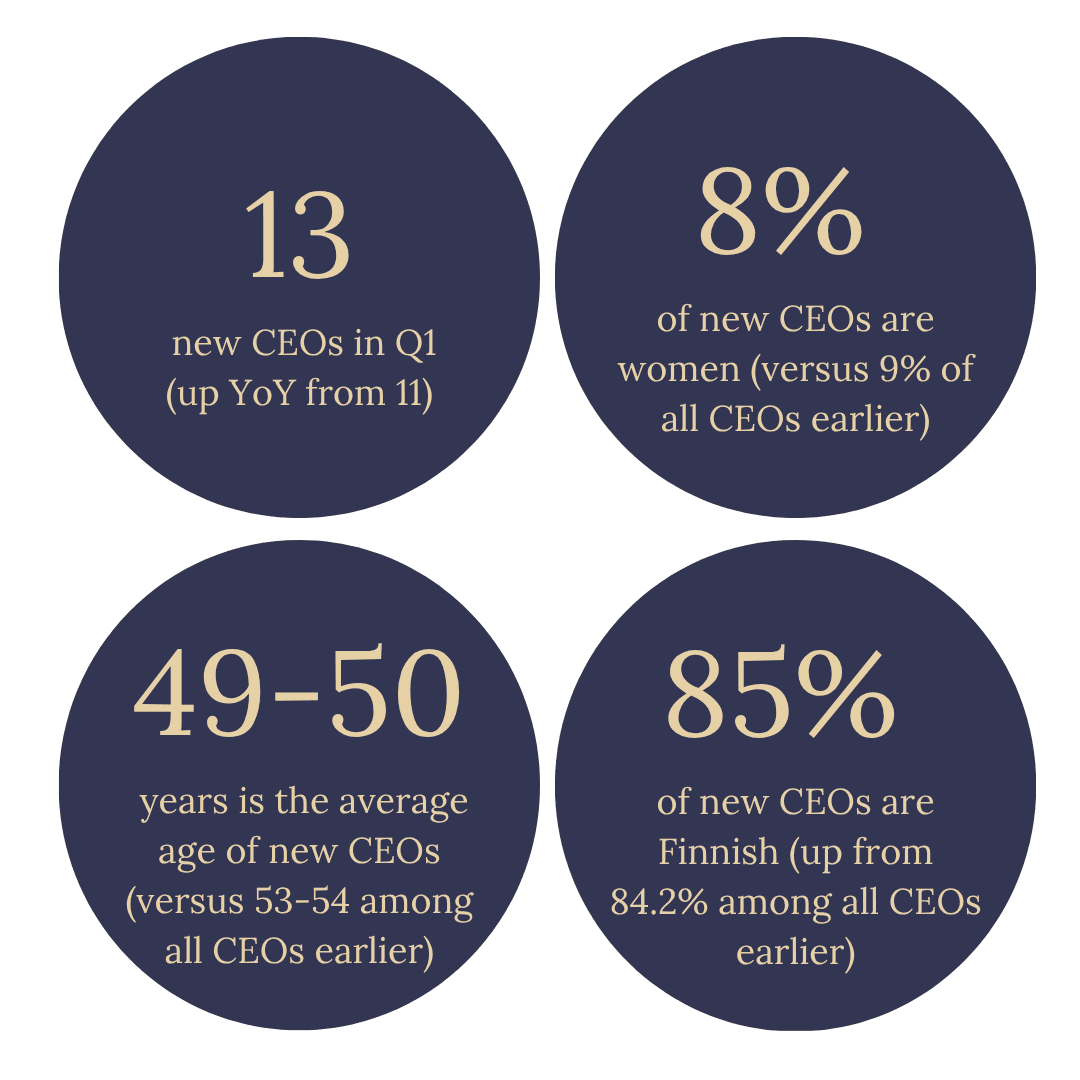
A generational shift is underway in Finnish listed companies, but it is happening at the edges rather than at the core, according to the latest CEO Index — Finland | Q1 2026, produced in partnership with SAM Headhunting.

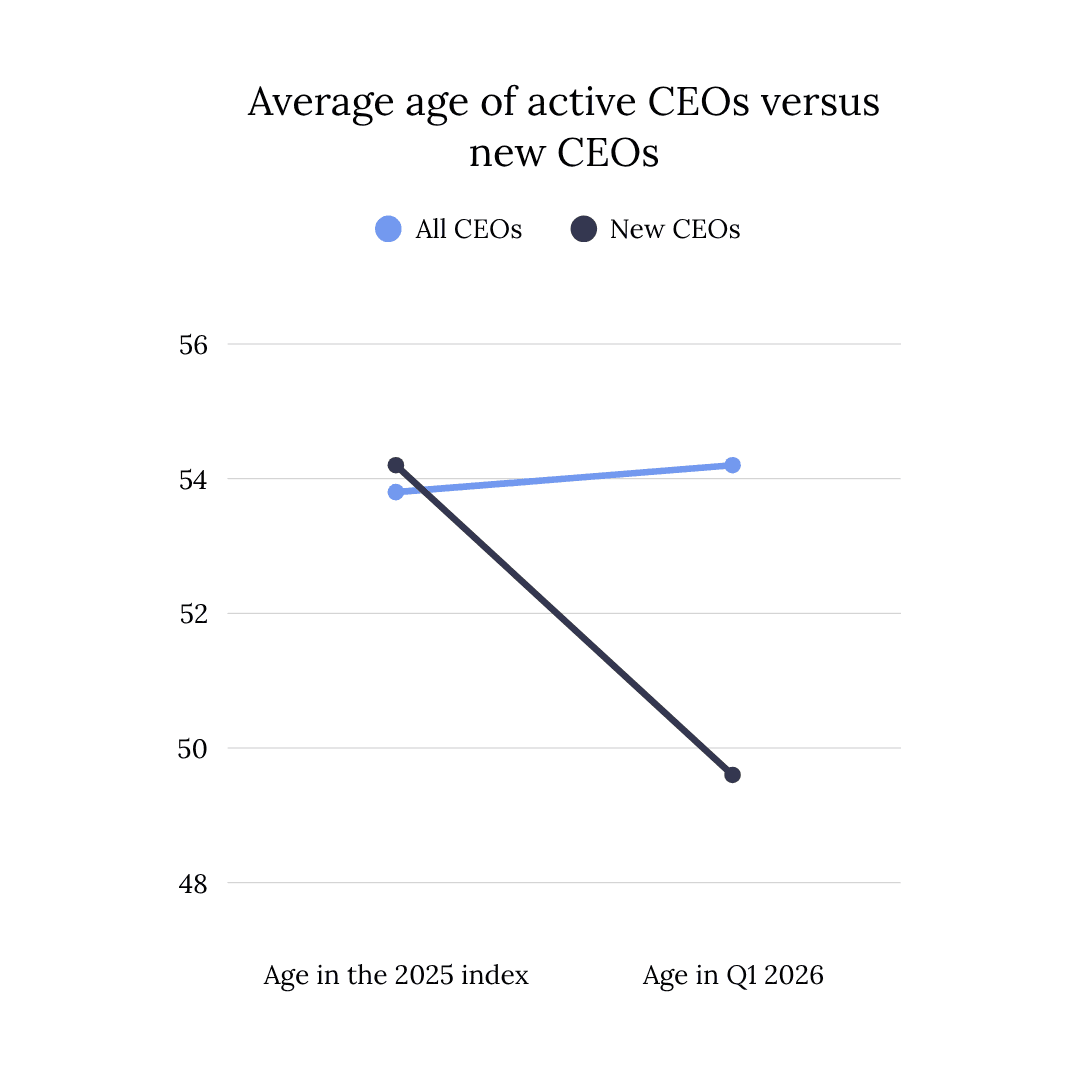
New CEO appointments in the first quarter of 2026 point to a clear change in profile. The average age of newly appointed CEOs dropped to 49-50 years, as much as five years below the overall CEO population, which stands at 53-54. At first glance, this suggests a meaningful renewal of leadership. Look closer, however, and the broader structure changes far more slowly.

“We are seeing a gradual shift toward younger CEOs, particularly those with strong operational backgrounds,” says Leena Hellfors, managing director at SAM Headhunting. “Boards are looking for leaders who can combine execution with adaptability in uncertain environments.”

The emphasis on operational capability is visible across appointments. Several of the new CEOs have stepped directly from senior execution roles: Anna Wäck at Sitowise was previously executive vice president for digital solutions, Juho Ahosola at Talenom served as deputy CEO, and Markku Taskinen at Dovre Group led a subsidiary as CEO of Suvic. 

Others bring similarly hands-on experience, such as Matti Erkheikki at QPR Software, who was chief product officer, and Pauli Anttila at EcoUp, who stepped up from the CFO role. These are not outsiders brought in to redefine strategy, but operators with deep familiarity in running businesses and delivering results. In a context where most of the companies in question reported declining profitability, this is not surprising.

“While some companies are undergoing significant changes, these should be viewed in the light of longer-term sector pressures. Industrial transformation, regulatory demands in financial services, and profitability pressures continue to shape leadership decisions,” says Taru From, senior partner at SAM Headhunting.

From also points to a clear shift in what companies are asking for. “Nearly every leadership search now asks for a step change and for renewal. Companies are looking for leaders who can bring, create, and lead through change. That means having a clear vision, alongside the experience and track record to back it up.”

Continuity beneath the surface

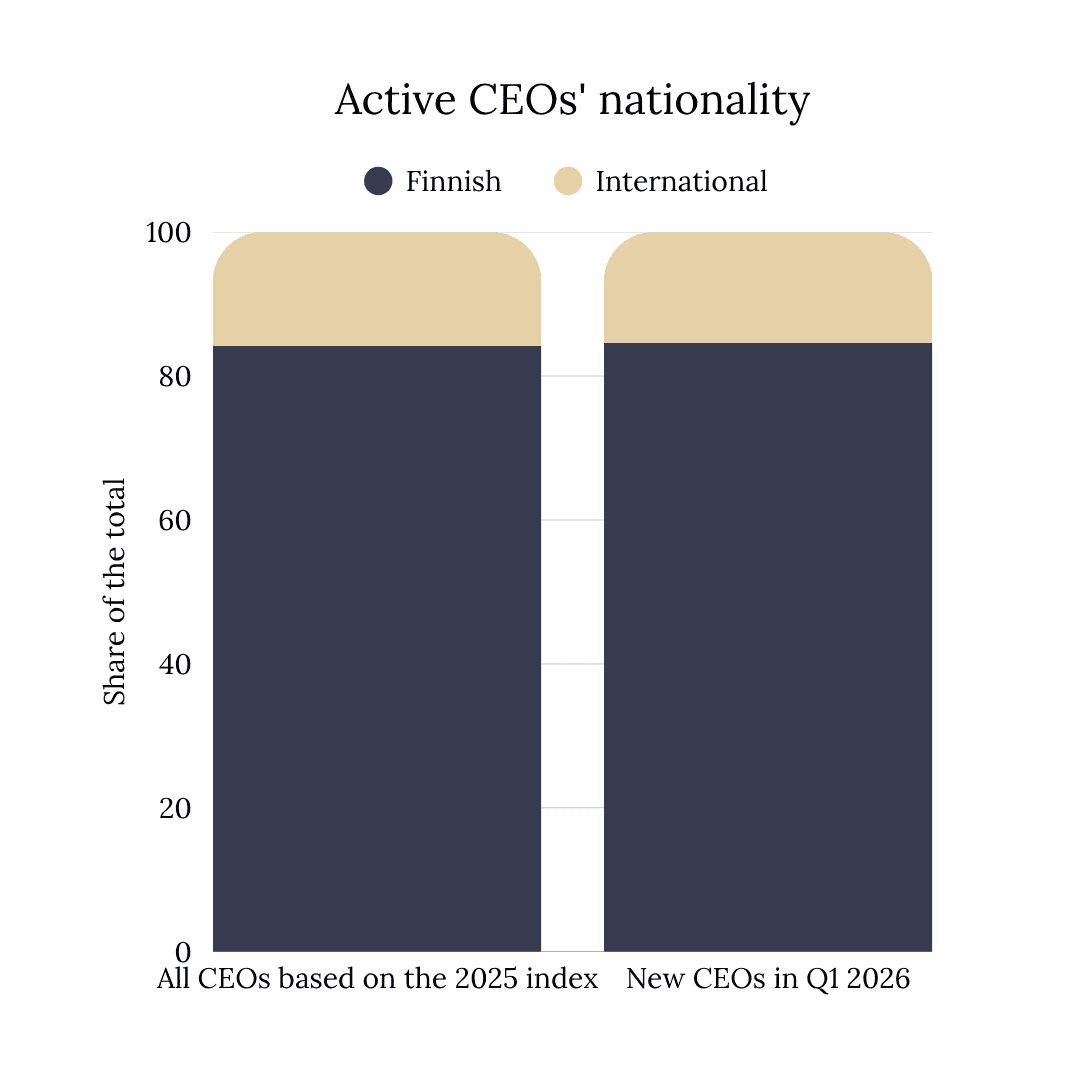
What is more striking is what has not changed. Despite the influx of younger leaders, diversity metrics remain largely static. Women account for just 8.8% of all CEOs and 7.7% of new appointments in the quarter. Nationality follows a similar pattern. While new hires are slightly more international, the CEO population is still overwhelmingly Finnish, at more than four out of five.

This creates a clear divide between entry and structure. Renewal is happening at the point of selection, but it is not yet reshaping the system itself.

A similar pattern is visible across Europe. Data from European listed companies show that while a slight majority of CEO appointments in 2025 were external, larger firms continued to rely heavily on internal candidates, with two-thirds of appointments in companies above $20 billion coming from within (Spencer Stuart, 2025). This reflects a broader preference for continuity across Europe, as boards invest in succession pipelines and promote leaders with proven operational experience.

Individual cases illustrate the shift in age. Juho Ahosola of Talenom and Anna Wäck of Sitowise, both born in 1988, represent a move toward earlier leadership transitions. At the same time, appointments such as Teppo Paavola at Enento show that experience remains in demand, particularly in roles requiring financial and technological depth.

The result is not a clean break between generations, but a layering of profiles. Younger CEOs are entering the system, yet they are doing so within a framework that continues to favor familiar backgrounds and networks.

For boards, this raises a more strategic question. If the goal is adaptability in uncertain markets, is refreshing the age profile enough? Or does real renewal require a deeper shift in how leadership potential is defined and sourced?

For now, the data suggest a cautious answer. Finnish companies are opening the door to a younger generation of CEOs. They are just not changing the room that those leaders walk into.

Insights

CEO Index — Finland | Q1 2026

May 26, 2026

A sharper reset cycle, but a narrower one

Produced in partnership with SAM Headhunting

Finnish listed companies appointed 13 new CEOs in the first quarter of 2026.  At that quarterly pace, 2026 would deliver roughly 52 CEO changes, compared with 44 in 2025 — a step change in the rate of renewal at the top of the Finnish stock market.

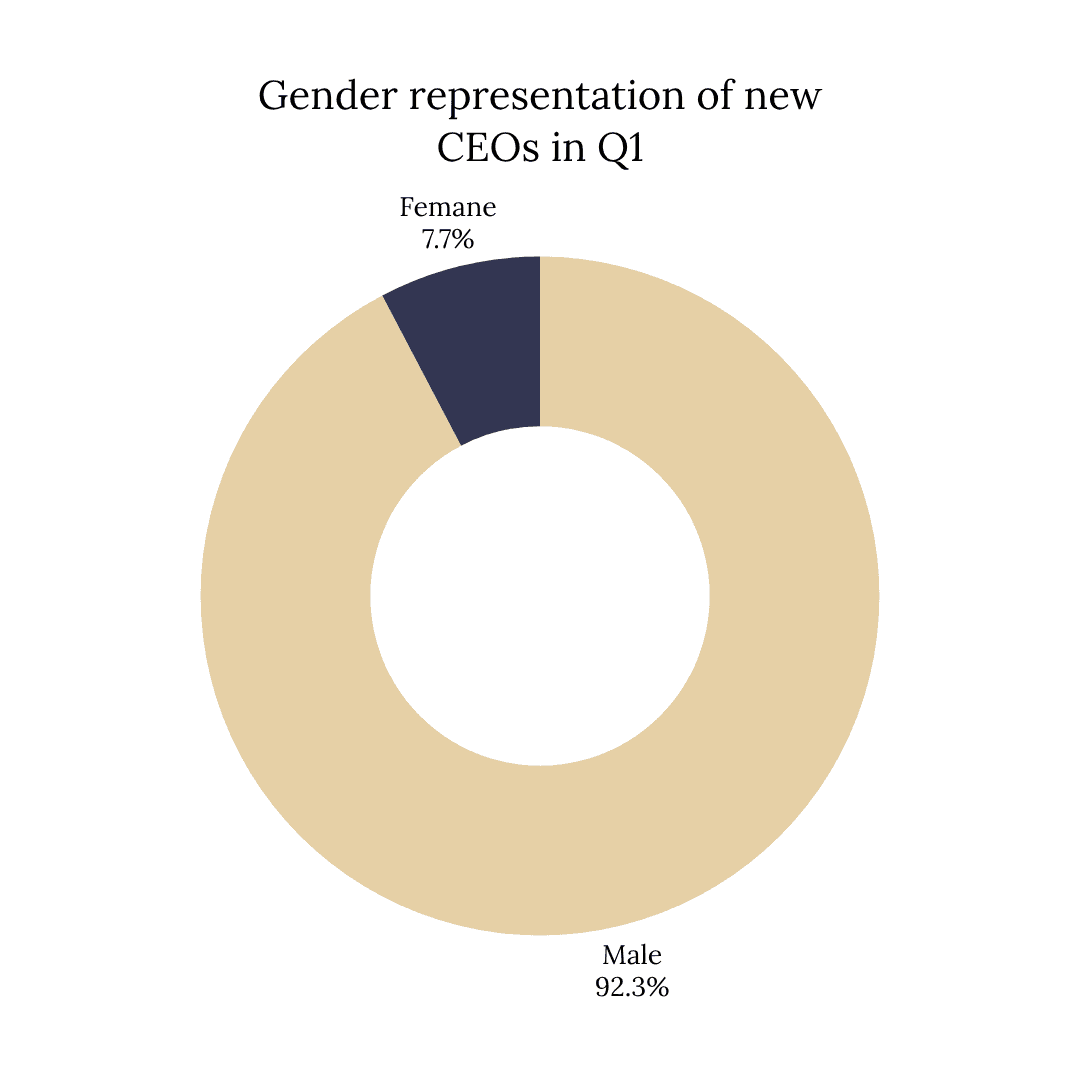
But pace is only part of the story. Against the 2025 annual index, four shifts stand out in Q1 2026: Large Cap turnover has collapsed from more than one in three companies in 2025 to zero in Q1 2026; external hires now account for 62% of appointments, up from 45%; new CEOs are averaging 49-50 years, roughly five years younger than the active population; and the share of women among new appointments has slipped to 7.7%, below the 9.3% baseline. The reset is sharper at the point of entry — and narrower, concentrated at the smaller end of the market.

Highlights

  • 13 new CEOs in Q1 2026 — annualized pace of ∼52 vs 44 in 2025

  • Zero CEO changes in Large Cap, down from >33% turnover in 2025

  • External hires: 62% of Q1 appointments, up from 47% in 2025

  • Average age of new CEOs: 49-50 years as of May 2026, vs 53-54 for the active population

  • Women: 1 of 13 new CEOs (7.7%), below the 9.3% active CEO population share

  • Two international hires, leaving the overall nationality mix essentially unchanged

The findings draw on the Listeds Executive Intelligence platform and cover all CEO appointments in Finnish listed companies in the period 1 January to 31 March 2026. Baseline figures for the active CEO population refer to the CEO Index — Finland | 2025 published in February 2026.

New CEOs stepped into challenging circumstances

Most of the 13 companies that changed CEO in Q1 2026 reported a decline in profitability in their most recent fiscal year, according to their annual reports. Enento Group and Duell Corporation were among the notable exceptions, both reporting improved operating profits.

Enento and Sitowise both recorded modest net-sales growth of around 3% in the fourth quarter of 2025 and are among the cases where new CEO appointments coincided with wider management changes. These situations represent the more active end of the spectrum; the full picture of follow-on organizational change will only become visible in the Q2 index, when a longer post-appointment window is available.

Large cap goes from most active to most stable

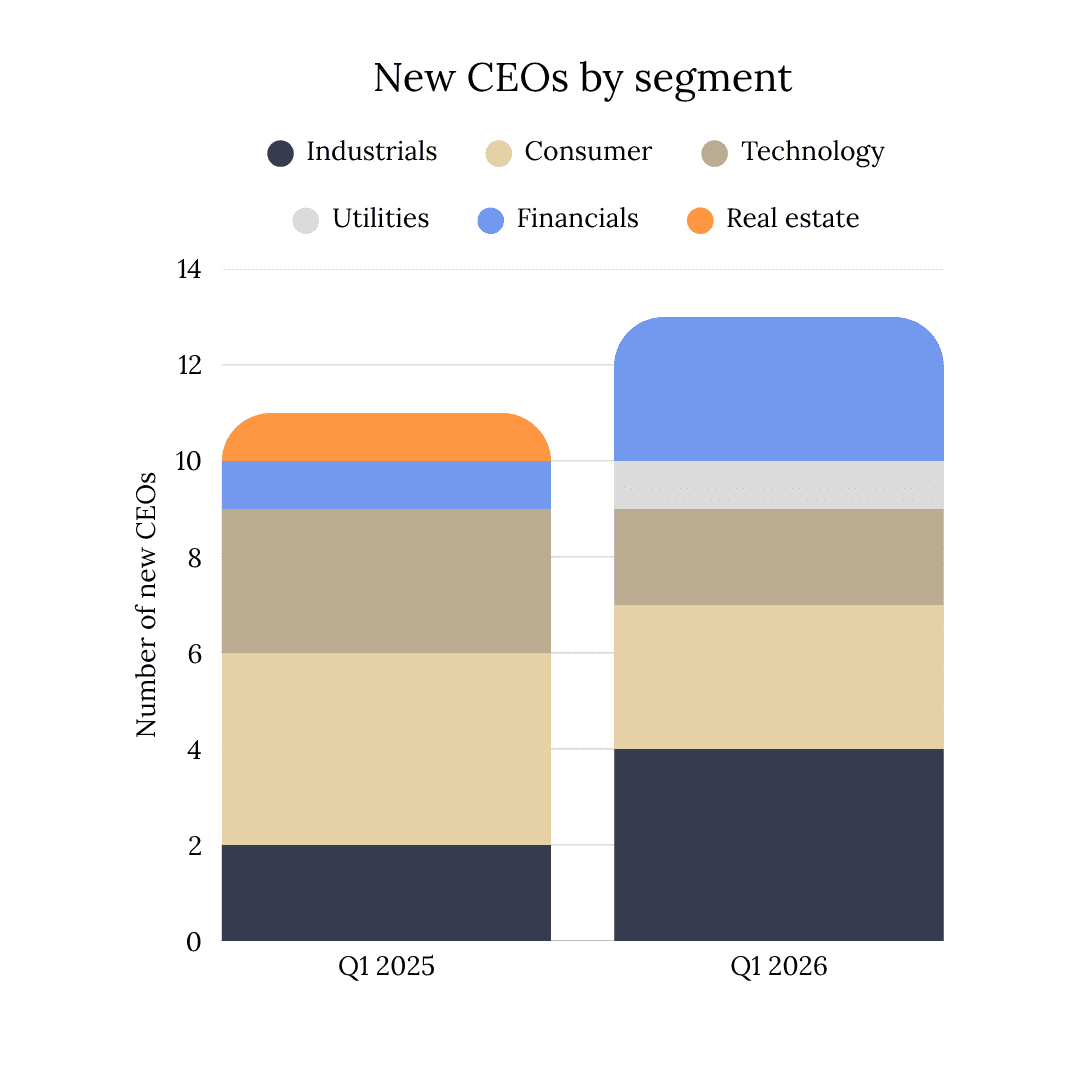
The most striking shift in the quarter is where CEO change did not happen. In 2025, large cap had the highest turnover rate of any segment, with more than one in three of the 32 large-cap companies changing CEO during the year. In Q1 2026, large cap recorded zero appointments.

Every change in the quarter happened below that tier:

  • Small cap: 6 CEO changes

  • Mid cap: 4

  • First North: 3

  • Large cap: 0

The burden of renewal has moved one tier down the market, where companies operate with tighter resources and fewer layers, and where leadership changes translate more directly into execution moves.

“While some companies are undergoing significant changes, these should be viewed in the light of longer-term sector pressures. Industrial transformation, regulatory demands in financial services, and profitability pressures continue to shape leadership decisions,” says Taru From, senior partner at SAM Headhunting.

From also points to a clear shift in what companies are asking for. “Nearly every leadership search now asks for a step change and for renewal. Companies are looking for leaders who can bring, create, and lead through change. That means having a clear vision, alongside the experience and track record to back it up.”

Renewal at the point of entry: new CEOs are five years younger

New CEOs appointed in Q1 2026 average 49-50 years of age, compared with 53-54 across the active CEO population. The nearly five-year gap is one of the clearest signals in the quarter that renewal is happening at the margins, even while the overall leadership base shifts only slowly.

At the lower end of the range, Juho Ahosola (Talenom) and Anna Wäck (Sitowise), both born in 1988, illustrate this move toward earlier leadership transitions. At the other end, Teppo Paavola (Enento), born in 1967, reflects the continued demand for experienced financial and technology leaders.

“We are seeing a gradual shift toward younger CEOs, particularly those with strong operational backgrounds. Boards are looking for leaders who can combine execution with adaptability in uncertain environments.” — Leena Hellfors, managing director, SAM Headhunting

Boards are hiring externally more than before

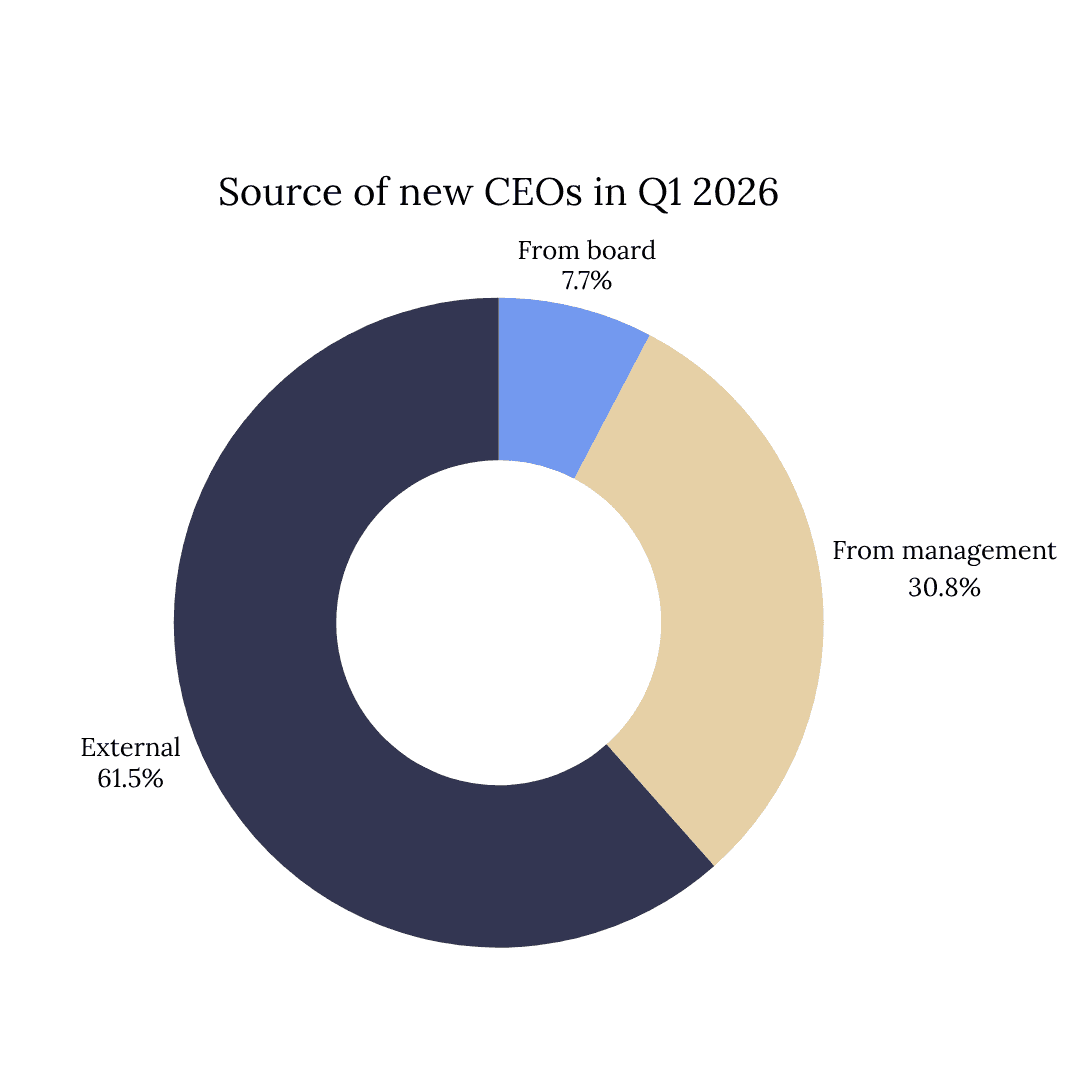
Of the 13 appointments in Q1 2026:

  • 8 were external hires

  • 4 were internal hires

  • 1 came from the board

In 2025 as a whole, external hires accounted for 20 of 44 appointments (45%). The Q1 2026 share is 62%, a meaningful jump. Internal experience remained a factor — several new CEOs were drawn from COO, business unit, or CFO roles — but the quarter leaned more decisively on outside talent than the 2025 average.

The examples illustrate the mix of backgrounds rather than a single pattern:

  • Aki Gynther (Alisa Bank) and Alexander Schoschkoff (Alexandria) bring sector-specific financial expertise.

  • Anna Wäck (Sitowise) and Matti Erkheikki (QPR Software) represent internal operational continuity.

  • Fred Larsen (Lamor) and Markku Taskinen (Dovre Group) bring governance and project leadership backgrounds.

“Boards are becoming more deliberate in CEO selection. The mandate is often clearer from day one, which reduces the need for a long transition period.” — Leena Hellfors

Across both internal and external hires, the common thread across the quarter is readiness to execute rather than transition gradually.

Gender representation moves in the wrong direction at the point of entry

Women accounted for 7.7% of Q1 2026 appointments — one of 13 new CEOs — below the 9.3% share of women in the active CEO population as measured in the 2025 annual index. Single-quarter figures are volatile given the small base, but the direction matters: renewal at the point of entry is not currently narrowing the gender gap.

Sector-level patterns have shifted compared to the 2025 index. Industrials now show the highest representation of female CEOs, followed by health care, with consumer staples, financials, and consumer discretionary forming a middle tier. Basic materials and technology remain at the lower end, with only limited female representation at the CEO level.

International hires remain the exception

The quarter saw two international appointments, leaving the overall nationality mix largely unchanged.

Individual cases highlight where international recruitment adds value. Jean-Charles Gaudechon, a French gaming-industry veteran, now steers Remedy Entertainment. Christian Gebauer, a Swedish expert in decentralized management, was appointed to lead Relais Group in January. Both illustrate targeted international hires where specific expertise is required, rather than a broader shift toward international leadership across the market.

Sector pressure continues from 2025

Leadership changes in Q1 2026 are visible across sectors, with industrials, financials, technology, utilities, and consumer-facing businesses all represented. Industrials led with Sitowise, Dovre Group, and Talenom. Financials were represented by Alisa Bank and Alexandria. Technology saw QPR Software, utilities saw Lamor, and consumer discretionary saw Remedy Entertainment change hands.

Industry-level data show that CEO changes remain concentrated in a few sectors, but the pattern has evolved since 2025. Industrials continue to account for the largest number of new CEO appointments, while financials and consumer discretionary now follow closely behind. Technology remains active but at a lower level, and utilities continue to see limited turnover.

Follow-on management change: too early to generalize

The 2025 index reported an average of 4.2 group management changes per new CEO (2.3 hires, 1.9 resignations), with the appointment of Scott Phillips at Hiab driving the largest post-CEO restructuring of the year (19 changes, linked to the Cargotec/Kalmar demerger).

For Q1 2026, it is too early to report a comparable figure: most appointments only happened in February or March, and the full pattern of post-CEO management change will not be visible until the Q2 index. Early indicators from Enento and Sitowise suggest that leadership transitions are again coinciding with wider management adjustments at more than isolated companies.

Conclusion

Thirteen appointments in a single quarter, at a pace that would exceed 2025’s full-year total, is the sharpest signal yet that the CEO reset cycle is tightening. Boards are moving faster, hiring more externally, and appointing younger leaders than the active population would suggest.

But the reset is narrower than the headline numbers suggest. Large Cap is quiet after a year of unusual activity. Women remain underrepresented at the point of entry, and international hires are the exception rather than the norm. The renewal is real. The profile of who is being renewed, less so.

The CEO Index — Finland will next be updated at the end of Q2 2026. Readers can follow the CEO Newsletter for interim leadership signals. They can also discover a more visual and concise version of the CEO Index Q1 2026 by viewing or downloading a slide deck.

At a glance: 2025 annual vs Q1 2026

Metric

2025 annual

Q1 2026

Direction

Pace of CEO changes

43/year

13/qtr (∼52 annualized)

+21% run rate

Large Cap turnover

>33% of firms

0%

Full stop

External-hire share

47% (20/43)

62% (8/13)

+15 pts

Avg new-CEO age

53-54

49-50

∼5 yrs below pop.

Women among new CEOs

9.3% (pop. baseline)

7.7% (1/13)

–1.6 pts

Finnish share

84.2%

83.1%

Effectively flat

About the data

The analysis draws on the Listeds Executive Intelligence platform and covers all CEO appointments in Finnish listed companies made between 1 January and 31 March 2026. Active-population figures are carried forward from the CEO Index — Finland | 2025 published in February 2026, which covered 183 active CEOs across 184 listed companies as of 29 January 2026.

Stay on the pulse, catch the signals

Subscribe to Listeds Leadership Intelligence Platform:

  • leader and company database access

  • email alerts

  • career, boards and interim opportunities

Our Pulse newsletter

Your weekly leadership intelligence briefing.

What happened, why it matters, and what to watch across every CEO, board, and executive move in Nordic listed companies, starting with Finland. Fast, factual, and to the point.

Delivered every Monday.

By signing up, you agree to our Privacy Policy