/

Author

Anni Ihamäki

Content writer

Anni, one of Finland’s best-known hosts with a two-decade career across radio, podcasts, and television, leads our weekend lifestyle section.

/

Author

Anni Ihamäki

Content writer

Anni, one of Finland’s best-known hosts with a two-decade career across radio, podcasts, and television, leads our weekend lifestyle section.

/

Author

Anni Ihamäki

Content writer

Anni, one of Finland’s best-known hosts with a two-decade career across radio, podcasts, and television, leads our weekend lifestyle section.

Weekend

Baked Camembert with puff pastry twists

Dec 23, 2025

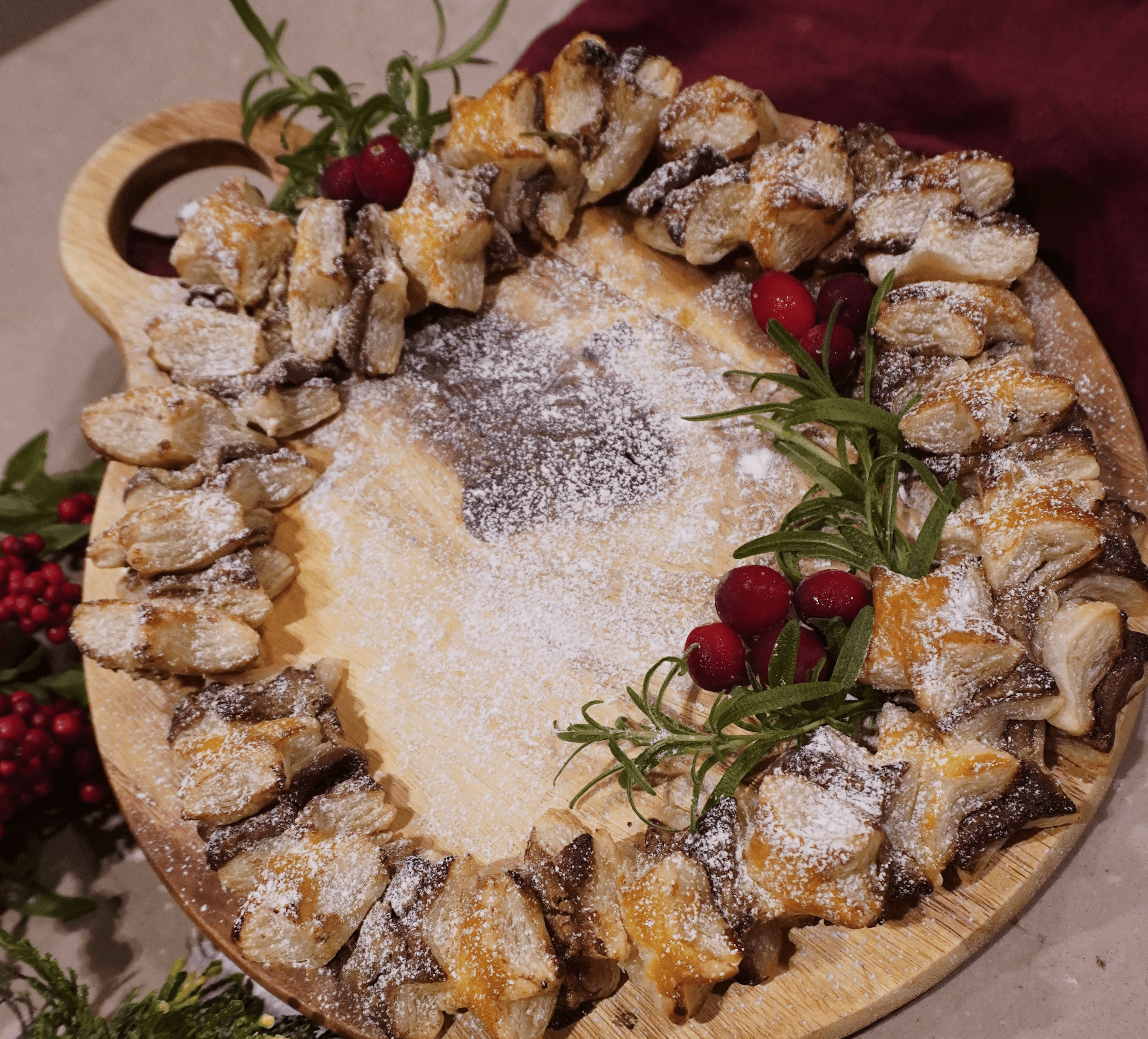
Tear apart crispy pesto twists and dip them into melted, hot cheese… I almost dare to promise that this dish will earn you compliments! For me, at least, it has since it is one of my most popular recipes ever. Baked Camembert with pesto twists is surprisingly easy to make, serves a festive crowd, and looks beautiful on the table — almost like having its own program number at your party.

Ingredients

Serves 10

  • 1 Camembert cheese in a wooden box (important to keep the melted cheese in place after baking!)


  • 2 large sheets of puff pastry (about 500 g total)


  • 1 jar of fresh pesto


  • 1 egg, for brushing


  • Olive oil


  • 1 clove garlic, thinly sliced


  • Fresh thyme


Instructions

Check out my tutorial video (in Finnish) here.

  1. Defrost the puff pastry sheets. Preheat the oven to 200°C (390°F).


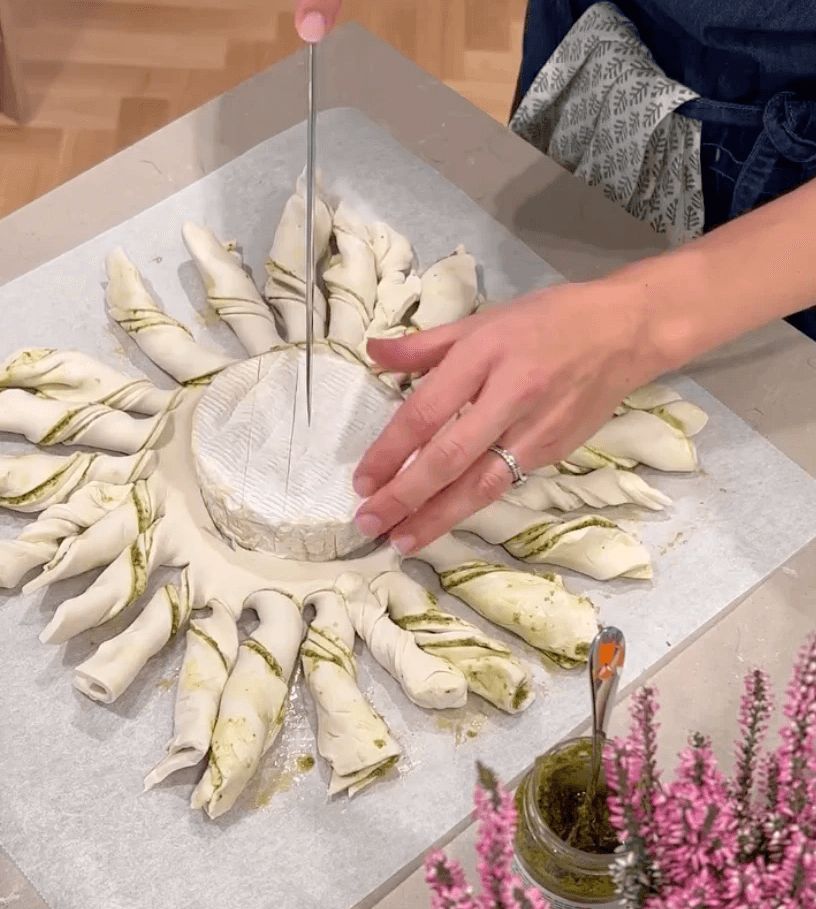
  2. Roll the pastry sheets a bit thinner. Place one sheet on a baking tray lined with parchment paper and spread pesto evenly over it. Place the second sheet on top. Use the disc of camembert as a guide and cut a circle from the center of the pastry the size of the cheese.


  3. Carefully remove the plastic wrapping from the cheese, place it back in its wooden box, and set it in the center of the pastry. Score a light criss-cross pattern on the surface of the cheese with a sharp knife. Tuck the garlic slices into the cheese, drizzle with olive oil, and sprinkle thyme leaves on top.


  4. Cut the pastry around the cheese into thin strips and twist them around so that the pesto peeks through. Use the circular cut-out pastry to make a few extra twists and place them on the tray as well. Brush the pastry twists with beaten egg and bake in the oven for 10–15 minutes, or until the puff pastry is golden brown.


  5. Let cool slightly before serving, and let everyone dip the pesto twists into the melted cheese.


Weekend

Why Nordic people turn to the sauna for community and clear thinking

Dec 19, 2025

For many Nordic executives, the sauna is more than a wellness ritual. Finnish Sauna Society member Hanna Pakarinen — also known as the winner of the first season of Idols — frames the sauna not as leisure but as a structured environment that enables busy people to decompress, recalibrate, and connect. 

Approaching its 90th anniversary, the Finnish Sauna Society is a non-profit cultural institution dedicated to preserving and promoting Finland’s sauna traditions. Pakarinen — a member for a decade — has supported that mission by helping organize the mobile sauna showcased at the most recent Eurovision contest in Basel.

UNESCO’s decision to place Finnish sauna culture on its list of intangible cultural heritage further strengthened the sauna society’s identity and reach. Pakarinen recalls the scale of the campaign, noting that securing the designation “was a major undertaking and a significant moment for the community.”

A system for mental clarity

Finnish Sauna Society premises, photographed by Reetta Virtanen.

The modern lifestyle today demands constant cognitive switching and emotional endurance. The sauna forces the opposite. The heat, silence, and absence of devices narrow attention into the present moment.

Pakarinen captures this effect: during intense heat followed by a cold plunge, the mind “stops scanning everything else and focuses entirely on the physical present.” This narrowing of attention resembles what psychologists describe as transient hypofrontality, a temporary reduction in activity in the prefrontal cortex often associated with exercise or entering a state of flow.

What earlier generations felt in their bones is now showing up in peer-reviewed studies. Regular sauna use has been linked to significantly lower stress levels, improved autonomic balance, and better sleep quality (Harvard Health 2015; University of Eastern Finland 2018). Heat exposure also elevates heart rate and increases circulation in ways comparable to moderate exercise (UCLA Health 2022). Especially for executives dealing with high cognitive load, these effects translate into clearer thinking, faster recovery, and improved emotional regulation. 

A neutral zone for leadership behavior

Despite its informality, the Finnish Sauna Society enforces behavioral rules that encourage constructive interaction. Phones are banned. Only low-alcohol drinks are allowed. Conversations should remain respectful and considerate. These constraints create a rare leadership environment where hierarchy flattens.

Pakarinen notes that even long-standing members “do not stand above anyone else and everyone shares the same etiquette.” For people accustomed to environments defined by rank, the sauna becomes a behavioral equalizer. It promotes listening, patience, and unpressured dialogue — qualities that often erode in high-stakes corporate settings.

Community as resilience infrastructure

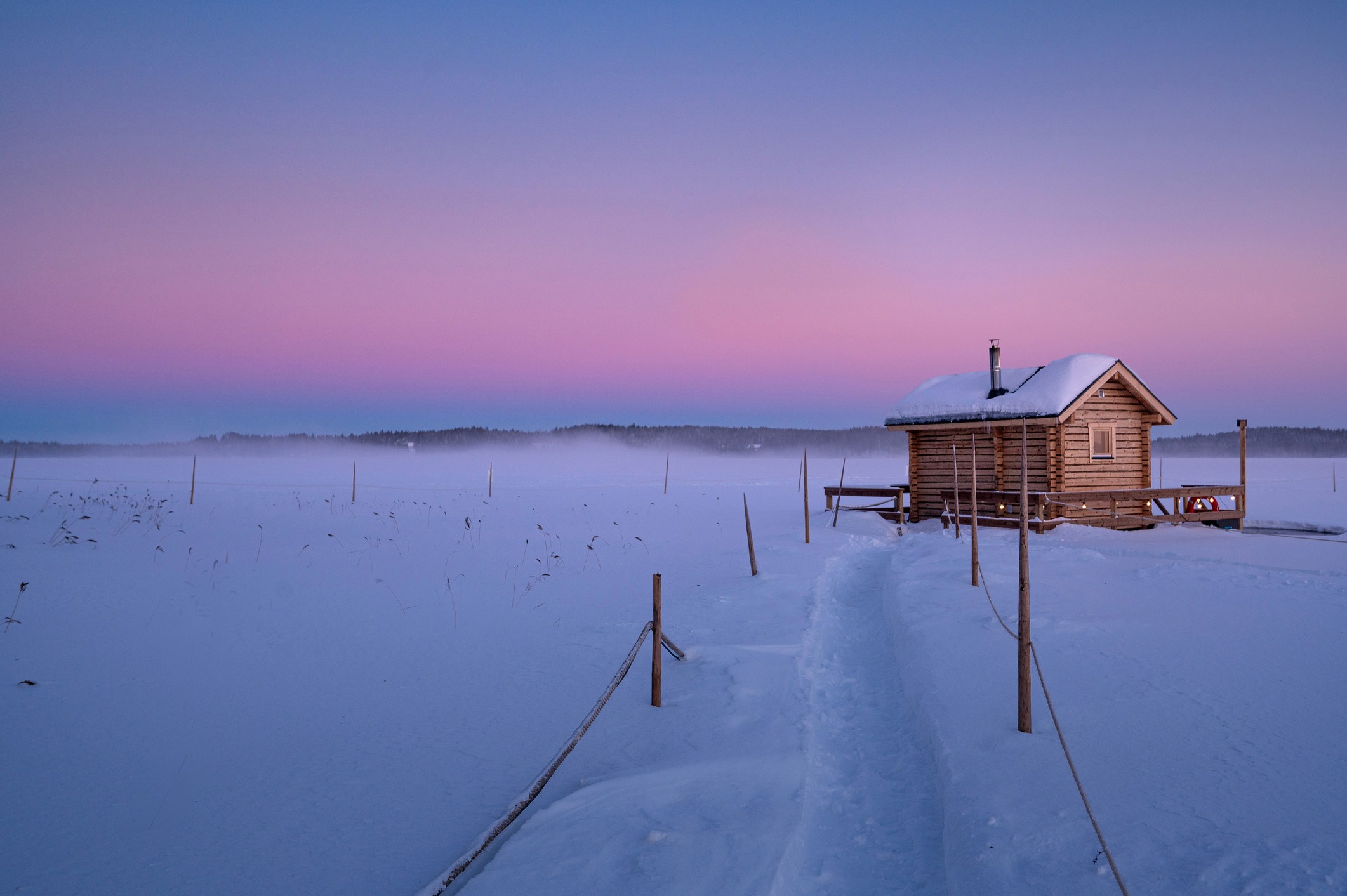
Inspired by Finnish mythology, the Louhi sauna is a specific hot, chimneyless (smoke) sauna located within the Finnish Sauna Society's complex in Vaskiniemi, Helsinki. Photography by Reetta Virtanen.

In contrast to the rise of individualistic wellness culture, the Finnish Sauna Society treats well-being as a shared experience. Pakarinen notes that many members, especially older ones, consider sauna days “an essential part of their routine and a deeply social anchor.”

This rhythm is as important as the heat itself. The Finnish Sauna Society maintains multiple wood-fired and electric saunas, limits the number of bathers, and enforces etiquette to preserve calm.

Pakarinen describes her own experience as a complete mental reset: after heat and cold immersion, “there is simply no room left for the clutter of the day.” The combination of exertion, silence, and nature creates a clean break from decision fatigue.

As jobs grow more cognitively demanding, environments that reinforce clarity and resilience become strategic assets. Finland’s sauna tradition quietly delivers this benefit. It sharpens focus, stabilizes mood, strengthens community, and instills norms that encourage humility and presence.

Best public saunas in Finland for executives:

  1. Löyly, Helsinki
    A frequent choice for executive meetups and visiting international leaders. Private lounge options, a high-quality restaurant, and direct sea access make it suitable for low-key discussions away from the office. The smoke sauna offers a quieter setting during off-peak hours.

  2. Kulttuurisauna, Helsinki
    Ideal for leaders who prefer minimalist surroundings and uninterrupted focus. Phones are banned, conversation stays subdued, and the rhythm encourages reflective thinking — a strong fit for executives seeking clarity rather than socializing.

  3. Tampereen Sauna Restaurant Kuuma, Tampere
    Excellent for executive teams holding off-site days in Tampere. The wood-heated saunas and lake swimming create a natural “reset cycle,” while the restaurant provides a neutral space for follow-up discussions over an early dinner.

  4. Rajaportin Sauna, Tampere
    Best suited for leaders who value authenticity and community. Its slower pace and historic character make it a good location for informal peer connections or grounding.

  5. Helsinki Allas Sea Pool Saunas
    Particularly useful for time-pressed executives staying near the city center. Early morning sessions offer privacy and space, and the combination of sauna heat with Baltic Sea swimming is an efficient way to reset before a full workday.

What is the Finnish Sauna Society?

The Finnish Sauna Society (Suomen Saunaseura ry) is a non-profit cultural organization founded in 1937 to preserve, research, and promote Finland’s sauna traditions. Based in Helsinki, the society maintains the historic Vaskiniemi sauna house, which includes several wood-fired, smoke, and electric saunas used exclusively by members.


Scientific sources

Harvard Health Publishing (2015). “Sauna use linked to longer life and fewer fatal heart problems.”
https://www.health.harvard.edu/blog/sauna-use-linked-longer-life-fewer-fatal-heart-problems-201502257755

UCLA Health (2022). “Benefits of sauna bathing for heart health.” https://www.uclahealth.org/news/article/benefits-sauna-bathing-heart-health

University of Eastern Finland – Laukkanen et al. Multiple longitudinal studies linking frequent sauna use with reduced cardiovascular and all-cause mortality. https://jamanetwork.com/journals/jamainternalmedicine/fullarticle/2130724


Weekend

Sleep doctor: Building a sleep protocol that actually works

Dec 12, 2025

Executives across the Nordics are sleeping worse than they admit, and the trend is becoming difficult to ignore.

According to the If Insurance Nordic Health Report 2024–2025, 65 percent of Nordic respondents – and 69 percent of Finns – report that stress has disrupted their sleep, making it the most common consequence of rising workplace pressure.¹ Many also say poor sleep is now affecting their ability to perform at work.

For Finnish sleep physician Henri Tuomilehto, who has treated more than 15,000 patients, none of this is surprising. He has watched the trend build for years: leaders convinced they are functioning normally while operating in a state of chronic depletion. “If you are always tired, it is a bit like being half-drunk when you make important decisions.”

Tuomilehto argues that many executives underestimate how quickly poor sleep erodes judgment, leadership presence, and even emotional stability. “The first thing poor sleep hits is behavior. Some people get irritable, others withdraw. If that person happens to be a leader, it shapes the entire workplace.”

The hidden toll of poor sleep on executive cognition

Sleep loss does not just cause fatigue – it degrades the very capabilities leaders rely on. Research shows that sleep deprivation impairs attention, short-term memory, and vigilance.² It also disrupts higher-order decision-making, making people more prone to risky or inconsistent choices.³ Creativity and cognitive flexibility also decline when sleep is restricted.⁴

Tuomilehto sees this play out clinically. “A tired person does not adapt. Even small challenges feel overwhelming. And if you are in a strategic role, losing concentration or creativity is a real problem.”

How to build your sleep protocol

Executives do not need a perfect nightly routine – they need a realistic, science-based protocol that reflects how sleep actually works. Tuomilehto’s guidance, supported by current research, offers a clear and practical framework.

1. Treat sleep as a non-negotiable performance asset
Many leaders still follow the myth of the so-called winner’s hour – waking at 4 or 5 AM to get ahead. Tuomilehto is firm on this: “It makes no sense. If you sleep less than your body needs, you never recover. Fatigue becomes your new normal.” Consistent under-sleeping erodes cognition, judgment, and mood long before leaders notice the decline.

2. Fix your wake-up time
Rhythm is more important than bedtime. Waking at the same time each morning stabilizes the circadian system and allows sleep pressure to build through the day. “I get up sufficiently early to control my evening energy,” Tuomilehto says. It prevents late-night alertness and helps the body recognize when it is time to wind down.

3. Support healthy sleep pressure during the day
Good nights start with good days. Regular meals, hydration, and light activity maintain stable energy. Leaders who skip lunch or grind through long meetings often arrive at evening overstimulated and struggle to fall asleep. Protecting daytime energy protects nighttime recovery.

4. Draw a clear boundary between work and evening
Tuomilehto ends his workday with a family dinner at 8:30 PM – then no emails. That consistent “shutdown signal” reduces cognitive load and gives the brain permission to disengage. Executives who stay mentally “on” until bedtime make it significantly harder for sleep pressure to translate into actual sleep.

5. Use trackers for motivation, not measurement
Wearables monitor movement, heart rate, and temperature, but they do not capture the brain activity that defines real sleep stages. Research confirms they are helpful for habit-building rather than diagnosis.² “People check their score every morning,” Tuomilehto notes, “but your body already tells you how you slept.”

6. Personalize your motivation
Long-term improvement requires a reason beyond ticking off eight hours. Leaders who succeed tie sleep to something meaningful: clearer thinking, better presence, improved resilience. “Motivation must be personal,” Tuomilehto emphasizes. “Otherwise, people quit after two weeks.”

7. Recover strategically
A short nap can restore alertness, but it cannot compensate for chronic restriction. Tuomilehto stresses that rhythm, not occasional rescue, is what restores high performance.

Why sleep matters more for leaders than anyone else

Leaders set the emotional tone of organizations. When exhausted, their judgment narrows, creativity declines, and empathy fades – all consequences well-supported by neuroscience and sleep research.⁵

Tuomilehto puts it plainly: “A good leader is an engine, not the person everyone tiptoes around.” Chronic fatigue reverses that dynamic. When a leader becomes irritable or withdrawn, psychological safety erodes and the tone of the entire organization shifts. And when strategic thinking falters, poor decisions start to cascade through teams and projects.

Better sleep sharpens judgment, steadies mood, and restores the creativity leaders need to navigate uncertainty. In other words, sleep is not indulgence. It is a leadership asset hiding in plain sight.

References

  1. If Insurance, Nordic Health Report 2024–2025: Key findings on stress, sleep, and work ability (2025), available at: https://www.if-insurance.com/large-enterprises/insight/key-findings-health-report-2024

  2. SleepFoundation, Lack of sleep and cognitive impairment (2024), available at: https://www.sleepfoundation.org/sleep-deprivation/lack-of-sleep-and-cognitive-impairment

  3. E. Aidman, K. Johnson et al., “Effects of sleep deprivation on executive functioning, cognitive abilities, metacognitive confidence and decision making” (2018), available at: https://www.researchgate.net/publication/328583846

  4. Nature Research Intelligence, Sleep deprivation and cognitive performance (2023), available at: https://www.nature.com/research-intelligence

  5. Frontiers in Psychiatry (2024), “Altered risk propensity and decision-making following sleep deprivation”, available at: https://www.frontiersin.org/journals/psychiatry/articles/10.3389/fpsyt.2024.1307408/full

Weekend

Energy for the dark months: Five science-backed tips

Nov 28, 2025

The Nordic October gloom brings more than just gray skies. As daylight shrinks—Helsinki and Stockholm see under ten hours by late October—bodies produce more melatonin, leaving many feeling drowsy and craving sugar.

For professionals, these seasonal changes can erode productivity: the NIH lists difficulty concentrating, irritability, and poor decision-making among the symptoms of seasonal affective disorder.

“People need light and warmth, and when there’s none, the body will try to replace them with something else,” says Sonia Wahlroos, founder and CEO of Nordic Nutritionist. Here are her five evidence-based strategies to stay focused and energetic through the “winter blues.”

1. Prioritize sleep like a strategic asset

Winter often disrupts the sleep-wake cycle. Prolonged lack of daylight can delay sleep timing, fragment rest, and heighten sensitivity to blue-light screens—creating a vicious cycle of poor sleep, according to a study on Antarctic research crews in winter.

Rather than surrender to fatigue, says Wahlroos, use the season to reset routines. Shifting bedtime an hour earlier—around 10 p.m.—aligns rest with natural drowsiness and improves recovery, as the deepest sleep occurs in the first half of the night. “When it gets dark, you get sleepier—allow yourself to go to bed earlier,” she notes. Aim to wake up without an alarm. Reconsider how you think about sleep: is it a cost or an investment in cognitive capital?

2. Eat warm, high-quality fuel

Reduced daylight disrupts appetite-regulating hormones, often triggering cravings for sugar and refined carbohydrates. “The best way to fend off sugar cravings is to give your body the right kind of nutrition,” says Wahlroos.

She recommends warm vegetable soups, whole grains such as quinoa, and protein-rich meals to steady blood sugar and keep the body warm. Avoid long gaps between meals—hunger encourages impulsive snacking. Carbohydrates can be especially tempting in darker months, so limit simple sugars and refined grains. If summer indulgence already stretches over a few months, adding a carb-heavy winter means most of the year is spent off track, she warns.

3. Hydrate—But don’t rely on coffee

Cold weather often blunts thirst cues, yet mild dehydration can mimic fatigue. Drink two to three liters of water daily; herbal teas or warm lemon water add comfort.

A word of caution on coffee: “If you struggle to get out of bed, caffeine alone won’t fix the problem,” says Wahlroos. She warns that afternoon or evening coffee can disrupt deep sleep cycles, worsening seasonal fatigue instead of relieving it.

The National Sleep Foundation advises avoiding caffeine at least 6 hours before bedtime because it lengthens sleep latency and decreases slow-wave sleep.

4. Supplement smartly: Vitamin D and omega-3

Sunlight in Nordic countries plunges below four hours a day by December, insufficient for natural vitamin D synthesis.

The Finnish Food Authority recommends daily supplements, but Wahlroos suggests even higher doses in winter, even up to 100 µg (4,000 IU), well above the standard 20 µg guideline for people who spend time outdoors.

Her second recommendation is high-quality omega-3s, guessing that few people receive enough such fatty acids from fish. A review of more than 170 academic studies links omega-3 intake to improved learning, memory, and cognitive well-being.

5. Seek light and movement daily

Grey weather can make outdoor activity less inviting, but exercise remains essential, Wahlroos says. She adds a caveat: while gym sessions build strength, they cannot replace the benefits of natural daylight. Her advice: keep up routines such as evening walks or bike rides, even alongside regular gym workouts.

Between the lines, staying active isn’t just about daylight and exercise—it’s also about nurturing social connections. After the interview, Wahlroos adds one more tip: “See people! Organize something fun!”

Dark months need not dim performance. With small adjustments—better sleep, smarter fuel, outdoor light, and social connection—professionals can protect energy, focus, and decision-making well into winter.

Weekend

What can leaders learn about charm and the art of speaking from an actor?

Nov 24, 2025

Leaders are familiar with the saying: It’s not what you say, but how you say it. Still, performing can be challenging — and at the very least, nerve-racking. We asked the actress and performance coach Armi Toivanen for practical insights on how every leader can develop their presentation charm and speaking skills.

Armi Toivanen, one of Finland’s most popular actors, literally starts from the basics when asked about the qualities of a good speaker and performer. Toivanen wants every leader to master a skill that we all possess as children but later on forget. That is, how to communicate with authenticity. She opens up the toolkit of the certified teacher of the Miller Voice Method to serve a different stage: the corporate world, where executives and teams perform daily under scrutiny.

“The key to everything is learning expression. And that’s something anyone can practice, once they get the right tools,” Toivanen explains.

Executives often mistake preparation for memorization or endurance. In Toivanen’s view, preparation means exploring what kind of impression you actually want to leave, and closing the gap between that imagined version and your current reality.

From survival to connection

Toivanen’s analysis of performance situations is something most of us can relate to: we tend to focus on surviving the situation. The inner mantra is don’t think about it, just be yourself. But few ever ask what truly creates the listener’s experience.

“If you want to make an impression, you have to learn and understand what that impression is made of. What affects you? What does it take for you to truly hear someone? Not just politely listen, but actually receive the information so it triggers a process within you?”

That understanding is emotional, not intellectual. The essence of good communication is not about avoiding looking nervous, but about staying connected so that the body, voice, and mind are all aligned. Actors train for this daily, but executives rarely do.

So the question is: What can executives learn from actors?

Preparation is imagination, not repetition.
Toivanen starts with preparation tactics. Before a presentation or negotiation, imagine the best version of yourself. What impression do you want to leave? Then ask honestly: what’s missing?

Words are not your vehicle.
Toivanen reminds leaders that meaning comes from the non-verbal layer; rhythm, tone, and gesture. There is far more to communication than words alone.

“Words don’t determine how people are affected by each other. To understand that, we have to look back to our childhood. How do humans first learn to connect? We have no words then, yet our messages are crystal clear.”

She illustrates this with a simple example: a parent often recognises a child’s emotional state from a single word, sometimes even without looking. One word, such as “mom,” can signal joy, distress, or fear. The message travels through tone long before language.

Your body is your instrument.
Tension, shallow breathing, and stiff posture betray anxiety long before words do. Under stress, the body triggers fight-or-flight responses – tight throat, raised shoulders, frozen expression. Training in body awareness helps to keep communication alive and flexible.

Learn to identify the ‘leader voice’.
Many executives default to a commanding, monotone delivery that they believe sounds professional. Toivanen calls it “the army voice.”

“That’s the extreme end of the spectrum,” she warns.

The problem isn’t confidence. It’s connection. A speech without variation in pitch or rhythm may sound authoritative, but it leaves little trace. 

“What did you actually hear in that 45-minute talk? I’d argue, not much, because the speech lacks variation in pitch and rhythm – the very things that convey opinion and perspective.”

Without those elements, the listener can’t form a clear image of the speaker. The experience of identification, meaning the ability to see oneself reflected in another, never happens. And when that emotional link is missing, so is the outcome leaders hope for.

Practice expressiveness, not performance.
The goal isn’t to act, but to stay human.

“The essence of good speaking and good performance is not to ‘be yourself’, but to be as human as possible, so another human being can relate to you.”

Practical steps for leaders to improve their performance skills

Toivanen’s five-point checklist for expressive leadership:

1. Practice mindful breathing. 

Under pressure, we often hold our breath, creating stiffness and tension that limit our body’s ability to perform. In stress, we tend to hold, hide, or push, which pulls us away from clear expression. Practising continuous, easy breathing helps you stay open and expressive, even in challenging moments. A steady, unforced breath calms the mind, sharpens focus, and keeps you fully present.

2. Practise pausing between thoughts.

Start in safe settings, like with friends, because it may feel awkward at first. We’re taught to speak quickly, but to be truly heard, you need to slow down and pause, ideally taking a breath as you do. Pauses sustain attention, keep you present, and pull you out of your “home office” of rehearsed lines. They make your speech more natural, clear, and impactful.

3. Practice different tempos.

Speaking in a flat tone deprives listeners of cues they need to grasp your perspective – a crucial skill for any leader who wants to inspire others. Vary your rhythm and pitch to keep your audience engaged. Practise by emphasizing different words and noticing how the meaning shifts, for example, in the sentence: “I will win the race today” and “I will win the race today.” Use this technique to give key ideas more weight.

4. Take a moment to observe your audience.

Don’t focus solely on your slides or script – watch your audience. Observe their facial expressions and body language. Are they attentive, confused, or distracted? 

Then, think back to the presentations that stayed with you. What kind of body language, messages, and delivery made you feel engaged? How did they make you feel?

5. Reflect and document.

After your presentation, reflect: Did I move anyone, or did I just inform them? Record your performance on video and watch it later with compassion and honesty. Notice your natural strengths and the moments that felt genuine. Pay attention to how your voice and body work together. The goal isn’t to perfect your style, but to communicate your message with clarity and authenticity.

Fact box: Armi Toivanen

  • Profession: Actress, performance coach, and certified Miller Technique teacher

  • Education: Master’s degree in Acting

  • Focus: Communication training for corporate leaders and professionals

  • Method: Bridging actor training with business communication
Stay on the pulse, catch the signals

Subscribe to Listeds Leadership Intelligence Platform:

  • leader and company database access

  • email alerts

  • career, boards and interim opportunities

Our Pulse newsletter

Your weekly leadership intelligence briefing.

What happened, why it matters, and what to watch across every CEO, board, and executive move in Nordic listed companies, starting with Finland. Fast, factual, and to the point.

Delivered every Monday.

By signing up, you agree to our Privacy Policy

Join our Pulse, Best-of-the-Week, and Weekend newsletters

Join our Pulse, Best-of-the-Week, and Weekend newsletters