/

Topics

/

executive search

executive search

Picture of Tomi Hyryläinen

Leaders

Tieto CFO Tomi Hyryläinen to leave as software-led strategy gathers pace

Jul 1, 2026

Finance chief exits as Tieto advances leadership reset and 2026–2028 transformation

Tomi Hyryläinen, chief financial officer of Tieto, will leave the software and digital-engineering company at the end of December 2026 after nearly eight years in the role, opening a search for his successor as the company advances its software-led strategy and works toward its 2026–2028 financial targets.

Hyryläinen decided to leave on his own initiative to pursue opportunities outside the company and will remain on the group executive team through December to ensure an orderly handover, Tieto announced yesterday.

The search for a new chief financial officer begins immediately. Hyryläinen’s departure follows a board refresh, a series of executive team changes and the appointment of a new chief executive over the past year.

One of the architects of Tieto's transformation

Hyryläinen joined Tieto in 2018 from PricewaterhouseCoopers, where he served as assurance leader and partner. Born in 1970, he holds an MSc (Econ.) from the Helsinki School of Economics and Business Administration and has worked internationally, including in Sweden and Silicon Valley.

During Hyryläinen’s tenure at Tieto, he helped oversee the company’s transformation from Tietoevry into a more focused software and digital-engineering business. The group divested its Tech Services business, adopted the renewed Tieto brand, and reorganized around four businesses: Tieto Banktech, Tieto Caretech, Tieto Indtech, and Tieto Tech Consulting.

President & CEO Endre Rangnes credited Hyryläinen with playing a central role in the transformation. "I would like to thank Tomi for his leadership and commitment in driving the strategic transformation of Tieto. His finance leadership capabilities combined with solid business understanding have been highly valued and recognized across the company. I wish Tomi every success in his future endeavors," Rangnes said.

Leadership transition continues

The finance succession is the latest step in a wider leadership overhaul. Kimmo Alkio stepped down as chief executive in May 2025, with board member Endre Rangnes initially taking over on an interim basis before becoming permanent president and CEO. In May 2026, Bent Phillipps became interim managing director of Tieto Indtech, Johan Enger Nygaard moved to interim managing director of Tieto Tech Consulting, and Pär Johansson left the group executive team.

Hyryläinen's departure removes one of the longest-serving executives from the leadership team that led the company's transformation and leaves another key appointment to complete as management implements its new strategy.

What Tieto is trying to accomplish

Management has positioned 2026 as a transition year following the sale of the Tech Services business and the simplification of the group into four software-focused businesses. The strategy is to build a more focused software and digital-engineering company with stronger profitability, a simpler operating model, and greater exposure to software and consulting markets.

The company has set financial targets for 2026–2028 that the incoming CFO will inherit. Tieto is targeting annual revenue growth of more than 5% in 2027 and 2028 after a flat-to-slightly-negative 2026, while lifting its adjusted operating margin above 16% by 2028 from 13.8% in 2025. It also plans to complete a EUR 130 million cost optimization program by the end of 2026 and maintain net debt below two times EBITDA.

Management's strategy rests on four priorities: putting customers first, simplifying the business, pursuing selective expansion, and maintaining a competitive cost base. Portfolio reshaping has continued alongside the new strategy, with the sale of Bekk Consulting in Norway and two software businesses to EG, while acquisitions of OpenSpring and GrupoOnetec have expanded the company's presence in Spain.

Early progress has been encouraging. Tieto reported adjusted operating profit of EUR 256.5 million in 2025, up from EUR 225.4 million a year earlier, despite a 1% decline in revenue to EUR 1.85 billion. The company described the first quarter of 2026 as showing strong profitability and solid software performance. Capital returns remain a priority, with a EUR 150 million share buyback running through March 2027 and 810,000 repurchased shares cancelled in late June.

Moreover, Tieto is reshaping its listing structure. Following the March 2026 name change from Tietoevry Oyj to Tieto Oyj, the company has proposed delisting from Oslo Børs and is evaluating a potential delisting from Nasdaq Stockholm, leaving Nasdaq Helsinki as its primary trading venue.

Investor watchpoints

  • CFO succession: Whether Tieto appoints an internal or external successor ahead of Hyryläinen's departure at the end of December 2026.

  • Margin delivery: Progress toward lifting the adjusted operating margin above 16% by 2028 while completing the EUR 130 million cost optimization program.

  • Portfolio execution: Whether management continues to reshape the business through acquisitions and divestments in support of its software-led strategy.

  • Listing structure: The proposed Oslo Børs delisting and review of a Nasdaq Stockholm delisting, concentrating trading in Helsinki.

  • Capital returns: Progress on the EUR 150 million share buyback and any further share cancellations.

Leaders

Raute begins search for services EVP as Kurt Bossuyt departs during market downturn

Jun 30, 2026

Kurt Bossuyt, one of Raute's longest-serving executives, will leave the Lahti-based wood technology company as executive vice president of services and a member of the executive board by Sept. 24, 2026, as the company continues reshaping its leadership during a sharp downturn in demand. Raute has launched the search for his successor immediately.

Bossuyt joined Raute in 2016 and has served on the executive board since September 2019, making him, alongside EVP, Wood Processing Jani Roivainen, one of the longest-tenured members of the current leadership team and its only non-Finnish member. His departure will temporarily reduce the executive board from seven members to six until a successor is appointed. 

The company acknowledged Bossuyt's role in developing its services business. "I would like to thank Kurt for his valuable contribution in the Executive Board and the development of Raute's Services business unit, and wish him success in his future endeavors," President and CEO Mika Saariaho said in the company’s recent press release.

Bossuyt's departure caps a year of management changes. Arto Kaikkola was confirmed permanently as chief commercial officer in May after initially joining on an interim basis in late 2025, while Timo Kupsanen became EVP, Analyzers, and an executive board member on May 1, 2026, replacing long-serving executive Markus Sirviö in the leadership team. 

At board level, Anna Hyvönen joined as a director following the April AGM, while Chair Laura Raitio and Vice Chair Joni Bask remained in place, providing continuity as the executive team evolved.

What Raute is trying to accomplish

Raute is pursuing a strategy designed to make its business more resilient through the cycle while strengthening its position as a technology partner to the global wood products industry. 

The company says its purpose is to be "the partner to future-proof the wood industry" and has built its strategy around three priorities: advancing the industry's ESG agenda, growing faster than the market by expanding its business profile, and increasing profitability while reducing earnings volatility.

In the near term, management is focused on delivering its revised 2026 guidance after a sharp deterioration in market conditions. The company expects 2026 net sales of EUR 125 million-160 million, down about 9%-29% from 2025, and comparable EBITDA of EUR 10 million-19 million, down about 27%-62%, after lowering its revenue outlook following weaker demand.

The first quarter illustrated how quickly market conditions deteriorated. Net sales fell 35% year over year to EUR 33.5 million, comparable operating profit halved to EUR 3 million, and the order book declined to EUR 81 million, underscoring the scale of the slowdown.

A central part of Raute's plan is expanding its services business, which generates more recurring revenue through modernization projects, maintenance, and lifecycle support than its equipment business. That makes the search for a new services EVP particularly significant, as the company is relying on services to reduce earnings volatility during weaker investment cycles.

At the same time, Raute is investing in AI-enabled production technologies to support future growth. The company recently introduced production-proven AI defect detection for veneer, plywood and LVL manufacturing and secured an order from Chilean forestry company ARAUCO for AI-based Visual Analyzer R7 panel-repair systems, with deliveries scheduled for late 2026.

Management is also adapting the cost base to lower demand through temporary layoff negotiations covering up to 140 employees in Finland and by transferring technical documentation operations to Etteplan. 

Despite the downturn, Raute continues to emphasize shareholder returns and financial strength through a proposed EUR 0.65 per-share dividend for 2025, a share repurchase program launched in February 2026, and repayment of EUR 3 million in convertible junior loans.

Investor watchpoints

Raute enters the second half of 2026 with a leadership team still taking shape. 

CCO Arto Kaikkola was confirmed in May, Timo Kupsanen only recently assumed responsibility for the analyzers business, and the services unit now faces a leadership transition just as management is relying on recurring service revenue to reduce earnings volatility. 

How quickly Raute appoints a successor, and whether the EUR 81 million order book reported at the end of the first quarter begins to recover, will be key indicators of whether the company can deliver its revised 2026 guidance.

Insights

Report: The Finnish headhunting market in 2024

Nov 24, 2025

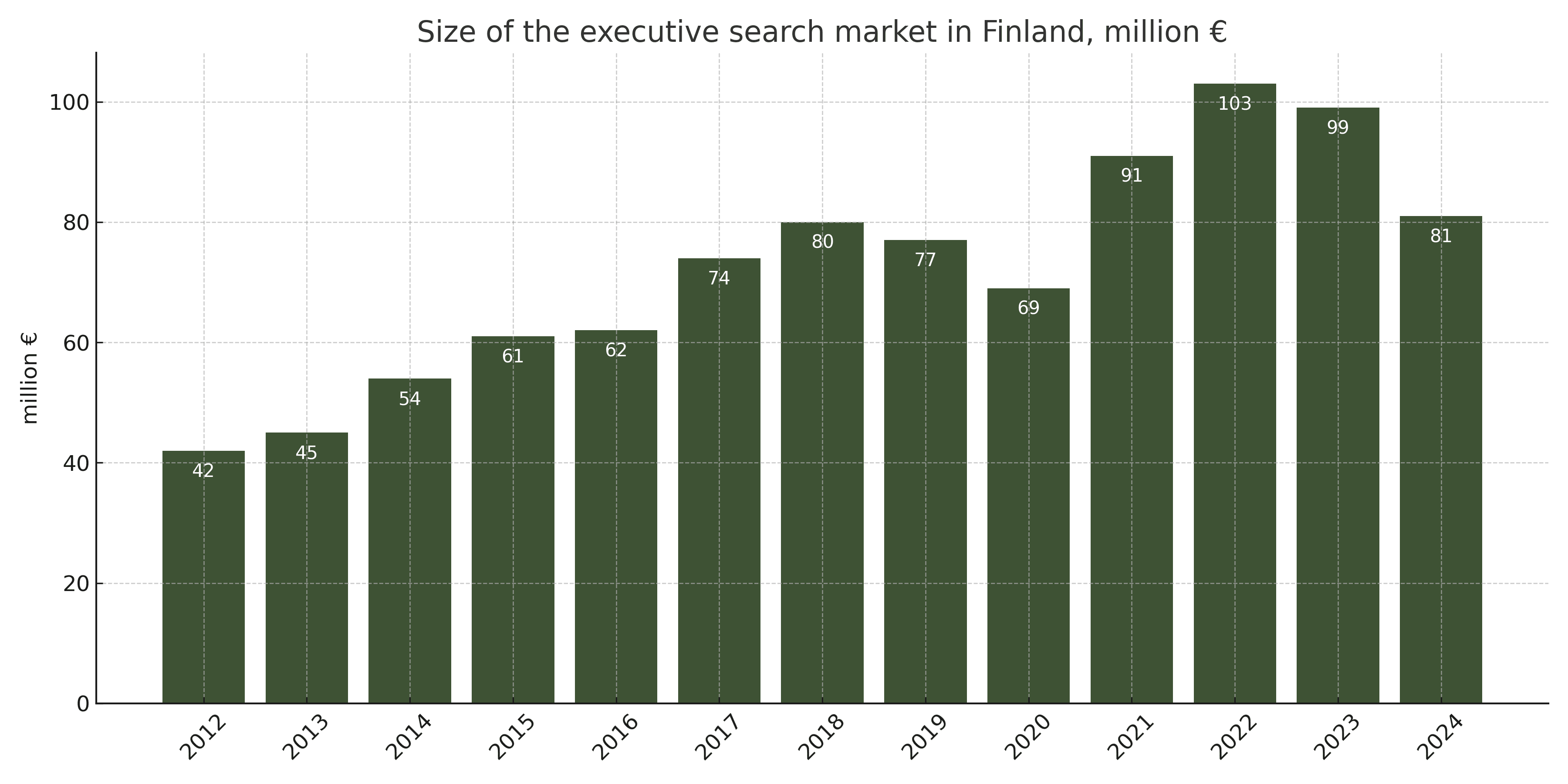
The Finnish headhunting market contracted by 18% to €81 million in 2024 from the year before, with notable shifts in structure, competition, and performance, according to the findings of a survey conducted by Listeds in partnership with recruitment media Duunitori.

Listeds collected survey data for Duunitori to build a comprehensive industry picture, covering 133 companies and their revenue development during their latest fiscal year. The 2023 figures come from Duunitori, which published the latest 2024 report on Nov. 20 (in Finnish).


Source: Duunitori.

Market overview

  • Executive search turnover 2024: €81 million

  • Turnover 2023: €99 million → This represents a contraction of about 18 percent.

  • Number of companies with 2024 headhunting turnover: 133

  • Pure headhunting enterprises (100 percent executive search): 46 → About a third of all companies focus exclusively on executive search.

The market has grown significantly over the past decade, although with some cyclical fluctuations. The 2024 decline signals a more cautious hiring climate for senior roles and a shift toward selective recruitment.

Market structure and segmentation

Category

Turnover range (€)

Number of companies (All)

Micro

< 0.5 M

89

Small

0.5 – 1 M

19

Medium

1 – 3 M

19

Large

3 – 10 M

6

Interpretation

  • The Finnish market remains heavily weighted toward small operators. Two-thirds of companies fall in the micro category with under €0.5 million in annual turnover.

  • Mid-sized enterprises in the 1–3 million euro range form an increasingly important professional core, although the single largest concentration of pure headhunting specialists remains in the micro tier.

  • Only a few players reach the large category, typically between three and 10 million euros in annual turnover. In 2024, this group included MPS, Mercuri Urval, Egon Zehnder, InHunt Group, IMS Talent, and Heidrick & Struggles.

  • No companies surpass €10 million in annual headhunting turnover, which underlines the fragmented and boutique-oriented nature of the Finnish executive search industry.


The 20 largest headhunting companies in Finland (including mixed-service providers)

This ranking includes both pure-headhunting companies and mixed-service HR providers that offer executive search as part of a broader portfolio.

The table shows the 2024 headhunting turnover in comparison to 2023, and how large a share of each company’s business was executive search in 2024. The latest data are primarily based on survey responses.

Rank

Company

2024 Exec Search (€)

2023 (€)

YoY %

1

MPS

6,429,000

7,581,000

−15%

2

Mercuri Urval

4,732,709

3,895,000

+22%

3

Egon Zehnder

4,534,174

7,038,000

−36%

4

InHunt Group

4,392,000

5,689,000

−23%

5

IMS Talent

3,433,995

3,418,000

0%

6

Heidrick & Struggles

3,416,724

3,559,000

−4%

7

Fairchild Executive Search

2,579,069

2,967,000

−13%

8

Sam Headhunting

2,299,796

1,116,000

+106%

9

Boyden

2,178,013

3,282,000

−34%

10

JFP Executive Search

2,149,000

1,760,000

+22%

11

HR Satama

2,076,000

1,779,000

+17%

12

Staffpoint Executive

2,050,000

2,179,000

−6%

13

Amrop Finland

1,961,000

2,346,000

−16%

14

Alumni / Harvey Nash

1,825,000

1,841,000

−1%

15

Odgers Berndtson

1,808,000

1,762,000

+3%

16

Eezy Personnel

1,717,249

2,250,000

−24%

17

Compass HR Group

1,600,000

1,184,000

+35%

18

Adecco

1,500,000

647,000

+132%

19

HRS Advisors

1,400,000

1,655,000

−15%

20

Avila

1,324,485

1,511,000

−12%

Key insights

  • The top 20 service providers together represent a significant share of the market, likely well over half, which indicates moderate concentration at the top despite the long tail of small operators.

  • MPS leads the market by total executive search revenue, even though less than 50 percent of its business is pure headhunting.

  • After MPS, the highest ranks are occupied by Swiss advisory giant Egon Zehnder, Sweden's Mercuri Urval, Finland's InHunt Group, and IMS Talent, as well as Chicago-headquartered Heidrick & Struggles, each above €3.4 million.

  • Fastest growth was recorded by:

    • Adecco Finland (+132 percent)

    • Sam Headhunting (+106 percent)

    • Compass Human Resources (+35 percent)

  • Several major market players experienced significant declines compared to the Duunitori report last year, reflecting lower demand for retained executive search assignments.

Year-on-year trends

  1. Market contraction: Executive search volume decreased about 18 percent from 2023 to 2024.

  2. Growth in specialization: More than one-third of companies are now pure headhunting specialists.

  3. Polarization by size: The market is divided between global networks and boutique firms, while the middle segment continues to thin.

  4. Focus on cost efficiency: Firms maintained profitability overall but faced slower profit growth.

  5. Boutiques gaining ground: JFP Executive Search and Sam Headhunting showed strong performance, while Fairchild maintained its competitive position despite the market downturn.

Summary

The 2024 Finnish headhunting market is professional, highly specialized, and structurally fragmented. Although the total value declined to €81 million, the industry remains competitive and dynamic with 46 pure headhunting companies and over 100 active companies overall.

The year highlighted significant contrasts. Large international search enterprises saw declining revenues, while several national boutiques achieved strong growth. Client behavior appears to be shifting from high volume toward high value and from large brand names toward flexible, specialized providers.

If you want to read the Duunitori report (in Finnish), you can find it here.


How was the data collected?

Listeds collected survey responses on behalf of Duunitori from operators in Finland’s executive search field in October 2025. We asked companies to confirm their total and headhunting revenue from the most recent financial year. A total of 34 responses were received, and the official revenue figures for other companies were retrieved from Kauppalehti’s pages. In cases where companies offer other HR services in addition to executive search, Duunitori’s suggested percentage coefficient was used — the same as in the previous year.

Insights

Finnish executive search set for gradual recovery by 2026, insiders say

Nov 24, 2025

Finland’s executive search market shrank by 18 percent in 2024, falling to €81 million according to the findings of the Listeds and Duunitori survey. The contraction has forced a reset across the sector, accelerating the adoption of AI, raising expectations for transparency and scientific assessment, and widening the gap between high-quality operators and companies relying on lighter processes.

Although the overall market remains subdued, early signals point to stabilization. Companies with senior-level rigor, credible methodology, and global sourcing depth appear best positioned for a gradual improvement heading into 2026. Only six enterprises surpassed €3 million in executive search revenue in 2024, underscoring how concentrated the upper tier remains in a market of 133 active providers.

Lauri Vaisto, Duunitori’s principal consultant in strategy and employer branding, notes in an article that executive search reacts more slowly to economic cycles than the broader labor market. “Employers have reduced and postponed these strategic hires, but they have not abandoned them altogether,” he says, suggesting that latent demand may return quickly once economic confidence improves.

AI accelerates the shift toward transparency and value

InHunt Group, ranked fourth among recruitment service providers with €4.39 million in executive search revenue, sees the market dividing more sharply between credible and low-quality operators.

The quality of search processes has declined significantly in the sector due to the negative financial performance, InHunt CEO Kari Juutilainen said. "Lower prices and lighter processes inevitably increase errors and reputation risks.”

Juutilainen expects AI to accelerate changes to pricing and service expectations. “As companies learn to use AI better for identifying the right search criteria and attraction factors, standardizing interviews for consistency and quality, and moving candidates more efficiently through the process, it is no longer justified to charge tens of thousands of euros for the work.”

A more selective, senior-led market

Mercuri Urval, the second-largest search provider in Finland with €4.73 million in revenue, sees demand concentrating at the top of the leadership pyramid.

Partner and Director Teemu Tiainen says, “In a changing environment, the importance of leadership selection keeps rising and organizations expect more fact-based and quality-assured methods from their executive search partners.” He notes that international and multi-country assignments are increasing as Finnish companies seek growth abroad.

Juutilainen expects search partners to be used less for full recruiting cycles and more for sourcing depth. “Companies will need headhunters even more in the future, not necessarily for entire recruitment processes but to ensure access to a wide and high-quality candidate pool.”

Companies that outperformed the downturn
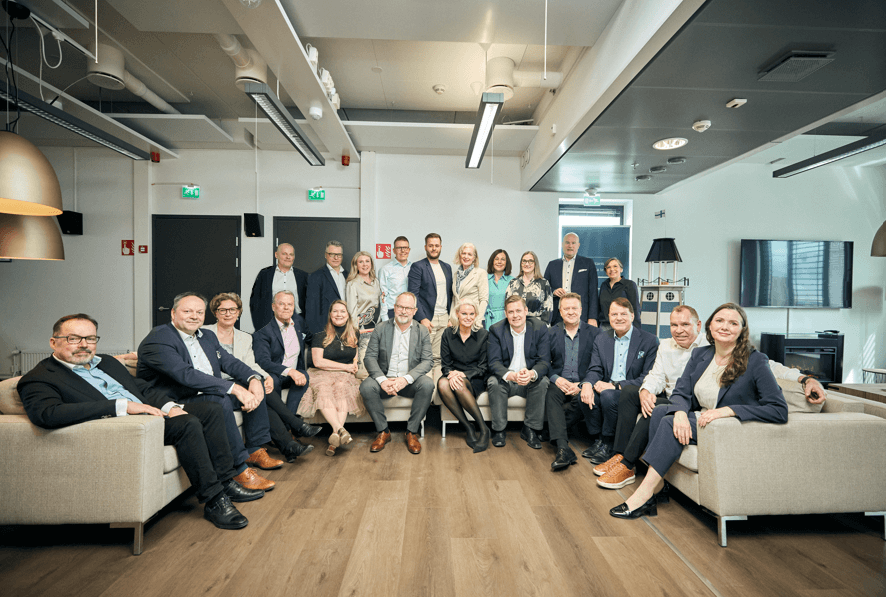
SAM Headhunting team.

SAM Headhunting, now ranked 8th nationwide after growing more than 100 percent to €2.3 million, was one of the market’s strongest performers.

Senior Partner Taru From says the company benefited from increased demand for high-impact leadership roles. “Growth comes from C-suite searches and broad industry expertise.”

Consulting expert From sees the early signs of a rebound. “We have now seen gradual signs of recovery and believe that the market has started moving toward growth as we head into 2026.”

Adecco Finland, ranked 19th, delivered the fastest growth in the top 20 with a 132 percent increase in executive search revenue. Though search represents only about 2 percent of its total business, the company recorded substantial gains by pivoting toward senior roles and interim placements.

“We began to invest more heavily in direct search, executive-level roles, and interim placements so we can serve a broader client portfolio,” said Suvi Onkamo-Häkkinen, Adecco's country manager in Finland.

IMS Talent, ranked fifth with €3.43 million in revenue, remained stable despite the national decline. Partner Sari Salojärvi expects moderate improvement ahead. “Toward 2026, we again believe in growth opportunities for ourselves, and perhaps in a slight recovery for the industry.”

Salojärvi notes that demand for top leadership remains structurally consistent. “In our view, the top leadership search market is generally quite stable; there is always demand for leadership changes.”

A fragmented market that may consolidate

The new survey underscores how fragmented the Finnish executive search landscape remains, with nearly two-thirds of all providers generating under €0.5 million in revenue. Larger international enterprises saw steep declines, in some cases more than one-third. In contrast, fast-growing specialists such as SAM Headhunting and JFP Executive Search expanded during the downturn.

Duunitori’s Vaisto believes the market is moving into a more structured phase. “The executive search market is developing the way many industries do: large providers expand their services, smaller ones specialize and move quickly,” he says. “I would not be surprised if this fragmented market begins to consolidate through acquisitions or new forms of collaboration.”
Stay on the pulse, catch the signals

Subscribe to Listeds Leadership Intelligence Platform:

  • leader and company database access

  • email alerts

  • career, boards and interim opportunities

Our Pulse newsletter

Your weekly leadership intelligence briefing.

What happened, why it matters, and what to watch across every CEO, board, and executive move in Nordic listed companies, starting with Finland. Fast, factual, and to the point.

Delivered every Monday.

By signing up, you agree to our Privacy Policy