
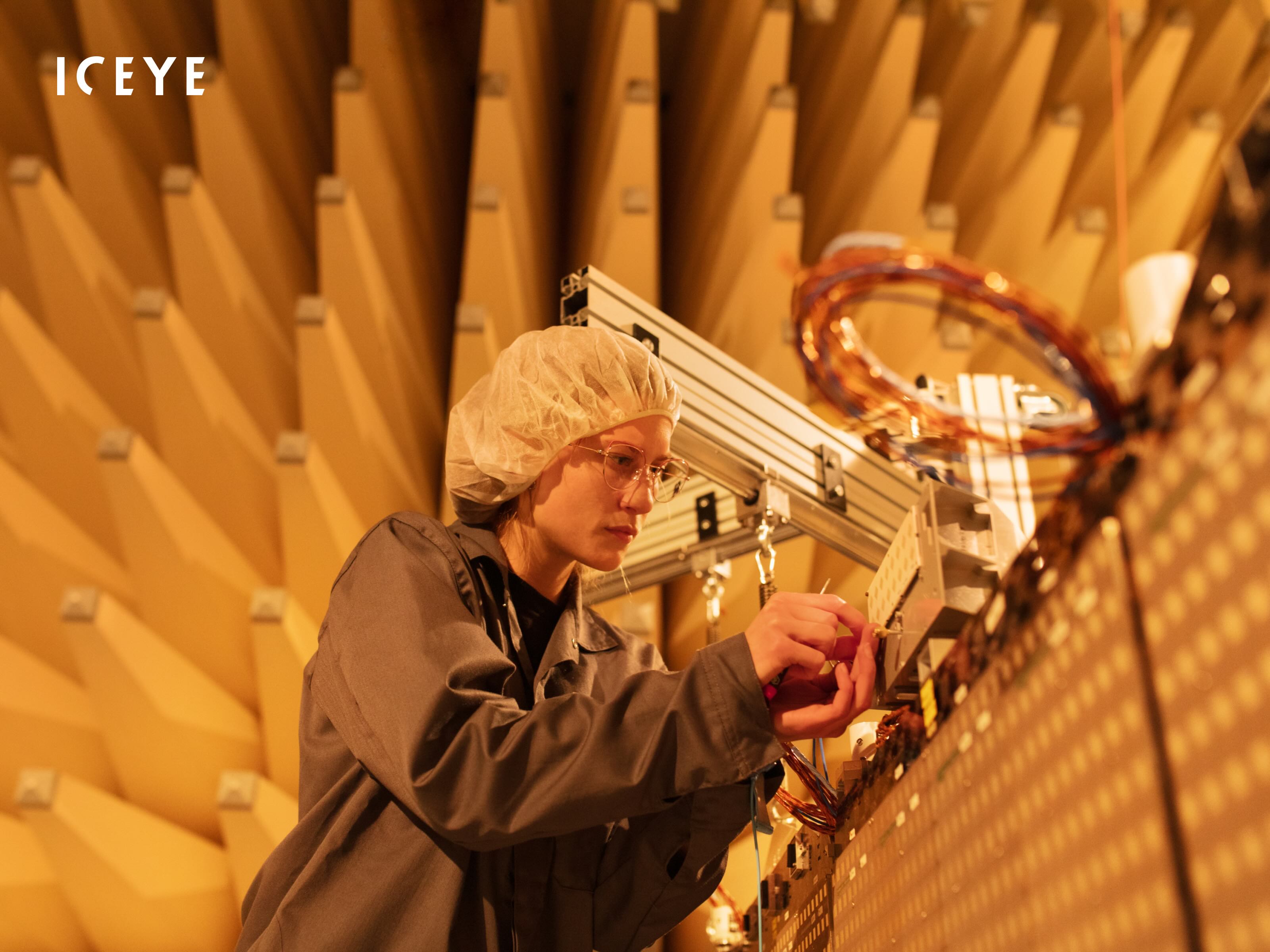
Finnish satellite company Iceye has raised more than €1 billion in fresh funding, becoming one of Europe's most valuable privately held defense technology companies.

The company announced a €450 million primary funding round today led by General Atlantic. Combined with a secondary share sale, the transaction exceeded €1 billion. Investors include Solidium, Tesi, Varma, Ilmarinen, Nokia, Lifeline Ventures, Qatar Investment Authority, and TCV.

According to Tesi, the round values Iceye at €10.5 billion, making it Finland's third decacorn after Supercell and Oura. Tesi described the transaction as one of the largest growth funding rounds ever completed by a Finnish company.

The valuation reflects growing demand for technologies that give governments direct access to intelligence and surveillance capabilities. Iceye operates the world's largest synthetic aperture radar satellite constellation, producing imagery regardless of weather conditions or time of day.

Seven governments have procured sovereign satellite systems from Iceye, according to the company. Earlier this year, it delivered a fully operational space intelligence system to the Polish Armed Forces within 12 months of contract signing. The company says it is now replicating the model across Europe, the Middle East, and Asia.


The business has also reached a scale rarely seen among European space companies. Iceye reported more than €250 million in revenue and over €100 million in EBITDA in 2025, alongside a contracted backlog exceeding €1.5 billion. Satellite production is expected to double from 50 units annually today to 100 by 2028.

The funding round also leaves Finland with a meaningful stake in one of its most strategically important technology companies. According to Tesi, the state investment company will own around 7% of Iceye following the transaction. Through Tesi and Solidium, the Finnish state will control roughly 12%, while Finnish institutional investors collectively hold around 17%.

For Finland, the milestone extends a short list of globally significant technology companies founded in the country. For Europe, it highlights how quickly space-based intelligence has moved from a specialist capability to part of the continent's broader security infrastructure.

|

|

Business

Iceye becomes Finland’s third decacorn with €10.5 billion valuation

Iceye becomes Finland’s third decacorn with €10.5 billion valuation

·

5 min read

Credit: Iceye

Credit: Iceye

Finnish satellite company Iceye has raised more than €1 billion in fresh funding, becoming one of Europe's most valuable privately held defense technology companies.

The company announced a €450 million primary funding round today led by General Atlantic. Combined with a secondary share sale, the transaction exceeded €1 billion. Investors include Solidium, Tesi, Varma, Ilmarinen, Nokia, Lifeline Ventures, Qatar Investment Authority, and TCV.

According to Tesi, the round values Iceye at €10.5 billion, making it Finland's third decacorn after Supercell and Oura. Tesi described the transaction as one of the largest growth funding rounds ever completed by a Finnish company.

The valuation reflects growing demand for technologies that give governments direct access to intelligence and surveillance capabilities. Iceye operates the world's largest synthetic aperture radar satellite constellation, producing imagery regardless of weather conditions or time of day.

Seven governments have procured sovereign satellite systems from Iceye, according to the company. Earlier this year, it delivered a fully operational space intelligence system to the Polish Armed Forces within 12 months of contract signing. The company says it is now replicating the model across Europe, the Middle East, and Asia.

Our Pulse newsletter

Your weekly leadership intelligence briefing.

What happened, why it matters, and what to watch across every CEO, board, and executive move in Nordic listed companies, starting with Finland. Fast, factual, and to the point.

Delivered every Monday.

By signing up, you agree to our Privacy Policy

Our Pulse newsletter

Your weekly leadership intelligence briefing.

What happened, why it matters, and what to watch across every CEO, board, and executive move in Nordic listed companies, starting with Finland. Fast, factual, and to the point.

Delivered every Monday.

By signing up, you agree to our Privacy Policy

The business has also reached a scale rarely seen among European space companies. Iceye reported more than €250 million in revenue and over €100 million in EBITDA in 2025, alongside a contracted backlog exceeding €1.5 billion. Satellite production is expected to double from 50 units annually today to 100 by 2028.

The funding round also leaves Finland with a meaningful stake in one of its most strategically important technology companies. According to Tesi, the state investment company will own around 7% of Iceye following the transaction. Through Tesi and Solidium, the Finnish state will control roughly 12%, while Finnish institutional investors collectively hold around 17%.

For Finland, the milestone extends a short list of globally significant technology companies founded in the country. For Europe, it highlights how quickly space-based intelligence has moved from a specialist capability to part of the continent's broader security infrastructure.

Topics

# Topics

Authors

Emmi Laine is head of business content at Listeds and our lead for finance and business coverage. She sets the editorial agenda, interviews Nordic business leaders, and writes stories, newsletters, and social content on timely market and corporate topics. Emmi brings nearly eight years of experience from Shanghai's Yicai Global / Yicai Media Group, where she was awarded for reporting on China’s economy, finance sector, and technology innovation. She holds an MSc in Innovation and Entrepreneurship from ESADE Business School in Barcelona and a Master’s degree in International Design Business Management from Aalto University. She also holds a Bachelor’s degree in Culture Studies with a major in Journalism from Stockholm University and has studied Mandarin Chinese and Chinese culture. Emmi is a Finnish citizen and has lived in Finland, Sweden, China, and Portugal.

Emmi Laine is head of business content at Listeds and our lead for finance and business coverage. She sets the editorial agenda, interviews Nordic business leaders, and writes stories, newsletters, and social content on timely market and corporate topics. Emmi brings nearly eight years of experience from Shanghai's Yicai Global / Yicai Media Group, where she was awarded for reporting on China’s economy, finance sector, and technology innovation. She holds an MSc in Innovation and Entrepreneurship from ESADE Business School in Barcelona and a Master’s degree in International Design Business Management from Aalto University. She also holds a Bachelor’s degree in Culture Studies with a major in Journalism from Stockholm University and has studied Mandarin Chinese and Chinese culture. Emmi is a Finnish citizen and has lived in Finland, Sweden, China, and Portugal.

Authors

Journalist

Emmi Laine is head of business content at Listeds and our lead for finance and business coverage. She sets the editorial agenda, interviews Nordic business leaders, and writes stories, newsletters, and social content on timely market and corporate topics. Emmi brings nearly eight years of experience from Shanghai's Yicai Global / Yicai Media Group, where she was awarded for reporting on China’s economy, finance sector, and technology innovation. She holds an MSc in Innovation and Entrepreneurship from ESADE Business School in Barcelona and a Master’s degree in International Design Business Management from Aalto University. She also holds a Bachelor’s degree in Culture Studies with a major in Journalism from Stockholm University and has studied Mandarin Chinese and Chinese culture. Emmi is a Finnish citizen and has lived in Finland, Sweden, China, and Portugal.

All Listeds newsletters (bundle)

One sign-up, the full picture.

Get every Listeds newsletter: the daily signal drumbeat, the weekly Pulse briefing, the monthly Best of the Month, the CEO letter, and the Weekend read.

By signing up, you agree to our Privacy Policy

All Listeds newsletters (bundle)

One sign-up, the full picture.

Get every Listeds newsletter: the daily signal drumbeat, the weekly Pulse briefing, the monthly Best of the Month, the CEO letter, and the Weekend read.

By signing up, you agree to our Privacy Policy

Latest signalsLive feed
Moves trackerLive feed

Investor Event

Listeds Investor Event · Defence

Nordic defence is in a once-in-a-generation growth cycle. Eight listed and pre-IPO companies pitch to 100+ invited investors at Valkoinen Sali, Helsinki

21 September 2026

Latest on Listeds

Leadership Moves

Teemu Kokko moves from Arvo's board to its chief executive's chair

Sep 7, 2026

Kokko becomes deputy CEO in December and chief executive on 1 April 2027, after five years on Arvo's board of directors. The nomination committee that selected him sits under the supervisory board, one level above that board; Arvo has not disclosed whether he keeps his seat.

On 1 September 2026, Arvo Sijoitusosuuskunta released as inside information that Teemu Kokko will become its chief executive. He starts as deputy CEO in early December 2026 and takes over on 1 April 2027.

Kokko joins from the insurance underwriter Arch Underwriters Europe Oy, where he is regional director. He has also been a member of Arvo's board of directors since 2021.

The committee sits one level up

Arvo is a cooperative. Its highest governing body is not the board of directors but the supervisory board which represents the members, has 18 to 30 seats, serves three-year terms and meets roughly three times a year. That body appoints a nomination committee from among its own members.

When Jari Pirinen announced on 8 September 2025 that he would retire in spring 2027 on turning 66, Arvo said management succession planning sat with that committee, and supervisory board chair Tuomo Tamminen said it would report on progress later.

So the body that selected Kokko is not the board Kokko sits on. It is drawn from a members' organ and answers to the members.

In a listed limited company there is no such layer. The board appoints the chief executive itself. That is the comparison for any Finnish board weighing one of its own directors as a successor: Arvo can point to a committee above the board; a listed board has to show its process instead.

Two things Arvo has not disclosed. The release does not say whether Kokko remains a member of the board of directors once he becomes deputy CEO in December or chief executive in April. Nor does it say how the board handled his candidacy, he has been a director throughout the period covered by the succession process announced in September 2025.

Arvo's board was re-elected in February 2026 and comprises Marjo Kolehmainen as chair (a director since 2018, chair since 2022), Mika Kiljala as vice chair (director since 2017), Juha Laakkonen and Kokko (both since 2021), and Titta Mantila (since 2024).

The handover runs 19 months end to end

Retirement flagged in September 2025. Successor named in September 2026. Four months as deputy chief executive from early December 2026. Handover on 1 April 2027. Pirinen then moves to special duties on the board of directors from that date, takes accrued leave, and retires on 31 May 2027.

That is a longer and more pre-committed sequence than Helsinki practice, where chief executive changes are often announced with an interim in place and a search still running.

The numbers he inherits, and the transaction inside them

Arvo reported group operating profit of EUR 8.5 million for the first half of 2026, against EUR 6.5 million a year earlier, and a net result of EUR 7.0 million against EUR 2.7 million. Annualised return on invested capital was 17.0 per cent, against 10.3 per cent. Equity per unit rose to EUR 123 from EUR 117.

Most of the step-up traces to one position. Arvo sold its entire holding of 896,806 shares in Nasdaq Stockholm-listed HANZA AB in March 2026 for a capital gain of approximately EUR 6.9 million. It had taken those shares in 2025 as part of the price for exiting Leden Group — a Finnish seller accepting equity in a Swedish listed acquirer, then realising it inside twelve months. That structure is the more transferable lesson in the half-year for anyone selling a Finnish asset across the Gulf of Bothnia.

Underlying performance was already ahead of target before the disposal. Parent-company return on invested capital was 10.1 per cent for full-year 2025, which the company said clearly exceeded the board's return target, and the board proposed a per-unit interest of EUR 5.77, which Arvo characterised as about 60 per cent of the year's earnings. At the end of 2025 the cooperative had 22,373 members and 814,470 units.

The units closed at EUR 84.20 on 3 September 2026. Equity per unit was EUR 123 at 30 June 2026. On those two dates the units traded roughly 32 per cent below reported equity per unit — a gap readers should weigh themselves, and one measured across a two-month interval rather than at a single date. Inderes rates the units Accumulate as at 21 August 2026; Arvo is a commissioned research client of Inderes, and its coverage should be read with that in mind.

The mandate points one way, the reported share the other

Tamminen set the direction in the appointment release:

"Under Teemu's leadership, we believe Arvo's investment operations will develop further and the share of direct investments will grow."

He paired it with a constraint in the same release:

"We continue to regard it as important that Arvo remains a stable payer of the per-unit interest, as in previous years."

Grow the illiquid share; keep the cash distribution steady. Those two pull against each other, and holding both is the substance of the job.

The measured direct share has been moving the other way. Direct investments were 47 per cent of the portfolio at fair value at the end of 2025, up from 44 per cent a year earlier. At 30 June 2026 they were 40 per cent, against 45 per cent at 30 June 2025.

The profit and the fall have a common cause: the HANZA exit produced the gain and removed a direct holding. So the growth mandate starts from a lower base than the 2025 figures suggest. 

Deal activity has continued. Arvo took a minority stake in bus operator Wiimax Oy alongside Wiimax's acquisition of J.M. Eskelisen Lapin Linjat Oy, and joined a Helmet Capital-led investor group in Oskutuote Oy, a wild bird food specialist.

Why it matters beyond one cooperative

Arvo listed its units on Nasdaq First North Growth Market Finland, Cooperatives segment, on 20 June 2023 under the ticker ARVOSK — the first cooperative units listed on Nasdaq's Nordic markets. It is a listed issuer with a members' register the size of a mid-cap shareholder base and a governance architecture most Finnish listed companies gave up decades ago.

Three questions for any company announcing a new chief executive.

  • Who runs the process, and does that body sit above the candidate or beside him? Arvo can point one level up.

  • What gets disclosed at the moment of appointment? Whether the incoming chief executive keeps a board seat, and how his candidacy was handled, are reasonable things for a market to be told at announcement rather than to reconstruct afterwards.

  • What is the mandate measured against? Kokko is asked to grow direct investments while keeping the per-unit interest stable, from a direct share that fell in the most recent reported period, after a disposal that produced the profit he inherits credit for.

Market Signals

Oura's board is being built for Nasdaq: prospectus reveals $1.21bn in nine-month revenue and four US-market directors

Sep 4, 2026

Oura has filed publicly for a Nasdaq listing in the United States and, according to reporting by The Wall Street Journal, intends to list during September. The Finnish smart ring maker submitted a confidential filing in May. The prospectus arrives with a board reshaped for US public markets, and a Nordic presence now outnumbered on it.

The prospectus filed with the U.S. Securities and Exchange Commission shows revenue of $1.21 billion for the nine months ended 30 June 2026, the first three quarters of a fiscal year that ends 30 September, against $697.6 million in the same period a year earlier, a rise of 74%. Full-year FY2025 revenue was $907.9 million, against $406.8 million the year before. The net loss attributable to common shareholders over the same nine months was $924.3 million, compared with $182.8 million a year earlier.

Oura shipped 3.1 million rings in the nine-month period, against 1.8 million a year earlier. Membership revenue reached $240.5 million, up 121%, and paid members doubled to 5 million, the recurring line that will matter most to public-market investors, and the one that turns a hardware company into a subscription business.

The headline loss sits beneath a $985m deemed dividend

Before the deemed dividend attached to preferred shares, Oura's net result for the period was a profit of $60.8 million, against $1.6 million a year earlier. The $924.3 million figure emerges after a $985 million deemed dividend to holders of redeemable convertible preferred shares is deducted. The comparable deemed dividend a year earlier was $184.4 million.

Oura raised more than $1.2 billion privately before this filing. A Fidelity-led round in October 2025 valued the company at $11 billion. The listing could raise up to $3 billion for the company and some of its backers at a valuation exceeding $16 billion, Bloomberg reported on 24 August 2026, a repricing of roughly 45% in under a year. 

The new board adds Robinhood's IPO-era CFO and Wolt's founder

Oura said on 2 September that it will appoint Jason Warnick, Leslie Kilgore, Miki Kuusi and David Sze as directors.

Warnick spent seven years as chief financial officer of Robinhood, where he helped take the company public and through its subsequent life as a listed business. He retired from the role earlier this year and was succeeded by Shiv Verma. Before that he spent nearly two decades at Amazon across finance, investor relations, audit and enterprise risk, and began his career as a CPA at Deloitte & Touche.

Kilgore sits on the boards of Netflix and Pinterest, and has previously served on those of LinkedIn, Medallia and Nextdoor. She was chief marketing officer at Netflix, and held earlier positions at Amazon, Procter & Gamble and Booz Allen Hamilton.

Kuusi co-founded Wolt and led it as chief executive from 2014 until DoorDash acquired the company in 2022. He now oversees DoorDash's international business and serves as chief executive of London-based Deliveroo. 

Sze is a partner at Greylock Partners, where he led investments in Facebook, LinkedIn, Roblox and Pandora. He previously held senior operating roles at Excite and Excite@Home.

The four join Timo Ahopelto, Dennis Durkin, chief executive Tom Hale, Wen Hsieh, Eurie Kim and chairman David Shuman on the board.

"Adding Jason, Leslie, Miki, and David strengthens our board with leaders who know what it takes to build and scale category-defining global businesses," Hale said in the company's statement.

What the appointments say about where Oura's governance now sits

The appointments describe a specific destination. Warnick is a CFO who has already run a listing and the quarterly reporting cycle that follows it. Kilgore brings the consumer-brand seat that US public boards expect. Sze holds an investor seat. None of the three has a Nordic mandate.

That leaves a ten-person board on which Ahopelto and Kuusi are the Nordic voices, at a company founded in Oulu that will report as a US filer under SEC rules rather than the Finnish Corporate Governance Code. For Nordic investors, Oura is on the way to becoming a company you can read about but not vote on in Helsinki, the governance follows the listing venue, and the listing venue is Nasdaq.

Oura is not leaving Finland. The engineers stay, the product stays. What moves is the register, the governance regime and the venue where the company answers for itself. IQM proved that part is a choice, it took both listings. Oura’s prospectus takes one.

Join our Pulse, Best-of-the-Week, and Weekend newsletters

Join our Pulse, Best-of-the-Week, and Weekend newsletters