Iberdrola, one of Europe’s largest electricity companies, is buying Caruna, the grid that powers 1.5 million Finns. The deal has reignited Finnish anger over foreign ownership of critical infrastructure, and reopened old wounds about how the grid was sold, priced and taxed in the first place.
On 21 July 2026, Spain's Iberdrola agreed to buy 80% of Caruna, the company whose wires reach about a quarter of Finland. The sellers, US private equity firm KKR and Canada's Ontario Teachers' Pension Plan, are exiting in full. The two Nordic pension owners, Finland's Elo and Sweden's AMF, are keeping their combined 20%. The price for the 80% stake is about €2 billion, valuing Caruna at around €5 billion including debt. Completion is expected in the first quarter of 2027, subject to Finnish foreign investment screening, EU merger control, and foreign subsidy review.
The opposition wasted no time. Antti Kaikkonen, leader of the opposition Centre Party, wrote in a Facebook post that the government should not watch this from the sidelines but actively explore a domestic ownership solution for the grid, with Finnish pension companies possibly taking part.
He called the original sale of Fortum's networks to foreign investors a serious mistake whose consequences persist: a monopoly whose customers cannot change their network company yet pay rising transfer fees while profits flow abroad. He was careful to add that he does not oppose foreign investment in general, only that critical infrastructure should put the national interest first.
The diagnosis is sharp, and widely shared. But the remedy that now dominates the public reaction, making Caruna Finnish again, is on its own the wrong frame. Caruna has not been in majority Finnish hands since 2014, and the owners now selling are already American and Canadian.
The harder question, the one Finns have been paying for since 2016, is why a monopoly that every household in its area depends on was turned into a financial asset in the first place, and what that ownership model does to the people at the end of the line.
Why this is personal for 1.5 million Finns
Caruna is Finland's largest electricity distribution company. It owns and runs the local grid that carries power to about 744,000 customer connections and is the primary distributor in 57 municipalities in southern, southwestern and western Finland, plus Joensuu and Koillismaa. Those connections reach roughly 1.5 million people, more than a quarter of the country's population of about 5.6 million. Its share of the national distribution market is close to 20%.
A distribution grid is a natural monopoly. A household cannot choose a different set of wires to its home.
If you live in Caruna's area, you pay Caruna to move your electricity, whatever your energy supplier, and you pay it every month of the year. That is why the bill is personal, and why it bites hardest for many households in a Finnish winter, when heating and darkness push consumption to its annual peak and the distribution charge rides on top of every kilowatt hour.
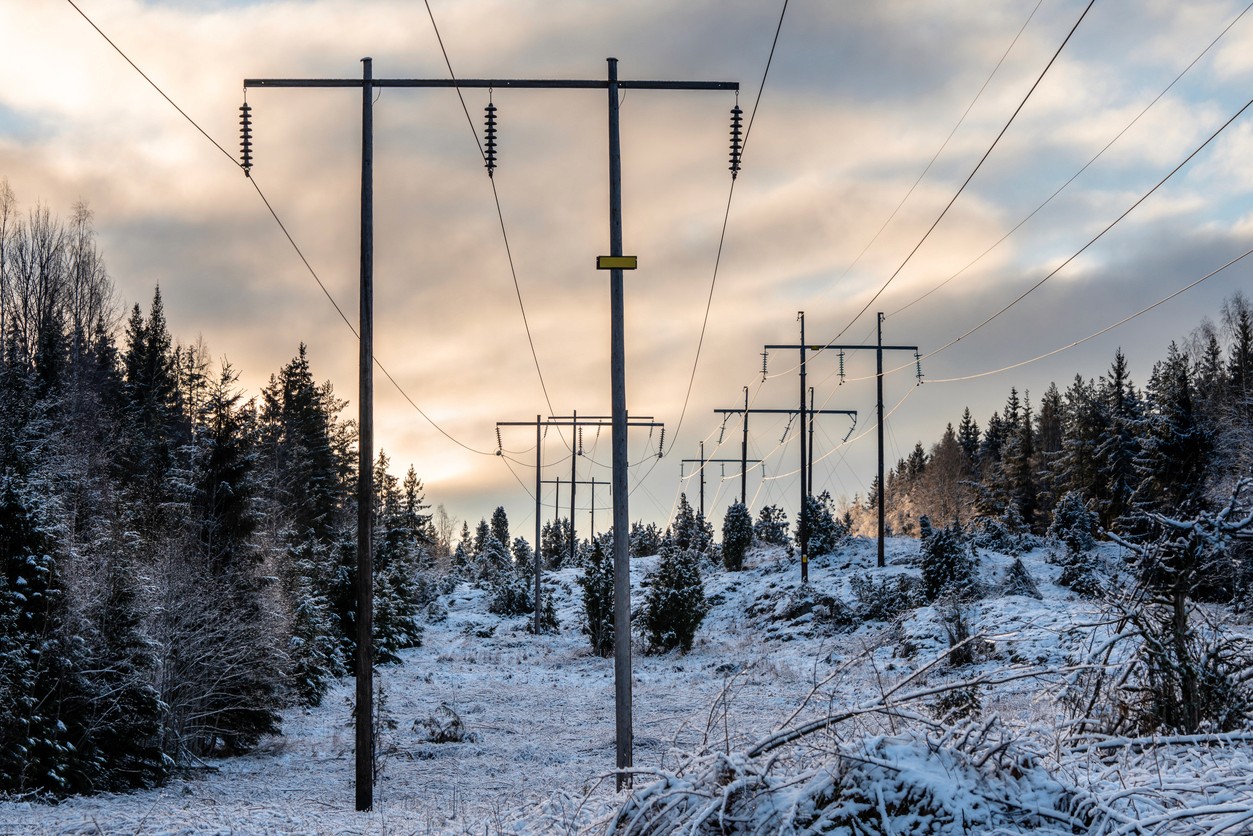
Regulation caps how fast these charges can rise, and how much a grid company can earn, precisely because customers have nowhere else to go.
The gap inside Caruna's own network shows how much the model matters. In 2025, according to Sähköhinta.com figures reported by Kauppalehti, the basic monthly distribution charge in Caruna's main area was €29.71, the fourth highest of any Finnish grid company and roughly double the national average of €14.85. In the separately run Caruna Espoo area, the basic charge was only €7.34, and the energy charge was 2.66 cents per kilowatt hour against 5.26 cents in the main area. Same owner, very different bills.
That is also why the bill carries memory. When the grid was first sold, Finns were promised that private ownership would not raise transfer prices. It did.
The sale that still stings
Caruna exists because of a political decision that its architects promised would be painless. The sale of Fortum's Finnish distribution business was approved by the government in late 2013 and completed on 24 March 2014, when state-controlled Fortum sold the grid to a consortium called Suomi Power Networks for about €2.55 billion.
The buyers were Australia's First State Investments and Canada's Borealis Infrastructure, each with 40%, alongside the Finnish pension investors Keva and LocalTapiola Pension.
The grid served about 640,000 customers at the time. In the ministerial committee, the sale was backed across Jyrki Katainen's six party coalition, by the Social Democrats, the National Coalition Party, the Greens, the Swedish People's Party and the Christian Democrats.
Only the Left Alliance's Paavo Arhinmäki opposed it, filing a dissenting opinion on the grounds that a natural monopoly carrying critical infrastructure should stay in public hands.
The ministers who led it were confident in public. Prime Minister Katainen said the sale would not raise transfer prices for customers because electricity transfer and its pricing are strictly regulated.
Minister of Economic Affairs Jan Vapaavuori called it "a safe solution for Finland's energy policy" and argued that because network companies face a regulated ceiling on their returns, no price spike could even be constructed.
Pekka Haavisto, the minister responsible for Fortum ownership steering, defended the deal too, saying the distribution grid was not infrastructure the state needed to own, that the operator could not price freely, and that it carried heavy obligations for maintenance and customer liability.
It did not hold. At the turn of 2016, Caruna announced transfer price increases averaging about 27%, reported elsewhere as up to a third, from the start of March. The backlash was national, and with the Consumer Ombudsman raising the prospect of a class action, the company backed down, phasing the increase in and temporarily cutting the basic fee, with no further rises before 2018.
It did not stay down: in April 2018 Caruna raised distribution charges again, by about 6.5% on average including taxes. The company, a monopoly's customers cannot walk away from had become, in Finnish public debate, shorthand for public anger.
In fairness, not all of the spending was optional. The Tapani storm that swept Finland on St Stephen's Day, 26 December 2011, with a second storm, Hannu, hours behind it, was among the most destructive the country had seen: it toppled trees onto overhead lines across the south and cut power to hundreds of thousands of homes, some for more than a week.
The disaster exposed how fragile the grid was, and Parliament's answer was the 2013 Electricity Market Act, which required distribution companies to storm-proof their networks so that weather outages could not exceed six hours in towns or 36 hours in the countryside, to be achieved by 2028, with extensions to 2036 for the hardest rural stretches, mainly by burying cables underground. Caruna's grid, now about 89,000 km and roughly two-thirds underground, was rebuilt to that standard. The obligation was genuine. The fight was always over how much of that cost, and how much profit on top, landed on customers who could not say no.
Then there was tax. Caruna's ownership structure kept its Finnish tax bill strikingly low.
In a series of investigations, public broadcaster Yle found that in 2014 the company reported more than €50 million in operating profit but, after financing costs, paid only about €800,000 in Finnish corporate tax, using a complex intra-group debt structure routed through Dutch, Luxembourg, Maltese and Cayman Islands companies, with owner loans carrying interest well above bank rates.
In 2016 it paid an effective rate of about 0.28% on more than €150 million of operating profit.
The civil society group Finnwatch estimated that Finland lost around €12 million in tax revenue in 2017 alone, and pointed to a balance sheet exemption rule that let Caruna deduct all of its interest costs after its owners had driven the company's equity negative with very large shareholder loans.
Finland tightened these rules in stages, and the first stage barely touched Caruna. The 2019 reform under the EU anti-tax-avoidance directive broadened the interest limit but left the balance sheet exemption intact, so little changed: Caruna paid only about €10.7 million in Finnish corporation tax in 2020, and Finnwatch estimated the state still lost around €10 million that year.
The real bite came from a later change to that exemption, in force from the start of 2023. Caruna could no longer deduct all the interest on its owner loans, and its Finnish corporation tax roughly doubled, from €13 million in 2022 to €26 million in 2023, with about €9 million of the rise coming from the rule change.
The loss to the public ran wider than the tax bill. Before 2014 the grid sat inside Fortum, which is majority owned by the Finnish state, so the state shared in its earnings through Fortum's dividends. Selling it for €2.55 billion brought a one off gain, but it handed the recurring dividend stream of a regulated monopoly to private owners. And the whole tax structure rested on a simple asymmetry: interest on owner loans is deductible in Finland, while dividends are not, so financing Caruna with shareholder debt rather than equity turned profit that would have been taxed into deductible interest routed abroad.
The backlash eventually reached the law. In 2021, Sanna Marin's government pushed through amendments to the Electricity Market Act, in force that August, that cut distribution companies' maximum allowed return and shrank the size of one off increases. The reasonable rate of return on capital fell to 4%, from about 5.73% in 2020, grid companies were projected to collect some €350 million less from customers, and the ceiling on annual transfer price increases was halved from 15% to 8%. It was the first turn of the screw. The Energy Authority would tighten again for 2024 to 2031, and that is what the companies, Caruna among them, took to court.
From price cap to Washington
The tension between a regulated monopoly and its owners has since moved to the courtroom.
The Energy Authority tightened the model that limits how much grid companies may earn for 2024 to 2031, most importantly by freezing the valuation of existing networks at their 2023 level. Almost every distribution and transmission company, Caruna among them, challenged the methods at the Market Court, which rejected the appeals in full on 21 November 2025. The profit cap stood.
Caruna's foreign owners went further than anyone in Finland expected, and they did not wait for the Market Court's verdict to do it. Invoking investor protection under the Energy Charter Treaty, they filed to take Finland to the International Centre for Settlement of Investment Disputes, the World Bank linked arbitration body in Washington.
A company whose grid the Finnish state once owned was now suing the Finnish state on an international stage, in what would be the first such claim ICSID has handled against Finland. ICSID cases typically run three to four years, and the rulings are binding with no appeal. Whoever owns Caruna next inherits that dispute as part of the package.
Who the new owner is
Caruna is passing from financial owners with a fixed horizon to a strategic industrial one. Iberdrola is a Spanish multinational utility based in Bilbao and chaired by Ignacio Galán, one of the largest electricity companies in the world, with about 45,000 employees, serving more than 100 million people, and operations in roughly 30 countries. With a market capitalisation of more than €140 billion, Iberdrola is Europe's largest electricity company by market value.
Caruna would join the regulated networks it already runs in Spain, the United Kingdom through ScottishPower, the United States through Avangrid, and Brazil through Neoenergia, alongside one of the world's largest wind portfolios.
In one sense the deal brings the grid closer to home, from American and Canadian funds to a European company inside the single market, bound by EU rules and subject to EU merger control, though that is only the domicile, not the whole story.
The more revealing view is one level up, at who owns Iberdrola. Its largest shareholder is the Qatar Investment Authority, with close to 7%. At roughly $600 billion it is one of the world's largest sovereign wealth funds, and a deliberate anchor investor in Iberdrola since 2011. Next comes BlackRock, the world's largest asset manager at some $15.3 trillion, though its holding is the passive, index-driven kind it takes in almost every big listed company. One owner is strategic, the other close to automatic, but either way a fifth of Finland's electricity grid would sit, in effect, at the end of a chain that runs through Doha and New York.
That scale cuts two ways. Iberdrola is a working network operator rather than a passive owner: it runs regulated grids under demanding regulators in Spain, Britain, the United States and Brazil, and it has the balance sheet to fund the storm proofing and cabling that Caruna's tariffs exist to pay for. It is not a controversy free buyer, though. It spent years at odds with the Mexican government before selling most of its Mexican fleet, about $6.2 billion of assets, to a state backed fund in 2023 and 2024, with some litigation continuing.
For Iberdrola, none of this dims the appeal of Caruna. The logic is a clear playbook: acquire stable, regulated network assets in politically secure countries and hold them for the long term, and a Finnish distribution monopoly with a mandated investment programme and a regulated return is exactly that. The company says the ownership change will not affect Caruna's operations, customers, employees or investments.
The size difference matters, and it works both ways. Caruna is essential to 1.5 million Finns, but to Iberdrola it is tiny. Caruna is worth about €5 billion, only a few percent of the a company Iberdrola’s size. Its 744,000 customers are a small number next to Iberdrola's much larger networks in Spain, the United States, Brazil and Britain. That can be reassuring, because an owner this big can easily afford the investment Caruna's grid needs. It can also be unsettling, because a grid Finns cannot live without will be run by a company for which it is a minor part of a much bigger business.
Why the Nordic owners stayed, and why the return was fading
The most revealing detail is who did not sell. Pension companies Elo, with 7.5%, and AMF, with 12.5%, keep their combined 20%. Elo's head of equity investments, Jukka Vähäpesola, told Kauppalehti that Elo received the offer and turned it down because the price was not high enough, arguing that Caruna has real potential as society electrifies and networks matter more than ever.
AMF's infrastructure portfolio manager, Fredrik Lundeborg, said AMF is a satisfied long term investor looking forward to working with Iberdrola.
The North American owners saw it differently. Caruna had been a strong payer: in 2023 the group paid its owners €130 million in dividends, up from €35.1 million the year before, plus €66.7 million in shareholder-loan interest, €196.7 million in all, about 40% of revenue, on a record €213 million operating profit. But 2023 was the high-water mark.
The Energy Authority's 2024 to 2031 model cut allowed returns, and the grid companies then lost their court challenge, so the most profitable years seemed to be ending. KKR and Ontario Teachers' chose to sell. The pension companies, with their longer horizons, did not: Elo said the price was simply too low to give up an asset it still rates highly. Two kinds of owner, one company, opposite conclusions.
What it means for prices
This is, of course, the question Finnish households are really asking: do prices go up now? An owner change does not by itself move a regulated monopoly's prices. The Energy Authority sets the framework, and a grid company may raise distribution charges by at most 8% per year (section 26 a of the Electricity Market Act).
But the 8% is a limit on the speed of increase, not the level: how much a company may charge in total is capped separately by its allowed return, so the ceiling cannot simply be compounded year after year to double a bill. Within that framework, the owner still chooses.
The Energy Authority's network director Veli-Pekka Saajo told Kauppalehti that prices in the Espoo area are not set to rise immediately, but the main Caruna area is different. Caruna ran a deficit of just under €160 million in 2024, meaning it collected less than the regulator allows. A company in that position can raise prices to close the gap. Saajo estimated that perhaps €100 million of deficit may remain, and that if Caruna lifts charges by the full allowed 8%, increases could continue for roughly another year. The 2025 figures are due in the autumn.
Beyond that, as Helsingin Sanomat's Juha Pippuri has pointed out, grid companies still hold hundreds of millions of euros in so called uninvoiced transfer receivables, revenue the old, looser cap would have let them collect but they did not, which frames the direction of travel.
As Saajo put it, the ownership change does not alter the regulator's methods, but the owner decides on what timetable, and whether, to use the accumulated deficit.
Two ways to read it
Not everyone sees the sale as a loss. Iberdrola is not a fund hunting an exit but an industrial utility that builds and runs networks for a living, and its shareholders are the kind of long horizon institutions, Norway's sovereign wealth fund among them, that hold regulated grids for decades.
On this reading Caruna moves from financial owners who wanted a return to a strategic owner who wants the asset, which is what a grid needs. It is also, defenders note, ordinary listed company ownership, no different in kind from Fortum's own international register, only far larger: With a market capitalisation of more than €140 billion Iberdrola is worth close to eight times Fortum. A state, they add, cannot guarantee the capital or the operational focus that an owner like this brings.
There is a more forward-looking case, and it comes from the demand side. Pasi Kuokkanen, who heads ELFI, the association of Finland's large electricity users, welcomed Iberdrola's arrival in Kauppalehti, suggesting Caruna may be less the prize than the foothold. Iberdrola sells far more than wires, and if it brings its full range to Finland, long-term clean-power contracts for industry and data centres, it would hand Fortum a serious rival and, through competition, ease price pressure. That competition would play out in the open parts of the market, though, not in Caruna itself, whose regulated price the state still sets whoever owns it.
The sharper critique runs the other way. A regulated monopoly is a rare kind of asset, with almost guaranteed demand and a return set by the regulator, and critics argue the allowed return was set too high. An analysis commissioned by the electricity users' association ELFI, based on 2019 conditions, put grid companies' returns €480 to €705 million above a reasonable level. A ceiling expressed as a percentage of the asset base can even reward raising prices, since a larger base means a larger absolute profit.
Ownership, meanwhile, has often been routed through low tax jurisdictions, and by some accounts few of Finland's large grid and energy companies are genuinely domestic. And if a country decides critical infrastructure matters enough, the state can step in.
Britain, facing the loss of its last major steelworks, took control of the Chinese owned British Steel in 2025 and nationalised it outright in 2026, on national security grounds. A steel plant is not a power grid, but the lesson carries: when a government judges an asset too important to lose, it can take it back.
Bringing it home is harder than the anger suggests
So the sharper way to read Kaikkonen's demand is not as a call to prefer a Finnish owner over a Spanish one. It is a question about what the state is willing to do about essential infrastructure it once controlled, or wants to control.
The state's other energy holdings are substantial. It owns all of Gasgrid, the gas transmission network, about 51% of the power company Fortum, 44% of the refiner Neste, and a majority of the transmission grid Fingrid. What it does not own, at all, are the two largest distribution networks, the wires that actually reach people's homes: Caruna, the biggest, now passing to Spain, and Elenia, the second biggest, already 90% owned by Germany's Allianz and Australia's Macquarie.
Finland has shown it can act, but even that was a fight. Early in 2026, according to Helsingin Sanomat, the pension company Ilmarinen had been shopping its 20% stake in the national transmission grid, Fingrid, to foreign buyers "around the western hemisphere." That alarmed a government that treated the backbone as national property. Invoking its pre-emption right after months of wrangling, the state, with OP, Finland's largest financial group, bought the stake for about €560 million, the state paying roughly €400 million to lift its holding to 59.5%, which Finance Minister Riikka Purra justified on national security grounds.
It was the Caruna dynamic in miniature: Ilmarinen argued its duty is to maximize returns for pensioners, not to serve the state, and used foreign bids to raise the price, the same logic now driving Caruna's owners. But Fingrid is the high voltage backbone, and there is currently no state plan or mechanism to reacquire Caruna.
If Finland wanted a domestic solution, it would need both a vehicle and a mandate, and neither is obvious.
Some have floated the state investment company Solidium, but it is a poor fit. Solidium holds minority stakes in listed companies such as Nokia and Sampo, about €10 billion in all, not controlling positions in unlisted infrastructure, and 80% of Caruna for around €2 billion would lock up a fifth of its portfolio in a single asset well outside its remit.
The pension companies are no answer either. Elo and AMF already hold 20%, but, as Ilmarinen's Fingrid sale showed, they invest for returns, not to keep assets Finnish.
The more realistic route is the one just used for Fingrid: the state buying directly, on national security grounds, through the Ministry of Finance's ownership steering. But that is a far bigger leap here. With Fingrid the state was already the majority owner and held a pre-emption right; in Caruna it owns nothing and has no such right, and would have to find around €2 billion for 80%, or roughly €1.3 billion for a bare majority.
A neater and more ironic option would be Fortum itself, the state-controlled company that sold Caruna in 2014, buying it back, alone or with the state. But that would reverse the very logic of the original sale.
Fortum has spent the decade since getting out of distribution and redeploying toward bigger European ambitions, above all its takeover of Germany's Uniper, a bet that imploded when Uniper's Russian gas exposure collapsed after the 2022 invasion of Ukraine, forcing Fortum to hand Uniper to the German state at a pre-tax loss of just under €6 billion.Those losses landed on Finnish taxpayers, and critics judged them predictable and avoidable.
Because Fortum is majority state-owned, the hit fell largely on the state, and through it on citizens, gutting the value of its own stake and the dividends it had counted on. The Uniper rescue talks, led for Finland by ownership-steering minister Tytti Tuppurainen, dominated Finnish headlines for months.
The opposition filed two no-confidence motions, accusing the government of failing to oversee its majority stake and pressing for answers on who had signed off €8 billion in loans and guarantees to Uniper; by one estimate the losses came to roughly €1,700 per Finnish tax household.
The recurring sense that Finland keeps fumbling its biggest energy calls is part of what still feeds the anger, Caruna included.
Fortum, in any case, is not about to buy back a regulated grid. The state controls Fortum, but it cannot simply order a listed company with tens of thousands of other shareholders to spend €2 billion undoing its own past decision. None of that is on the table today.
Step back, and Caruna is one more piece of critical Nordic infrastructure passing between global owners, with domestic pension money riding along in the minority, a pattern now familiar across the region.
It is not inherently bad: regulated grids need patient capital and heavy investment, and owners like Iberdrola and the pension funds seem to have interest in both.
But it sharpens the question the Caruna years should have taught Finland to ask early. Who exactly owns the assets a country cannot function without, how long do they mean to stay, what return do they need, and what disputes do they carry, like the arbitration claim now waiting in Washington.
The deal also shows how hard ownership is to reverse. Finland let the grid go for €2.55 billion in 2014; buying it back today would cost around €5 billion, roughly double. So the wires will not change in any way a customer can see, and in Caruna's heartland the bills will likely keep climbing as the deficit is worked down, felt most in the dark of winter.
It is worth asking what is actually at stake, because critical infrastructure covers very different things. The high-voltage backbone, Fingrid, and the cross-border links that hold the national system together are a genuine security matter, which is why the state guards them.
A local distribution grid is essential too, but the case against foreign ownership of it is weaker. The wires do not leave the country, the regulator sets the prices, and no owner, Spanish, Qatari or American, can switch Finland off; Caruna is bound by Finnish and EU law and an independent regulator whoever holds the shares.
For an asset like this the honest worry is not national security but economics: who captures the returns from a captive customer base, how much leaves in interest and dividends, and how little comes back to the public.
So is there anything to be done? About Caruna itself, little. The anger is understandable, and the sale is a genuine hot potato, but the deal is signed, and no Finnish buyer is waiting.
What Finland can still decide is what comes next, and not only in electricity. The debate about which assets are genuinely critical and worth keeping, ports and telecoms as much as grids and power stations, belongs before a bid arrives, not after it. It has to be honest about money, too: holding strategic assets is not free, and a country short of cash cannot keep everything, so at times selling is the rational call. The point is to choose deliberately what to protect and what to let go, rather than discover deal by deal what has already gone. Caruna is a lesson with a bill attached. The only question is whether Finland reads it before the next sale, or after.
·
5 min read

Iberdrola, one of Europe’s largest electricity companies, is buying Caruna, the grid that powers 1.5 million Finns. The deal has reignited Finnish anger over foreign ownership of critical infrastructure, and reopened old wounds about how the grid was sold, priced and taxed in the first place.
On 21 July 2026, Spain's Iberdrola agreed to buy 80% of Caruna, the company whose wires reach about a quarter of Finland. The sellers, US private equity firm KKR and Canada's Ontario Teachers' Pension Plan, are exiting in full. The two Nordic pension owners, Finland's Elo and Sweden's AMF, are keeping their combined 20%. The price for the 80% stake is about €2 billion, valuing Caruna at around €5 billion including debt. Completion is expected in the first quarter of 2027, subject to Finnish foreign investment screening, EU merger control, and foreign subsidy review.
The opposition wasted no time. Antti Kaikkonen, leader of the opposition Centre Party, wrote in a Facebook post that the government should not watch this from the sidelines but actively explore a domestic ownership solution for the grid, with Finnish pension companies possibly taking part.
He called the original sale of Fortum's networks to foreign investors a serious mistake whose consequences persist: a monopoly whose customers cannot change their network company yet pay rising transfer fees while profits flow abroad. He was careful to add that he does not oppose foreign investment in general, only that critical infrastructure should put the national interest first.
The diagnosis is sharp, and widely shared. But the remedy that now dominates the public reaction, making Caruna Finnish again, is on its own the wrong frame. Caruna has not been in majority Finnish hands since 2014, and the owners now selling are already American and Canadian.
The harder question, the one Finns have been paying for since 2016, is why a monopoly that every household in its area depends on was turned into a financial asset in the first place, and what that ownership model does to the people at the end of the line.
Why this is personal for 1.5 million Finns
Caruna is Finland's largest electricity distribution company. It owns and runs the local grid that carries power to about 744,000 customer connections and is the primary distributor in 57 municipalities in southern, southwestern and western Finland, plus Joensuu and Koillismaa. Those connections reach roughly 1.5 million people, more than a quarter of the country's population of about 5.6 million. Its share of the national distribution market is close to 20%.
A distribution grid is a natural monopoly. A household cannot choose a different set of wires to its home.
If you live in Caruna's area, you pay Caruna to move your electricity, whatever your energy supplier, and you pay it every month of the year. That is why the bill is personal, and why it bites hardest for many households in a Finnish winter, when heating and darkness push consumption to its annual peak and the distribution charge rides on top of every kilowatt hour.
Regulation caps how fast these charges can rise, and how much a grid company can earn, precisely because customers have nowhere else to go.
The gap inside Caruna's own network shows how much the model matters. In 2025, according to Sähköhinta.com figures reported by Kauppalehti, the basic monthly distribution charge in Caruna's main area was €29.71, the fourth highest of any Finnish grid company and roughly double the national average of €14.85. In the separately run Caruna Espoo area, the basic charge was only €7.34, and the energy charge was 2.66 cents per kilowatt hour against 5.26 cents in the main area. Same owner, very different bills.
That is also why the bill carries memory. When the grid was first sold, Finns were promised that private ownership would not raise transfer prices. It did.
The sale that still stings
Caruna exists because of a political decision that its architects promised would be painless. The sale of Fortum's Finnish distribution business was approved by the government in late 2013 and completed on 24 March 2014, when state-controlled Fortum sold the grid to a consortium called Suomi Power Networks for about €2.55 billion.
The buyers were Australia's First State Investments and Canada's Borealis Infrastructure, each with 40%, alongside the Finnish pension investors Keva and LocalTapiola Pension.
The grid served about 640,000 customers at the time. In the ministerial committee, the sale was backed across Jyrki Katainen's six party coalition, by the Social Democrats, the National Coalition Party, the Greens, the Swedish People's Party and the Christian Democrats.
Only the Left Alliance's Paavo Arhinmäki opposed it, filing a dissenting opinion on the grounds that a natural monopoly carrying critical infrastructure should stay in public hands.
The ministers who led it were confident in public. Prime Minister Katainen said the sale would not raise transfer prices for customers because electricity transfer and its pricing are strictly regulated.
Minister of Economic Affairs Jan Vapaavuori called it "a safe solution for Finland's energy policy" and argued that because network companies face a regulated ceiling on their returns, no price spike could even be constructed.
Pekka Haavisto, the minister responsible for Fortum ownership steering, defended the deal too, saying the distribution grid was not infrastructure the state needed to own, that the operator could not price freely, and that it carried heavy obligations for maintenance and customer liability.
It did not hold. At the turn of 2016, Caruna announced transfer price increases averaging about 27%, reported elsewhere as up to a third, from the start of March. The backlash was national, and with the Consumer Ombudsman raising the prospect of a class action, the company backed down, phasing the increase in and temporarily cutting the basic fee, with no further rises before 2018.
It did not stay down: in April 2018 Caruna raised distribution charges again, by about 6.5% on average including taxes. The company, a monopoly's customers cannot walk away from had become, in Finnish public debate, shorthand for public anger.
In fairness, not all of the spending was optional. The Tapani storm that swept Finland on St Stephen's Day, 26 December 2011, with a second storm, Hannu, hours behind it, was among the most destructive the country had seen: it toppled trees onto overhead lines across the south and cut power to hundreds of thousands of homes, some for more than a week.
The disaster exposed how fragile the grid was, and Parliament's answer was the 2013 Electricity Market Act, which required distribution companies to storm-proof their networks so that weather outages could not exceed six hours in towns or 36 hours in the countryside, to be achieved by 2028, with extensions to 2036 for the hardest rural stretches, mainly by burying cables underground. Caruna's grid, now about 89,000 km and roughly two-thirds underground, was rebuilt to that standard. The obligation was genuine. The fight was always over how much of that cost, and how much profit on top, landed on customers who could not say no.
Then there was tax. Caruna's ownership structure kept its Finnish tax bill strikingly low.
In a series of investigations, public broadcaster Yle found that in 2014 the company reported more than €50 million in operating profit but, after financing costs, paid only about €800,000 in Finnish corporate tax, using a complex intra-group debt structure routed through Dutch, Luxembourg, Maltese and Cayman Islands companies, with owner loans carrying interest well above bank rates.
In 2016 it paid an effective rate of about 0.28% on more than €150 million of operating profit.
The civil society group Finnwatch estimated that Finland lost around €12 million in tax revenue in 2017 alone, and pointed to a balance sheet exemption rule that let Caruna deduct all of its interest costs after its owners had driven the company's equity negative with very large shareholder loans.
Finland tightened these rules in stages, and the first stage barely touched Caruna. The 2019 reform under the EU anti-tax-avoidance directive broadened the interest limit but left the balance sheet exemption intact, so little changed: Caruna paid only about €10.7 million in Finnish corporation tax in 2020, and Finnwatch estimated the state still lost around €10 million that year.
The real bite came from a later change to that exemption, in force from the start of 2023. Caruna could no longer deduct all the interest on its owner loans, and its Finnish corporation tax roughly doubled, from €13 million in 2022 to €26 million in 2023, with about €9 million of the rise coming from the rule change.
The loss to the public ran wider than the tax bill. Before 2014 the grid sat inside Fortum, which is majority owned by the Finnish state, so the state shared in its earnings through Fortum's dividends. Selling it for €2.55 billion brought a one off gain, but it handed the recurring dividend stream of a regulated monopoly to private owners. And the whole tax structure rested on a simple asymmetry: interest on owner loans is deductible in Finland, while dividends are not, so financing Caruna with shareholder debt rather than equity turned profit that would have been taxed into deductible interest routed abroad.
The backlash eventually reached the law. In 2021, Sanna Marin's government pushed through amendments to the Electricity Market Act, in force that August, that cut distribution companies' maximum allowed return and shrank the size of one off increases. The reasonable rate of return on capital fell to 4%, from about 5.73% in 2020, grid companies were projected to collect some €350 million less from customers, and the ceiling on annual transfer price increases was halved from 15% to 8%. It was the first turn of the screw. The Energy Authority would tighten again for 2024 to 2031, and that is what the companies, Caruna among them, took to court.
From price cap to Washington
The tension between a regulated monopoly and its owners has since moved to the courtroom.
The Energy Authority tightened the model that limits how much grid companies may earn for 2024 to 2031, most importantly by freezing the valuation of existing networks at their 2023 level. Almost every distribution and transmission company, Caruna among them, challenged the methods at the Market Court, which rejected the appeals in full on 21 November 2025. The profit cap stood.
Caruna's foreign owners went further than anyone in Finland expected, and they did not wait for the Market Court's verdict to do it. Invoking investor protection under the Energy Charter Treaty, they filed to take Finland to the International Centre for Settlement of Investment Disputes, the World Bank linked arbitration body in Washington.
A company whose grid the Finnish state once owned was now suing the Finnish state on an international stage, in what would be the first such claim ICSID has handled against Finland. ICSID cases typically run three to four years, and the rulings are binding with no appeal. Whoever owns Caruna next inherits that dispute as part of the package.
Who the new owner is
Caruna is passing from financial owners with a fixed horizon to a strategic industrial one. Iberdrola is a Spanish multinational utility based in Bilbao and chaired by Ignacio Galán, one of the largest electricity companies in the world, with about 45,000 employees, serving more than 100 million people, and operations in roughly 30 countries. With a market capitalisation of more than €140 billion, Iberdrola is Europe's largest electricity company by market value.
Caruna would join the regulated networks it already runs in Spain, the United Kingdom through ScottishPower, the United States through Avangrid, and Brazil through Neoenergia, alongside one of the world's largest wind portfolios.
In one sense the deal brings the grid closer to home, from American and Canadian funds to a European company inside the single market, bound by EU rules and subject to EU merger control, though that is only the domicile, not the whole story.
The more revealing view is one level up, at who owns Iberdrola. Its largest shareholder is the Qatar Investment Authority, with close to 7%. At roughly $600 billion it is one of the world's largest sovereign wealth funds, and a deliberate anchor investor in Iberdrola since 2011. Next comes BlackRock, the world's largest asset manager at some $15.3 trillion, though its holding is the passive, index-driven kind it takes in almost every big listed company. One owner is strategic, the other close to automatic, but either way a fifth of Finland's electricity grid would sit, in effect, at the end of a chain that runs through Doha and New York.
That scale cuts two ways. Iberdrola is a working network operator rather than a passive owner: it runs regulated grids under demanding regulators in Spain, Britain, the United States and Brazil, and it has the balance sheet to fund the storm proofing and cabling that Caruna's tariffs exist to pay for. It is not a controversy free buyer, though. It spent years at odds with the Mexican government before selling most of its Mexican fleet, about $6.2 billion of assets, to a state backed fund in 2023 and 2024, with some litigation continuing.
For Iberdrola, none of this dims the appeal of Caruna. The logic is a clear playbook: acquire stable, regulated network assets in politically secure countries and hold them for the long term, and a Finnish distribution monopoly with a mandated investment programme and a regulated return is exactly that. The company says the ownership change will not affect Caruna's operations, customers, employees or investments.
The size difference matters, and it works both ways. Caruna is essential to 1.5 million Finns, but to Iberdrola it is tiny. Caruna is worth about €5 billion, only a few percent of the a company Iberdrola’s size. Its 744,000 customers are a small number next to Iberdrola's much larger networks in Spain, the United States, Brazil and Britain. That can be reassuring, because an owner this big can easily afford the investment Caruna's grid needs. It can also be unsettling, because a grid Finns cannot live without will be run by a company for which it is a minor part of a much bigger business.
Why the Nordic owners stayed, and why the return was fading
The most revealing detail is who did not sell. Pension companies Elo, with 7.5%, and AMF, with 12.5%, keep their combined 20%. Elo's head of equity investments, Jukka Vähäpesola, told Kauppalehti that Elo received the offer and turned it down because the price was not high enough, arguing that Caruna has real potential as society electrifies and networks matter more than ever.
AMF's infrastructure portfolio manager, Fredrik Lundeborg, said AMF is a satisfied long term investor looking forward to working with Iberdrola.
The North American owners saw it differently. Caruna had been a strong payer: in 2023 the group paid its owners €130 million in dividends, up from €35.1 million the year before, plus €66.7 million in shareholder-loan interest, €196.7 million in all, about 40% of revenue, on a record €213 million operating profit. But 2023 was the high-water mark.
The Energy Authority's 2024 to 2031 model cut allowed returns, and the grid companies then lost their court challenge, so the most profitable years seemed to be ending. KKR and Ontario Teachers' chose to sell. The pension companies, with their longer horizons, did not: Elo said the price was simply too low to give up an asset it still rates highly. Two kinds of owner, one company, opposite conclusions.

What it means for prices
This is, of course, the question Finnish households are really asking: do prices go up now? An owner change does not by itself move a regulated monopoly's prices. The Energy Authority sets the framework, and a grid company may raise distribution charges by at most 8% per year (section 26 a of the Electricity Market Act).
But the 8% is a limit on the speed of increase, not the level: how much a company may charge in total is capped separately by its allowed return, so the ceiling cannot simply be compounded year after year to double a bill. Within that framework, the owner still chooses.
The Energy Authority's network director Veli-Pekka Saajo told Kauppalehti that prices in the Espoo area are not set to rise immediately, but the main Caruna area is different. Caruna ran a deficit of just under €160 million in 2024, meaning it collected less than the regulator allows. A company in that position can raise prices to close the gap. Saajo estimated that perhaps €100 million of deficit may remain, and that if Caruna lifts charges by the full allowed 8%, increases could continue for roughly another year. The 2025 figures are due in the autumn.
Beyond that, as Helsingin Sanomat's Juha Pippuri has pointed out, grid companies still hold hundreds of millions of euros in so called uninvoiced transfer receivables, revenue the old, looser cap would have let them collect but they did not, which frames the direction of travel.
As Saajo put it, the ownership change does not alter the regulator's methods, but the owner decides on what timetable, and whether, to use the accumulated deficit.
Two ways to read it
Not everyone sees the sale as a loss. Iberdrola is not a fund hunting an exit but an industrial utility that builds and runs networks for a living, and its shareholders are the kind of long horizon institutions, Norway's sovereign wealth fund among them, that hold regulated grids for decades.
On this reading Caruna moves from financial owners who wanted a return to a strategic owner who wants the asset, which is what a grid needs. It is also, defenders note, ordinary listed company ownership, no different in kind from Fortum's own international register, only far larger: With a market capitalisation of more than €140 billion Iberdrola is worth close to eight times Fortum. A state, they add, cannot guarantee the capital or the operational focus that an owner like this brings.
There is a more forward-looking case, and it comes from the demand side. Pasi Kuokkanen, who heads ELFI, the association of Finland's large electricity users, welcomed Iberdrola's arrival in Kauppalehti, suggesting Caruna may be less the prize than the foothold. Iberdrola sells far more than wires, and if it brings its full range to Finland, long-term clean-power contracts for industry and data centres, it would hand Fortum a serious rival and, through competition, ease price pressure. That competition would play out in the open parts of the market, though, not in Caruna itself, whose regulated price the state still sets whoever owns it.
The sharper critique runs the other way. A regulated monopoly is a rare kind of asset, with almost guaranteed demand and a return set by the regulator, and critics argue the allowed return was set too high. An analysis commissioned by the electricity users' association ELFI, based on 2019 conditions, put grid companies' returns €480 to €705 million above a reasonable level. A ceiling expressed as a percentage of the asset base can even reward raising prices, since a larger base means a larger absolute profit.
Ownership, meanwhile, has often been routed through low tax jurisdictions, and by some accounts few of Finland's large grid and energy companies are genuinely domestic. And if a country decides critical infrastructure matters enough, the state can step in.
Britain, facing the loss of its last major steelworks, took control of the Chinese owned British Steel in 2025 and nationalised it outright in 2026, on national security grounds. A steel plant is not a power grid, but the lesson carries: when a government judges an asset too important to lose, it can take it back.
Bringing it home is harder than the anger suggests
So the sharper way to read Kaikkonen's demand is not as a call to prefer a Finnish owner over a Spanish one. It is a question about what the state is willing to do about essential infrastructure it once controlled, or wants to control.
The state's other energy holdings are substantial. It owns all of Gasgrid, the gas transmission network, about 51% of the power company Fortum, 44% of the refiner Neste, and a majority of the transmission grid Fingrid. What it does not own, at all, are the two largest distribution networks, the wires that actually reach people's homes: Caruna, the biggest, now passing to Spain, and Elenia, the second biggest, already 90% owned by Germany's Allianz and Australia's Macquarie.
Finland has shown it can act, but even that was a fight. Early in 2026, according to Helsingin Sanomat, the pension company Ilmarinen had been shopping its 20% stake in the national transmission grid, Fingrid, to foreign buyers "around the western hemisphere." That alarmed a government that treated the backbone as national property. Invoking its pre-emption right after months of wrangling, the state, with OP, Finland's largest financial group, bought the stake for about €560 million, the state paying roughly €400 million to lift its holding to 59.5%, which Finance Minister Riikka Purra justified on national security grounds.
It was the Caruna dynamic in miniature: Ilmarinen argued its duty is to maximize returns for pensioners, not to serve the state, and used foreign bids to raise the price, the same logic now driving Caruna's owners. But Fingrid is the high voltage backbone, and there is currently no state plan or mechanism to reacquire Caruna.
If Finland wanted a domestic solution, it would need both a vehicle and a mandate, and neither is obvious.
Some have floated the state investment company Solidium, but it is a poor fit. Solidium holds minority stakes in listed companies such as Nokia and Sampo, about €10 billion in all, not controlling positions in unlisted infrastructure, and 80% of Caruna for around €2 billion would lock up a fifth of its portfolio in a single asset well outside its remit.
The pension companies are no answer either. Elo and AMF already hold 20%, but, as Ilmarinen's Fingrid sale showed, they invest for returns, not to keep assets Finnish.
The more realistic route is the one just used for Fingrid: the state buying directly, on national security grounds, through the Ministry of Finance's ownership steering. But that is a far bigger leap here. With Fingrid the state was already the majority owner and held a pre-emption right; in Caruna it owns nothing and has no such right, and would have to find around €2 billion for 80%, or roughly €1.3 billion for a bare majority.
A neater and more ironic option would be Fortum itself, the state-controlled company that sold Caruna in 2014, buying it back, alone or with the state. But that would reverse the very logic of the original sale.
Fortum has spent the decade since getting out of distribution and redeploying toward bigger European ambitions, above all its takeover of Germany's Uniper, a bet that imploded when Uniper's Russian gas exposure collapsed after the 2022 invasion of Ukraine, forcing Fortum to hand Uniper to the German state at a pre-tax loss of just under €6 billion.Those losses landed on Finnish taxpayers, and critics judged them predictable and avoidable.
Because Fortum is majority state-owned, the hit fell largely on the state, and through it on citizens, gutting the value of its own stake and the dividends it had counted on. The Uniper rescue talks, led for Finland by ownership-steering minister Tytti Tuppurainen, dominated Finnish headlines for months.
The opposition filed two no-confidence motions, accusing the government of failing to oversee its majority stake and pressing for answers on who had signed off €8 billion in loans and guarantees to Uniper; by one estimate the losses came to roughly €1,700 per Finnish tax household.
The recurring sense that Finland keeps fumbling its biggest energy calls is part of what still feeds the anger, Caruna included.
Fortum, in any case, is not about to buy back a regulated grid. The state controls Fortum, but it cannot simply order a listed company with tens of thousands of other shareholders to spend €2 billion undoing its own past decision. None of that is on the table today.
Step back, and Caruna is one more piece of critical Nordic infrastructure passing between global owners, with domestic pension money riding along in the minority, a pattern now familiar across the region.
It is not inherently bad: regulated grids need patient capital and heavy investment, and owners like Iberdrola and the pension funds seem to have interest in both.
But it sharpens the question the Caruna years should have taught Finland to ask early. Who exactly owns the assets a country cannot function without, how long do they mean to stay, what return do they need, and what disputes do they carry, like the arbitration claim now waiting in Washington.
The deal also shows how hard ownership is to reverse. Finland let the grid go for €2.55 billion in 2014; buying it back today would cost around €5 billion, roughly double. So the wires will not change in any way a customer can see, and in Caruna's heartland the bills will likely keep climbing as the deficit is worked down, felt most in the dark of winter.
It is worth asking what is actually at stake, because critical infrastructure covers very different things. The high-voltage backbone, Fingrid, and the cross-border links that hold the national system together are a genuine security matter, which is why the state guards them.
A local distribution grid is essential too, but the case against foreign ownership of it is weaker. The wires do not leave the country, the regulator sets the prices, and no owner, Spanish, Qatari or American, can switch Finland off; Caruna is bound by Finnish and EU law and an independent regulator whoever holds the shares.
For an asset like this the honest worry is not national security but economics: who captures the returns from a captive customer base, how much leaves in interest and dividends, and how little comes back to the public.
So is there anything to be done? About Caruna itself, little. The anger is understandable, and the sale is a genuine hot potato, but the deal is signed, and no Finnish buyer is waiting.
What Finland can still decide is what comes next, and not only in electricity. The debate about which assets are genuinely critical and worth keeping, ports and telecoms as much as grids and power stations, belongs before a bid arrives, not after it. It has to be honest about money, too: holding strategic assets is not free, and a country short of cash cannot keep everything, so at times selling is the rational call. The point is to choose deliberately what to protect and what to let go, rather than discover deal by deal what has already gone. Caruna is a lesson with a bill attached. The only question is whether Finland reads it before the next sale, or after.





Investor Event
Listeds Investor Event · Defence
Nordic defence is in a once-in-a-generation growth cycle. Eight listed and pre-IPO companies pitch to 100+ invited investors at Valkoinen Sali, Helsinki
21 September 2026


Latest on Listeds

