/

Topics

/

wellbeing

wellbeing

Weekend

Executive coach Thoby Solheim on addiction, ambition, and the hidden pressure of high-performance leadership

Mar 13, 2026

“I have a choice about when I start drinking. But once I start, I don’t have a choice about when I stop.” For many years, that sentence described the private reality of Thoby Solheim’s life while his professional life told a very different story.

At the time, Solheim was a successful investment banker working with some of the world’s largest institutional investors. From the outside, everything looked exactly as it should for a high-performing leader in global finance.

Yet behind the scenes, something was slipping out of control.

Today, Solheim speaks about that period openly. After leaving banking, he retrained as an executive coach and now works with leaders navigating pressure, identity, and performance. His perspective on leadership is shaped not only by years inside the financial industry but also by his own experience with alcohol addiction.

“We still have a level of shame about alcoholism,” he says. “We moralize it.” That shame often prevents leaders from speaking about what they are going through — even when they know something is wrong.

Success and silence

Solheim began his career in the mid-1990s as an equity sales trader in London, a world defined by long hours, intense competition, and relentless expectations.

“You worked hard, you worked long hours, you got up early,” he recalls. “And then you had at least two nights a week of socializing and drinking.”

Alcohol was woven into the rhythm of the industry. Deals were celebrated with drinks. Lost opportunities were softened with drinks. Success and disappointment triggered the same ritual.

“We would win a deal, we would celebrate, and go big. We’d lose a deal, we’d commiserate and go big.”

Over time, both outcomes started to produce the same thought. “Oh, I did so well today — I’ll have a drink. Oh, I didn’t do well today — I’ll have a drink.”

For Solheim, alcohol also served another purpose. As an extrovert with a hint of introversion working in an intensely social profession, it helped him loosen up in situations that demanded constant networking and relationship building.

But gradually something changed. Drinking stopped being casual. It became intentional. That realization led to a darker understanding: the moment drinking began, control disappeared.

The illusion of the high-functioning leader

Despite his growing dependence, Solheim’s career continued to advance.

He eventually became head of trading at Portuguese investment bank Banco BPI and later worked with Macquarie Group in South Africa. His professional performance remained strong. His reputation remained intact.

Externally, he appeared to be thriving. Internally, however, the dynamic was becoming more fragile. Solheim describes himself during that period as what many would call a high-functioning alcoholic — someone whose outward success masked an escalating personal struggle. “Often people realize their problem long before the system notices,” he says.

Leaders in positions of authority are rarely confronted directly about risky behavior. Performance can mask warning signs, and power often creates distance between the individual and honest feedback.

“From the outside, everything can look successful,” Solheim says. “The system is reasonably blissfully unaware.” Eventually, however, the effects begin to surface. Substance abuse gradually weakens the very capabilities leaders rely on most: judgment, impulse control, and emotional regulation under pressure.

The pressure behind ambition

Looking back, Solheim believes there is often a deeper connection between ambition and vulnerability.

“In the drive for high performance, maybe there is a sacrifice on the other side,” he reflects. For many leaders, that sacrifice can involve mental health. “There can be a link between anxiety and self-worth,” he says. “And that can become exposed in highly competitive environments.”

Research increasingly supports this observation. Studies show a strong relationship between anxiety disorders and alcohol misuse. Anxiety increases the likelihood of alcohol dependency, while alcohol use can intensify anxiety over time.

Alcohol can also act as a signal that the workday is over. High achievers often compress recovery into short bursts of intense decompression — what Solheim describes as accelerated “me time.”

“Alcohol was a medicator that helped tone down excitement,” he says.

Crossing the line

For Solheim, the turning point came with a simple but difficult realization.

“Alcoholism is a progressive disease,” he says, admitting that once you cross a certain line, the only direction left is down. The hardest step was acknowledging the loss of control.

“The most difficult part was admitting I was powerless over alcohol.” But the moment of acceptance also created relief. “I’m not a bad person,” he says. “I’m a sick person.”

Solheim entered treatment and began the process of rebuilding his life. The path included rehabilitation, withdrawal treatment, and a clear commitment to both his family and employer to seek immediate support in case of relapse.

Returning to normal life required adjustments. “You can’t just slot back into the way you used to live,” he says. Recovery meant building new routines, new boundaries, and a different relationship with ambition itself.

A different kind of leadership work

After leaving banking, Solheim began searching for a new sense of purpose.

He retrained as an executive coach, completing a Master’s degree in Management Coaching at Stellenbosch University in 2015, along with additional certifications, including Neurozone and Time To Think.

Today, he works with senior leaders dealing with many of the same pressures he once experienced. His coaching focuses on resilience, self-awareness, and sustainable leadership.

“I understand the environment they operate in,” he says. “I’ve lived it.” That lived experience often allows him to see patterns early — especially when leaders are silently carrying more pressure than they admit.

The courage to ask for help

For individuals facing similar struggles, Solheim believes the first step remains the most difficult.

“Asking for help,” he says. For many leaders, particularly in Nordic cultures where independence and resilience are highly valued, vulnerability can feel uncomfortable. Yet Solheim insists it is the turning point.

Today, he does not see quitting alcohol as a loss. “I gave up nothing,” he says. What he gained instead was clarity, purpose, and a different relationship with success. Because behind many high-performance careers, he believes, there is a reality leaders rarely speak about.

And sometimes the strongest leadership decision a person can make is admitting they cannot solve everything alone.


Weekend

One of the simplest ways to become happier, according to neuroscience

Jan 2, 2026

I’m a coach, and over the years, I’ve studied neuroscience to understand what actually helps people feel better and function better. 

One of the simplest methods I learned, and still recommend, is the gratitude journal.

It sounds almost too easy to matter. Yet both neuroscience and behavioral science consistently show that writing down what you’re grateful for can change how the brain works — and you can often feel the difference in just a few days.

What research shows

Multiple studies show that people who regularly write gratitude lists experience higher levels of positive emotion, better sleep, and lower stress compared to control groups. In some studies, benefits appeared within one to two weeks.

Neuroscience adds another layer. Brain imaging studies have found that practicing gratitude increases activity in the medial prefrontal cortex, a region involved in emotional regulation, learning, and meaning-making. This area becomes more active — and more efficient — the more gratitude is practiced, suggesting the brain is literally being trained to notice positive information more easily.

Other studies show that gratitude practices reduce activity in the brain’s threat and stress systems, particularly those linked to rumination and chronic worry. In simple terms, gratitude lowers the nervous system’s background noise. Problems don’t disappear, but they stop dominating attention.

Why writing matters

Research consistently finds that writing gratitude is more effective than just thinking it.

Writing slows the brain down. It deepens encoding in memory-related networks and strengthens emotional associations. When gratitude is written, the brain treats it as something worth storing, not just passing through.

This is why short, written gratitude exercises tend to have longer-lasting effects than fleeting positive thoughts.

Why the effect is so fast

The brain is highly plastic when it comes to attention. What you repeatedly notice, your brain learns to prioritize.

When someone writes a gratitude journal, even just three concrete things a day, the brain begins to shift its default scanning pattern. Instead of constantly asking “What’s wrong?”, it slowly starts asking “What’s working?”

That shift alone can noticeably improve mood, sleep, and emotional balance in days, not months. Many people report feeling calmer, more grounded, and more resilient within the first week.

Why this matters especially to leaders

High performers and leaders are often trained to focus on gaps, risks, and next steps. That mindset is useful until it becomes the only lens.

Gratitude journaling doesn’t reduce ambition. Research suggests it actually supports long-term motivation and resilience, helping people recover faster from stress and setbacks.

That’s why I often recommend working on this. It’s low effort, scientifically proven, and surprisingly powerful.

Three minutes. A pen. Three real things you’re thankful for.

Sometimes the simplest things are the best ones.

Weekend

One test that makes you think differently

Dec 23, 2025

We spend years developing our skills and judgment, but rarely examine the inner voice that shapes how we use them. Inspired by the Saboteur Assessment, this piece looks at how that critic operates and what can change when you start noticing it instead of following it. 

I recently had a session with a top executive coach. She asked me to do a short self-assessment, the Saboteur Assessment. I didn’t expect much from it. And then, to my own surprise, I loved it.

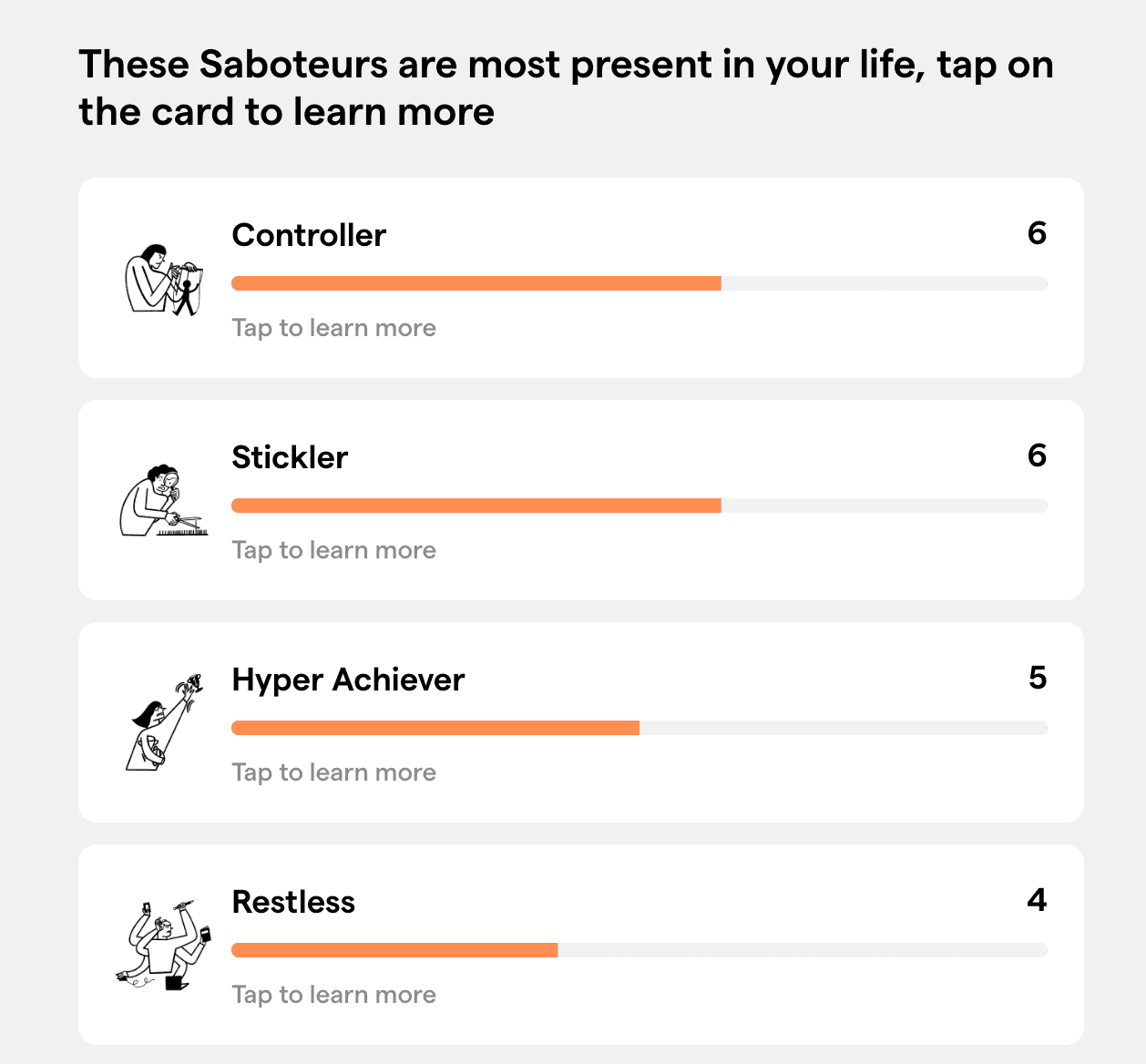
Test results show archetypes of the inner critic.

This was not just another online self-help test. The Saboteur Assessment, part of the Positive Intelligence framework, measures mental fitness by estimating the balance between the “Sage”, the constructive and adaptive mind, and the “Saboteur”, the patterns of thinking that work against us under stress. The model is based on the New York Times bestseller Positive Intelligence by Shirzad Chamine, who has trained faculty at Stanford and Yale business schools.

To be clear, the assessment was not useful because it was comforting. Quite the opposite. It gave language to something most of us experience every day and rarely stop to examine: the way our own mind can quietly work against us.

You know the moments. You leave a meeting that went well, yet your mind fixates on one sentence you could have phrased better. You wake up at night worrying about a decision you already made. You delay a difficult conversation because it doesn’t feel like the right time. Or you reach a meaningful milestone and almost immediately move the goalposts.

Your mind is your best friend. It helps you plan, anticipate, protect, and perform. But it can also be your worst enemy.

This idea of an inner critic is well established in psychology. Often described as inner speech, covert self-talk, or internal monologue, it refers to the ongoing verbal commentary we carry inside our heads. Research suggests that this internal dialogue plays a central role in how we regulate our thoughts, emotions, and behaviour across both childhood and adulthood. Psychologists Charles Fernyhough and Peter Alderson-Day, for example, argue that inner speech helps us plan, reflect, and problem-solve, but can also reinforce self-criticism and rumination when it turns repetitive or evaluative rather than constructive.

The Judge

How do you become aware of the critic that lives inside you? The test introduces the concept of the Judge, the master saboteur we all carry. The Judge replays mistakes long after they matter, warns obsessively about future risks, and keeps pointing out what is wrong with you, with others, or with your life.

What makes the Judge so powerful is that it rarely sounds harsh. It sounds reasonable. It disguises itself as realism, responsibility, or high standards. Especially in leadership roles, it can feel like competence. Over time, though, it quietly drains energy, increases stress, and narrows perspective.

Once active, the Judge invites other patterns. Avoidance, control, overachievement, perfectionism, constant busyness, people-pleasing, or relentless vigilance. These are not character flaws. They are learned survival strategies — automatic ways the mind tries to keep us safe, valued, or in control.

The value of the assessment is not in fixing yourself. It is in noticing. When a thought is named, it loses some of its authority. You begin to recognise when the Judge is speaking, instead of assuming every critical voice is true or useful.

For me, the shift was subtle but powerful. I stopped asking what was wrong with me and started observing how my mind reacts under pressure. That small change creates space. And in that space, choice becomes possible.

The assessment is not therapy. It is a mirror. Leadership, growth, and a meaningful life rarely begin with doing more. They begin with seeing more clearly.

Sometimes, one simple test is enough to change the conversation inside your head. You can do the 10-minute test for free here.

Weekend

Sleep doctor: Building a sleep protocol that actually works

Dec 12, 2025

Executives across the Nordics are sleeping worse than they admit, and the trend is becoming difficult to ignore.

According to the If Insurance Nordic Health Report 2024–2025, 65 percent of Nordic respondents – and 69 percent of Finns – report that stress has disrupted their sleep, making it the most common consequence of rising workplace pressure.¹ Many also say poor sleep is now affecting their ability to perform at work.

For Finnish sleep physician Henri Tuomilehto, who has treated more than 15,000 patients, none of this is surprising. He has watched the trend build for years: leaders convinced they are functioning normally while operating in a state of chronic depletion. “If you are always tired, it is a bit like being half-drunk when you make important decisions.”

Tuomilehto argues that many executives underestimate how quickly poor sleep erodes judgment, leadership presence, and even emotional stability. “The first thing poor sleep hits is behavior. Some people get irritable, others withdraw. If that person happens to be a leader, it shapes the entire workplace.”

The hidden toll of poor sleep on executive cognition

Sleep loss does not just cause fatigue – it degrades the very capabilities leaders rely on. Research shows that sleep deprivation impairs attention, short-term memory, and vigilance.² It also disrupts higher-order decision-making, making people more prone to risky or inconsistent choices.³ Creativity and cognitive flexibility also decline when sleep is restricted.⁴

Tuomilehto sees this play out clinically. “A tired person does not adapt. Even small challenges feel overwhelming. And if you are in a strategic role, losing concentration or creativity is a real problem.”

How to build your sleep protocol

Executives do not need a perfect nightly routine – they need a realistic, science-based protocol that reflects how sleep actually works. Tuomilehto’s guidance, supported by current research, offers a clear and practical framework.

1. Treat sleep as a non-negotiable performance asset
Many leaders still follow the myth of the so-called winner’s hour – waking at 4 or 5 AM to get ahead. Tuomilehto is firm on this: “It makes no sense. If you sleep less than your body needs, you never recover. Fatigue becomes your new normal.” Consistent under-sleeping erodes cognition, judgment, and mood long before leaders notice the decline.

2. Fix your wake-up time
Rhythm is more important than bedtime. Waking at the same time each morning stabilizes the circadian system and allows sleep pressure to build through the day. “I get up sufficiently early to control my evening energy,” Tuomilehto says. It prevents late-night alertness and helps the body recognize when it is time to wind down.

3. Support healthy sleep pressure during the day
Good nights start with good days. Regular meals, hydration, and light activity maintain stable energy. Leaders who skip lunch or grind through long meetings often arrive at evening overstimulated and struggle to fall asleep. Protecting daytime energy protects nighttime recovery.

4. Draw a clear boundary between work and evening
Tuomilehto ends his workday with a family dinner at 8:30 PM – then no emails. That consistent “shutdown signal” reduces cognitive load and gives the brain permission to disengage. Executives who stay mentally “on” until bedtime make it significantly harder for sleep pressure to translate into actual sleep.

5. Use trackers for motivation, not measurement
Wearables monitor movement, heart rate, and temperature, but they do not capture the brain activity that defines real sleep stages. Research confirms they are helpful for habit-building rather than diagnosis.² “People check their score every morning,” Tuomilehto notes, “but your body already tells you how you slept.”

6. Personalize your motivation
Long-term improvement requires a reason beyond ticking off eight hours. Leaders who succeed tie sleep to something meaningful: clearer thinking, better presence, improved resilience. “Motivation must be personal,” Tuomilehto emphasizes. “Otherwise, people quit after two weeks.”

7. Recover strategically
A short nap can restore alertness, but it cannot compensate for chronic restriction. Tuomilehto stresses that rhythm, not occasional rescue, is what restores high performance.

Why sleep matters more for leaders than anyone else

Leaders set the emotional tone of organizations. When exhausted, their judgment narrows, creativity declines, and empathy fades – all consequences well-supported by neuroscience and sleep research.⁵

Tuomilehto puts it plainly: “A good leader is an engine, not the person everyone tiptoes around.” Chronic fatigue reverses that dynamic. When a leader becomes irritable or withdrawn, psychological safety erodes and the tone of the entire organization shifts. And when strategic thinking falters, poor decisions start to cascade through teams and projects.

Better sleep sharpens judgment, steadies mood, and restores the creativity leaders need to navigate uncertainty. In other words, sleep is not indulgence. It is a leadership asset hiding in plain sight.

References

  1. If Insurance, Nordic Health Report 2024–2025: Key findings on stress, sleep, and work ability (2025), available at: https://www.if-insurance.com/large-enterprises/insight/key-findings-health-report-2024

  2. SleepFoundation, Lack of sleep and cognitive impairment (2024), available at: https://www.sleepfoundation.org/sleep-deprivation/lack-of-sleep-and-cognitive-impairment

  3. E. Aidman, K. Johnson et al., “Effects of sleep deprivation on executive functioning, cognitive abilities, metacognitive confidence and decision making” (2018), available at: https://www.researchgate.net/publication/328583846

  4. Nature Research Intelligence, Sleep deprivation and cognitive performance (2023), available at: https://www.nature.com/research-intelligence

  5. Frontiers in Psychiatry (2024), “Altered risk propensity and decision-making following sleep deprivation”, available at: https://www.frontiersin.org/journals/psychiatry/articles/10.3389/fpsyt.2024.1307408/full

Stay on the pulse, catch the signals

Subscribe to Listeds Leadership Intelligence Platform:

  • leader and company database access

  • email alerts

  • career, boards and interim opportunities

Our Pulse newsletter

Your weekly leadership intelligence briefing.

What happened, why it matters, and what to watch across every CEO, board, and executive move in Nordic listed companies, starting with Finland. Fast, factual, and to the point.

Delivered every Monday.

By signing up, you agree to our Privacy Policy