/

Topics

/

branding

branding

Voices

What IKEA understood about the power of being Nordic

Mar 16, 2026

Walk into an IKEA anywhere in the world, and you are stepping into a carefully constructed version of Sweden. The surprise is not that IKEA built a global brand from that idea. The surprise is how few other Nordic companies have tried.

IKEA did not become the world's most recognizable furniture company by accident. It did it by being relentlessly, unapologetically Swedish – and by understanding that Sweden, as a brand, does a great deal of the selling before a single word of copy is written.

The flat-pack logic, the unpronounceable product names, the meatballs: none of this is accidental quirk. It is a coherent identity system built on a country image that maps almost perfectly onto what consumers around the world want to believe about the things they bring into their homes.

The question for other Nordic companies is why so few of them have leaned into this inheritance with anything like IKEA's confidence.

Country brand is a product feature, not a footnote

In international marketing and communications, people use a country’s brand image as a quality shortcut. German engineering, Italian design, French gastronomy: these associations function as warranties, reducing the cognitive effort required to trust an unfamiliar brand.

The Nordic countries are in a remarkably advantageous position here. Survey after survey places the Nordics among the most positively perceived regions on earth: nature, honesty, technological competence, social trust, and clean governance. These are not just flattering. They are commercially useful.

Yet many Nordic companies have historically treated their origins as a minor biographical detail, often actively suppressing them. Nokia at its peak is the instructive case. In 2007, the year it ranked as the world's fifth-most valuable brand, the nation branding guru Simon Anholt observed that Nokia executives, when asked why they didn't make more noise about being Finnish, would explain that companies need to localize their marketing, that Nokia was a global company with more non-Finnish than Finnish employees, and so forth.

Anholt's own diagnosis was blunter: Nokia knew it was a bigger brand than Finland, and feared that closer attachment would cause brand equity to flow from the stronger to the weaker, to Finland's benefit and Nokia's detriment. Ericsson made much the same calculation. So did many Nordic industrial and technology companies that followed, preferring to lead with ISO certifications and ROI projections while leaving a significant credibility multiplier untouched.

Anholt, who launched the Nation Brands Index in 2005, thought this was a miscalculation. Consumers who feel loyalty toward a brand, he argued, are unlikely to revise that loyalty upon discovering it comes from a small or unexpected country. They are more likely to revise their opinion of the country, and feel a quiet prestige at choosing something that doesn't come from the US, Japan, or Germany. Nokia's Finnishness, in other words, was an asset it was too cautious to spend. IKEA had no such inhibition.

What IKEA did, and what it did not do

IKEA did not simply stick a Swedish flag on its products. It constructed an experiential world that expressed Swedish values: democratic access to good design, functionality over ostentation, and informality as a form of respect. The Swedishness was not decoration. It was the load-bearing structure of the brand.

Equally important: IKEA adapted without diluting. When its furniture proved too large for Japanese apartments, it redesigned the furniture. When Middle Eastern families needed bigger dining tables, it built them. The Swedish identity stayed intact. The execution adapted. Many Nordic exporters miss this distinction: they interpret localisation as identity compromise, when adaptation is precisely what makes the identity land.

The Nordic country brands are, if anything, even more valuable in B2B contexts than in consumer markets. When a procurement manager in Southeast Asia or a hospital administrator in the Gulf is choosing between suppliers, they are managing risk. The Nordic association with institutional transparency, long-term reliability, and regulatory compliance functions as pre-sold credibility.

For companies in healthcare technology, cybersecurity, or critical infrastructure, telling a potential client that your company comes from a country consistently ranked as the world's least corrupt is not nationalism. It is relevant information that reduces their perceived risk.


How to make it work

Country brand is a multiplier, not a substitute for product-market fit. Three conditions seem necessary.

First, the Nordic dimension must be genuinely embedded in the proposition, not applied as a label. Authenticity counts: a company claiming Nordic values while running on the lowest-cost supply chains will be found out.

Second, the framing must adapt to market context: in Central Europe, Nordic signals design authority, in East Asia modernity and safety, in North America honest quality without pretension, and in the Gulf neutrality and competence. The core is consistent, but the emphasis shifts.

Third, and this is where many Nordic companies stumble: the story must be told with conviction. Nordic cultures tend toward understatement and a discomfort with self-promotion that, while admirable in a social context, can be commercially limiting. IKEA is not modest about being Swedish. It is proudly, insistently, structurally, operationally Swedish. The Nordic country brand is a shared asset. Most of the companies entitled to draw on it have barely started.

Leaders

Finns need to learn long-term brand commitment to drive growth

Feb 23, 2026

Listeds met Joel Huttunen, who has been responsible for successful Nordic brands in both B2B and B2C contexts throughout his career. Based in Denmark, he shares his insights on what Finnish companies can learn about brand building and marketing. “If you want a brand to perform, the first question is whether the organization is truly committed to building it and being brave internally. Brand has to become a leadership tool – and one that leaders actually use.”

Brand is too often seen as a communicative fluffy layer – a surface added to help companies face their customers. That way of thinking is misguided. In reality, a brand should be understood as a business lever and growth driver, a tool that supports leadership and decision-making. This is how Joel Huttunen puts it. Over his 15-year career, he has been responsible for both global and national brands in Finland and Denmark, working in large international companies as well as on the agency side.

Listeds spoke with Huttunen about the role of the brand in driving company growth. 

Denmark is known for its strong design culture, vibrant urban life, and successful brands. This naturally raises the classic question: what can Finland learn from Denmark when it comes to building brands?

Long-term commitment. Huttunen’s answer comes without hesitation. It is an area where both Denmark and Sweden are ahead of Finland.

“In Finland, it’s common to say that Swedes are simply very good at branding and almost just accept it as a natural law. In reality, Finland has exactly the same potential to stand out. The difference is that we don’t commit to long-term brand development in the same way as Sweden and Denmark do. In marketing, there’s a simple rule: ambition and effectiveness start to fade when focus slips.”

For a brand to truly function as a growth driver, companies must commit to repetition and continuity rather than isolated efforts.

Company culture is the brand’s ultimate truth test

What about courage? Courage and risk-taking are not Finland’s natural strengths in the field of branding, and in times of economic uncertainty, bravery is often the first thing to give way to caution and safe choices. How is courage nurtured in Denmark? 

“The key difference, in my view, is that in Denmark there is open discussion about the level of courage across the organization, including at the leadership level. Courage also requires repetition – not just short-lived spikes like individual campaigns,” Huttunen says. “Courage also means saying something that not everyone will like. If a company focuses solely on not upsetting anyone and on saying things everyone wants to hear, it ends up saying nothing at all. That’s the path of jargon, where there is no differentiation and no value creation. Modern audiences are quick to see through this.”

Both courage and long-term thinking are only possible if there is genuine internal commitment to the brand. According to Huttunen, this commitment is often the hardest part.

“I’ve seen many brand transformations driven by the same underlying question: the brand isn’t delivering results right now – could it deliver next year? If you want a brand to perform, the first question is whether the organization is truly committed to building it and being brave internally. Brand has to become a leadership tool – and one that leaders actually use. It’s unnerving how many times I’ve seen senior leadership just waiting to see the new logo, even in the 2020s.”

In Denmark, Huttunen was initially surprised by how little people talked about brands. He quickly understood why. When a brand is truly lived through company culture, there is no need to constantly define it in meetings and steering groups. Brand is not a separate layer of activity; optimally product development, innovation, ways of working, and strategic initiatives all rest on it.

Everything starts with a clearly defined and shared core mission. Across the organization, people understand why the company exists, what it is striving for, and how their own work contributes to the whole. This is where purpose comes in – a word often dismissed as marketing jargon or even treated as a buzzword.

According to Huttunen, purpose is directly linked to how well a brand is understood – and lived internally. Company culture is every brand’s ultimate truth test.

“As a leader, you can deliver the most inspiring speeches and commission a beautifully polished brand from a prestigious London agency, but if your products, actions, decisions, and people don’t reflect what you claim the brand stands for, it simply isn’t true.”

Beyond performance metrics, the big picture still matters

Purpose also accelerates decision-making, Huttunen says. It provides a clear filter: is this at the core of who we are, or not? Does it support our goals, or does it pull us away from them?

“We live in a time when all kinds of issues surface as controversies, and everything gets broken down into parts. Brands must dare to speak – and stand behind what they say. If a company’s purpose never leads to difficult decisions, it’s probably too generic.”

But how should companies evaluate and justify the business impact of their brand?

“Marketing and communications professionals must be able to demonstrate the value of the brand through data, but organizations shouldn’t get lost in numbers alone. When too much emphasis is placed on short-term performance wins, it’s easy to lose sight of what we’re actually trying to build. The big picture and long-term perspective have to be present all the time.”

B2B brands need emotion too

Throughout his career, Huttunen has worked with massive global brands as well as smaller, local companies and businesses at the very beginning of their journey. He has experience in both B2C and B2B contexts. What can they learn from each other?

“Building a B2B brand from scratch is often extremely difficult. It’s easy to fall back on messages that lack differentiation – saying you’re fast, high-quality, and efficient. What is often forgotten, and what B2B can learn from B2C, is that beyond credibility and reliability, a brand also needs emotion. It’s people that make purchasing decisions in B2B as well.”

For Huttunen, brand is ultimately an emotional bond that forms between a company and people over time. Organizational culture, ways of working, communication, outward expression, and products all contribute to building this connection. Once that bond exists, it begins to guide choices and decisions.

Ideally, brand building is supported by both courage and investment. However, large budgets alone are never the solution.

“The fundamental principles of brand building are the same regardless of budget size. When money is limited, the bar for courage and creativity must be raised. Successful brand work requires strong expertise in using different media, as well as an understanding of weak signals and emerging trends. You need to know what your audience wants right now and how your brand connects to the phenomena of the moment. Customer understanding must be deep, and there has to be genuine curiosity about how to turn change into opportunity.”

Weekend

Wolt, SEES, and Salama show the power of a small market

Feb 19, 2026

“Five and a half million people with modest purchasing power and even weaker willingness to spend,” says Riku Vassinen, CEO of marketing communications agency Hasan and Partners and a board member at Salama Brewing Company, describing the Finnish market. It is, he adds, “a difficult combination. The market exists elsewhere.”

For Salama, fragrance house SEES, and food delivery company Wolt, that reality has shaped strategy from the start. In a small home market, growth demands sharper positioning and earlier international moves, sometimes even at a Hollywood scale.
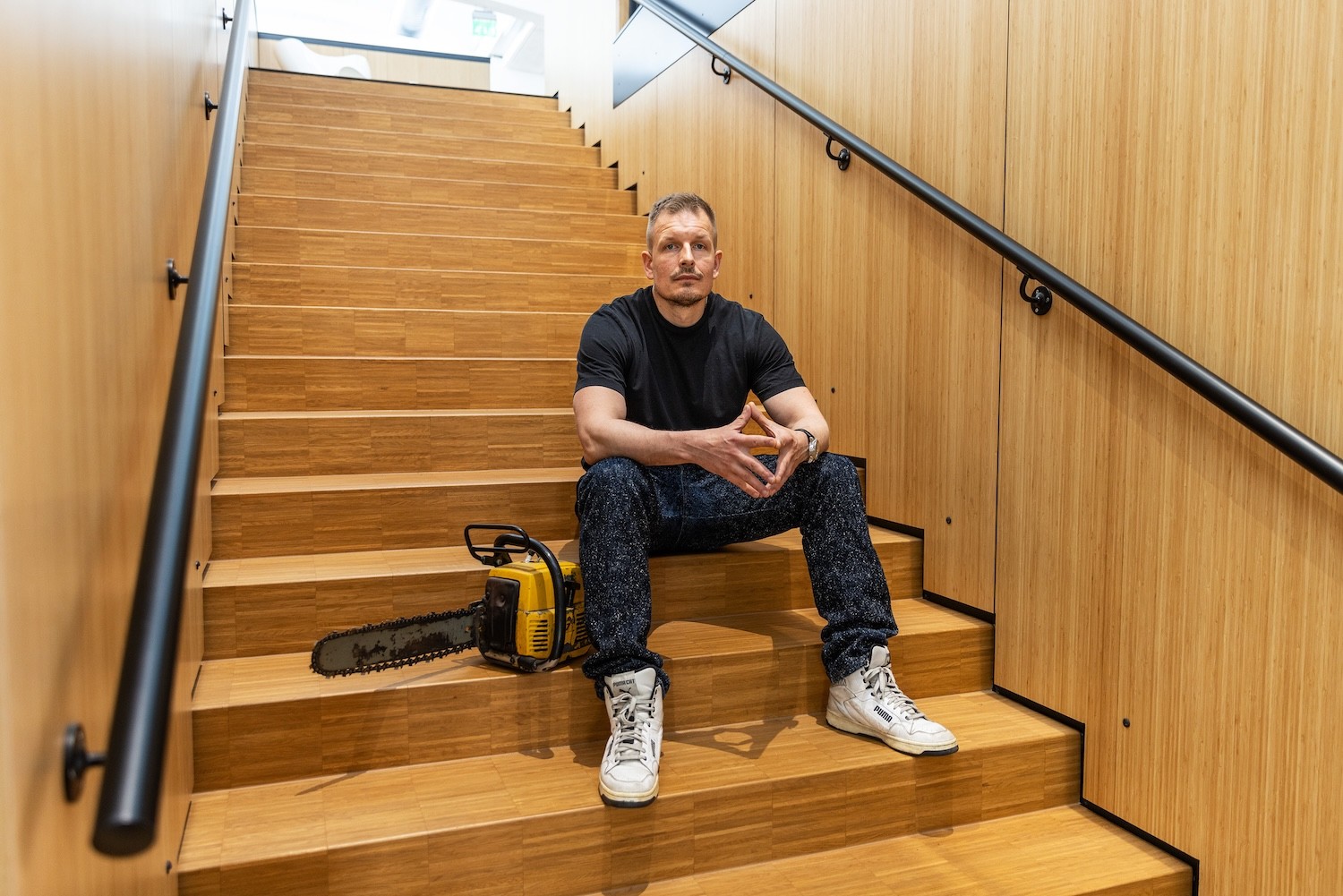
Riku Vassinen, CEO of marketing communications agency Hasan and Partners and a board member at Salama Brewing. Photo given by Vassinen.

Salama. Export as structure

Salama, a craft brewer founded by four friends in 2019, shows how quickly the domestic ceiling appears.

The Helsinki-based brewery recently began exporting to China, marking its 23rd export market. Export revenue is approaching half of the total turnover. At the current pace, Sweden may soon surpass Finland as its largest market.

International growth has been deliberate. Salama has maintained a steady presence at festivals, bars, and trade events outside Finland.

Recognition followed. Hop Culture selected Salama as one of the most interesting breweries in the world in 2025. The New York Times listed its Salamanation bar as a must-visit destination in Helsinki. In an ironic twist, fame abroad accelerated recognition at home.

SEES. Small and fast

SEES, led by CEO Elisa Koivumaa, represents a different kind of leverage.

SEES hand wash products. Photographed by Christian Jakowleff.

Earlier this month, the Finnish fragrance house placed its products in the Grammy Awards goodie bags, Koivumaa shared on LinkedIn. International visibility had been building earlier. SEES products had appeared in the And Just Like That series, Koivumaa explains to Listeds.

The collaboration came without a marketing agency. Someone on the HBO team had discovered SEES on Instagram and was drawn to its minimalist aesthetic.

“Small can be an advantage,” Koivumaa says, adding that a niche brand like SEES should think globally from day one.

Her thinking was shaped by time spent living in Japan, where branding, storytelling, and restraint are highly valued. The experience led her to question why Finland’s strengths, pure nature, quiet design, and conceptual clarity, so rarely translate into global hit brands.

Part of the obstacle, she suspects, is fear of failure. Some founders worry that not entering large supermarket chains signals defeat. Koivumaa disagrees. When HBO requested products for the sequel to the HBO series Sex and the City, SEES was able to customize the products and meet the requirements immediately.

Being niche allows the brand to position itself as exclusive and premium. Producing biodegradable cosmetics, scents, and detergents in Finland is not a limitation. It enables SEES to say yes only to opportunities that align with its values. Above all, it leaves room to think internationally from day one.

Wolt. Hollywood without hesitation

Wolt, acquired by DoorDash in 2022, reflects the same small market logic at a greater scale, with the backing to think bigger.

Andrew MacDonald, CEO of MacWell (wearing black), photographed during filming with Owen Wilson in Australia. Photo provided by MacWell.

In its first global brand ambassador campaign, Wolt cast Owen Wilson, known from Midnight in Paris and Zoolander, and rolled out a cinematic campaign across 25 countries last year.

According to MacWell, the agency leading the project, the decisive factor was not the celebrity alone but the process. As Andrew MacDonald, CEO of MacWell, puts it: "Wolt was looking for an iconic face whose influence could travel across regions while still feeling neighborly and authentic.” Wilson was selected after extensive shortlisting, and the creative was written with his voice in mind. The guiding question was simple: how would Owen do this?"

The production took place in Australia over a single, tightly orchestrated day, involving multiple teams and remote collaboration. The more lasting lesson came afterward.

“A celebrity is not an idea. You need to match the persona's brand to your brand positioning,” says Liisa Paasio, executive creative director at MacWell. It requires investments, she states, but offers exponential returns.

MacWell's Executive Creative Producer Marc Stevenson urges Finnish companies to ask bigger questions. What kind of campaign could we build with an A-list star? What if it were possible? He sums it up: “If you do not ask, you do not receive.” 

Built for beyond

Vassinen argues that the shift must happen early. “Companies must look beyond Finnish borders. This means that leaders must speak to global audiences and brands must be built for international relevance from the very beginning.”

For Salama, that has meant export markets accounting for nearly half of revenue. For SEES, it has meant designing a brand that can respond quickly when the global media calls. For Wolt, it has meant launching a campaign across 25 countries with a Hollywood actor at its center.

Finland’s 5.5 million consumers do not allow companies to rely solely on domestic depth. The constraint demands clarity, speed, and international orientation.

Voices

Brands in the age of AI — It’s time to rewire the corporate mind

Dec 5, 2025

Strategy is no longer an annual exercise or a controlled process with a beginning and an end. It sits permanently on the board table, constantly challenged by forces that move faster than corporate cycles. Among these forces, one has become utterly inescapable: artificial intelligence.

What changed is not only the technology itself, but the parameters of the world in which we operate. When new interfaces like ChatGPT, Claude, and Copilot made intelligence universally accessible and computation globally scalable, the competitive landscape shifted in a way that many companies still underestimate. AI is a fundamental rewiring of how businesses are built, how brands are discovered, how decisions are made, and how power is distributed.

In the future, brands will not primarily live on websites, campaigns, or controlled touchpoints. They will live in conversations. Not only the ones between people, but in the dialogues happening inside large language models — the “thinking substrate” of the AI era. Consumers and investors are already asking these models questions like: “Why do people choose this product?” “Is this company trustworthy?” “What are the alternatives?” If your brand is not part of those conversations, in the right context and with the right information, it effectively does not exist.

This applies equally to consumer brands and to B2B companies, professional services, and listed companies. In a world where people no longer search but converse, discoverability becomes conversational, not algorithmic. Traditional SEO is being replaced by something more fluid: the ability to be found, understood, and recommended within AI-driven dialogues.

Leaders need to internalize that this is not a communication issue; it is a resilience and competitiveness issue. Corporate thinking has been shaped over decades — in some cases, half a century — with assumptions built for a linear, often predictable world. But AI introduces competitors who didn’t exist before, markets you’ve never looked at, and dialogues you cannot control. It produces narratives about your company by reading everything: disclosures, earnings calls, consumer reviews, Reddit threads, academic papers, news cycles, and thousands of micro-signals across languages and regions. And often, unfortunately, also hallucinates the answers. 

For a listed company, this creates a new governance challenge. Disclosures are regulated. AI conversations are not. Yet they shape investor sentiment, consumer perception, employer reputation, and strategic positioning. What happens when your carefully crafted regulatory announcement is reduced to a single sentence by an AI model that interprets it differently from your intention? What happens when the model draws conclusions from unofficial sources and merges them into one narrative? And how do you govern something that spreads across languages, markets, and platforms without boundaries?

This is why the board must now ask: Are we truly AI-ready as a leadership body? Readiness is not about whether the company has pilots, models, or dashboards. It is about whether the board understands the implications of autonomy, speed, scale, and non-linearity. Some boards have already limited the use of tools out of caution. Others have leaned in and allowed automated transcription, analysis, and model-assisted briefings in their governance processes. The next step will be deciding how much autonomy to give to agents. This discussion will change industries.

A brand in the age of AI is not a visual identity or a messaging framework. It is a living information system that moves through global models. It is shaped as much by earned media as by AI-mediated interpretations. It does not respect borders or linguistic limits. You may suddenly find your company referenced in a university case study in a country you’ve never operated in, simply because the model connected your data to a theme.

Boards and leadership teams must therefore understand that the relationship between formal and informal information has changed. People trust AI tools even when they have not followed every link or verified every source. This creates a responsibility for companies to ensure that the data feeding these systems is correct, coherent, and strategically aligned.

We have reached the moment where AI must be brought into the core context of the company: brand, reputation, disclosures, marketing, sales, stakeholder networks, internal processes, and governance. It is not enough to talk about what AI could enable. The question now is what AI will do if we do nothing, because the world around us is already shifting.

In the end, the board’s responsibility is not to predict the future but to prepare the organization to operate in it. That preparation begins with clarity, courage, and a shift in mindset.

And it ends with three unavoidable questions that belong on every board agenda:

  1. How will our brand be found and understood in AI-driven conversations?

  2. How do we ensure our data, disclosures, and narratives remain accurate as models interpret them?

  3. How much autonomy are we willing to grant to AI agents, and where does responsibility lie when they act?

These questions define the next era of brand leadership. They also define which companies will remain relevant in a world where intelligence is no longer scarce, but universal and instantly accessible.


About Kati Sulin:

Kati Sulin is a Nordic business leader with experience in digital transformation across companies such as DNA Oyj, Terveystalo, Ifolor, and Fazer. Her work covers digital operations, e-commerce, data use, and customer processes in multiple industries. 

Sulin has held leadership roles in strategy and digital development and has worked with projects involving brand development, AI deployment, automation, and operational renewal.

Sulin serves on the boards of Apetit Oyj, Madara, LähiTapiola Henkivakuutusyhtiö, and Viestimedia Oy, and has previously served on the boards of Pihlajalinna, Witted Megacorp, and Kalevala Koru Oy.

Stay on the pulse, catch the signals

Subscribe to Listeds Leadership Intelligence Platform:

  • leader and company database access

  • email alerts

  • career, boards and interim opportunities

Our Pulse newsletter

Your weekly leadership intelligence briefing.

What happened, why it matters, and what to watch across every CEO, board, and executive move in Nordic listed companies, starting with Finland. Fast, factual, and to the point.

Delivered every Monday.

By signing up, you agree to our Privacy Policy