
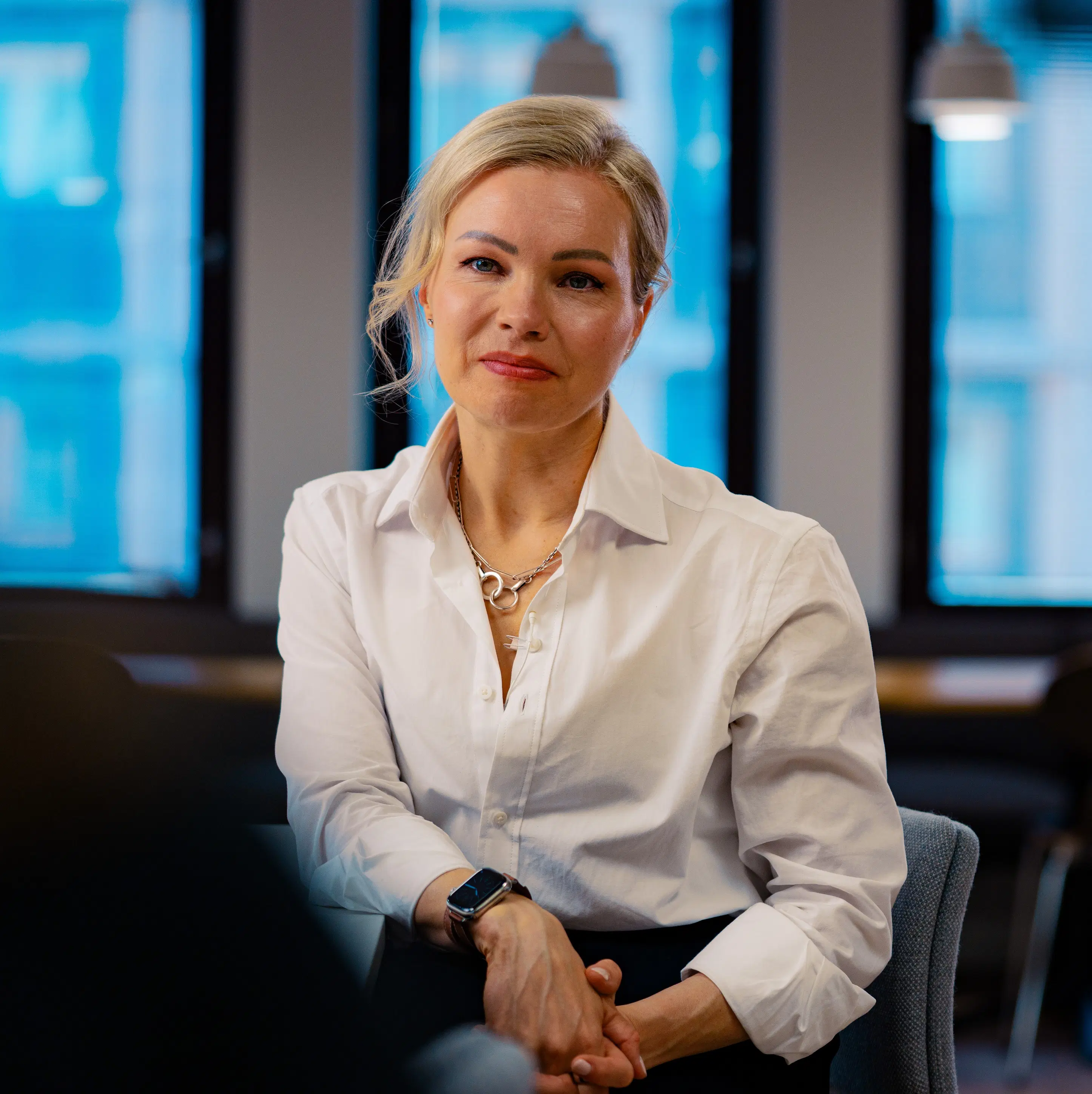
Kati Kaksonen, vice president, investor relations & sustainability at private clinic operator Terveystalo Plc, joins office pod producer Framery Plc as investor relations director in July 2026.

She will report to CFO Lauri Isotalo and lead the company’s investor relations efforts as it continues to expand globally, Framery announced yesterday. 

Kaksonen brings extensive experience from guiding Terveystalo’s investor relations since its 2017 IPO, as well as more than a decade at Finnair, where she most recently served as investor relations officer. 

Framery Plc, a Finland-based manufacturer of soundproof office pods and smart workplace solutions, also reported its first-quarter 2026 earnings yesterday. Revenue remained flat at EUR 58.4 million, with EBIT at EUR 13.9 million and an adjusted EBIT margin of 24.0%. Earnings per share rose to EUR 0.13, while net debt stood at EUR 64.8 million.

“We are excited to welcome Kati to Framery. Her proven track record in building world-class investor relations from the ground up and her extensive expertise in the field will be invaluable as Framery continues its global growth journey and strengthens its engagement with the capital markets,” CFO Lauri Isotalo said.

|

|

Leaders

Kati Kaksonen joins Framery from Terveystalo as IR director

Kati Kaksonen joins Framery from Terveystalo as IR director

·

5 min read

Explore and follow profiles from this article to get timely updates:

Credit: Siemens Healthineers, Kati Kaksonen

Credit: Siemens Healthineers, Kati Kaksonen

Kati Kaksonen, vice president, investor relations & sustainability at private clinic operator Terveystalo Plc, joins office pod producer Framery Plc as investor relations director in July 2026.

She will report to CFO Lauri Isotalo and lead the company’s investor relations efforts as it continues to expand globally, Framery announced yesterday. 

Kaksonen brings extensive experience from guiding Terveystalo’s investor relations since its 2017 IPO, as well as more than a decade at Finnair, where she most recently served as investor relations officer. 

Our Pulse newsletter

Your weekly leadership intelligence briefing.

What happened, why it matters, and what to watch across every CEO, board, and executive move in Nordic listed companies, starting with Finland. Fast, factual, and to the point.

Delivered every Monday.

By signing up, you agree to our Privacy Policy

Our Pulse newsletter

Your weekly leadership intelligence briefing.

What happened, why it matters, and what to watch across every CEO, board, and executive move in Nordic listed companies, starting with Finland. Fast, factual, and to the point.

Delivered every Monday.

By signing up, you agree to our Privacy Policy

Framery Plc, a Finland-based manufacturer of soundproof office pods and smart workplace solutions, also reported its first-quarter 2026 earnings yesterday. Revenue remained flat at EUR 58.4 million, with EBIT at EUR 13.9 million and an adjusted EBIT margin of 24.0%. Earnings per share rose to EUR 0.13, while net debt stood at EUR 64.8 million.

“We are excited to welcome Kati to Framery. Her proven track record in building world-class investor relations from the ground up and her extensive expertise in the field will be invaluable as Framery continues its global growth journey and strengthens its engagement with the capital markets,” CFO Lauri Isotalo said.

Follow moves like this on the Listeds Executive Intelligence Platform.

Board Programme

Built for Nordic listed company boards.

The only programme in the Nordics designed specifically for listed-company board work.
Five sessions, one cohort, twenty leaders in one room - Helsinki, 2026.

Board Programme

Built for Nordic listed company boards.

The only programme in the Nordics designed specifically for listed-company board work.
Five sessions, one cohort, twenty leaders in one room - Helsinki, 2026.

Authors

Emmi Laine is head of business content at Listeds and our lead for finance and business coverage. She sets the editorial agenda, interviews Nordic business leaders, and writes stories, newsletters, and social content on timely market and corporate topics. Emmi brings nearly eight years of experience from Shanghai's Yicai Global / Yicai Media Group, where she was awarded for reporting on China’s economy, finance sector, and technology innovation. She holds an MSc in Innovation and Entrepreneurship from ESADE Business School in Barcelona and a Master’s degree in International Design Business Management from Aalto University. She also holds a Bachelor’s degree in Culture Studies with a major in Journalism from Stockholm University and has studied Mandarin Chinese and Chinese culture. Emmi is a Finnish citizen and has lived in Finland, Sweden, China, and Portugal.

Emmi Laine is head of business content at Listeds and our lead for finance and business coverage. She sets the editorial agenda, interviews Nordic business leaders, and writes stories, newsletters, and social content on timely market and corporate topics. Emmi brings nearly eight years of experience from Shanghai's Yicai Global / Yicai Media Group, where she was awarded for reporting on China’s economy, finance sector, and technology innovation. She holds an MSc in Innovation and Entrepreneurship from ESADE Business School in Barcelona and a Master’s degree in International Design Business Management from Aalto University. She also holds a Bachelor’s degree in Culture Studies with a major in Journalism from Stockholm University and has studied Mandarin Chinese and Chinese culture. Emmi is a Finnish citizen and has lived in Finland, Sweden, China, and Portugal.

Authors

Journalist

Emmi Laine is head of business content at Listeds and our lead for finance and business coverage. She sets the editorial agenda, interviews Nordic business leaders, and writes stories, newsletters, and social content on timely market and corporate topics. Emmi brings nearly eight years of experience from Shanghai's Yicai Global / Yicai Media Group, where she was awarded for reporting on China’s economy, finance sector, and technology innovation. She holds an MSc in Innovation and Entrepreneurship from ESADE Business School in Barcelona and a Master’s degree in International Design Business Management from Aalto University. She also holds a Bachelor’s degree in Culture Studies with a major in Journalism from Stockholm University and has studied Mandarin Chinese and Chinese culture. Emmi is a Finnish citizen and has lived in Finland, Sweden, China, and Portugal.

All Listeds newsletters (bundle)

One sign-up, the full picture.

Get every Listeds newsletter: the daily signal drumbeat, the weekly Pulse briefing, the monthly Best of the Month, the CEO letter, and the Weekend read.

By signing up, you agree to our Privacy Policy

All Listeds newsletters (bundle)

One sign-up, the full picture.

Get every Listeds newsletter: the daily signal drumbeat, the weekly Pulse briefing, the monthly Best of the Month, the CEO letter, and the Weekend read.

By signing up, you agree to our Privacy Policy

Latest signalsLive feed
Moves trackerLive feed

Investor Event

Listeds Investor Event · Defence

Nordic defence is in a once-in-a-generation growth cycle. Eight listed and pre-IPO companies pitch to 100+ invited investors at Valkoinen Sali, Helsinki

21 September 2026

Latest on Listeds

Market Signals

The world will cross 1.5°C within a few years, UNEP says. The EU dropped the duty to plan for it in March.

Sep 10, 2026

Net-zero alone would not bring temperatures back to 1.5°C before the second half of the 22nd century. The report says most developed countries now need net-negative targets beyond 2050. The Omnibus made having a transition plan at all optional.

The UN Environment Programme published Limiting Overshoot: Navigating exceedance of 1.5°C and pathways towards return on 2 September 2026. Its opening line is a position, not a projection: global warming is set to cross 1.5°C above pre-industrial levels, likely within the next few years. Even an optimistic scenario of full implementation of all national climate plans plus additional net-zero targets puts expected peak temperature rise at 1.8°C.

"There are no good outcomes if we remain above 1.5°C," said Inger Andersen, UNEP's Executive Director, on publication.

The best available case and the breaking point are the same number

That 1.8°C appears twice, in two roles. It is the peak under the most optimistic scenario. It is also the level past which the return trip stops working: beyond around 1.8°C, decline to 1.5°C during the 21st century becomes increasingly challenging.

The best case available therefore sits at the threshold where coming back down becomes hard. The report's own verdict: by no means an acceptable or preferred pathway, simply the best remaining option.

Net-zero is a milestone towards net-negative

That is the report's own section heading, and its point is that mitigation policy can no longer be framed solely around reaching zero.

The math here deserves a second read. Global net-zero would produce a temperature decline of roughly 0.3°C per century, so if mitigation stops there, a return to 1.5°C is unlikely before the second half of the 22nd century, even at a 1.8°C peak. Keeping a return within credible reach relies at a minimum on net-negative targets for most developed countries beyond 2050. Every Nordic economy is in that group.

For a Nordic listed company holding a 2035 or 2040 net-zero commitment, the commitment is not what comes under pressure. Its sufficiency as an endpoint does.

The obligation went in March

The Omnibus I Directive was published in the Official Journal on 26 February 2026 and entered into force on 18 March. It removed from the CSDDD the requirement to adopt and implement a climate transition plan. Member states have until 19 March 2027 to transpose the reporting changes, so national law in Helsinki, Stockholm and Copenhagen is still catching up. Under the CSRD a company discloses information about a plan where it has one, and nothing obliges it to have one. Scope narrowed at the same time, to more than 1,000 employees and turnover above €450 million, leaving much of the Nordic mid-cap universe outside mandatory reporting. Outside banking and the Paris conditions on green bonds, the duty is voluntary.

Some of the Nordic names were on the other side of the rollback

The narrowing was not something Nordic large caps asked for. Nokia, Nordea, Ingka Group and Vattenfall were among 194 organisations that signed a joint statement on 1 July 2025 urging the EU not to weaken the CSRD and CSDDD. Listeds covered the case for holding the line in a commercial partnership column by Riikka Kuha of Hannes Snellman in November 2025.

What still moves the number

The report is not fatalistic, and it is specific about where the leverage sits.

Every fraction of a degree avoided, and every year by which overshoot is shortened, saves lives, protects ecosystems and reduces economic losses. The fastest lever in the immediate term is methane and other short-lived climate pollutants, because cutting them slows the rate of warming quickly rather than decades out. After that the sequence is deep and sustained decarbonisation to at least net-zero as temperatures peak, then sustained net-negative CO2 emissions as they decline.

The report is blunt about the deadline on that last capability. Decisions made during the coming decade will shape technology, infrastructure and land-use choices, determining whether countries retain the capacity to move beyond net zero if required.

Which is the practical translation for a Nordic board. March removed the requirement to hold a transition plan. It did not remove the decade in which the plan had to be made.

Market Signals

Finland lands Google's €13bn; Fortum sells half of Loviisa's output to 2049

Sep 10, 2026

Google will invest at least €13 billion in Finnish digital infrastructure across 2027 and 2028, with data centres and supporting infrastructure in Hamina, Kajaani, Muhos and Vaala. It is the company's largest single investment in Europe. For scale: annual industrial investment in Finland normally totals around €10 billion, and Etla puts the €13 billion at roughly a fifth of all investment flowing into the country in a year. 

Google announced the investment on 9 September. It has operated in Finland since 2009 and is developing new infrastructure in Hamina, Kajaani, Muhos and Vaala 

Fortum has signed a 22-year power purchase agreement with Google covering up to 50% of Loviisa's capacity. Offtake begins in 2028 at a reduced volume and runs at half the plant's capacity from 2030 to 2049. The two parties also signed a memorandum of understanding to explore new flexibility capacity and new generation, including potential new reactors at Loviisa

The political reception 

Every named Finnish voice in Google's release welcomed the investment without qualification: the prime minister, the climate and environment minister, and the municipal leaders of all four host locations. The caution came from outside it.

Prime Minister Petteri Orpo said “Finland is an attractive destination for investments, and attracting further investment remains a top priority". Speaking at Google's announcement event, he took on the question the build raises for households: energy prices will not rise because of the investments. He also said public debate in Finland tends to underestimate data centres, and that the investments mean jobs for Finns.

Climate and Environment Minister Sari Multala tied her support to supply, saying “These investments are very welcome in Finland and demonstrate that it is possible to invest in AI infrastructure in a way that benefits both local communities and the broader energy system, including other energy users. This long-term approach and commitment are exactly what we need to generate value for both investors and Finnish society. A long-term agreement with an energy company helps ensure that new electricity generation capacity is developed to meet growing demand"

The four municipalities emphasised grid position and local business. Vaala's municipal manager Minna Kärkkäinen said the municipality "is located at a key point in Finland's main electricity grid, which makes it an attractive location for industry and energy projects"; Hamina, Kajaani and Muhos pointed to regional economy, jobs and the data economy.

Outside the release, EK director Sami Pakarinen told Verkkouutiset that "this is, if anything, fantastic news for the Finnish economy." 

The market reaction 

Fortum closed at €21.36 on 8 September, a quiet 0.7% gain that left it up 17.5% from the 2025 year-end close of €18.18. The next session was anything but quiet. The stock jumped 15.8% on 9 September to close at €24.74 after the Google nuclear deal, its sharpest one-day gain in at least a year, taking the year-to-date advance to 36.1%

Fortum has said the agreement is expected to raise the group's comparable return on net assets by approximately 1.4 percentage points over time, once half the plant's output is contracted.

What the contract secures

Loviisa's two units are licensed by the end of 2050. The Finnish government granted that extension in February 2023, replacing licences valid to 2027 and 2030. Fortum has a lifetime-extension investment programme of about €1 billion under way — ten portfolios, more than 300 projects and states that without those investments the plant could not continue producing after 2030.

CEO Markus Rauramo said long-term partnerships are essential "especially in today's uncertain market environment characterized by low visibility and highly volatile electricity prices." Loviisa supplies around 10% of Finland's electricity and employs about 580 people.

Ownership and disclosure

Fortum is majority state-owned; the Finnish State holds just over half the shares. Half of the plant's capacity is contracted to one counterparty for the years 2030–2049. Neither party has disclosed the contract price, and Fortum's 1.4-percentage-point RONA guidance is the only quantification of the deal's value available to shareholders. The MoU on new capacity at Loviisa carries no announced timetable or investment figure.

The rest of the energy package

Onshore wind PPAs with Valorem (Ostrobothnia) and Suomen Hyötytuuli (Ostrobothnia and Central Finland) take Google's new-to-grid onshore wind capacity to 629 MW more than the roughly 446 MW Google had previously contracted across five announced PPAs in Finland. A contracted 94 MW battery system near Kajaani is expected operational in late 2027. Fingrid CEO Asta Sihvonen-Punkka said of the site choices: "Our aim is to keep the costs of the growing electricity system competitive, while reducing environmental impacts."

Google also committed €31 million over four years across the four municipalities, including €10 million for research and innovation, AI skills training for over 4,400 workers through Google.org's AI Opportunity Fund, and a programme with EKAMI to train up to 100 students a year for data centre roles.

The economic projections, and the challenge to them

Google projects an average €3.6 billion annual contribution to Finnish GDP during construction, more than 37,000 jobs nationwide — about 16,000 in construction, at an average €911 million in annual labour income — and 7,000 jobs a year once operational, at wages 24% above the Finnish median. 

Yle put the projections to Google's own Gemini, which judged the claim "economically and in scale heavily exaggerated, and conceptually misleading". Etla senior researcher Sakari Lähdemäki was more measured: "I'm critical too, but not that critical." He said €13 billion equals roughly a fifth of all annual investment into Finland, and that the decisive question is how much of it leaves the country again as imported hardware. On Yle's calculation from Google's own figures, about half the €13 billion goes on semiconductors and other materials and equipment imported from abroad, which do not add to Finnish GDP. "Imports aren't 100% of it, so some production inevitably stays in Finland too," Lähdemäki said. On the employment figures: "Google has calculated these perhaps more optimistically than with any great precautionary principle." Data centres, he said, employ heavily during construction and are largely automated afterwards.

Against Google's own capital budget, the Finnish commitment is small: Alphabet's reported 2026 capital expenditure guidance is between USD 195 billion and USD 205 billion, up from a previous range of USD 180 billion to USD 190 billion.

Join our Pulse, Best-of-the-Week, and Weekend newsletters

Join our Pulse, Best-of-the-Week, and Weekend newsletters